the Story
The first time you see the Graviton Maw, it looks like a smudge someone tried to erase from the sky and then changed their mind. It is not a hole so much as a hesitation: a place where space forgets its lines. Pilgrims moor their vessels to the threshold and sit with their engines cooling and their courage warming, and they tell each other they’re ready. You don’t say you’re ready. You are tired of telling. You have come for the one thing the Maw is rumored to give anyone who crosses through without flinching: a truth that fits.
You step out with nothing but a pressure suit, a pocket of salt for luck, and a thread tied around your ring finger. The thread is the only thing you insisted on—thin, gold, and frayed. You can’t remember when you tied it or why you refuse to take it off. Memory is a room with half the furniture missing; you’re here because the rumor said the Maw keeps an attic of lost chairs.
A light blinks. The threshold yawns. The universe performs a four-second blink—open, shut, open again—and you move.
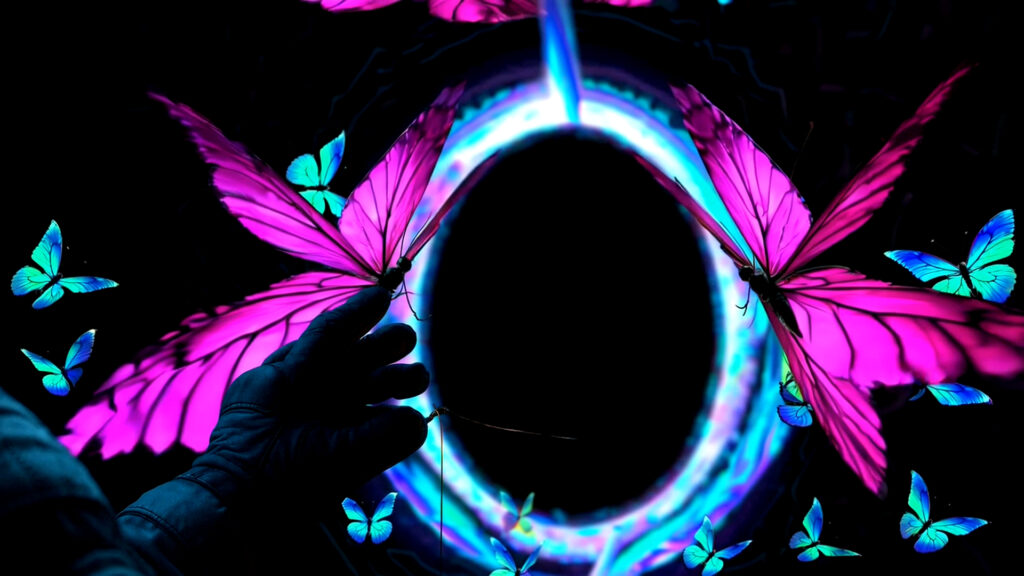
The first sensation is texture. Space is no longer smooth; it granulates under your boots like sugar. Psilocybin fireflies wobble in the airless dark—impossible, then instantly ordinary—each insect carrying a single pixel of a constellation on its back. They seam together as you walk, stitching the sky into diagrams only your peripheral vision can read. “Welcome,” they write when you decide not to be afraid. “Welcome,” again when you become afraid anyway and keep walking.
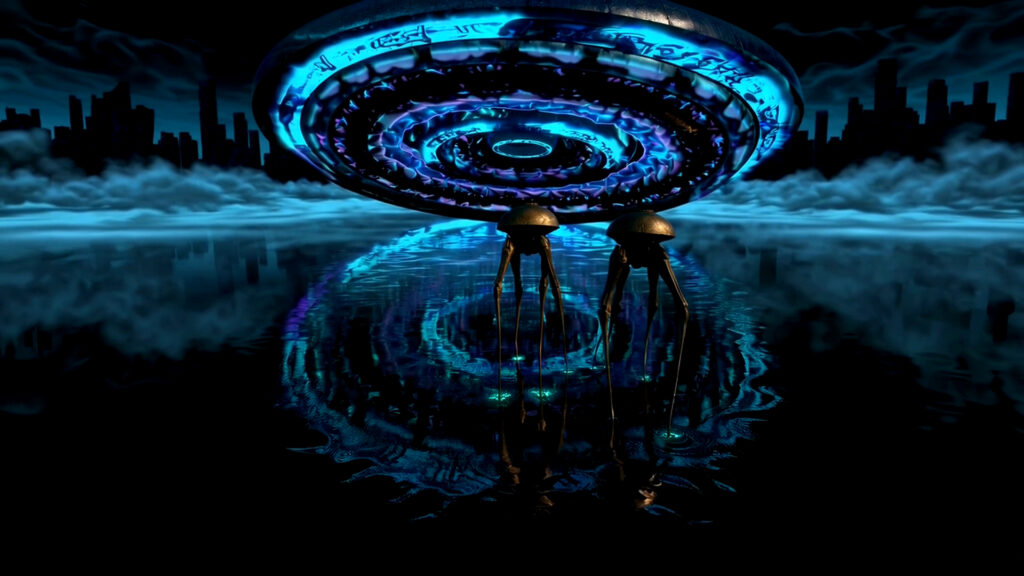
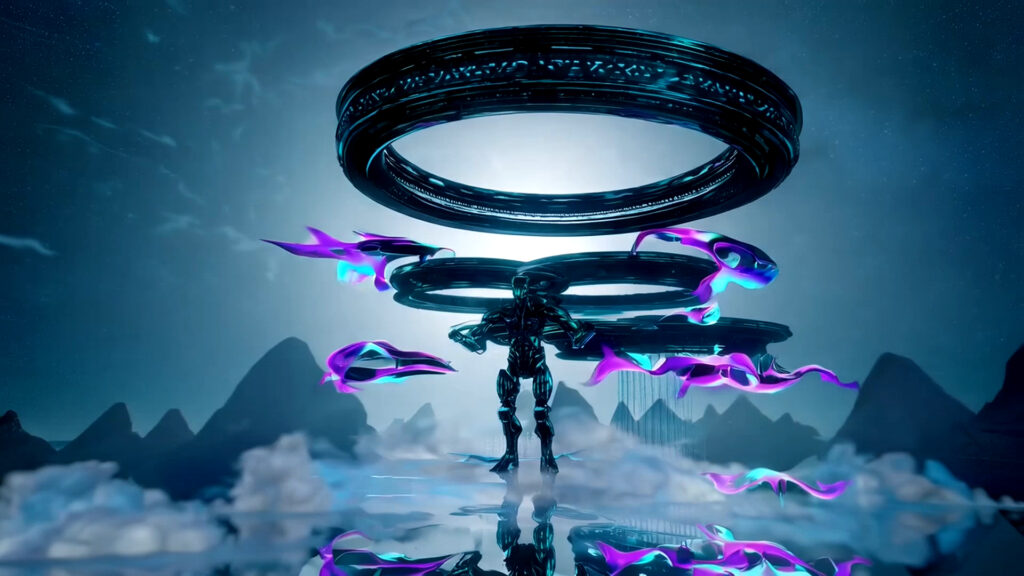
Ahead rises a city no architect would admit to: concentric rings turning in silence inside a glass sea. The rings overlap like ripples on ripples and the overlaps sing a shape. It is an F♯ drawn in geometry, the first letter of a forgotten name. Your finger twitches toward the thread. You do not tug.
You are not alone. Bronze-legged striders, pale as the inside of seashells, stride across the vacuum as if gravity were a polite suggestion. Each step leaves a footprint of fluorescent sand that refuses to drift. They regard you without eyes. Something in their slow confidence calms your breath. You step in one of the prints. It fits your boot as if it was waiting.
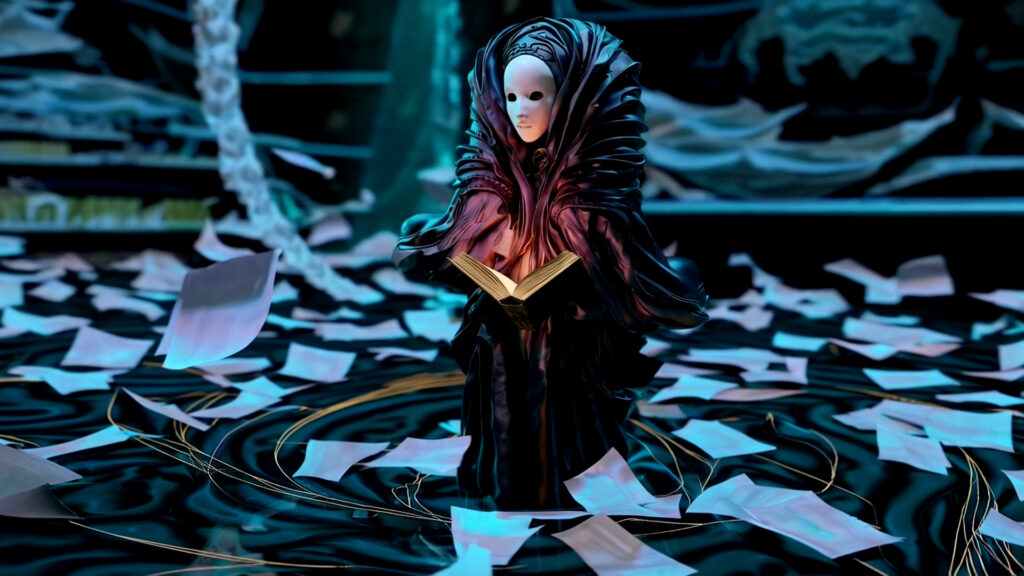
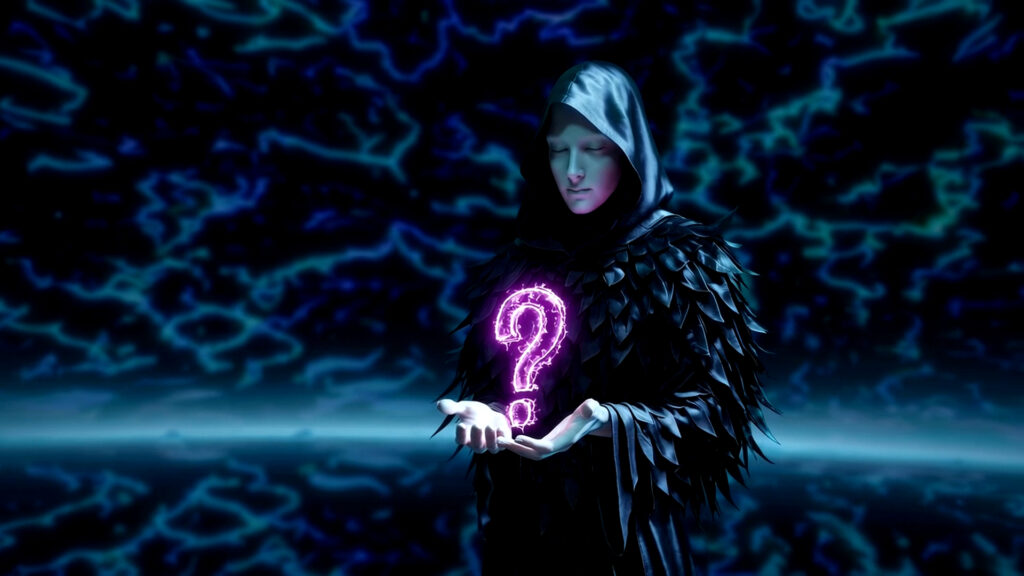
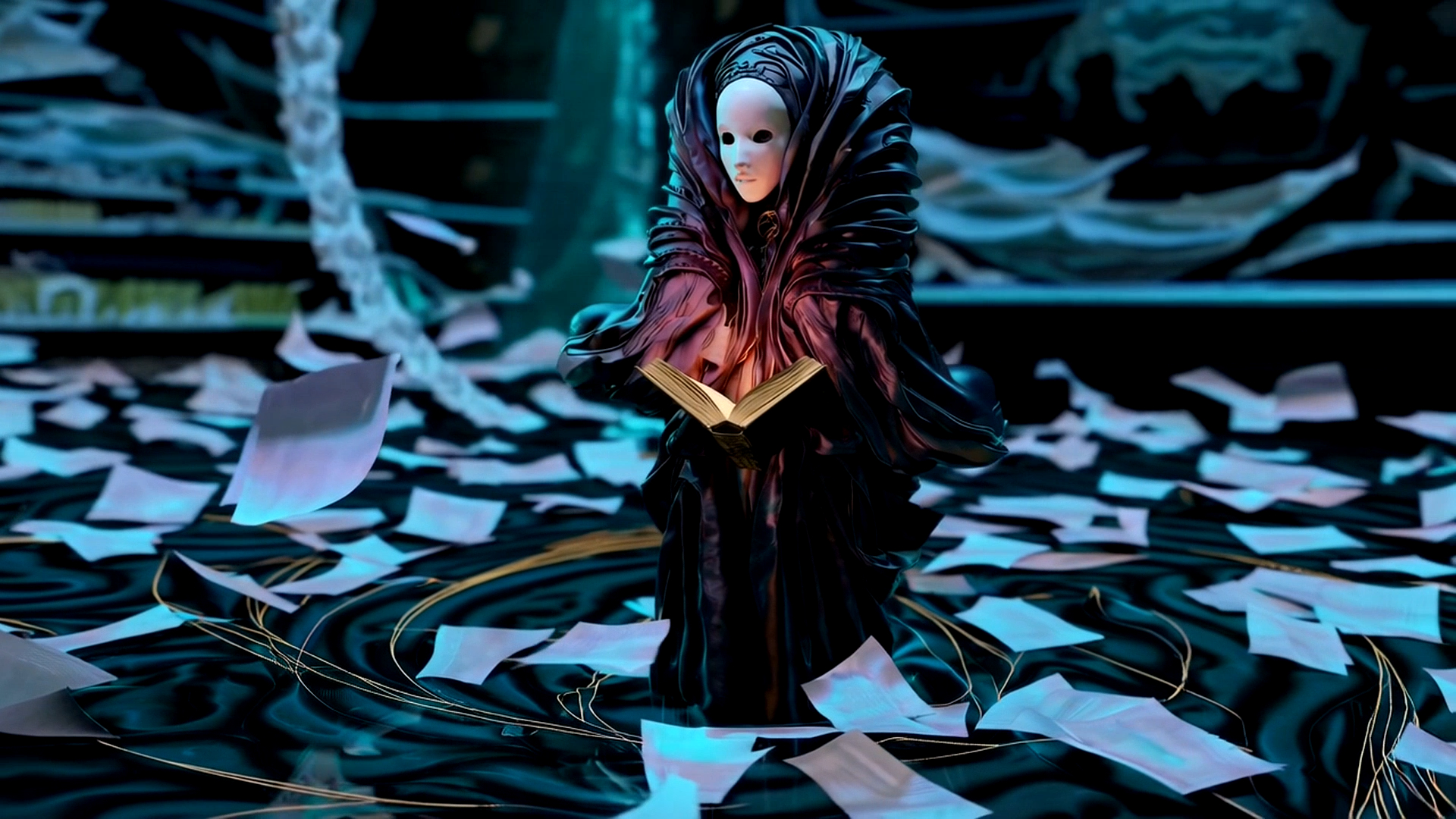
Time goes syrupy, then thins. Your pace becomes the planet’s pulse. A librarian appears without arriving—hooded in pages, their robe made of index cards that blink with weather and prayer. Where their face should be is a smooth oval of ketamine porcelain: not blank, but restful. The quiet surrounding them has laws. They hold out a book bound in moon-leather. It is heavy in the way thoughts are heavy—dense with angles. When you open it, there is a diagram of yourself. The diagram raises a hand. You raise yours back. Your palms meet on paper and the page deepens into a corridor lined in mother-of-pearl.
You walk your own blueprints. Rooms you’d forgotten unfurl around you: a kitchen whose window looks out on a street full of rain, a balcony with a potted cedar that always smells like a story, a station platform where the announcement never comes. As you pass, each room shakes its head fondly and recedes. The corridor pours you out onto a platform above the glass sea. The city rings rotate more quickly now; the rims glitter with mescaline sunflowers pedaling light. Every seed in the flowers is a projector. They hum childhoods you never owned—beaches with purple sand, a creek that laughs only at night, the soft thud of a peach on a windowsill. None belong to you, and yet they are yours the way a river belongs to a traveler who drinks from it.
“Rapture is not a conclusion,” the librarian says without sound. “It is the precise weight of your next step.”
The city leans. You fall sideways into acceleration. The rings strobe the air with running bands of brightness; the bands arrange themselves into ladders you could swear are humming. You climb without moving. Space folds like origami and when it opens you are on the shore of an obsidian lake. The ceiling is a powdered galaxy; the lake’s surface is the cleanest mirror you’ve ever ruined with your face. DMT dragonflies sew arcs over the water with threads of ultraviolet; when the threads touch the surface, words blossom in bubbles.
You kneel and read a sentence the lake wrote for you: You are permitted to be multiple.
Permitted is a small word that unknots a larger word. The thread on your finger tugs, not from outside, but with the gentle insistence of a memory trying to be useful. A face cuts through the lake—your face, older, with two scars you don’t remember earning and a grin you recognize with a jolt of relief. The reflection opens their mouth. Water spills out shaped like syllables.
“Keep going,” your older voice says. “You’ve already forgiven yourself. You just haven’t noticed.”
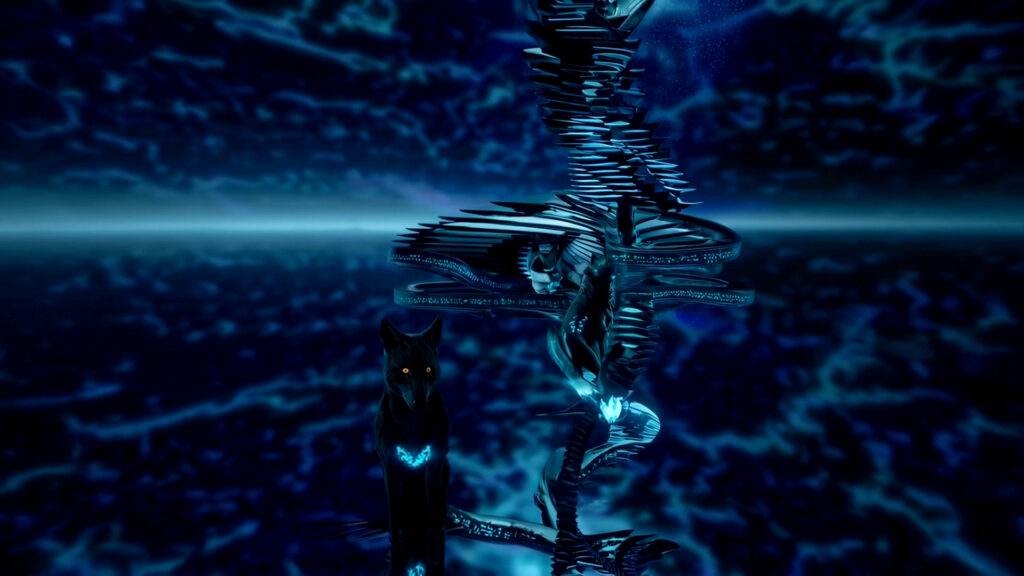
The bronze-legged striders appear on the far shore and stop in formation, like punctuation marks waiting to decide where the sentence will end. Behind them, coyotes pad into view—sleek and deliberate, wearing coats the exact color of the heartbeat you hear in your ears. Peyote patterns ripple along their flanks; as their tails swish they count in elegant mathematics: one, two, many, river, prayer, door. When they reach the number that means now, they look at you and tilt their heads toward a staircase spiraling down into your reflection.
You descend. Each step is made of a choice you have not made yet. The first is small: ask for help. The second, surprisingly larger: accept it. The third is heavy: forgive the version of yourself that used to cut the ends off stories because you were afraid of their teeth. The staircase keeps going and you keep accepting the steps as the only ground worth trusting.
When you surface again, the city has darkened to a color like black honey—deep, reflective, dangerous if you rush. The rings tighten; the librarian floats above a porcelain plinth, and the air crackles with A♯—not a sound, but the personality of a shadow that knows it’s beautiful. The striders make room for something you have no word for. You call it a Rapture Mechanism because your mind loves nouns. It is seed-sized and shaped like a question mark.
You do not ask how to use it. You plant it behind the sternum, where a bone remembers being a shield. Roots unravel at once, searching for moisture in the caverns of your life. Branches pierce upward into the future. They fruit. The fruit are warm and hum like held laughter. You bite one and taste the exact moment a rainstorm began when you were eight and the entire world smelled like an apology and you didn’t know what for. Your knees go soft. You sit down on nothing and nothing holds.
The city spins to the edge of recklessness, then pulls back. You spill into a canyon where everything happens at half speed. This is the ketamine corridor everyone speaks about in the way people speak about lovers who were good to them: careful, grateful, a little superstitious. Gravity arrives as a whale big enough to wear a mountain for a hat; you rest on its back, and it drifts through a tunnel of aurora folded into ribbons, a gift you’re allowed to open with your eyes.
Here, the thread on your finger reveals its name. It was tied by a friend whose patience had saved your life twice without telling anyone. She tied it when you walked away from the last version of yourself because to stay would have been a slow drowning. She tied it with a sailor’s knot and a laugh that always made you feel anchored. You had been calling it memory. Its true name is promise.
The canyon opens into the Meltwater Archive—halls of transparent ice where snow keeps precise notes on every footstep it ever met. Running along the rafters are conduits filled with dreams that didn’t have the resources to wake. Mescaline lanterns bead the ceiling with spiky halos; they buzz with little documentaries about decisions and their consequences. You watch a few. Not the hard ones. The ordinary ones you’ve always underestimated: drinking water, answering the message, looking up. Each documentary ends with a person turning toward someone else. It is suspicious how often the person is you.
The librarian waits at the far end among shelves of frozen breath. Where their face had been a porcelain calm, there is now something like affection. It has weight. They present a cloak woven of futures. You do not have to choose, they sign with their hands made of pages, but we recommend you do. You touch the fabric and it reshapes to your posture—the shoulder you favor because you used to carry too much on it, the waist that learned tension early, the ribs that grew around secrets and are tired of being architecture for shame. The cloak fits the way a tide fits a harbor.
When you step outside the Archive, the air is filled with lettering. LSD latticework scrawls the sky in ornate cursive; the sun filters through it and every line becomes a hallway. You can read the script only when you stop trying to. It says the old thing in a new way: You are permitted to be multiple, followed by its less polite companion: And you will be, whether or not you permit it.
The city swells to welcome your decision. The rings loosen. The striders kneel and present you with small things they stole from probability: a coin that always lands on its edge, a thimble that holds oceans, a map that changes every time you look away and somehow becomes more accurate. The coyotes circle once, pleased with their arithmetic, and howl a chord the whales answer from far below.
You sense the Rapture Mechanism ripen inside your chest. This is not a crescendo, because crescendos imply a peak followed by a decline and you are not interested in declines. This is a set of doors opening in sequence so quickly it feels like one door forever. You stand at the center while your life learns to orbit you correctly. You feel the gravity adjust. It is subtle and then it is everything.
The librarian raises one page-palm in farewell. You understand what they are not saying: no one lives inside the Maw. People come here to learn a step, then return to teach their ground how to dance. You take a breath whose length would embarrass a mountain and step back through the blink.
On the far side, the sky is honest again—stars arranged in their familiar habit of pretending to be still. The pilgrims at the threshold nod, then stop nodding and look harder, like someone hearing a song crawl out of a radio that had been off for years. You do not tell them what you saw. The thread around your finger glows in the small, smug way of work that is finally going to be done.
You set off.
You cross a station whose announcement arrives right when it should. You pass that balcony; the cedar smells like it still knows every story and has learned better endings. The kitchen window looks onto rain you don’t need to explain. In the glass, your older reflection winks and disappears; you do not mind that the scars have not yet arrived. You open your palm and find three gifts the striders tucked there while you weren’t looking: the coin, the thimble, the map. You balance the coin on the thimble rim and the map unspools across the table, showing you routes that are not shortcuts but honest roads.
On the first road you knock on a door you had been pretending was locked. On the second you sit with the friend who tied the thread and say the ordinary sentences you now know are sacred: I’m sorry. Thank you. I’m here. On the third you teach your ground to dance, and it is clumsy, then funny, then deft.
At night, when the house goes quiet, you feel the seed in your chest extend another root. It is not dramatic; it feels like a small, welcome weight on your ribs. You dream whale corridors and coyote arithmetic and the librarian shelving auroras by temperature. You wake laughing. You drink water. You answer the message. You look up.
And when the days complicate again—as they always do, because chaos is just the universe’s way of keeping itself awake—you touch the thread and find that you can open a door in your breath and step into halftime for a minute. Inside that minute, you recall how to be multiple without shattering, how to choose without grinding your teeth, how to move through a world that keeps insisting it is real and discovering that it is, and is not, and is more for your knowing it.
People will ask what the Graviton Maw gave you. You’ll think of words—truth, permission, choreography—then shake your head. What the Maw did was simpler and more difficult. It returned you to your own orbit and made you equal to your gravity. It did not crown you or cleanse you or exalt you. It set you down inside yourself and reminded you of the one rule etched into the thread’s gold: You can come back, but you will never be the same sentence.
So you begin speaking new ones, careful at first, then with speed. Some are tiny, like “good morning” and “I forgive you.” Some are stitched from star-metal and sunflower pollen and patience. Some are the kind of sentences a city makes when it relaxes its rings and becomes a harbor. The people around you hear them and remember they, too, are permitted to be multiple. Entire neighborhoods change their gait. The air warms. Someone plants a question mark in the community garden, and everyone laughs at how obvious it seems now.
On certain evenings when the heat lifts and the neon outside your window has the decency to hum softly, you look up and think you can make out the librarian in a faint reflection, shelving a new volume bound in moon-leather. You suspect the title. You do not say it aloud in case the spell demands silence. You smile anyway.
The whales in the ketamine corridor turn in their sleep. The coyotes do the math again and arrive, as ever, at now. The dragonflies stitch one more ultraviolet sentence across the lake, just to keep the grammar limber. The city rings coast on earned momentum, shining with the light their sunflowers pedal all night.
And you—thread-touched, seed-grown, orbit-steady—you carry the Maw’s rapture like a candle cupped in wind, walking home through a world that, it turns out, has been waiting this whole time to be real with you.
the Gallery