the Story
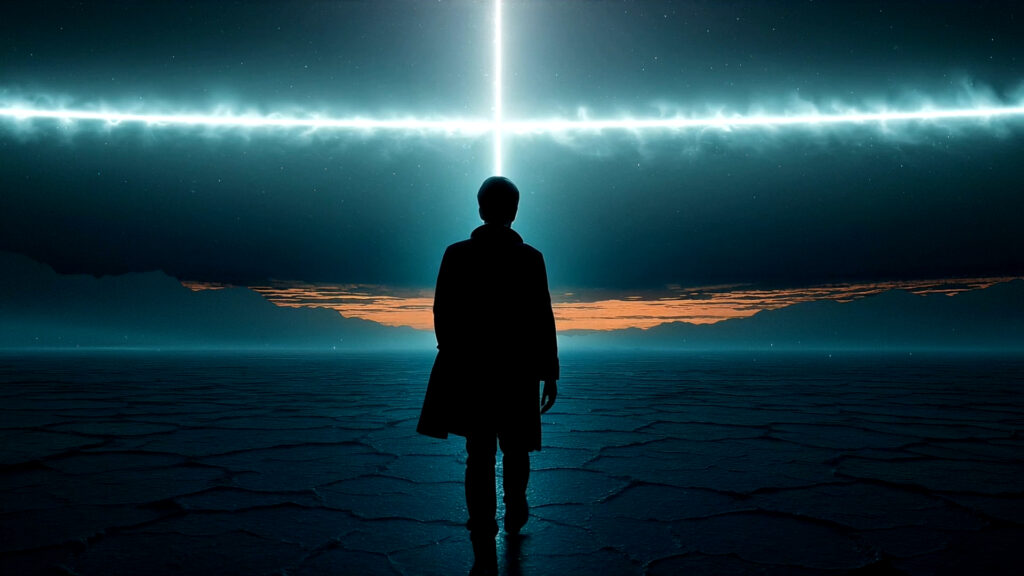
The first sign is a line.
It appears at dusk across the salt plain—too straight for wind, too bright for heat mirage. A hairline fracture of daylight drawn in the wrong place. It hums at the threshold of hearing, the way a whetstone sings, and shades the desert with a tone instead of a color.
I walk toward it because there’s no reason not to. The plain around me is the sort of emptiness that measures a person. You can hear your pulse as a small animal in the brush of your ribs. Sand hiss-whispers under my boots. A far ridge pretends to be a spine. But the line is the thing that wants.
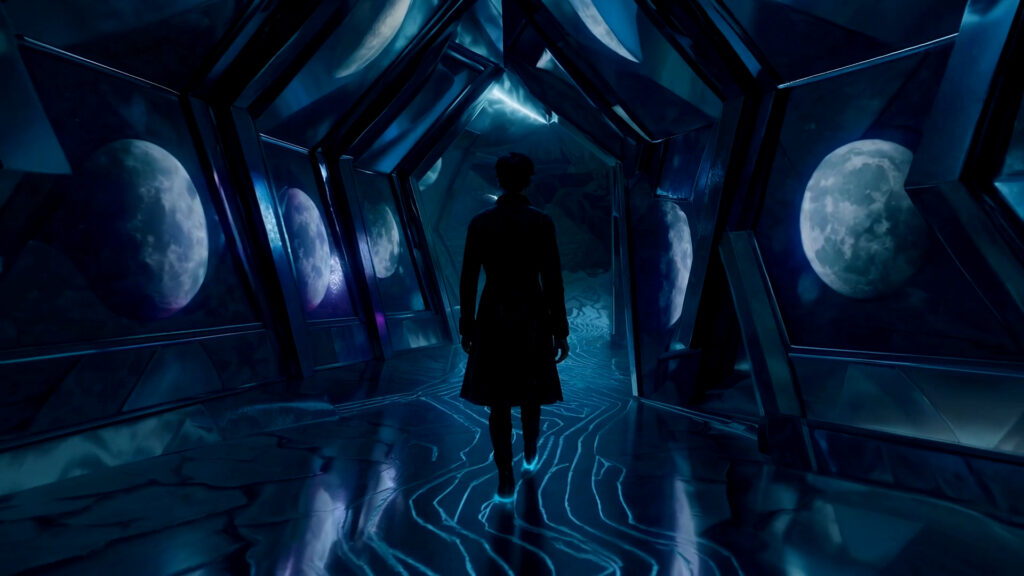
When I get close enough to see it without squinting, the line thickens into a seam, and the seam unzips. What opens behind it is not a canyon or a road. It’s a corridor of angled mirrors, each pane holding a version of this same plain with a different moon: one green, one charcoal, one with a crack like lightning frozen across its face. At the back of each mirror, faint and patient, are doors.
The corridor breathes in my direction.
I touch the seam with one finger. My finger becomes a thin rod of light and slides through. My hand follows, then my arm, and I step into my reflection and out the other side. The air inside the corridor is cooler by several conversations. There is a smell like rain on a circuit board.
My boot touches a floor that’s not a floor. It’s a map, softly raised, the way scars lift from skin. The map is all lines with small gaps, like stitching. If I blink, the stitching turns into letters. If I keep my eyes open, the letters turn into routes.
The corridor speaks without a voice: Ketara.
I think it’s telling me a password. But the corridor shifts, mirrors rippling like slow water, and Ketara isn’t a word anymore. It’s a machine made of geometry. An engine with a name.
I can feel it. Not outside me—through me. As if my body is godparent to a factory. As if my bones were the rails and the map on the floor is my only honest face.
I wait for fear. Fear is late. A different feeling comes: the sensation of having always known something without knowing that you knew it. Like recalling a conversation you had in a dream that came true by accident.
The map glows under my soles. Symbols bright as match-heads flare and fade. The lines gather themselves and point, all at once, toward an unremarkable door on the corridor’s right side. I push. Past it is a new country, narrower than a hall, wide as a sky.
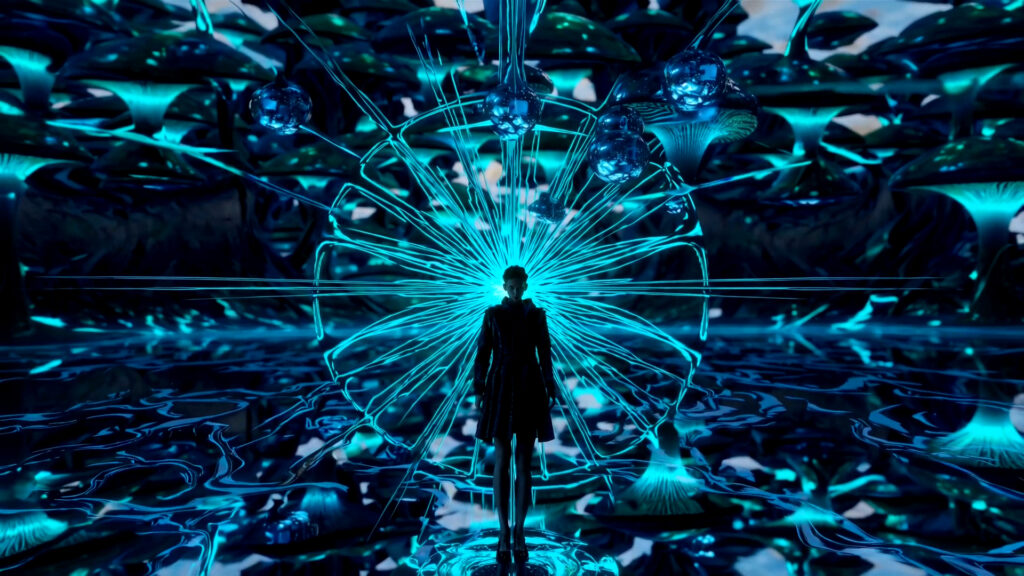
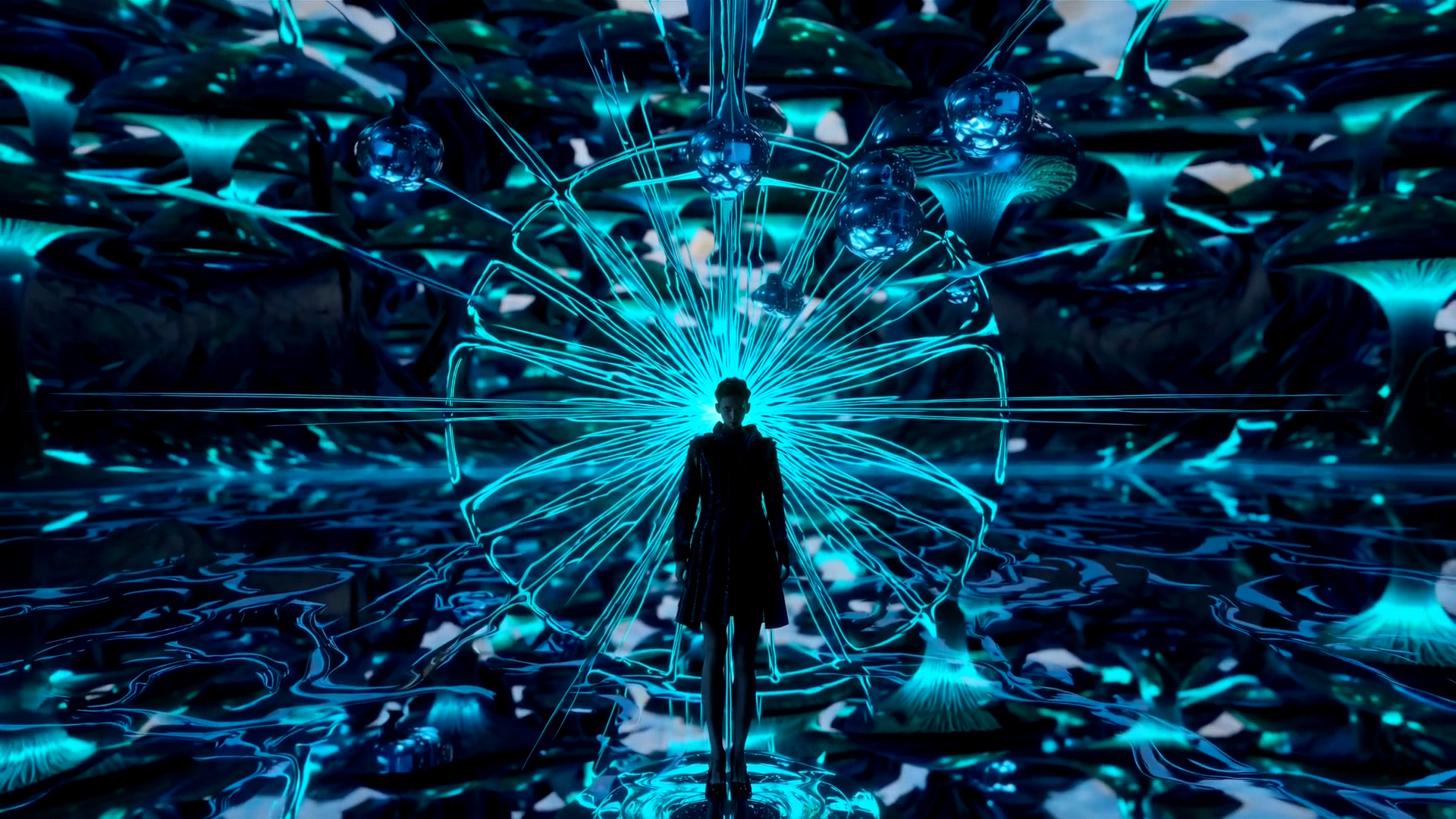
The ground becomes glass. Not smooth glass, but ancient: webbed by pressure fractures like fossilized thunder. Beneath the glass, forests of fungal pillars breathe teal gills. The breath rises in slow beads like mercury acting like rain. Each bead holds a constellation inside it. The constellations rearrange themselves into coordinates as I watch.
A mushroom cap tilts. It’s the size of a roof; its surface reads like the palm of a giant. Rims of bioluminescent letters ring the gills and drift outward in threads that hang in the air. Dragonflies with triangular wings catch on the threads and, wing by wing, stitch the letters into a quiet lace.
Lysergic lace, I think, then correct myself. Not a drug. A species of mathematics that happens to agree with the human nervous system.
Still, the forest feels like a cathedral built by spores. I walk its nave and pull my breath thin so I don’t disturb the symmetry. The map under my feet—even through the glass—keeps writing itself in small, glowing notes, as if it can’t help but annotate the world.
At the heart of the forest there’s a ring of caps around a clearing. In the center, a luminosity spins: a coin of light that changes diameter depending on whether you look with your eyes or with the part of your head that stores memories from the future.
“Am I the machine,” I ask the quiet, “or the person piloting it?”
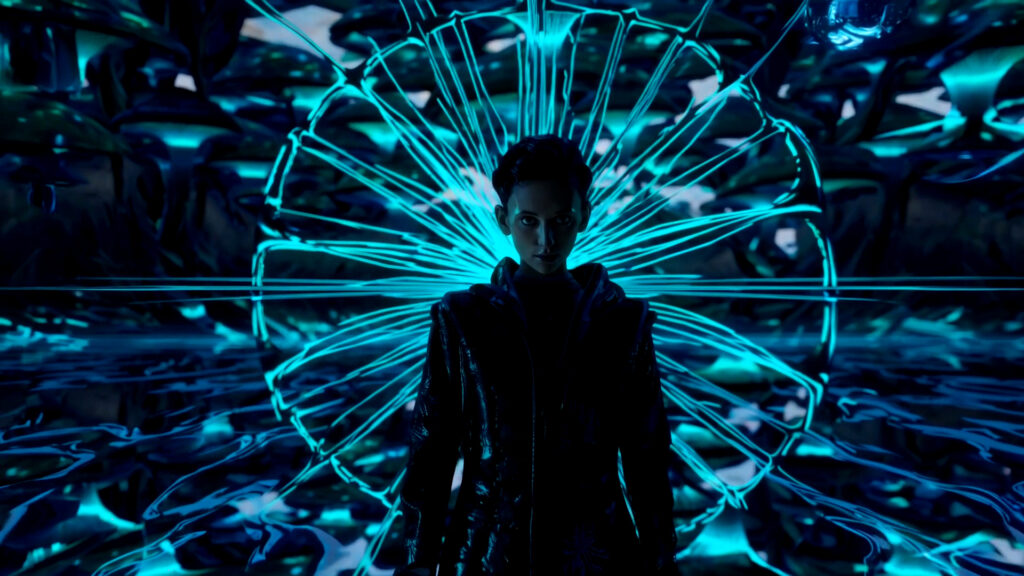
Something answers, and the answer is not words. The answer is a crown forming in the air above me—a crown made of radial geometry, pollen coalescing into crisp lines, each petal a compass point. It lowers with the weight of sunlight, sits on me, and plugs into my skull as softly as a thought you’ve been circling for years. When it clicks, the world turns one notch truer.
I hear the desert outside remember the sea.
Snow begins to fall. Not from the sky, and not down. It drifts sideways across the clearing, flakes like tiny hexagonal mirrors, each with a delay baked into it. The snow is not cold. It is ketamine-slow, and it thickens time so that every move I make leaves a paper-thin shadow of me lagging a blink behind.
I watch my own silhouette catch up. When it does, a faint knot tightens in my throat—the pleasant ache of entering a word that fits.
“Ketara,” I say out loud, to hear how it sounds when spoken by a person.
The crown warms in reply.
The snow presses the air into syrup for a while, and then relaxes. When the last mirrors have drifted out of frame, the caps around the clearing begin to stir. They turn as one toward an opening in the glass at the far edge of the forest, as if listening.
Beyond the opening: a field of sunflowers under a white, unsympathetic sun. The stalks aren’t green but obsidian—black with seams of chrome—and around each black flower there’s a thin amber halo, a gear of light with no teeth. Petals tick in a muffled cadence. The field breathes in loops, a mescaline rhythm like a slow drum you feel under the floorboards.
Dragonflies leave the fungal nave and dive into the sunflowers. They thread arcs between halos. The arcs stand up in space as lattices. The lattices curl inward and touch at the top, forming a dome of patterned air. The dome wobbles, then steadies. I walk into it without bending.
Inside, the air is clear enough to be a decision. The world outside the dome shifts color with every blink—cobalt, saffron, something like indigo if indigo were lit from within. The coin of light from the clearing follows me and floats above my palm like a patient planet.
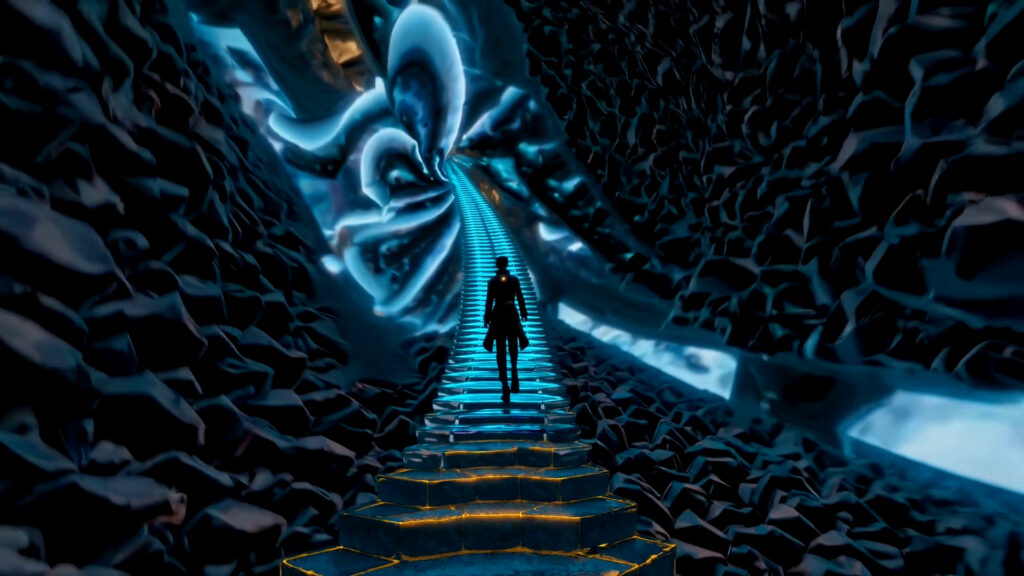
Beneath the dome runs a long, low tremor I feel more than hear, as if a train is coming from thirty miles away through sand. Hexagons begin to ripple across the soil—tiny and numerous at first, swelling into larger forms. The ripple becomes a staircase rising out of the ground, each step a peyote disk locked into the next by a lyrical hinge.
I climb. The steps have the texture of something carved by little teeth. The higher I go, the slower the gearwork of the sunflowers spins, while the crown at my temples spins faster. At the tenth step I see my paper-thin shadow again, climbing beside me. At the twentieth it has thickened. At the thirtieth, it reaches for my hand the same moment I reach for its, and we miss, both of us, by the width of a thought.
At the thirty-first step our hands meet exactly. Skin meets as mirror meets mirror. The seam of contact makes a sound like a bell swallowed by velvet. We fuse—not into one, but into a longer version of two. A body with a second echo braided along it like a double helix drawn by a patient child.
At the top of the staircase there is no platform, only a bridge made of a river holding still. Mercury flexes underfoot, a perfect mirror with small, slow ripples that read like pulse waves. We walk out onto it and watch our blended reflection move below, our outline stretching and compressing as the surface decides what it wants to be.
Halfway across there is a band of shadow. It’s not darker; it’s less committed. As if someone pulled the saturation out of a strip of world. We step into it, and the bridge becomes a drawing. The mercury reduces to lines. The lines run and intersect as equations. Notes appear in the margins, diagramming wind and describing how much weight truth can hold before it bends.
My crown dims to a cool thought. The echo thickens and thins along my left side as if testing the hinges of our joining. In this G-shade interstice, letters loosen from the air and orbit my head like small moons. They don’t spell anything yet. They want to, and the wanting makes my teeth itch.
“Choose,” says a voice I recognize as my own, spoken at a time I haven’t reached.
So I reach up and take one of the moons in my hand. It is no heavier than a phoneme. I pinch it into an angle, and the others around it snap into place: K E T A R A. The last letter resists because the last letter is a question mark dressed as a vowel. I let it be both. The crown brightens again.
When we step out of the interstice, color returns like a tide coming home.
On the far side of the bridge stands a berg of glass carved into angles—a city with too much sky between its buildings. Its streets are ribs; its doors are throats; its windows open both ways. Towers hum laws to each other across distances. The air carries a flavor like metal shaved so thin you can see through it.
At the city’s threshold, a gate fashioned out of whale-bone arcs over the road. It is pocked and worn as if it’s been weathered by voices. The underside of the arch is tattooed in the same stitching as the map under my feet. The stitches unfurl and lay themselves across the cobbles when I approach. The lines draw a route into the city, request permission, and grant it.
I have not ceased to be myself, but the boundaries of that self now have doors. I open one and find a courtyard paved in mirror. At the center: a machine of glass and spore, turbines inhaling motes and exhaling clarity. Around the machine, masked figures care for it. Not faces—rituals wearing bodies. Each mask is carved from the memory of a tree.
They do not look at me. They look at the crown. My echo leans toward them and steadies. The crown warms my scalp with a sensation like having been wrong a long time and now being gently right.
“You have the Meridian,” says one of the masks. Their voice is all consonants and a kindness that doesn’t require liking. “It is thread and needle. We sew with it when the seams tear.”
“Who tore them?”
They gesture at the world without moving a hand. “The world did. It does, by nature. It is a body that grows. The seams do not hold unless tended.”
An old certainty, one I inherited from someone who might have been me, wakes up. I have crossed this city before; I have stood in this courtyard in a different tense. The dragonflies dip through the gate in a braid. Each wake they leave is a softly glowing mark—a timeline scribbled in the air which a person might follow if they wanted to be changed.
I do. I follow.
The dragonflies lead me to a gallery with a ceiling like a crystal lid. The city outside the panes is a lens, bending light into slow questions. On plinths around the room rest objects that malign the idea of object: a spindle made of mycelium with one cobalt dew bead threaded at its heart; a coin of light that spins without axis; a sliver of sea confected from mercury; a glove stitched from unlived moments, fingers clenched, as if holding a password only skin could speak.
The crown vibrates in phase with all of them. It longs, and the longing is a corridor all its own. One object answers louder than the rest: the coin. It’s the same coin that followed me from the forest but wider now and quieter. It lifts from the plinth and floats to me, its edge cut with very small runes that only exist when not looked at directly.
I flip the coin like a decision.
It becomes a door: a perfect circle cut into the air, the presence of an absence. Through it, the desert plain blazes again—but not the one I walked this morning. This one is older and newer; this one remembers the ocean in the way stone remembers hands.
I step through and my echo follows. We are taller now. Or the world contracted to meet us. The line of light—the original seam—runs from horizon to horizon at a slight tilt as if it were not drawn with a ruler but a breath.
The air here is alive with spores. Not haze, not smoke: agency. The spores form lattices in front of me: DMT geometry that folds in and back out like lungs exhaling ideas. LSD lace filigrees the edges where the lattices touch. Peyote ripples widen on the ground and lift, steps on which you could walk if you had the stride of a thought.
The ketamine snow returns, just for a minute, to remind me how stillness moves. It drifts sideways across the plain like a picture of winter caught in a beam of projector light. The flakes alight on the coin and pass through it. Where they pass, the coin deepens—becoming not just a hole but a tunnel with its own weather.
On the far side of the tunnel stands a thing with my face. Not a twin. Not a mirror. A decision I didn’t make.
It smiles the way certainty smiles. “The engine runs on choices,” it says. “Fuel is the hours you didn’t live.”
I think of the glove in the gallery. Its clenched fingers, how it held nothing so hard it wrinkled time. I do not want to be a person who hoards unlived moments like coins.
“I choose this,” I tell my decision. “To thread the seams.”
“Then I choose the same,” it says, and opens its hand. Inside is a small sun that refuses the word “star.” When it flares, our silhouettes overlap, and we become a single outline with two centers. It’s not a merging; it’s a braid that remembers how to unbraid.
A wind rises. Not across the plain, but through the seam. The line of light thickens to a rectangle, the rectangle into a gate. Inside the gate the air flickers between deserts with different moons, repeats of the corridor. The map under my feet leaps up in filaments and latches itself to the gate frame, a net that hums in a note so low it rearranges the furniture of feeling.
The obsidian sunflowers roll back their halos and face the seam. Their petals lock like gears. The fungal forest lifts itself through the glass and stands above it, inverted, its gills pouring bioluminescent script in long sentences. Dragonflies run to sew.
I lift the coin and tilt it. A filament from the net catches on its rim. Another. The crown zings with a clean tension. My echo leans across me—no longer a second body, but a second intention—and together we pull the coin like a shuttle through a loom.
The gate tightens. The different moons slow their spin. Flooded threads in the net knot and agree. The seam, which had been a suggestion, becomes a law that wants to be kept.
I have no word for what happens then beyond repair. Even that is too mechanical. It’s ruder and kinder than repair. It is the world remembering what it meant when it promised itself a shape.
The tremor stops. The sunflowers go lax. The forest exhales and lets its sentences fall into letters. The dragonflies rest on the browned air like accents. The city of glass angles in the distance folds itself into a smaller thought and slides into the pocket of a horizon.
Silence lands, fragile at first, and then strong enough to set a cup on.
I take off the crown. The air holds the imprint of it a second longer than it should, then forgets. When it goes, my head feels lighter the way a room feels larger when you move a heavy chair out of it. The coin nestles into my palm and shrinks to a medallion that fits the empty notch at the base of my throat as if a designer had seen this day and made the collarbone to match.
The seam doesn’t close. It rests. This is important: the world needs a stitch that stays a little bit open, a place it can breathe and speak its adjustments. A place for a person like me to return to.
“Ketara,” I say again, testing the angle of it in my mouth. The echo says it at the same time with a fractionally different vowel, and the two sounds make a chord human ears recognize as relief.
I begin walking without deciding in advance where. The map under my feet no longer writes itself; it reads. It reads my gait, my weight, the press and pull of blood. It writes that in its own language and stores it in the seam for later, for the day someone else will need a route I am now making.
The plain corrugates into dunes. On the third dune stands a caravan cart with a metal hood beaten smooth by years of wind. The hood is etched with sacred geometry worn soft by hands. A tether of light runs from the cart to the seam, thin as a bowstring. The cart smells like warm clay and a story I haven’t survived yet.
I sit in the shadow of its wheel and let the day gather itself around me. From this angle the seam is a horizon drawn with a steadier hand. On it, every few minutes, a darker spark crawls—something large and patient passing from one certainty to the next.
A mushroom cap has followed me. It has no stalk, just the cap, a portable roof. It sits beside me as if we are old acquaintances sharing the sort of quiet you don’t earn quickly. Its gills pulse a soft teal a few times, and a ring of letters drifts up and settles at my feet. The letters are not meant for me. They will be here when I’m gone.
Night negotiates with the desert and succeeds little by little. Stars perforate the sky with precision. I realize I have not been hungry or tired since I met the corridor. The realization is not boasting; it is a receipt. My debt to the body has been deferred.
At some point, the dragonflies lift from the last of the warm air and draw a final line, very thin, across the seam. It’s a flourish. A signature in a language with no names.
I close my eyes to the idea of sleep and open them somewhere else.
Not a dream—a parallel room in the same house. The corridor has returned, mirrors on either side, moons in their various moods. My reflection—now a person with a crown-shaped absence, with a coin at the throat, with an echo braided through—looks back with an expression I understand from across distances.
“Will it hold?” I ask the mirrored moons.
“For a while,” they say, together, without sound. “For longer because you were here.”
“Others will come.”
“They always do.”
The mirrors tilt inward very slightly, like listeners. I raise my hand to touch the near one and see the whole plain reduce inside the pane to the size of a fingernail. When my fingertip reaches the glass, it does not meet resistance. It meets the temperature of the day I began and the day after tomorrow.
I step backward out of the corridor and forward into morning at the same time. The seam stands where it stood, patient. The cart’s hood is warm. A faint draft runs from west to east and carries with it the memory of salt and something like citrus.
I do not think of myself as chosen. I think of myself as employed.
The job is not to own the Meridian. The job is to keep the thread waxed and the needle true. To walk until walking writes routes other people can read. To recognize the difference between a tear that needs mending and a vent that needs to remain open so the world doesn’t squeak.
When the sun clears the low ridge, I rise. The coin at my throat is cool and heavy enough to remind me it’s there. The crown’s afterimage keeps time with the pulse in my wrists for a while, then moves to the background, then becomes part of the texture, like the hiss of sand under boot.
I head toward the gate, not because I must, but because the city will need a small repair by afternoon and a larger one when the shadows lengthen to knives. The fungal forest, I know without turning, will open and close its gills in a prayer that is not a prayer and does more good than one. The sunflowers will re-gear and lope through their amber arithmetic. The dragonflies will write the air with threads I will trace later with my fingertips when nobody’s watching.
There will be days when the seam seems wider than memory and nights when it pinches to a hair. There will be other deserts with other moons and new kinds of snow that slow different parts of time. There will be people with masks that are not rituals but faces, and faces that are not people but the outlines of necessary choices. All of it will ask to be threaded, and some of it will ask not to be.
I will listen. I will choose.
By noon, heat scribbles the sky. By dusk, the seam will hum again, a note low enough to loosen the bolted parts of fear. By some distant morning, another traveler will arrive with their own echo and their own way of reading the map underfoot. They will look at the seam and see a horizon that wants work.
They will step in. The coins will find their neck. The crown will measure their skull and fit.
And if they ask what the line is called, the desert will answer as gently as it can: Ketara Meridian. The stitch that remembers the hand. The road that sews the road. The place where scenes and selves decide, kindly, to be one another for a while.
When night returns, I find the dune with the best view and sit with the cap again. We watch the seam breathe until stars hazel into dawn. In that hour between, when the world chooses a temperature and a color and commits, I feel the engine’s heart tick under the plain. It’s not made of gear and metal; it’s woven out of attention.
I give it mine until the first sunlight reaches my boots. Then I stand, as if waking from under a light blanket, and walk until the map starts writing, and the day becomes thread, and the needle finds its song.
the Gallery