the Story
I. Letters of Light
The tundra does not begin so much as arrive.
I crossed a ridge of cobalt ice, and the sky opened like a book turning to its first bright page. Lines of aurora braided above me—mint, sakura, electric teal—ribboning into sharp, deliberate strokes, as if some patient hand were writing with light. The wind was not cold. It had the temperature of a held breath, the taste of orange peel and winter.
They had warned me: There is a place where weather remembers how to feel. Go there if you want your moods repaired, or rewritten. The map they gave me was only a single sentence: Follow the serif.
So I did. The aurora’s edges were not vague swirls but exact, knife-graceful curves, the kind a calligrapher draws when they mean every millimeter. I followed as if reading, and the sky punctuated distances with dots of amber stars, the way a sentence grips you with its rhythm until your steps match its meter.
The land below was an ocean rendered in slow motion—waves of violet and indigo snow, frozen mid-crest. From between the drifts rose mushrooms the size of towers, their caps freckled with lantern pores. Light leaked from them in steady breathing, as if the earth itself were practicing calm.
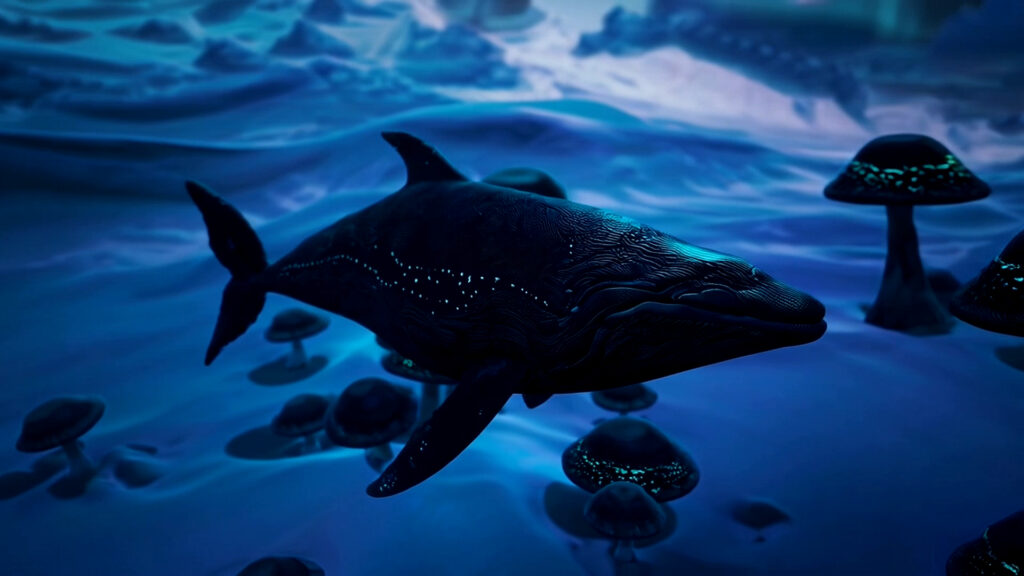
Far off, a silhouette moved: a whale gliding along the seabed of snow as if swimming through density alone. When it surfaced, the surface did not break; the snow accepted its shape and let it pass. Its flanks glimmered with constellations I didn’t recognize.
I spoke without deciding to. “I came to remember how to be happy.”
The whale’s eye turned. It was not human, not even mammalian in any familiar way, and yet something like patience lived there.
The nearest mushroom’s gills trembled, releasing a sigh of bioluminescent dust. Spores drifted up, each a tiny coin of color. When they touched the aurora, letters kindled—angular, clean, and ceremonial. They spelled the tundra’s answer across the sky:
WELCOME, READER.
It made me smile, and it made me feel read.
II. The Whale Beneath
The whale slid nearer, the snow folding around it. It hummed—a single syllable of midnight—and the nearest mushroom answered by tilting its cap, as if tips were a language.
“Do you understand me?” I asked.
The whale’s hum gained harmonics, climbing like rungs. The answer arrived as a sensation instead of a word: Come down. Let the slow help you.
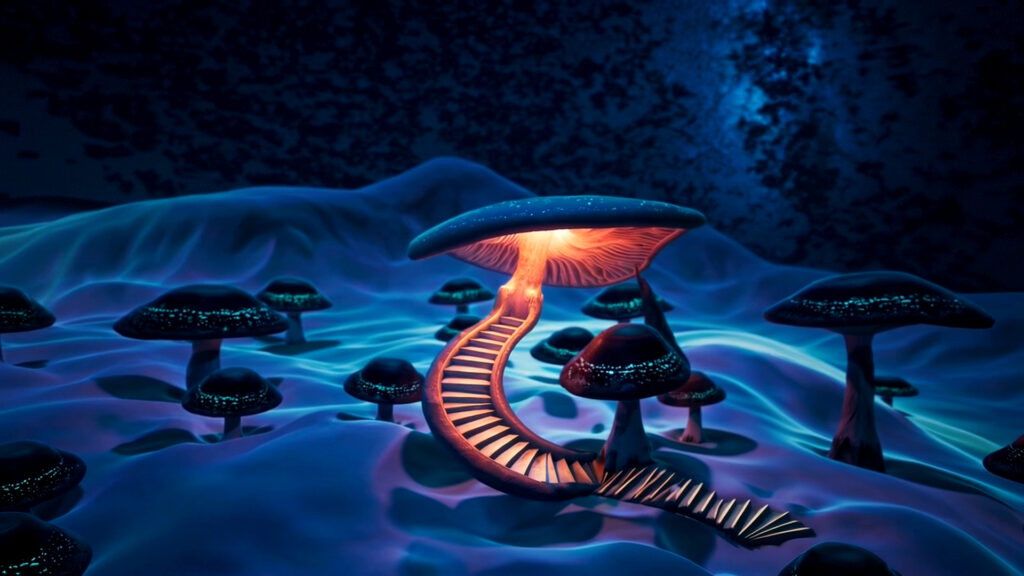
The mushroom pulsed again. A stairway of ridged gills descended, spiraling like a cathedral staircase. I placed a boot on the first step; it sank a hair, then firmed. Within, the air smelled of clean soil and starfruit. The gills’ undersides glowed in bands—tangerine to magenta to indigo, a gradient you could walk.
Below the cap was a chamber where the gills were wires in an instrument I could not name. Spores hung like lanterns, suspended by nothing. The whale waited outside, visible through a curtain of translucent mycelium, as if I looked through ice.
An idea rose in me that did not feel like mine: We will connect if you slow your inside weather. It came with instructions as spare as a diagram—inhale for four, hold for four, exhale for eight—until my heartbeat fell into that deliberate, architectural rhythm. The whale rose, pressed its face to the mycelium, and the mushroom tightened its filaments around our shared gaze.
Then the chamber shifted.
Colors stretched. Sound thickened. The room’s geometry breathed open like a flower made of measured lines. What people call a ketamine drift dropped over the moment—not drowsy, not numbing, but a velvet dilation of time that turned thoughts into statues. In that measured slowness, the whale’s hum drew glyphs I could read: chords that were also paths, intervals that were also doors.
The mycelium distanced itself and tunneled, filaments burning with neon as they drew a map outward and under the snow. The whale slipped into that tunnel and I followed, not with my body, but with the part of me that chooses where to look and what to remember. We traveled as attention travels: wherever I set it, the world unrolled to meet me.
Spore constellations braided into lattices. Certain nodes flared—memories I’d cross-referenced to grief so often they’d fused. The whale brushed them with its flank, and every brittle association shook free—same facts, different edges. A DMT clarity came and went, that clean blue logic of hyper-detailed mercy, where each snow crystal is both itself and the rule for all crystals. Within it, I watched a memory of my mother laughing through ruined plans, and for the first time the laugh was not resistance but design: a way she told the air to re-arrange.
We surfaced in the open tundra again. The aurora’s serif strokes sharpened, as if our passage had increased resolution. I exhaled a breath I’d been saving for years.
The whale dipped its head. Another sensation arrived—the closest thing to words I’d yet felt:
Feeling is a craft. Not a trap.
I looked up at the sky and believed it.
III. Parliament of Caps
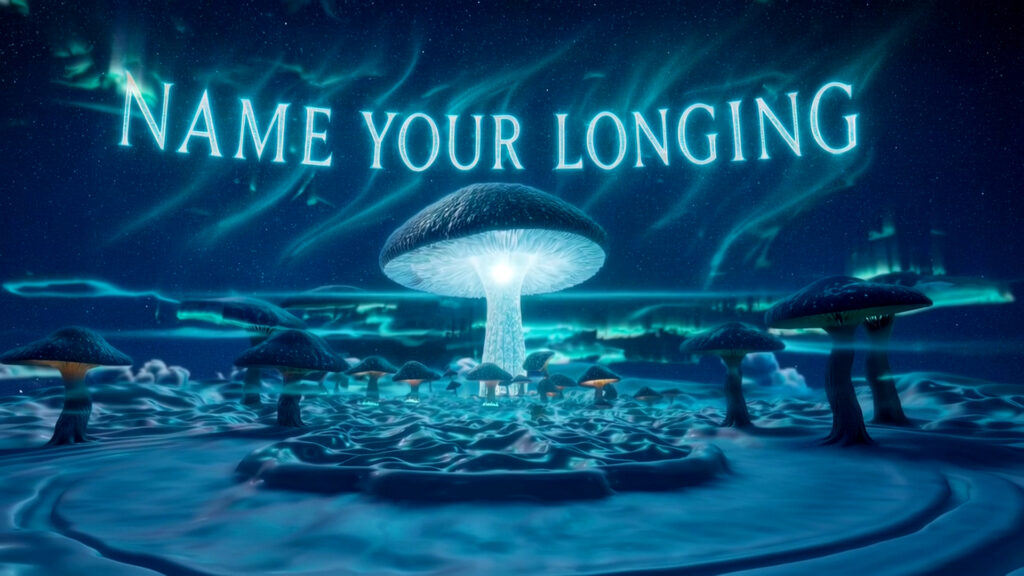
We traveled to the tallest mushroom—the one you would have used as a lighthouse if oceans had latched onto the sky. Its stalk was marbled peach and ultramarine; its cap’s underside fanned out like organ pipes. Around its base, younger mushrooms clustered like apprentices.
“Is this… where decisions get made?” I asked. I didn’t know why the question shaped itself like politics.
The whale hummed low. Spores showered down in answer, arranging on the snow in a circular carpet of dotted light. A circle within the circle darkened, and from that aperture rose a platform of packed, velvet soil.
Figures unfolded from the cap’s edges. They were not humanoid. They were not animals. But each had a posture that looked like listening and a contour that looked like intent. They were shapes of organization—rings, coils, planes with edges too straight for chance—woven from the same stuff as the mushroom’s gills and the aurora’s letters. Parliament felt like the right word, and caps the right crown.
The central figure—if a plane of light can be a figure—tilted toward me. The aurora above slotted into a new phrase, the serif angles severe enough to be sacred:
NAME YOUR LONGING.
The first answers that jumped up were small, honest, and uninteresting. A good sleep. Fewer stumbles. Someone to share a kitchen with. I held them gently and waited. Beneath them, under the deeper ice, something heavier shifted. I named it aloud before I could look for cleverness.
“I want to be someone my days can’t starve.”
The parliament did not applaud or smile or change color. It simply accepted the sentence the way earth accepts seed. The big cap’s gills darkened, then blazed. A hiss of spores rose, a collective inhalation.
OFFER A GESTURE, the sky wrote.
“What kind?”
The whale brushed its fin along the snow, leaving a groove that gleamed for a moment before the surface healed. The instruction was clear: something simple, not a speech but a stroke.
I knelt and pressed a palm to the snow. The cold was immediate but precise, like a scalpel that agreed to cut only where I pointed. I drew a line, then a second, then a small crossbar. It was not a symbol I’d planned; it was the first letter I’d ever loved—the one my childhood teacher said looked like a ladder with its confidence showing. In the tundra’s script, the letter grew cross-hatched spines, a display-serif version of itself, then left my hand and rose, bright and deliberate, into the air.
The aurora reached down to meet it, and in the contact I saw how the sky had been writing to me all along: not in vagueness, but in type you could set by feel. Letters struck across the firmament in disciplined arcs until my small glyph found its place within a larger sentence. My throat ached.
WE WILL TUNE YOU IF YOU STAY TO TUNE OTHERS, the sentence concluded.
I wanted to say yes. But a different weather moved on the horizon—colorless, and fast.
IV. Night of the Gray Moth
It came from the east, slung low: a matte sheet that ate hue as it traveled. The violet drifts dimmed to museum shadow; the mushrooms’ pores went out one by one; the whale’s constellations snuffed until its outline was a stubborn math against the gray.
The parliament’s figures narrowed to blades. The big cap’s gills snapped into chords, calling up reserves. But the gray tide kept erasing.
“What is it?” I asked.
The whale’s hum carried weight: A hungry night. It comes when stories forget they’re allowed color.
The notion terrified me in a clean way, like an accurate diagnosis. The gray moth—because that’s how it moved, like a wing that refuses to admit to being a wing—rushed across us, and where it passed, the aurora’s letters became mute lines.
The parliament’s central plane slid under my feet and rose, lifting me toward the cap. WRITE, the sky commanded, though its brightness flickered. WRITE FASTER THAN IT FEEDS.
I had no pen, no brush, and nothing to write on. But the gills were a staircase, and the cap a canvas, and the whale a metronome fixing tempo. I climbed, the whale’s hum setting my breath. Up close, the cap was a city of ridges. Spores frothed around me, waiting for strokes to follow. The gray moth loomed and the breeze from its approach smelled like dust, like forgetting.
I cut letters into the air.
Not paragraphs, not even words at first—only stems and arcs, crossbars and terminals, the primitives of an alphabet with its jaw set. Every stroke I made summoned color. A vertical line dragged a river of ultramarine; a curve pulled magenta from the sky like thread; a serif flicked sparks of citron. The parliament echoed my gestures, multiplying them with their own rigid grace. The gray moth swallowed what it touched, and we supplied more to touch. The aurora joined, bending its ribbons to our angles, until each letter could brace the next like trusses in an impossible bridge.
The whale rose fully from the snow. It leapt. Its body carried the last of its constellations into the moth’s mouth and exploded them into galaxies. The boom had no sound, only pressure, a bass you feel in the bones. Stars lodged in the gray like seeds in meat. The moth’s edge frayed. I carved the letter I loved most—the ladder with confidence—and gave it a name so it would stay. Keser. It brightened, called its siblings, and together they spelled a phrase I hadn’t chosen but recognized as mine:
SEROTONIN TUNDRA.
The words did not describe; they enacted. The moment they finished, the moth wheeled, looking for a sky without grammar, found none, and unraveled into a weather of harmless ash. When the flakes touched the snow, the mushrooms absorbed them and lit up baseline bright again, a steady pulse you could set a day to.
I lay on the cap, gasping. Spores settled on my skin and winked out, as if savoring the warmth. The whale returned to the ground, the stars along its flank brighter than before.
The parliament’s central figure held still until the quiet had time to be believed. Then the aurora wrote, simply:
STAY.
V. The Practice
I did.
Not forever. The tundra asked for seasons, not a sentence. The parliament taught me measures: how to pull a color with a gesture and tie it to a mood without choking it; how to build a serif sturdy enough that grief could lean and not fall; how to adjust spacing between events so breath could fit. The whale took me under the snow whenever distance grew foggy. Inside that slow, I could find the exact hinge where a day had gone stiff and oil it.
Travelers came.
Some had names for what hurt; some had knots so old they’d started calling them bones. We did not cure. We tuned. We wrote their longings into the sky in letters daring enough to be read from far away. The mushrooms learned their rhythms and grew caps shaped to resonate with them. Once, a child asked the whale to show them what joy was made of, and the whale obliged: the tunnel blossomed into a library of tiny, repeatable choices, each shelf lit separately, none of them demanding worship.
On the last night of my promised season, the aurora dipped low and took a shape it had never taken for me: a hand making room.
I walked to the ridge where the tundra had first arrived. The whale followed, leaving groove-light that healed, and the parliament’s figures waited at the base of the tallest cap, a row of planes like open books. No speech. Just presence. The best graduation they could offer.
“Will you be alright without me?” I asked, knowing the answer and wanting it aloud anyway.
The sky wrote nothing. Instead, the mushrooms breathed in unison and the whale sang a chord warm enough to be furniture. It was not we don’t need you. It was we will keep happening.
I turned to go, then remembered and laughed. “One last thing.”
I raised a hand and wrote my real name in their alphabet. The letters looked both sharper and kinder than they ever had in mine. The aurora carried them higher than the eye could hold. The whale kissed the snow. The mushrooms’ pores brightened, then settled into a dependable nightlight of color.
I crossed the ridge into whatever waited.
Halfway down the far slope I felt the tug—the kind of ache that used to mean hunger or fear but now translated as you are being read by something that loves sentences. I looked back. The words I’d set for them—SEROTONIN TUNDRA—hung above the horizon in long, clean strokes, not a brand, not a spell, but a practice in plain sight. The snow answered with a shimmer. The whale’s back broke the surface one last time, a moving constellation. The tallest mushroom bowed, not as a king does, but as a craftsman does to another.
The wind tipped its voice toward citrus again. I smiled because that flavor always means the world is paying attention.
It would not always be easy beyond the ridge. There would be gray moth weather, busy rooms that steal color, days when distance forgets how to be near. But I carried a laddered letter in my pocket, and it fit into any sky I chose to raise. I could set it at the beginning of a morning or the end of an argument and trust it to hold.
Feeling is a craft. Not a trap.
I walked on, and the page kept turning.
the Gallery