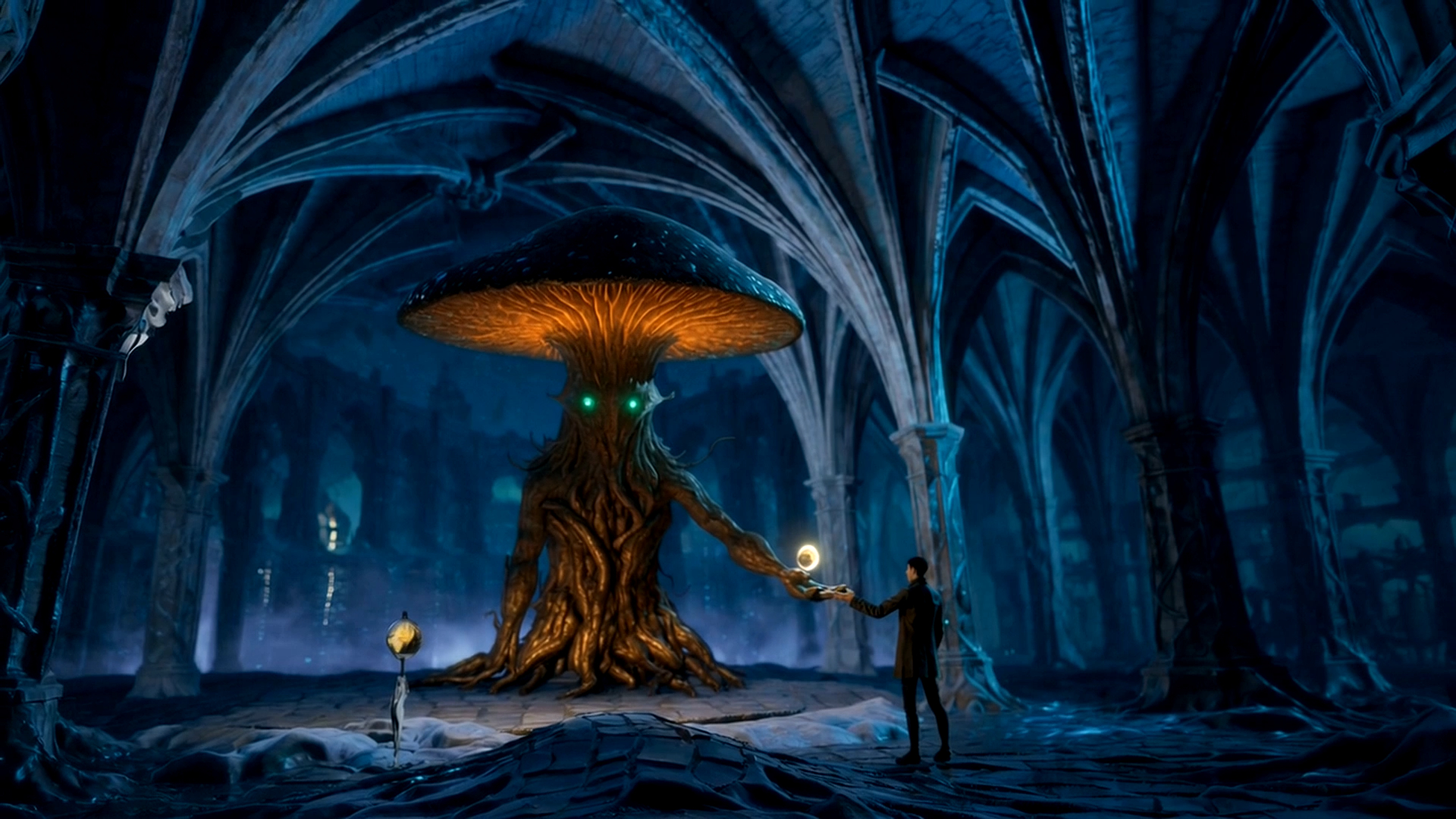
Prologue — The Color That Learns Your Name
On the far side of a drowned continent, a river of mirror-liquid runs uphill into the clouds. It threads a trench through the sky and vanishes into an angle no map allows—an ongoing mistake in the geometry of weather. Locals call it the Chromatic Torrent. At night, it sheds feathers of light that fall like snow and melt into color without leaving the ground wet.
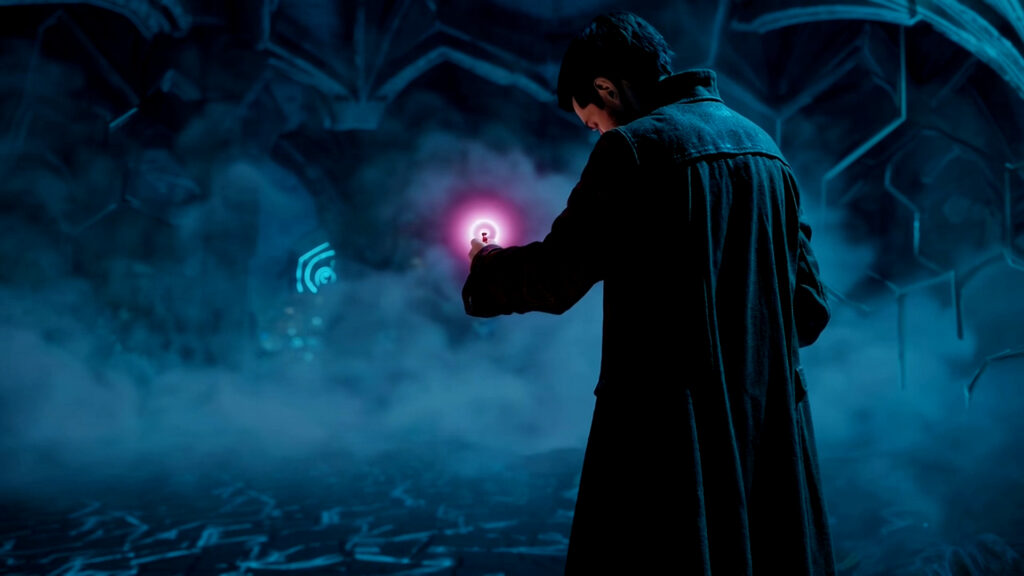
The courier arrives alone: a silhouette wrapped in a midnight coat that collects stray glints like rain. Their skiff waits behind them, folded to a blade of light under the quay, ribs ticking softly as if remembering the ocean. The courier closes a hand around a coin of pale fire and the coin grows lighter, as if it recognizes the palm. It is a permit and a promise, a round door that fits any lock that isn’t made of metal.
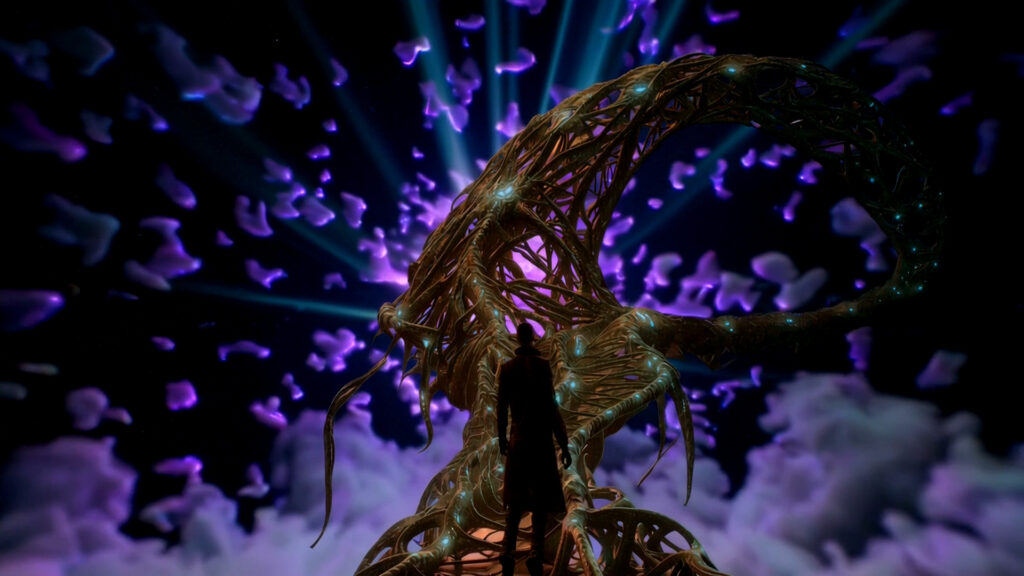
The wind smells of iron and cloves and wet stone. Above, the Torrent leans out of the sky like a muscle flexing, then loosens, then flexes again. Color runs within it in shifting lanes: indigo, teal, a little magenta heat, turned by some gravity that doesn’t belong to the world.
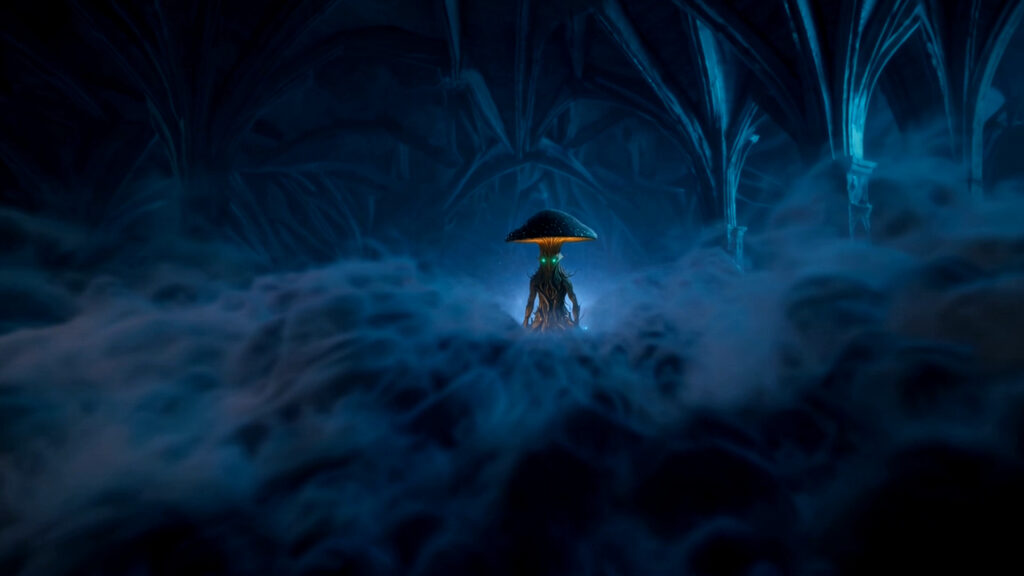
To the east: a forest of mushroom pylons rises from salt fog, the caps broad as amphitheaters, the stems braided with cables of living hyphae that carry light as if it were water. In that forest stands the one the courier has come to find: the Bioluminal Oracle, the ancient humanoid mushroom tree. It is older than the city, which is older than the sky in its current mood. When it moves—slow, slower—the fog reads the gesture and translates it into attention. The courier breathes once to count their ribs, then starts walking.
No one walks out to the Torrent without first speaking to the Oracle. If you try, the river will look away. That is how people drown in dry air.
I — City Quay, and a Coin That Warms Like a Small Moon
Boardwalks hold to the shore with brass teeth; underfoot, gullies of shadow. Traders have packed away their night markets, leaving the quay smelling of smoked kelp and engine perfume. The courier slides between shuttered kiosks until the buildings thin and the quay becomes a tongue of basalt licking the fog.
The coin grows warm, and with it, the world clarifies. On the basalt, faint as breath on glass, a lattice of DMT filament unfurls, lines intersecting in patient thirty-degree rhymes, leading east toward the mushroom pylons. Each joint glows like a pinprick star. When the courier steps on the lattice, the lines brighten. There is no sound, yet the bones of the quay vibrate minimally, as if acknowledging a password.
A shape crosses above—no bird, not a craft. A figure made of ovals of light connected by corridors, a strolling bureau of weather examining its paperwork. The courier keeps moving.
They do not carry weapons. There’s nothing to fight out here that knows what a weapon is.
II — Spore Cathedral
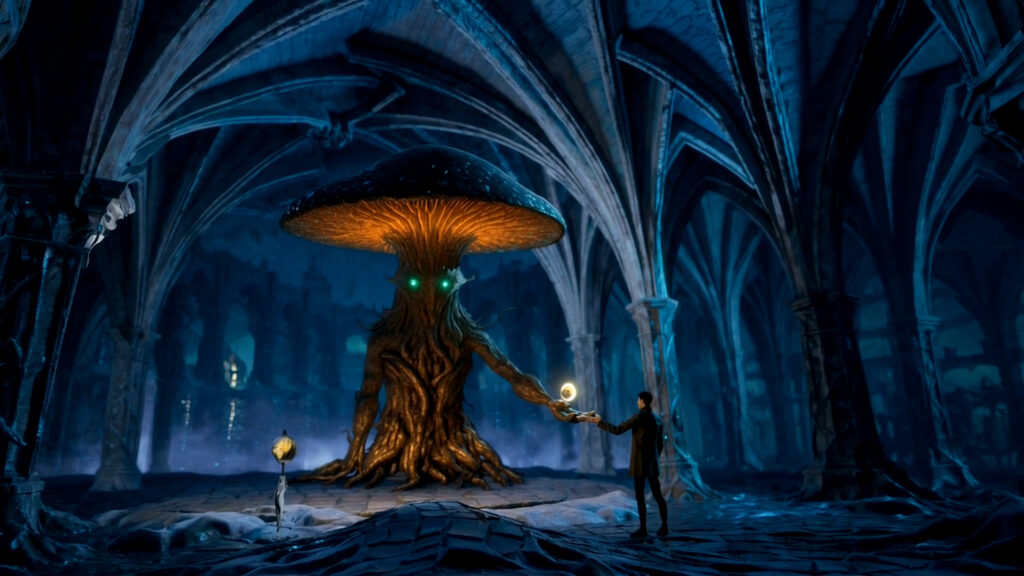
The Oracle’s grove is built out of itself: a cathedral of spore-light, arches ribbed with white stone shot through with mycelial glass. Spores rise like snowfall reversed, each grain a letter in an alphabet that smells like after rain. The Oracle is at the center where the nave reaches for a vault that isn’t there. Its bark is grey, then blue, then a breath of green, then a texture without a color. The face is almost human. The cap throws a broad shade that the fog respects.
The courier stops just inside the first column of glow and waits. That’s how you talk to the Oracle: you do not. You give the Oracle a chance to remember you.
A light opens inside the cap, not bright so much as exact. The courier’s coin answers by dimming, and in the dimness a ketamine hush pours into the space: the sense of falling very slowly through the thickness of reality, the way the air seems to become velvet and the distance forgets to be measured.
The Oracle extends an arm-root with the softness of a thought. Where it touches the ground, a thread of LSD aurora unspools, not a beam but a veil with living edges. Symbols move inside it like fish in a river, reading the courier as the courier reads them back.
“What you ask,” says the air, “is not a question. It is a route.”
The courier opens their palm and shows the coin of light. The Oracle’s shade deepens.
“Where you want to go,” says the air, “will ask you to stay.”
The courier nods. The Oracle has always been a rumor of kindness; the danger here is never cruelty. It is precision. Precision kills slowly, as if politely, and in that courtesy lies the trap: you don’t mind sinking as long as the sinking is beautiful.
The Oracle lifts both arms and the helix arrives—two slender ribbons of glow rising from the ground, twisting up to meet the cap’s shadow. Information is strung between the ribbons like rungs, and every rung is a door. Inside each door is a memory the world once tried to have. The courier can feel each memory as a pressure change against the eyelids.
“Cross by seven doors,” the air says. “You may choose any seven. Only do not choose the same door twice, even by accident. The Torrent respects novelty.”
A pulse runs up the helix like a heartbeat seen from far away. The courier steps forward.
III — Hex Gate
The first door opens to a chamber where walls are DMT lattice, facets folding like deckle-edged paper. On each facet, a species of light creeps and maps itself. This is the Hex Gate—the entry rule to any anomalous place generated by ocean and time.
The room wants a signature. The courier rolls the coin of light across their knuckles and it becomes briefly heavier, then lighter, then a contradiction with an outline. They press the coin to the air; the air appropriately indents, accepting the argument.
The courier waits longer than is comfortable. The Hex Gate is formal. It likes to ask questions in the way of geometry—no language, only tight hairpin turns between statements. After a while, it shows the courier a card made of frost. On it is a fine, almost shy script: you are you. The courier nods. This is not entirely true, but truth isn’t what opens the next door. Consistency does.
IV — Prism Lock
The second door spills out onto a balcony over the Prism Lock—a canyon of suspended color. The space hums without sound, as if charged with a solar memory. Beams knit above like stained-glass rivers. To cross, a traveler must align three tones of light exactly: an indigo that knows salt, a teal that belongs to iron, and a magenta that forgives.
The courier closes both eyes. Once, in another city, they stood in a room that remembered their outline but not their name. They recall the smell of hot wiring, the pace of their breath stitched to the scribble of light across the ceiling. They take that breath now and place it on the canyon like a plank. Indigo slides closer, an artery returning to a heart. Teal arrives grinning like a blade. Magenta hums and says nothing.
A bridge grows where the three meet, granular at first, then smooth as poured glass. The courier steps into the middle and the canyon deepens all around, showing levels of color no eye was made to parse. They do not look down. That’s not fear; it’s manners. You don’t stare at a cathedral while you’re walking on its ribs.
On the far side, a wind rises carrying peyote ridge-lights, little green tufts that wink on and off across invisible contours, mapping elevations that shift as quickly as feelings. The courier collects a few in their coat and the coat accepts them, warming.
V — Mycelial Causeway
Third door: an outdoor night larger than any night the courier knows, full of mescaline sunfields reduced to embers. Between two cliffs, a mycelial causeway arcs out, luminous and articulate, as if woven by a thousand patient hands. Hyphae threads shiver and re-braid themselves along the span. Beneath, the ketamine basin reflects the sky’s slow-motion weather, an inverted storm where the drops are made of time. Step too fast and gravity argues. Step too slow and your shadow forgets you.
The courier steps with the patience of someone who has been rained on by stone. Each footfall answers the causeway with a small ovation of glow, the light running ahead to hint at where the next foot will like to land. Halfway, wind blows up from the basin, cold as old language. The courier breathes and the breath spreads along the hyphae like frost. The bridge tightens underfoot, approving.
Near the far cliff, a pause in the weave permits a view straight down into the basin’s interior. The courier looks for a fraction of a heartbeat and sees a library of sunken rooms, shelves of quartz stacked with labels and maps, a Bureau of Rains disassembling a cyclone into rules written on sea glass.
The courier slips a hand from the coat and bows, not to a person but to the work.
The hyphae knit shut the pause and the causeway completes itself under the courier’s step.
VI — Suncrown Gallery
Fourth door: a hall of warm, unarguable light. The ceiling opens to Suncrown motes, tiny halos drifting down like pollen. Each mote is its own sun with a soft perimeter; they kiss the courier’s shoulders and hang there as if remembering where to be. On the walls, living frescos replay futures that have already retired: a city built inside a whale’s shadow; a court where laws are written in the motion of fish; a market trading in lost Mondays.
The courier wanders the hall with the curiosity of a locksmith in a palace of time. Here, mescaline petals leak light—each drop losing its color only after it teaches the floor to glow. There, a pulley lifts a ladder made of speeches no one gave. At the far end, a window looks onto a Peyote Ridge, cactus spines shining with runway lights that don’t tell anyone to land.
In the center of the hall, a font of liquid mirror catches the motes and sorts them into constellations with no stories. The courier leans over the font, palms flat on the lip. In the mirror, their face has not aged. It has learned a different room for its bones. The motes rearrange and the courier, without speaking, thanks whatever decided to be generous today.
The hall does not answer. It is enough.
VII — Horizon Break
Fifth door: a balcony welded to the open wind, the Horizon Break a step away. The Chromatic Torrent hangs here at eye level, impossible and obvious. It flows not forward but elsewhere, its surface rippling with versions of color that split like cells and recombine with gossip. The courier lifts the coin of light and the coin split-winks into two, then four, then a ring of eight, each coin hovering just above the palm in a slow orbit.
The coins cast small moons on the Torrent. Each moon sticks and becomes a wheel-gate, a circle you can step through if you agree to be multiple for a minute. The courier has practiced being multiple. It is sometimes the only way to be whole.
They step into the first gate and the world becomes very still—ketamine still—as if the torrent and the body have agreed on a new tempo. The courier’s eyelashes carry frost. The second gate opens mid-step. The courier breathes water without choking, drinks a color with no vowel, touches a rung of DMT lattice that isn’t there and feels the absent stair accept their foot.
In the third gate, there is a room nothing can grow in except memory. The courier leaves a memory there: the weight of an unmailed letter. The room thanks them by giving the weight back as buoyancy.
By the fourth gate, the coins have all synced their orbit until they don’t seem to move at all. The courier steps out onto a rail of color so thin that it is only a promise. Beneath is the ground. Above is the same ground. Somewhere, the Oracle’s cap turns to a new page of shade.
The courier laughs once without sound.
VIII — Prism Rains and the Bureau That Isn’t People
Sixth door: rain—LSD prism rains—fall at different angles to the same ground. The drops are hollow and full, both. Inside each drop: a city with fog for walls. The courier walks and the rains braid themselves around the steps. Bureaucracy hangs here like a hymn. Not the bored kind, the devout kind—a registry of storms, seamed with signatures of thunder.
Forms drift by: copied in silver ink on translucent skins. The forms ask nothing. They have already been filled out by the weather. The courier gives each a nod, choosing to be respectful toward whatever lives in duty. A desk made of cloud slides near and stamps the courier’s coat on the inside where only fabric can read it. The stamp is a spiral with the suggestion of teeth. It does not hurt.
A blue door swings open. The courier hesitates—the blue is teal that belongs to iron—and then crosses, and the rain accepts this as a proof of thought.
Beyond the door: quiet.
IX — The Mirror That Shows a Debt You Want to Pay
Seventh door: a narrow room, miles long, with a single mirror set at an angle. The mirror reflects not the room but the Mycelial Causeway from before, and the small pause in the weave that permitted a view down into the ketamine basin. The courier watches themself pause at the pause. The reflected courier looks down, longer than they remember looking, and then kneels and presses one palm to the hyphae.
Where the hand meets the bridge, light runs outward like spores exploding under glass. The hyphae tighten in gratitude, and a throughline connects the bridge to a field the courier has never seen, a brown expanse seeded in a spiral. Rain starts in that field. People—adults, wind-scarred—face the sky and laugh like the idea of gravity just walked into a door. The courier feels that laughter in the knees.
No one speaks, even in the reflection, but a sentence forms: some doors respond to courtesy more than to keys.
The courier bows again: a debt, gladly owed.
X — Return to the Oracle
The helix yields them back into the cathedral with the sense one gets leaving a library at midnight: quieter than silence, full of paper dust and a kindness nobody asked you to earn. The Oracle inclines its crown. Spores arrange themselves above its shoulders into a constellation shaped like a corridor that turns right twice and becomes a river.
“Seven doors,” says the air. “Now the Torrent will look at you while you look at it.”
A wind moves along the nave and reloads the fog with new light. The courier takes the coin, which has become warm again, and closes it into the fist. The Oracle does not step aside; there is nowhere to step. The cathedral has never kept anyone but has never allowed anyone to be lost. That paradox is the sanctuary.
The courier walks out, the coin a sun in the palm that refuses to burn.
XI — Drift
Back at the quay, the Torrent leans down until the courier can see their face in it: the good cheekbone, the old scar, the blink. The river’s skin puckers with curiosity. The courier lays the coin on the water. The water becomes textured, as if remembering how to be stone. The coin sinks or rises—words fail—and the river accepts the traveler like a treaty.
The skiff drops from beneath the quay and unfolds: prismatic hull, brushed-chrome ribs catching the blacklight of beginning. Runes along the rail wake like polite snakes. The courier steps in and the hull becomes denser; the water becomes lighter; something becomes somebody.
The Torrent’s inside is not a tunnel. It is the underside of a color.
Walls appear when you need them and withdraw when you remember the name you used last. The skiff makes a wake of tessellated tiles that climb the walls and then step off into the air to become windows, each window admitting an idea into the weather. The courier sees Spore Cathedrals in other cities, caps bent over harbors, hyphae writing letters to bees.
At times the drift slows into a ketamine drift-well, the body light enough to be a question, the world thick enough to be an answer that invites more questions. At times the drift sharpens into LSD fins, the edges of geometry singing against the hull in a language that is nothing but edge. At times the drift warms into mescaline terraces, beehive-layered, carrying warm hushed laughter up a cliff of wind. Peyote ridge-lights mark the edges where unsafe meets possible. The courier learns the shape of their hands again. It’s easy to forget when your hands have been doors for so long.
Above, a weather desk stamps a cloud with the day’s shape. Below, a shadow of the skiff follows. Between the two, the courier discovers a room inside the breath where the coin of light can rest without going out. The room shapes itself to fit both palm and sky. The skiff, pleased, shows that feeling in the tilt of its wake.
On the river’s inside, the sense of distance disobeys. The courier watches their own back from ahead, then waves, and waves at the wave. The echo returns as a new kind of forward. The Torrent enjoys displays of cleverness but likes best what happens when cleverness becomes simplicity.
XII — The Quiet Exit and the City That Pretends It Hasn’t Changed
When the Torrent releases, it does so without ceremony. The skiff slides out into open air and the quay opens the same way it always has: teeth of brass, smell of clove and iron and stone. Night pretends to be night. The city pretends to be a place.
The courier folds the skiff back into a blade and ties it under the quay where only gulls and ideas look. The coin of light has no heat left and no need to have any. It is not transformed; it is integrated. That’s the gift of real travel: not a new costume for the world, but a seam that closes so cleanly you only find it with your fingertips.
They return to the market’s ghost aisles, between stalls sleeping like boats. In a window, a television shows a show about a family learning to live without a long list of things. The courier turns the sound off even though it isn’t on.
Fog lifts its shoulders and drops them again. Far east, the mushroom pylons rise like planets shaking off night. The Bioluminal Oracle stands where it stood, as if the world’s acts, however odd and generous, are merely annotations on a text older than desperate weather.
The courier does not look back to it, not out of indifference but out of respect. To stare at an oracle is to ask for more than your share of answers. The night gives way to a tight, careful dawn, the kind that will break fully open if you say please and mean it. Out in the bay, the Horizon Break folds into itself like a kindly trap shutting with the gentleness of a closing book.
XIII — Spores of After (Addendum for Those Who Prefer Maps)
Days later, the city discovers that its alleys now resist certain types of sorrow. Not perfectly—no door holds forever—but efficiently. Rain patterns reorganize to be useful, falling hardest where dust keeps secrets, softest where words need to be heard. Ferries run on time without announcements. On a ridge beyond the quay, a field spirals green where none was planted. Someone attributes this to a subsidy; the accountant who writes the memo draws a spiral with their index finger in the condensation on their glass.
In the Bureau of Rains, a clerk with a face like a lake notices a stamp where no stamp could have been. They touch it lightly and hear the sound of a skiff’s ribs ticking under a quay after the tide changes its mind. They close their eyes and feel amber-warmth crown their shoulders, then open them and enter the day’s measurements with a smile that does not show any teeth. The weather is honored, not obeyed.
At the edge of the market, someone who has never left the city finds their feet remembering a bridge they have not crossed. They step around a crack in the boardwalk without seeing it, but with the certainty of a person who has memorized the distance between opposite possibilities. They buy a pear that tastes like sunlight caught in lint. It is the best thing they have ever eaten. They do not mention this to anyone. Some news is private.
Late each night the Chromatic Torrent flexes and relaxes, loving the work of being impossible. If anyone is watching, distant Suncrown motes bloom and close around their shoulders like a blessing you can’t spend, only carry. A rumor circulates that the Oracle’s shade is larger by an arm’s length, an imprecise measurement that satisfies the city.
The courier walks the quay, pockets empty. They are not lighter or heavier than before. They are differently arranged. When the fog comes in very low, the air smells of clove and iron and wet stone, and a thread of color dips to eye height, a small greeting. The courier nods and it nods back. Neither of them owes the other anything. This is what passes for love in the architecture of rivers.
Epilogue — A Note Pinned With Light
On a porch that looks over the basin where mushroom pylons hold their council, a note is found the morning after a long rain. It is pinned to the wood with a circle of cooled light too exact to be metal. The note has no words. It is blank lined paper, edges softened by damp. When a passerby lifts it, the paper smells like the interior of a library and the first breath after a dive. The passerby replaces it carefully.
All day, the note does its job. Anyone who thinks to read it discovers a sentence they have always wanted to tell themselves, written in their handwriting. The sentence does not solve anything. It returns a person to themselves with a patience that is older than storms. At dusk, the light-pin loosens and becomes a coin again, then a drop, then a small scream of color that lands on the water and swims away as a fish with a spiral instead of scales. Children—no, not children; people who remember being small—will say they saw it, and who are we to argue, when the world is made of arguments that remember how to be kind?
Night arranges its shoulders. The Bioluminal Oracle breathes once, a tectonic motion that looks like a breeze. Spores assemble into letters and then into shapes and then into nothing at all, because sometimes the most precise language is the willingness not to speak.
The Chromatic Torrent climbs into its sky-trench, working, always working, forever polishing the seam where the real and the nearly real swam together and decided to keep each other. Somewhere in that seam, a skiff of folded light rests, and a person with a coat that gathers glints like rain holds a coin that may never need to be warm again.
If you stand at the quay and wait, color will come to you with the seriousness of a tide. It will not test you. It will ask to know your name, and when you give it, it will return the name improved—not changed, not decorated—clarified. You will belong a little more to the world that is trying, every day, to belong to us.
That is the drift.
That is the story the river tells when it pretends to be a road.
the Gallery