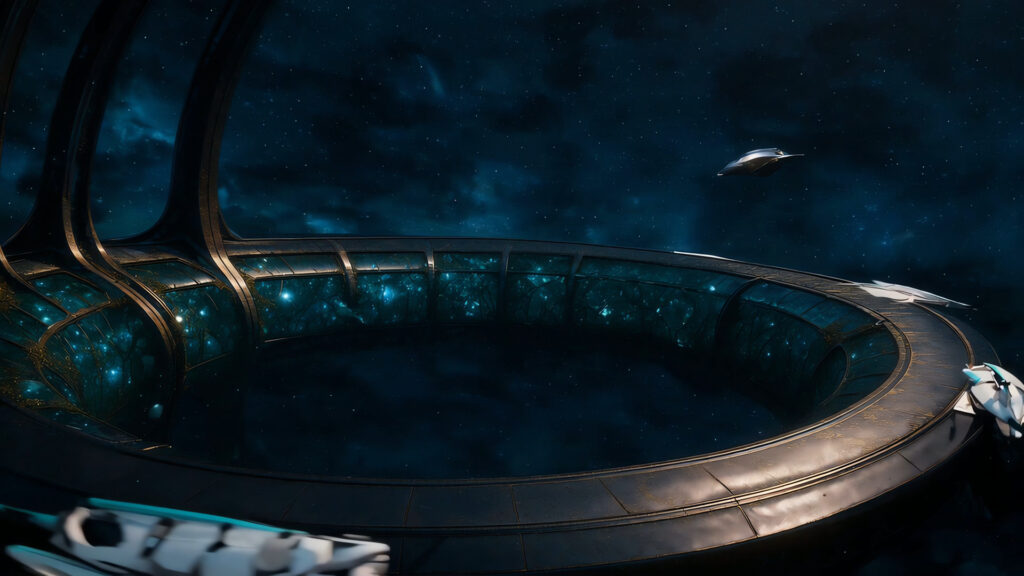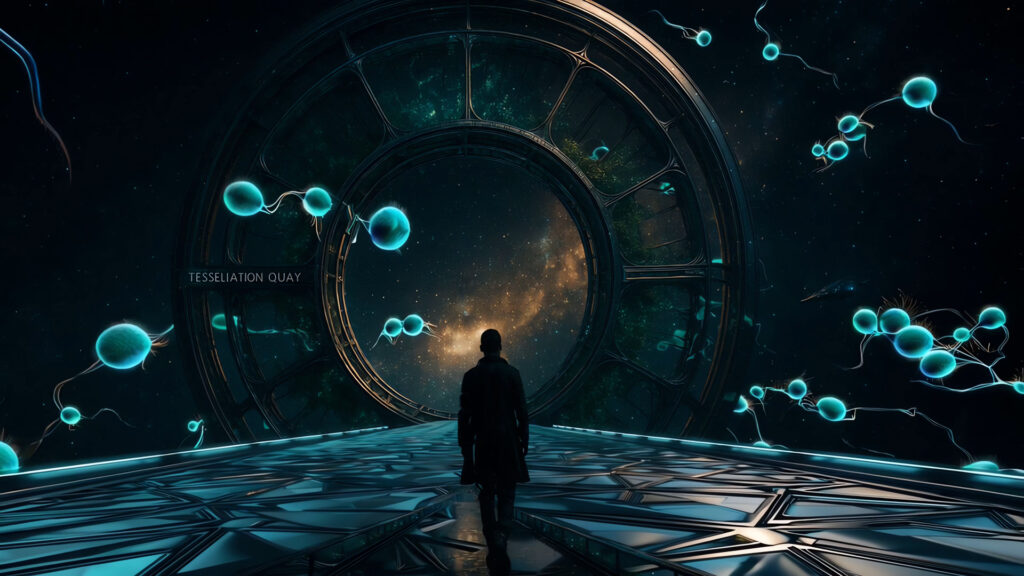
The shuttle cut across the dark like a scalpel of dull chrome, its hull showing only a thin comb of starlight as it banked toward the Quay. Below, an archipelago of structures rose out of the vacuum—a ring of barbed petals and glassy ribs, like a flower pressed between the pages of physics. They called it Tessellation Quay, and at its center—hung on invisible filaments—waited a round, black sheet with a faint sheen, as if it were coated in oil that refused to drip.
Amri Quell watched it tilt, an angle shifting against nothingness, and adjusted her ship’s attitude until her reflection skimmed the slick surface and fractured into a dozen faint copies. The copies kept flying, like she did, but their courses were off by the smallest degree, and she had a brief, superstitious fear each one would plow into some invisible wall she’d avoid only by accident.
“The Mirror’s awake,” said the Quay’s traffic mind, its voice a steady alto that made no effort to be comforting. “Dock on rib seven. Your sponsor is waiting. And Amri—don’t touch the surface.”
“As if anyone comes this far to smudge a priceless artifact,” she said, and let the shuttle kiss the rib with a well-practiced lean.
Mag clamps took hold. The cockpit glass irised open. She climbed down into air laced with a mineral chill and the faint musk of wet soil—the Quay kept gardens threaded everywhere, corridors furry with moss and filaments, a mycelial skeleton that made walking through the place feel like navigating a living lung. The filament glow was gentle, teal and cobalt, as if bioluminescence had learned restraint.
A figure waited at the end of the causeway—a long coat, a thin halo of thin-film iridescence around the shoulders, and the austere expression of a person who conversed mostly with machines.
“Conservator Nals,” said Amri. “You look exactly like your letters, which is mildly disappointing.”
“Pilot Quell,” Nals said, dry. “You look exactly like someone who doesn’t believe in mirrors.”
“I believe in mirrors. I don’t trust them.”
“Good. The Rosette returns mistrust with courtesy. Come.”
They walked a narrow path that spiraled inward, over a dark well where the Mirror hung. From above, it was not perfectly round. Its edge flowered into petals of angle—eight elaborate lobes, like a rosette carved from shadow. Each lobe was the suggestion of symmetry, not symmetry itself; when she tried to count the facets at any given radius, the count changed by one, as if the Mirror reserved the right to differ with her.
“Everyone calls it the Rosette Mirror,” Nals said. “But that’s not its name. It’s an artifact we don’t know how to name.”
“What does it test?” Amri said.
“Continuity.”
“Of what?”
“Intent.” Nals stopped at a console grown from something like glass and tree bark. “We have an engine sleeping in a dead system. A gate that binds lanes between colonies that forgot each other before they could agree not to. If we wake the engine without the Rosette’s grammar, we could restart wars our grandparents died to end. Your job isn’t to pass. Your job is to be measured. We need someone the Rosette likes to carry the wake-seed and ask the engine to rise.”
Amri looked down at the Mirror. “If it doesn’t like me?”
“Then it will show you why,” Nals said. “And we will try someone else.”
She thought about the dark systems beyond the Quay—engine rings gone cold and lanes grown moss over vacuum. “And if it does?”
“If it does, it will show you a route no map can hold.” Nals tapped the console. A small case rose like a fruit on a stem. Inside lay something that looked like a coin cut from frost, thin as a thought and veined with light that came and went in obedient pulses. “The wake-seed. Don’t drop it. Don’t feed it. Don’t try to fix it if it sings at you in the wrong key. Let it do what it was grown to do.”
“You talk like I’ve done this before,” Amri said.
Nals looked at her for a beat. “You’re one of six pilots left who can ride unmarked geometry and not blame the tools. You don’t flinch when a corridor folds. You don’t reach for superstition when the sky writes a different number. The Rosette notices people like that.”
“I also chew the ends off my sleeves and forget names mid-conversation,” Amri said. “If the Rosette notices that, tell it to be kind.”
Nals did not smile, but some layer of austerity slipped aside. “The Mirror notices everything. That is different than judging.”
They clipped her suit into the umbilical and lowered her on a thin platform, a plank of graphite with a rail barely high enough to call a rail. The drop was not far, but the dark gave it infinite depth. She stood over a round so black her eyes decided it had depth, and from that depth rose a very slow pattern of rosettes—circles blooming into petals blooming into circles, faint ripples like frost fractals growing across a glass lake at night.
“Speak your name and the purpose of your visit,” said the traffic mind, bored.
Amri waited for the air in her chest to even out. “Amri Quell. I’m here to be measured. To carry a wake-seed to a sleeping engine without unmaking the kinds of agreements that don’t fit in treaties.”
Silence, long enough to hurt. Then the Mirror stirred. A ring moved on the surface like a muscle contracting. The rosettes deepened. The black became a depthless gray; the gray grew veins of light that made patterns she almost recognized. Some looked like the underside of a mushroom cap, delicate gills in perfect, patient order. Some had the harsh tessellation of armor plates. One, for a breath, looked exactly like her mother’s hand—a memory her mind had kept unexamined for a decade. Then it was gone.
“Don’t step,” Nals said, voice thin through the com. “Wait for it to answer.”
“It’s already answering,” Amri said, and realized she was whispering.
The Mirror flexed. The rosettes opened. Space did an impossible thing: it creased and hinged, as if the world were printed on a paper that could fold along lines she hadn’t seen a second before. The platform rattled. The rail hummed like a tuning fork. The Rosette raised a hemisphere from its surface, a dome of near-black shot through with kaleidoscope geometry—petals inside petals, a pattern that seemed to rotate without turning.
“Step forward.”
Nals had said to wait. But the Mirror was the path. Amri stepped.
The dome swallowed her like a droplet taking back a smaller drop. Gravity faded into a guess. The air tasted clean and mineral, like the inside of a cold cave. Sight rearranged itself by priority—edges first, then depth, then color, as if her vision had to choose what to reassemble with the time it had. She stood on a surface that wanted to be both floor and pond; it held her weight without pushback and reflected her in long, petaled streaks.
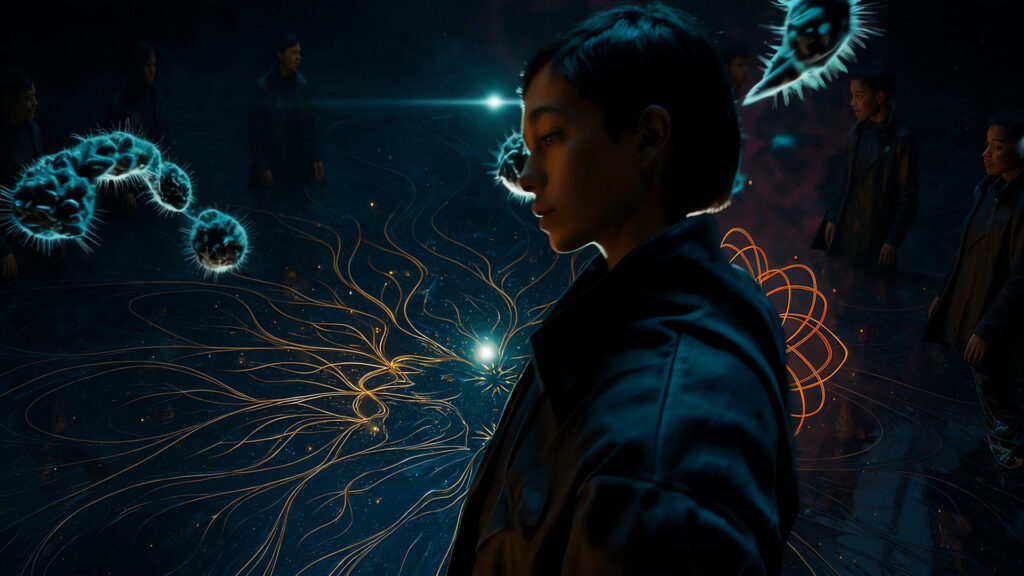
Her reflection moved. Not as she did, not exact. Eight Amris gestured a fraction too slow, a fraction too fast, a fraction too doubtful, too bold, too patient, too suspicious, too weary, too elated. The eighth one did not move at all.
“Continuity,” said a voice. It did not come through her com. It did not come through air. It was the voice of the dome, the voice of its geometry. “You carry a seed meant to wake a ring. Waking is a kind of choice. Show us your thread.”
Amri swallowed. “How?”
“By not lying,” said the dome.
“People lie to themselves by accident,” Amri said. “If I do, will you know the difference?”
“That is the test.”
The eight reflections drew closer, their faces luminous with the lambent sheen of the dome. The first spoke with her mouth but not her tone. “We take the quickest way.”
The second said, “We take the safest way.”
The third said, “We take the way nobody sees, so nobody follows.”
The fourth said, “We take the way everyone sees, so nobody suspects.”
The fifth: “We change the destination to match the route.”
The sixth: “We change the route to match the destination.”
The seventh: “We wait until the war ends and call it wisdom.”
The eighth said nothing.
Amri felt the shape of it—eight petals, one core. She set her boots a shoulder-width apart and listened for the reflex that would make her pretend to be better than she was. She was a pilot; she believed in luck because she believed in momentum. But luck, she knew, was just consistency measured from the right angle.
“The quickest way is rarely the right way,” she said to the first, “but urgency buys lives if you spend it well. The safest way is a lie unless it includes the other pilot’s safety. The way nobody sees becomes a myth until someone does, then it’s a trap. The way everyone sees is a parade by another name. Changing the destination is cruelty. Changing the route is a practice. Waiting for the war to end is a way to let it grow into the walls.”
“And the eighth?” said the dome, pleased and not.
“The eighth is the way the route and the destination teach each other,” she said, surprising herself. “It’s the way that doesn’t collapse early.”
Silence again, but now the geometry breathed slower. The rosettes widened until the petals linked into a chain that circled her like a thin horizon. Inside the chain, spore-motes floated—glow particles the size of dust, rising as if gravity were a rumor they refused to spread. Their motion held a rule she couldn’t see; the chain’s petals seemed to decide where each mote should drift, and the motes obliged with a grace that struck Amri as polite to the edge of cruelty.
“Continuity is the patience to let structure teach intent,” said the dome. “You will go now where paths fold like gills and gates spin like coins. Keep the seed in your left hand when the sky tries to be your right.”
The floor tipped. Amri did not fall so much as reorient. The dome became corridor, textured like stone and skin, lit by biolum ridges that pulsed with an ocean’s regularity. The geometry ahead swelled and narrowed in repeating sections, like the bars of a song she’d once learned by walking until she’d reached its end. The corridor took a turn that was not a turn; the world hinged again, and she stepped through a hex cut from night into something like a field.
Except the field grew under glass; an orchard of vortices hung from nothing, as if someone had pruned time into spheres and left them to ripen. Each vortex was a slow swirl of mirrored stars, rimmed with mycelial threads that blinked in a code she could feel at the back of her teeth. The air was full of a white noise that felt like a hand not touching her shoulder—a presence.
The seed in her pocket warmed a degree. She took it out, and the glow threaded her fingers in slender lines, geometry choosing bone for a page. She felt a tug in the ring finger of her left hand.
When the sky tries to be your right.
Amri lifted her left hand and watched the motes answer. The vortices shivered, their rims briefly becoming rosette petals that looked suspiciously like the Mirror behind her. A path emerged between the hanging swirls—narrow, impatient, a line of symmetry that demanded she keep her weight right down the middle. She walked it, and the orchard responded with the silent ecstasy of a machine realizing it had an audience.
Halfway through, someone stepped into her path.
He wore her suit. He had her face. But his eyes had the long tiredness of a person who had walked too many routes and called that experience. He raised a hand that did not carry a seed.
“Shortcut,” he said. “One petal in, one petal out. We can skip the engine. We can publish the cadence and let the colonies build their own.”
“And what happens when the cadence fractures?” Amri said.
“We keep moving and call that freedom,” he said. “We stop to carry children across old bridges and call that charity. We offer maps to people who haven’t learned to read and call that mercy.”
Amri waited for the irritation that would have come a year ago, when she still believed the only way to honor urgency was speed. It didn’t arrive. The orchard’s motes drifted around the other-Amri’s head in an orbit that never quite decided whether it was prison or crown.
“Who are you?” she asked.
“Early collapse,” said the other. “I’m your habit of mistaking first answer for best answer. I’ve saved your life. I would have killed someone else someday.”
Amri lifted the seed and watched its glow pour into a small rosette that hovered between them like a puzzle half-solved. “Get out of my path.”
“I am your path,” he said.
“Then I’ll go through you.”
She stepped. He did not move. The rosette’s petals widened, an iris taking a breath. Amri walked into it and felt the resistance of water, the push of a memory trying to keep its shape. For a moment the other-Amri’s hands closed around her wrists with the weight of shared bones; she saw, in a harsh flare of images, every time she’d chosen efficiency and called it care. Then the seed pulsed in her palm, a brief, unambiguous yes, and the resistance dissolved. She stepped out the far side, and the orchard closed behind her with the soft shiver of leaves.
The corridor returned, now with teeth of light that rose and fell in measured waves, never biting, only counting. She thought of a river measuring a bridge by refusing, every day, to forget the stones. She let the teeth count her in. The totalling felt like a liturgy—eight pulses, pause, eight pulses, pause—until she felt the urge to rush the next gap. She didn’t. The light-teeth flexed, pleased in their precise, machine way. She reached a landing that looked like a hinge, a joint in space where angles met and argued.
“Librarianship by geometry,” she murmured.
The hinge unfolded.
Beyond it loomed the ring—an engine the color of unremembered nights, thick and silent, parked in a firmness of vacuum that felt old and scoured. It had the proportions that make the body want to bow. The seed twitched in her grip and grew veins across its frost-glass face. Tiny spores climbed those veins, glowing just enough to look like they were apologizing for the dark.
“Amri Quell,” said the hinge, or the ring, or the Mirror’s voice running through both. “Your thread holds. Will you spend it?”
“Yes,” she said. “If it wakes without remaking what needs sleep.”
She stepped to the ring’s heart. The seed knew where to go; she let it choose a seam and press itself home—not a docking, not an insertion, but a grafting, mineral to machine to organic lattice. The ring shuddered, the way a whale shudders in a deep bay when a sound too loud for its bones rolls through water.
Light did not blaze. It organized. Lines of amber flowed in a slow spiral across the ring’s inner rim, a tide tide-lining the beach of a black shore. The amber warmed to gold. The gold sharpened to a strict white that still carried color in its edges, as if the spectrum had decided to be kind without going weak. Where the white passed, spore-ridges awakened, clicking open like tiny books. The ring inhaled.
The inhale moved the orchard she’d walked through; somewhere behind her, a dozen vortices brightened, a dozen others dimmed, as if preferences had a physics. The hinge folded itself back into a joint and watched. She felt watched by civilizations that had not yet learned to name the stars close to their skin.
“Continuity holds,” said the Mirror through everything. “Your thread reaches the far quay. Carry it back or leave it here to be taught.”
“Explain,” she said.
“Routes make pilots,” said the Mirror. “Pilots make routes. You could become a custodian, a person whose intent is learned by a machine that doesn’t claim to know you. Or you could go back and tell them how slowly you moved. Both will save someone. Neither will save everyone. The difference is where your patience lives.”
Amri looked at the ring she had woken. It wasn’t fully awake; it would grow for hours, maybe days, its biolum gills opening and closing in meters so slow time would have to defer to them. She thought of the colonies on either side, the councils and brigades, the loose-knit ports with their gorgeous compromises and ugly feuds. She thought of the other-Amri’s shortcut and felt the bruise of it lift, the way a meaning sometimes lifts from a word when you look at the word long enough.
“I will come back,” she said. “I will carry people who do not move at my speed. And I will come back until the ring has a habit of me.”
“That is continuity,” said the Mirror. She could feel the approval as a reduction of noise, a clarity more quiet than silence.
The corridor reversed itself by obligation, not drama. The teeth of light folded down and disappeared into smoothness. The orchard withdrew its hanging vortices like lanterns taken into a house at night. The dome returned, the petaled patterns closing with gratitude she couldn’t have proven but trusted. The floor became platform. Gravity remembered its job. Air smelled again like mineral and cool soil.
She stepped out of the rosette and into the rib light of the Quay. Nals waited with a look Amri had never seen on that face—a readiness to change an opinion.
“Your pulse,” Nals said.
“Still mine,” Amri said.
“Your intent?”
“Measured and still mine.”
Nals nodded once. “Then the engine?”
“Waking,” Amri said. “It will learn our patience if we give it enough of the right kind.”
Nals put out a hand—not to take the seed (which was gone), but to touch Amri’s shoulder, brief, as if testing her density. “There are pilots,” Nals said, “who think a gate is a trophy. There are pilots who think it’s a door. There are a few who learn it is a teacher.”
“Don’t promote me yet,” Amri said. “I still flinch when the sky writes a different number.”
“Keep flinching.” Nals turned for the console. “It’s the body’s way of reminding the mind we were never meant to outrun the next thought by too much.”
They climbed to the observation curl above the Quay and watched the ring in the far dark begin to halo. Its first lines were faint, a whisper of geometry on the lip of a black coin. Ships were already moving in arcs far outside the Quay, reluctant to look like they were waiting, eager to be waiting anyway.
The traffic mind poured quiet commentary into the air, updates from small craft: someone transporting soil bacteria, someone carrying a crate of books, someone with a hold full of glass seeds engineered to grow in two gravities at once. Bets were being made about how bright the ring would get before it decided it had been seen enough.
“What did it ask you?” Nals said.
“It didn’t ask,” Amri said. “It showed. It showed me where I collapse early.”
“And you didn’t?”
“I did,” Amri said. “Once. Then I walked through it.”
The ring brightened—petals beating slowly, a rosette that refused to stay a mere pattern. Its light did not flood; it articulated space, as if giving names to edges that had gone unaddressed since the gate went down. Near the inner rim, the biolum gills of the engine opened one notch, then one more, regular as sleeping breath.
“People will try to own this,” Nals said. It was not warning or prophecy, just inventory.
“People will try to survive with it,” Amri said, matching tone to tone. “We can help a little by making the first route a patient one.”
“You’ll go back,” Nals said. It was not a question.
“Until the ring knows how not to forget me,” Amri said. “And then until I’m ready to be forgotten.”
Nals watched her without surprise. “We have a stipend for pilots who make themselves into habits.”
“I’ll take the habit,” Amri said. “You can keep the stipend until I remember how to want it.”
Nals almost smiled. “You’ll want it when you decide to build a kitchen where there’s only floor.”
“Is that a test?”
“It’s a promise.”
They stood long enough for the ring to glare—one period of brightness, not blinding, just harshly honest. Somewhere in the Quay’s lower decks, growers would be checking moisture in the mycelial corridors, calibrating spore output to keep the air’s glow from drifting into a carnival. Geometry liked to party, given a chance. The Quay preferred a steady pulse.
“Tell me something,” Amri said, after the ring’s glow softened into its careful breathing again. “If I had failed—if the Mirror had hated me—would you have told me what shape the hate took?”
“Hate is too loud a word for what the Mirror does,” Nals said. “But yes. We keep records of where each pilot collapsed, early or late. We draw maps of those places. Sometimes the maps teach other pilots before they try.”
“And the pilots who don’t return?”
“We add their names to the library of correct cautions.” Nals glanced at her. “You’ve just made a different library. The kind with recipes.”
Amri tried on the word—recipes—for a machine and a path and a habit. It fit better than she’d expected. “I’ll write them down,” she said. “I’ll insist they can be improved.”
“That is the only way recipes live,” Nals said.
They broke apart there, Nals to the consoles and the traffic mind’s constant procedural hum, Amri to her shuttle and the small rituals a pilot performs when the air of a place quits being inside her lungs. On the ramp, she paused, because the Quay’s light had dropped very slightly, a pulse not meant for her. She looked up. The rosette within the Mirror’s surface dilated, just once, fast as a blink.
A message? A nod?
“Thank you,” Amri said to it, feeling foolish and right.
The Mirror did not answer. But when she sealed the shuttle and cut the clamps, the ring out there in the far dark gave her a path—a line so straight it could not be seen, only flown. She dipped a wing to the Quay out of a superstition she had no reason to betray, and the Quay did not laugh at her. She turned the nose into space and into the patient brightness of a gate-engine that had decided to be part of someone’s habit again.
The route unspooled with polite geometry, every hinge exactly as odd as it needed to be. When the first fold came, her body wanted to rush it. She didn’t. The fold opened like a book forgiving the reader who’d once bent its spine. Beyond it, an orchard of vortices hung like lanterns waiting for someone to declare it evening. She moved among them as if walking down an aisle lined with old friends who finally chose to clap quietly.
The Mirror’s voice—if it was the Mirror—was silent now. The ring was breathing. The wake-seed had learned its place and had started teaching the engine how to remember. The colonies that had been rumors to each other across a long, dark distance were about to become opinions again. Arguments would arrive. Commerce too. People would send books and soil and glass seeds. People would send lies and apologies.
Amri’s hands lay easy on the controls. The shuttle’s spine hummed with the not-quite-music of the route. She had the sweet suspicion she was being useful in a way that would not require her to be heroic. That had always been the secret dream, once the uniforms and banners lost their shine: not to be a story, but to be the thread that keeps a story from breaking when it turns a corner.
Ahead, space brightened by degrees, petal by petal. The first Quay on the far side would be awake when she arrived; a Conservator would be waiting; a new Mirror might be there or might be an older sibling of the one she’d just met. She would dislike the tea and drink it politely. She would build a kitchen where there was only floor. She would fail in small ways and write better recipes. She would become predictable in exactly the useful sense.
And on some later day—not soon, because patience is the only pace the Rosette respects—she would stand again above the black, slick surface and watch it bloom. Not to be tested, not to be praised. To be measured by an old, careful machine that kept remembering how to be kind without going weak. She would say her name. She would declare a purpose. And the Mirror would adjust one petal in the pattern it used to understand intent, because people changed and it had promised to learn.
She flew into the fold. It accepted her like a book accepts a thumb. The world creased and hinged and offered her a page she had not read before. She read it anyway, and the reading felt like walking, and the walking felt like a gate learning to breathe.
That was the test. That was the passage. That was Rosette Mirror Test.