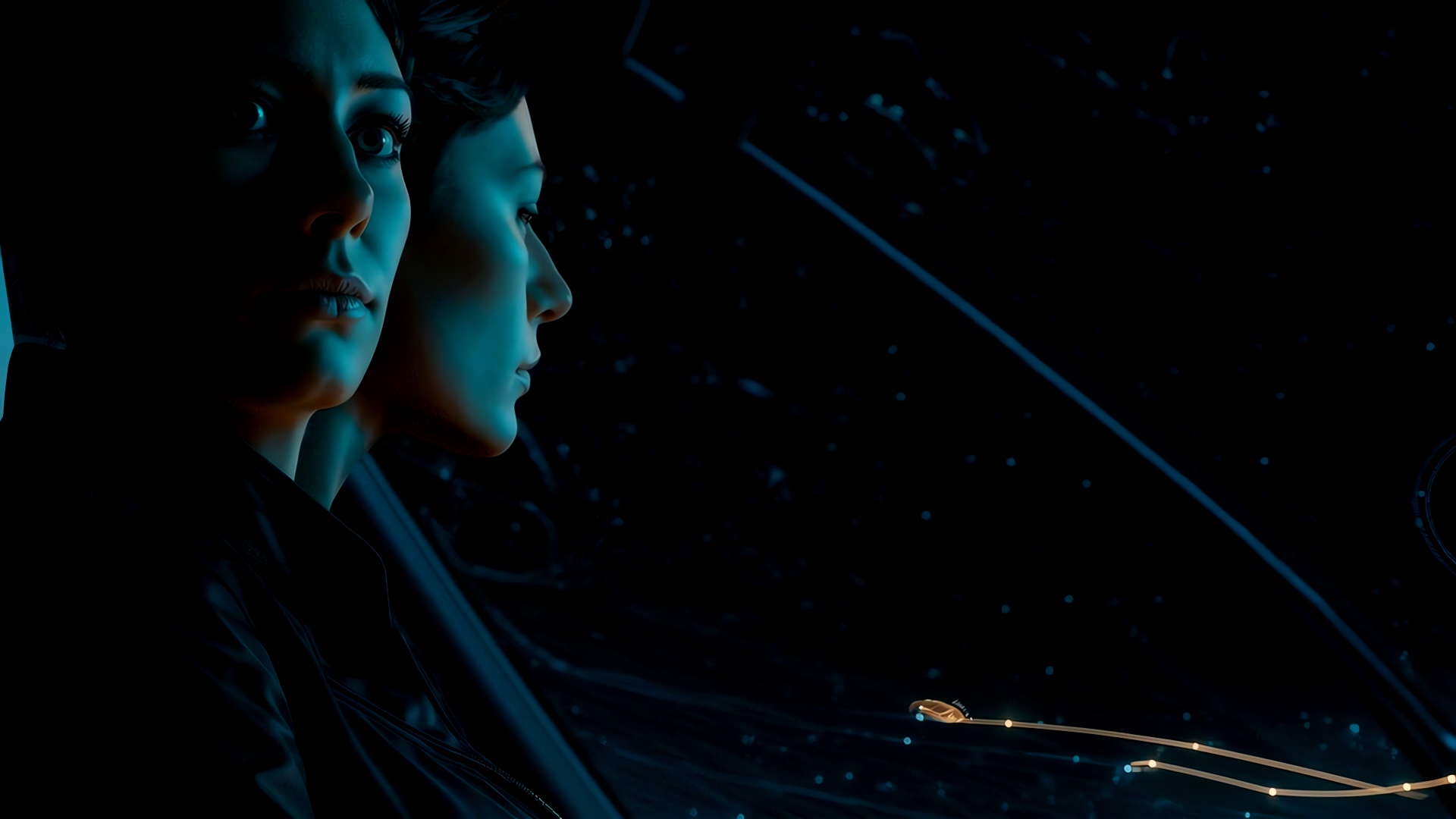
The first time the stars breathed, Kiera thought the station’s windows were fogging from the inside. A ribbed pattern shimmered over the night—fine, parallel lines radiating outward, folding and unfolding like the underside of some celestial creature. Then the pattern vanished and the sky returned to the ordinary cold scattering of points.
Kiera held still, counting. Three seconds. Five. Eight.
The pattern returned, faint but certain: silver lamellae sliding across the constellations, as if the dark itself wore gills.
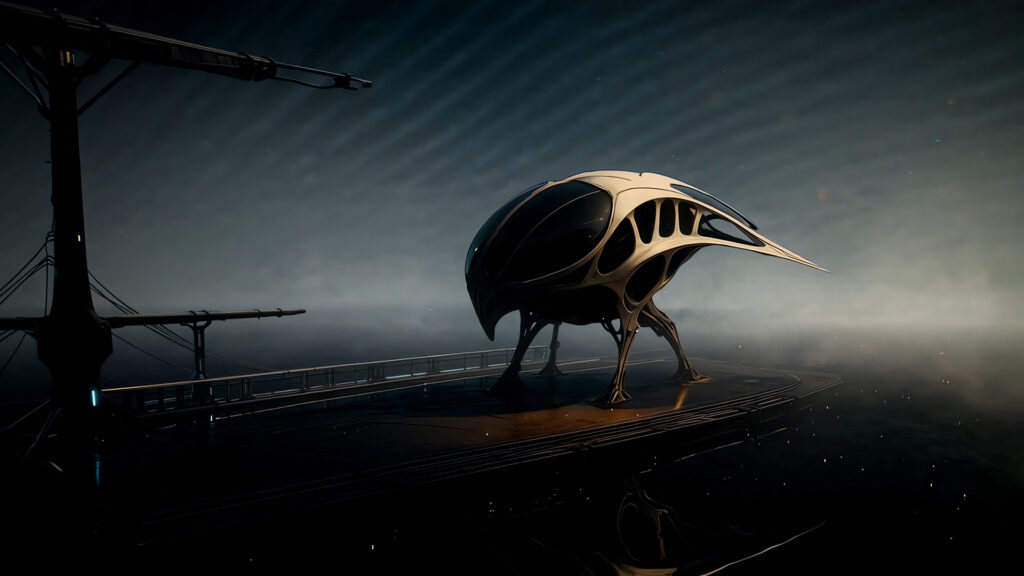
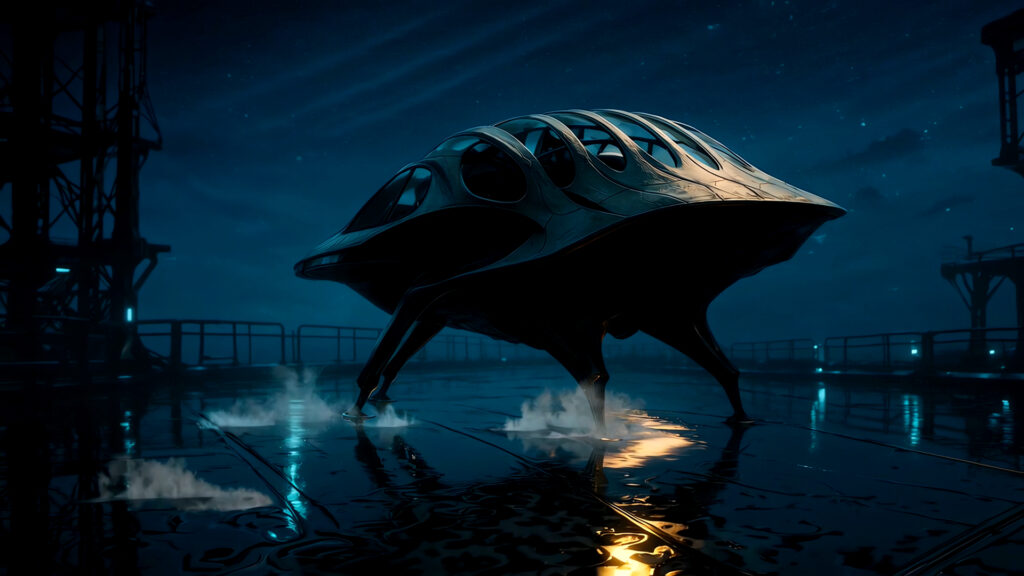
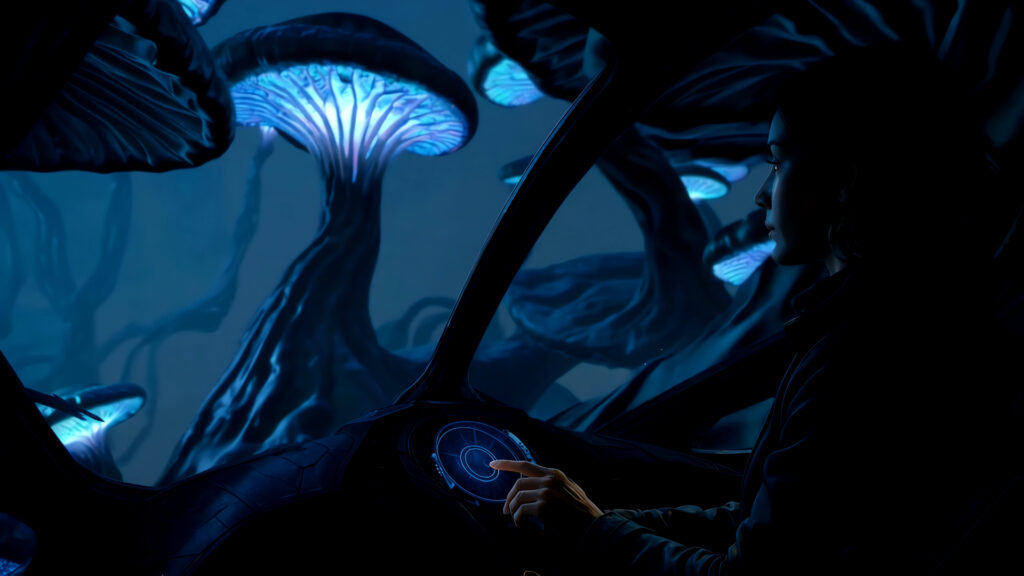
She killed the cabin lights of the Kite of Radials and let her eyes adjust. The ship—a grafted thing of bone-white ribs and black ceramic tissue—hung docked on Harbor Nine like a seed caught in a spiderweb. In the dim, the cockpit felt more grown than built: vein trails in the console resin, organ-glass curled around the navigation core, the slow pulse of the hull’s self-healing membranes.
“Show me the sky raw,” she said.
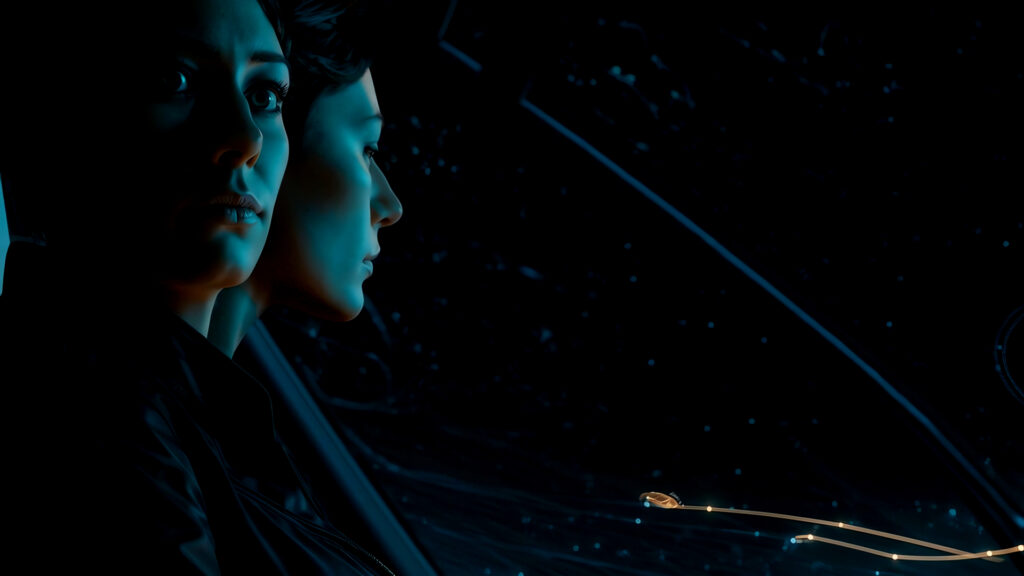
The glass peeled back its filters. Deep field flooded in, along with the faint photonic noise the station usually scrubbed. There—again—the slow, tidal sweep of lines, not atmosphere, not lensing, not a glitch. It was a rhythm. A breath.
Kiera’s left hand eased toward the lamina compass she wore on a cord around her throat. It was an old, illegal thing: a coin of frost-glass with a thin gold filament threading inside it like a living maze. At first breath the filament trembled; at the second it traced a curve to starboard. By the third, it formed an arc that settled toward a patch of nothing near the Mirror Belt.
“Coordinates,” she whispered, and the Kite woke by degrees—panels unfurling, thrusters whispering, marrow engines tasting vacuum.
Three months earlier, a courier had handed her a cloth-wrapped bundle with no name. Inside: the lamina compass and a single line of handwriting, shaped like a sigh.
Find where the stars learn to breathe.
Kiera had laughed then, because she had spent years mapping lies dressed as mysteries. Contracts with extraction fleets taught her that most wonders hid pipes and price tags. But now, with the compass thrumming and the windows showing parallel ridges slipping over starfields, the old skepticism felt thin and brittle. This wasn’t a trick. The sky had gills.
She undocked without asking permission. Harbor Nine came from a culture that never said no if you didn’t ask first, and Kiera had long since learned to protect that balance.
The Kite drifted, then glided, then became a line spreading away from the station into the black.
She cut the main engines near the Mirror Belt and let the ship drift into its own silence. The Belt wasn’t a ring, not really, but an irregular range of polished debris and frozen sea—broken worlds glazing themselves smooth with time and radiation. Light skated along its faces in long, patient strokes. It looked as if someone had tried to teach ice to speak in reflections.
The gill-pattern strengthened here. Not constant—never constant—but regular enough to ride like a tide. Each sweep changed the contrast of the starfield, revealing faint lines drawn between certain points, lines that did not exist when the sweep receded. Routes. Sluices. Corridors in waiting.
The lamina filament brightened. A curl of gold wove a signature not unlike a fingerprint, and she recognized the character of it—a shape she had once seen etched into the shell of a carved bone charm hanging from Eno’s neck.
She breathed. Eno. A name that lived at the back of her throat like an unspoken chord.
“Stay with me,” she told the Kite, and dipped the nose into the first faint channel.
Navigation by breath is a ridiculous sentence in a handbook, but it felt ordinary at once. The corridor did not force; it agreed. The ship’s hull tingled where micro-gauges tasted direction on the skin. The lamina compass shivered between her fingers, not pointing so much as inclining. She had set out to find a phenomenon; instead she felt found.
The corridor narrowed. Left and right bled into grainless dark. Ahead glowed nothing in particular, but the nothing grew welcoming. On the scope, a sequence pulsed in prime numbers—luminous dots nested inside a restrained halo. She recognized antique etiquette when she saw it.
“Requesting entrance,” she said, not through the radio but to the place itself, and eased the Kite to a halt.
For a long moment, nothing changed. Then the halo tightened, becoming a thin mouth. The mouth opened. Kiera guided the Kite forward with the care one uses to pour tea into a sleeping friend’s cup. The dark on either side rippled, faint and ordered. The windows dimmed themselves without being told.
She crossed the threshold and the sky changed like a key shifting upward on a well-tuned instrument. There was more blue in the black. Starlight grew edible. Kiera did not feel smaller here; she felt seen.
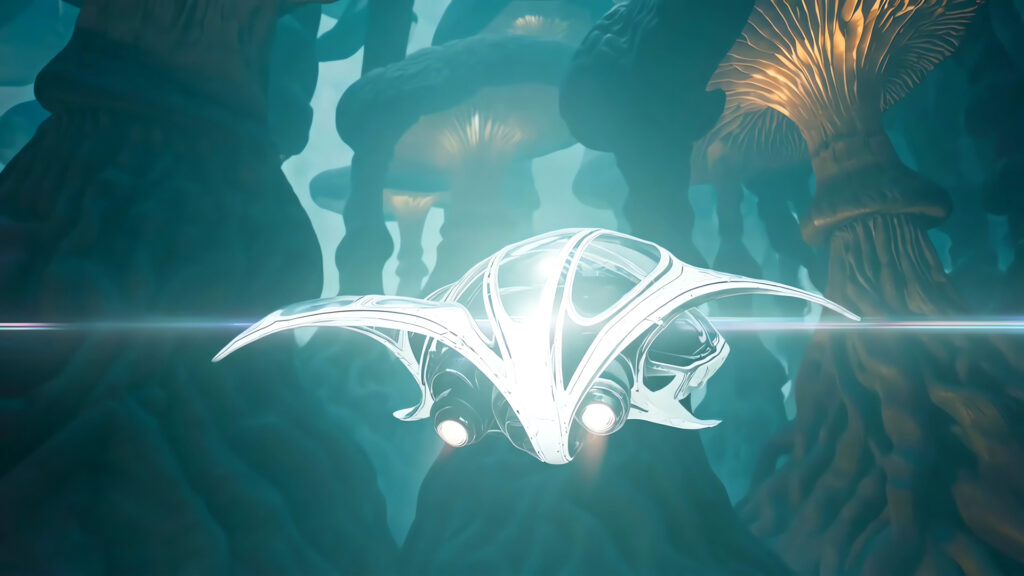
It was not a city in any geometry she carried. It was a reef suspended in night—arches and vaults and spokes grown of some mineral that loved both crystal and cartilage. Every surface seemed patterned with thin plates, thousands upon thousands of parallel ridges. Gills. They opened and closed without moving, optical currents flowing across them, a million-fold shiver that made the constellations beyond take on new shapes. The reef’s edges were softened by a radiant fog that was not fog at all, but spore-light—particulates drifting in careful lattices, grouping into kaleidoscopic forms and then dispersing as if embarrassed at their own cleverness.
The spore-light reminded her of festival nights in the Latchways when the avenue lanterns would be dusted with biolum powder and everyone’s laughter turned crystalline for an hour. It also reminded her of DMT art shows she had mapped for a gallery that specialized in experiences instead of objects—those symmetries that felt more like fundamental statements than decoration.
She drifted under an arc that might have been a bridge if bridges were built by patient coral. The lamina compass warmed as if near a hearth, and its filament traced a loop that ended in a little knot. The Reef was speaking in a language made of breaths counted in light.
“It’s beautiful,” Kiera said, and the ship’s mics captured the word, pulled it apart, and let it dissolve through the cabin like tea smoke.
The Reef answered.
Not in sound. In permission. A panel within the arch quivered and relaxed, revealing a passage braided of three tunnels, then rebraided into one. Kiera felt the choice resolve without choosing. Her fingers rested on the guidance rings. The Kite of Radials slid into the braided path like a leaf settling into the slow water of a canal.
On the third loop she saw that the tunnels weren’t tunnels; they were throats, and she’d been invited to ride speech.
“This is the Array,” she whispered. “This is what they meant.”
Find where the stars learn to breathe.
Her old life tried to rise. How much would a place like this fetch on a contract? What would the Extraction Houses pay to bottle a breathing sky? The numbers ran out of her skull like rain. Kiera pinched the thread of the thought and flung it away. She had not come for a ledger. She had come for Eno’s curve written in the filament’s glow.
The Reef opened into a chamber and, at its center, something like a listener waited.
It was not an entity with eyes. It was a ring built of radiating lamellae, eight spokes meeting at a void, and the void was shaped like an ear.
“Archivist,” Kiera guessed. “Or something older.”
She brought the Kite to a standstill and spoke the oldest courtesy she had: “I have a question. I have brought no teeth.”
The ring brightened, each lamella catching light as if a small sun rose just off to the side. Spore-light gathered, becoming points, becoming a constellation, becoming a pattern she knew.
Eno’s curve.
The ring pulsed. Kiera swallowed. The lamina compass warmed to the edge of pain, but she did not drop it. Gold filament etched a path over the glass.
“What do you require of me?” she asked.
The spore-light shifted. It drew a shape that was not hers. A ship heavier than hers, blunt-muzzled, hungry with pride. Harvester geometry. A House build. The constellation of it stung her eye.
“No,” she said. “No callouts. No coordinates sent.”
The Reef did not threaten. It breathed. The stars behind the ring swelled and thinned. The chamber’s gills slid their light like pages turned back and forth. The message was clear. This was not a treasure to be hoarded or offered. This was a vocabulary. She had to learn a word and speak it back.
“Teach me,” Kiera said.
The chamber dimmed and the ring’s spokes unfurled, becoming a spiral corridor lined with lamellae as thin as wishes. She guided the Kite forward and entered the spiral. As she moved, the shapes along the walls changed—cutouts, negative spaces, apertures. Each matched a pattern the lamina filament threw when she tilted the coin just so. The corridor was, in essence, a pronunciation guide.
One turn, two. The patterns tightened, then widened. She kept the ship steady as the reef’s light swelled to a soft, LSD-bright sheen: not intoxication, but clarity sharpened until geometry felt like feeling. The sense of a syllable in the making.
On the seventh turn, a shadow crossed the far mouth of the corridor.
Kiera froze. The shadow had mass. Engines.
She dimmed every light in the Kite until the cabin was a heart in a cathedral. On the scope, a heavy drone coasted against the Reef’s skin, with three smaller escort motes haloing it like wasps.
They had followed her breathwake.
The drone sent a seeking ping that did not echo—Reef geometry drank it instead of replying. The escorts peeled off and swept the arches.
Kiera tasted iron behind her tongue. She had known this was a risk from the moment she left Harbor Nine without a flight plan. Even if she said nothing, her passage signaled to anyone skilled, and the Houses were very skilled.
She looked at the pronunciation corridor. A set of cutouts glowed in a sequence that felt like urgency. Speak now.
“Teach me quickly,” she said, and for a breath she felt ridiculous asking a living city to hurry. But the lamellae flickered and a simple triad of shapes held steady. A cut oval. A notch. A slit. She held the coin to them one by one and the filament drew three gold strokes in reply.
“Okay,” Kiera whispered. “Okay.”
She exhaled. Let the air go all the way out. In the emptiness before she pulled another breath, she understood the word.
Not a word to open doors or call down force. A softer, better thing. A word that meant I belong here without owning. A word the Reef recognized as a form of listening.
She spoke it.
No sound left her mouth. The Kite spoke, not with radio but with adjustments in its surface tension, with the way its thruster cones sighed, with a change in the alignment of its ribbed skin. It spoke in gill, which is to say it spoke in time.
The Reef answered at once. Panels around the corridor flexed and then relaxed, unspooling a current. The current wasn’t a push; it was a suggestion shaped like gravity, and the suggestion said: Come into the breath between breaths.
Kiera let go.
The Kite slid along the living current like a bead along a string and passed under the far lip of the corridor just as the heavy drone’s shadow crawled over the mouth behind her. The escorts streaked past—fast, overeager. The Reef gave them nothing. It did not need to fight. It simply exhaled. The lamellae rippled. The escorts overshot into empty black and found no purchase, because the corridor had changed shape the way a tongue changes to hide a consonant you’re not ready to hear.
Kiera laughed without sound, the way you laugh in a quiet temple.
“Thank you,” she said. “I won’t make you regret it.”
The passage spat her into a space both spacious and intimate, as if the inside of a throat had learned to be a plaza. Columns rose, braided of filaments edged with a glow that never stopped moving. Rings hung between them, each ring a different geometry. Some were flat and formal, some elliptic and playful; one looked like a ripple through a pond that had frozen in the act of becoming.
At the center of the plaza stood a mirror. Not reflective in the ordinary way—no face would look back out of it—but reflective of paths, of if. It showed Kiera three versions of the Kite in three attitudes she had to choose among.
The first: nose down, speed up. Run the Reef before the Houses could trace the breathwake again. Keep the map. Keep the word. Keep it yours as an edge.
The second: broadcast. Send the word through every corridor she knew, teach others to listen. If the Houses could arrive, so could the quiet ones, the pilgrims, the scientists who record without taking. But opening a door opens it to all.
The third: give the word to the Reef itself and let the Reef decide who would receive it when and how—a trust not placed in people who loved collecting permissions, but in a place that had outlived collectors.
Kiera stared at the mirror until her eyes watered. The lamina compass warmed against her palm in a way that was not advice. She looked down at it anyway. The gold filament curled, then uncurlled.
Eno’s curve lived in that filament, or at least her memory of it. Eno had held a job similar to Kiera’s once—pre-House, pre-ledger, back when cartography meant walking the world to learn its vocabulary before spelling your name across it. Eno had died when a House crew tried to rewrite a canyon and the canyon rewrote back with rocks. The lamina coin had been found on the ground near the break in the earth. Kiera had told herself a story about that for years: that Eno had tilted the coin in her hand one last time and decided something noble, something that had nothing to do with merchandise.
She knew that if she could prove the Reef to a boardroom, someone would use her name to fence it.
She lifted her hand and pressed the coin to the mirror.
“I choose the third,” she said.
The mirror did not accept the coin—it breathed it. The gold filament didn’t burn; it diffused into the lamellae as if they had always belonged to one another and had just been returning from an errand. For a heartbeat, Kiera felt fingerless, as if the object she’d clutched for months had been a shape she could finally unclench.
The plaza brightened. Rings spun. A field of spore-light rose like snow falling upward. Somewhere deeper in the Reef, a change in pressure rolled outward like a tide that hadn’t learned to be water yet.
The Reef spoke to her in the only language it trusted her with: it allowed her to stay without belonging to her.
The Houses would never understand that sentence.
“Archivist,” she said softly, “do with the word what you will. If you ever want me again, speak in breath and light. I’ll hear.”
Something like a thank-you trembled along the gills. Somewhere close by, a door she could not see closed with love.
Kiera piloted the Kite out through a different corridor than she had entered, because the Reef had changed its grammar. On the outer skin, she shuttered every active system and let the ship drift until the lamellae of the sky folded back to their ordinary position. She counted three breaths. Five. Eight. The pattern faded.
Nothing pursued her.
This did not mean the Houses had given up. It meant the Reef had chosen a better place to put a threshold.
Back in open dark, she lit a low burn and angled the Kite toward the Mirror Belt. The comms chirped with Harbor Nine’s passive beacon. A shiver ran under her skin—the sensation of something just missed, or something just granted.
She cycled the cockpit lights and noticed her reflection faint in the glass. She looked older and lighter at once, like a page that had been written on and then harmonized with the story around it.
“Eno,” she said, testing the sound of a name in a room alone. “If you wanted me to find that, I hope I did it correctly.”
A strand of spore-light that had clung to the Kite’s hull through the passage drifted free and hung at the window as if listening. In it, a tiny geometry unfurled like a fern, and she recognized—with the kind of certainty that feels like a friend’s hand—the shape of the lamina filament carving Eno’s curve. The spore geometry winked, then broke apart, rejoining the night.
“Okay,” Kiera said. “Okay.”
She docked at Harbor Nine by illicit muscle memory and slid through debrief with the same story she had used a dozen times: survey run, dead sector, beautiful waste. The staffer on duty nodded in a polite I-am-not-paid-to-care rhythm. Harbor Nine’s genius lay in its indifference; nobody sold anything if there were no buyers.
Back in her berth, she slept for the first time in two days and dreamed that she was underwater looking up at stars that were not stars but gilled mouths breathing her name.
The Houses came, of course. Three weeks later, a fleet with perfect papers and a broken sense of scale. They moved like a fork scraped across a plate. Kiera listened to them on the open channels, because sometimes knowledge is only knowing the exact tone of your enemy’s confidence.
They found nothing. The corridors did not agree with their accelerations. The Reef did not breathe when they demanded it. They pinged the dark with mechanics and law. The dark answered with hush.
Kiera took work mapping dull distances, paying for fuel and mistakes. She lit her stove twice a week and made tea with real leaves so she would not forget what hospitality felt like. Small things anchor a person when the big things you want to say belong to a city that speaks in gills.
Rumor traveled anyway. Quietly at first: a place that appeared between breaths, a ring that could hear you, a reef that chose its listeners. Kiera never confirmed and never denied. She carried a new compass instead: not a coin, but a practice. How to breathe. How to ride. How to ask a place what name it had for itself.
On a warm night in the Latchways, at an outlet bar where the stools were welded from defunct antennae, Kiera met a group of pilgrims who studied mushrooms and mathematics with equal humility. They were building instruments too soft for Houses to notice. She listened to their plans and said only that they should bring tea, and patience, and leave their teeth at home.
One of them, a woman with hair like lightning and the habit of touching every surface as if noting its temperature, drew a sketch on the table with condensation from her glass: parallel lines, curving outward.
“Gills,” she said. “In the stars.”
Kiera watched the lines evaporate. “That’s a good title,” she said.
“For what?”
“For the map that leads nowhere unless you can hear it.”
The woman raised her glass. “To maps that don’t lie.”
Kiera clinked glass to glass and felt, for the first time since Eno’s canyon, that the world might not be a mouth that only understood bite.
Months later, in a sector where light goes to forget itself, the Kite of Radials caught a breath. It was faint, as if someone far away had sighed against the window of the universe. Kiera cut the engine and looked.
The lamellae unfurled, silver on black. Somewhere deeper than instruments, she felt the Reef say come.
She answered without coordinates. She answered with how she held her breath for a count of five and let it go slowly. She answered with the angle of her ship to the dark. She answered with the promise she had made at the mirror.
The corridor unfurled; the permission allowed; the Reef received.
She did not come to take. She came to bring. From a pouch sewn inside her sleeve, she drew out a small, living thing—a woven knot of hyphae incubated under the Kite’s warm vents for months. It was a gift grown from spores that had clung to her hull on that first passage, a little loop taught to pulse in the rhythm of her name.
She placed the knot against the instrument well, and the ship carried it outward, a seed returning to a parent that had not known it had dispersed.
The Reef brightened. Rings turned. Geometry smiled, and that is not a silly sentence if you were there.
“Teach whomever you wish,” Kiera said. “Choose them for how they breathe.”
She laid a hand against the grafted resin of the control arch. The Kite purred. Outside, the gills in the stars opened, and stars looked like what they had always been—holes punched in a sheet to let something bigger shine through.
She stayed a long time, not moving, until the breath cycle eased and the corridor loosened its form. Then she let the Reef return to its own business and backed the Kite away.
On the charts she kept for herself, she drew no lines. She made a small curl, then another, then a long, looping arc that started nowhere and ended nowhere and fit into no grid. Beside it she wrote a single word.
Permission.
On nights when Harbor Nine slept and the Belt polished its mirrors and the Houses bored themselves to honors, Kiera unshuttered the cockpit glass and watched for those pale, rhythmic ridges.
When they came, she matched them with her own quiet breathing, little gills opening in her chest, synced to a sky that had learned to speak in lamellae.
Between one breath and the next, she felt the universe inhale with her.
And even if no one else saw it that night, even if the Houses wrote it off as a glitch, even if Harbor Nine miscounted docking fees and she had to haggle for the price of her own bed—the stars still breathed, and Kiera breathed with them, and in the long, patient language of places that outlast their names, someone far away felt a corridor open and knew to come light-footed and unarmed.
Because there are doors you batter and doors you learn to pronounce.
Because there are charts you sell and charts you surrender.
Because, once, a woman released a word into a city of gills and trusted it to choose.
And the stars, having learned how to breathe, did not forget the taste of kindness.