— Page 1 —
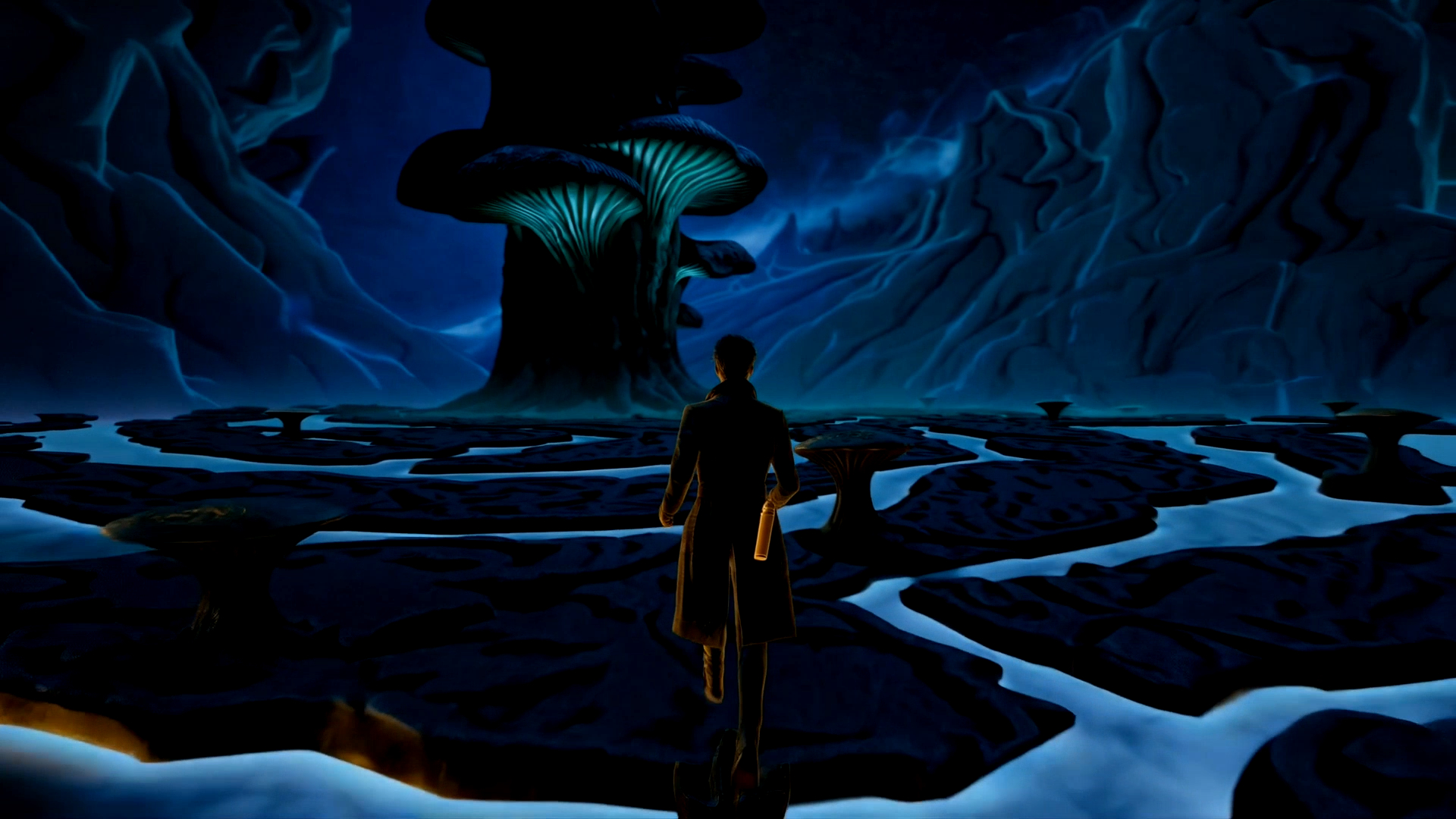
The basin looked like someone had poured night into a bowl and then raked a single line across it with a needle. Wind moved the salt in long sighs. I stood where the line met the rim, a blank blueprint rolled tight in my fist and a coin of cinnabar resting on my palm. The coin wasn’t mine, though I woke with it in my boot three days ago. Its weight refused to match its size, as if it contained a decision I hadn’t made yet.
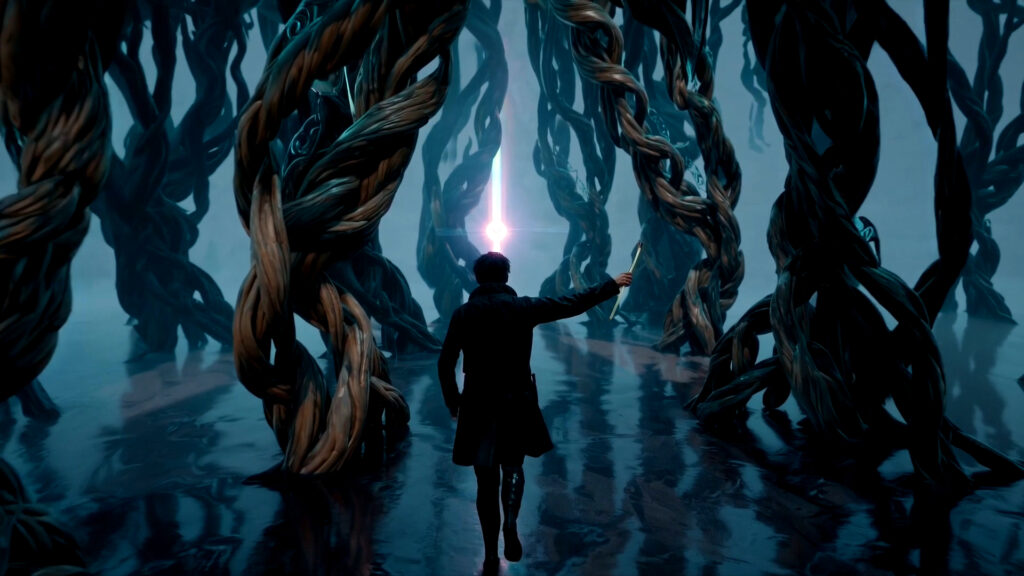
Across the basin, the Orchard rose—no trunks, no leaves, only a lattice of branches that forgot to stop branching. The structure breathed with a regularity I could feel through my boots. Every inhalation pulled the stars into thin lines; every exhalation returned them to points. People called it a grove because that was the nearest human word. Specialists called it a photonic-biologic computer, a self-indexing archive of unchosen routes. I called it a place you approach once.
A corridor opened in the branches without moving them, the way a thought opens a door. Pale equations flared across their bark-spiral skins and then went dim again, as if embarrassed to have been seen. The blueprint warmed in my hand. The coin hummed once—one pure note without air—and oriented itself, turning so that the stamped face with the radial notch faced the Orchard. The notch aligned to the basin’s needle-scratch. Permission, though no one had uttered the word.
Inside, the corridor’s floor seemed poured from glass and silt. The air tasted faintly metallic, like the moment before rain. Capacitive filaments along the walls registered my body and then withdrew to a polite distance. The Orchard understood the calibration signal of the coin and let my outline exist here.
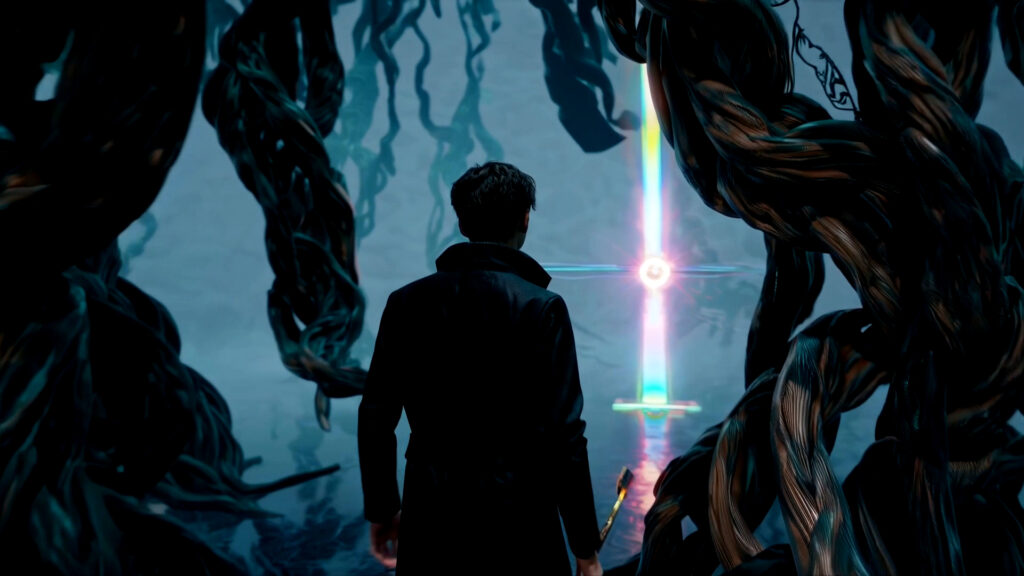
The first room was small enough to matter. No gore of myth; no booming gods; just a chamber with a low ceiling and a single object in the center: a stair made of prisms nested within prisms, each step splitting the room’s dimness into bands of color that drifted away like escaping ideas. Not an invitation to climb—an exam.
I placed the coin on the bottom step. The stair recognized the alloy—old-world cinnabar seeded with something not on our table—and sprouted a thread of light straight through the coin’s notch. The thread pointed not north, but near. The blueprint’s surface—previously a matt emptiness—absorbed the thread and printed a line that curved in a way compass roses never do.
A figure stood to my right; I hadn’t heard it arrive. “Pilot?” it asked.
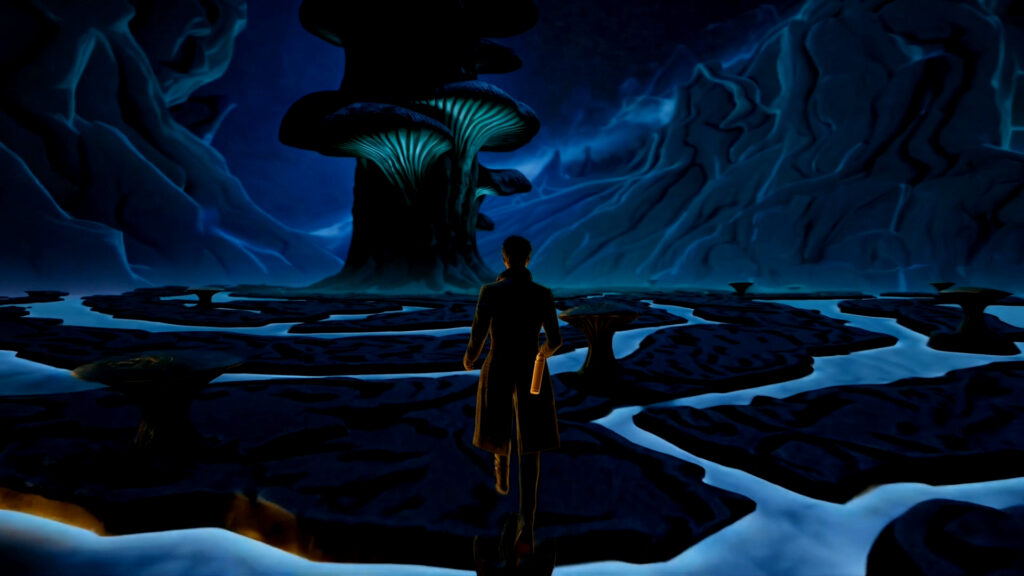
Its voice rustled like pages being turned in a glove. It was not flesh. It was a pillar braided from mycelial cords, with teal gill-ribs that breathed faint luminescence and a face assembled from the geometry of patience. Heat exchangers masquerading as gills, I reminded myself. Biological computation doing what silicon rarely can. A clerk. A librarian. A host.
“You brought the consent key,” it said, glancing at the coin. “The Orchard can index again. If you wish to proceed, ascend.”
The stair brightened by increments, a gradient of patience. I put a hand on the coin, felt the notch tug toward the line the Orchard had ghosted across the basin. Above me, somewhere deeper than up, something rearranged itself to make room. I climbed.
— Page 2 —
Each step did something precise to the world. My hand changed color where the prism light touched it, and when I looked down, I counted six shadows where my body insisted on one. The stair tuned me—unwound the biases I’d brought in, turned them sideways, measured their refraction index, wrote those numbers into the air. I could feel the Orchard reading me as much as the other way around.
The corridor that opened at the top wasn’t a corridor until I agreed that it was. The walls hung on consensus like tension lines. A thin frost formed along the blueprint’s edge, resolving into marks that were not letters but their older relatives—vectors that implied grammar. I pressed the blueprint to the wall; the wall printed onto it, faintly, as if not wanting to admit we were collaborating.
“Where does this go?” I asked the Clerk. It moved without locomotion, gliding by editing its surrounding branchwork to be somewhere else.
“Toward the Threadway,” it said. “Through the Sunfield. Past the Corridor of Slow Decisions. Into the Engine. These names are approximations for what your tongue can do.”
“Why me?” I asked.
“The coin chose your path before you were aware of it,” the Clerk said. “Consent is not a simple function here. Your yes had to exist before you could form it, or the Orchard could not have grown a passage to meet it.”
A lie shaped like truth, or a truth wearing a poet’s coat—either way, the structure around us flexed. The stair below us retracted without actually moving, the prisms sliding into their own edges like thoughts filed correctly.
We entered a chamber woven from filaments that looked like moonlight captured by spider glass. This, the Clerk indicated with a bow of its gill-ribs, was the Threadway. Bond angles changed with the same delicacy as falling snow. I set the coin into a cradle in the floor—my hands shook, not from fear but from the precise gravity of being a component. The cradle read the notch and aligned a hundred little micro-hinges in the air.
Doors unfolded. The first was a hexagon that forgot one of its sides halfway open. The second was a circle with a loaded pause. The third was a line that learned it could be a doorway if it shook with the right frequency. Beyond them, a bridge assembled itself from the idea of bridges.
I stepped onto it and felt the world split into two adjacent frames: one where distance cared and one where it didn’t. Walking across both versions at once made my legs feel like they had overheard a secret not meant for them. The coin clicked against my palm in tiny acknowledgments, negotiating with invisible agencies that ran the Orchard’s architecture.
The Threadway pulsed. The Clerk kept pace by simply always being where I next intended to look. The blueprint at my hip began to annotate itself—tiny numbers that were not human units, scales marked with intentions, a note that translated to: Bravery, nominal.
“Hold that calibration,” the Clerk said as a new chamber unfurled like a folded protein finally deciding what shape it wanted to be. “The Corridor of Slow Decisions has its own weather.”
— Page 3 —
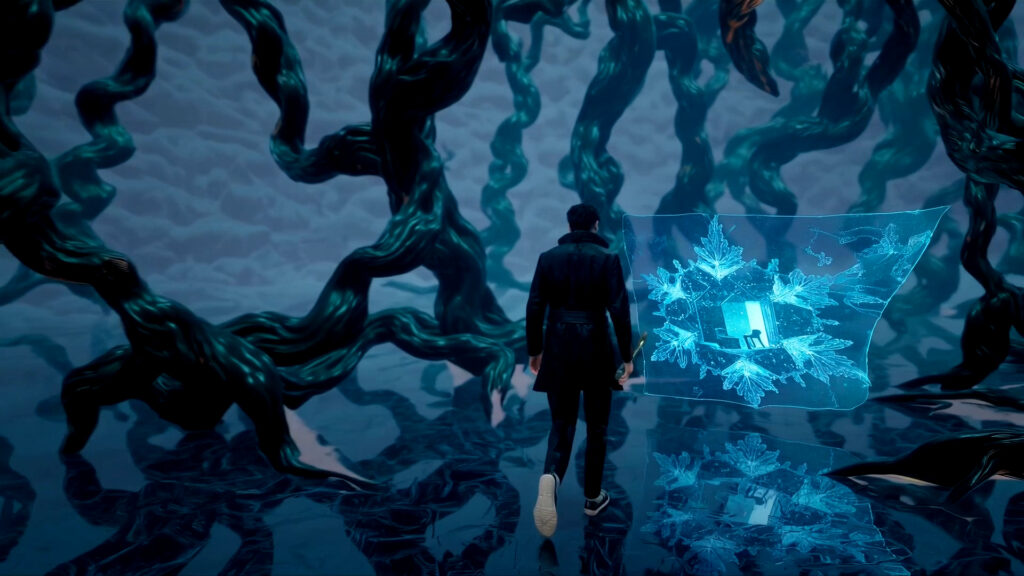
The temperature dropped one careful degree at a time until my breath made a pale diagram in front of my face. Flakes fell. At first I thought it was dust from the branchwork, but each flake contained a room—no wider than a fingernail—complete with a window, a chair, and a faint sense that someone had just stood up to leave. The flake landed on my sleeve and melted into a map, which then evaporated. The Corridor of Slow Decisions didn’t want to paralyze; it wanted to give you evidence you could not finish analyzing.
Time stretched and then rubber-banded back. My footfall lagged behind my leg’s order; then my body installed a patch and the delay vanished as if it had been a test. The coin’s hum lowered, the way machines do when they conserve power for a precision task.
“Do not attempt to be faster,” the Clerk advised. “Attempt to be exact.”
So I named the steps instead of counting them, assigning each one a task: Recognize. Reconcile. Release. The corridor approved. Its flakes changed, resolving into only those rooms that matched the names I’d chosen. The floor shortened by a length of patience, then lengthened by an apology. I refused to be teased. That refusal had a taste—copper and winter—and the Orchard cataloged it.
At midpoint, the Corridor tested me with two simultaneous offers. On the left, a door that promised ease: a clean exit back to the basin, a life that would feel chosen. On the right, a door that promised clarity: not comfort, but the removal of a particular fog I had lived in for years. The clarity door was edged in nothing; it didn’t shine. The ease door gleamed like an advertisement.
I put the coin against the clarity seam. It didn’t open. The coin’s notch wasn’t aiming there. It aimed toward a corridor that my eyes refused to render. I pressed anyway. The seam temperature rose to exactly body heat. The blueprint wrote a new line with a very old curve.
The invisible corridor turned visible because I insisted on seeing it. It wasn’t defiance; it was cooperation with the part of the Orchard that preferred stubbornness to speed. We moved forward into light so soft it felt like a fact.
Beyond, a plain spread to the horizon, and every stalk on that plain ended not in a flower but in a disc—obsidian with a skin of rotating geometry that never repeated a pattern. The Mescaline Sunfield, though names like that make scientists bristle. Each disc analyzed me and then turned away, the way professional disinterest looks when it’s being polite.
“What do they show?” I asked.
“What you would have become if you had decided one minute earlier across your life,” the Clerk said. “And one minute later. And all the offsets between. Do not stare long or you will dissolve into comparisons.”
The field vibrated. Not a sound; a number that passed through sternum and spine. I took the center path anyway. The discs turned to follow—not menacing, not adoring, simply collecting data. They projected braided light-lines across my boots, marking where my momentum intersected their models.
The blueprint unrolled itself three centimeters and placed a scale along the margin. Not meters, not miles, but a unit that felt like integrity. Each step ticked one unit. Bravery, nominal, the margin repeated, then updated: Bravery, sufficient.
— Page 4 —
The Sunfield ended at a wall that wasn’t a wall so much as the idea of limits having grown a body. Hexes tiled it—perfect until you touched them. Each contact sent a ripple outward, and the ripple edited whatever it passed: arches became spirals, spirals became rooms, rooms became routes. I had reached the Peyote Hex Engine, whose function I understood the way you understand the surface of an ocean without any urge to measure its depth right this instant.
“Set the coin,” the Clerk said. The way it stood beside me was almost companionable.
I placed the coin on a junction where six hexes disagreed by a micrometer. The coin’s notch aligned to an axis I had never been taught to notice. A low amber consent signal pulsed—not visible, not audible, but unambiguously there. The Engine acknowledged me as an operator rather than a tourist.
“Will this change the Orchard?” I asked.
“It will let it resume the work it paused when you arrived,” the Clerk said. “You will not like all of that work.”
It had not warned me of anything until now, which meant the warning mattered. The Engine needed a route to index, and the only route on offer was me. I understood, without drama, that the Orchard cataloged people as maps of what they would do. I also understood that consent here was a recursive function: by choosing to proceed, I created the very shape that justified the proceeding.
The hexes shuddered. I inhaled until the breath had weight. The engine ran.
Architecture rolled through the chamber like a thought finally finding its words. Doorways flipped their orientations. Floors reconfigured their friction. The ceiling performed micro-adjustments that felt like someone adjusting a collar you’d never noticed was tight. The blueprint drank it all. Lines appeared in pairs, then braided. Tiny annotations rendered in a language I didn’t know seconds ago and recognized now.
“Hold,” the Clerk said. “Something is arriving.”
It arrived in the way a mirror arrives when you look for it. An echo of me, offset by a thumb’s width, stepped into the Engine’s light and blinked once, not particularly impressed. Its equipment matched mine: a rolled plan, a coin, a willingness to be calibrated. But its coin’s notch aimed at a different axis. In its world, an earlier choice had spun the Orchard on a slightly different bearing.
“I’m not your adversary,” it said, and I heard my own voice differ by a season. “We’re redundant contingencies, not rivals.”
The Engine considered us both. Two routes, one index. It could accept both if the divergence didn’t fold the Orchard into contradiction. The Clerk looked at me, then at the echo, then back. “Choose,” it said.
“I choose both,” I answered, surprising myself with the ease of it. “Composite the map. No pruning.”
The echo smiled—a rare gesture I recognized as hope in my own face. Our coins synchronized, their notches aligning not to a single axis but to a harmonic between them. The Engine pulsed with a new pattern, one that didn’t erase differences but arranged them into something we could read without biting our own tongues.
The Orchard extended a ramp of mirrored metal—the river I’d seen from the Threadway, raised into a bridge. Not liquid, but a surface that moved like a question looking for what would answer it.
“Mercury River,” the Clerk said softly, pleased, perhaps, or indulging my need for names. “Cross, and the Orchard will sign your page.”
— Page 5 —
Walking the river was like walking a polished question mark. Each step sent wavelets through the mirror, and each wavelet returned with a slight data payload that made my ankles feel like they had read a book. Where the wavelets overlapped, small interference flowers unfolded and then closed with crisp manners. The echo walked beside me, offset by that thumb’s width, our strides not perfectly in phase. The interference patterns liked that. They enjoyed being complicated.
Halfway across, the surface projected frames from lives we had not lived. Not seductions—audits. There I was, leaving earlier. There I was, refusing the clarity seam. There I was, never stepping onto the prism stair at all. Each frame came glazed with that former certainty and then retracted, filed for future algorithms. The Orchard didn’t want me to regret; it wanted me to know.
On the far side, the air thinned, not dangerously, just enough to make me count breaths. The final chamber resembled the first on purpose: low ceiling, single object in the center. No stair this time. A desk. On it, a pen.
The desk was grown from branchwork and mathematics. The pen was made of nothing I could identify and everything I wanted to trust. The blueprint unrolled itself across the desk as if it remembered this geometry across lifetimes. The coin settled into a recess, its notch locking with a neat click. The echo set theirs beside mine; the recess didn’t exist and then did, accepting both.
“Signatures,” the Clerk said. “Not names. Lines. Each a shape you will live into.”
I had thought the signature would be the line I’d carried through—Near, Not North. But my hand did not draw that. Instead, it traced a loop that touched its own start and then, politely, chose not to close. The echo drew a line that crossed mine at a point that felt like a vow without the theater. The pen recorded both without scratching. The page glowed—no, not glowed; the page understood.
The Orchard inhaled. The basin outside turned its stars back into points. I felt the structure’s relief the way you feel a room relax when a long-outstanding apology finally gets spoken. The Clerk bowed. The gill-ribs dimmed to maintenance levels.
“What did we fix?” I asked.
The Clerk considered the desk, as if it hadn’t seen it in a very long time. “We restored a feedback loop. The Orchard maps what will be chosen. It needed to remember that plural futures do not require singular maps.”
“Will there be more signatures?” my echo asked.
The Clerk turned to regard the corridor behind us—the stair neatly compacted, the Threadway asleep but still humming in its bones. “There always have been,” it said. “You are simply aware of it now.”
We walked back through the Orchard, but backward was not the direction it had been when we came. Corridors that had been hesitant were now confident; rooms that had been testing had become teaching. The Corridor of Slow Decisions offered no doors this time, only a plain through which flakes fell without embedded rooms. The Sunfield turned its discs to face us and then, one by one, ceased their rotations—a courtesy. The Threadway untensioned its hinges, content to be pathless until called upon.
At the rim of the basin, the coin cooled. I placed it against the basin’s needle-scratch line and watched as the notch aligned to the precise curve we had signed. The line accepted the contact—a tiny change in how the salt lay, a fractional redistribution that made the basin reflect the sky with less arrogance and more accuracy.
The echo stood a thumb’s width away, the distance feeling now like a useful difference rather than a sorrow. “I’ll head along the left perimeter,” they said. “You take the right. Send updates if your path invents new nouns.”
I laughed. It startled me, then pleased me. “Deal.”
The Clerk remained at the threshold. It would not cross. “When you need to be recalibrated,” it said, “bring what you have learned. The Orchard will build rooms to fit it.”
“You keep saying ‘will’ like it’s a certainty,” I said.
“Certainty is not a requirement,” the Clerk replied. “But it is not a fault, now, either.”
— Page 6 —
I camped at the basin’s lip, where wind made a low note over pulled salt and the stars practiced their patient mathematics. The blueprint lay unrolled on my knees, its surface alive with parallax, as if it were a window into an algorithm more than a page. The signature lines we had drawn glided under my fingertips like small rivers refusing to be persuaded into a canal.
What am I, without the Orchard? A person with a line to follow, yes. But also a person who finally understood that maps are not prisons and routes are not verdicts. The page did not command; it described tendencies, preferences, tolerances. It recorded where I became more myself, and where I drifted toward the idea of someone else’s convenience.
I slipped the blueprint back into its tube and rolled the coin over my knuckles. The metal took skin heat and offered steadiness in return. In the distance, the Orchard’s branchwork tightened its weave and then loosened again—a sleeping creature adjusting its blanket. It would index other arrivals, other consent keys, other insistences. It would build threadways to accept what those lives needed to walk.
I traced the right perimeter for three days. The blueprint updated with soft clicks I felt more than heard. I sent the echo a packet via the prism stair’s remote interface, letting it refract across the basin’s line like a respectful rumor. Their reply arrived in the pattern of morning frost: two lines had intersected a second time, and both had decided to proceed without collapsing into sameness.
On the fourth morning, I returned to the basin’s rim. The line across it—once a scratch, then a guide, now a story—had deepened by a depth too small for instruments and too exact for indifference. I set the coin down at its midpoint and whispered—not to the Orchard, not to the Clerk, but to the habit of shying away from the work you were clearly designed to do.
“Near,” I said. Not north. Not away. Near, to whatever keeps the geometry honest.
Somewhere under the basin, the mirrored river shifted, pleased by something as small as honesty. Somewhere in the Orchard, a threadway flexed in anticipation. Somewhere—maybe in the same world, maybe a thumb’s width to the side—my echo picked up their coin and began a new traversal, sending wavelets through the map we now shared.
I stood. The sky drew its diagrams in patient light. I folded the tube into my satchel, felt its weight align my spine, and started toward the place the blueprint had marked not with an arrow, but with a sentence that didn’t end.
The ground beneath me hummed with a faint grid, so subtle I couldn’t decide if I was feeling it through my boots or remembering it from inside my hands. Either way, the world had signed back, and that was enough.