Prologue: The City That Forgot Its Corners
The city had no right angles anymore. Years of slow migration in its own sleep had rounded every edge into a soft, treacherous kindness. Streets drooped like ribbons. Towers leaned in to hear each other breathe. At night, light pooled in bowls and refused to climb the walls. People blamed the damp, or the age of foundations, or the recent habit the wind had of returning lost words.
Sen walked through it with the steady patience of someone who carried a task heavier than their shadow. Their satchel held a glass seed—smooth, thumb-sized, faintly warm—taken from a mineral library deep under the old quay. The librarians had warned that it wasn’t a seed at all, but an organ, the kind you could add to a place in order to give it a new sense. “Don’t plant it in soil,” they’d said. “Plant it in a problem.”
The city’s problem was the same every city kept hidden: it had forgotten where it ended. Some nights its borders drifted so far that fog felt foreign; some mornings the outer districts woke up looking at mountains that weren’t on any chart. The mayor had asked for better fences. Sen, a cartographer too stubborn for fences, had asked for the seed.
On the night that began the end of drifting, the seed woke. Not with light, not with sound, but with vibration—a low, velvet hum that traveled up Sen’s bones and mapped out a direction behind the ears. When Sen faced that way, the hum smoothed. When they turned aside, it rasped. That was how Sen knew the thing was a map: it cared when they cheated.
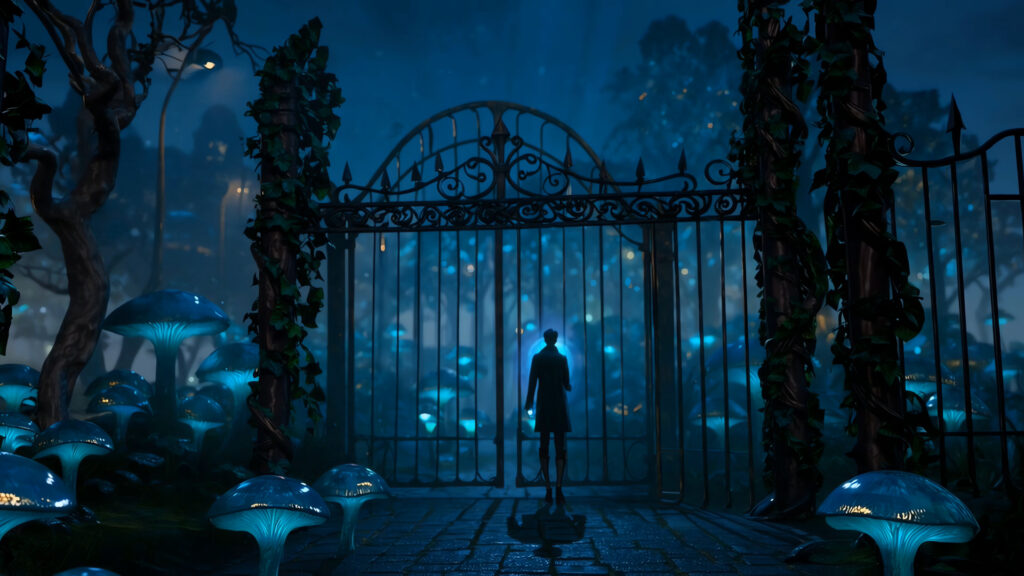
The seed’s hum pulled them through the city’s softened streets to a battered iron wicket that had never opened for anyone sober. Beyond it lay a scar of land no one managed to name—the Orchard of Glass to some, the Prism Orchard to those who liked their danger with geometry—the place where trees grew mirrors and fruit pretended to be planets. At the orchard’s edge, the air carried the flavor of cold coin and rainwater under stone. Mushrooms at the roots of the iron fence opened teal gills and breathed out a pause, like a door deciding whether to be a door.
Sen set the glass seed on their palm. It rolled toward the fence and pressed itself against the iron. The hum pressured Sen’s ribs. The wicket sighed and forgot that it had ever been locked.
“Show me,” Sen said to no one and to the seed and to the orchard. The hum approved.
They stepped through.
I — Threshold Sap
Inside, the orchard’s darkness was organized. The trunks were columns. The leaves were ruled lines. Moss laid out a grid with small, amber nodes, and every so often one node blinked and sent a ripple through its neighbors until the whole mat had agreed on something quiet.
Sen took one more glance back, as people do when they hope their second thought will stop them. The city waited behind the gate like a cat pretending not to care. The orchard breathed in, and the mushroom crowns tilted as if listening to the hum in Sen’s palm. Enter, said the breath, not with syllables but with an idea of warm wood.
Sen obeyed.
Teal dew gathered at the edges of leaves and trembled without falling. The trunks exhaled coolness that tasted like the inside of glass. As Sen stepped, the moss grid folded its attention around their boots, then relaxed. The seed’s hum faded to a baseline purr—approval, orientation, readiness.
Sen had the old cartographer’s habit of sketching while moving, recording motion as if it were a form of ink. But every attempt to draw a line here turned into a circle, turned into a loop, turned into a small spiral and then a spiral inside the spiral. The orchard wasn’t interested in lines. It wanted roundness, it wanted return.
“You lead,” Sen told it. “I’ll trace later.”
The moss blinked twice, and a path appeared—not brighter, not flatter, just slightly more true than the surrounding ground.
II — Corridor of Soft Teeth
The true path narrowed to a throat, then opened into a corridor of stacked stones cut like hexahedra, their edges softened by centuries of thoughtful friction. Every joint housed a tiny glyph: not letters, but gestures held still. Sen recognized none of them and all of them at once. They couldn’t be read; they could only be followed.
As Sen walked, the glyphs loosened and drifted like sparks, towing lines through the air that braided themselves into faint, guiding ribbons. The hum in the seed adjusted its pressure: a nudge if Sen veered, a velvet encouragement when they aligned with the corridor’s will. The air tasted amicably metal, like the inside of a tin cup left under the rain, and somewhere ahead a draft moved with the softness of breath sleeping in a giant’s chest.
The corridor flexed once, a ripple along stone, and Sen paused. The flex wasn’t a threat. It was a stretch, the physical relief of a structure remembering it had a spine and that spines are allowed to be pleased. Sen smiled despite themselves and kept on, letting the ribbons choose where their feet belonged.
At the corridor’s end sat a door so thin it looked like a crease in daylight. Pressing the seed to it felt inevitable. The crease widened to a mouth and the door said, If you are certain, you may continue, and if you are uncertain, good.
“I am both,” Sen said.
Perfect, said the door, and disappeared.
III — The Orchard Proper
The corridor first offered a clearing, then a suggestion of altitude. Sen’s body adjusted the way a ship adjusts to new currents: by small compromises rather than declarations. The orchard unrolled up a gentle slope onto a terrace where trees of glass inhaled sky and exhaled geometry. Every leaf was a beveled mirror the size of a hand. Every branch wore prisms like lanterns. Fruit swelled here and there, each a miniature world with weather: a cloud flicker, a dust-lantern, an inland sea with a slow moon.
Even the shadows seemed engineered. They pooled in hexes. They joined where roots braided. Sen stood inside the geometry and felt their internal organs think about moving differently.
Bioluminescent filaments descended from the canopy like cautious comets. They combed through Sen’s shadow and gathered it into symmetrical birds that hopped a little and then took off, flying only as high as the shoulder. Sen reached up. The birds adjusted around their fingers, more suggestion than creature, their edges fluttering with teal light.
The seed warmed. The hum extended outward from Sen’s bones into the orchard, testing distances the way a blind person learns the shape of a room with a stick. The feeling wasn’t invasive. If anything, the orchard seemed curious. It tried on Sen’s posture the way a host tries on a guest’s accent. Then the strangest sensation arrived: the world made a decision about who would move.
Sen’s weight shifted without their consent. Their boot knelt to the path on its own, then rose. The orchard had accepted the job of walking them, as if it were a river deciding how to pour itself downhill. Sen didn’t fight it. Some places will only carry the version of you that stops pretending to be in charge.
They walked that way for a time measured only by how many breaths the trees took.
IV — The Pin
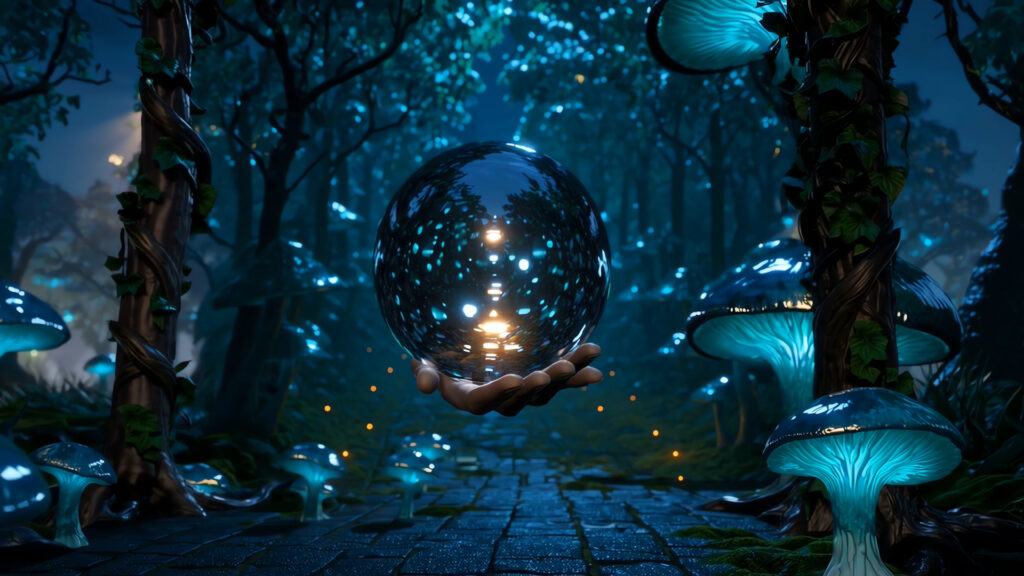
The path constricted to the inside of a heartbeat. Sen entered a chamber so polished that even quiet sounded like a reflection of quiet. At its center, a bead of dew hung mid-air, not falling, not rising. It housed a mountain turning very slowly. Snow crawled its slopes. Rivers the width of hair insisted on their own patience. The mountain had no right to be inside a dew drop and yet there it was, faithful to scale, arrogant in its unlikeliness.
Sen stepped closer. The dew brightened cousin to yes. The seed in Sen’s palm clicked twice, the way a good lock whispers when a key arrives, and something behind their ears softened like a clenched fist unmaking itself.
Sen lifted the dew carefully. It did not weigh what dew weighs. It weighed remorse that had been given somewhere soft to land. Inside, the mountain continued turning, a geology unbothered by the tremble in Sen’s hands.
“What do you want me to do with this?” Sen asked.
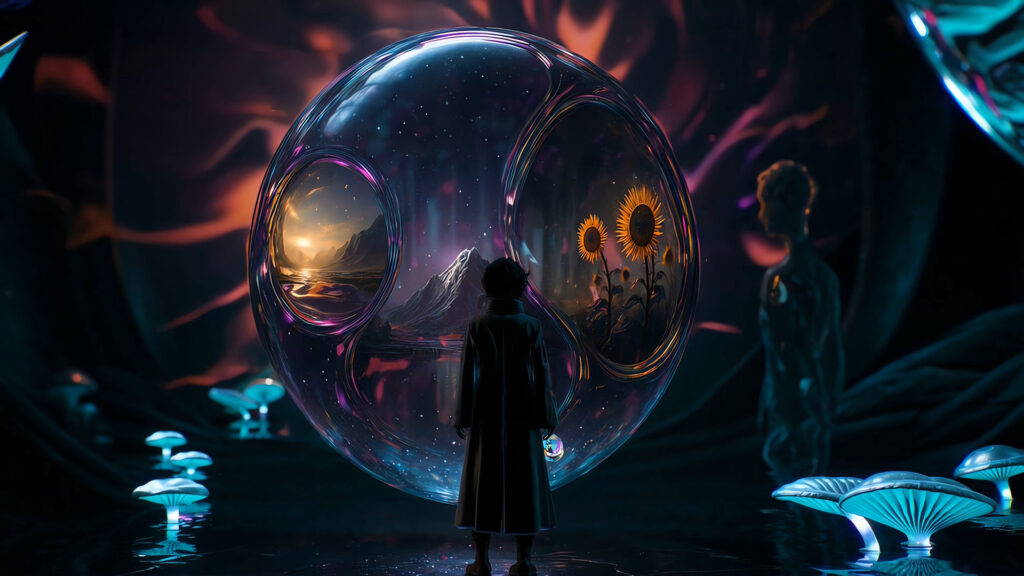
The dew answered by becoming a tiny lens through which the orchard shifted its scale. Through the bead, the countless leaves of glass were not leaves but windows, and through each window blinked a place—not here, not anywhere close. A desert with a river that moved like mercury. A room where law was sung and every word was an edifice. A field where sunflowers wore halos of amber fire. A gate made of whale bones. A corridor lined in mirror air.
The bead put each place in Sen’s eyes and took them away again, saying nothing but remember.
Sen nodded, as if anyone was there to see. They placed the dew back into the air, and it stayed, faithful to levitation.
V — Ketamine Snow Field
On the far side of the chamber, the orchard exhaled into a hush. Not silence—silence is a lid. This was cushion. Snow began to fall, then corrected itself and fell sideways instead. Flakes were large enough to wear facets. Each facet held a slowed thought. Sen tried to catch one and felt their hand arrive there a moment ahead of their intent, leaving a faint future in the air where their glove would be. Footprints stitched into the drifts before their feet committed to stepping. The air’s temperature was the exact warmth of a cheek against a winter window.
Sen’s balance loosened, not to the point of danger but to the point of negotiation. Gravity hummed a little off-center, as if the orchard had crooked its head and was watching Sen with one amused eye. The seed pulsed. The hush agreed. A raven made of shadow and filament collected itself onto Sen’s left shoulder and said nothing. The world was not wrong; it was simply choosing another coordinate frame in which to be true.
They moved. The snow field’s logic—slow, sideways, forgiving—invited a kind of thinking that did not stab. The cartographer in Sen took the invitation. They let phrases that were usually strapped down (route, border, certainty) sit beside gentler ones (trace, welcome, maybe). The footfalls that arrived before their feet became a kind of promise: the future is not an enemy if you meet it with a clean palm.
At the far edge of the field, the hush unlatched. A small wind gathered and escorted Sen toward a structure that had been waiting while pretending not to.
VI — The Lattice’s Wink
The structure was less a building and more a net of prisms knitted from air. Each joint broadcast a fine, iridescent mathematics in every direction: angles humming toward agreement, distances shaking hands with their reciprocals. Passing through it felt like walking under a chandelier built by insects that had fallen in love with the idea of forgiveness.
The net didn’t stop Sen. It read them. It asked a few untranslatable questions that nevertheless urged honest answers. Sen answered with posture: shoulders un-raised, jaw unclenched, the seed offered open on the palm. Whatever measurement the lattice ran concluded with a warm harmonic that could have been a laugh if laughter were an equation, and the structure folded itself into a narrow belt that wrapped the orchard’s waist. Sen felt, briefly, like they’d watched a cathedral decide it preferred being jewelry.
“Thank you,” Sen said to the air and meant it.
The path brightened by a shade that had no name because it wasn’t a color—it was the taste of steel softened by steam.
Ahead, an echo waited—a second figure shaped like Sen, two centimeters to the right, edges trembling with a prism’s caustic. The echo nodded at the original with a comradely impatience.
“You’re Else?” Sen asked.
If an echo could be pleased, this one was pleased. It lifted a hand and drew, with the tip of its forefinger, a doorway into clear air. The doorway accepted this behavior with the benevolent denial of matter that has decided to pass for grace.
VII — Mescaline Sunfield
Doorways rarely keep their promises, but this one delivered: Sen stepped into a field of obsidian-stemmed sunflowers wearing thin rings of amber fire. The stems moaned pleasantly when the wind moved them. The petals—chrome one moment, velvet black the next—turned in unison to follow a sun that kept changing jobs with the moon in an elegant shift rotation.
Above the field, the sky admitted color the way a well-mannered host admits guests late to a quiet party. Hues arrived one at a time, bowed, and took the place they had obviously already been assigned. Over the horizon, a whale with skin like pearl and basalt lifted, moved through the atmosphere as if through water, and then sank back out of sight, leaving behind a wake that bent light like a lens.
The echo—Else—walked beside Sen without sound. When Sen slowed to brush a ringed petal, Else did too, but its hand passed through the halo without disturbing the fire. “What are you?” Sen asked.
Allowance, said Else, or perhaps the field said it on Else’s behalf. A version of you the orchard can wear for high-risk tasks.
“High-risk,” Sen repeated, watching a halo balance on the edge of its own brightness. “Will this next part require courage?”
Yes, said the field without being cruel. But not bravado. The other kind.
“What other kind?”
Tenderness.
Sen’s throat tightened as if a new weather front had moved through the chest. They nodded. “All right.”
The sunflowers pivoted, opening a path not through the stalks but through the feeling they held between them—a corridor of acceptance. Else ghosted slightly ahead, leaving Sen to choose their own rhythm. The seed warmed further, a convex gratitude.
VIII — Mercury Bridge
Past the sunfield, the land sagged into a basin floored in black salt. A river ran through it, not with water but with a liquid mirror whose surface maintained a polite ripple as if doing so were part of the river’s job description. Where banks stooped close enough to see themselves, the mirror bent their reflection into thoughtful complicity.
Sen stood at the edge and tasted the metallic sweetness of storms too far away to matter yet. Else pointed at the middle distance, where a pale bridge rose from the mirror like a memory rising from sleep—there before, not used for a while, suddenly beyond doubt. It was not built of stone or wood or known alloy. It was built of decision, layer by patient layer, until it held.
Sen stepped onto it. Their soles kissed their reflection in a perfect geometry of meeting. The bridge did not sway. The mirror below folded images of a hundred skies together and proposed a thousand versions of the same crossing. Sen chose one at random and found it matched the actual.
Halfway over, the mirror lifted a hand. Not literally; water does not own hands. But the surface shaped itself into a gesture, and inside that gesture a face formed—not Sen’s, not Else’s, not anyone they had ever known—built out of shimmering angles. It regarded Sen with the frank interest of a librarian faced with a noisy problem.
“What do you need from me?” Sen asked the mirror.
To be planted, said the gesture, singing without sound. But not in the ground. Plant your organ in our question.
Sen opened their palm. The seed quivered. The mirror formed a small well on the bridge’s surface, a depression in the idea of reflection. Sen laid the seed there.
The bridge thought for a slow beat. The well closed. The mirror wore the seed like a pearl under skin.
Good, said the river’s angle-face, relieved as only math can be. Now cross.
Sen did. Else nodded. On the far bank, the orchard collected all its pending breaths into one pleasant release.
IX — Engine of Spores
The path opened into a courtyard with a floor like a mirror deliberately grown thick. Around it rose towers made of chrome and black stone, their surfaces cut to drink light and sing it back as architecture. At the center waited turbines whose only job was to inhale spores and braid them into diaphanous cables. The cables hung between the towers as if the sky had begun to knit itself a shawl.
Sen’s chest recognized the place before their eyes did. This was an engine not of gears but of intention—a device that took raw possibility and taught it to hold hands. The cables drifted toward Sen, testing the air for a compatible quiet.
One cable tapped Sen’s wrist in inquiry. Sen answered by loosening that place behind the ears the seed had softened earlier, letting the orchard’s question rise into the room of decision. The cable brightened. The towers bent closer, the way trees bend when they eavesdrop with shade.
“You want something,” Sen said softly. “Name it.”
The engine gathered a focal warmth and projected a weave into the air above the mirror floor: stars, not of the sky but of memory. Each point a person. Each connecting line a kindness not taken back. In its center pulsed an absence shaped like a fear.
Sen knew it immediately. The fear was that if they drew the map fully and fixed the city in place, they would also fix themselves—no more wandering, no more nights of stepping into possibilities dressed as alleys.
Else glanced at Sen with a tilt that meant: Admit it.
“I like drifting,” Sen said. The admission tasted like honesty left out in dew. “But the city needs rest. I can live without the ache that comes from sleeping on a moving bed.”
The engine listened with its turbines. The cables braided more closely, expecting an offering.
Sen reached—catastrophically easy, like opening a window that had wanted to be open—and pulled from their satchel not paper but the habit that had made paper work. They took the act of mapping and placed it on the mirror floor.
“Plant it,” Sen said. “Plant my need to chart and my love of not-knowing. Plant them together so neither wins.”
The floor accepted the offering and printed it as shadow. The shadow gathered form, bones of gradient, tendons of probability, and then it stood: a Map that was not made of pigment or fiber or code. It was made of reciprocity. It hummed, softly, into Sen’s bones, and Sen hummed back.
The engine trembled with a pleasure so exact it had the courtesy not to spill. The turbines wound down, satisfied. The cables relaxed into the shape of a future with good posture.
Else smiled, or did the thing that a prism-echo does in place of smiling. “You’ll carry it?” Sen asked the echo.
We both will, Else said without syllables. You in the world. Me in the version of the world that insists on being shine.
Sen lifted the Map. It weighed no more than their trust in their own palms.
X — Harmonic Court
Maps need law, even maps that refuse to be tyrants. The orchard made a room for this, a hall whose floor was mirror, whose pillars were obsidian stitched with threads of light, whose ceiling pretended to be sky but had opinions about everything below it.
Sen entered with Else at their shoulder. On the far end, a dais rose, and upon it perched a figure that had grown itself from wood and fungus and time: the Oracle, humanoid in the ways that invited conversation, ancient in the ways that discouraged lying. Its bark wore spiral etchings. Beneath the curve of its cap, gills glowed a doctor’s teal.
“You made a Map,” the Oracle observed, in the tone of a weather system that has witnessed rivers do river things.
“A Map that answers when spoken to,” Sen said. “A Map that considers the one who traces it.”
The Oracle nodded slowly, small roots in its crown stirring. “You intend to fix a city without breaking its permission to dream.”
“Yes.”
“Then we need a law that behaves like a question,” the Oracle said. It gestured, and a panel of air hardened into a tablet. On it appeared nine marks, each a version of a gate Sen had already passed—the corridor, the dew bead, the snow field, the lattice, the sunfield, the river, the engine, the court itself, and a ninth left empty.
“The ninth is always left empty,” the Oracle said. “For the thing we didn’t know to expect.”
Sen lifted the Map, and it matched the tablet’s marks with its own moving hum. The marks on the tablet answered by emitting a gentle pressure, as if to say: We will hold this, but not as a cage.
“Judgment,” said the Oracle, voice like rain learning the lengths of glass. “The Map will be granted authority in proportion to its willingness to be changed by what it maps.”
Sen felt the law seat itself inside the Map like a gear that refuses to grind. Else flickered, satisfied. The court’s pillars simmered in approval, and the ceiling accepted a small portion of humility.
XI — The Ninth Gate
Back outside, the orchard had rearranged the air. A space hung where space had no business hanging—square in dimension, round in mood. It was the ninth gate, the one marked empty. It would not label itself. It would not be revealed by pressing every brick. It would say what it was only after Sen had passed.
Sen approached, Map on their palms, echo at their shoulder. The gate’s edge felt like the breath of someone who has just told a secret well. Sen stepped through.
For a heartbeat the world vanished all categories. Not black, not white, not color; not loud, not quiet; not hot, not cold. Then a texture unfolded—like the surface tension over the top of a full glass—and Sen understood: the ninth gate was mercy. The orchard was capable of many things. It could fracture the mind with too much symmetry, bruise the ego with a correct scale, polish memory until it was thin and true. Mercy was the discipline of stopping.
The Map pulsed. Sen heard, not with ears, a request: Will you stop when stopping is the map?
“Yes,” Sen said, and meant it.
Even if stopping looks like failing?
“Yes.”
The gate exhaled, satisfied. Mercy took its place among the other laws without demanding a trumpet. The ninth mark populated itself on the Oracle’s tablet far away, and the court’s pillars leaned a millimeter closer to one another, companionably.
Sen emerged into the orchard, which, relieved now of its pending tasks, allowed itself to become simply beautiful.
XII — Cinder Signature
Dawn rehearsed itself along the orchard’s upper branches. A quiet gold walked the leaves. The field exhaled what night it had left in its pockets. Sen felt the city call—a dog-eared page beckoning a finger back to the margin.
The Map rested on Sen’s palms with the contentment of a cat that has been taught the difference between lap and keyboard. Else’s outline thinned, as echoes do when the space that makes them is fully understood. “Not leaving?” Sen asked it.
I sit in your periphery now, Else said, amiable. When you need angle more than glare, I’ll arrive.
They stood together under a tree that had never agreed to be a metaphor and watched the last of the night tidy up. Then the orchard lifted a breeze and signed its name on Sen’s palm—not ink, not rune, but warm cinder, a pressure that would outlast washing without ever becoming tattoo. The signature meant: You owe me only attention. I owe you only surprise.
Sen bowed, a precise tilt, grateful to be allowed such accuracy. The orchard bowed back without bending.
They left through the same wicket, which didn’t close so much as adjust the idea of open to the size of one person and one echo. The city greeted them with a renewed softening of corners, but this time the softenings were intentional—curves that considered ambulatory knees, arcs that cupped shadow so it wouldn’t pool in a mean way.
Sen walked to the first place where the city had been forgetting its edges and set the Map down—not on stone, not on soil, but on decision. The Map hummed, and the paving stones answered back. The border declared itself not as a wall but as a gradient that the rains could understand.
A market awning stopped trying to become a wave. An alley ceased pretending to lead elsewhere. The street took responsibility for its own ending.
Else flickered approval. Sen moved to the next place, and the next, and the next, until the city no longer asked to wander without thinking about who it would wake.
Days later, the librarians came to examine the work. They walked through the city and touched surfaces to feel where the map had asked a question instead of barking an answer. “It’s good,” one said. “It will keep its shape without making us stiff.”
“What did it cost?” asked another.
Sen looked at their palm, where the orchard’s cinder-signature warmed like a small sun with manners. “Only the kind of courage that can tell the truth when no one is mad.”
They didn’t say what else the Map had taken: the option of being the sort of cartographer who leaves before morning. They didn’t mourn it. They would still walk, they would still trace, but now the city walked too, and that was better for both of them.
At night, when the windows poured light into bowls and left the walls in their dignified gloom, Sen would sit at their table and place the Map between their hands. It would hum. They would hum back. In the hum there was a loop, a small one with a spiral inside it, and inside that a spiral holding a seed that remembered being a seed.
When sleep came, it came honest.
And far away, in the orchard that had learned mercy, the dew bead still held its mountain, turning. The sunflowers rotated through their slow discourse with the moon. The lattice wore itself as a belt, pleased with its practicality. The engine inhaled spores and exhaled braided willingness. The river polished its mirror into gentleness. The Oracle rustled a little, gills glowing, and considered the eighth law and the ninth and how both of them would age.
The orchard could not leave itself, but that was all right now. It had Sen walking its dream in the form of a city that remembered how to end without being cruel.
And the Map, obedient to affection rather than control, kept humming back.