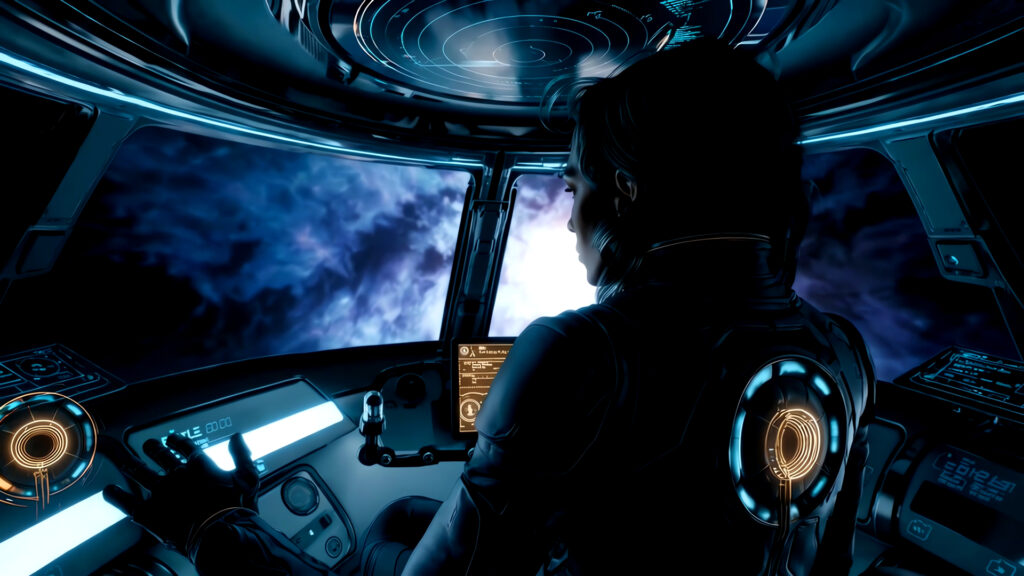
The spool looked like a scar the color of thunderclouds. It sat on a velvet square inside a pressure‑sealed vial, not turning so much as remembering how to. You didn’t pick it up with your hands; you picked it up with your oath.
“I need a name for the record,” said the clerk behind the counter. Her office floated at the edge of the Tangled Dock, where ships moored like insects under the belly of a sleeping leviathan. The walls were utilitarian alloy engraved by a patient hand into simple repeating tessellations—triangles drifting into hexagons, hexagons into twelve‑pointed starbursts. When the station lights dimmed for cycle-change those carvings did a strange thing with shadow, a faint color‑split that made them seem to breathe.
“Ilyra Vale,” I said. “Courier class. Solo.” I let my thumb rest on the imprinted pad. It tasted my blood and pretended to be surprised.
The clerk glanced at her slate, not at me. People who work too long where the Dock meets the Loom learn to look slantwise at reality. “Destination?”
“Uncertain.”
The smile she gave me was the bureaucratic version of a shrug. “Then I’ll put Anomalous / Designated by Cargo.” She slid the vial through the pass window. “You know the penalty for threading without registration.”
“I’ve never pretended otherwise.”
“Then sign the waiver that absolves us of ever having known you.” The clerk’s smile became human. “And don’t die in a stupid way.”
I slotted the vial into the Spindle Heart I wore over my sternum and felt the little tremor go through my chest. The Spindle was a ring of spun glass riddled with filament paths; when it accepted cargo it warmed like tea between hands. The moment the spool touched its cradle, the filaments shifted and the warmth became a soft, insistent pulse—not yet and hurry at the same time.
My vessel waited in Bay Thirty‑Two, a small thing built for stupid jobs. The hull had the matte look of an instrument that spends more time listening than shouting. Three phase‑sails folded along her spine; her name, stenciled under the docking lights, had been painted and sanded off and painted again until it refused to take any pigment. Names cling and weigh. I called her Ravel because she unmade tangles.
Docking clamps sighed; bay doors yawned like the eye of an animal that forgives you for riding in its skull. Ravel pushed away from Tangled Dock and let the black close over us like cool water. The Spindle Heart ticked in my ribs. The spool pulsed once, as if testing my attention.
“Go ahead,” I told it. “Point.”
It didn’t point. Impossible threads never do. They incline. It was like standing in a room where a good song has started somewhere nearby and knowing which doorway will make it louder. My hands did a thousand familiar things in response—trimmed the vector, unfurled the first sail, feathered the second. Ravel angled toward a star that wasn’t there and away from one that was.
Shapes came out of the dark as we fell: sheets of ice that had learned to flow without melting, beetle‑black debris gloved in frost, and once the graceful stem of a cap‑field—a slow‑growing orbital garden of mushrooms anchored on a dead satellite. The stalks listened to the vacuum; their caps were immense, red as new rust, and their pores sifted spore‑light into what passed for wind. The cap‑fields cleaned up space where old wars had condensed. The spool in my chest went very calm as we slid past, the way a child quiets when you pass a certain corner on a certain street for a reason you never learned.
Ravel shook herself as we slipped into the Loom proper.
Some people think the Loom is a metaphor. It isn’t. If you stand far enough back from the plane of any galaxy and squint, you can see the filaments. Dark matter, crimson‑shifted nebular dust, slow rivers of iron under light—it all curls into threads and knots and braids, and those are not poetic terms. They are navigation. The Loom is where routes behave like fabric. You can catch the right stitch and ride.
There are maps, of course, but most of them are wrong in important ways. The Loom changes when you look at it. The maps that don’t lie are kept by people who don’t sell them.
I have never sold a map. I carry them.
The first tug came as a sideways ache in the teeth. Ravel’s coils creaked, the sail ribs flexing. A path unfurled just outside the window—a faint, shimmering seam, not luminous but more real than the dark it passed through. The Spindle Heart warmed. I tapped a thruster, and we inclined our way forward.
As we slipped into that seam, the world split along three subtle spectra. It wasn’t color so much as interpretation: the way red means heat means urgency means danger means a berry worth finding to someone else. The Loom does that. It runs your senses through prisms. The first split turned the field of stars into a triptych: leftward, everything leaned blue and far; rightward, it warmed and drew near; center, it stacked in a way that made distance feel like a habit rather than a law.
Breathing helped. Even couriers forget that sometimes. I synced my in‑and‑out to the pulse in my chest, the Spindle’s beat, and the split held steady like a chord that tolerates being tuned.
We slid through hex‑ripples that trembled the way a pond does when insects tap its surface. Those waves weren’t water, but they behaved like it when they met our hull. They passed through with a soft consonant sound I could feel in my jaw more than hear, like a hum a cathedral swallows.
“Don’t name that,” I told myself. Naming things pins them. The spool wanted to stay light.
Ravel and I made the first braid on instinct—slip, catch, slip, and back—our wake weaving behind us in a pattern I’d never seen. Impossible threads ask you to trust patterns you haven’t learned yet. The Loom isn’t malicious. It’s too old for that. But it does enjoy a good test.
The first test wore a badge.
It came in on a line as straight as an accusation: a needle‑nosed craft with a body like a sharpened spoon and a wake that smelled like burnt sugar inside your skull. Its lamps were cold white; its vector said enforcement. My slate pinged and printed a warrant on my window, right over the view of the Loom. MINISTRY OF DIRECTION crawled across my field of stars, all gracious capitals and legal clarity.
“This is the courier Ravel,” I said. “What are you doing in a place that refuses to be measured?”
A polite voice cut through on a shared band. “Ensuring commerce does not become theology.”
“That’s a profound way to say ‘confiscate.’”
“We received a declaration of Impossible Transit filed fifty‑four minutes ago by—” A pause. “—an office at Tangled Dock that appears to have been dissolved twelve years back. Could you explain how you lodged a contract from a dead room, Ms. Vale?”
I didn’t answer. The clerk had slid the vial through the window without a flourish, but I had noticed her hands. Old scars laddered her knuckles, the kind you get handling filament under heat. I had never seen her before today.
The spool pulsed. Incline. It was not afraid of the Ministry; it was bored.
“Ms. Vale,” the voice said more gently. “Ravel is small. Your coil tolerances are good but not indefinite. Phase‑sails fail at bad times. Just drift. We’ll lace you to a safe lane and sort the paperwork where it’s warm.”
The Loom parted to show me a lace: three angled seams intersecting to make a neat star. The invitation glittered with the obviousness of a banana peel in an opera.
“Ravel, hold.” I pulled the third sail half‑free and angled us into a vector you would never file. The triptych of the starfield leaned, the left panel breathing tidal blue, the right going honey‑warm, the center tightening into a tense, clear grid. The Loom does not consent to being ordered, but it does allow conversation.
“I’d wager you don’t get paid by the chase,” I told the Ministry pilot.
Silence, which is the sound of someone deciding whether to pivot to threat.
“You see that seam opening at your starboard?” I asked, because he didn’t.
He craned; I could hear it in the click of his jaw against his mouthpiece. That seam wasn’t a seam. It was a mycelial relay—one of the fungal cableways that grew between structures where the Loom thickened against civilizations that had learned to cooperate. A hypha runs between nodes. Ships like mine can ride them if we speak in the right grammar.
“You’re too slow to catch me on it,” I said. “I’m too small to be worth your missiles. Let’s not teach each other bad habits.”
“Ms. Vale,” the pilot said, weary now. “You think the threads want you. They use you. When you’re no longer novel, they will slough you like dead skin.”
“Then I’ll go be skin somewhere else.” I cut the channel.
Ravel slipped into the hypha and everything turned biological—not gooey or sentimental, just precise in the way living structures are. The tunnel we rode was velvet dark with a coherent sheen; my instruments ticked in polite confusion and then confessed ignorance. In the hypha, traffic moved in pulses, not intervals. I matched breath to light. The Ministry ship blinked out behind us as if swallowed.
The Spindle Heart beat hard enough to ache. The spool did not warm; it cooled, the way a fever breaks when you think you’re dying. I swore without being angry. I knew that sensation. The cargo was changing itself. Impossible threads do that. They recode based on the corridor they pass through, like letters rearranging between envelope and destination. That’s why the Ministry hates them. Templates resist power.
We exited the hypha into a lattice zone where space decided to be obvious about its geometry. Planes arranged themselves at angles that made your eyes do math. It wasn’t hostile. It was clarity edgelit into discomfort. Shapes pulsed in right triangles and saucer‑stacked ovals; they weren’t signs, but they had the grammar of signs. If you let your vision go soft enough to stop naming, you could feel what the angles wanted you to do.
I did not steer. Steering would have been an insult. I agreed.
The first destination presented itself as a building that could never have been built: three archways that were also one, corridors that refused to be arranged in any order you could draw. Ravel slowed as if she had arrived under an old friend’s balcony. My slate tagged it ATLAS ROOM without my permission, which was irritating and correct.
Inside the Atlas Room hung maps that weren’t maps. Threads stretched between anchor rings, and on those threads were beads made of moments. I don’t mean artifacts or recordings. I mean the actual hinge‑points of histories strung like seeds, each seed a decision.
The spool in my chest recognized the place with a relief that made me dizzy. It uncoiled a little. I felt it, like a sigh against bone. My hands had to grip the console to keep them from helping in ways that would only tangle.
“Atlas,” I said. “I brought you something I don’t understand.”
The walls did not answer. They tilted into a listening angle. My voice fluttered in the room and then found a perch.
“This thread filed its own contract,” I said, because saying it aloud kept the world honest. “It used a dead office. It inclined along cap‑fields, drank a hypha, played light with a lattice. I think it’s trying to reach a place that doesn’t exist yet.”
The air learned a tone. “Correct.”
I startled only a little. The voice wasn’t a human voice; it was interval, three pitches yes‑and, stacking into a single assertion. The Atlas Room did not have a visible speaker, because the speaker was the math.
“What do you want with it?” I asked.
“Release. A city asks for a seed of journey. The city is not woven. The seed will tell it how to anchor a first road.”
“Where is this city?”
A pause that felt like someone counting backwards to slow their heart. “Ahead of you, and behind you, and on a tangent. The Loom grows cities the way forests grow clearings. Some happen.” The voice softened, if interval can soften. “You are called Courier because you accept verbs as destinations.”
“I accept payment,” I said, because ritual matters.
“Keeping is a currency the Ministry understands. Sharing is not. You’ll be paid in roads that won’t betray you.”
That is a cruelly persuasive wage.
“Then tell me the next inclination.”
The room did not point. It brightened a set of beads along one taut thread and shaded the rest into patient quiet. The beads looked unremarkable until you stepped closer and saw the micro‑geography inside each one—a shore bent by wind, a walkway scoring a field of glass, twelve doors opening and closing like the blinking of an animal that isn’t deciding but doesn’t need to.
“Follow the beads until they stop pretending to be beads,” the Atlas Room said. “When the thread stops being a thread, you’ll be there.”
“That’s not how threads behave.”
“It’s a question.”
I left the Atlas Room by a door that looped me past where I’d entered even though it was the only door. The Loom does not care about your pride in knowing which way is out.
The beads behind us kept glowing as we moved, not to guide but to encourage. Their light was the color of memory you didn’t earn—that soft, guilty gold you feel when you’re told a family story you weren’t present for but have to carry anyway.
We crossed a field of ruins where the gravity had failed and then learned ballet. Broken superstructures rotated with the elegance of dancers practicing the same turn forever. We threaded a quicksilver stream that had learned to climb, droplets becoming columns, columns becoming a river that forgot down. Ravel’s coils sang; the Spindle Heart counted.
Twice I saw Ministry shadows far behind, the needles crawling the grid, patient and humorless. They couldn’t enter the hypha corridor without consent and they didn’t know where the lattice began. Their method was sheer time. Enough measuring will eventually mimic understanding. I respected it the way you respect erosion.
The bead‑thread led us into a quieting—space that felt muffled, as if wrapped in velvet. Sensors dulled; lights dimmed; the Spindle’s warmth became a cool kiss that slowed my pulse. I set Ravel to drift and unstrapped, because the room asked for the decency of standing.
The bead nearest my chest cracked. Not in a breakage way. In a germination way. A hairline opened and something true stepped out—route, yes, but smaller and more curved than any route I’d seen, a line with a habit, a path that might grow if you gave it air.
I held my breath because I was foolish and then let it go because the thread came anyway. It didn’t crawl. It leapt in three steps, from Spindle to hull to black—an elegant animal chasing where its pack had gone.
“Follow.” The Atlas Room’s voice was far now, almost shy with what it had asked me to do.
Ravel went obedient as a kite in steady wind. The bead’s issue—the small thread that wasn’t a thread—ran ahead like a spark looking for tinder. It led us into the Substrate, the place where matter shakes hands with intention. Mushrooms grew there, not like gardens but like fonts. Their caps were translucent, their stems firm as bone, their hyphae lacing between stones of frozen light. When they breathed (and they did), the air took on a clean chemical sweetness that reminded me of numbers. I knew better than to touch and I wanted to more than anything.
The small thread stopped at the base of one great cap and trembled like a needle that has discovered it is also a compass. The cap’s pores flexed. An engineer’s geometry rose inside my mind’s eye—triangles with thoughts, ovals with grammar. Not a language. A protocol.
“Give it to me,” said a voice that had no mouth. Three intervals. But different. Dusty, lower. Older.
“Who speaks?” My hand hovered a ridiculous inch over the console because humans still want to touch when they know touching makes no sense.
“An unbuilt city. We need a first way in.”
“Who are you built by?”
“Anything that learns to stand here without owning here. We’ve chosen a site under the Substrate where the hyphae have agreed to arcs and not pillars.”
“I have enemies behind me,” I said, because threat disclosure is an ethic even in lawless work.
“Then you have company. They will be late.”
The small thread flicked like a fish testing current. It wanted to go into the cap, not around it. I bared the Spindle and pressed its warm ring to the porous skin. There was a hiss, but not of pressure. A hiss of agreement. The small thread slid through like silk pulled through a needle’s eye by a tailor who cannot miss.
Ravel sighed. The hull brightened without light, like a muscle unclenching. My slate filled with lines that were not coordinates but behaviors—things a city does that become roads: way‑finding music; the curve of a public stair; a rule that says a door must be the same weight on both sides; a promise that a corridor will not change out from under feet except when asked kindly.
“Paid,” said the old voice. “When the city blooms, you will know. There will be places that are already your size.”
“That is a strange wage.”
“You accepted verbs as destinations. Accept nouns as gifts.”
I sealed the Spindle. The vial inside it now held a smear of gray that smelled like rain. This happens. Some cargo burns away and leaves temperature behind.
Ravel turned as if pushed by nothing I could name and we set out through a new seam that had not existed five breaths before. It felt like leaving a celebration early: the music still bright behind, your pockets unexpectedly full of bread you didn’t see anyone bake.
We made our way out of the Substrate the slow way, because fast looks like theft in places like that. Outside, the Loom greeted us with a color‑split gale—red leaning into copper, blue into chalk, the center panel singing thin and high. Ravel said faster without speaking; I gave her the second sail and part of the third. We had stayed too long. The Ministry shadows sharpened.
They didn’t hail, this time. They understood they were late. They cast nets—not literal nets but gravitational quilts laid across likely routes. They would have caught me if I had been the pattern their training taught them to expect. But the impossible thread had changed us, and good training never anticipates grace.
I cut all thrust. No engines. No lights. Ravel drifted like a petal past the nets, not resisting, just failing to be sticky in the right places. The quilts settled behind us into a sulk.
The Ministry fired a bright line. It missed. No one was surprised.
When the danger thinned to background habit, I let the triptych relax. Space flattened into the good old lie of distance: near, far, too far. Ravel’s coils cooled. My hands shook then, the way they do after you pretend not to be afraid for professional reasons.
The Spindle Heart ticked once. Not warm, not cold. Just present. The vial in its cradle held the rain‑smear and nothing else, but I could still feel the shape of the thread that used to be there. You feel absence like a weight. The Atlas Room had been right about the destination: I had reached a question and let the question answer.
I slept the kind of sleep you get after not dying. It is thick and poor in oxygen, and when you surface from it, there is a taste in your mouth as if you’ve eaten coins.
When I woke, the Loom wore a new seam where a seam didn’t belong. It was the kind of thing no sane navigator allows themselves to see: an invitation hidden inside an accident. My slate did not tag it. My heart did.
I’m not a mystic. I’m a courier. But you spend enough time on the Loom and you learn it isn’t mystical to follow a thread that wants you. It’s a kind of etiquette.
We entered the seam as one enters a stranger’s house: with shoes quiet and eyes down until invited to lift them.
Ravel sighed at once in pleasure. I felt it through the joists. This was home geometry. The seam braided around us and then settled into the shape of a street so good it made my throat hurt: the right width for three people to talk without bumping shoulders, the right tilt to carry rain to where thirsty ground waited, the right amount of space between edges for a market to bloom twice a week. There were no buildings. But the habits of buildings were there, waiting.
“You came back,” said the old voice, amused like a god at a child pretending it had a choice. “We’re not built yet, but some of us learned the trick of building without walls. Would you like to see the place where you’ll turn left even when you meant to go straight?”
“Yes,” I said.
We did. We walked a future block. We passed a square that refused to be a square and an alley that decided to be a courtyard at a certain hour. At one end of the seam lay a river that would one day hold boats, and at the other a ridge that had already learned to frame a sunrise. I thought of the Ministry ships crawling the old grid, nets in hand, sincere and doomed to catch everything that could be measured and nothing that mattered.
When I left the seam, I didn’t feel bereft. Some destinations are already yours even before you arrive. I had earned the shape of that curve, the way your feet find a route across a room you’ve never seen because someone kind taught you how to step.
I turned Ravel toward the Tangled Dock. The long way. Couriers learn to accept that rest is part of speed. The cap‑fields glittered as we slipped past their silent gardens. The hyphae hummed to themselves. The lattice zones flickered their cheerful do you see it yet? at any eye willing to unfocus enough to listen.
I thought about the Ministry pilot who had called the threads users. He wasn’t entirely wrong. The Loom does use us. It uses us to move, the way wind uses leaves to show that it is there.
Back at the Dock, the clerk was gone. The office where she had sat now housed a restaurant serving noodles slick with spice. Menus crusted the window where the pass slot had been. The booth had not existed twelve years; it had not existed yesterday. Both statements were true, and filing a grievance about that would get you laughed out of any room that mattered.
I signed my delivery with a note: Delivered to a city that has not yet admitted to itself. Payment received: roads that won’t betray me. There was a space for rating the client. I drew a thread that became an infinity symbol and let it stand as my score.
The Dock shifted to evening and then to night. In the night, musicians pulled soft tones out of instruments that looked like spiders made of glass. People whose jobs involved coordinates sat with people whose jobs involved prayers. The Dock is good at that: setting down cups between disciplines and letting laughter recalibrate the gravity.
I carried Ravel’s detachable coil to a repair stall and bought the kind of attention you pay with respect. The mechanic didn’t ask where I’d been. He patted the hull and told me to take better care of a ship that clearly liked me. That’s a kind of blessing. I put it in my pocket.
Three days later, in a sector cleaned of storms by sheer silence, my Spindle ticked again. The tick wasn’t a call to launch. It was a memory receiving a reply. Out my window, a seam stitched itself out of nothing, not thoroughly enough to ride but enough to say hello with the casual authority of weather.
On the seam were tiny curls, not beads. Each curl made the same shape as the thread that had hatched in my hands. Each glowed the way embers pretend not to.
The city I had paid for was practicing routes in a place with no streets yet. That is how you know a thing is alive: it makes rehearsal a kind of worship.
I took Ravel close enough to warm without intruding. Somewhere in that curlwork, I recognized a left turn I had not yet taken. It sat there like a promise. It was already my size.
The Ministry continued its measuring. That is not a failing. Someone has to keep the background honest. Their nets caught smugglers and tax cheats and once a ship pushing a weapon so stupidly cruel that even they seemed embarrassed when they released the footage. The Loom tolerated them. It even liked them at a distance, the way a forest likes fences far away from its heart.
I kept carrying. Most cargo was not impossible. Most routes obeyed. But once a quarter or so, something would slide across my slate—no name, no origin, Anomalous / Designated by Cargo—and the Dock would pretend a clerk had never been born while a woman with scars on her knuckles stepped behind a counter in a room no longer there and slid me a spool the color of thunderclouds.
I learned small courtesies that make impossible transit less war and more conversation. In lattice zones, you soften your gaze like a person listening to a friend confess. In hyphae, you clean your language of metaphor because those tunnels hear the shape of lies. In cap‑fields, you let the mushrooms count your heartbeats and let them set your speed if they want to. They don’t always. They like you best when you laugh without showing your teeth.
I grew older in a profession that doesn’t promise that option. The Loom stayed older than that and kept joking about it with auroras. Once, I saw a DMT‑clean cathedral at the edge of a collapsed dome—a structure made of ratios so elegant I cried and then got angry at myself for crying and then cried at that, too, until the math forgave me.
The city kept writing to me with small seams you could mistake for bad weather. It developed a market that will one day be famous for an hour at dusk when all its awnings breathe at once. It settled on a law about doors and then broke it in a way that made the law kinder. It learned to let people get lost in it and then find something better than what they were looking for. That last skill is advanced. If a city learns it early, you can trust it with the big reliabilities later.
One evening—if evening has meaning when you are three rotations away from any sun worth name—my slate pinged with a thread I recognized. Not the one I had delivered. Another that had learned from it. It asked to be carried backward, which is not an error. Some journeys return so that memory can be installed retroactively, the way a graft takes only when you cut back.
I angled Ravel. The Ministry silhouette followed on a nearby grid a little like a parent following a child and pretending not to. I did not resent them for it. You need someone in the world who believes lines are straight. It makes curves meaningful.
We cut into a seam that smelled like the first time someone opened a book in a house full of new paint. The Spindle Heart warmed the way anything warms when a lesson begins. The thread pressed against the glass and I unlatched the cradle.
“Where to?” I asked, ritual and sincerity in the same breath.
“To a woman who has not taken a job yet and thinks she won’t.” The voice in my ear made of intervals had learned to wink. “Leave the thread where she leaves her keys when she doesn’t want to forget them but will.”
“That’s not a destination,” I said, smiling like a fool, and we went.
We delivered. Of course we did. That’s what couriers are for. We carried an impossible thread into a room where it will wait for hands that don’t yet know they are capable. We set it down on a dish by a door in a building not built in a city not woven in a universe that still likes a good joke.
The thread made itself small. It curled like a sleeping animal. I watched it for a long time and then I left without locking anything.
On the way back, the cap‑fields exhaled. The hyphae pulsed like arteries in a painting of a saint. The lattice framed a sky so exact you could have measured your longing against it and found it precise.
The Ministry pilot hailed me once more, old politeness in his voice and a tired hope. “Ms. Vale, does any of this matter?”
“Yes,” I said. “And the worst thing is it matters even if you and I stop believing it does.”
“Then why do you do it?” he asked, not as a man safeguarding borders but as a person wanting a reason to keep working where work is hard.
“Because someone has to courier the questions,” I said. “Answers can call their own taxis. Questions need an escort.”
He signed off with a laugh I wasn’t supposed to hear. Either he will be the Ministry that learns to bend or he’ll be the one they pretend died in a training incident when he doesn’t. Both outcomes are normal.
Ravel and I angled toward the Dock. The clerk behind the counter may or may not exist when I arrive. There will be noodles in the office or a stamp or nothing. I will sign with a drawing that is not a signature and put my back into the act of not owning what passes through my hands.
I carry for a living. It looks like movement. It’s really a posture.
Out there, somewhere between lattice and hypha, a city is writing streets by practicing how we will walk them. It knows a left turn that fits the length of my stride, and that is a kindness I never asked for and still received. The Loom lets those moments accumulate like dew on a net made to catch mornings.
I am Ilyra Vale. My ship answers to Ravel when names are required. I carry threads that shouldn’t be possible and escort them to places that don’t exist, except they do.
When I sleep, I dream of questions with handles. When I wake, I check the Spindle for a pulse. It is never still for long.
The universe keeps asking.
I keep delivering.