I — The Beacon and the First Lantern
At moon‑zero, the meadow remembered how to breathe.
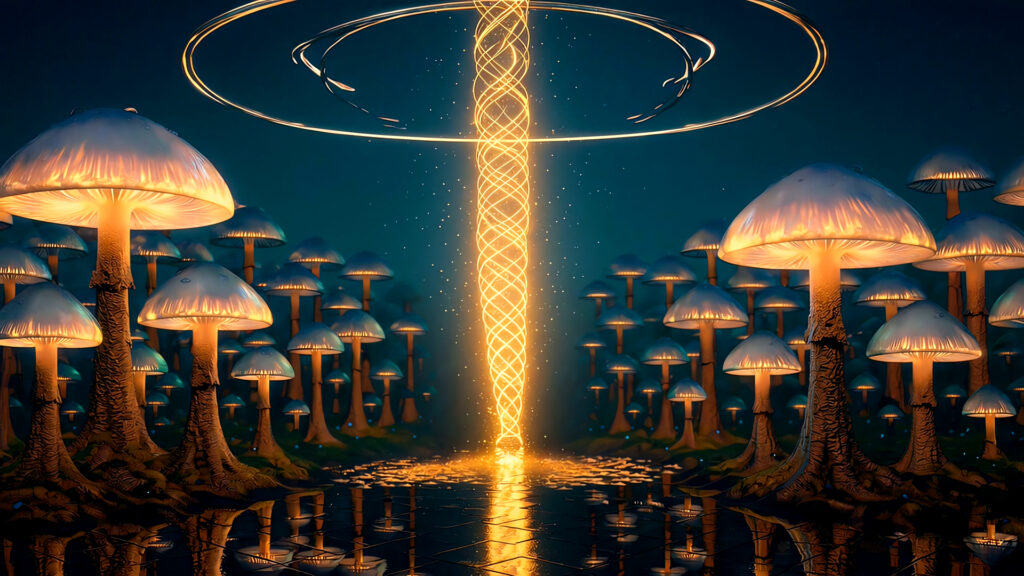
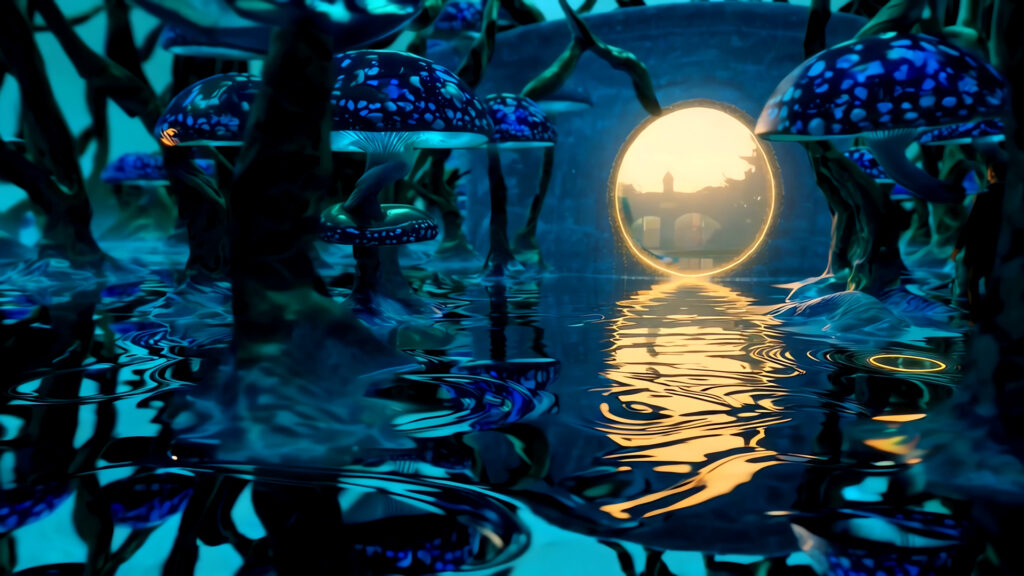
Its surface looked like dew until you knelt close and saw the dew was a crowd of micro‑lanterns—round as seeds, each holding a patient ember—the kind of glow you notice first in your peripheral vision. They were asleep, nested at the rims of opal‑capped mushrooms whose gills pulsed as if listening for a hand. The air tasted bright, with a citrus‑metal afterthought. Somewhere underfoot, a slow machine turned: roots counting, capillaries arguing, distance learning to be flexible.
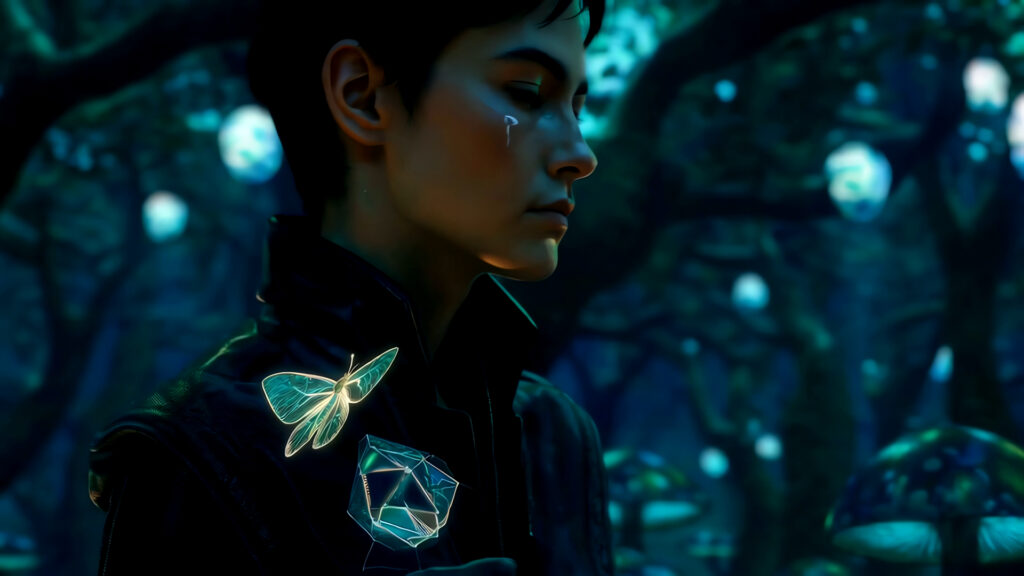
Iri arrived without sound, a dark coat unruffled by the sideways breeze. They had been told the Elsepath only appears to people who are not sure the next step belongs to them. That was true. Uncertainty had followed them for months, soft and insistent as fog. It had the shape of a coin they did not own, and the weight of a question that would not settle.
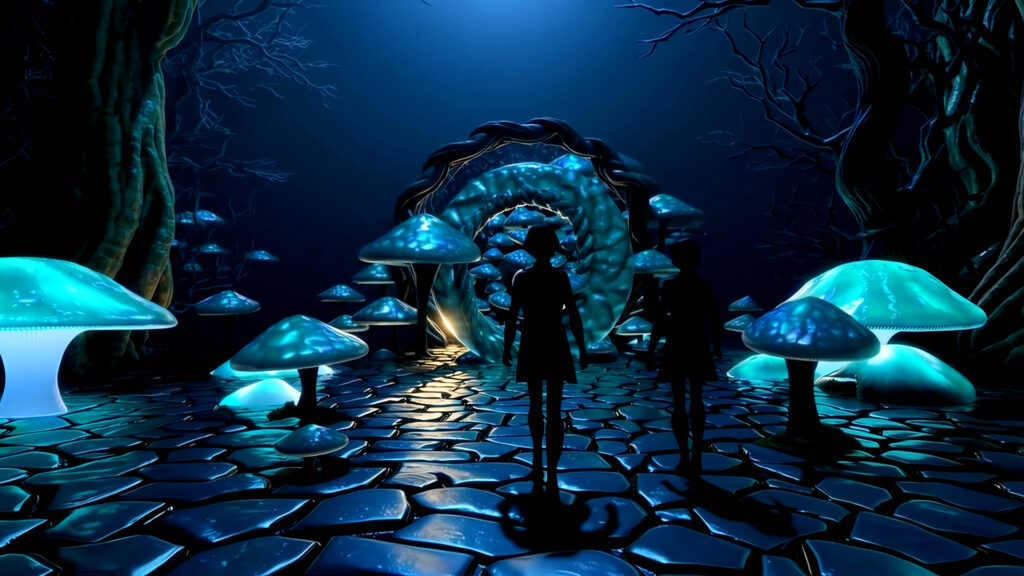
On this night, a Fractal Beacon uncoiled above the meadow like a spiral drawn by a patient giant. It wasn’t a tower or a flame but a geometry of light, threadlike and certain, rising from the mushroom field and stopping at a height that felt intentional. When it pulsed, hundreds of the tiny lanterns woke in a quiet shiver and lifted, no heavier than breath, to form a hovering halo of seeds around Iri’s shoulders.
“Lanterns of the Elsepath,” Iri said without speaking. It was not a spell. It was manners.
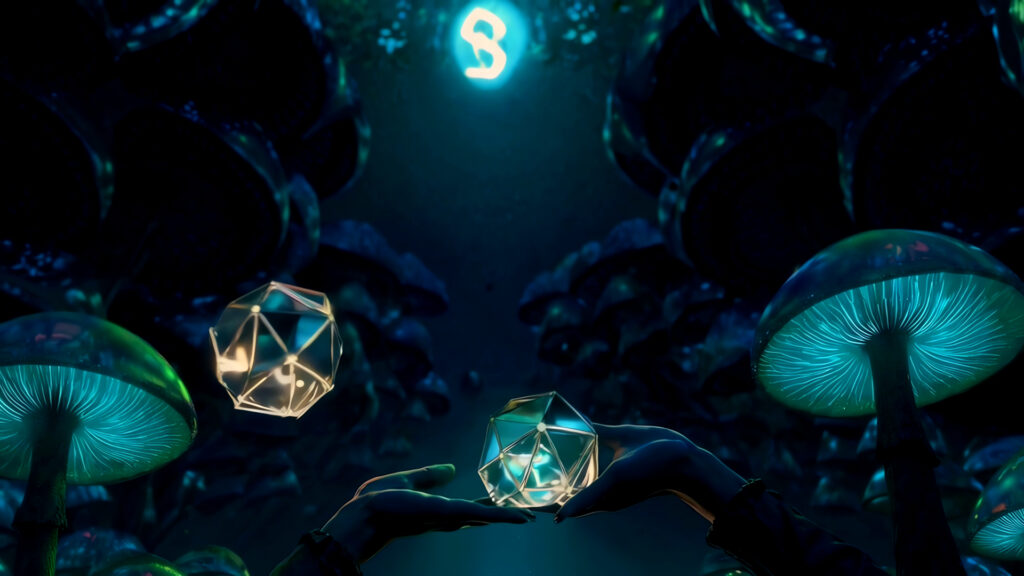
The lanterns answered by drifting into a pattern—three triangles arranged inside a fourth, lines of glow between them like veins in a leaf. The pattern hung in the air, rotated once, and slid forward, an invitation to follow. The Beacon brightened by a degree the eye could not measure but the skin could feel. The mushrooms nodded, gills opening, exhaling a faint, LSD‑like color split that sliced Iri’s silhouette into green, violet, and cobalt for a blink. When the colors rejoined, the Elsepath appeared under their feet.
It didn’t look like a road. It looked like an angle deciding to last.
Iri stepped onto it.
II — Lattice Footfall
The path assembled one stride ahead, one stride behind, never all at once: a lattice of glass treads supported by nothing, each step humming a tone you didn’t hear so much as feel as a temperature of blue. The lanterns gathered at ankle and wrist height, forming little way‑plumes that cooled when the foot was placed, warmed when it lifted, learning Iri’s rhythm with the eagerness of new rain memorizing a roof.
On either side of the lattice, the meadow folded into planes of possibility like pages that had forgotten which book they belonged to. In one plane, a fog of DMT dragonflies combed the air with thread‑thin UV trails, knitting invisible nets that only became visible when a lantern drifted too near and lit them. In another, the horizon had a seam—just a neat stitch of gold—where day and night agreed to shake hands.
After the sixth step, Else joined Iri.
It did not arrive from in front or behind but from beside, a thin 2‑centimeter refraction where air became a copy. Else was not a mirror; it was a vote from other possible Iri—prismatic, slightly offset, wearing the same coat, the same patient face, but carrying their weight on a different part of the foot. The lanterns split amicably: some remained with Iri, some adopted Else, and both travelers accepted this with the ease of swallows swapping branches.
The Beacon watched without blinking. The lattice kept inventing itself, step by step, over a shallow valley of mushrooms that sighed as if story and weather were the same thing.
III — The Parallax Orchard
The lattice softened into soil that wasn’t soil, and the Elsepath widened into an orchard of parallax. Trees grew here, but each branch ended in geometric fruit: dodecahedrons engraved with wind, pears of smoked glass with snow falling upward inside. The trunks were braided from mycelial cords, pale and sure, their crowns lit by lanterns nesting among leaves that felt like sentences you could sit under.
Iri reached for a fruit and their arm split into three intentions, stacked like pages, then rejoined. The fruit they chose weighed almost nothing. Inside it, a map of the orchard rearranged itself into spirals; if they moved the fruit, the spirals wrote new corridors. Else tapped one with a knuckle and it hissed out a trail of prism pollen that rose like a staircase.
Between trees, the mushroom caps grew taller—some as high as city gates—each cap veined with delicate circuitry. Every so often their gills flashed a breath‑of‑gills signal, open‑close, open‑close, that seemed tuned to the Beacon’s interval. The orchard listened to a rhythm that had nothing to do with sound.
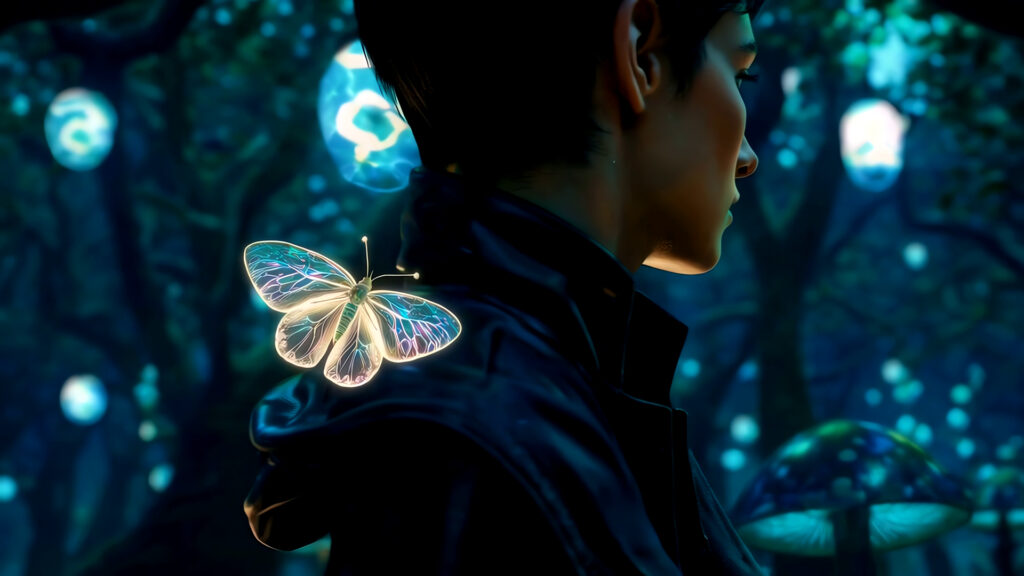
A coin‑moth settled on Iri’s shoulder: a moth the size of a coin, minted from frost, with wings inscribed in aurora script. It pulsed a small, courteous message into Iri’s collarbone: Your route is observed. Your lanterns are counted. The Elsepath approves your curiosity.
Else looked pleased in a way that Iri felt down their spine.
Ahead, a ribbon of air thickened. The orchard’s maps converged on a low, glassy structure braided across the ground like a spill that had decided not to continue. The lanterns drifted toward it, dimming themselves in what felt like respect.
“The Mirror Weir,” Else said, and for the first time, their voice could be heard, warm and unstartling, like the first line of a story you didn’t know you already knew.
IV — The Mirror Weir
At first, the Weir looked like a river made of liquid slate; then it looked like a contour map where elevation lines were made of mercury and the legend was a scent. When Iri leaned over it, a dozen reflections leaned back—twelve variants of themselves, each with a slightly different copper to their skin, a slightly different angle to their mouth, an echo glint in the eye that said, I am you, but not today.
The coin‑moth lifted from Iri’s shoulder and skimmed the surface, writing slow circles that sank without ever arriving at bottom. The lanterns organized above the Weir into constellations, each constellation an answer to a question Iri had not asked yet. Else reached into their coat and took out something Iri did not know they carried: a curl of saffron wire, thin as breath, humming like a sleeping ceramic bowl.
“What is the price?” Iri asked the Weir. One does not cross someone else’s memory for free.
The Weir rearranged its ripples into an answer: a knot. It wasn’t angry or complicated. It was simply what it was.
Else touched the wire to the knot. The knot changed its mind, remembering that it had once been a gate. The reflections in the Weir did not vanish; they stepped lightly away from being only images and became bystanders, gathering at the banks, applauding the decision with the polite noise of sleeves.
The path through the water appeared, not as stones but as permissions, and Iri walked it with Else. Their lanterns stayed raised above the water like small suns, unafraid. At the center of the Weir, the surface rose to touch Iri’s palm, and when it did, a single lantern—larger than the rest, copper‑cored—woke with a sound like a letter unfolding.
So named, it hovered by Iri’s cheek, flickering in three languages at once. It did not say what it wanted. It simply kept up, as lanterns do, and for a moment Iri felt less like they were being guided and more like they were family to a field of motion.
They crossed. The orchard exhaled. The Beacon’s spiral tightened by one imperceptible notch and relaxed again. Time leaned to watch.
V — Breath of Gills
Silence doesn’t travel at the speed of sound. It arrives everywhere at once.
The Breath of Gills is the place in the Elsepath where all moving things agree to stand still without becoming statues. Mushroom gills open and close like the lungs of a sleeping continent. Lanterns dim to embers and drift in predictable ellipses. The air makes room for your shoulders. You hear your heartbeat and it’s not a beat but a hover.
Iri and Else sat on a low ridge of cap‑stone while the coin‑moth folded into a small glass disc and rested inside Iri’s palm. The lantern—the larger, copper‑cored one—tucked itself into the hollow behind Iri’s ear and made no sound but felt like a friend at the edge of a laugh.
“What happens if we stay?” Iri asked. The question had edges.
Else considered the question as if it were a species you could catalog. “We turn into a chapter no one reads because it is always being discovered and never finished.”
“That sounds restful,” Iri said.
“It is,” Else said. “It is also a way to miss all the other kinds of rest.”
The Beacon hummed a single wordless syllable. The lantern above Iri’s shoulder brightened in agreement. Quiet, when it is done properly, isn’t absence. It is preparation. After long minutes or no time at all, both travelers stood, bellies full of untasted bread, and resumed.
VI — Knot of Directions
The Elsepath narrowed into a corridor of floating tessellations, each tile etched with a glyph that tasted like mint when you looked at it long enough. Some tiles rotated in place as if thinking. Some darted like minnows. Others pulsed and went still, like someone practicing how to be a lighthouse.
The lanterns flowed ahead, streaming into braids of light that recoiled from certain turns and insisted on others. The coin‑moth slipped back into the air, tracing LSD color splits across the corridor’s edge that revealed secondary paths hiding within primary paths—like discovering there was a whisper inside a whisper, and both of them had something useful to say.
At cross‑roads, Else raised a palm and the glyphs stopped moving. At dead ends that turned out to be not dead, Iri put a hand to the wall of air and felt its temperature—cool when it lied, warm when it told the truth. The corridor smelled sometimes of salt, sometimes of hot slate, sometimes of distant rain being rehearsed.
They passed niches where DMT dragonflies slept upright in cages made of their own past light. They passed an alcove where a mescaline sunflower rotated so slowly it took a minute to notice, its obsidian stem braced by a ring of lichen, its center a pinhole lens that watched politely and then resumed watching politely when they had gone.
Directions knotted and unknotted, and then the corridor agreed on a destination the way a flock agrees on turning. The floor swept down in a modest bow. Ahead, the air brightened like cloth catching on a nail. Something large and patient waited beyond.
VII — The Loom That Hums Maps
The Loom was not a machine so much as an audience of strings listening to one another. Cobalt threads ran east to west; saffron threads ran north to south; black‑honey filaments slanted in rebellious diagonals. Where the threads crossed, a hum gathered—intelligent, unhurried, willing to wait centuries for the right hand to adjust one tension half a millimeter.
Iri stepped closer and the Loom recognized them, not by face or foot or coat but by how their doubts weighed. The lanterns fanned around the frame and dimmed, as if unwilling to distract a nervous animal. Else stood slightly behind, profile warm with reflected light.
“You wish to chart Else,” the Loom said without sound. “You wish to find a path to a version of yourself who didn’t turn away on the day the wind shouted. We ask a price.”
Iri looked at their own hands and understood that the price would not be coins or promises made to other people. The price would be the story they told themself to avoid looking into a certain room.
The coin‑moth balanced at the edge of the frame. The copper‑cored lantern drifted to the warp and weft like a gentle star and lit a square of pattern Iri had not noticed: a map that hummed back.
“I’ll pay it,” Iri said, and told one true thing aloud they had not spoken even in private.
Threads tightened. The Loom’s hum stepped upward by the width of a smile. The map unfolded into a transparent scroll that didn’t unroll so much as awaken. It placed an angle of light into Iri’s chest where it would not burn. The Lanterns, all of them, brightened with a small restrained joy.
When the Loom sang again, nothing in the orchard changed except everything. The Elsepath shone underfoot in gold geometry that had not been there until now, and the air learned a new way to carry weight.
“Show us,” Else whispered, and the Loom obliged.
VIII — Hex‑Garden, Open Gate
The ground cracked itself like thin ice under careful boots, each crack choosing to become a boundary line. The meadow rearranged into a hex‑garden, tiles of soft light clicking into place with the satisfaction of a well‑fitted lid. At the garden’s heart, a ring‑gate grew from nothing: a lichen‑stone hoop threaded with living mycelial gills, inside surface rippling with mercury rain flowing upward and then sideways.
The lanterns arranged themselves in petals around the gate. The coin‑moth flew a slow figure‑eight, trailing hairline sparks like stippled stars. The Beacon’s spiral above condensed, concentrated, then widened, as if it had come to a conclusion.
“This gate opens to the Prismatic Court,” Else said. “Not a place of judgment. A place where laws exist before anyone decides how to use them.”
Iri nodded. “Let’s learn a law.”
They stepped through.
They did not fall. The gate did not spin. They did not burn or blur. They simply became else and also at once, which is what gates are for when they are built with care.
IX — The Prismatic Court
There was no roof. The Court’s ceiling was the weather of thinking. Pillars rose like frozen questions, glass‑clear with veins of chrome, each humming a single, polite note that did not demand attention but never stopped deserving it. The floor was a mirror that answered only by reflecting true angles; if you lied on it, you slid.
At the far end stood not a judge but a Lawshelf, a stack of thin, bright discs that looked like coins minted from promises. Between pillars, birds woven from LSD color splits perched and re‑perched with satisfying economy. DMT dragonflies drifted along the aisles as custodians, rearranging silence when it pooled where it shouldn’t.
The Court invited no speech, so Iri and Else walked in patterns, letting their footsteps spell. The lanterns hovered above the mirror, each a comma in a sentence being written across the floor. The copper‑cored lantern settled between Iri and Else and widened its glow until it included both.
At the center, the mirror pulsed once and birthed a coin of light—frosted, thin, with a living filament threading its interior. Iri reached for it and felt resistance, then permission, then the comfortable weight of a law that wasn’t heavy: When you step aside, you are not abandoning the path. You are learning to carry more than one at once.
Else nodded; the law bowed back. The coin slipped into Iri’s pocket and learned the shape of its neighbors.
Before they left, Iri knelt to the mirror and placed an index finger flat. The mirror accepted the deposit: a small rumor of courage to be compounded with interest for whoever came next. The Court approved without applause.
They turned, not because they were finished but because the Elsepath tugged at Iri’s sleeve like a polite friend with another idea.
X — Lacunae
Outside the Court, the world widened into lacunae—a meadow of pauses that were not empty but charged emptiness, like the page between chapters where the ink might go later. Everywhere Iri looked they found facets: prisms standing in the field like doorways that had chosen to rest on their sides. Each facet displayed a version of the moment they were living, tipped a degree one way or another.
In one facet, Iri wore a crown of thin metal that spun in time with their breathing. In another, Else had a shadow that walked a half‑second ahead. In a third, the coin‑moth had become a glass cicada and every word spoken lifted a wing from its back like a limit being revised.
They did not step through. The meadow didn’t ask them to. Instead, Iri pressed a palm to a facet where the sky had the exact color of saying yes, and the facet became warm. Not hot. Not cold. The temperature of permission.
They stood there long enough for a story to decide it belonged to them. The lanterns drifted into a ring, then a line, then a ring again. The Beacon above loosened and tightened, loosening and tightening, a lung you could mistake for a halo.
Else touched Iri’s shoulder. “We can go on or we can go deeper.”
Iri smiled. “Both,” they said, which was appropriate, and the lacunae rearranged to allow it.
XI — Sporefall Coda
The road home is never the road you arrived on, even if it insists that it is. When the Elsepath decided to end, it did so by turning into sporefall—not weather, not confetti, not ash. Sporefall is the memory of a forest choosing again, and when it landed, each grain wrote a fleeting, luminous letter on the surface of Iri’s coat, spelling a paragraph they would only be able to read in dreams.
The mushrooms bowed, caps tilting as if to say good lesson. The lanterns—thousands now, because every decision attracts cousins—gathered themselves above Iri and Else like an inkblot that had learned to sing. One by one, they dimmed, leaving the copper‑cored lantern last, which whispered along the jawline, not a word but a texture of trust, and tucked itself into the hollow beneath Iri’s tongue.
Not to swallow. To remember.
The coin‑moth performed a last small duty: it folded, refolded, and became a single bright grain that slid under the copper lantern’s light and nested there, its warmth proof against forgetting.
The Beacon above recognized that it had done its work with these two. It unspooled by one turn and remained, patient as the idea of noon. The orchard went on being an orchard. The Weir kept reflecting useful strangers. The Corridor rehearsed its mint glyphs. The Court hummed inside its permanent ethics. The Loom watched new threads arrive; it always has room.
Iri and Else returned to the edge of the meadow where the Elsepath first decided to become a road. The world beyond waited at a human scale—doors and cups and questions that didn’t require geometry. The law in Iri’s pocket adjusted its weight, making room for breath and bread and conversation with difficult relatives who aren’t difficult, only thorough.
“Was that the end?” Else asked, half to Iri, half to the path, half to the lanterns who were no longer here and also very much here.
“It was an end,” Iri said. “And also a beginning. The Elsepath seems to enjoy being accurate.”
They walked until the Meadow’s languages receded into sensible grass. But some languages, once learned, continue speaking no matter how far you go. The copper‑cored lantern flickered behind Iri’s ear when they thought a certain thought. The coin of light in their pocket warmed when someone asked for directions, even if the directions were about recipes or left turns or forgiveness.
Weeks later, when the moon forgot to be a circle and the wind shouted at a door, Iri found themself pausing on a threshold. They looked down and saw a single hex tile of soft, patient light under their shoe. No road extended from it, but permission did. Else stood beside them, two centimeters of refraction offset that never felt like a gap.
“Lanterns?” Else asked.
“Always,” Iri said.
They stepped through a door that led to a room, and the room to a garden, and the garden to a conversation about nothing and everything. In the corner, between the potted basil and the toolbox, a mushroom had decided to grow. Its cap was unambitious. Its gills opened and closed with the certainty of tide. For a moment, the home smelled faintly of prism rain. The DMT dragonflies that had once escorted them vibrated in memory only, and that was enough.
That night, Iri dreamed the Beacon’s spiral from below. It was quiet. It was busy. It was both. In the dream they held a lantern up to their own face and saw three expressions overlay into one: curiosity, relief, and the private humor of someone who finally knows the punchline will never arrive because the joke is the walk.
They woke with their mouth tasting of copper light—not metal, not sunlight: something that remembered both. Beside them, Else was not sleeping because Else did not need to, but they were practicing. Their face was calm, the little 2‑centimeter refraction barely showing, the exact degree of offset that makes a compass interesting.
Outside, the dawn failed to notice how many geometries had passed through this address in the night. It still did its dawn work—gray to gold, gold to ordinary. The mushroom in the corner politely declined the sun and glowed from inside in a way only noticed by those who had once crossed a Weir and spoken honestly to a Loom.
On the table lay a napkin with a crude map Iri had drawn—two turns, a circle, an X that wasn’t centered because centering is a kind of lie. Next to it, the coin of light sat in a cup as if this were the obvious place to put laws while you made breakfast. If someone had peeked into the cup, they would have seen the filament draw a single new line around the rim: Elsepath (local). The filament’s handwriting was impeccable.
Iri laughed, the kind of laugh lanterns adore.
They carried the cup outside. The neighborhood was just a neighborhood—wire fences, a cat considering murder, a delivery girl calculating angles of satisfaction and caffeine. But when Iri held the cup low, the pavement flickered, and for a second a hex‑garden appeared under the tires of a parked bicycle, and the bicycle became a chime that only the bicycle had to hear.
“Shall we find another Else today?” Iri asked.
Else cocked their head. “We never stopped.”
On their walk they passed a mural painted in color‑split bands, the artist unknowingly quoting a sky that had once taught Iri the taste of a path. They bought fruit with dodecahedral thoughts carved into the skin by an inattentive machine. They helped a stranger lift a box and were repaid by a story that left a warm tile under the moment for anyone else to step on later.
At noon, they rested under the only tree that still knew how to shake hands with the horizon. They ate the fruit and it tasted like fruit. The world layered its plausible noises into a single, forgiving choir. The lantern behind Iri’s ear warmed once and went still. The cup’s filament spelled nothing fancy, just a small, patient circle: home.
When the day folded back into evening, Iri looked to the east where fields might be, and to the west where the city kept its organized confusions, and felt the weight of a map that hummed back.
Then, in the margin of the moment, in the splice where two breaths trade places, they saw it: one quiet lantern bobbing at street‑corner height, humbled to the scale of stop signs and the patience of dogs. It had a copper heart and no intention of leaving without company.
Iri raised their hand. Else raised theirs. The lantern came to perch, as if it had always lived there.
“Direction?” Else asked.
“Forward,” Iri said, and did not try to watch what forward meant. They stepped. The street complied. The corner agreed. Somewhere out past the last fence, the Beacon rotated by one kind idea. The Elsepath—local, global, internal, seasonal—stretched, yawned, and made room for another story that had the same name as this one and a different ending.
The lanterns did what lanterns do best. They went ahead. And the ground, persuaded by their honesty, became a road.