The door appeared where the salt‑blue plain met the thought of a horizon. It had no hinges and no handle—only a seam of rain‑smelling dusk that traced a tall, thin ellipse in the air, as if the world had remembered an opening and then drawn it by reflex. Under the crust of the plain, pale threads stirred. They quivered like sleepers waking from long, accurate dreams.
Saephra stood before the seam, studying the faint letters gathering along its edge. Letters wasn’t the right word. The markings looked like frost, moved like ideas, and each carried a taste—copper, cedar, old stars. Saephra read them without eyes; the gill‑veils at their throat tensed and released, sifting the air for sense the way oysters tease salt from tide.
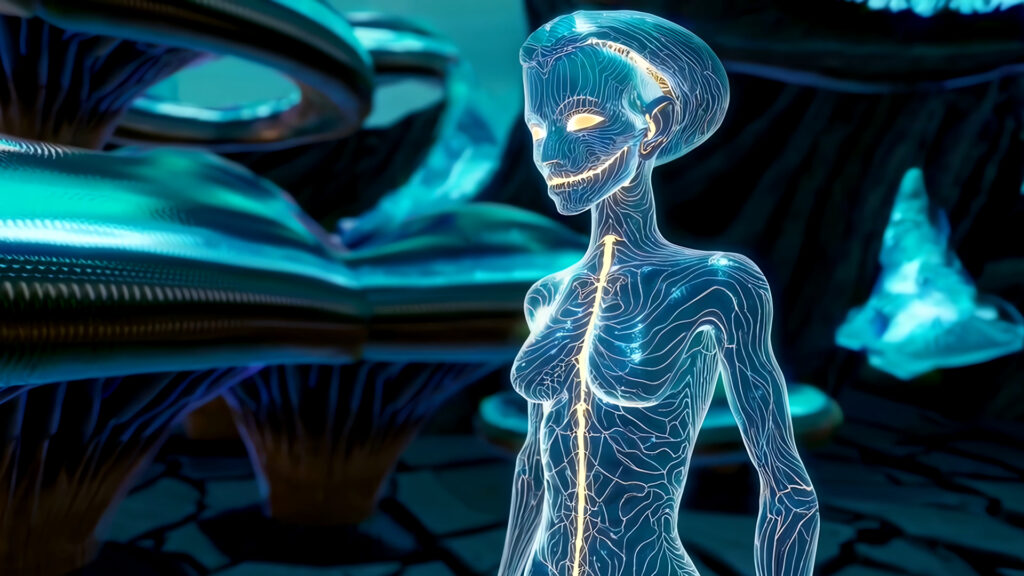
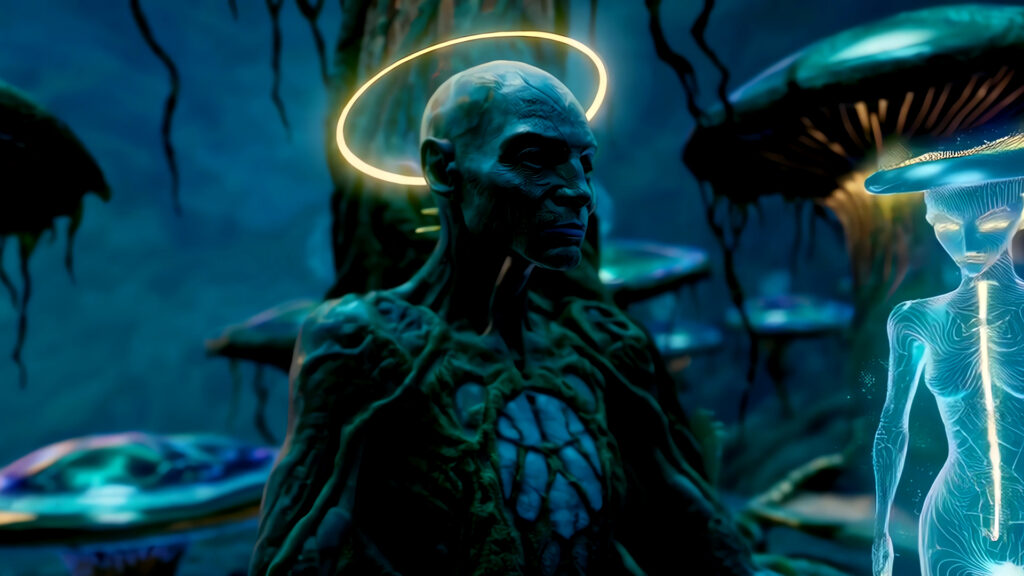
Saephra’s body shifted with the wind. Bones of smoked glass, flexible and resonant. Skin thin and living, patterned like a leaf—networks of capillaries that were not blood but hyphae, carrying light where blood might have carried warmth. Their hair wasn’t hair so much as a down of dormant filaments, pearl‑grey now, yet to bloom into the arcs and tassels that would name them Pilgrim. Above Saephra floated a halo the size of a tea saucer, a ring of dew held together by tension and will. It was a seed, coaxed from the Root Cathedral and entrusted to no one and nothing—until it had chosen Saephra with a voice like gentle thunder and a soft, inexorable tug toward this seam.
A wind came across the plain; it lifted grains of salt and secreted them back into the ground. The seam inhaled. Lichen script bloomed brighter, and in that instant the door became a door by ceasing to be a question. Saephra stepped forward. The seam opened, becoming a corridor lined with lamps that grew by themselves—a procession of mushroom caps as thin as coins, each one lit from within. Their gills were a cartographer’s daydream, filigreed and tight; when Saephra moved, the lamps’ light split into orderly, LSD‑clean bands, and the air arranged the colors into columns like a filing system for rainbows.
Saephra bowed to the lamps. Not a learned bow, but the courtesy that happens when a breath regards another breath. The corridor exhaled in answer, and Saephra felt the ground begin to change beneath their feet—if feet were the word for the yes‑shaped pads that loosened when they needed grip and rolled into glides when the road called for speed. The floor became threads. Threads became a road. Through the weave of hyphae Saephra could see a second sky, slowly turning under all other things, wheels within wheels: a patient star‑machine.
In the thread‑road’s gleam, the dew seed above Saephra’s crown shivered. It would be a crown if it learned Saephra’s path well enough to answer it. Pilgrim was not a title given; it was a shape the world would admit only when worn by someone already walking like a pledge.
They entered a hall where the road paused, the way a sentence pauses to keep from breaking. The hall was not empty. Prisms stood there, a court of faceted guardians arranged like a circle of wolves. Inside each prism, a version of Saephra walked in a slightly different age and weather. In one, Saephra had grown a vast mantle of hyphae flowing like a comet tail, and the dew ring had become a crown that threaded itself into the air above—constellations cabled together. In another, Saephra had chosen the Root Cathedral and lived inside its bellies of warmth, teaching little crowns how to balance on hope. In a third, Saephra knelt by a mirror‑water and learned to speak its grammar: not sound but surface.
The prism nearest to them rotated, and light split around Saephra until the room was bristling with soft razors. Their hum was not audible, only sensible—like learning. If the prisms had voices, they used light to make them. Saephra listened. They did not pick a prism. They did not smash any either. They stepped into the circle and allowed the court to turn them into facets and facets into clearer, finer faces of one whole. Standing in that disciplined clarity, Saephra said their first truth aloud: “I am the one who moves without forcing.”
The prisms bowed, edges inside edges bending like grass. The road restarted.
The corridor spilled Saephra into a bowl scooped from the air itself. The lamps dimmed until their crowns were a field of ember freckles. The bowl had a flavor: iron cooled in moonlight. The world loosened here. Time, which had been stepping along with Saephra so tidily they hadn’t noticed its company, set down its bundle and stretched. Sound thinned until it could be threaded through a needle. Saephra’s gill‑veils opened to their widest; their pulse slowed until each beat seemed like a clean note set reverently into emptiness.
From the bowl’s rim, a swarm of moths drifted down in a slow scroll. They were small as thumb bones and heavy as syllables. Their wings were printed with DMT‑geometry—repeating tiles too exact to be casual, hexes nested inside hexes until pattern felt like quiet intelligence. Their bodies were stitches of living gold. The moths made a slow, deliberate orbit around Saephra’s head, a coronation mimed in careful circles, then drifted over the lip of the bowl. A few hovered by Saephra’s dew ring, tasted it with their hummingbird tongues, and were satisfied by whatever truth they found there.
At the bowl’s center, something grew. It was a stalk, yes—mushroom‑born, but more than mushroom. Its stem glistened with the slow pour of mercury, and its cap was not a cap at all but a lens. The lens peered like an eye that had never been asked to blink; it observed without hunger. When Saephra approached, the lens tilted a little, as if nodding to a peer. The dew ring above their head spun once and came back to rest. Saephra reached out, touched the rim of the lens with one careful finger.
Ripples. Not in the lens, but in the world as seen by the lens—concentric rings of permission. In the ripple’s center, the thread‑road gathered itself from the floor of the bowl and made something like a promise: it reassembled from the fragments of footprints Saephra had not yet made. It was like meeting your own intentions walking toward you.
Saephra thanked the lens in the language available to their throat—breath squeezed through the gills so gently it became warmth without sound. Behind the lens, the air took a deep breath it had been saving. Columns of wind woke underneath the threads, pushing through stone grilles and leaving lace in their wake. The lace wasn’t fabric. It was a kind of mathematics that air performs when it feels seen. Patterns slid across patterns until the world felt like a friendly labyrinth. In that rising structure, colors behaved with exquisite discipline: one hue moving a fraction ahead of its neighbors, light splitting itself like a responsible river into clean tributaries. The whole place brightened as if it had found the switch for its own confidence.
Saephra moved again. The corridor widened into a terrace built out of thousands upon thousands of coin‑thin caps. The terrace rose to meet them not all at once, but obligingly—first under one foot, then the other, like a polite host that wants you to stride without concern. Every cap was a map. Every map contained a little kingdom of gills inscribed with histories of migratory rains and the addresses of friendly stones. When Saephra stepped onto each cap, it bowed toward them, and in the tiny movement the cap announced its oath to something larger than itself. Spores rose in their wake, not as dust but as galaxies that had agreed to be very small for a while.
The star‑machine beneath the terrace turned a notch. Saephra felt attention coil and then unwind into stride. They learned to pace their breathing with the terrace’s rising so their body and the caps’ courtesy would not argue. The dew ring above them shivered, quavered, and then, with a tender sound like silk consenting to be cut, sent out the first two filaments of crown. They climbed from the ring and arced upward, pairing the way parentheses lean into their work. Their tips split and split again until the air above Saephra looked like an illuminated draft—a mind rehearsing lace.
Shapes moved along the terrace’s far edge. Not enemies. Not friends either. Witnesses. Five Glass Harts, long as boats, sleek as the intent to leave. Their antlers were not antlers, exactly—arrays of prismatic panes hinged on whispers. Each time a Hart turned its head, light underwent temperament. The Harts’ hooves were polished obsidian that clicked quietly on the caps without bruising them. They stood like reading lamps in the wide room of the terrace, their bodies built to show the current weather of wisdom.
Between the Harts and Saephra stood three Archivores—moss‑skinned creatures with librarian spines, their ribs shelved full of ferns that carried the weight of well‑kept mishaps. Their eyes were stained‑glass windows depicting rooms they had never been in. The Archivores’ mouths were stitched shut, and still they could speak perfectly in the grammar of gesture and groomed silence. When Saephra came near, one of the archivores bowed from the waist in the old style and then drew a circle in the air with one green finger. The circle filled with frost‑script and boiled lightly as the moths’ breath touched it.
“Pilgrim,” the circle said, and there was no sound in Saephra’s ear, only care unrolled into a single word. “We have kept the path out of appetite. You will keep it out of attention.”
Saephra nodded. The hypha crown grew another thread.
The terrace did not end. It continued because it did not want to. The day—if this place had days—glided along, and with it Saephra. Their stride became a moving ritual of reading caps, bowing to Harts, acknowledging Archivores, and learning the texture of the hex‑tide that rose from the wind columns. Sometimes the air knit itself into a coherent honeycomb and lifted Saephra delicately so that they walked across floating tiles of invisible geometry. Sometimes the air tried on vines and draped itself over Saephra’s shoulders, heavy with the debt of scents—cedar, night water, copper laughter. Sometimes it learned to be mirrors and showed them versions of themselves passing through halls they could not yet reach, where every door was painted with the same seam of dusk.
In that long glide, travelers from other kingdoms stepped through briefly; they did not stay. A choir of Needle Seraphs descended from a seam overhead, thin as harp strings and jointed like praying mantises. Their halos were made from frost that refused to melt—eight‑lobed rosettes that painted numbers on the air with their cold. They wove themselves into a lattice and allowed Saephra to walk into their architecture. Every step changed the pitch of their bodies, but the change was not sound; it was the flavor of exactness rippling through a library.
Farther on, a convoy of Mirror Tortoises creaked along the cap edge. Their shells were mercury caught in the act of remembering stone; every step they took rephrased the light around them, and the scene answered with quiet grammar. A single Tortoise paused to look at Saephra. In the mirror of its shell, Saephra saw their own crown predicted at a size that made the ceiling bend. The Tortoise blinked so slowly that the blink was a meditation. Then it moved on, scraping the idea of patience into the terrace.
Later—if the word means anything when the world behaves like a hallway of agreeable clocks—Saephra met the Warden of Measured Shadows. This creature traveled at the edge of things the way clarity haunts the edge of confusion. It was tall and thin, built like a caliper someone had taught compassion. Its arms extended into precise lengths with little witnesses of bone; its face was a plate of matte slate with a single notch to indicate the mood of the world. It never made a sound. It would approach an object—a mushroom, a Hart’s antlers, the gill‑veil at Saephra’s throat—and cast a shadow on it that fit the object perfectly. The shadow wasn’t dark; it was simply the absence of panic. The Warden measured without diminishing. Saephra let themself be measured and found nothing missing that attention couldn’t teach how to stand up.
All the while the crown grew, thread by thread, and with each addition the dew ring lost a little of its droplet tenderness and took on the quiet certainty of architecture. The newest filaments lifted like antennae, then softened into branches, then wove a midair nest. The crown did not sit on Saephra’s head. It sat a hand’s breadth above, never touching, an orbit of acknowledgment around the intention that held Saephra upright. When wind passed through the crown, it made the air tactile, like silk learning to be useful.
Past the longest run of caps, the terrace funneled into a colonnade of spores suspended the way dust is, except spores have missions and dust has habits. Each spore carried a tiny ring of script. Saephra reached out, and one spore settled on their palm and showed them, in an instant, the blueprint of a small valley where rain knew which stones to flatter, which roots to argue with, and which nests to leave notes for. Saephra bent and breathed the spore into their gills, and the valley’s discipline became a sentence written in warmth along the inside of their throat. The crown above them answered with a clink of threads aligning; a golden thread ran through the center of the lattice and then went still, as if the crown had stitched a small valley into itself and was now carrying geography like a candle.
By now, Saephra suspected what the door, the corridor, the prisms, the bowl, the lens, and the terrace had wanted them to know: the crown was not a trophy. It was a loom. A way of weaving what the world had been listening to the whole time. If Saephra learned to notice well enough—and notice gently enough—the crown would learn to hold the noticed things without breaking them, and they would become Pilgrim not because of miles traveled but because they could move without forcing anything to become what it was not already trying to be.
At the colonnade’s end, the air thinned again into a shape that looked like the idea of the first door. Not a door: an outline. A line drew itself, erased itself, drew itself—like a pen practicing faith. Standing there was a creature that had not appeared before because the world had not yet taught Saephra how to see it: the Scriptor of Elseways. It wore robes of fog that hinged on rainbow joints. Its face was a mask of punctuation—comma eyelids that opened like questions, a colon smile that suggested future answers. Where the Scriptor’s heart should have been, a lantern swung, and inside the lantern a city made of patient turns stayed awake, windows lit, inhabitants slow‑moving and kind.
The Scriptor bowed. Their lantern swayed slightly, and the city inside paused in the act of turning a corner to see who had arrived. “Pilgrim,” said the air, which had become fluent in speaking without sound. “Hypha learns names when we agree to be named by what we are walking toward. You have carried the terrace as if it were light and not obligation. Your crown recognizes that you are a road with breath. Will you take the Oblique Vow?”
The dew ring above Saephra shone through its own threads. The crown had become something with both grace and policy. Saephra, who was never a child of anything except attention, lifted their face and let the gill‑veils flare open. “Yes,” they said. “Name me to my work.”
The Oblique Vow was not an oath in words, but in posture. The Scriptor showed Saephra a stance, and Saephra stepped into it: shoulders loose, throat open, hips hinged as if the world could pass through them without snagging; knees ready to go anywhere attention required. The crown scattered a handful of seed threads into the air; they didn’t land. They planted themselves in nothing and sprouted into little ladders leading to nothing, and the ladders pulsed, invisible rungs lifting and lowering like a breath training itself.
The Scriptor pointed to the outline. “This is not an exit. This is how a line remembers being a circle. Step through, and you will learn to travel by recognizing the exact present as the correct door at all times. There will be senses you do not own yet. They will become yours as the crown grows.”
They did not step immediately. Saephra turned and looked back down the length of all they had crossed. The coin‑caps glittered, a million tiny oaths catching and throwing light in ways that did not seem eager but did seem enduring. The moths made their careful orbits. The Harts’ antlers conducted philosophies. The Warden measured shadows that were now gentler because someone had seen them measured and found them appropriate. The Archivores maintained their shelves of well‑kept mishaps and looked satisfied that someone had taken the long way on purpose. The lens at the bowl’s center watched still, and that watching warmed the room like a well‑built stove. The prisms were busily considering their own edges. The corridor of lamps continued to breathe, extending itself without complaint.
Saephra smiled. On their leaf‑vein skin, the capillaries brightened; the crowns of the nearest lamps lifted as if saluting. The Scriptor lifted an arm, and the lantern at their heart swung like the slow start of weather. Saephra stepped into the outline and felt the world reorganize itself into a clarity that did not have scale.
They emerged into a place that had not been waiting, exactly; it had been practicing welcome. The ground did not look like ground. It was a field of suspended paths, each the width of a vow, crisscrossing in layers and moving with the slow certainty of plate tectonics. Above, not sky. A ceiling of mirrored rain that never fell, each drop a memory rehearsing the instant of letting go. Around Saephra, creatures moved as if they themselves were agreements. A troupe of Coil‑Bears unrolled ribbony bodies and wrote cursive into the air with their own spines. A trio of Lumen Viscera—beings made of distributed glow and minimal architecture—arranged themselves into a circle and attempted the ancient joke of becoming a wheel; they failed with such elegance that even the failures of the room felt like practice for good news.
Here, there was work. Not punishment. Work the way a seed works: reaching without straining. Saephra’s crown oriented itself toward an absence and was content. From below, the mirror rain lifted a droplet to hang in front of them. Inside it, a valley pulsed in need. Once, long ago, the valley’s hyphae had been taught to carry only the messages that soothed stones. Their discipline had become narrow, and the valley’s speech had been crimped by its own caution. Now rains arrived and could not find which way to break themselves. The valley’s gills were sore with unspent names.
Saephra reached up and touched the droplet with the back of their finger. It pushed into their skin like an acceptance letter. The crown loomed down a thread and stitched the valley into itself beside the earlier valley—both glowing modestly, like lamps built to light only a table while refusing to brag to the whole house. Saephra inhaled the exact amount of air necessary to begin a chore and stepped onto the nearest suspended path.
The Oblique Vow worked immediately. Where the path broke, Saephra’s attention stitched the break, and the stitch became bridge. Where shadows went brittle, the Warden’s discipline—remembered by the crown—softened them into articulate shade. Where a Prism Hart’s antlers framed two contradictory ways forward, the archivores’ modestly curated mishaps provided small, careful detours that resolved both contradictions without anyone being wrong. Where moth swarms congested into beautiful, useless ornaments, Saephra exhaled through their gills a wordless pattern learned from the lens in the bowl, and the swarm reconfigured into a scrolling road sign that did not boss the path so much as offer suggestions.
Hours or centuries passed—the crown didn’t care which. It acquired weight and then shed it in the same motion, like a thought that refuses to be heavy. It grew balconies where new threads could sit and watch older threads do their work. It stored inside itself a catalog of moments when noticing had been enough to alter the weather. It learned to cast a shadow on places that needed rest; the shadow did not darken, it merely cooled.
The mirror rain droplet grew warm on Saephra’s skin. The valley they had carried bent like a hinge and became a place into which they could walk. They did, which is how a promise becomes geography. The valley accepted them the way a well‑trained host accepts a guest who refuses to be impressed: kindly, lightly, with a good chair and a clean glass. Saephra crossed the valley and found the stone that had bossed the water. The stone was not a bully. It had simply been carved by a long argument. Saephra placed their palm on it, and the hyphae in the stone flinched and then remembered a wider correspondence. The crown hummed—again not sound, but the flavor of exactness. The stone moved itself half an inch to the left with the relief of a shoulder that has just learned it doesn’t have to carry a bag.
The rains returned, and now they had entrances. They braided themselves the way polite cousins braid hair. Spores wove across the valley, carrying messages beyond what stones could justify. A small wind, pleased with its own accuracy, made the rounds and checked on everyone like a good steward.
Saephra walked to the valley’s edge, let the mirror rain’s droplet slip away, and felt the outline door rise from the grass as if invited by the angle of their curiosity. The Scriptor of Elseways waited on the other side, lantern warmed by some new notion. Saephra stepped back into the field of suspended paths and saw that, where they had been, the crown had left a trace—a line of tiny ladders leading nowhere in particular, pulsing like sleeping birds.
There were other needs. A ridge of broken prisms that had learned the wrong lesson about sharpness. A grove of coin‑caps that had forgotten their oaths because the night had told them a flattering lie. A shallow sea whose mirror had cracked and never learned to stop apologizing. Saephra moved with the calm of a tool placed correctly into a waiting hand.
They never rushed. Even when importance came sprinting over the horizon with its heart in its mouth, Saephra let it finish its sprint and then taught it how to walk. Their gill‑veils became attuned to micro weather patterns in thought. The hypha in their skin bloomed mark by mark into glyphs only the crown could read. Sometimes, at rest, Saephra stood still for so long that small, grateful creatures built their nests in the shadow the crown offered; Saephra would move only when the nests grew quiet and the creatures were out on errands. They slept with one eye open and discovered that this meant nothing: sleep and wakefulness were neighbors of the same city and borrowed each other’s spices.
And if the room ever turned dark in ways that were not restful—if the air forgot its colors and the caps stopped bowing—Saephra would open their hands and let the moths arrive: DMT‑geometry bright as precise laughter, slow as consent, wings beating numbers into calendars. The moths would orbit Saephra’s crown and then drift outward like ambulances that didn’t need sirens. They fixed problems not by speed but by saying their names thoroughly. Problems capitulated to being seen well.
One day, or a day‑shaped interval in a place with poor respect for calendars, Saephra returned to the first corridor. Lamps still breathed. The prisms were polishing their options. The bowl’s lens watched with the warmth of a grandmotherly planet. The Harts’ antlers studied light the way scholars study a long‑worn path in an old garden. The Archivores tended their shelves of mishaps with a supervisor’s compassion. The Warden made conservative measurements and wrote no tickets.
Saephra looked upon these friends and not‑friends and realized there had never been an enemy in any of this—only angles that needed naming until they agreed to be less sharp. The dew ring, which once shivered like a newborn thought, had become a careful crown able to host strangers. It projected now a single filament upward and held there an unmade ladder, an invitation to anyone who could breathe well enough to climb.
“Hypha Crown Pilgrim,” the corridor said, the lamps all tipping at once like kind trees in a wind. “Will you continue?”
Saephra laughed, which is an arrangement of air that sometimes looks like defiance but is actually gratitude. The laugh rippled through the crown; ladders folded and unfolded. The outline door redrew itself one more time, patient as ink.
“Yes,” Saephra said, stepping forward. “There is always another valley to teach how to spill.”
They passed through, and the door practiced being a circle again, and the world, which had been content, became slightly more itself.