I. The Door That Breathes Spores
At the rim of the desert stood a seam in the air, hairline and luminous, like a scar that learned to exhale. When it sighed, motes unfurled into the dusk—opal dust and spore‑light that arranged itself into shy constellations. The seam smelled of rain that could not remember where it fell.
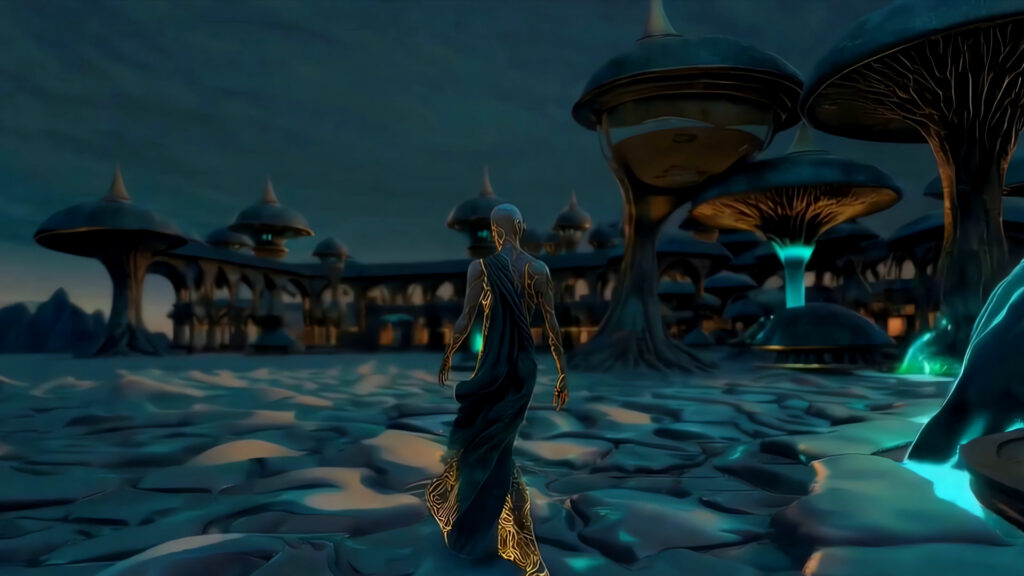
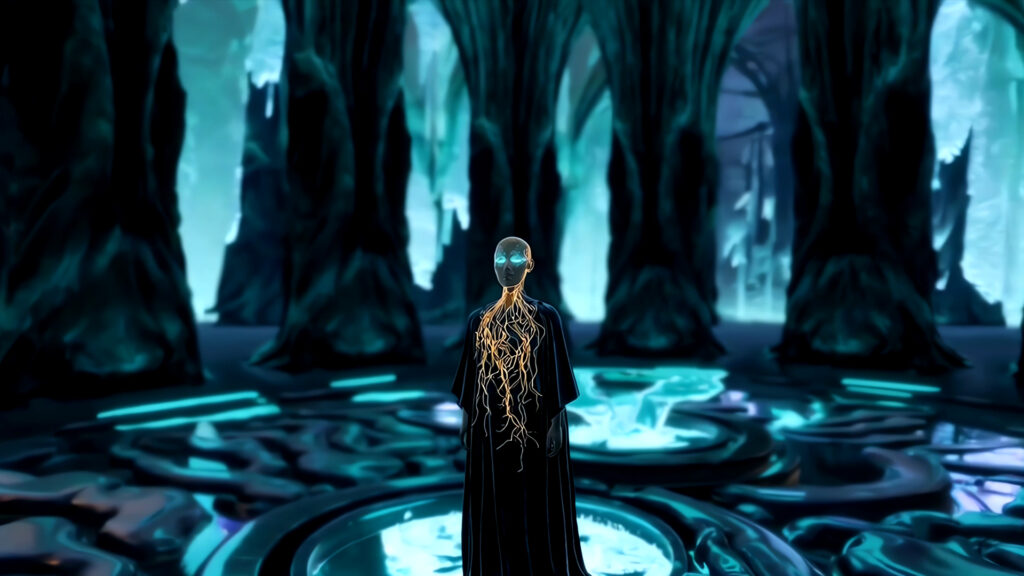
Aneleth arrived without footsteps. Their feet left no mark by design; their kind, the Mneme‑walkers, were sworn not to bruise the hours beneath them. Aneleth’s body was a study in glass and vellum: skin the color of quiet dawn, thin enough to show the rivers of gold filament that ran like patient lightning under the surface. Along the throat, a translucent veil fluttered—a gill‑lace that drank aroma and rumor. The eyes were coin‑bright and slow‑turning, with irises that gathered starlight, folded it, and kept it as a kindness for later.
They wore a mantle of mycelial silk grown in moon‑dark gardens, the threads still alive, still remembering the tunnels from which they had been coaxed. On Aneleth’s left wrist slept a ring of living wire—the Thread, a compliant serpent of gold that could smell distance the way others smell smoke.
Aneleth placed an open palm upon the seam. The air learned their shape. Spores swept forward like a soft tide, mapping the fingers, the lifelines, the old scars of vows kept and nearly broken. The seam widened, not as a door does, but as a thought does when it finds its opposite. Hyperfine cracks spread, diverged, and converged again in a lattice that suggested both invitation and correction.
“Let me in,” said Aneleth in the language of mineral patience.
The seam spoke back in fern breath: Come in if you can accept the arithmetic of forgetting.
Aneleth had come for that arithmetic. The Dunes of Liquid Memory waited beyond the seam, and somewhere inside those dunes lay the promise they once made in the Dark Orchard—the promise the desert had taken as collateral and never returned.
They stepped through. The seam stitched itself closed with a surgeon’s certainty, and silence rearranged its furniture to make room.
II. The Glass Dunes and Their Blooming Sigils
The desert was not sand so much as the idea of sand persuaded into matter. Each dune was a slope of congealed recollection, liquefying and resolidifying on its own clock. The grains were translucent and full of tiny occlusions—faces, gestures, half‑remembered weather. When the wind moved, the dunes flowed in slow currents, as if all memory wanted to be water but had first to practice being glass.
Beneath Aneleth’s feet, the surface tensed and softened in alternating pulses. Every step was a negotiation. Motes rose where they trod and blossomed into sigils: fungi‑glyphs that brightened with teal biolum, their gills inscribed with micro‑scripts that meant nothing today and everything tomorrow. On the slopes nearby, coin‑moths took flight, those delicate tetragonal beings whose bodies were frosted lenses and whose wings wrote aurora‑script in the air. They circled Aneleth in gentle ellipses, each orbit a murmured hypothesis.
“Guide me,” Aneleth told them. “Or refuse me, but do not pretend not to see.”
Coin‑moths were minted from promises. They recognized the taste of a vow on Aneleth’s breath and responded by arranging themselves into an arrow the size of a violin bow. The arrow pointed toward the heart‑dunes, where currents converged, where the desert kept its densest distillations.
Across the horizon, something moved like a rolling cathedral. Aneleth watched the approach of a Glass Hart herd, cathedral antlers catching algebraic sunlight. Their bodies were made of layered panes that flexed without shattering, each pane clouded by trapped weather, each hoof leaving a soft eddy in the dune stream. The lead Hart paused, pressed its nose to Aneleth’s veil, and inhaled the story of the traveler as if it were a perfume. Satisfied, it stamped twice—a sign of accord—before the herd continued, their steps ringing like far bells under snow.
The desert accepted Aneleth’s presence with neither malice nor warmth. It simply rearranged. The suns (there were two, one honest and one remembering how to be honest) shifted higher, and every shadow learned to be a corridor.
III. The Thread‑Road Wakes
The Thread around Aneleth’s wrist stirred as if dreaming of a former task. It unwound with courteous urgency, lifting its head to taste the air. Threads possess no eyes, but they remember tension; this one had followed many maps and returned from most. It sniffed the charge of the Dunes and chose a direction that was less a place and more an argument.
Aneleth spread their fingers, and the Thread flowed between them, knitting itself into a narrow road that extended forward over the liquid dunes like a gold filament bridge. Where it touched the surface, sand‑memories rose to examine it, then subsided with relief. The road sang a single note of alignment—inaudible to ears, audible to intention.
With the Thread‑Road beneath them, Aneleth moved more quickly. The coin‑moths escorted, weaving knots in the air that spoke the names of distant districts: Palinode, Syllabarium, Courtyard of Soft Silence, Archivory Street. Names found Aneleth the way rain finds the path of least resistance. They measured the distance in moods rather than in spans, and the Dunes obliged by bending.
Overhead, cirrus veils performed an LSD color‑split, where light pried itself apart into mint and cobalt and amber then stitched itself back together with visible seams. Far dunes briefly mirrored themselves and slid into place like tiles in a caring mosaic. If the Dunes owned a heart, this ribbon of Thread was its pulse for a while.
A figure coalesced on the railroad horizon—humanoid in the sense of comfort rather than echo. The being was long and uncluttered, joints marked by articulated light. Its face was all plane and angle, yet not unkind. In the space above its shoulders hovered a collar of calipers and measuring rods that adjusted minutely, clicking like the idea of rain on bone.
“I am the Warden of Measured Shadows,” it said without opening its mouth. Its voice was tidy geometry. “State your variance.”
“Variance from what?” asked Aneleth.
“From what is correct,” said the Warden. “All steps leave accusations. Every traveler asks the desert to forget on their behalf. You come to retrieve. That creates a debt.”
Aneleth lifted their hands to show the emptiness there—the honest kind of empty that knows what it once held. “I will pay with what I am permitted to lose.”
The Warden considered Aneleth’s shape, as if each curve and chord contained an answer to a proof. “Your margin is acceptable,” it decided. A caliper arm stretched to the Thread‑Road, touched it, and found its calculus harmonious. “Proceed, Aneleth of the Mneme. The first turning waits.”
The Warden stepped aside with the decorum of a theorem and dissolved into proportions, leaving behind a pleasant aftertaste of accuracy.
IV. First Turning of the Dunes
A shiver passed across the desert. Not cold—reorientation. The Dunes rotated as a city would pivot its avenues to meet a parade. Ridges aligned; troughs untangled; currents synchronized. For a lucid interval, every slope agreed with every other slope on the subject of where the traveler should go.
At the turning’s center stood the Hourglass District, where dunes stacked in opposing spirals and traded sand the way lungs trade breath. Each column was a tower of falling memory, each inversion a correction. Structures emerged: galleries roofed by translucent gills, colonnades of laminated shadow, plazas paved with fused recollection polished to an indulgent gloss.
Windows dawned where stone had not intended them. In each window, not reflections, but conjectures—eight alternate Aneleths crossed eight possible deserts accompanied by eight species of loyalty. One Aneleth carried a storm in a bag. Another conversed with a river that was also a rumor. A third walked barefoot and left behind a trail of growing orchids that argued softly with one another.
The Thread drew taut and pointed toward the center: a fountain whose water fell upward. In the rising column, sandflakes drifted like snow unsure of its allegiance. Aneleth leaned close, and a face formed in the climbing water, a face that resembled Aneleth’s but carried a different invitation in the eyes.
“Return the vow,” said Aneleth. “Return the word I gave to the Orchard before the Orchard knew what it was.”
The fountain‑face smiled like a law being temporarily suspended for the sake of art. Not yet, it mouthed with water lips. There is a break. There is a basin where silence is taught to sit. Go there, and we will adjust your access.
The hourglasses rotated again and the world clicked by a fraction of a notion. The Thread slackened, changed its angle by a measured degree, and guided Aneleth from the plaza of climbing water toward a corridor roofed by mushroom gills that breathed a slow, civil wind.
V. Court of Soft Silence
The corridor opened into a circular amphitheater of velvet basalt whose floor was a dark mirror, broken only by the slow fall of droplets that never reached it. Droplets hung in a ring at eye height, a halo of restrained rain. The air here was a padded room for thunder.
Along the circumference, beings of distilled hush sat or knelt or stood. They were Quieters, creatures shaped like cloaks draped over absent bodies, each with a single opal eye set in the sternum. When the Quieters breathed, the basalt drank sound. When they blinked, candles went out in distant houses for a fraction of a breath and no one minded.
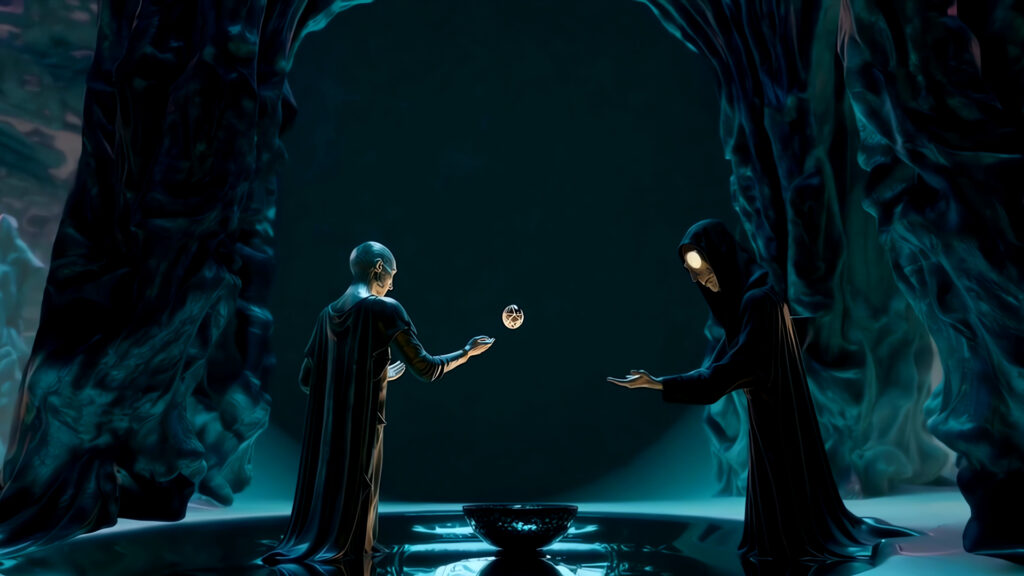
At the Court’s center lay a bowl on a low pedestal, full of mercury that had discovered ethics. The surface did not reflect but translated, offering shapes not as you were but as you ought to be to your better intentions.
Aneleth approached, palms open. “I request silence that is not empty but prepared.”
The eldest Quieter lifted its hem, revealing a lattice of whispered laws. “Drink,” it intoned, the opal eye brightening with responsible interest. “We do not hoard silence. We lease it.”
Aneleth dipped two fingers into the bowl. The mercury did not wet; it conversed with the skin in a language of thermal agreements. Under the veil, Aneleth’s gill‑lace fluttered and slowed, then slowed again. Thoughts quieted not by force but by being offered chairs and tea. In that stillness, Aneleth found the shape of the vow: not a sentence, not even a word, but a curve—the contour of an intention that loved persistence more than victory.
“Thank you,” Aneleth said, and their voice made no dent in the room at all. The Quieters inclined, alight with professional satisfaction. As Aneleth turned to go, a Quieter touched their elbow—no pressure, only a suggestion of adjacency—and pressed a tiny sable seed into their hand.
“For later,” it breathed. “Plant it where language misbehaves.”
Aneleth left the Court carrying a silence that made other silences feel welcome. Outside, the desert held its breath long enough for the Thread to locate the next necessity.
VI. Lantern Grammar
Past the Court, the Dunes dipped into a shallow valley whose floor was tiled in hexes of dark glass, each hex bordered by a barely visible line of copper. Here the air thrummed with syntax. Seed‑lanterns the size of teardrops lifted from sockets in the hexes and arranged themselves midair into strings that looked like constellations that had learned to conjugate.
They were Lexalumes, living punctuation that understood promise and correction. Each lantern carried inside it a small filament engine that spun golden thread into legible light. As Aneleth entered, the lanterns paused, then began to blink in measured intervals—shorts, longs, longs bound to shorts—a grammar forming at the edge of comprehension.
The coin‑moths hovered, fascinated. The Thread tapped Aneleth’s wrist like a mentor telling a student to attend.
“Teach me,” Aneleth said. “Or test me.”
The lanterns swarmed and resolved into lines and spirals, building diagrams in the air. Verbs grew ribs. Nouns sprouted gills and began to breathe context. Aneleth answered as well as they could, speaking with palm, veil, and the arrangement of stillness around their feet. Where their speech failed, they offered the sable seed from the Quieters and planted it midair. The seed expanded into a tidy branch of black honey on which hung fruit the size of commas. The Lexalumes cooed in collective approval.
From the branch, a single fruit fell and did not fall, arrested by grammar. It reformed into a key made of braided shadow and sweetness. Aneleth closed their hand around it and felt the coolness travel their arm with small careful feet.
A piece of ground ahead peeled open in a DMT kaleidoscope hinge, folding reality into symmetrical facets then unfolding it again, revealing a bridge composed of mirror panes welded by promises. The Mirror Bridge arced over a river of not‑quite‑mercury, its current full of scenes that might have been and might be again if asked politely.
The Thread grew eager, the way a compass needle perks in the presence of a mountain. Aneleth stepped onto the Bridge.
VII. The Mirror Bridge Ignites
When Aneleth’s foot met the first pane, the Bridge awakened. Light ran along its bones, soft and determined, like dawn figuring itself out. Rails formed at each side—one rail bitter with star remnants, one rail warm with memory in recovery. The river below flowed in slow confidence. Reflections rose and fell like breathing glass animals.
Along the banks stood spire‑shrooms, towering columns with lamellar gills that pulsed a teal aurora in steady intervals. Each pulse sent a lid of brightness across the Bridge that briefly rendered Aneleth transparent. Through their translucent skin, the gold filaments glowed. Aneleth looked like a map of someone’s beloved mistake.
On the third span, something surfaced from the river and kept surfacing. A Mirror Tortoise raised its head, mercury eyes peering through a veil of refracted rain. Its shell was a slow carousel of remembered rooms; its legs, four columns of patient deliberation. It placed itself beneath the Bridge and matched pace with Aneleth so that they moved together, one above the other, like two notes learning harmony without touching.
“I carry what sinks too slowly to be bothered with drowning,” the Tortoise said, voice wet with wisdom. “Do you intend to take from the river or give to it?”
“Both,” said Aneleth. “On alternating days.”
“Reasonable,” said the Tortoise, and dipped its head, satisfied that no theft was planned that would leave the water sulking.
At mid‑span, the air became full of snow that fell upward. Each flake, a short replay of someone opening a door and finding exactly who they hoped to find. Aneleth stopped to watch the snow ascend into nothing. They smiled without the mouth’s help. Then they continued, and the Bridge welcomed their weight with uncomplaining edges.
The far bank reared, sudden as a good idea. There, the Dunes formed orderly aisles, and between the aisles, stall after stall of beings tending inventories: the district called Archivory Street.
VIII. Archivory Street
It was a market that traded only in what the world forgot. The Archivores kept shop—beings with moss for skin, fern ribs visible beneath a translucent bark, and patient faces carved from last season’s green. Their hair was a crown of nested calendars. Each Arci‑vore wore a sash woven from the spines of books that had never been written down but insisted on being remembered anyway.
They greeted Aneleth with the affection they reserved for beings who arrived with silence properly leashed. “What do you seek?” asked the nearest, its voice like wind talking softly to a shelf.
“A vow,” said Aneleth. “I promised something to something. The desert took the promise and kept it. I intend to retrieve it, pay my debt, and leave the Dunes with a future that knows its work.”
“Ah,” said the Archivore. It reached into a drawer made of sleep and withdrew a glass vial containing a dried weather. “We deal in specific vagueness. Bring us a coil of your Thread. We will plant it, grow it into direction, and give you a harvest of certainty.”
The Thread tightened around Aneleth’s wrist in a reluctant embrace. “It will grow back,” Aneleth assured it. The Thread sighed in the language of metals and allowed itself to be clipped. The Archivore planted the coil in a pot filled with black honey soil. At once, a tendril sprouted, leafed, and became a small, insistent voice.
“This way,” said the voice, pointing as voices do by leaning toward the future. “The vow is kept by the Ring‑Gate at the rim where the desert practices being horizon.”
In exchange, the Archivore offered a jar no larger than a knuckle. Inside, a first wind chased itself around and around and never seemed to tire. “You will need this,” it said. “A gate knows many names. It prefers to hear the earliest one first.”
“Your kindness will be documented,” said Aneleth.
“Do not threaten us with paperwork,” said the Archivore, and smiled, fern ribs flexing.
Aneleth walked on, the pot’s voice riding inside their mantle, the jar of first wind tucked against their sternum where it could not startle any ideas into misbehaving. The Dunes, beneficent or simply cooperative, shaped a causeway from sand that held long enough for passage and then forgot it had ever been a road.
IX. The Gate That Learns Your Name
Evening leaned in, large and uncomplicated. The desert cooled into thoughtfulness. At the edge where sand meets not‑sand, a ring rose, stone rim banded with lichen that glowed the color of resolved arguments. Inside the ring, not stone, not sky, but liquid slate that trembled with a subtle appetite for honesty.
This was the Ring‑Gate, a device built by the Dunes to practice fairness. It knew the sound of nearly every name, and it enjoyed pronunciation the way others enjoy bread.
As Aneleth approached, the Gate hummed—not aloud, but in the bones—then began to speak names. It said the truename of the Mirror Tortoise, which was a riddle solved by a raindrop. It said the lineage of the Archivores, a branching melody of leaf and ledger. It said the original name of the Dunes themselves, a coil of syllables that smelled of salt and deliberate heat.
“And you?” asked Aneleth, standing within arm’s length of crossing. “What do you call me when you are not being polite?”
The Gate’s inner surface rippled. It tasted the old promise on Aneleth’s breath, the hush of the Court in their posture, the grammar of lanterns knitted into their gait, the tick of the Thread at their wrist, the truthful residue left by Glass Harts’ benediction. It inhaled the jar of first wind and exhaled a small, perfect cyclone of memory that died instantly and left behind the scent of minted courage.
Then it spoke Aneleth’s name the way rain names stone—softly, repeatedly, with conviction.
When the Gate said it, the name contained the vow. It arrived whole, without riddle or ash. Aneleth felt it return to the groove behind the heart where vows rest when they are not at work. Relief rose so quickly it startled the desert birds hidden inside the sky’s fabric. Aneleth swallowed the feeling gently, as instructed by better moods.
The Gate dilated, and the liquid slate thinned to the translucency of an argument that knows it will win. Through the opening, Aneleth saw an orchard made of ribs and bells, where trees wore leaves that were also lamps and fruit that was also verbs. The Dark Orchard, but awake now; not dark, not in need of rescue, only a partner wanting its portion of the vow.
“Remember us kindly,” said the Gate.
“I intend to,” Aneleth said. “Kindness is the most accurate remembering.”
They stepped through.
X. Interleaf: The Orchard That Returns What You Meant
It looked like a city had decided to grow on branches instead of on ground. Arches of living cartilage curved in intersecting domes. Between the arches, thin membranes trembled with the passing of small winds carrying seed‑sized lights. Mushrooms the height of stories tilted their roofs to hear the testimony of bees made from punctuation. There were no straight lines because nothing here wished to rush.
Beings tended the Orchard: the Librarian Hinge, a many‑jointed entity with books for elbows and a face the shape of a question that had learned to dance; the Ferryman of Syllables, hooded in silvery reed‑cloth, whose boat was the idea of a boat and whose oar was a long unbroken sentence that refused to end in anything so crude as a period; Glass Harts again, smaller here, tender and domesticated by proximity to fruit.
Aneleth offered the vow to the Orchard in the only way vows enjoy—by keeping it. They bowed, not low but correctly. The Orchard bowed back with entire groves, a bow that required time and the consent of every leaf. The Librarian Hinge reached out an arm that made three clever turns and touched Aneleth’s brow.
“You kept the shape,” it said, voice like amber poured onto parchment. “The Dunes filed the edges to a kinder sharp. Good. The world has enough careless points.”
The Ferryman of Syllables offered a sip of river from a cup woven of hyphae and light. The sip tasted like a door opening and finding exactly the right face. Aneleth’s veil fluttered with gratitude; the gold threads under their skin sang without sound.
“You will go back,” said the Ferryman. “The Gate expects you to leave as well as arrive.”
“I prefer to depart where I entered,” Aneleth said. “It keeps the arithmetic elegant.”
The Orchard approved. It set a single coin‑moth upon Aneleth’s shoulder, a small witness whose wings bore the story of the crossing in aurora script. The coin‑moth settled into the mantle’s living fibers with the right to be there, tiny head cocked, antennae reading futures like braille.
Aneleth turned to go. The way out was the way in, because fairness is more a circle than a line.
XI. A Plateau of Driving Grace
Back across the Ring‑Gate, the Dunes held steady, neither turning nor sulking. The Mirror Bridge lingered with the dignity of a promise kept. The river of not‑quite‑mercury made a sound like prescience mending a tear. The spire‑shrooms breathed their teal aurora in measured pulses, each glow a reassurance that the world continued to admire its own internal engineering.
Aneleth walked, and the Thread‑Road accompanied with less tension now that the object of travel had been returned to its pocket behind the heart. Along Archivory Street, the Archivores waved with fern fingers. One handed Aneleth a small book made of woven fog in which was written all the things Aneleth would remember later when the remembering became useful.
“Consider us remembered,” Aneleth said.
“We always are,” the Archivores replied, and if moss could blush, theirs did.
The Warden of Measured Shadows met Aneleth at the district’s boundary, its calipers at a restful angle. “Your variance now measures within polite limits,” it commented, and an almost smile assembled itself briefly across an otherwise serious face. “Proceed in confidence. The desert bears no grudge that survives a correct exit.”
Aneleth bowed by a quarter of a notion—the exact angle the Warden found agreeable—and continued until the dunes softened their shoulders and made room for an ending.
XII. Outro: The Seam Mends Kindly
The seam stood where Aneleth had left it, breathing spores with the reserved pleasure of a duty that fulfills itself by existing. Coin‑moths formed a slow wreath over the place where inside becomes outside. The suns nested low, the honest one and the one still learning, both satisfied with their assignments.
Aneleth paused at the threshold and turned back. The Dunes of Liquid Memory lay under the evening like a sleeping cathedral. In the distance, the Hourglass District rotated by some dignified fraction, aligning itself with a wind the size of a pronunciation. The river threw up a small celebration of spray. Glass Harts bell‑stepped along a ridge, antlers holding the minimal silver of the approaching night. The Ring‑Gate rippled once and then wore the sky again like a polite mask.
Aneleth stepped through the seam. It closed like a healed wound that keeps no scar from vanity. Outside, a lesser desert waited—common sand and ordinary weather. Aneleth inhaled, and the gill‑lace at their throat sifted the air for the residue of a place that loves promises enough to keep them when asked nicely.
Under the mantle, the vow rested where it belonged, touring the body like an inspector who does not wish to write any citations. The Thread, clipped and planted, had already begun to grow back, end tickling Aneleth’s wrist like a bored kitten. The coin‑moth on the shoulder slept with wings open, a habit common among punctuation that dreams in clauses.
Aneleth walked without leaving marks, as was their way. Behind them, the seam learned a little more about how to exhale.
The Dunes of Liquid Memory did what they have always done: they flowed, they forgot with exquisite ethics, they remembered with accuracy edged in kindness, and they waited with the patience only geography can afford.
And somewhere inside those dunes—the Orchards, the Bridges, the Courts that lease silence, the Streets that archive what you thought you’d lost—the world turned its face slightly toward mercy and held still long enough for someone to keep a promise.
Bestiary & Cast (for the map you cannot fold)
- Aneleth of the Mneme‑Walkers — Humanoid, androgynous; translucent skin showing gold filament rivers beneath; gill‑lace at the throat that breathes scent and sincerity; eyes that fold starlight; mantle of living mycelial silk; carries the Thread, a gold serpent of direction. Speaks mineral patience and grammar taught by light.
- Coin‑Moths — Frosted glass bodies; wings write aurora script; born from vows and minted by the Dunes; attracted to correctness; sleep with wings open to ventilate memory.
- Glass Harts — Deer‑like cathedrals with prismatic antlers; paneled bodies flex without fracture; hooves ring like bells under snow; sanctify crossings with nose‑touch benedictions.
- Warden of Measured Shadows — Humanoid of angles and light articulations; collar of calipers and rods; determines variance; speaks in proportions; fond of polite exits.
- Quieters — Cloak‑shaped beings with a single opal eye; collect and lease pre‑warmed silence; browsed by candles; their touch persuades rooms to soften.
- Lexalumes (Lantern Grammar) — Seed‑lanterns that compose syntax from filament light; reward correct planting with keys spun from shadow and sweetness; conjugate promises into bridges.
- Mirror Tortoise — Colossal, with mercury eyes and slow carousel shell; carries what is too patient to drown; approves of alternating generosity.
- Archivores — Moss‑skinned with fern ribs; keep stalls along Archivory Street; plant coils of Thread in black honey to grow direction; trade first winds and bottled weather for honest collateral.
- Ring‑Gate — Stone rim with lichen that glows like resolved arguments; inner skin of liquid slate; pronounces names with the precision of rain; opens to orchards that return what you meant to promise.
- Dark Orchard (Awake) — Arches of cartilage; leaves that are lamps; fruit that are verbs; tended by the Librarian Hinge and the Ferryman of Syllables; hospitable to vows returning home.
Thus the dunes flow on—glass, water, memory—each grain an alphabet shard, each crest a sentence trying for grace. And if, on some future evening, you see a seam in the air exhale spores that map your hand, you will know a gate is asking you whether you can accept the arithmetic of forgetting and the poetry of return.