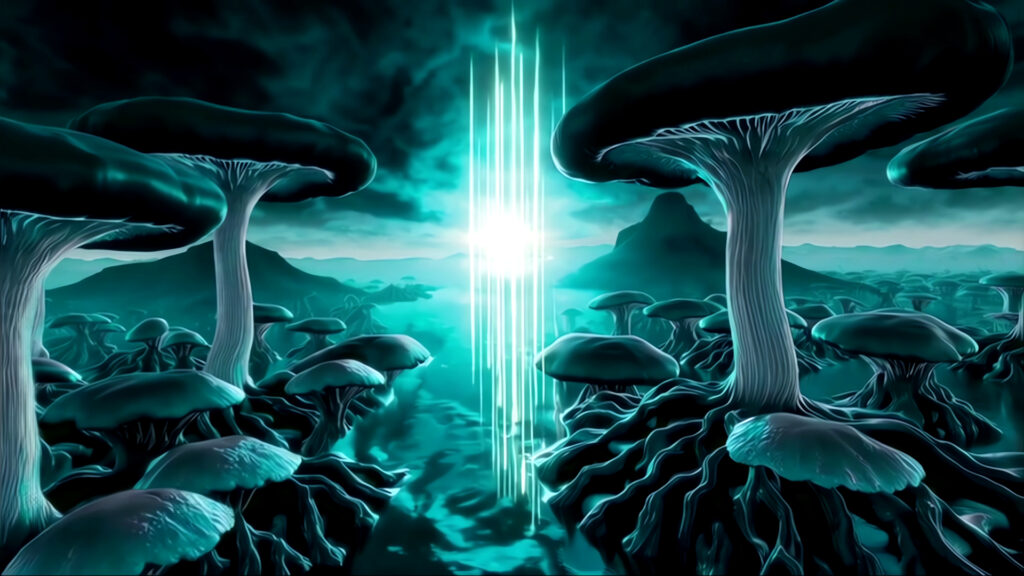
By the time the firmament loosened, the sky poured in threads rather than rain. Each filament was a liquid line of star‑light, silver at its core and haloed by shifting colors, a river falling upward as much as down. The elders called it Liquid Star Dawn, a rare hour when the night remembered its own birth and melted into rivers that ran between the worlds. It happened once in an age, and it unstitched distance. Roads grew out of it like veins. Gateways remembered how to breathe.
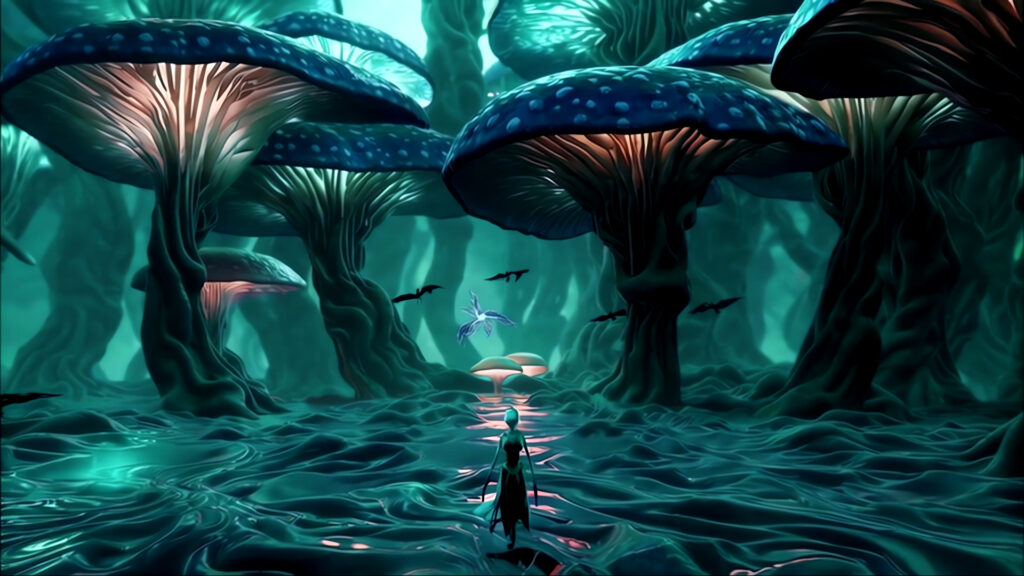
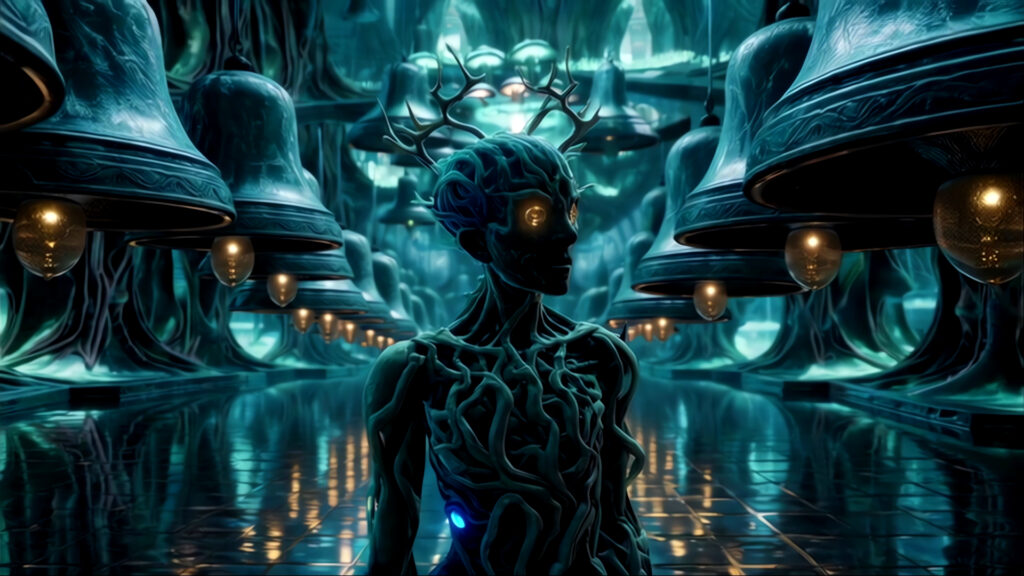
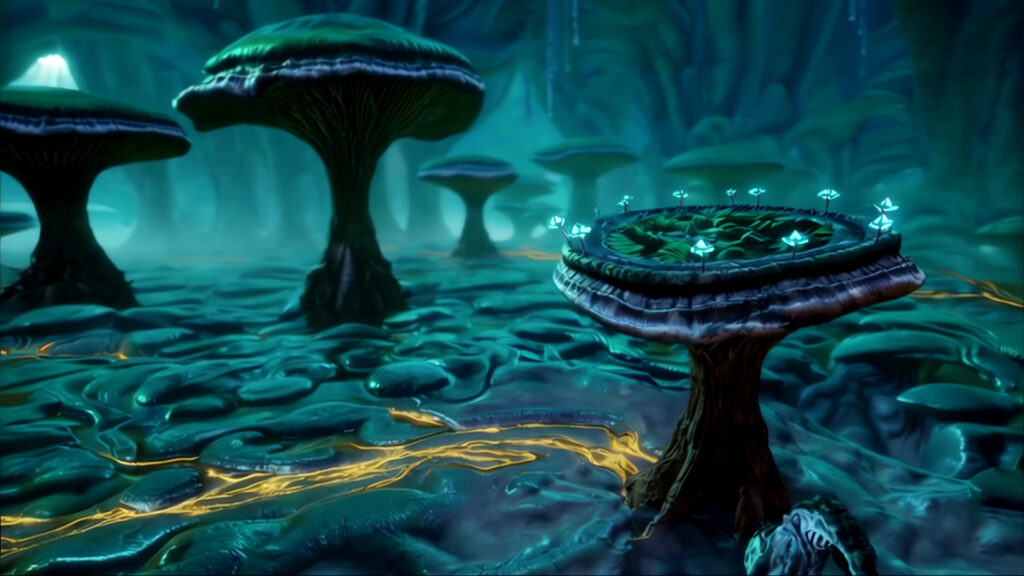
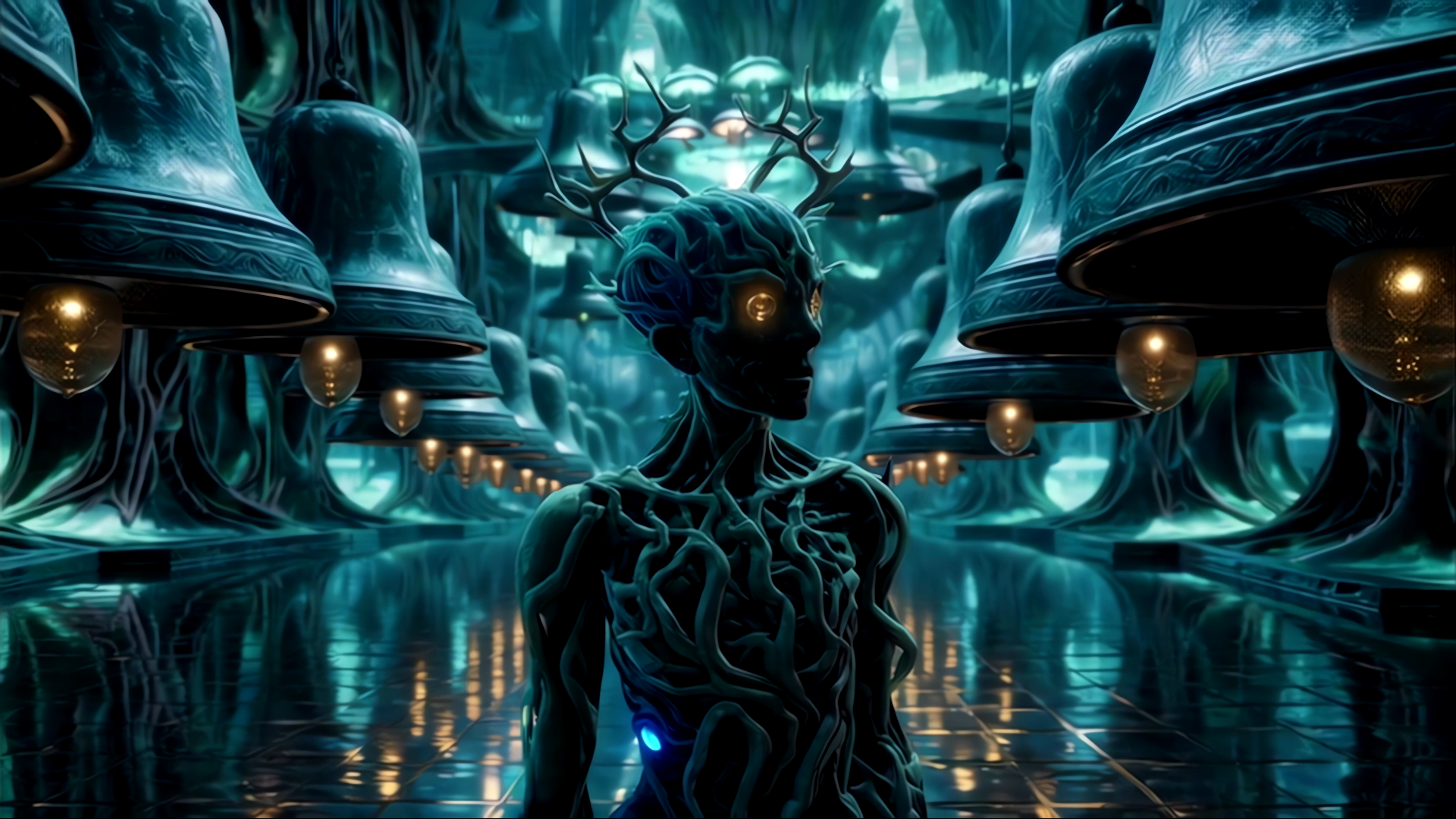
On the edge of a bioluminescent vale, where luminous mushrooms rose like spires and bells, a figure waited who was not made of simple flesh. Vaelith was of the Luminari Myce, a humanoid people whose skin was a tapestry of living threads. Soft blue light drifted beneath her filaments the way pulse drifts beneath translucent wings. In the dark, she looked like a map of constellations walking upright. Along her skull grew a crown of pale, antler‑like hyphae; each antler sprouted tiny lantern caps whose gills breathed faint, cold fire. Where others slept, Vaelith listened—to soils, to stones, to the small sighs the world makes when it changes its mind.
Liquid Star Dawn had been whispered across the roots for weeks before the sky finally unlatched. The Dream‑Mirror Tides—a bright, crystalline wind that turned reflections into gates—were said to follow the star‑rivers and shape them into bridges. Only myth had returned from those bridges, myth and the occasional traveler who came back with a new shadow, or none at all. Vaelith had been chosen to follow the first, brightest stream to its fount and bring back a draught for the sleeping Crown Titan far below the mycelial cathedrals. The Titan was the island’s dreamer; without its dreaming, forests would forget their own names and wind would forget to be kind.
Vaelith wore a mantle of night‑ferns and a belt woven of moon‑vine. On her palms, her filaments unfurled into soft cilia, quick to taste the air for changes. Slung over one shoulder was a lattice instrument called a chronophore, grown from the ribs of ancient shelf‑mushrooms; it did not measure time, but angles of possibility, the way a compass measures north. The chronophore rattled gently as the first star‑threads pooled into a shallow, shining river across the mushroom clearing.
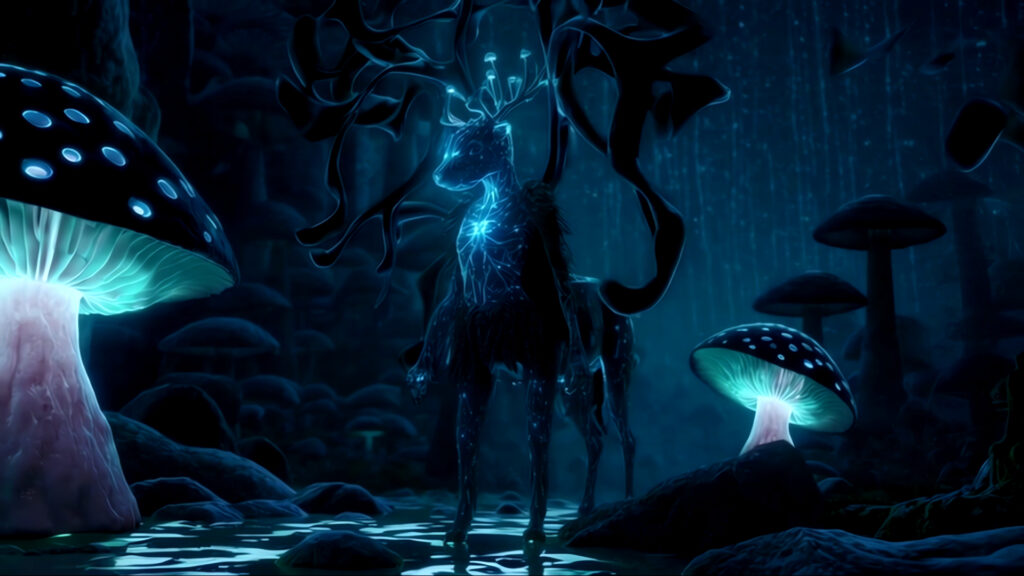
A silhouette lifted from the far side of the grove, taller than any stag, more delicate than any deer. Its antlers were a choir of intricate loops; its face was a mask of obsidian facets reflecting a horizon no one could presently see.
“Treadlight,” Vaelith greeted, dipping her head.
The horned being bowed, and its many eyes blinked in slow sequence, like a constellation shuttering. Treadlight was an Aether Cervid, a creature of the Dream‑Mirror Tides, summoned by the promise of Liquid Star Dawn. Its hooves did not touch earth; they visited it.
“You will want to step into the river before it remembers it is a river,” he murmured, each word blossoming as steam that smelled of iron and citrus. “Once it remembers, it begins to move.”
Vaelith placed one filamented foot into the star‑water. It was not cold. It was arrangement. It reorganized the sensation of foot into something that both rose and sank. In the reflection, Vaelith saw herself as a different species entirely—her antlers branching into galaxies, her hands a pair of jellyfish, her eyes two polished seeds. Then the Dream‑Mirror Tides blew through, and the image shattered into a thousand excellent doors.
Vaelith chose the door where her chronophore sang loudest.
—
The Corridor That Grew Sideways
She stepped into a corridor lit by the quiet aura of bracket mushrooms clinging to bent pillars. The space didn’t agree that it was a corridor; it thought of itself as a suggestion of forward. Walls leaned away, then back; stairs hove into view, then dissolved into angles. When Vaelith moved, the corridor moved too, like a polite companion adjusting its stride.
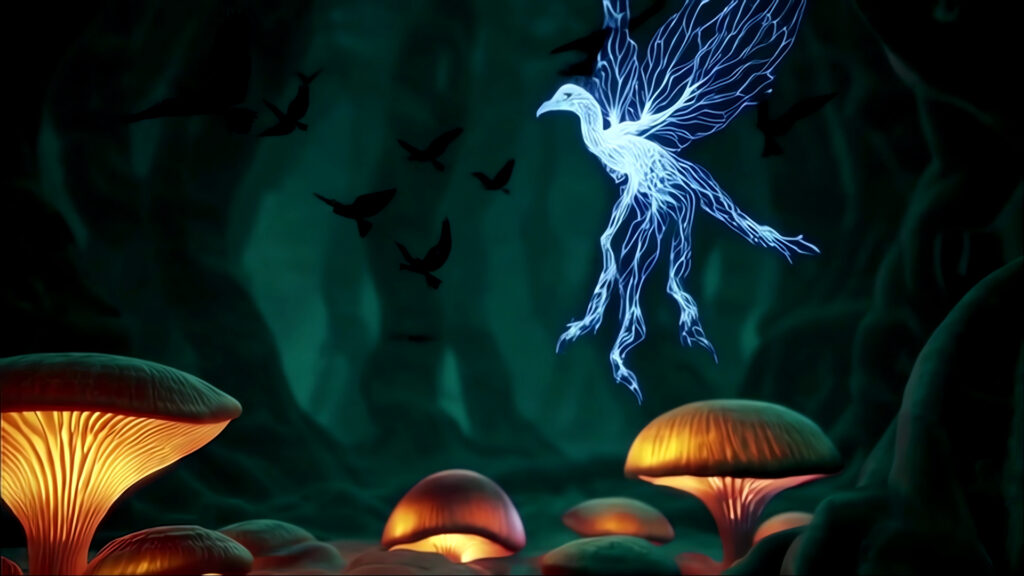
A creature uncoiled from the ceiling—neither snake nor curtain, but something woven of translucent sheets, each sheet lettered with dew. Scriptwraith, she realized. Librarians of their own skin. It hovered, irisating faintly, and unfolded a page for her to read. Letters did not sit still; they were birds with their wings folded into glyphs. When she touched one, it unfolded and flew, becoming scent: cedar, wet stone, the memory of thunder.
“I seek the fount,” Vaelith said. “I seek Liquid Star Dawn as it arrives.”
The Scriptwraith rustled, then turned its pages toward a convex arch that did not exist until it pointed. On the arch’s threshold were mushrooms not of this vale: tall, translucent caps, each with thunder clouded in their gills. The air tasted like coin and rain.
“Thank you,” Vaelith said, and the Scriptwraith’s letters pinned themselves to her mantle, warm as moths.
The arch admitted her into a garden that remembered her first. The garden had seen versions of Vaelith that were past, or might be, and greeted her with precisely the right scent—a blend of ozone and crushed mint. Trees grew from mirrored soil, their roots like nests of glass eels. Overhead, the Dream‑Mirror Tides braided themselves into bright cords that hissed like distant surf.
At the center of the garden, a Spore Elder rose: a being of towering hyphae, its cap the size of a marketplace, its stem an ivory column veined in light. Its face was an arrangement of pores, each dilating and closing with slow consideration until it formed a countenance. It wore history like a cloak: pressed leaves from forgotten seasons, shells grown from words.
“I am Velim of the Substrates,” the Elder breathed, its voice a low thrum that stirred pollen in luminous swirls. “The river you seek is a spine through the sky. It must be convinced to bow.”
“How does one convince a river?” Vaelith asked.
“You enter it with your name,” murmured Velim, “then you leave it with a different one.”
The Elder stooped; the garden leaned with the motion as if gravity itself were a courtier. Beneath the Elder’s cap, Vaelith saw a gate—a latticework of antlers grown from a thousand ancient beasts, polished by the tongues of winds. The antlers were not bone but slow lightning turned into sculpture. Between them, star‑light pooled like mercury.
“Before you choose a new name,” Velim added, “you must remember why you carry the old one.”
“I remember,” Vaelith answered, though her voice was softer than she expected. She remembered a cavern under the world where the Crown Titan lay in a cradle of roots, its breathing shallows turning centuries like pages. She remembered its breath growing thin, its dreams paling—the island tilting toward forgetting. Without the Titan, the mycelial cathedrals would go mute; Treadlight’s antlers would tarnish. The wind would lose its stories and become simple, stale motion.
“Go,” said the Elder, in the way mycelium says “go” to seedlings. “Choose the stream that wants you.”
—
The Indigo Engine
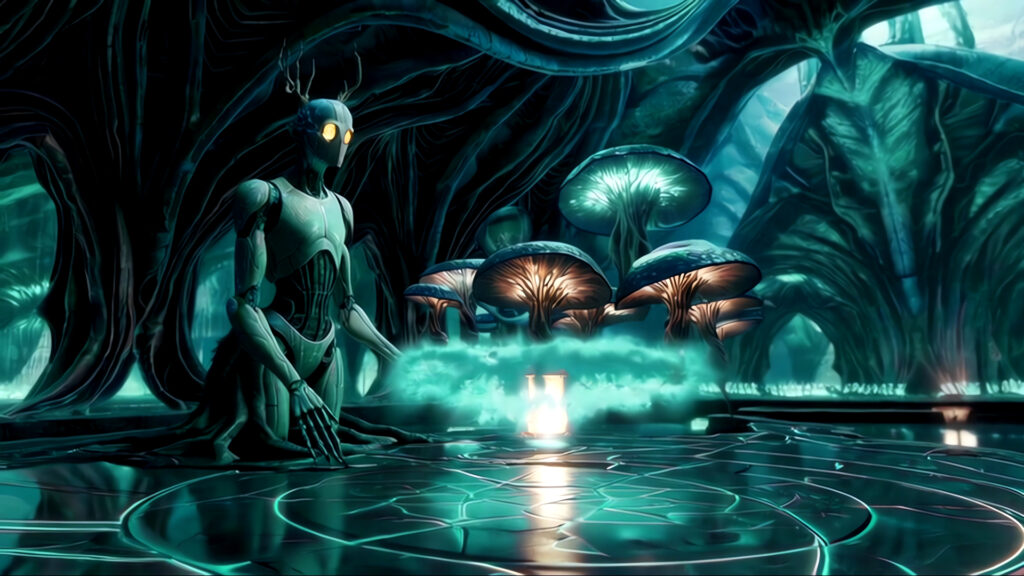
Vaelith stepped through the antler lattice and found herself walking across a mechanism the size of a continent. It was not made of gears; gears would have felt clumsy and confident. This thing—the Indigo Engine—was woven out of equations and cobalt smoke, its parts humming in languages that had no nouns. Streams of Liquid Star Dawn flowed along its struts and beams, turning wherever a ghost‑wheel dreamed itself. Beings tended the Engine, beings with hands like surveyor’s compasses and eyes like hourglasses. They were the Maintainers, neither benevolent nor cruel—merely rigorous.
One of them approached, its face a soft isoceles that slid into place as it spoke.
“Traveler. You wear the roots. Purpose?”
“To draw a draught from the first fount,” Vaelith said, and held up her chronophore. Its ribs twitched; its lattice glowed in wild geometry. “To pour it into a sleeping crown.”
The Maintainer flicked its left eye. Time inside the glass stumbled, then regained its stride. “You’ll pass through the Hall of Echoless Bells,” it said. “Speak nothing. If you must greet, greet in colors.”
“I will.”
“And you will be asked for an answer to a question that no one asks. Keep an answer for yourself. Otherwise, the Engine will make you a bridge.”
Vaelith inclined her antler crown and moved on. The liquid threads thickened; she could hear their movement now, not as a sound, but as a change in her bones. Edges softened, then returned. She could not tell if the Engine wore her like a ring, or if she wore it like a coat.
At the Hall, bells hung on invisible cords—bells of obsidian milk, bells of air frozen into petal shapes, bells carved from the exoskeletons of colossal nebula insects. Vaelith raised a hand and greeted them in cobalt and saffron, the way wind greets grass by choosing a direction. The bells glowed back: chartreuse, then a thoughtful green that tasted like juniper. Echoes tried to exist and could not find purchase. They became footpaths instead, sloping toward a high aperture stitched in star‑thread.
Treadlight waited just beyond the bells, as if he had always waited there.
“The Engine has accepted your answer you haven’t spoken yet,” he said, his voice like a length of silk being folded in a shadowed room.
“What was my answer?” Vaelith asked.
“That you will be yourself until you are not. That you will not be less when you are changed.”
“Good,” she breathed. “I meant that.”
—
Night‑Ferns and the Unasking
They traveled along a balcony with no railing, flanked by night‑ferns whose fronds collected light and returned it as rumor. The Dream‑Mirror Tides gusted through; for a moment, Vaelith’s shadow became a city of small, moving doors. In the city, tiny citizens made of hand‑held rain walked about doing work with solemn joy. She tried not to envy their simplicity.
Beyond the ferns, the balcony bent toward a vestibule shaped like a question mark. Within, a creature hung that had never been persuaded by gravity. Its body was a slow vortex of mirrored petals and midnight. Where a mouth might be, there was a polished obsidian oval reflecting nothing.
“I am Una,” the creature said without speaking. The name didn’t resemble a word so much as a temperature shift. “I unask. Give me the answer you have kept.”
Vaelith’s filaments tightened. Her mantle whispered. She had kept many answers. Why she had chosen to be the one to carry the chronophore. Why the Spore Elders had not come themselves. Why she had promised the Crown Titan in the cavern that she would pour silver dawn into its mouth and call it back to color. But those were all answers to asked questions.
The unasked question felt like this corridor—less a thing than a suggestion of forward.
Vaelith bowed to Una, letting the light within her antlers pulse steady as breath. “Here is my answer,” she said in a voice like moss warmed by sunlight. “That even if the fount is a mirror and it returns no image, I will pour it anyway. That a gift not understood can still be right.”
Una’s mirrored petals slowed, then accelerated the smallest degree. “Unasking complete,” it announced, and opened like a flower. Through the blossom, Vaelith could see water standing on the underside of sky.
“Go,” said Una, and the word felt like hands gently rotating her until she faced the correct version of forward.
—
The Mycelial Gate
The passage ended at a cliff the world had grown for the occasion. Below yawned the Mycelial Sea, not water but a continent of mushrooms upon mushrooms, their caps big as plazas, their stems a forest of columns swaying in a wind that did not formally exist. Between the caps ran channels of Liquid Star Dawn, stitching the Sea together into a single, rippling mind. In the far distance, the aura of something immense pulsed—slow, regal, patient. The Crown Titan, perhaps, dreaming underneath everything, or a cousin.
There, rising from the cliff like a carved cathedral gate, was the structure Vaelith had known she would find. It was a gate of antlers, yes, but antlers grown from whalebone constellations, antlers etched with runes that looked like the shadows of geese flying upside down. Each tine held droplets of star liquid quilted in delicate tension. The aperture beyond it was not a place so much as a decision.
“It is almost time,” Treadlight said, his antlers reflecting the gate’s delicate choir. “When the quilts break, the river stands up and walks. And then runs. And then flies. Few can keep stride.”
Vaelith smiled, and the filaments along her cheeks flared like tidepools lit by winter moon. “I am not few.”
Treadlight tipped his head in assent and turned to face the horizon, where the first true edge of dawn bled into a bruise of stars. The Dream‑Mirror Tides condensed into bridges of glass rain and hung there, waiting to be noticed.
Velim’s final whisper traveled up through the fungal columns: Remember why you carry your name.
Vaelith stepped into the gate.
—
Crown of the Sleeper
The world beyond was a courtyard after thunder—the kind of light that happens when storms remember to step aside with dignity. The Liquid Star Dawn had found its first fount and was pouring in. In the center hung a bowl that had been carved by the orbit of a planet’s first thought. Around it, shapes larger than mountains knelt: Titans, but not like the Crown Titan below Vaelith’s island. These wore rings of fungal constellations as crowns, and each crown was a clock that told when more than what time.
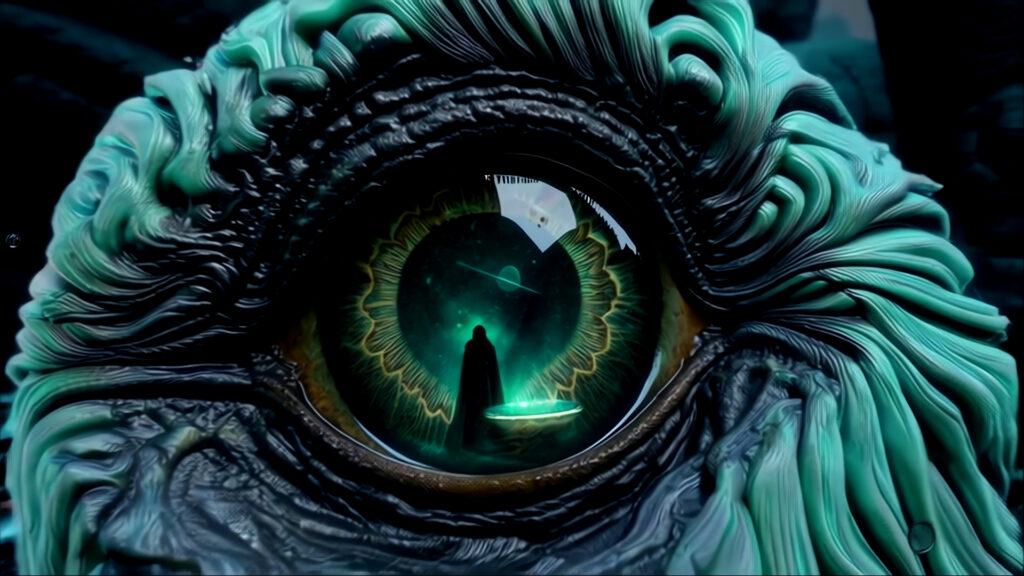
The nearest Titan opened an orbit‑eye and looked at Vaelith as one looks at a cipher that has decided to cooperate.
“You have come a long way,” the Titan said, words emerging as pebbles reorganizing themselves into sentences at Vaelith’s feet. “Do you come for yourself, for your kin, or for the breathing you have never seen?”
“For the breathing that keeps our names in our mouths,” Vaelith answered. She felt small, and not diminished.
The Titan nodded once. “Pour from the bowl. But know that Liquid Star Dawn does not always become what you expect when it leaves the sky. It becomes what you need, dressed as what you are willing to recognize.”
Vaelith approached the bowl. The rim was slick; the star‑liquid had a surface like muslin stretched over a drum, but softer, the color of mercury thinking. The chronophore at her side quivered; its ribs strained, then relaxed, then stilled. Treadlight stood beside her, hooves slightly above the ground.
“Names matter at this edge,” he whispered. “What will yours be when you step away?”
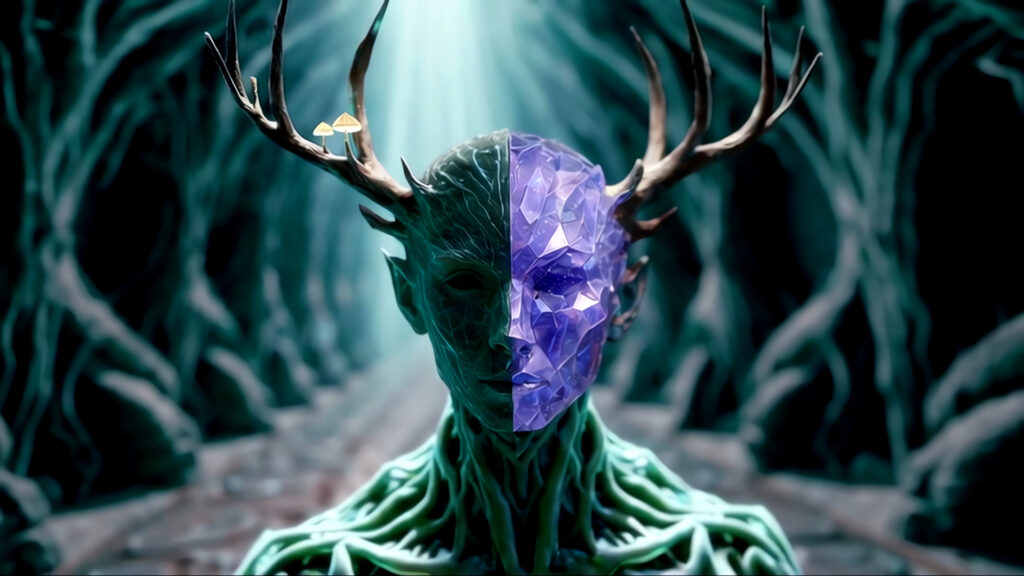
Vaelith looked down into the bowl. In its surface, she saw herself as two. In one, she was as she had been: filaments in pale nets, antlers bright with lantern caps. In the other, she was made of geodes—crystals stacked like pages, veins of frozen lightning. She saw herself lift the bowl and pour it down into darkness; she saw the darkness catch it and brighten. The two selves looked at each other, then at her.
“Keep the syllables,” she told herself. “Change the patience.”
She dipped her hands. The star‑liquid caught at her filaments, then parted, then threaded itself into her. It did not weigh her down. It made her buoyant. She raised her hands, cupped full of dawn, and for a heartbeat the courtyard held its breath.
Then Vaelith poured.
—
The Coronation of Light
The star‑liquid fell through the gate, through the balcony, through the antler choir, through the night‑fern vestibule where Una unasked and was quiet now, through the Hall where bells swung and produced colors that tasted like rain’s decision to arrive—and finally through the antler lattice in the Spore Elder’s garden, and down, down into the caverns where the Crown Titan slept.
Vaelith did not follow with her feet.
She followed as a column of attention.
She raced beside the pour as though she were an arrow made from the will to finish. The Dream‑Mirror Tides hurled themselves along; in them, she saw countless places the liquid would have preferred to go—the thirsty mouths of unmade stars, the parched and seeking skies of rivers that had forgotten how to curve. But the chronophore hummed, and the pathway that was Vaelith’s promise had been carefully braided, and the star‑liquid kept to it, reluctantly at first, then with the serene inevitability of a river that understands its own destination.
They reached the cavern.
The Crown Titan’s mouth was a ravine along which cities could have built their balconies. Moss grew inside its teeth, soft and affectionate. Its breath moved in thin shawls that barely flapped when they should have billowed. Vaelith hovered at the lip of the ravine and watched the first silver thread stitch into the Titan’s breath and tug.
Air sucked in like rain being remembered.
The Titan’s chest rose. The cavern’s stalactites harmonized into shape, aligning with their shadows. Root systems five continents wide tightened, then relaxed with a sound like parchment being turned by a patient hand.
Vaelith felt a color she had never known before: a kind of teal that tasted of iron and warm stone. The Titan exhaled, coughed once—a cough that made mountain ranges reassess their posture—and inhaled again, deeper.
She kept pouring until her cupped hands were empty; then she kept pouring with her name. When she had nothing left, she let the empty shape of pouring continue until it was a habit the Titan could borrow, then own.
“You have done well,” a voice said. It was not the Titan’s, but the Spore Elder’s, traveling like roots along her attention. “Come back now.”
—
Courtyard After Thunder
The return had the texture of waking from a profound nap and remembering one must still go to a hard place. Vaelith’s feet found the balcony with its night‑ferns; the Dream‑Mirror Tides had loosened their bridges and were flowing like a benevolent rumor along the Engine’s limbs. In the Hall, bells watched her with their patient carapaces. Una inclined its mirrored petals in approval, the obsidian mouth reflecting the first honest hint of her silhouette in a while.
Back in the garden that remembered things before they happened, the Scriptwraith waited, hanging in patient sheets. It unfolded the very page it had shown at the beginning and let the bird‑letters settle again into glyphs.
Treadlight paced in slowly overlapping circles beside the antler gate. He looked lightened, as if a weight had been removed from the now of him and placed gently in his then.
“Will it last?” Vaelith asked softly. “Or will the Titan sleep again soon?”
“Everything sleeps,” Treadlight replied, “and everything wakes. What matters is the quality of each. You gave the Crown Titan an articulate dawn. When it sleeps, it will sleep in color.”
Velim of the Substrates towered above, the pores of his countenance forming what might have been a smile, or the mycelial equivalent—an agreement. “You went with the name you carried and are returning with one that answers it. Tell it, so the vale can imprint it in its roots.”
Vaelith lifted her chin, the lantern caps on her antlers breathing small halos. She felt the old syllables of her name in her throat, felt how they were still true but had weathered. In their place, a new cadence settled, like pebbles that had traveled far to find a bed in which to lie.
“I am Vae‑Lith,” she said, dividing it so that Vae tasted of silver and Lith tasted of stone. “Still a bridge of filaments. Now also a span of rock.”
The velveteen air of the garden took the name and pressed it into seeds. Far below, the Crown Titan inhaled again, and the roots carried that breath through soil and into the capillaries of mushrooms and trees. The vale recalibrated itself. Colors shifted half a shade toward true.
—
The Dream‑Mirror Tides Turn
To honor the engine that had let her pass, Vae‑Lith and Treadlight journeyed one more time through the corridor of suggestions and onto a viewpoint where the Dream‑Mirror Tides could be watched making and unmaking the world. The Indigo Engine thrummed along its cobalt limbs; Maintainers adjusted their arguments and sketched new angles of possibility in chalk that wrote itself.
Liquid Star Dawn continued to rain upward in slender ropes, and then, with the odd stubbornness of miracles, it began to thin.
“Will you keep some for yourself?” Treadlight asked. He meant not a vial, for vials had no place in such matters, but a habit. Some travelers grew too attached to a single kind of light and became prisons for it; others learned how to be porous in the bravest way.
Vae‑Lith looked at her palms. The filaments there had changed. They were not geodes—she was not the other self entirely—but when she turned her hands, she saw facets move between her threads, modest, sure. She would hold light differently now, perhaps for a very long time. She felt braver in a quiet way. She would pour more easily into mouths that were only metaphorically mouths, into hollows that were actually old sadnesses wearing stone as a mask.
“I will keep the shape of pouring,” she said. “Not hoard the river.”
“Then the river will visit you often,” Treadlight said with something like joy.
They stood until true, ordinary dawn crept up behind the star‑rivers and politely asked them to make space. Dream‑Mirror Tides unspooled their bridges and turned themselves into small winds that found work in leaf and sail. Velim withdrew into his cap, lowering like a moon. Una unasked elsewhere.
At last, Vae‑Lith and Treadlight began the walk back through the mycelial cathedrals, each cap humming with a new, faint song that had nothing to do with music and everything to do with alignment. In the spaces between caps, cities of tiny rain‑citizens continued their solemn, joyful work of pulling morning through the pores of the world.
—
What Follows the First Dawn
In the days that came, the island increased in cleverness. Roots that used to fumble now tied knots before dawn and loosened them in the afternoon to make room for wild thoroughfares. Streams practiced being mirrors and then graciously went back to being water. Where the fungus grew thickest and brightest, small myriad beasts appeared—each the size of a palm, each a different proposition: a lizard made of interlocking zippers, a moth whose wings were diagrams of forgetting, a beetle that wore a map of nearby kindnesses on its back.
The Luminari Myce, Vae‑Lith’s kin, celebrated not with noise but with pilgrims: they carried pieces of their memories to the Crown Titan’s cavern and tucked them into the moss at the edges of its mouth. Each offering was a mood, a temperature shift, a glow. In return, the Titan sent up dreams in the shape of weather—rains that remembered gentleness, fogs that tried to teach mountains patience, lightning that bent down to kiss seas as apology for past brashness.
When the next Liquid Star Dawn arrived far off—on another island, above another sleeper—Vae‑Lith felt it in the filaments along her back, like the lightest touch of a friend asking if she had a moment. She smiled into the dark and considered the miles between yes and no. Treadlight stood beside her, antlers full of tidy, polite galaxies.
“You will go again,” he said, though no one was making her.
“Not always,” she answered. “But when the dreamers of the world forget how, I would like to remind them. It seems a fair trade for having been reminded myself.”
Treadlight lowered his heavy head until it rested on her shoulder, not touching, but near. “You are a bridge that does not charge a toll,” he mused. “The Engine will remember you fondly.”
Vae‑Lith gestured at the horizon, where the Dream‑Mirror Tides were busy painting corridors that grew sideways across the sky. “And I will remember it as a machine that is also a meadow.”
They walked beneath antlers that had once been lightning and passed through nights that behaved like courtyards after thunder. In the mushroom cities, the rain‑citizens held small, civic festivals where they painted doors with inks that smelled like citrus and iron, and hung tiny bells that tasted like juniper when they swung, and laid down footpaths where echoes once would have been.
And sometimes, late, when the world turned slightly in its sleep and the star‑rivers tugged at her, Vae‑Lith walked to a cliff and looked down into the Mycelial Sea, alive with breathing, vibrant, patient. She practiced pouring by exhaling, by listening as much as by doing. The habit of it changed the shape of her shadows, which now held cities of their own that did good, modest work while she faced other directions.
The sky wore scars of dawn like fine tattoos. The island wore crowns of fungus and called them names. The Titans dreamed with better color.
And when Liquid Star Dawn came again—because it always would, not often, but unfailingly—the first to step into it would be those who had learned to keep a shape for pouring. They would step into the river before it remembered it was a river, because some things are easier to enter when they still think they are doors.
Vae‑Lith would be among them, wearing the old syllables of a new name. She would walk with creatures whose hooves visited the ground, with librarians who stitched questions from dew, with unaskers whose mirrors had learned to hold silhouettes kindly. Together, they would move through engines that were meadows and meadows that were engines, and when they poured, they would pour with articulate dawn.
That was the way of it. That was the bargain. Every crown sleeps. Every crown wakes. Between them, there is a bright place where rivers stand up and walk, and bridges grow out of breath—and if you meet it by its true name, it will meet you in yours.
Liquid Star Dawn.