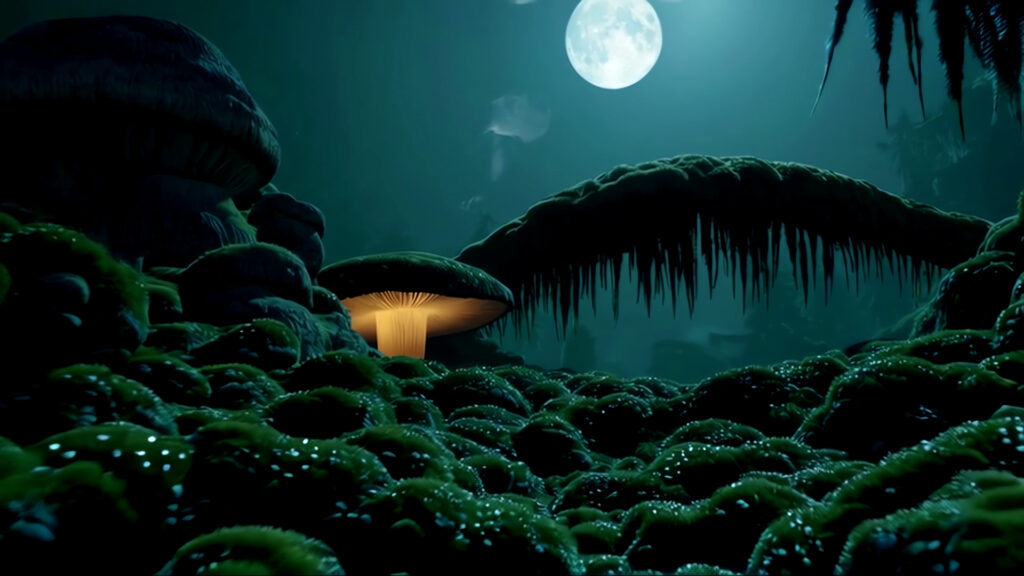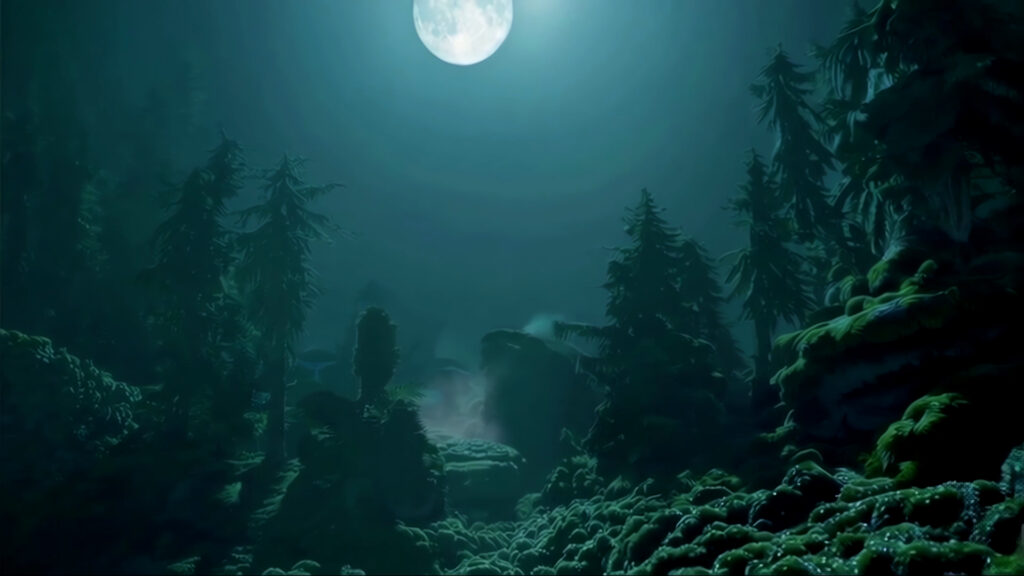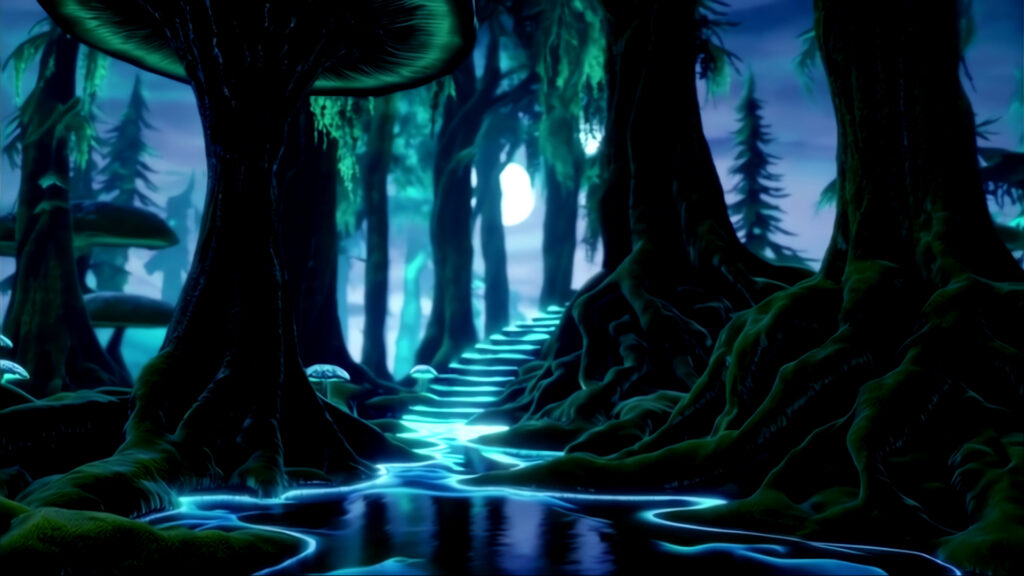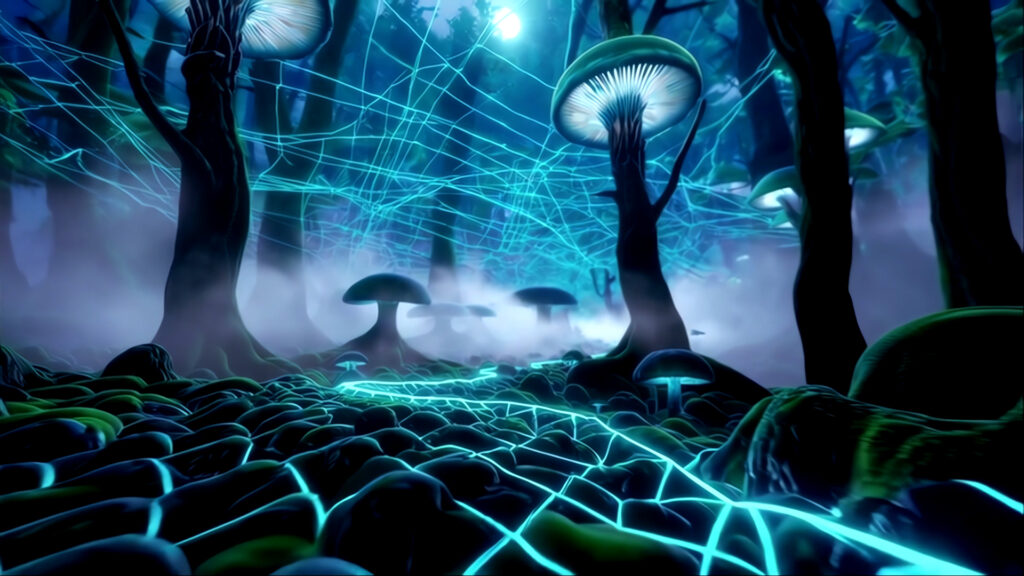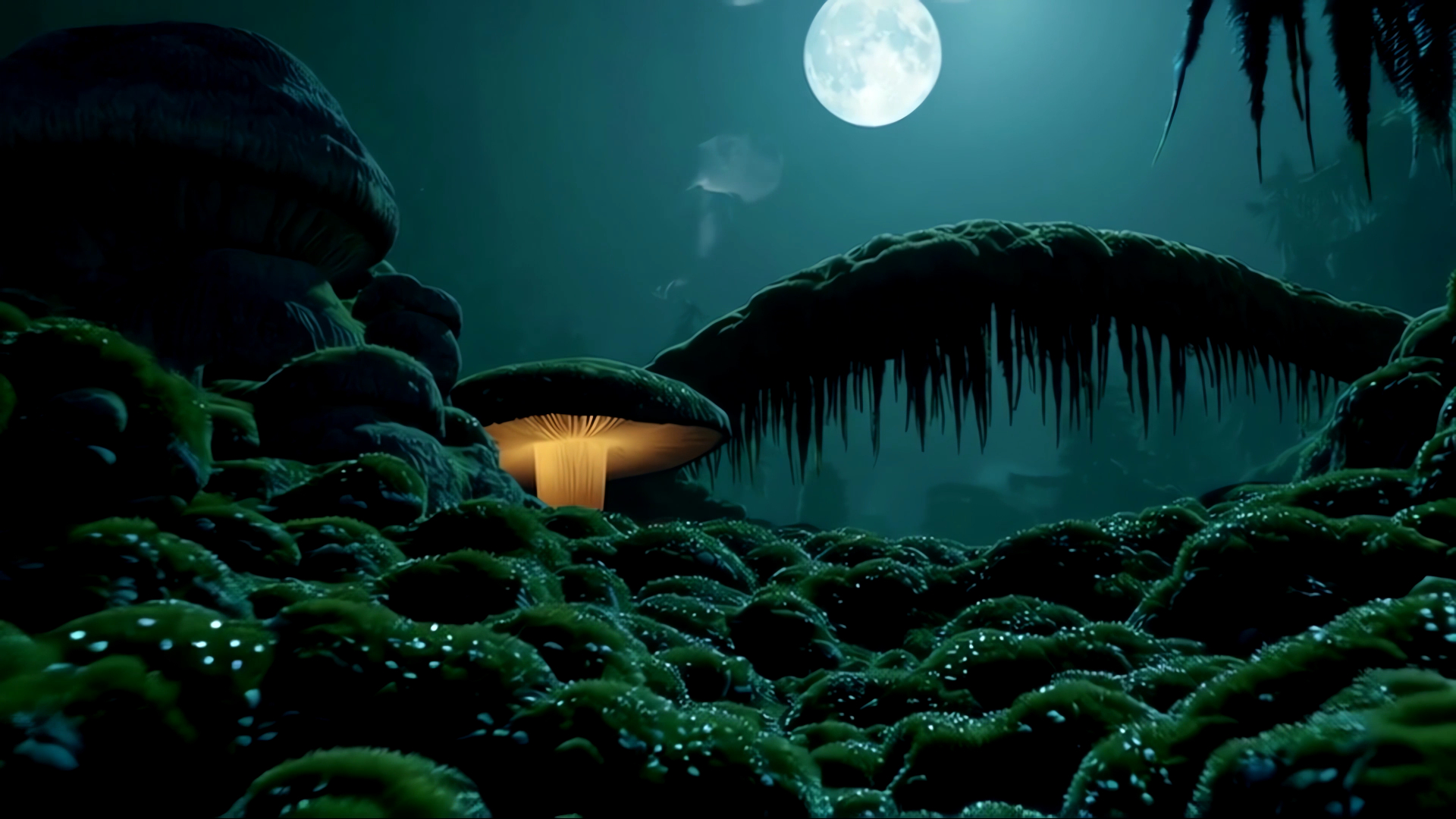
The night forest wore the moon like a needle. Pale light stitched from branch to branch, fastening leaf to leaf, turning dew into a lace of cold fire. Beneath that careful seamwork stood a traveler who was not born but assembled—woven out of comet silk, lark‑black shadow, and the quiet intelligence of mycelium. The traveler’s name was Vaelith, though names here were less like labels and more like roots: buried, drinking deep, feeding leaves farther away than anyone could see.
Vaelith’s eyes were slow spirals of silver, rotating once for yes, twice for no, and three times when questions were too complex for a single answer. A braid of pale moss lay across their shoulder; it pulsed softly, an extra heart given by the understory. From the traveler’s waist hung an oval shard of fused stardust—meteor glass—which warmed whenever a path wanted to be found.
That night the glass began to thrum like a low tide in the bones. The shard lifted, not by string or charm but by fondness, and spread a hairline beam across the leaf litter. The light was thin and precise, like a thread the moon had misplaced and now asked Vaelith to return.
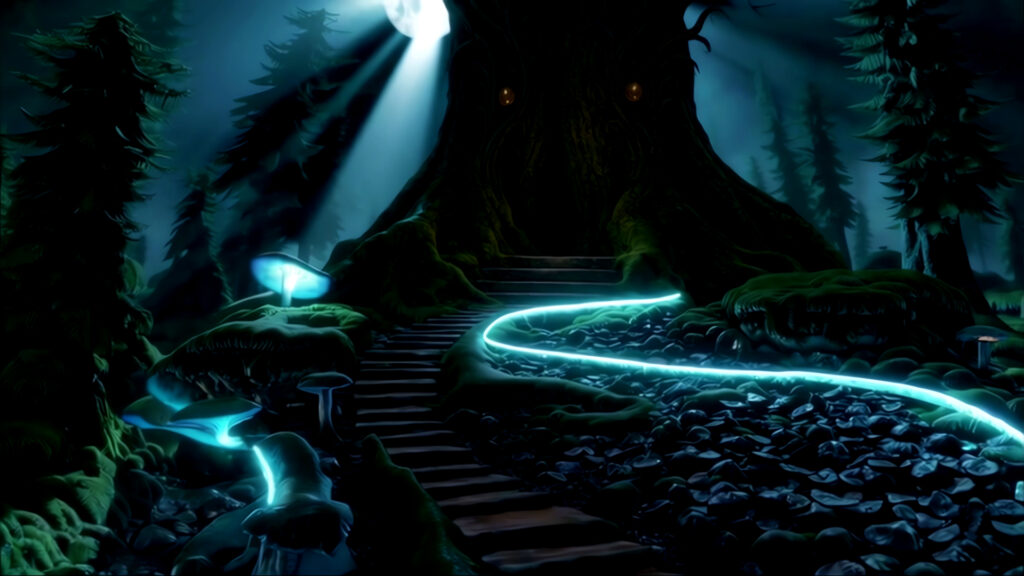
They stepped forward. The mossy braid stirred, tasting the air, and the forest answered by re‑arranging itself with hospitality: roots angled to make steps; mushrooms turned their luminous caps to guide; ferns bowed in a rustle that meant we’ve been expecting you. Distant trunks clicked together the way stones do after speech, and the meteor glass kept humming.
As Vaelith walked, soft lanterns rose—small colonies of caps with gills that glowed a psilocybin blue, then shifted into LSD‑bright filaments that crossed the trail like sutures in living skin. The threads did not tie anything down; they held it in a promise. Overhead, branches met in arcs that had never seen architecture and yet produced it, a natural vault where owls wore masks of DMT‑geometry, feather‑tips repeating the same perfect triangle, smaller and smaller, until the pattern fell inward like a whisper.
A figure waited at the mouth of the first clearing: humanoid in the way a tree is humanoid only when the wind persuades it. Limbs were slender cambium, veneer polished by moonlight. Eyes: two slow pools of resin. Antlers: not antlers, but growing scrolls of polished bark carved by termites into filigree. It bowed with the patience of old rainfall.
“Loom‑kin,” Vaelith said, their voice a weave of low breath and the click of beetle shells. The resin eyes brightened.
“I am Soresyn of the Canopy, tender to the seam that holds this world together,” the being said. “The moon has placed thread in your keeping. Something is unraveling beyond my reach.”
The meteor glass hummed harder. Vaelith lifted it, and inside the shard swam a map that wasn’t a map—not inked lines but living filaments drifting as if underwater. They nudged one, and it laid itself along a path only the forest could see.
“Speak of the unraveling,” Vaelith said.
Soresyn unfurled a hand of curling cambium. Where fingers should have been, thin mycelial cords spread and then disappeared into the soil. When the cords returned, they brought up a rumor: a grey light, not bright but hungry, moving through the undergrowth like an idea with teeth. It left silence not only where sound had been but where memory had nested. Birds forgot their names. Stones forgot their weight. The Null Bloom, the canopy tender called it—not bloom for flowers but for the cruel logic of expansion.
“Each time it passes, one thread breaks,” Soresyn whispered. “The seam that binds root to moon is thinning. You are a thread‑worker. Will you stitch?”
Vaelith’s eyes rotated once, then twice, then three times—yes, no, yes in one motion of acceptance. The meteor shard exhaled a line of frost‑light that settled on their fingers. The moss braid on the traveler’s shoulder swelled as spores awakened, listening.
“Then this way,” said Soresyn, and melted backward into the shadows, leaving a scent of resin and rain.
The first path wound past cap towers—fungal pillars as tall as bell towers, striated like tiger’s eye. Their undersides looked like the pages of a book someone had tried to read while asleep. They pulsed with thought, drawing patterns in the air: loops and spirals, recursive wings, a tessellation that suggested the forest was solving a riddle it had asked itself before the first comet seeded it.
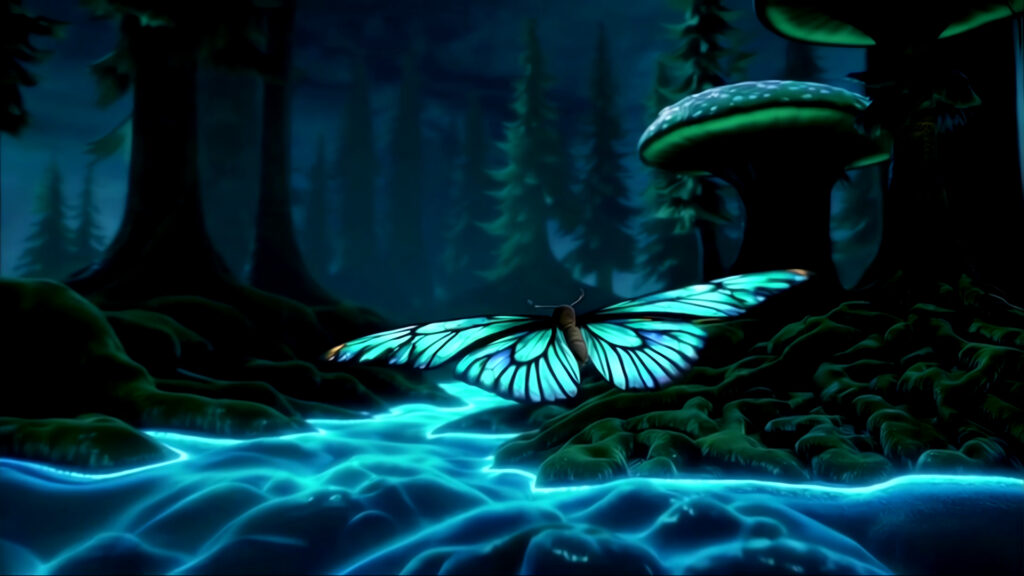
Something scurried from the base of one cap tower and stood with surprising grace. Its body was a tufted spindle, part moth, part ember, and mostly conscience. The wings were stained glass cut into triangles, each triangle containing a smaller version of itself—a living fractal. Its face was crafted of moving angles, and yet its bow was old‑fashioned.
“I am Aeth‑Amal, courier of the Prism Flocks,” it chirred. “I carry messages too strange for linear mouths. Your task threads with ours.”
“Walk beside me,” Vaelith said, and it did, leaving tiny footprints that flashed and folded like thought experiments.
The path rose. Moonlight grew thicker, as if stirred. Then the canopy opened. Not gradually; not like a door—more like a book being returned to its original fold. Moon‑shards angled down, braided by wind into herringbone patterns. The forest exhaled. In that exhale, Vaelith felt their own seams stretch and take new shape. The meteor glass warmed even more, and in its depth, the living map aligned with the new sky.
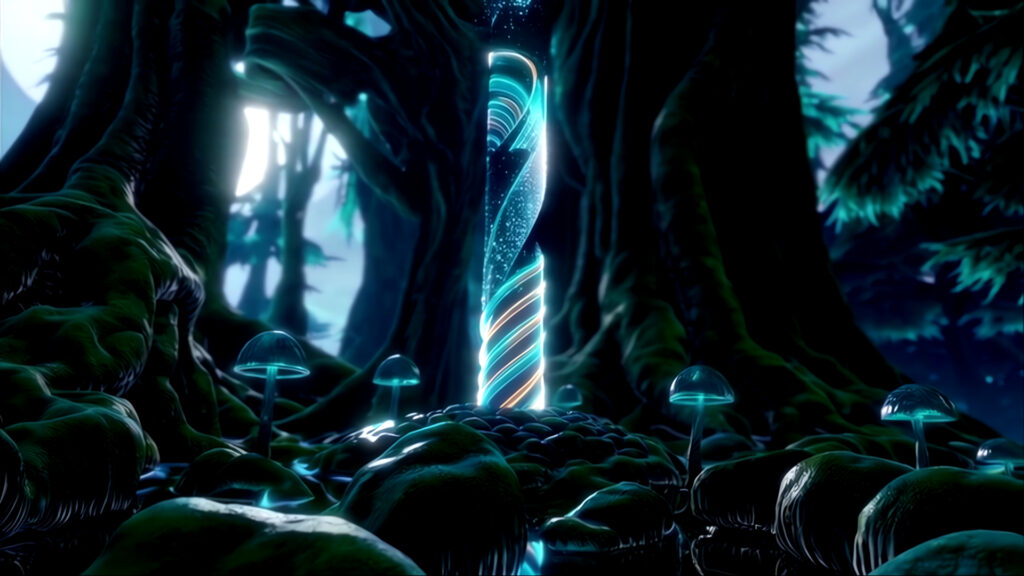
At the clearing’s center stood a pillar of water with no mouth or root, printed with micro‑constellations that tumbled and re‑sorted themselves with every beat of Vaelith’s heart. The water smelled like the moment before lightning. Around it, six creatures knelt; they resembled humanoids wearing the forest as clothing, but the clothing was their true body. Their shoulders grew tiny orchards of bioluminescent mushrooms; their fingers were cap stalks; their hair a spill of moss the color of comets. Their faces were smooth planes of bark polished to mirror. They turned, and Vaelith saw their expressions reflected: alert, spare, resolved.
“Chorus of Caps,” Aeth‑Amal whispered, it being unwise to name any six of anything too loudly. “They carry the Deep Lexicon.”
One of the Chorus rose. Their voice sounded like a droplet breaking and reforming. “Thread‑worker,” they said. “The Null Bloom scours meaning until only structure remains. We can teach you to follow the semantic residues it cannot remove.”
The pillar shivered. Images appeared within it: a trail of unmoored metaphors drifting through the understory; a ring of stones with mouths; a wind that sliced moonlight into needles and then took the needles away. Vaelith reached into the water. Their hand did not wet; it cooled. Fingers closed around something that was not a thing—a spool of lumen, tight as a nova, soft as breath.
“Use this to stitch what has been taken,” said the Chorus. “But understand: the Bloom has a center. Threads repair; they also lead.”
Soresyn’s resin eyes reflected the pillar without blinking. “Follow the residues to the ridge,” they said. “There, the wind knows too much and cannot stop talking. If the Bloom has a name, the wind will have learned it.”
Vaelith nodded. Aeth‑Amal fluttered up to perch between two of the traveler’s fingers like a living ring. The spool of lumen nested inside the meteor glass, as if the shard had been waiting for it all along.
They left the clearing by a path the water dreamed into being.
The forest changed timbre—the air took on the taste of rusted stars; bark bore constellations not native to this latitude. Between the trunks, Listening Stones grew half‑buried and watchful, faces smooth as lake ice. Each stone had lips, pale as fog. Each mouth held a secret: some whispered recipes for light; others recited names of vanished rivers; one kept repeating the same pastoral memory of a cloud shaped like an answer.
Vaelith approached the largest stone, whose face had a small crack, like a smile afraid of itself.
“Speak,” they invited.
The stone exhaled a low wave that made leaves align. “Long before the Bloom learned hunger,” it said, “there was a simple balance: moon paid moss in light, and moss paid moon in stories. The Bloom came as an account‑keeper. It took the stories first, calling them excess. Now it wants interest.”
The spool of lumen vibrated. Threads lifted, sniffing the air, pointing along a seam where moss went silent mid‑sentence. Vaelith knelt and anchored one end of the lumen to a root with a touch; it held as though thanking them. They stitched from root to stone, stone to branch, branch to moonline, following the path the Bloom had chewed. The thread didn’t look like thread when it settled. It looked like memory suddenly choosing to stay.
Their fingers moved without haste. When the line closed, the air adjusted; birds that had forgotten their names tried them out and kept them; the stone laughed once, the way an avalanche would if it felt safe.
But these were repairs at the edge. The Null Bloom had a habit of testing borders before consuming centers.
A wind rose. It was not a wind of movement but of pattern: leaves became algorithm; moths became recursion; breath became arithmetic. This was the Fractal Wind, and though it carried no sand, it scoured. Light split into needles and then into needles of needles, stitching and un‑stitching the sky in quick revisions.
“The ridge,” Aeth‑Amal said, voice tight with awe. “It is telling us everything at once.”
They climbed. The understory flattened into a naked slope studded with mineral lenses that caught the moon and offered interpretations. Each interpretation disagreed lovingly with the last. At the ridge’s crown hung the Constellation Grid, a vast hovering net of faint lines connecting stars that had no obligation to one another. This was an older loom than the canopy’s, older even than names. It hung and waited, patient beyond patience.
At its foot sprawled the Null Bloom.
It was not a creature with edges. It appeared as an emptiness shaped by context and regret: wherever it lay, things failed to retain shape. Ferns simplified into outlines. Stones became spheres reduced to textureless utility. A deer—no, not a deer, a hooved eidolon whose antlers grew spirals of copper leaves—watched from the edge and slowly forgot why fear mattered.
The Bloom twitched and something vanished: a poem hidden in bark; a scent that once cured grief; the private manner a lizard had of nesting within a snail’s abandoned coil. Each loss made a small, tidy silence.
Soresyn stood with the Chorus of Caps on one side of the slope. Their bodies had become staves of shadow and light, wrists ribboned with moss. Aeth‑Amal shivered so fast its wings became equations.
Vaelith did not draw steel. They drew threads.
They held the meteor glass up to the Constellation Grid, and the shard answered by revealing its contents to the sky. The living map bloomed outward until it became a second grid overlaying the first, but fluent where the other was exact. The spool of lumen came with it, unwinding in loops that refused straightness. It traced curves on air, then dipped, then rose, obeying a logic older than rectangles.
The Bloom shifted to meet it. It pressed into the map with a neat, accountant’s hunger—devouring loops, generalizing curves into lines, turning lines into points, points into nothing. Where it passed, the shimmer of the map dulled to a diagram, then faded.
Vaelith changed tactics. Instead of offering thread to the Bloom, they anchored thread to listeners. Threads tied to cap gills, to Soresyn’s antler‑filigree, to Aeth‑Amal’s fractal wings, to the hooved eidolon’s copper leaves. Threads sank into rocks that remembered the shape of glaciers, into moths still learning their names, into a pool that caught each star and taught it the dialect of water. The network shivered, living and multiple.
“Not a stitch but a chorus,” Soresyn murmured.
Vaelith felt the chorus taking weight. The Null Bloom tried to audit the network, to flatten its singing into a ledger. But a chorus has no single entry. Each note made the others larger; each thread multiplied by being crossed. The Fractal Wind learned the tune and misbehaved beautifully, slicing moonlight into needles that anchored themselves into nodal points the Bloom could not anticipate.
“Your hunger is an equation,” Vaelith said, a simple courtesy of naming. “You aim to balance by subtraction.”
The Bloom quivered. Within it, shapes almost formed—mouths, wrists, book‑spines—then dissolved. The name Vaelith had given it began to weigh upon it. Names are contracts, and contracts require parties, and parties require recognition. The Bloom wanted none of that. It surged toward Vaelith, a grey that promised a future without adjectives.
Vaelith stepped backward into the Constellation Grid. Threads trailed their fingers like comet tails. The meteor glass brightened, not by more light but by more meaning—etched with glyphs that were not alphabet so much as agreement.
The Chorus of Caps raised their hands. From their palms fell spores like snow, each spore a tiny lantern carrying a single remembered detail: the notch in a leaf where a moth learned; the way dusk holds its breath for the first star; the exact scent when a storm has forgiveness in it. Spores drifted, settled on the loom of threads. Each detail insisted upon itself quietly and then multiplied. Aeth‑Amal scattered around the edges, hitting perimeters like sparks meeting glass and leaving behind symmetric afterimages that adapted mid‑flight.
The Bloom struck.
Where it touched the network, parts of the chorus dimmed, but never entirely. A thread broke and three others rerouted. A note flattened and the harmony lifted it. The hooved eidolon stepped forward, antlers clanging like bells, and lent weight to a faltering knot. Soresyn planted their cambium foot into the slope and grew a brace to hold two threads in tension.
Vaelith saw the place the Bloom wanted most. Center is a liar—many centers exist—but there was a convergence here along a seam no one else had touched, connecting the first moss to the last moon in a way that didn’t acknowledge order or time. That seam trembled.
They took the last of the lumen and threaded it through their own chest. The moss braid pulsed once, twice; spores opened and the air smelled of new language. Vaelith walked into the seam, becoming both thread and needle, passing through their own weaving.
Inside the seam lived a corridor of night that had never met dawn. The Null Bloom hounded it like a principle, tidying frayed edges, deriding embellishment. Vaelith ran—not with haste but with clarity—carrying ties from friend to stone, from moth to water, from canopy to grid. The corridor narrowed. The Bloom crowded in, reciting balance sheets. Vaelith did something it did not expect: they remembered hard. Not for themselves, but on behalf of the world.
They remembered the time a fungus traded sugar for a story. The time a meteor taught a root to dream of orbit. The night a fox stole the smell of thunder and hid it in a hollow log because it liked the taste on its tongue. They remembered a dozen creatures deciding to share a single fear so that none drowned. The recollection had texture; it pulled like gravity; it filled like breath.
Memory is not efficient. The Bloom choked on it.
Vaelith reached the seam’s narrowest point, the pinch where moon’s thread first pierced moss. They drove the lumen through, tying the past to the now with a knot that could only be taught to a living hand. The knot recognized itself and locked.
The corridor shuddered. Outside, the Constellation Grid sang, a shimmer beyond heard. The Chorus of Caps exhaled like surf. Aeth‑Amal unfolded into a perfect star for the duration of one astonished heartbeat.
The Null Bloom recoiled, hunting for a loophole. It found one and tried to pull; the knot smiled without lips. The loophole wasn’t emptiness but play, and play resists audits. The Bloom reached again, smaller now, diminished not by damage but by the admission of other rules. In the newly enforced weave, its hunger could exist only as contrast, a lesson told to children by elders—
But there were no children here. Only beings that chose to be old or young by the logic of their tasks.
The Bloom shrank to a teachable size and retreated into a hollow between notes. It would remain there, an instrument members of the chorus could consult when they wished to balance a wildness without amputating it.
Vaelith exited the seam, thread unspooling from their chest. The moss braid re‑seated, threads settling against their shoulder like a cloak set back on a peg. The network held. On the ridge, light resumed its thousand small responsibilities. The hooved eidolon bowed and vanished into a paragraph of fog. Soresyn’s antler‑filigree unscrolled, relaxing. Aeth‑Amal landed on Vaelith’s palm and breathed very quickly, intoxicated by survival.
The Constellation Grid lowered by an inch, as if to hear better. Then it returned to patient altitude.
Below, the Listening Stones tested their mouths on words they had not risked in a while: mercy, mischief, multitudes. The pillar of water in the earlier clearing hiccuped a ring of symbols and then smoothed, embarrassed to have enjoyed itself.
Vaelith walked the ridge until the slope let them. Threads hung from branch to branch, light to leaf. The seam that had once threatened to split now looked like a mended scar, beautiful because it proclaimed both injury and skill. Spores drifted, catching on threads and becoming small, guiding lanterns.
“Threaded by moon and moss,” Soresyn said, hands folded into a chapel of living wood. “We were a page; now we are a book.”
“And books get heavier when they’re true,” Aeth‑Amal added, pleased by the weight.
The forest adjusted itself around them the way a room does when someone who belongs to it returns. Night air cooled, then warmed at the edges. Cap towers exhaled. The Prism Flocks made a spiral overhead, each wingbeat writing a quick geometry that promised no repetition and then kept that promise.
“Stay,” said Soresyn. “Let your thread rest.”
“Threads love edges,” Vaelith answered, but their eyes rotated once, yes: a pause. The moss braid agreed by purring softly, a kitten that had never been an animal.
They slept sitting, back against a trunk that shaped itself kindly. In dreams, the meteor glass told them a story: not in words, but in loops—roots learning constellations, moons tasting sap, spores counting stars until the number became too joyful to hold.
Morning came as a rumor of cobalt behind trunks. The moon refused to yield entirely, holding several threads of itself in the canopy like a parting gift. Vaelith rose. The seam held; the knot at the ridge had settled into the world the way a healed cut becomes new skin.
A figure waited at the trailhead: not Soresyn, not a member of the Chorus, not Aeth‑Amal’s kind. It was humanoid, yes, but assembled out of alien antiques—a spine of copper letters from an unknown alphabet; ribs made from the frames of vanished instruments that had never made music; hands that flexed like paragraphs learning cadence. Eyes: two coins stamped with stars that had never appeared in this sky.
“I am Ledger of the Hollow, once servant to the Bloom,” it said without defensiveness. “I counted so long I forgot the thing counting is for. You have chosen otherwise. What do those who choose otherwise require?”
“Stories,” Vaelith said simply. “Because stories are binding that does not bind.”
Ledger nodded. “Then I will learn one. Perhaps I will learn many.”
It stepped onto the path and allowed ferns to edit its shape. Its hands softened. One of the coin‑eyes dented where a squirrel had tried to bury it, choosing friendship over theft. Ledger smiled, and it looked like an equation finding beauty instead of proof.
Aeth‑Amal circled. “Will you carry messages with us?” it asked. “Some notes are too bright for straight lines.”
Ledger tilted its coin‑eye, considering. “Yes,” it said. “But I hope to learn how to fly crooked.”
Vaelith touched the moss braid, which swelled and released a hush of spores that smelled like ink and rain. They lifted the meteor glass. The shard had stopped humming; sometimes the way forward is to stop calling attention to itself. Still, when angled, it showed a fresh filament leading deeper where trees grew younger on the outside and older within.
The trail invited. The forest listened. The remaining threads brightened, one by one, not in chorus but in sequence, like a non‑linear constellation revealing its order to those who had earned a second glance.
Soresyn lifted one cambium hand in blessing. The Chorus watched with a satisfaction that did not seek applause. The hooved eidolon sent a tremor through the copper leaves that sounded like the beginning of rain. The Listening Stones pursed their lips but said nothing; they knew when silence is a promise rather than a lack.
Vaelith stepped into the green hush. Aeth‑Amal rode the traveler’s shoulder, a tiny constellation folded into a single body. Ledger learned to place its feet where memories were thick. Threads stretched ahead, a path braided by patient light.
The forest closed behind them—not as a door, but as a healed seam, holding strong, telling a story about everything it contained and everything it would invite.
And if you could have stood on the ridge then, in the first warmth of morning, you would have seen it: lines of moonlight stitched to veins of moss, an embroidery so intricate even the wind grew careful not to pull, a living tapestry that whispered to anyone who wanted to listen—
We hold by telling. We tell by holding. Threaded by moon and moss, we remember.