Prologue: The Slow Name
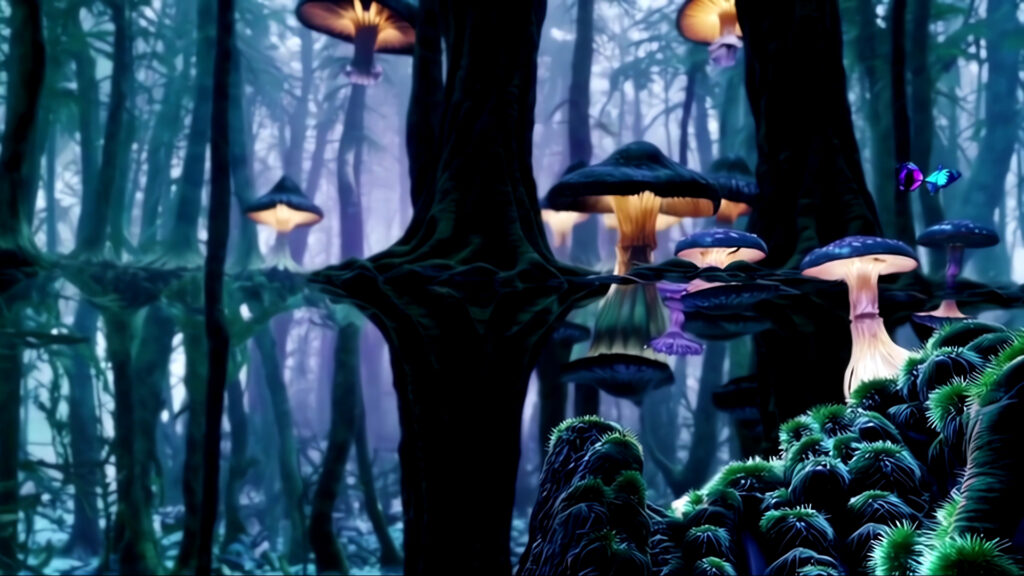
Aethyra was not a place so much as a mood the universe remembered. From a distance it looked like a pearl bruised by starlight, but inside its forests the air moved with a will. Towers of luminous fungi held up the sky; rivers traveled as if they had thoughts about destinations; and mountains slept like old guardians who preferred listening to speech.
Legends said Aethyra had a Slow Name, spoken only by the world itself. The Slow Name was not a word, but a pacing. Those who tried to hurry it heard nothing. Those who stopped entirely also heard nothing. To hear it, a traveler had to move with the patience of growing things.
Orasha came to learn that pacing.
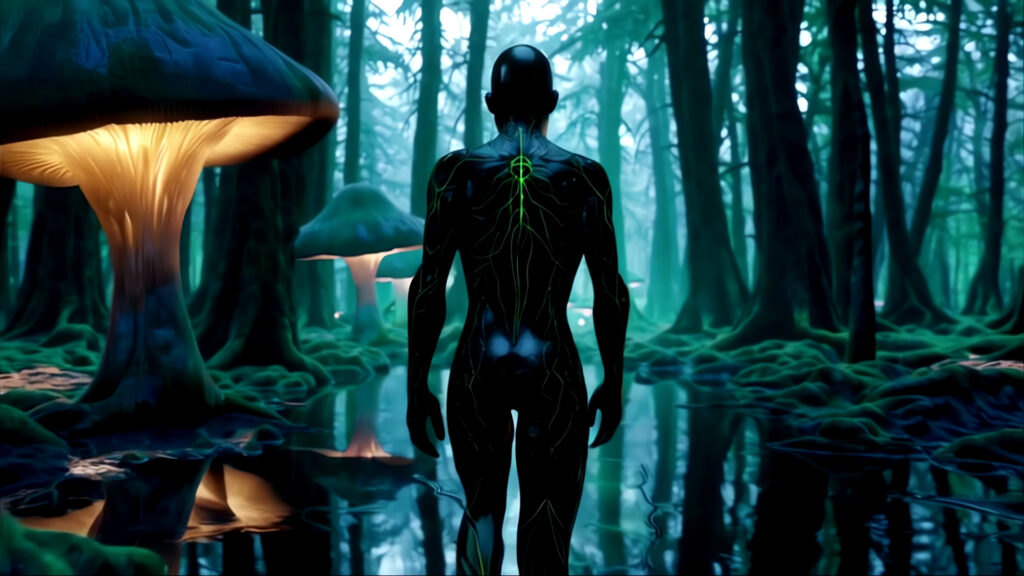
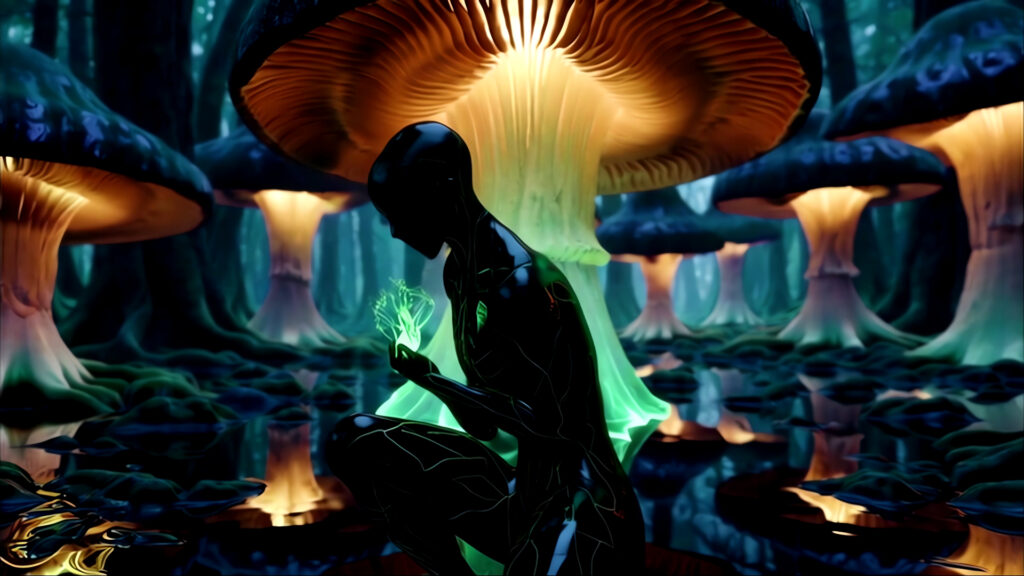
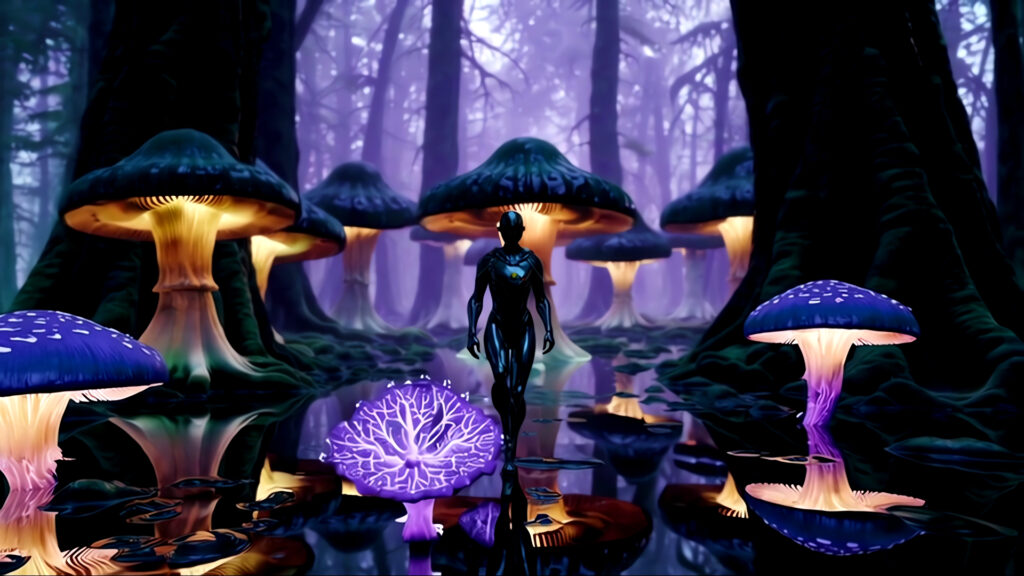
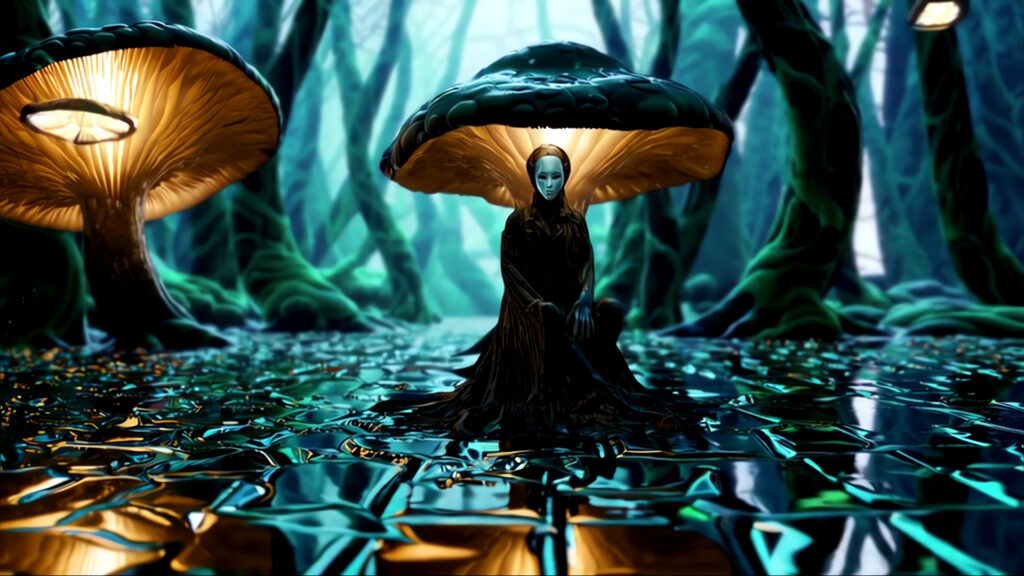
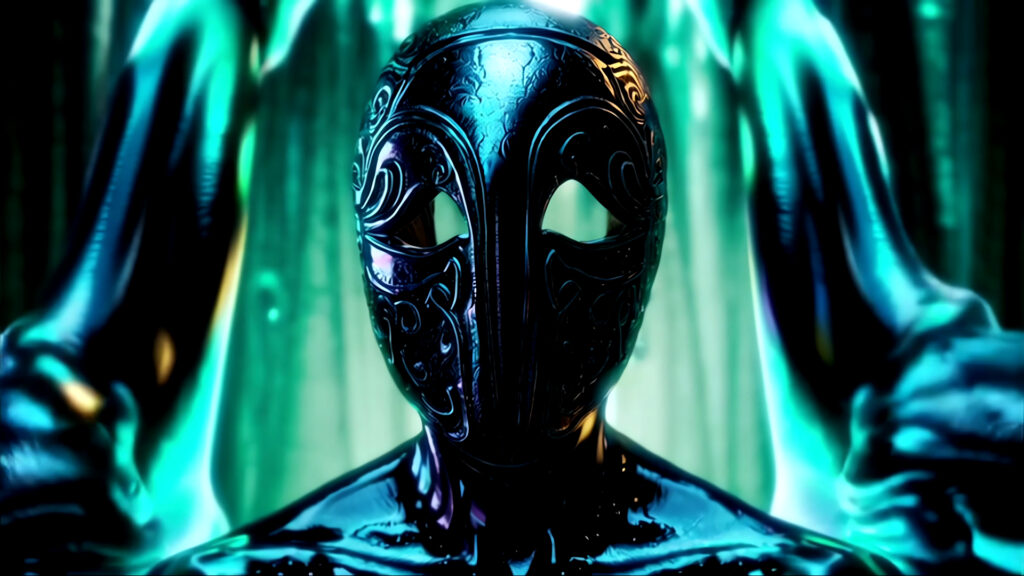
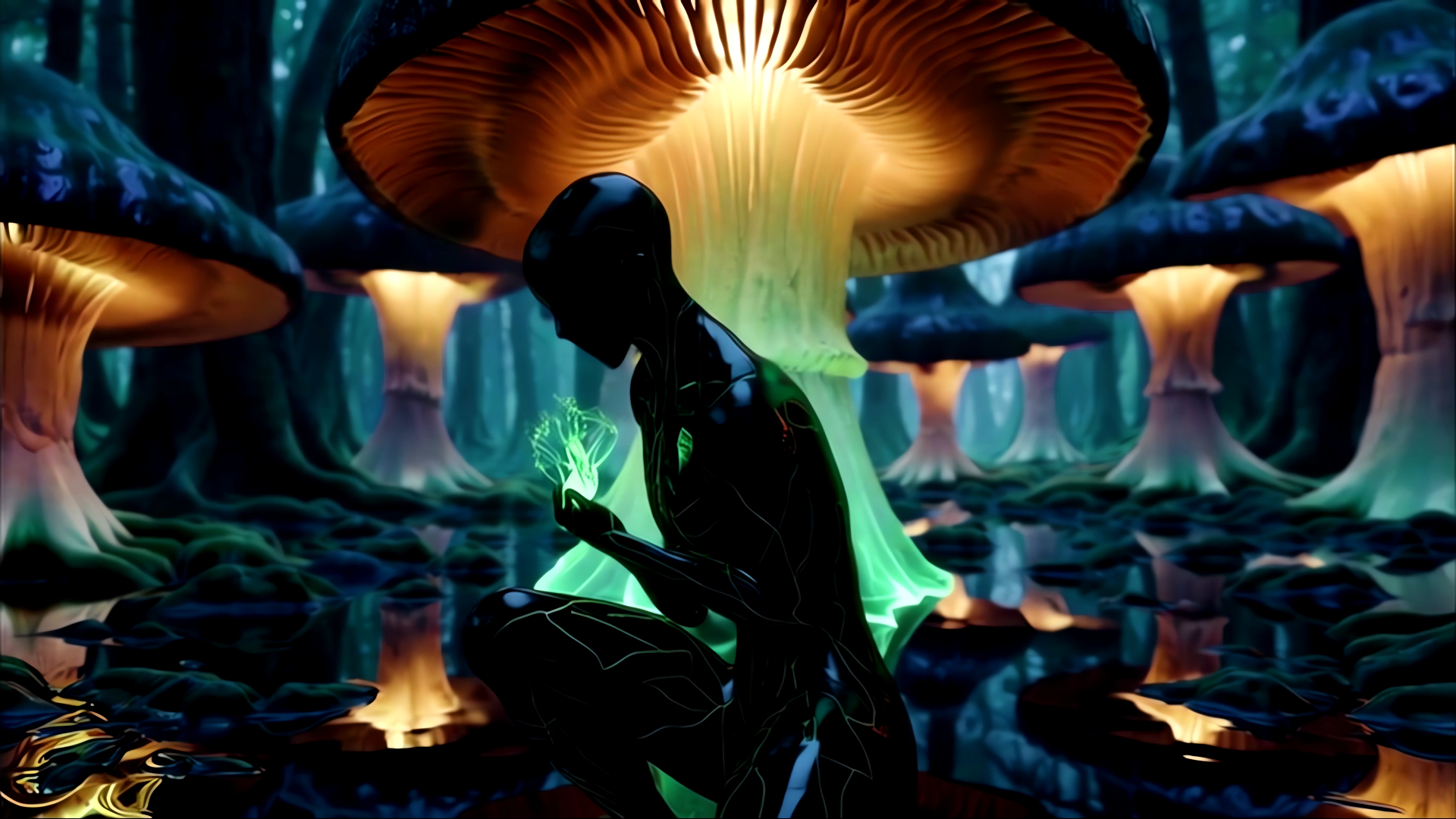
Orasha was Mirrorkin—tall and jointed like a reed, skin lacquered black as cooled obsidian, veined with slow‑pulsing lines of green. No one could mistake a Mirrorkin for a person of the common constellations; their faces showed no mouth, only a pane of reflective bone where gazes went in and did not return the same. Orasha’s gaze was kind. Behind that pane lived a voice that shaped thoughts into touch. A mantle of brittle light hung from their shoulders, and in the cradle of that mantle lay an hourseed: a small, living clock that grew leaves whenever Orasha kept still long enough for a single thought to flower.
On the third eclipse of the cerulean moon, Orasha stepped beneath the Violet Canopy and listened.
The world listened back.
I. The Gate of Amber Moss
The corridor between the first giants of the forest smelled like rain remembered. Caps the size of market domes leaned inward, each rim stained with amber moss that glowed as if lit from roots. Every step Orasha took awakened a chain of bioluminescent filaments, a path sketched in honeyed light that unraveled just enough to suggest a destination without confessing it.
The hourseed warmed. A leaf unfolded. Orasha paused and let it grow.
From the underside of a broad cap, a figure descended: a Kyr-monk, woven entirely of hyphae. It had four arms and no eyes, but its posture radiated welcome. The Kyr moved without touching the ground, buoyed on a cushion of spores.
You have the patience to let your clock grow leaves, the Kyr said without sound. The words arrived like damp wind. Then you may ask a question of the Gate, if you are prepared to wait for its answer.
“I am,” Orasha answered, by letting their mantle shift in a small bow.
The Gate did not look like a door. It was a section of moss that refused to show what lay beneath. Orasha knelt and placed both hands lightly upon it. The moss agreed to notice.
The world did nothing. Minutes went. A beetle with a glass shell tried and failed to understand Orasha’s reflection. The Kyr folded two of its arms, perhaps in prayer, perhaps in rest.
At last the moss sighed, and a seam the width of a breath unzipped. Behind it, darkness carried the smell of stone that remembered the sea.
You may pass, the Kyr conveyed. Remember: Aethyra answers slowly. Ask everything in the same rhythm you’d use to grow a garden.
Orasha stepped through.
II. The Violet Canopy Answers
The forest beyond the Gate was not merely violet. It was a living spectrum centered on violet, with blues that tasted of iron and purples that hummed like distant bees. Spores drifted in letters that refused to form a language. Orasha waded through a quiet storm of almost-words.
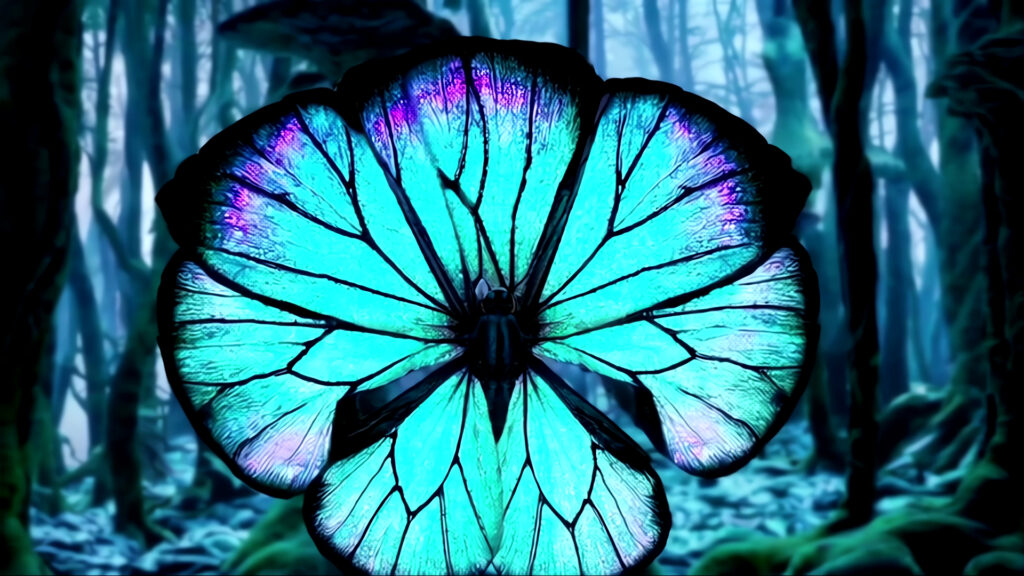
A flock of prism moths rose from a root like sparks from a kiln. Each was a thin geometry of wings and light, bodies jointed with silver wire, eyes like deep wells containing alternating constellations. They circled Orasha, very nearly touching, and the air between their wings developed a faint architecture, as if tiny cathedrals were being sketched mid-flight and then erased.
“Do you guard the path?” Orasha asked, lowering their mantle’s brightness to a courtesy dim.
The moths arranged themselves into a spiral—an answer in shape: Yes, and also No. Their spiral opened a channel through the forest, and Orasha stepped into it. The moths paced the corridor, fast when Orasha slowed, slow when Orasha hurried. In time the message became clear: Keep our rhythm, and the canopy will speak.
Orasha matched them. The hourseed was pleased and unfurled another leaf.
After a while the violet deepened to indigo, then to a shade near black where color kept its secrets. The path terminated at a glade tiled with square panes of floating light, each pane a moving window onto a different slope of reality. Orasha stood at the brink.
III. The Prism Orchard
The glade was the Prism Orchard, though no fruit hung from branches. Instead, the panes themselves fell like measured rain, stacking into slow rivulets that bent around rocks and pooled into mirrored ponds. Through one pane Orasha saw a mountain breathed upon by a sleeping leviathan; through another, a sky so full of moons they braided tides into ladders.
A creature waited on the far rim: the Hecateer. It was humanoid in the softest sense—tall, there were shoulders, a neck—but its head split into three masks that rotated slowly as it watched. One mask was laughing, one grieving, one asleep. Its hands were many, its feet were roots that ended in nothing and yet gripped.
Cross as the Orchard asks, the laughing mask said, voice like fragile bells.
Lift only the panes that volunteer, the grieving mask added, carrying the hush after thunder.
Place them where the river remembers light, the sleeping mask whispered, and even that whisper left ripples on Orasha’s mind.
Orasha waited a full breath, then another, letting the hourseed judge. Its leaves did not tremble; the way was not wrong. Stooping, Orasha touched a pane no larger than a hand. It brightened and slipped free, light as a suggestion. If Orasha tried to lift any pane that did not brighten, that pane turned to ash-cold glass and refused. Bit by considered bit, Orasha helped the river refine its own path, until the panes led to a narrow bridge of hovering squares.
The Hecateer inclined all three heads and stepped aside. Orasha crossed. The bridge flexed with an intelligence that did not want to hurry.
Midway, a stray pane brushed Orasha’s mantle and burst into an image so saturated it felt like scent: a map of a city made of mushrooms, streets drawn as mycelial lines, houses latticed with cap-spores. Orasha paused, memorizing nothing on purpose and everything by accident. The city winked and went away.
The bridge ended in a canyon as silent as a closed book.
IV. The Dusk Relay
The canyon was a Relay where forms traded places. A tower of basalt became a tree as Orasha watched. The tree bent and flowed into an arch. The arch sighed and pulled itself long into a corridor that reeked faintly of the ocean. Everything was busy forgetting what it was and remembering what it would be, and it all happened without any sound.
A guardian stepped from the shadow of a corridor and bowed. It was the Auburne, a humanoid clothed in leaves of rusted metal. Its face was a smooth oval inscribed with patient circles. When the circles rotated, the Auburne spoke.
Traveler of mirrors, it said, the Relay requires a trade. Give us one certainty you can do without, and take one uncertainty you will carry like a bird on your shoulder.
The hourseed did not warm. Orasha could not buy this quickly.
They knelt and thought about certainties. The stars rise. Rivers find downhill. Spores inherit wind. The hourseed grew a third leaf, very small, as if approving a conclusion reached at the speed of moss.
“I can do without the certainty that roads only go forward,” Orasha said at last.
The circles turned. And the uncertainty you will carry?
“That the Gate I seek may be the place I left.”
The Auburne smiled a smile that happened without a mouth. Both are fair trades. It reached into its chest and removed a small hinge carved from fossil light. This unlocks a version of distance. Use it when space becomes stubborn.
Orasha took the hinge and bowed. The canyon traded tree to arch, arch to corridor, corridor to sky. A path opened at ground level. Orasha stepped through, and a swarm of silver shapes tasted the air ahead.
V. The Silver Swarm
They rose from cracks in the stone like steam and made themselves real: moth-automatons, each the size of a hand, wings veined with live mercury, antennae tuned to patterns that could be smelled rather than heard. They orbited Orasha, weaving a sleeve of motion that adjusted perimeters and suggested acceleration.
“Your counsel?” Orasha asked, lifting the hinge so it could catch their reflection.
The moths choreographed an answer: There is a thin place ahead; if you rush, it closes. If you pause too long, it forgets to be a place. Move like a hanging drop of rain.
Orasha tried. The moths adjusted the cadence by circling faster whenever impatience bled through. Together they reached a plateau that looked like cooled night.
At the rim, the swarm dispersed and reassembled into a single creature—a Compasser—a moth body fused from many, wings held still. Its many minds spoke together.
When you wish to travel without walking, put the hinge in your shadow and turn.
Orasha nodded. The Compasser folded itself back into a flock and fell apart in a glitter of not-wings, not-bodies. The path ahead widened into an open field of basalt under a sky colored like the exact moment a blade forgets its heat.
VI. The Quiet Expanse
Silence arrived with weight. The Quiet Expanse stretched so far it taught the eye to measure trust. No features disturbed it except a river of cerulean glass that cut the plain at an angle too oblique to be an accident. The river did not flow; it remembered flowing.
Orasha approached. The hourseed cooled, as if pleased by a companion in patience. The surface of the river mirrored a sky that did not exist here—an archive of possible weather. For a heartbeat the reflection forgot the rules and flashed an E‑blue flare, a hue so pure it felt like a decision. The flare slid away and left the Expanse calmer than before.
A figure stood on the opposite bank. It was tall, but only because the wind allowed it. A cape of transparent scales hung from its shoulders, and through that cape Orasha could see galaxies walking in circles. Its face was an absence shaped like a face, and its feet were roots woven from silt.
You are late, it said kindly. I am Nocturn, the Patient. I am a river who retired from moving.
“I considered arriving earlier,” Orasha replied, “but Aethyra did not ask for earlier.”
You will do, said Nocturn. The Expanse gives two lessons: the first is that stillness has its own currents. The second is that every horizon is a mouth.
Nocturn gestured with a ripple of cape. The cerulean surface parted like the eyelid of a sleeping thing. Orasha stepped onto it and did not sink. The glass held them up with a strength that felt like faith.
Halfway across, the river decided to be most itself. Rain assembled from nowhere, but it was not wet. It hung midair in sheets, each droplet a window onto a city built from facets that corrected the stars.
The LSD Rain had begun.
VII. The LSD Rain
The sky layered itself into plates of liquid that refused to fall. Orasha walked between them like shelves in an impossible library. Each droplet contained a geometrical narrative: stairways that turned left into up, bridges that converged when your back was turned, rooms constructed from angles that split into kinder angles the longer you watched.
Creatures emerged from the rain. They were Amanthids, willow‑limbed and translucent, dressed in coats of moving patterns that accessed moods rather than colors. Their hands held nets woven from invisible thread, and with these nets they harvested the hanging droplets and released them again when the patterns inside grew too loud.
One Amanthid approached and touched its forehead to Orasha’s mantle, leaving a handprint of cool. Traveler, mind your pace, it conveyed. The rain doesn’t fall because it is thinking. If you walk too quickly, you will tread through decisions not yet made.
Orasha slowed. The hourseed grew a fourth leaf, notched like a smile.
A procession appeared through a veil of plates: a beast the size of a hill moving under a coat of moss. It had a mouth but did not use it for eating. A crown of caps arced over a skull layered with bark. Every footstep planted a paragraph of spores.
The Spore Colossus.
It knelt to see Orasha better. Moss parted. Light came through as if the creature carried dawns in its jaw.
I remember your kind, said the Colossus in a voice assembled from distant waterfalls. Mirrorkin listen before they speak. Aethyra appreciates listeners. What do you ask of this old back?
“Only a story,” Orasha said. “A story with enough patience in it that I can borrow some.”
The Colossus laughed like low thunder and began.
Once I tried to grow a mountain overnight. I planted the idea, fed it storms and promises. By morning I had a mound that sulked. Mountains want centuries. They are time wearing a mask of stone. I learned to stop wanting their size and start wanting their pace. The mound is a hill now, very proud, and I love it precisely because it refuses to hurry toward glory.
The Colossus lifted its mossy head and let a rain of spores draw letters in the air. The letters dissolved before meaning could trap them. Take that tale and place it where your impatience lives, it said. Aethyra will hear the weight change.
Orasha bowed. The Colossus planted another paragraph and walked into distance, its shadow sprouting small forests that already knew where to lean.
The rain chose to end. The plates of liquid turned to memory and left the Expanse bright with a clean hush.
VIII. The DMT Architects
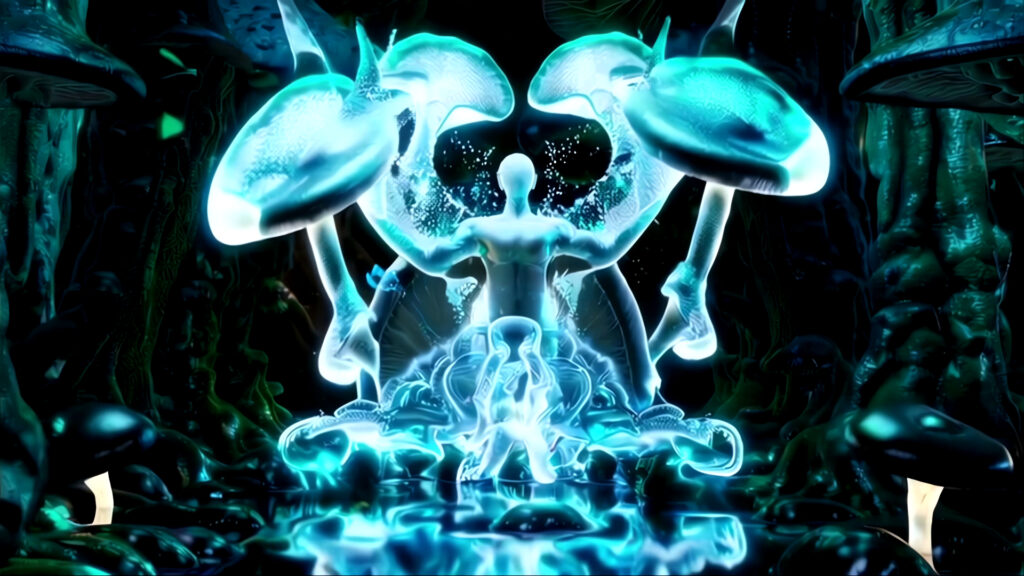
At the edge of the Expanse, the ground opened like a flower that had been practicing for millennia. From it climbed Architects—facet-bodied, mantis-long, delicate as thought. Each held a toolkit made from angles that argued with gravity and won politely. Their eyes were many; each reflected a schema for a world that had not yet convinced itself to exist.
They built in silence. Bridges of clear crystal unspooled from their forelimbs and set themselves across ravines that weren’t there until the bridges needed somewhere to go. Staircases assembled from triangles stepped sideways into rooms that listened. Every design held patience like an axle.
An Architect perched on Orasha’s shoulder and used the mantle’s light as a drafting table. It traced a door in the shadow that Orasha’s body cast.
This door will open, it said, when you want it most and do not move. Behind it waits an answer that dislikes rushing.
“What answer?” Orasha asked.
The Architect cocked its head so that its facets consumed a star. Patience is not waiting. Patience is moving at the speed of things that love you.
It slid away and left the door humming in Orasha’s shadow, a quiet hinge-shaped glow. Orasha did not test it. They walked on as if the door had been born there long ago and was only now learning the manners of a shadow.
IX. The Two Gates
Dusk gathered and folded itself into night. Just when the path should have vanished, it became obvious: a ribbed tunnel of caps whose undersides glowed with the kind of light a memory makes when it finds a home. Orasha entered and the air tasted of salt that never met an ocean.
At the tunnel’s end, two gates faced each other.
One was carved from obsidian orchard‑wood, its surface scored with glyphs that hinted at a thousand patient doings: seeds that chose, stones that voted, winds that tutored cliffs. The other gate was plain moss, shimmering faintly with the breath of small creatures that liked to shelter where choices gathered.
Between them stood a figure whose outline could not make up its mind. It was taller than Orasha, but only when measured by doubt. Its arms were multiple and sometimes none. Its face borrowed shapes from those who looked at it and returned them improved.
Traveler, the Usher of Else said, you stand where choice comes to practice. One gate opens to arrival that feels earned; the other opens to arriving before you have learned to enjoy the walk. Which is your patience closest to today?
Orasha let the hourseed speak. It had grown five leaves. Each leaf shone the way a promise shines when it stops trying to be more than its roots.
“I will choose the gate that expects a story first,” Orasha said. “The other seems impolite to the path that brought me.”
The Usher nodded, and a hundred bells no bigger than breath chimed without sound. Your answer matches the gait of the world.
Orasha stepped toward the obsidian orchard‑wood. The glyphs brightened and changed places the way dew does under a climbing sun. The gate considered Orasha’s reflection and decided to trust it.
It opened into the room that had been waiting since the first spore dreamed of architecture.
X. The Patience of Aethyra
The room was not a room, but a valley folded into privacy. Its floor grew soft grass that imagined oceans in its sleep. Its walls were cliffs tunneled by roots that sang in a register made for stone. In the center stood a pedestal growing out of itself, and on that pedestal lay nothing at all.
Orasha approached and set the hinge they’d been given by the Auburne upon the pedestal. The hinge did not click. It did not turn. It simply agreed to be placed and felt satisfied.
A figure materialized without a hurry. It was smaller than a mountain, larger than a sky when the sky is feeling shy. Its body was composed of layered mycelium and miles of patience braided into a person-shape. Its eyes were not eyes so much as weather systems studying kindness.
Aethyra, Orasha thought, but did not say.
I have been here the whole time, said the world, but it is polite to show a face when a guest sits down ready to listen.
“I came for the Slow Name,” Orasha conveyed, and the hourseed held still as stone.
You have been learning it since you stepped beneath my canopy, Aethyra answered. The Slow Name is not syllables. It is the practice of allowing a thing to arrive at the pace of its best self. I will say it now—but understand, I say it through you as much as to you.
A breeze moved between cliffs with the softness of a hand over a book. The pedestal grew a ring of lichen that pulsed exactly once and stopped as if content to be counted that far. The river at the edge of the valley chose to be a river for a while longer. Everything waited just enough to let the waiting be part of the deed.
The hourseed opened its sixth leaf.
Orasha’s mantle dimmed to a hush. Inside their chest, something arranged itself in a new order—the kind of order you recognize as if it had always been waiting for its name.
“What will you have me do with this?” Orasha asked after the right interval.
Take it where impatience has been crowned a virtue and ask it to sit down, Aethyra said gently. Teach it to like the view from a slower hill. Build stairways that step sideways into conversations. Plant hinges in shadows. Give answers that require a breath first, then another. Let the young storms of the universe learn they can be weather without being war.
Orasha bowed against the air. “May I return?”
Aethyra smiled the smile of a valley that knows the weight of centuries and enjoys each one. All listeners return. Some never leave, if you count leaving by heartbeat rather than footfall.
The pedestal bloomed into a diagram no one needed to read to understand. It folded itself small and tucked into Orasha’s shadow, where the Architect’s door slept. The door learned the diagram and relaxed.
Orasha turned to the gate. Before stepping through, they paused long enough to notice a moth resting on the inner wall. It was old, wingedges nicked by decades of gentle air. Orasha lifted a finger. The moth climbed onto it, tasted Orasha’s scent with its feet, then went back to sleep.
Outside, the forest prepared twilight in a thousand shades of violet. The Compasser’s descendants drew slow circles high overhead. The Hecateer had traded two masks and now wore a new one that looked like forgiveness. The Auburne stood in the Relay, where a tower had decided to be a tree again. The Spore Colossus moved on the horizon like a hill remembering to breathe. The Amanthids harvested and set free the last sheets of hanging rain. The Architects perched under fungi eaves, scribbling patience into angles until the stars approved.
Orasha walked until their shadow was long enough to hold a door. When it was, the door opened—not because Orasha pulled, but because the path undid the knot that had tied it closed. On the other side lay many worlds that mistook rushing for progress, and a few that were ready to learn better myths.
They stepped through, carrying a slow name no faster than the moss would choose to grow.
As the gate folded shut, Aethyra exhaled. The breath released spores that wrote nothing and meant everything, and in the writing-less sky of that valley no one hurried to explain.
The world had spoken, as it always did, in the patience of its becoming.
Coda: The Leafed Clock
Years later—or minutes, a measure is a choice—travelers on faraway stone will meet a tall figure with a mirror for a face and a clock that grows leaves. The figure will help them build bridges that prefer to listen before they span. The bridges will teach cities to breathe. A rumor will circulate that time itself has learned to pace its lessons, and the rumor will be true enough to be useful.
Back under the Violet Canopy, the Kyr-monk feels a familiar wind and folds two of its arms in thanks. The prism moths draft a slow spiral and let it unravel. The patient river polishes its glass with a thought. The valley smiles. The pedestal grows a second ring, not because it wants counting, but because counting asks politely.
Aethyra is not done. Worlds seldom are. But the Slow Name has a bearer now, and that is how stories choose to grow.
The patience of Aethyra continues, mushroom by thought, hinge by shadow, leaf by deliberate leaf.