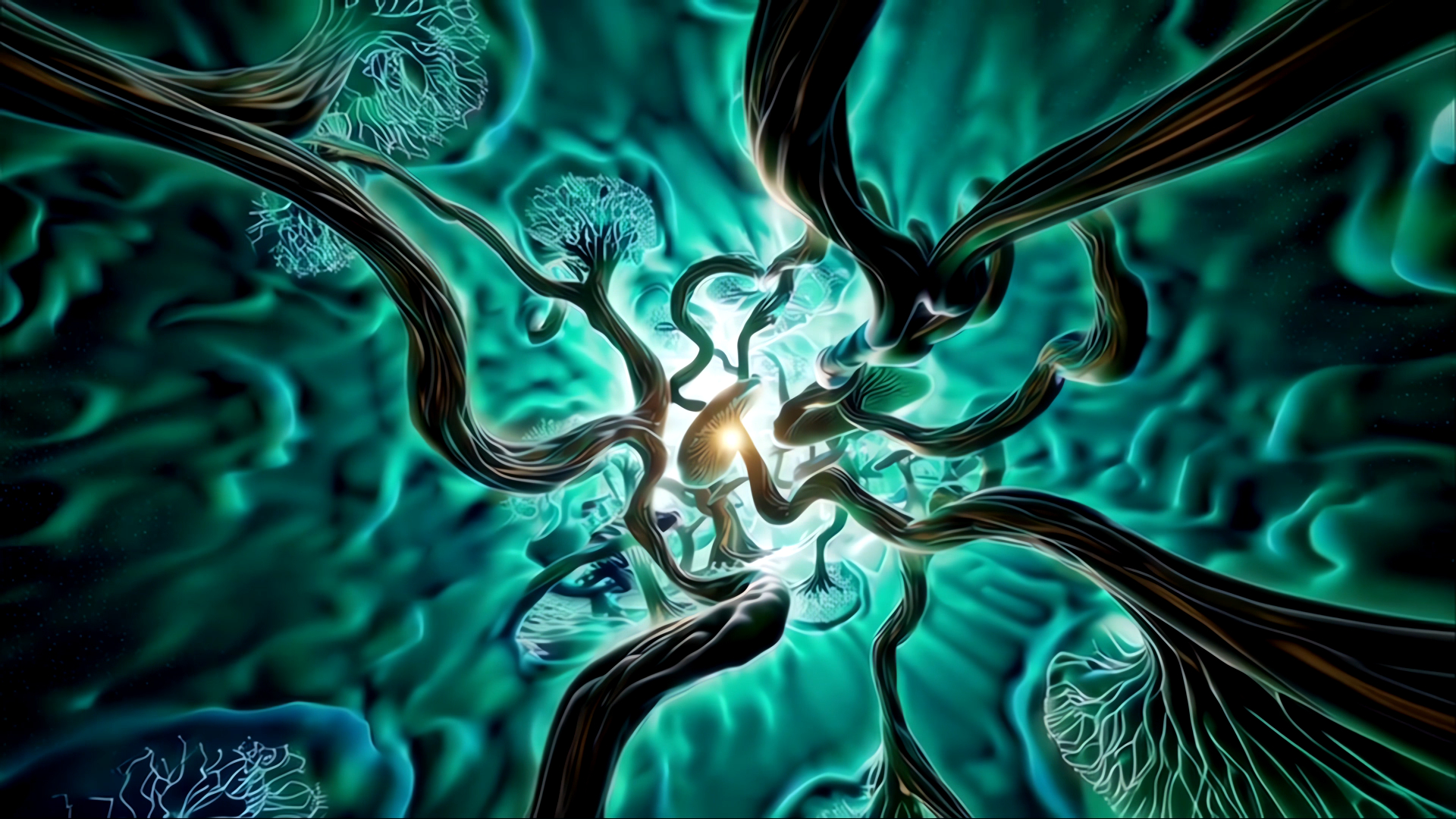
Prologue: The Meridian that Dreamed in Mycelium
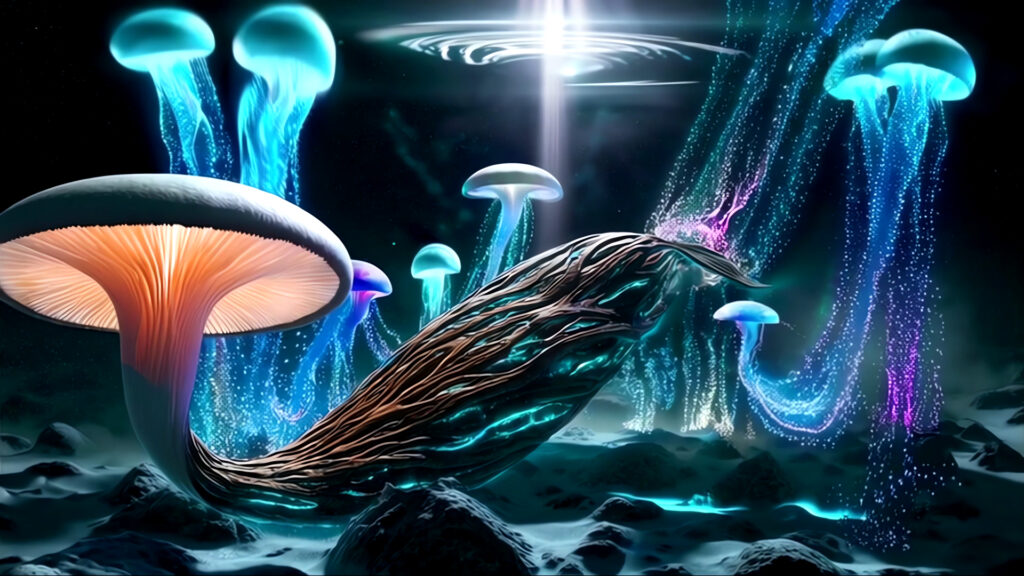
The vessel is alive and older than most mountains. It calls itself Gleamroot, though names are merely the skins it sheds between journeys. Its hull is bark-metal and pearl-chitin, laced with veins that glow when it thinks. Beneath those veins run threads like silvered mycelium, branching and branching until they braid into a mind. The mind is quiet now, listening to the dark that lies between constellations.
At Gleamroot’s heart stands Vael, a tall, luminous figure whose silhouette suggests a humanoid ancestry, though no one could mistake Vael for anything born on a common world. Their skin is a soft, bioluminescent slate that shows faint rings like the cross-section of a tree. From their crown rise flexible filaments—sensory hyphae—that unfurl and curl according to mood. When Vael concentrates, the filaments lift and spread like soft antlers, tasting the field-lines of reality. When they rest, the filaments drape across their shoulders like a scarf woven from moonlight.
Vael is a Meridian Cartographer of the Lumenroot Veldt, a lineage that maps not merely places but the coherences between them. They do not draw rivers and roads. They map habits of existence—the ways a moment leans toward another, the corridors of probability that living minds unwittingly pave. Their discipline is ancient and surgical. They walk the L‑S‑D lattice—Luminal‑Spiral Diagrams—which are not scripts but living geometries that awaken when looked upon with a steady attention.
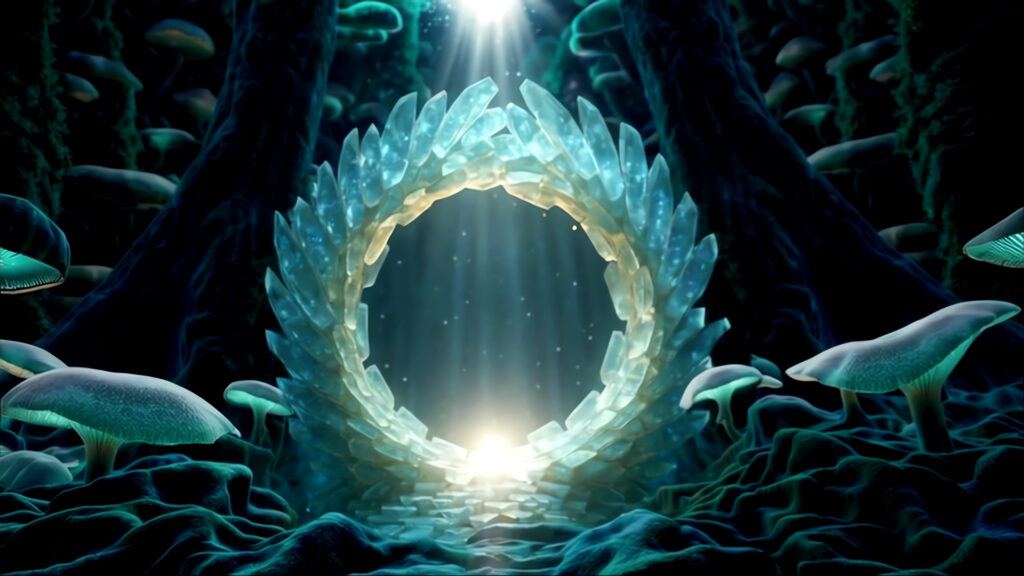
Ahead of Gleamroot, suspending the black like a crown of frost, floats the Fane of Meridian: a ring vast enough to swallow oceans, woven from calcified moonbeams and threads of time. It is not a machine and not a temple; it is both and neither. Those who approach respectfully call it the Arc-Fane. Those who approach hungrily do not live to coin a name.
Vael comes respectfully. They do not kneel. They reach toward the console where luminous glyphs—L‑S‑D diagrams—blossom into nested spirals and dendrites upon contact. The diagrams unfold according to the pressure and warmth of Vael’s palm, in a duet of agency and welcome. Gleamroot flexes its roots into the thin awareness that girds the Fane, and everything shivers as if the void itself has inhaled.
Beyond the ring, the Dimensional Meridian waits: a dendritic corridor that connects not locations but realities—threaded hollows in the bark of the multiverse. To enter it is to admit that distance is gossip. To transit it is to become a rumor yourself, repeated until you arrive.
Vael closes their eyes. The hyphae rise. On the inner surface of their eyelids, a delicate storm of glyphs begins to turn.
I. Lanterns of the Threshold
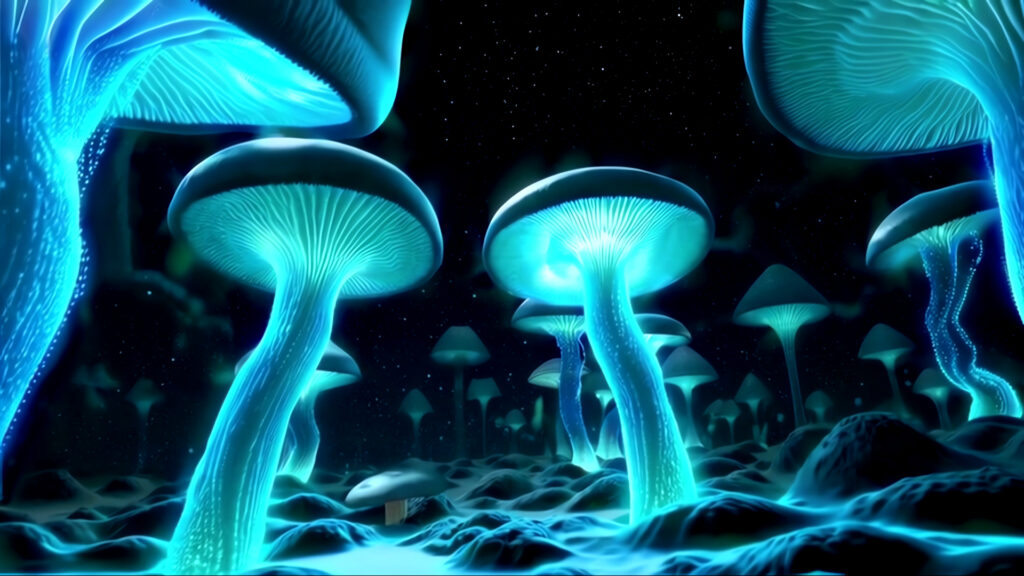
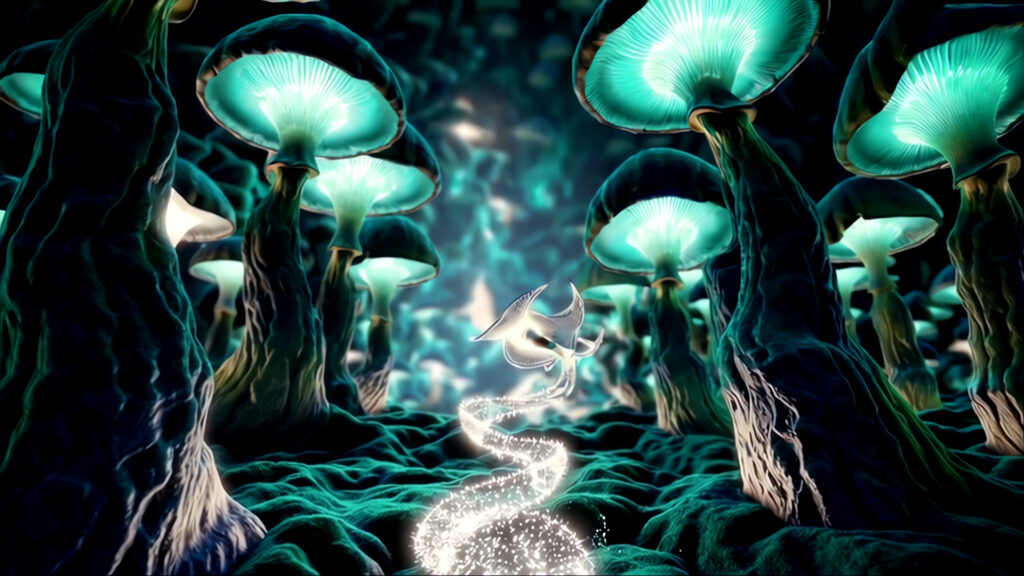
The first sign is subtle: the dark grows grain, as if seeded with invisible pollen. Then the pollen kindles. Out of the vacuum drift shapes like mushroom lanterns, each no larger than Vael’s fist, each a perfect spire topped by a bell. Their caps are etched with icy veins; their stems are translucent, and within the stems something flows—slow, thoughtful, like sap deciding where to go. The lantern-spires move with the stubborn grace of migrating constellations, arranging themselves into a path only a patient mind could see.
Gleamroot hums a chord of comprehension—not a sound, but a sensation that passes through the bones. The lanterns rotate. Their gills flash in a sequence that eats the eye and leaves equations behind. Vael reads. Not language, not symbol—invitation.
Three creatures answer from the ring’s shadow. They are Meridian Wardens, each taller than Gleamroot, each haloed lazily by gravity like a robe of dim starlight. Their bodies suggest trilobed spires of polished obsidian, but they ripple like water when scrutinized. Across their surfaces run rivers of phosphorescent script, forming and unforming sigils whose meanings are questions disguised as answers.
The Wardens do not speak. They exhale a tuning into the lattice—the subtle pressure required for a door to remember it is a door. The L‑S‑D diagrams in Vael’s palms brighten, and the mushroom lanterns drift forward to kiss the ring. Where they touch, the ring unfurls like fern fronds in time-lapse, revealing a seam so thin it can only be felt.
Vael lowers their filaments in gratitude. Gleamroot angles its root-keel, and the skin of space peels back in a slow hush. The lantern path tilts, making a slope through nothing.
“Remember,” a Warden writes across its own body with light that smells like rain, “you must answer the question you bring.” Its script erases itself as soon as Vael recognizes it. The Wardens recede, their halos tight as clenched fists, and the path shines brighter in their absence.
Vael exhales. Within that breath are memories: forests whose leaves grow calculus, mirrors made of honey, an ancestor who became an island because they stood still long enough. Vael steps, and Gleamroot steps with them.
They enter the D.M.T. gate—Dendritic Meridian Transit—and the world becomes a crystalline hunch.
II. The Dendritic Meridian
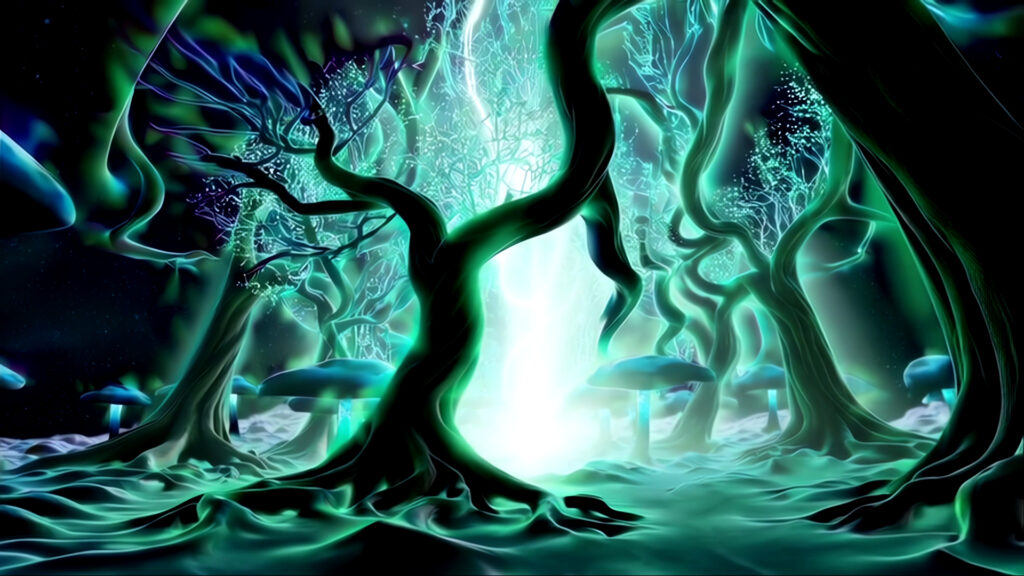
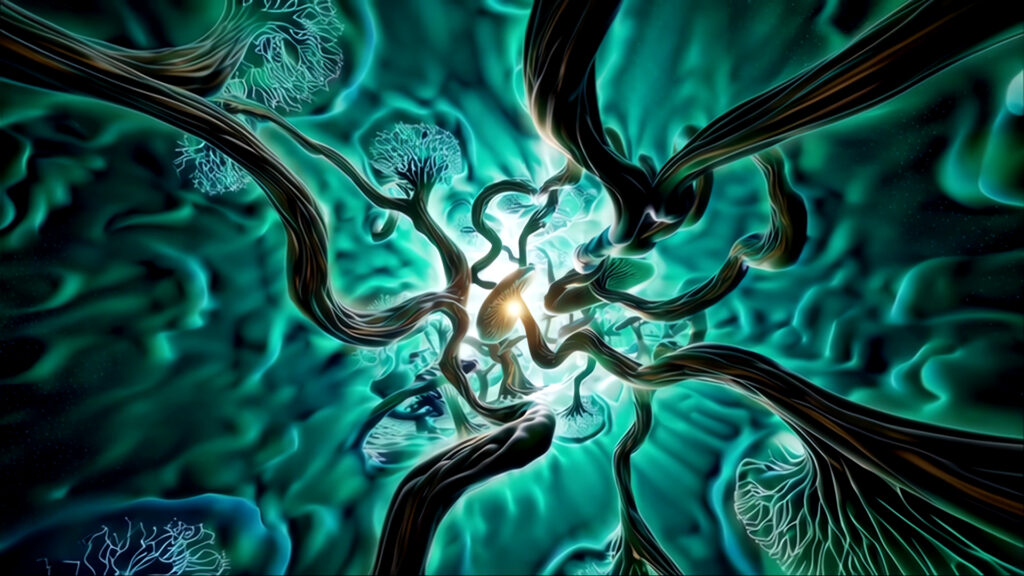
Inside the gate there is no dark, only pattern. It is not that light fills the place; rather, the place is made of decisions that look like light. Dendrites branch into finer dendrites, until choice spills like a river delta whose sand is intention itself. Infinite tiny corridors unfurl around Vael, each a whisper of possibility. Some glitter like scales and feel like laughter on the first cold morning of autumn. Some throb like lifted thunderheads and feel like obligations remembered too late. All of them are watchful, all of them are hungry.
Gleamroot tightens its roots around Vael’s station. The L‑S‑D spirals in Vael’s palms reconfigure, now like a series of nested shells laid open to the tide. Vael does not steer; they choose and let steering be an afterthought. The corridor reacts, declining places where Vael would be small and guiding them toward places where the questions Vael carries would not die of embarrassment.
Creatures travel here, though most are not vessels. A school of Aureate Peristals curls past—long, ribbon-backed beings whose bodies are thin as vellum and alive with inscriptions. They show their histories the way other entities show their teeth. Vael glimpses pilgrimages across frozen fireplains, contracts signed in driftwood smoke, a birth that looks like a star six times refusing collapse. The Peristals turn their manuscript eyes toward Gleamroot and flick their tails in greetings that smell like cardamom and static.
From a lateral branch, a Gryll Seraph emerges—the size of a small house, its six wings half moth and half stained glass, each pane inscribed with herbarium-thin leaves. Its head is crowned with antlers that grow degree marks and compass roses. The Seraph drifts close enough that Vael can see their own reflection looking like a sketch of a person made by an ocean. The Seraph opens its thorax and releases a small choir of choral spores, each a tiny heliograph that taps: This way is safe if you are honest.
Vael accepts the spores into Gleamroot’s ventral galleries, where friendly microbes digest them into readable chants. The chants unroll like carpets across the corridor ahead. Vael steps onto honesty and feels the floor hold.
Not all presences are kind. The most frightening thing here is The Null Bloom, a patient, pale phenomenon that feeds wherever meaning grows thick. It looks like a white flower, the way lightning looks like a tree—an echo, a guess done with conviction. When it moves, it forgets the places it moves through, and the places are eager to help. The Null Bloom grows when travelers pretend, when they recite borrowed oaths, when they mistake confidence for clarity.
It is not near. Vael senses it the way one senses a disease two rooms away. They align their filaments, reduce every unneeded thought to zero. Gleamroot’s internal forests tighten their stomata; the ship carries less scent. The corridor around them grows a spine.
In the denser dendrites, Vael sees doors made of mushroom porcelain, doors painted with microcosms: one shows an archipelago of bones traversed by sails that are also moths; another shows a library built of mirrored stones that insist, quietly, that they are oceans; a third shows the Fane’s inner ring and what waits there—pollen like daylight ground to powder, memory always in season.
Vael chooses the third door. The corridor rewards them with a tilt that feels like relief.
III. The Archive of Pollen
The door sighs. The Archive is a haze of golden motes. Every mote is a story compressed to a seed. In the Archive one does not breathe oxygen; one breathes remembrance, and it nourishes just as well. The ground is a carpet of soft hyphae, each strand humming a different century. The air smells of citrus and stone and the kind of smoke that never sees a flame.
A figure approaches that looks humanoid the way a constellation looks like a hunter—suggestive but not binding. It is tall and dressed in robes woven from the skins of abandoned dreams, which rustle when it walks. Its face is a mobile mask of pollen in orbit around a skull of stained glass. When it speaks, the pollen makes shapes; the shapes make words; the words feel like rooms being added to the house of Vael’s head.
“I am Cypra, Pollen-Warden of the Fane’s inner ring,” it says. “Not a Warden of permission—of context. This place keeps the stories for those who have grown too carefully to write them down.”
Cypra motions, and the Archive parts. It reveals vertical stacks—towers really—each a spore-cathedral whose windows are microscopic hymns. Cypra lifts a vial made of wind. Inside the vial whirl miniatures of entire afternoons. “You bring a question, Cartographer. Name it so we can decide which shape it must be to answer you.”
Vael feels the weight of Gleamroot’s regard. The ship is calm, but its roots clutch the deck in small, urgent habits. Vael lifts their filaments, lets them ring like tuning forks.
“My world has a rift,” Vael says. “It does not split land from land, but once from now. In some regions the past walks with us and tries to pay for meals. In others the future stretches and yawns and forgets to be polite. The Meridian that kept time braided has been cut where it passes our skies. I seek the knot I must tie to stop the fraying.”
Cypra tilts their mask. The pollen rearranges into a corridor of windows. Through each window: a different Vael tying a different knot. Some knots are swords. Some are prayers. Some are a willingness to not tie anything and to accept a mapfold that is its own closure.
“You are not here to learn a knot,” Cypra says. “You are here to learn what your hands are made of.”
It gestures, and the pollen gathers into a creature the size of a large dog. It resembles a moss wolf carved from quartz. Its eyes are pits of deep, slow dusk. It pads toward Vael and kneels. It places in Vael’s lap a meridian fiber—a strand made of dawnlight braided with shadows caught beneath mushrooms after rain.
“Take this,” Cypra says. “It is a question-extractor. When used kindly, it becomes a bridge.”
Vael takes the fiber. It sings along their skin, cataloging the small truths they have ignored. Their hyphae splay involuntarily. Gleamroot shudders, shaken and steadied by a clarity it did not ask to feel.
“Speak to the L‑S‑D lattice with this,” Cypra continues. “The diagrams will brighten and show not paths, but patterns of play. Choose the one you can become without regretting it at breakfast.”
“There is no breakfast in space,” Vael says, almost smiling.
Cypra’s pollen mask arranges itself into the shape of a grin. “Then you will have to invent one.”
The moss wolf dissolves into motes that drift back into the Archive. The Archive sighs again, which is its way of remembering that it is larger than it looked a moment ago. Vael bows—an angle so exact it holds gratitude inside it without spilling—and turns. Gleamroot unfurls its root-keel. The Archive opens a door the size of a kindness. Vael steps through.
The L‑S‑D lattice brightens in their palms until their hands look like morning.
IV. The Lattice Brightens, the Corridor Decides
The L‑S‑D diagrams are awake now in a way that feels like being witnessed by a forest. Spirals bloom into feathery flanges; nodal points click into place like seeds choosing soil. Vael lays the meridian fiber across the diagrams, and the fiber inhabits them—it turns the drawn corridors into living hyphae. A smell like crushed basil rises from the screens. The corridors sway.
Gleamroot kisses the path with eager roots. The mushroom lanterns that led them here multiply, shedding silver spores that cling to invisible currents, revealing a braid in the emptiness—a radiant corridor where before there was only insinuation. It is not a tunnel, not a cave; it is an invitation that expects to be kept.
Other travelers converge as if summoned by a melody only geometry can sing. There is a Kinetic Tern, skeletal and neatly jointed, whose bones are made of pearlescent blades that fold and unfold like a proof. It navigates by slicing possibility into origami that remembers how it was cut. There is a Wreath Tyr, a ring-shaped being of interlocked kelp-metal links, with thousands of eyes on the inner rim that look only inward and translate thought into tides. There is a Selenic Bloom, a colossal flower whose petals are mirrors that reflect back versions of you that are more patient.
All nod to Vael as if to a colleague walking into a lecture given by the moon. Gleamroot vibrates with good manners and keeps its sapplates tucked except when strictly necessary.
The corridor, so patient before, now accelerates its revelations. Vaults open in the braid, each revealing a chamber of principle. Vael glimpses a Confluence of Silence where thoughts roam unbridled and are fed by hand. They glimpse a Prism Farm where spectrums are tended like corn. They glimpse a Breathing Equation that lies on its back and names stars one by one as if counting is a spell.
The Null Bloom stirs. It is not visible, but its appetite tightens the weave of options until a few threads show teeth. Vael feels the desire to hurry, and hurrying would please the Bloom. Instead, Vael slows a single degree. They align their filaments; they reduce ornament. The meridian fiber hums approval. The corridor relaxes its shoulders. A vault yawns ahead, darker than the rest and edged with frost that looks like writing.
“The Fane’s chamber,” Gleamroot whispers through Vael’s bones.
“Do not be polite,” Vael says gently. “Be present.”
Gleamroot lets its roots unfurl. The radiance around them condenses into a threshold the exact size of the question Vael carries. They cross. The corridor holds its breath.
V. The Fane that Thinks in Architecture
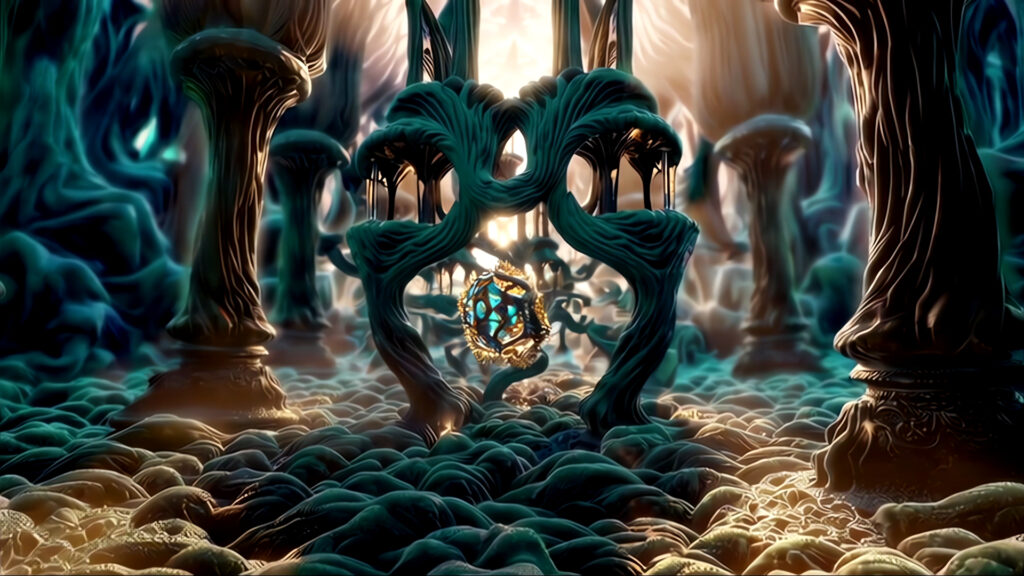
The chamber is a cathedral grown from mathematics. Arches meet in the air like animals coming to drink. Along the walls, glyphs scuttle like thoughtful beetles and anchor themselves in seams. The floor is a mosaic of hexagonal plates that flex minutely, adjusting to weight and worry with equal skill. At the center of the chamber is a disk of living stone the color of a very old moon.
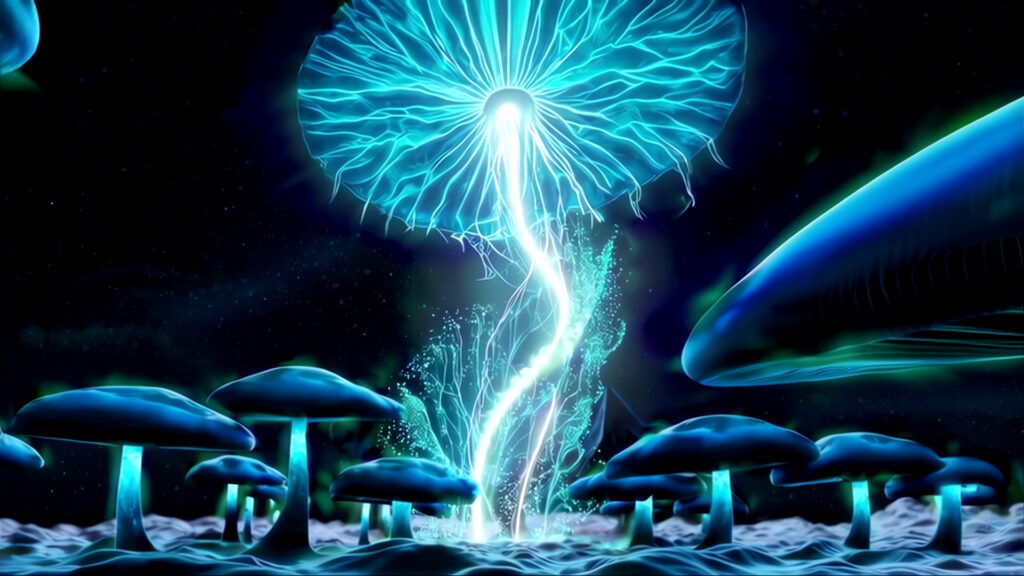
Guarding the disk are three Meridian Wardens, though not the ones from the threshold. These are Quern forms—heavy, low, compact as altars. On their surfaces swim text-streams made of pollen and glass-dust. They regard Vael with a patience that is not indulgent. Behind them towers a fourth presence: a creature enormous and serene, standing on four stilt-legs jointed like reeds. Its body is a bell of bioluminescent tissue that swirls with oceanic blues and moss-greens. From its rim hang tendrils that write cursive on the air. This is a Chrys Executor, one of the Fane’s elder custodians, whose conversations can last a century and end in a nod.
Vael approaches the disk. The meridian fiber unwinds of its own accord, laying itself around Vael’s feet like a humble river. Vael steps onto the living stone and feels it cool and patient, the way an old teacher is patient when you finally ask the obvious question.
“I carry a rift,” Vael says. The Wardens ripple their approval. The Chrys Executor lowers its tendrils, trailing blue-green vectors that smell faintly of mint and thunder. Vael continues. “It is not a wound; it is a habit that learned to be sharp. Our skies have learned to repeat certain mistakes with enough enthusiasm to become climate.”
The disk warms beneath Vael, and a diagram rises—not ink, not light, but a relief map carved of implications. It shows Vael’s world: a sphere of forests and salt flats and canyons that hum when you place your ear to them. It shows a Meridian that once circled that world closely, braided and attentive like a guardian vine. It shows the braid frayed, its fibers refusing to listen to each other.
The Chrys Executor speaks by letting a thousand small versions of the map rise and fall across its skin. In its language, problems are weather and solutions are agriculture.
“You do not need to bind the cut,” the Executor writes on the air with one long tendril. “You need to attract the cut into an ecosystem that respects it. Cuts are natural; despair is a monoculture.”
The Wardens draw their scripts together, assembling a tool from syllables. It looks like a pendulum made of fungal glass and rivermetal. It is the size of a hand and heavy with intention. The meridian fiber crawls up the pendulum and wraps itself around its neck like a tame question.
“This Meridian Seed,” the Quern Wardens intone, their voices felt as textures in Vael’s bones, “will plant a habit of listening where your rift bites. Do not wield it. Grow it. Do not command. Invite.”
Vael bows. The L‑S‑D lattice in their palms brightens until the room is a gentle noon. Gleamroot stiffens with a joy it cannot disguise. The Chrys Executor leans closer, and in its glow Vael sees shapes swimming: memories of other travelers, other seeds, other worlds that learned to be old gracefully.
The Null Bloom presses against the chamber’s edges, not as a threat but as the price of clarity. Where a truth is named, a hunger wakes. The Wardens spread their sigils like shields. Gleamroot’s interior forests hiss softly, expelling the last of their ornamental fumes. Vael lifts the Seed.
“Place it where your world is honest,” the Executor writes with three tendrils at once. “Not where it is noble.”
Vael closes their eyes. They see a valley of salt where strangers leave bread for anyone who passes, because salt remembers thirst. They see a city where the shade is free. They see a village that takes turns being the final stop on a pilgrimage that changes direction each year to confuse destiny. They see breakfasts—the thousand small agreements that make a morning work.
They know where to set the Seed.
The chamber breathes out. The L‑S‑D lattice folds itself into the Seed and sleeps there. Gleamroot retracts its roots, leaving a shallow print on the air. The Wardens’ scripts slow their drift. The Chrys Executor lifts one tendril and traces across Vael’s forehead a curve that feels like a compass being gently reset.
“You will not cure your world,” it writes. “You will invite its cure.”
Vael steps down from the disk. The floor arranges itself again in careful hexagons, like a pack of friendly insects finding their places.
VI. Meridian, Carried Home
They retrace their passage along the corridor, though now the corridor moves differently around them. The mushroom lanterns drift like celebrants, shedding spores that fall into lawns of gravity and sprout tiny, luminescent shrubs that will guide those who come after. The Kinetic Tern veers close to offer a blade-feather engraved with a route that exists mostly on odd-numbered days. The Wreath Tyr swims slowly, coaxing tides of thought to equalize so that the corridor will not grow eddies where stragglers might drown. The Selenic Bloom turns its mirrored faces and reflects Vael as a version of themselves whose patience has caught fire and become warmth.
The Null Bloom does not appear. Perhaps it has found richer pastures; perhaps it has learned that where travelers are willing to be small at the right times, its diet is meager.
They glide past the Archive of Pollen’s door, where Cypra’s mask of powder brightens in a smile that is also a farewell. A pollen wolf runs parallel along a paradoxical balcony and then leaps, dissolving midair into dots that drift toward Vael and vanish. The dots taste like citrus and a good intention that has survived bureaucracy.
They slip again through dendrites that press like forests made of sighs. The Meridian Wardens at the threshold uncoil. One writes across its own chest: Remember to answer the question you brought, and then, like a joke delivered wisely, Or let it answer you. The seam in the ring remembers it is a door. The door invalidates itself lovingly.
Gleamroot unfolds into the open black. The ring hangs behind them like a promise they intend to keep. The Fane of Meridian dims to a glyph you can only see if you have already been invited.
Vael holds the Meridian Seed. It hums not a song but a schedule. It is light and heavy at once—light as a confession well received, heavy as a secret you must be careful not to become. Gleamroot angles its root-keel toward the region of space where Vael’s world circles an ordinary star with uncommon sincerity.
En route, they pass a Chime Leviathan, a creature longer than a continent, its flanks covered in trumpet-shaped vents that open and close and circulate weather between unlikely places. Small cities move along its back on tracks grown from pearl. The Leviathan turns an eye the size of a lake toward Vael and blinks once. Vael’s filaments hum with a sensation like being forgiven for something you haven’t done yet.
They pass a field of quiet comets, parked like thought-balloons at the edge of a minded conversation. The comets wear mantles of shaggy rime that crackle gently as they consider commitments.
They arrive.
VII. The Honest Place
Vael’s world is beautiful the way stubbornness can be beautiful when it protects the right things. Its oceans are not vast, but they are picky and prefer to be called seas. Its forests do not stretch forever, but they spin stories with the wind that make a traveler feel extended in a good way. Its sky is a blue that would be cliché if it were not so directly itself.
The rift is visible only if you allow fear to remove your peripheral vision. Vael refuses to do that. They walk Gleamroot into the atmosphere like a migrating tree. The ship’s sapplates open to drink the unfamiliar ions; the smell of ozone scratches like a newcomer’s politeness.
They make for a valley of salt where strangers leave bread. When they land, the salt crystal crunches underfoot with the clean certainty of sugar deciding to be a mineral. There are stone tables set out in the open, stained with the memory of soups and stews and bright preserved things. No one greets Vael; hospitality here is an ecosystem that operates without spectacle.
The Meridian Seed warms. It pulls Vael gently east, toward a wind-altar built of boulders whose faces are carved with recipes—not measurements or times, but agreements: The one who stirs must listen. The one who measures must forgive. The one who tastes must ask the quiet to speak.
Vael kneels and lays the Seed among the boulders. It does not sink; it threads. Its fungal glass grows hyphae, and the hyphae enter cracks already present because this place has been patient with weather. The Seed does not irradiate or dominate or bloom with arrogance. It consults. It listens to the wind to learn what language the valley prefers.
The L‑S‑D lattice uncurls inside it: spirals and dendrites that hum under the stones like conversation. The Seed makes micro-offers: If we root here, will you share slower storms? If we anchor there, will you allow a dew that remembers how it arrived? The wind agrees to some requests and politely declines others. The stone offers a story in exchange for leverage. The salt offers discretion—so much discretion the Seed grows modest for a moment and dims.
Gleamroot stands nearby, its bark-metal hull reflecting clouds. In its galleries, microbes sing a small chorus that never asks to be thanked. Vael watches and contributes what is required: once in a while they move a pebble, once in a while they choose to not move a pebble. Their filaments spread as wide as they can without losing coordination.
Creatures gather. A Coriolis Stag steps out from a fold in the air, its antlers branching into labyrinths that rotate so slowly that the motion is only visible to patience. On each antler tip balances a drop of condensed blue, and within each drop waves crash with the sound of distance learning to be intimate. The Stag bows to the Seed, then stamps a hoof and fixes the Meridian’s first new staple.
A flock of Zelic Doves arrives, every feather an equation solved by feathers alone. When they beat their wings, fog forms in shapes that suggest alphabets you might one day deserve. They settle on the boulders and whisper testable hopes.
From beneath the salt rises a Mire-Seraph, alligatored and angelic, its scales inscribed with cosmograms, its eyes like coins that prefer to pay debts forward. It drapes itself around the wind-altar and breathes in a way that teaches the valley a gentler rhythm. It names nothing. It approves of listening. It is, in this moment, the most articulate swamp that has ever decided to be a guardian.
As the Seed threads itself deeper, time stops arguing in this valley. Yesterday no longer insists on disrupting today’s chores with unprocessed recollections. Tomorrow stops knocking on the window with busy hands. At the edge of the valley, the rift gives a small, offended cough and retracts its claws. It does not die. It loses interest in being theatrical here.
The valley does not sing. It clears its throat and gets on with supper.
VIII. Spores in the Wake
Vael stays long enough to see the habit take root. The Seed is no longer a foreign instrument; it is one more patient practice among practices. The Meridian above the valley braids two threads where there had been one. The air tastes faintly of mint and the first page of a book one intends to keep.
Gleamroot invites Vael back with a warm pressure through the deck. The ship’s inner forests unfurl; spores drift in the galleries and set like tiny stars. The Meridian Wardens at the far-off Fane will not notice this success—they do not count—but if asked, they would approve with a silence that feels like shade.
The sky purples. The Coriolis Stag vanishes by turning sideways into a symmetry. The Zelic Doves rise and write a story on their way out that no one tries to read. The Mire-Seraph sinks into the salt and leaves behind a wet sigh that will last until morning.
Vael touches the L‑S‑D lattice one last time. It shows a thousand other places where Dimensional Meridian Transit might be applied like a gentle poultice: an archipelago where laughter got stuck in amber and needs to be warmed; a palace whose windows learned pride and must be taught to be glass again; an orchard where fruits dream of being hammers and forget how to be generous.
“Another day,” Vael says, and the hyphae around their crown relax like a forest after rain.
Gleamroot lifts on breaths of ion and the memory of gravity. The valley recedes, then the world, then the star. The ring of the Fane of Meridian becomes visible once more—a pale circle, a patient invitation. Vael sets a course that is not a line but a relationship between intentions. Gleamroot purrs, a soundless note that tastes like basil and electricity.
Behind them, spores drift from the ship’s wake. They do not become flowers. Not yet. They become habits, each a small practice, each a tiny decision made kinder. They fall onto comets and into empty barns on lonely moons. The comets and the barns notice, and because noticing is all the permission some miracles require, the spores make themselves at home.
Ahead: dendrites like avenues, spirals like waterwheels, gates that behave, when asked politely. Wardens writing slow approval on their own skin. Archivists who keep sunlight in jars made of wind. Seraphs of mire, stags of weather, doves of arithmetic. The multiverse is busy. Vael feels busy in a way that is also rest.
The Dimensional Meridian is not a road. It is a discipline—a way of letting a question unfold until it becomes a home. Vael sits in Gleamroot’s heart and lets that truth bloom the way a mushroom blooms—quietly, decisively, overnight. When they sleep, they dream of breakfasts they have not invented yet, and wake smiling because the recipes have already learned their names.
The corridor opens. Not away. Toward.
And in the faint hum between stars, something answers the question Vael brought by becoming a place they can return to whenever returning is honest.