Prologue – The Prismfold
The realm was sick in a beautiful way.
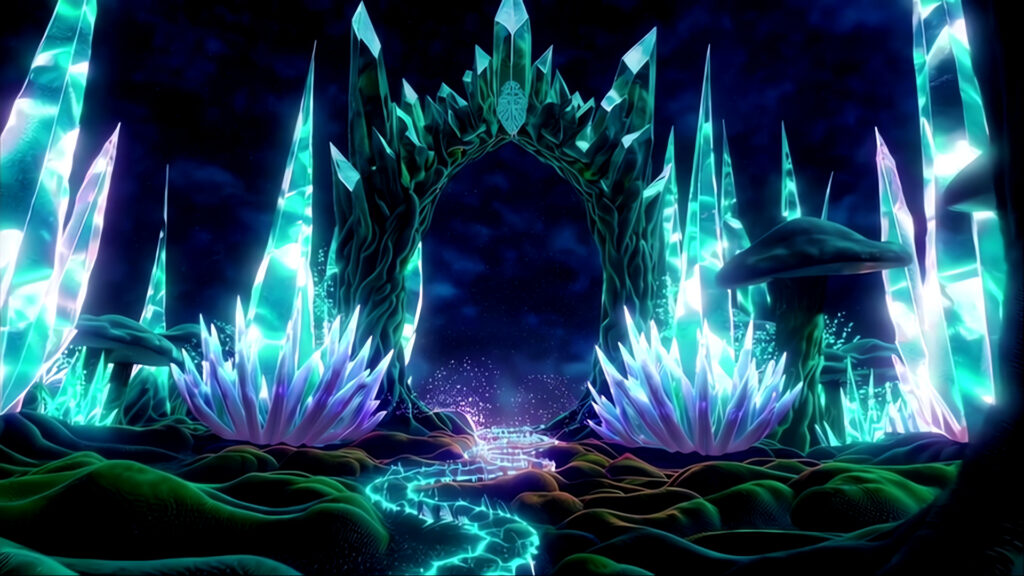
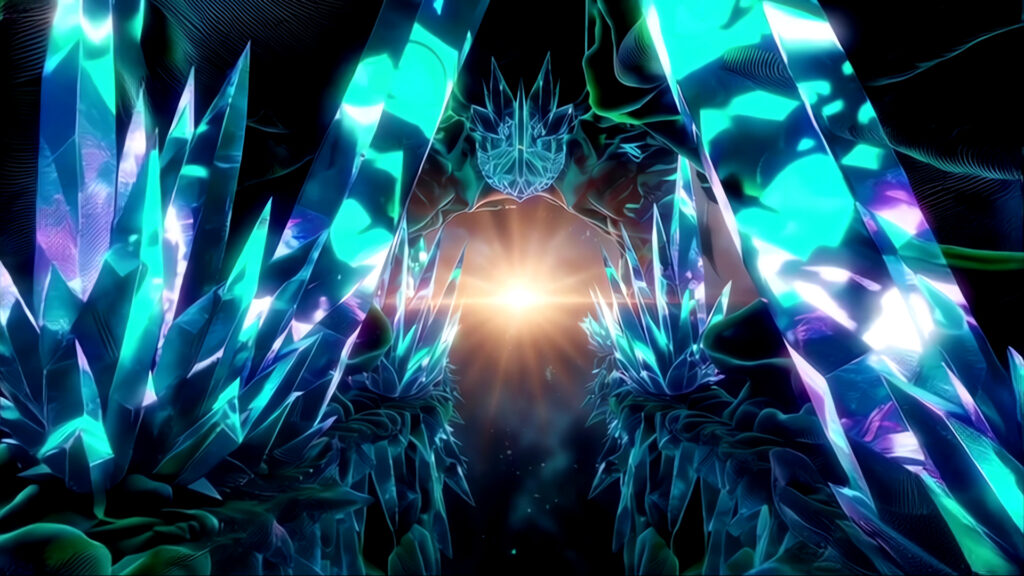
Across the Prismfold, reality no longer held still. Horizons rippled like liquid stained glass. Mountains folded inward into impossible angles, then unfolded into forests of crystal, then dissolved into drifting clouds of symbols before they remembered they were mountains again.
Once, this constant changing had a pattern. Every shift followed invisible rules, watched over by ancient beings known only as the Kaleidoscopic Gatekeepers. They sat at the passageways between domains, steering the flows of colour, form, and meaning so that travellers could cross without being shredded into nonsense.
But the pattern was slipping.
Gates misfired. Pathways closed halfway through. Travellers stepped out of one domain and never quite arrived in another, suspended as trembling mosaics in the empty between. The Prismfold was filling with half-finished thoughts.
In a pocket of relative stillness stood a lone figure.
They were not human. They were Shardborn—a tall, lithe humanoid shape composed of overlapping fragments of translucent crystal. Each shard reflected a different sky, a different landscape, a different version of themself. Their name was Kethriel, though in some shards they also answered to other names they had never spoken aloud.
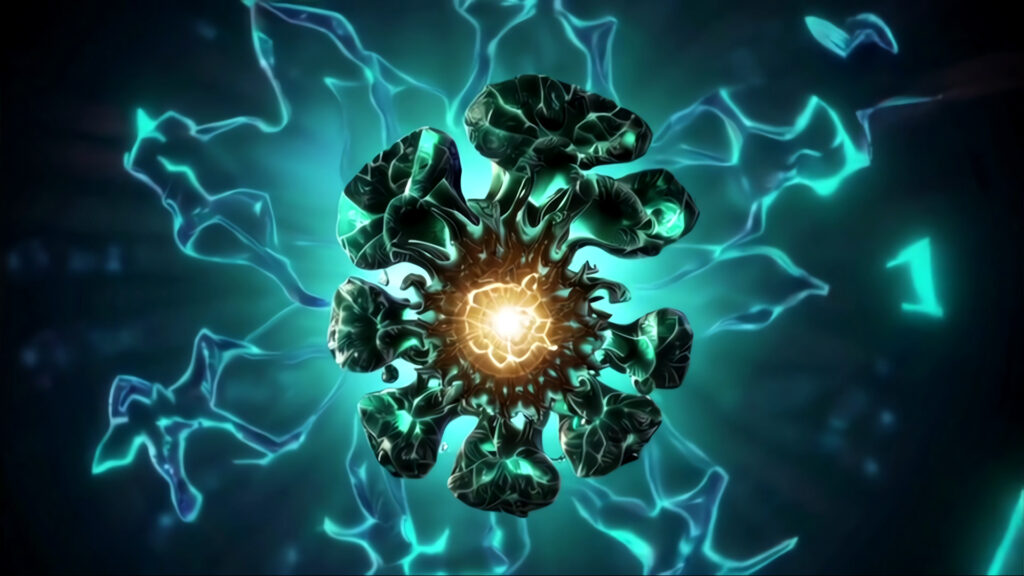
Where a heart should be, Kethriel carried a Liminal Core: a slow-turning knot of mycelial roots and prisms, pulsing faintly with soft ultraviolet. When the Core warmed, a gate was near. When it burned, reality itself wanted something.
Tonight, it burned.
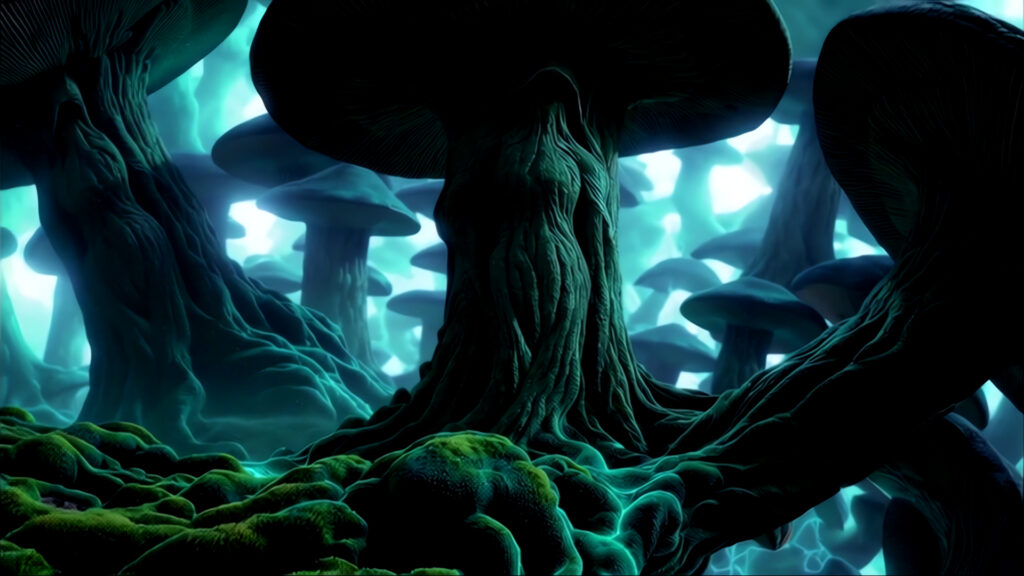
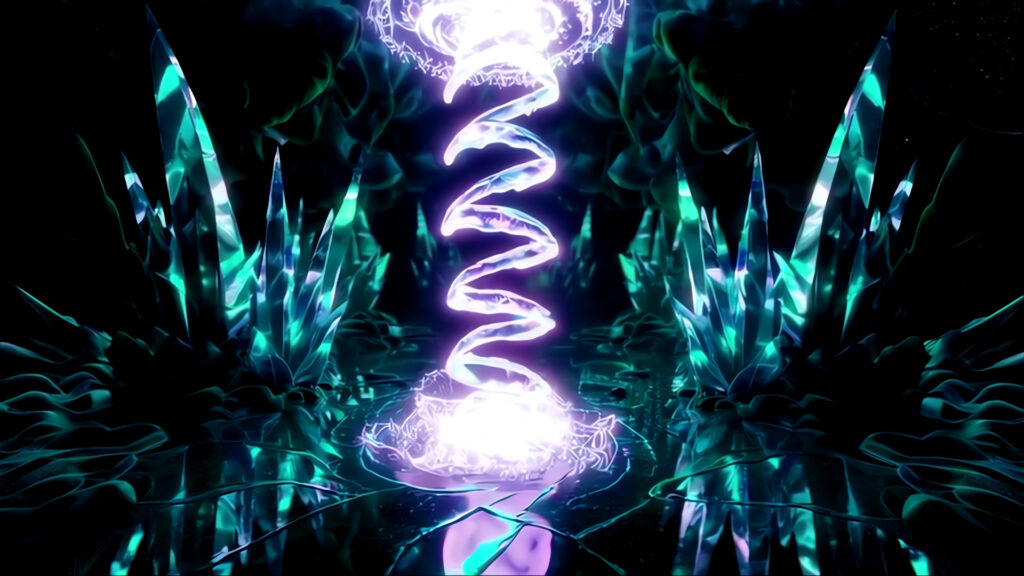
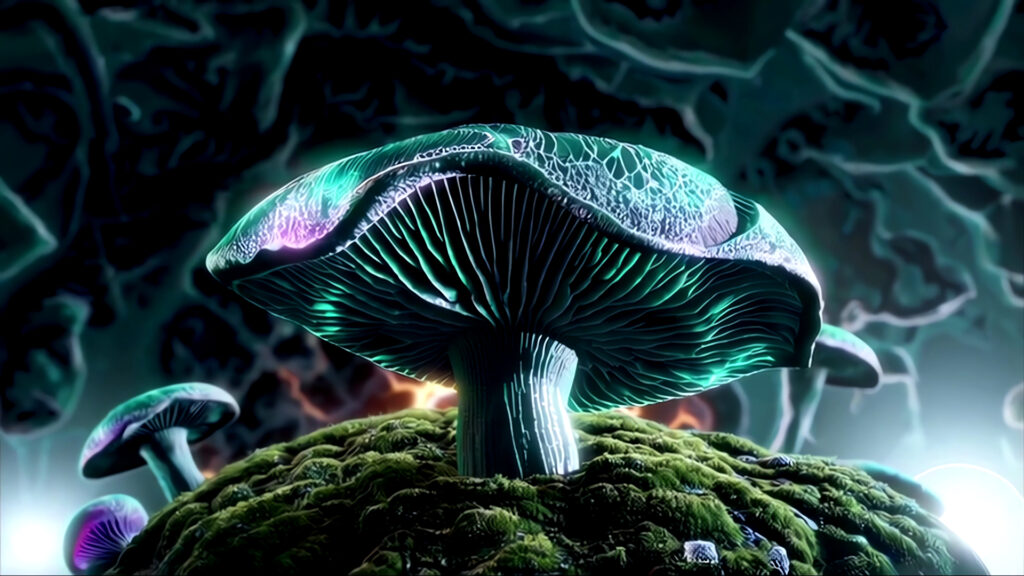
The air around Kethriel shimmered, and the ground beneath their bare crystal feet shifted from solid stone to a glowing mesh of bioluminescent mycelium. The threads pulsed in intricate patterns, like a living circuit board grown from psilocybin-soaked roots. Mushroom towers rose in the distance—giants with caps like stained-glass domes, breathing out glowing spores that floated in patient spirals.
Kethriel watched as lines of neon light traced themselves through the mycelial net, converging into intricate sigils. Each sigil resembled a tiny square of artwork, dots and swirls and animal-less constellations laid out in precise grids—as if the world were printing its own enormous, animated sheets of LSD-like designs underground.
At the center of those patterns, a ring of shifting triangles opened, not downward but inward.
A gate.
The stories said the Kaleidoscopic Gatekeepers had fallen silent.
Kethriel knew, with a certainty that resonated all the way into their Liminal Core, that if they stepped into that ring, silence would end.
One way or another.
They stepped forward.
Chapter I – The Mycelial Threshold
The mesh beneath Kethriel’s feet grew brighter with each step, threads of light thickening under their weight as though acknowledging an old agreement. The mycelial network responded not with sound but with colour-pressure, gentle pulses of cool cerulean and warm amber pushing against their crystalline shins.
The towering mushrooms watched.
They weren’t plants, not exactly. Their caps were broad disks made of semi-transparent tissue striped with luminous veins, patterns that moved like slow rivers. From their undersides hung gills that looked less like flesh and more like fractal canyons, etched with shifting mandalas in ultraviolet ink. Spores drifted from them like slow-motion snowfall—tiny particles that burst open into microscopic DMT-like fractals before dissolving into the air.
As Kethriel walked, the valley changed.
The sky, once an almost honest black, began to shimmer with faint geometry. Triangles grew along the horizon. Lines intersected, forming polygonal webs that hinted at constellations no one had named. Colours bled sideways—violets sliding into teal, oranges melting into neon greens, like someone had poured a solution of liquefied hallucination across the firmament.
The Liminal Core in Kethriel’s chest thrummed faster.
Ahead, the mycelial paths converged toward a circular clearing where the roots braided themselves into a raised platform. Around its edge grew a ring of smaller mushrooms, their caps patterned like tiny blotter sheets printed with impossible creatures—eyeless dragons, spiraled serpents, geometric birds with wings made of tessellating hexagons.
At the clearing’s center, space itself folded.
Lines of colour twisted inward, forming a slowly turning cylinder made of mirrored facets. Each facet reflected the valley, but not truthfully. In one, the mushrooms leaned in closer than they really were. In another, the sky broke into shards and spun like a slow tornado. In another, Kethriel themselves were taller, thinner, their shards edged with reddish light, eyes full of glyphs that were not there yet.
The first Gate was awake.
Kethriel stepped into the circle.
The mushrooms bowed. The mycelium flared. The turning cylinder of reflections slowed for a breathless moment—and then fractured.
From the pieces, something stepped out.
Chapter II – The Many-Masked Gatekeeper
The being rose from the broken reflections like a figure stepping through the surface of a calm lake. It was taller than Kethriel by half a head, its body cloaked in overlapping layers of dark, iridescent fabric that behaved less like cloth and more like liquid shadow. The cloak’s surface was patterned with triangles, squares, circles—each filled with swirling LSD-like scenes that morphed and bled into one another.
Its head was a mask, but no single mask could be its face.
Where a head should have been, there was a rotating wheel of faces—each one a different shape and texture. One moment it was carved stone, then polished bone, then iridescent insect chitin, then a slab of violet crystal. Some faces had many eyes; others had none. Each turn of the wheel clicked softly in a rhythm that Kethriel felt in their limbs rather than heard in their ears.
At the wheel’s center, where a nose and mouth might be, there was only a kaleidoscope—a tunnel of infinite symmetry. Colours folded inward and outward, repeating in mirrored patterns that never quite looped the same way twice.
Kethriel stood still. Their own shards brightened, then dimmed in unison.
“You have stepped without invitation,” the Many-Masked Gatekeeper said.
The voice did not come from any single face. It emerged from the kaleidoscope center, a layered chorus speaking all possible tones at once. The words felt like they were being spoken directly into the planes of Kethriel’s crystalline body, vibrating every shard.
“Your gates are failing,” Kethriel answered. They did not need a mouth; their words were carved directly into the air as lines of faint light, then dissolved. “Travellers are lost in frozen refractions. The Prismfold is becoming a graveyard of half-born worlds.”
A slow turn of the mask-wheel. A stone face with hollow eyes slid into view.
“And you would correct this?” the Gatekeeper asked. “A shardborne wanderer with a burning root in their chest?”
Kethriel touched their Liminal Core. Its mycelial threads flickered with soft blues and acid greens, like spores suspended in liquid starlight.
“I would see your pattern,” they said. “Or what is left of it.”
The kaleidoscope in the Gatekeeper’s center deepened, its symmetry sharpening into vicious clarity. The air around the clearing thickened, becoming glassy and resistant, as if Kethriel were standing underwater.
“Then we test,” the Many-Masked said. “Step through your own fragments.”
With a gesture, the Gatekeeper flung its cloak outward. The shadows peeled from the fabric and flew toward Kethriel as a storm of mirrors.
Chapter III – The Obsidian Bloom
The world shattered.
Not into pieces of valley and mushroom and sky, but into angles of possibility. Kethriel’s vision broke into a dozen simultaneous scenes, each one a version of themself stepping forward, stepping back, standing still, collapsing.
The Liminal Core flared, and one path grabbed them by the spine.
Gravity twisted sideways. Kethriel’s crystalline body elongated, then snapped back into shape as the mirrors swallowed them whole.
They fell—sideways, upward, inward—until the tumbling stopped with a soft impact.
The valley was gone.
Kethriel stood in the heart of an obsidian city. The ground was a slick black surface veined with electric blue light, like frozen lightning locked under glass. Fungal towers rose on all sides—mushrooms carved entirely from glossy stone, their caps edged in neon cyan. The undersides of those caps pulsed with patterns, shifting in hexagonal tilings that looked eerily like DMT-visions forced into architectural form.
The sky was a dome of ink streaked with bands of colour, curling around themselves in spirals. Geometric storms roiled overhead: triangles birthing triangles, squares splitting into grids, circles spinning into halos of repeating eyes.
The air tasted like minerals and ozone and the faint metal tang of something chemical that had never been swallowed.
“Shadow Bloom,” Kethriel murmured, shards picking up the light. “A fractured domain.”
Shapes moved between the towers.
They were tall, thin figures with bodies made entirely of overlapping polygons—transparent plates of glass-like material that caught the electric-blue glow and sent it scattering in jagged beams. Where faces might be, there were only layered, shifting patterns of symbols—circles inside triangles inside squares, each layer rotating at its own pace.
These were Echo-Guardians, lesser constructs of the Gatekeepers’ will, tasked with keeping broken domains from collapsing entirely.
They turned toward Kethriel. Their bodies flickered, frames deconstructing into hissing, pixelated dust, then reforming again, as if their existence depended on constant small corrections.
The nearest Echo-Guardian’s chest flared, projecting a rippling sheet into the air between them: a flat panel covered in tiny, repeating squares, each a different microscopic artwork—some like LSD-blotter patterns of flowing colours, others intricate mandalas made of spores and stars.
Across that shifting sheet, an image formed: Kethriel, entering the valley. Kethriel, stepping into the circle. Kethriel, swallowed by mirrors.
A message: We have seen you. We do not understand.
“I am here because your pattern is breaking,” Kethriel said. “The Prismfold cannot keep holding like this. Show me the gate.”
The Echo-Guardian tilted its head. Its polygons clicked into alignment, forming a rigid, crystalline posture. Then it turned, its body stretching unnaturally long as it glided between the obsidian mushrooms. The others followed—some climbing vertical walls, others flattening into sheets of geometric frost that slid across the ground, reforming ahead.
Kethriel followed.
As they walked, their shards reflected not a single city but many: the real obsidian one, a version where everything was made of dull sandstone, a version underwater with glowing jelly-shapes drifting overhead, a version where the sky was a lattice of pure numeric symbols streaming downward like rain.
Each reflection pulled at them, an invitation to step sideways into a different story.
The Liminal Core burned hotter, keeping them anchored.
At the city’s heart, a structure rose—a spiraling column of black glass, studded with shards of luminous fungi and veins of pulsing colour. It resembled a colossal mushroom whose stalk had been twisted into a helix and frozen mid-turn.
The Obsidian Bloom.
At its base, crystal steps led up to an opening: a doorway that was both empty and filled with swirling patterns of light.
A second Gatekeeper waited there.
Chapter IV – The Glass Seraph
The being at the entrance did not wear a cloak. It did not need to.
Its entire body was a shifting cathedral of glass shards and living light. Limbs unfolded from a central core of blinding radiance, each limb constructed from elongated prismatic plates that slid over and through one another without ever colliding. Wings—or structures like wings—fanned out behind it in layered arcs, each feather a thin, transparent pane etched with microscopic mandalas.
The light shining through its body carried dizzying scenes. One shard showed a forest of mushrooms breathing out streams of indigo spores. Another displayed a desert full of towering crystalline cacti, each spine tipped with mescaline-bright colours. Another showed swirls of orange and teal that folded into a kaleidoscopic tunnel reminiscent of pure DMT visions.
Kethriel realized, with a faint thrum of unease, that each image was a domain. An entire world, folded into a single pane of this being’s construction.
Its face was a mask of simplicity: a smooth oval of dark glass with a single slit, within which a vertical kaleidoscope-eye turned slowly.
“You are aligned,” the Glass Seraph observed. Its voice sounded like distant chimes, as if someone were striking crystal inside Kethriel’s own chest. “You did not fracture in the entry.”
“I held the anchor,” Kethriel said, touching the Liminal Core.
The Seraph inclined its head.
“This bloom is tilting,” it said. Panels along its arms rotated, showing momentary flashes of the city collapsing into jagged ruin, then reforming, then collapsing again. “The pattern decays. The Gatekeepers…disagree. We have lost synchrony.”
“Then I need to speak with all of you,” Kethriel said. “Not only your fragments.”
The kaleidoscope-eye narrowed, colours sharpening to knife-edged triangles.
“Bold,” the Seraph said. “The circle has not convened in one chamber since the Prismfold was bound. Long before your shards were cut.”
Kethriel stepped closer, their own body refracting the reflected cities. “That is why your gates misfire. You cannot keep the pattern alone.”
The Seraph watched them for a long moment. The air thickened with potential.
“Then enter the spine,” it said at last. “Climb until your form wants to smear across every angle. Climb until you cannot remember your own outline. If you still know your name, the higher Gatekeepers may listen.”
The doorway behind it rippled, glass panels peeling back to reveal a twisting corridor made entirely of interlocking prisms. Inside, gravity had clearly given up.
Kethriel nodded once.
They stepped into the spinal passage.
The climb had nothing to do with height.
Inside the spine of the Obsidian Bloom, direction stopped making sense. Surfaces could be floors or walls or ceilings depending on where Kethriel decided to place their feet. Shards within their body reflected infinite corridors, some empty, some populated by past versions of themselves, some filled with alien figures they had never met.
Light bent and folded, bouncing from pane to pane in manic patterns. Sometimes it coalesced into geometric storms that washed over Kethriel’s form, trying to soften their edges into pure colour and dissolve them into the Seraph’s internal cathedral.
The Liminal Core balled itself tighter, mycelial threads gripping their crystal structure like roots hugging stone.
They climbed—or perhaps declined, or drifted—inward.
When the corridor finally opened, it did so all at once, like an iris dilating.
Kethriel stepped into empty space.
Chapter V – The Suspension Bloom
There was no up, no down, only floating geometry.
Kethriel hung in a vast chamber made of hexagonal panels, each one a window into another hallucination. Some panels showed forests of towering mushrooms, their caps dripping with luminous spore-water that fell upward. Others displayed deserts made of cracked psilocybin tiles, each fragment etched with minuscule sacred geometry. Some panels were pure pattern—spiraling mandalas in LSD-bright palettes, turning slowly without ever quite repeating.
Between the panels drifted free-floating fungi, untethered mushrooms whose stems were delicate spirals of translucent fibre. Their caps were smooth disks of opalescent matter, and from their edges streamed ribbons of tiny spores that assembled into brief, fragile constellations before popping out of existence.
Kethriel realized that they were suspended mid-air, nothing supporting them but the shared agreement of the chamber that they should not fall.
Time in this place felt sticky, elongated. Moments stretched and folded like soft paper. The pulses from their Liminal Core slowed, each beat echoing through the chamber as a wave of faint colour.
A whisper brushed the edge of their awareness.
Not words at first. A rush of shapes: triangles nested in triangles, curves looping into themselves, bursts of spore clouds seen from inside. The whisper tasted like petrichor and static and the first inhale of a dream.
“Shardborn,” it murmured at last. “Why do you climb so far into broken symmetry?”
Kethriel turned slowly in the air. One of the hexagonal panels ahead darkened, then brightened again, not with a scene but with a presence.
A face pushed through from the far side—not a normal face, but a fluid mass of shapes, rearranging constantly: antlers made of branching crystal, eyes like rotating DMT-tunnels, teeth that were not teeth but tiny mushroom caps opening and closing in sequence.
“I climb because your gates are losing travellers,” Kethriel replied. Their voice emerged as small glyphs that floated away from their chest, rearranging themselves into visible sentences before fading. “Because the Prismfold is storing too many stuck reflections and not enough flowing paths.”
The shifting face smiled with a dozen mouths.
“Ah,” it said. “You seek the circle. The full Kaleidoscopic Assembly.”
“Yes.”
“That path is costly,” the face warned. “Every gate held by a Gatekeeper has its price. Climbing to where all of us touch?”
Panels shifted around them, their images fuzzing. For a heartbeat, every window showed the same thing: an empty chamber filled with seven towering silhouettes, each radiating a different flavour of impossible geometry.
“You might not return as you left.”
“I rarely do,” Kethriel said simply. “But I prefer to change on purpose.”
The face laughed, the sound like a handful of small glass beads rolling across stone.
“Very well,” it said. “We will let the sky decide.”
The chamber twisted.
Panels spun, rearranging themselves into a spiral that funneled Kethriel toward a single opening: a hexagon filled not with a scene but with blinding sky.
They fell, or rose, or slid sideways into light.
Chapter VI – The Sky Lattice
They emerged onto a bridge of mycelium stretched across an endless sky.
The bridge glowed from within, threads of pale green, hot pink, and electric blue weaving together in complex patterns. It was not a flat surface but a living cable, twisting gently as it spanned a gulf filled with clouds that looked suspiciously like slow-motion explosions of powdered crystals.
Beneath the bridge, there was no ground. Only a churning abyss full of floating shapes—polyhedral chunks of land spinning slowly, covered in forests of mirrored mushroom caps and jagged crystal growths. Between them flowed rivers of molten colour, like liquefied psychedelic paintings seeping through cracks in reality.
Above the bridge hung inverted mushroom forests, their caps pointing downward like bioluminescent chandeliers. Sporefall drifted from them in shimmering curtains, each tiny particle a miniature mandala unfolding through a dozen geometries before dissolving.
The air tasted sharp and clean, tinged with the faint metallic ozone of lightning about to happen.
The bridge hummed under Kethriel’s steps. Their shards reflected the abyss, the sky, and something else—a long, sinuous shape coiling through the clouds.
The shape resolved.
It was a serpentine dragon woven entirely from glowing threads of mycelium and aurora-light. Its body flowed seamlessly from one colour to another, the gradients rippling across scales that were not scales but tightly braided strands of living fibre. Each twist of its body sent waves of shifting patterns through its length, like someone rolling a kaleidoscope slowly between their hands.
Its head was crowned with antlers made of crystalline branches, each tip exhaling a faint mist of rainbow vapour. Eyes like twin galaxies fixed on Kethriel, irises full of spiraling DMT-esque fractals, pupils expanding and contracting with curious intensity.
It coiled around the bridge, not touching it, orbiting like a guardian storm.
“I am Aurora Mycelian,” it said, voice a rolling thunder that barely disturbed the air. “Gatewarden of the Sky Lattice. You have climbed high.”
“I was thrown high,” Kethriel corrected. “Somewhere below, a suspension bloom decided the sky should decide whether I live.”
The dragon laughed, a sound that splashed colour across the clouds.
“The face in the hexagon likes to make games,” it said.
Aurora Mycelian glided closer until its enormous head hovered before Kethriel. Threads of light brushed their shards, sending sparks of colour sliding across their crystalline body.
“You are stable,” the dragon murmured. “Most who arrive here are already smeared across several directions at once. Their edges softer than yours.”
“The Liminal Core holds me,” Kethriel said. “I am not easily scattered.”
The dragon’s eyes narrowed thoughtfully.
“You seek the Assembly,” Aurora said. “You are climbing toward the circle where we cross.”
“Yes.”
“That path is above the sky and below it,” Aurora Mycelian replied. “You must cross my bridge without losing any part of your outline. The lattice will try to borrow pieces of you. It is hungry for novelty.”
The dragon flicked its tail, and the bridge bucked like a living thing.
Suddenly, smaller lines of mycelium shot off from the main span, darting upward and downward, connecting to floating islands, mushrooms, and nothing at all. Each side-path was a temptation, a route toward some unknown hallucination.
The main bridge grew thinner.
Kethriel spread their toes along the mycelial strands, feeling the gentle tug of alternate routes. Some paths promised weightlessness, others warmth, others the soft drag of thick atmosphere, like moving through dream-water.
Their shards flickered, reflections threatening to peel away onto side bridges and vanish.
They moved.
Step by step, they walked the thinning span, each motion deliberate. Mycelial filaments snapped at their ankles, trying to hook stray reflections and drag them off, but the Liminal Core pulsed, sending small shockwaves through their body that knocked hungry paths away.
Aurora Mycelian circled, watching with amused interest.
Halfway across, the bridge narrowed to the width of a single glowing thread.
Below, an island of crystalline cacti rotated lazily. Each cactus spine shone with stained-glass colours, forming patterns reminiscent of mescaline mosaics. Spores drifted around the island like lazy comets, trailing faint glyphs that read like forgotten mathematics.
The draw of that side-reality tugged at Kethriel’s chest. One shard flickered, briefly showing an image of themselves walking there instead—shards coloured desert-red and cactus-green, limbs elongated, eyes like slow-turning gears.
They exhaled.
“No,” Kethriel whispered to their own reflections. “Not today.”
They stepped forward.
The mycelial thread beneath their feet thickened again, splitting into many strands, then a full bridge. Aurora Mycelian roared approval, sending a shockwave of colour blasting across the sky.
At the far end of the bridge waited another structure: a suspended citadel made of overlapping crystal spores, hanging in the air like a frozen explosion.
Aurora dipped its head.
“Cross that,” the dragon said, coils folding gracefully. “Inside, the Archivist will weigh your memory. If you are still intact afterward, the Assembly might listen.”
The citadel’s entrance yawned open.
Kethriel walked on.
Chapter VII – The Archivist of Spores
If the Obsidian Bloom had been a tower, and the Sky Lattice a highway hung in the air, the Spore Citadel was a library that had forgotten what “shelving” meant.
Kethriel stepped into a vast chamber where the walls were built from tightly packed clusters of giant spores—spheres of translucent material, each one containing a swirling scene. Millions of them, stacked in spirals that climbed up and vanished into hazy heights. Some spores housed miniature forests of glowing fungi. Others contained rotating crystals, fractal storms, or entire pocket-domains only inches across.
The floor was a mosaic of fossilized mycelium, polished to a mirror sheen. Every step Kethriel took sent faint rings of light rippling outward, stirring nearby spores into brighter glow.
In the center of the chamber stood a figure.
It was tall and slender, humanoid in outline but made entirely of floating spores and shimmering dust. Thousands of tiny orbs orbited a central invisible skeleton, arranging themselves into limbs, torso, and head. Each spore carried a different colour, a different symbol, a different tiny memory. Every few seconds, one spore would drift out of position, float through the air as if reconsidering its life choices, then snap back into place, altering the figure’s appearance.
Its face consisted of a single large, opalescent spore encircled by a halo of smaller ones. In its depths swirled a pattern that refused to settle—sometimes an eye, sometimes a spiral, sometimes a mushroom cap seen from below.
“I am the Archivist of Spores,” it said. Its voice was soft, powdered, like dust shaken from old books. “I hold the echoes of every traveller who has brushed against a gate and lived long enough to leave an imprint.”
The Archivist raised an arm. Spores flowed along the limb in a shimmering stream, coalescing at the hand into a single glowing orb. Inside it, a tiny, crystalline humanoid walked through a mushroom valley.
Kethriel recognized their own outline.
“You are recorded,” the Archivist observed. “But your earlier pattern does not match your current stability.”
The orb rotated, showing them stepping into the mycelial circle, then fracturing, then falling. The image fuzzed at the edges, as if the story had not decided how to end.
“I am still deciding how to end,” Kethriel said dryly.
A ripple of amused light ran through the Archivist’s body.
“To pass deeper, I must test your continuity,” it said. “The Assembly cannot host unresolved shards. If your sense of self is too brittle, reality might misfile you.”
It gestured.
The spores in the walls vibrated, then burst outward in silent waves. Thousands of them streamed toward Kethriel, not touching their body but orbiting it in tightening spirals. Each one flashed an image as it passed: Kethriel as seen by the mushrooms in the valley; by the Echo-Guardians in the obsidian city; by the Glass Seraph’s internal panels; by Aurora Mycelian’s watching eyes.
More images came, stranger ones. Kethriel standing in places they had never been: deserts of breathing sand, oceans of transparent jelly, skies filled with slow-falling cubes of stone. Some were possibilities; some were fragments from other lives, other shardborn, other travellers altogether.
The spiral tightened.
“Choose,” the Archivist whispered. “Which of these are you?”
Images slowed, then hung in the air around Kethriel, each waiting to be either grasped or dismissed. The room spun. The line between self and not-self blurred as spores offered them a thousand different anchors.
For a moment, Kethriel felt their outline soften. Limbs threatened to stretch toward multiple spore-clouds at once. Their chest flickered between crystal and mist. The Liminal Core trembled, its roots uncertain where to hold.
“No,” Kethriel said.
Their shards flashed, going momentarily opaque, rejecting all reflections.
“I am all of these,” they continued, voice steady. “And none of them. I am the path between. I am the one who walks through your archives and refuses to be reduced to a single shelf.”
The spores shivered.
Slowly, the spirals loosened. Images dimmed. The spore-cloud retreated, flowing back into the walls in reverse.
The Archivist’s face-spore glowed warm.
“Good,” it said. “We need a walker who remembers that identity is motion, not a snapshot. The Assembly might break you, Shardborn, but at least you will crack interestingly.”
It turned, raising both arms.
The fossilized mycelium at the floor’s center split open, revealing a spiraling stairwell that led downward into a shaft of kaleidoscopic light.
“Below is the Prism Core,” the Archivist said. “There, the Kaleidoscopic Gatekeepers intersect. If you descend, you cannot turn back as you are.”
Kethriel looked down into the swirling light.
Their Liminal Core pulsed once, twice, as if in answer.
“I did not come to turn back,” they said.
They began to descend.
Chapter VIII – Descent to the Prism Core
The stairs were carved from ancient mycelium turned to stone.
Each step glowed from within, veins of colour running through the fossilized tissue: soft blues, violent magentas, muted golds. With every footfall, the veins brightened, then dimmed, reacting to Kethriel’s weight as though recognizing an old code.
The shaft’s walls were not solid. They were made of slowly shifting mandalas, nested circles of pattern rotating in opposite directions. Some were simple—petals, stars, spirals. Others were intricate lattices of triangles and lines, reminiscent of art scratched into the backs of eyelids during deep visions. All of them carried a faint psychedelic aesthetic, like memories of substances that had never been consumed but existed yet as ambient dream-chemistry.
As Kethriel descended, the mandalas changed.
Early on, they showed scenes from the domains they had passed through: mushroom valleys, obsidian cities, sky lattices, spore libraries. Then the scenes shifted further outward: realms Kethriel had never seen, realms no one might have survived—planets with rings of floating fungi, galaxies shaped like enormous DMT-flowers blooming at the edge of time, forests of towering cacti whose spines sang inaudible harmonies.
Deeper still, the mandalas stopped showing places altogether.
They displayed pure pattern, maps of relationships, diagrams of how one geometry could twist into another, how one colour sequence could be inverted, how one rule of physics might fold into a different one if seen from a different angle.
The Liminal Core hummed, aligning.
At intervals, mushrooms grew directly from the walls—fossilized caps thrusting partway out, their stone gills lit from within. Some contained tiny crawling shapes made of pure light, repeating the same motions in endless loops, like trapped metaphors. Others were hollow, resonant, emitting faint chords of shifting colour whenever Kethriel passed.
Time blurred into the rhythm of steps.
Down.
Down.
Down.
Until the air itself thickened with a shimmering haze. The last of the stairs vanished, leaving Kethriel on a circular platform of polished mycelial stone suspended in an open void.
Above, below, and around them, the shaft expanded into a vast sphere filled with rotating planes of glass and light. Lines of colour crisscrossed like veins in a cosmic organism. Triangles nested inside hexagons inside circles, all turning at different speeds, all intersecting at precise, dangerous angles.
At the very center of this sphere hung a pulsing knot of pure, blinding geometry: the Prism Core.
And around it, in a slow, stately orbit, stood the Kaleidoscopic Gatekeepers.
Chapter IX – The Circle of Kaleidoscopic Gatekeepers
There were seven of them.
The Many-Masked Gatekeeper, cloak of shifting patterns billowing in a wind that did not exist, faces spinning in slow rotation.
The Glass Seraph, wings half-folded, body a cathedral of glass panels showing countless domains.
Aurora Mycelian, coiled in a graceful loop, its mycelial scales rippling with auroral light.
The Archivist of Spores, its body a cloud of disciplined dust, spores flowing in intricate orbits.
Three other Gatekeepers Kethriel had not met were also there:
One was a being composed purely of interlocking pentagons and octagons, a walking tessellation whose every surface rearranged to create new symmetric mosaics.
Another resembled an enormous humanoid made from stacked, translucent cubes, each cube containing a tiny, looping scenario—a city growing and shrinking, a mushroom field cycling through seasons in seconds, a dragon made of rain flying in circles.
The last defied easy outline, its body a constantly reconfiguring arrangement of crystalline vines and floating rings. Wherever one looked at it, the being seemed to be facing them, as if it existed in all angles simultaneously.
Kethriel stepped forward on the platform. Their shards caught reflections of all seven, endlessly repeated.
The Prism Core flared.
It was not a simple shape. It was a kaleidoscope turned inside-out—a tangled knot of lines, surfaces, and colours that never settled. Patterns rippled across it in waves: checkerboards, spirals, sunbursts, fractal tendrils, spore-print rings. At times it resembled a crystalline seed; at others, a blooming flower made of dimensions instead of petals.
The Gatekeepers watched.
“Shardborn,” the Many-Masked said, wheel of faces slowing. “You have passed four gates, preserved your outline, and refused to be shelved. Why do you come before the Assembly?”
Kethriel felt every shard in their body vibrate under that collective stare. The Liminal Core burned so hot it hurt.
“In the lower domains,” Kethriel said, “gates are misfiring. Travellers are being trapped in halfway states. Domains are collapsing into static images. Your pattern is failing.”
Aurora Mycelian’s coils tightened. The Glass Seraph’s panels flickered, some dimming, some flaring. The Archivist’s spores swirled, briefly blurring its frame.
“We are aware,” said the cube-bodied Gatekeeper, its voice echoing from a thousand tiny scenes. “Our calculations no longer agree.”
“What broke?” Kethriel asked.
“The Prismfold expanded,” answered the tessellation-being, panels rotating. “New domains joined. New rules intersected. Some of us chose to preserve older symmetries. Others wanted to incorporate the new geometries fully. The Core listened to all of us at once. Its pattern became…overloaded.”
The inside-out kaleidoscope at the chamber’s center pulsed in pained confirmation.
“We disagree on how to fix it,” the Many-Masked admitted.
The Archivist’s spores dimmed, emitting faint, sighing colours.
“Do we freeze more gates to stop the spread of instability?” it asked. “Do we loosen all patterns and accept greater chaos? Do we collapse entire domains to preserve the whole?”
Aurora’s voice rumbled. “We argued,” the dragon confessed. “Not with words, but with shifts and pulls and pushes. We tried to drag the Prism Core toward our preferred designs. It…fractured.”
Kethriel stared at the Core.
Within its swirling patterns, they saw flickers of domains: mushroom valleys frozen mid-sporefall, obsidian cities stuck in half-completed transformations, bridges that never finished reaching their destinations. Travellers caught as translucent mosaics, their identities smeared across a handful of possibilities.
“Your choices are too large,” Kethriel said slowly. “You try to fix everything at once. The Prismfold is not a static sculpture. It is a journey.”
They stepped closer to the edge of the platform, shards sparkling.
“You need a smaller rule,” they continued. “Not a single global design, but a local habit. Something that guides each gate without trapping the whole.”
The Gatekeepers exchanged glances—literal or symbolic, depending on their anatomy.
“And you,” the Glass Seraph asked, “offer this…smaller rule?”
Kethriel looked down at their chest. The Liminal Core pulsed in reply, mycelial threads reaching outward, as if yearning to root in the Prism Core’s wild geometry.
“I offer myself,” Kethriel said. “And others like me.”
They raised their arms. The shards of their body brightened, catching and multiplying the Core’s light.
“Let the gates attune to travellers who can walk patterns without needing a final design,” Kethriel said. “Let the Prismfold adjust itself locally, responding to the beings moving through it, instead of you trying to force one perfect symmetry on all realms at once. Keep your Assembly—but share your power with the ones who actually walk.”
Silence.
Then the reconfiguring ringed Gatekeeper spoke, its voice a distant echo from every direction at once.
“You ask us to give up control,” it said.
“I ask you to stop strangling the story,” Kethriel replied. “You are guardians, not authors.”
For a long moment, nothing moved but the swirling patterns across the Prism Core.
Then the Many-Masked Gatekeeper laughed, a complex sound like glass chimes dissolving.
“Bold,” it murmured. “But perhaps we did grow too attached to our own designs.”
Aurora Mycelian uncoiled, drifting closer to the Core.
“I am tired of dragging bridges into place against other paws,” the dragon said. “Perhaps sharing the weight would be…refreshing.”
The Archivist of Spores twinkled.
“I have always believed the travellers tell the best stories,” it confessed. “Not us.”
One by one, the Gatekeepers turned toward the Prism Core.
Lines of light spilled from them—streams of colour and geometry, each unique to their nature. The tessellated being contributed a flowing net of interlocking shapes. The cube giant offered streams of looping scenarios. Aurora added a braided cable of auroral mycelium. The Archivist, clouds of spores that each contained a tiny set of preferences, memories, and tendencies.
They all met at the Core, but instead of trying to seize it, they let go.
The Prism Core expanded.
The knot of geometry untangled, then retangled in a new way, its patterns no longer crushed inward but radiating outward in threads. Those threads spun through the air, seeking anchors.
Some reached for distant gates.
One reached for Kethriel.
The thread struck their Liminal Core like lightning.
Colours exploded behind Kethriel’s eyes. For a moment, their body ceased to be shards and became pure, flowing pattern—mycelial threads weaving through crystalline lattices, spore-clouds mixing with auroral streams, mandalas folding and unfolding.
They felt gates everywhere.
Valleys of mushrooms waiting for travellers. Cities trembling on the edge of transformation. Sky lattices yearning to flex. Each gate hummed with its own unique desire: some ready to change, some wary, some eager to melt and reform.
Kethriel understood.
They did not become a Gatekeeper in the old sense, seated permanently at one threshold, forcing a single path.
They became a circuit, a moving node in the Prismfold’s new nervous system, free to walk and adjust and mediate.
The kaleidoscope of reality had gained new hands.
When the light receded, Kethriel still stood on the platform, but their shards had changed. Colours swam beneath their crystal skin like slow-moving nebulae. Patterns rippled across their limbs—ghosts of mandalas, mycelial maps, spore prints.
They looked at the Gatekeepers.
“We will still argue,” the cube giant warned. “We are what we are.”
Kethriel smiled, shards catching the complex light.
“Then argue,” they said. “I will be busy walking.”
The Prism Core pulsed once, twice, in something that felt suspiciously like approval.
Chapter X – Return of the Shifting Paths
The ascent was not a climb this time.
The Prism Core exhaled, and the platform dissolved into a stream of colour that lifted Kethriel upward. They passed back through the spiraling shaft, the mandalas now brighter, their geometries smoother, less tense.
Worlds flickered along the walls as they rose: mushroom domains where gates now pulsed softly with invitations instead of brittle intensity; obsidian cities with Echo-Guardians moving more fluidly; sky lattices with bridges branching more generously, each path carrying a faint sense of the travellers who had walked it.
They shot through the Spore Citadel. The Archivist nodded as they passed, spores rearranging to trace Kethriel’s new outline. They crossed the Sky Lattice; Aurora Mycelian roared delightedly, coils spinning in playful loops.
They slipped again through the Suspension Bloom, its hexagon panels now showing not just potential paths but small icons of walkers—Shardborn, flame-bodied beings, cloud-creatures, others—moving through them.
They descended the spine of the Obsidian Bloom in reverse, reflections aligning more cleanly. The Echo-Guardians straightened, their polygonal bodies smoother, their internal symbols less frantic.
And finally, Kethriel stepped back into the mycelial valley where it had begun.
The towering mushrooms waited, caps shimmering with quiet approval. The patterns on their skins had changed: where once they had carried only static mandalas, now they showed tiny, animated loops of travellers crossing their domain, each leaving a soft imprint of colour behind.
The mycelial mesh underfoot pulsed, adjusting to Kethriel’s presence—but not demanding anything, not forcing a particular path. It presented options: here a curve toward a distant glowing forest; there a split leading to a sky bridge; elsewhere, a descent into some underground labyrinth lit by bioluminescent spores.
The Many-Masked Gatekeeper stood at the center of the clearing, cloak trailing gentle ripples of pattern. Its wheel of faces turned more slowly now, some of the tension gone from their edges.
“You altered the rules,” it said simply.
“You let me,” Kethriel replied.
The Gatekeeper’s kaleidoscope-center shone, reflecting Kethriel’s new form in infinite variations.
“Once, we feared sharing our power would dissolve us,” it said. “But the Prismfold breathes more easily now.”
“Breathing is good,” Kethriel said. “Especially for a realm woven from living roots.”
They looked around the valley. The spores drifting through the air seemed to move with purpose, forming brief glyphs of welcome before dispersing. The sky’s fractal geometry still shifted, but more like slow dancing than panicked scrambling.
“Where will you go now?” the Many-Masked asked.
Kethriel considered the branching mycelial paths, each one glowing with faint potential. In their Liminal Core, new threads of connection sang softly, guiding intuitive maps they could not see but could feel.
“Everywhere,” they said. “Gates will need help relearning how to listen. Travellers will need someone to tell them that being unfinished is part of the journey.”
They took a step toward a path that curved away into deep violet fog. The mycelium brightened to meet their foot, threads rearranging under their weight in subtle adjustments.
Behind them, the Kaleidoscopic Gatekeeper watched, cloak of patterns fluttering like a silent, endless shuffle of visions.
“You are a Gatekeeper now too,” it called after them. “Not in the old sense. In the moving sense.”
Kethriel paused.
They turned their head slightly, shards catching the valley’s light, the obsidian bloom’s echo, the sky lattice’s glow, the spores’ soft shimmer, the Prism Core’s faint afterglow.
“Good,” they said. “Someone needs to keep opening doors.”
They walked into the fog.
The mycelium shifted, the mushrooms leaned in, and somewhere high above, unseen in the geometry of the Prismfold, the Kaleidoscopic Gatekeepers adjusted their patterns to make room—not for a single perfect design, but for an endless, evolving flow of strange, radiant stories.
The realm remained trippy, tangled, and impossibly complex.
But now, its gates remembered how to welcome the ones who dared to step through.