Movement I — Cobalt Threshold
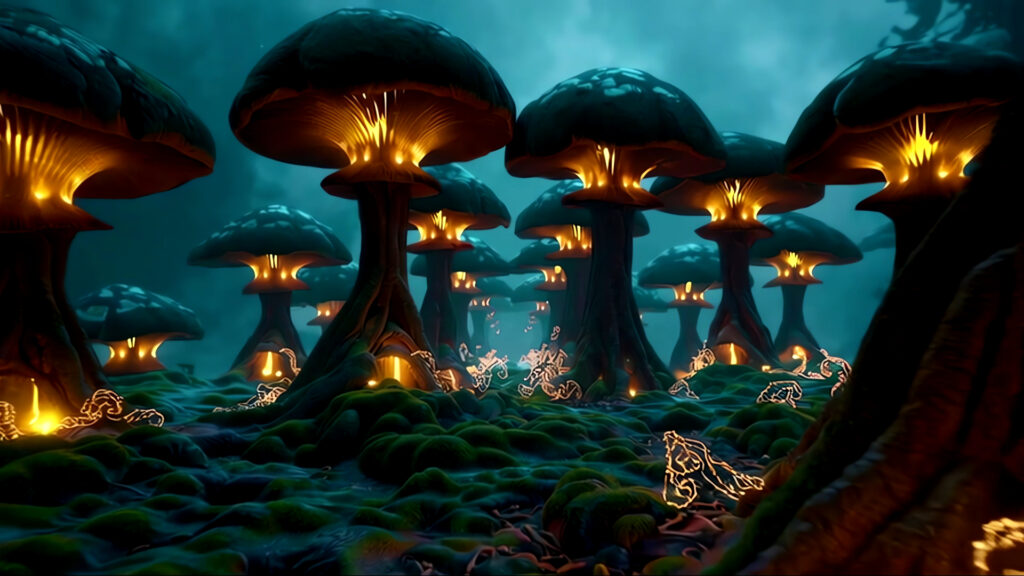
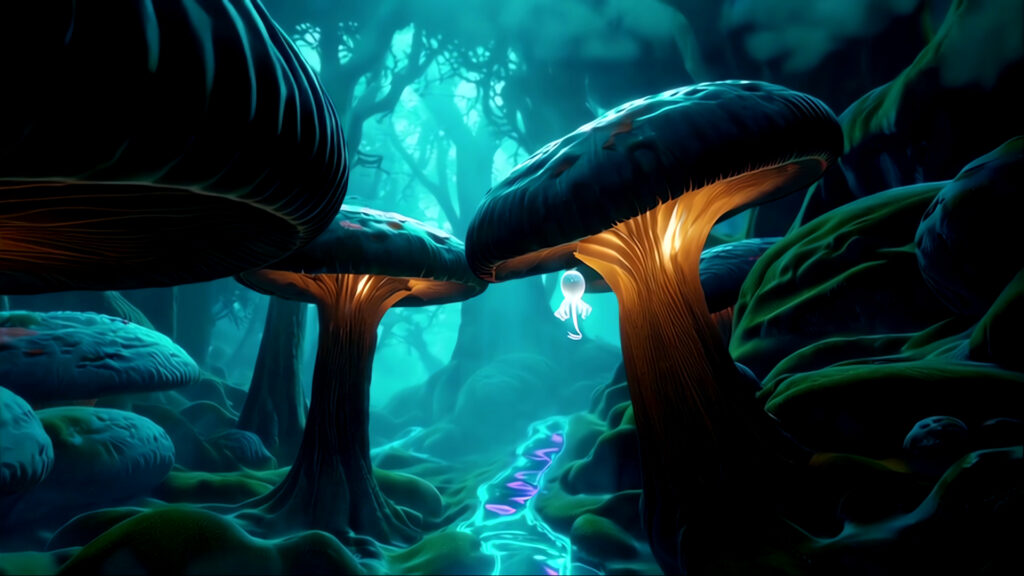
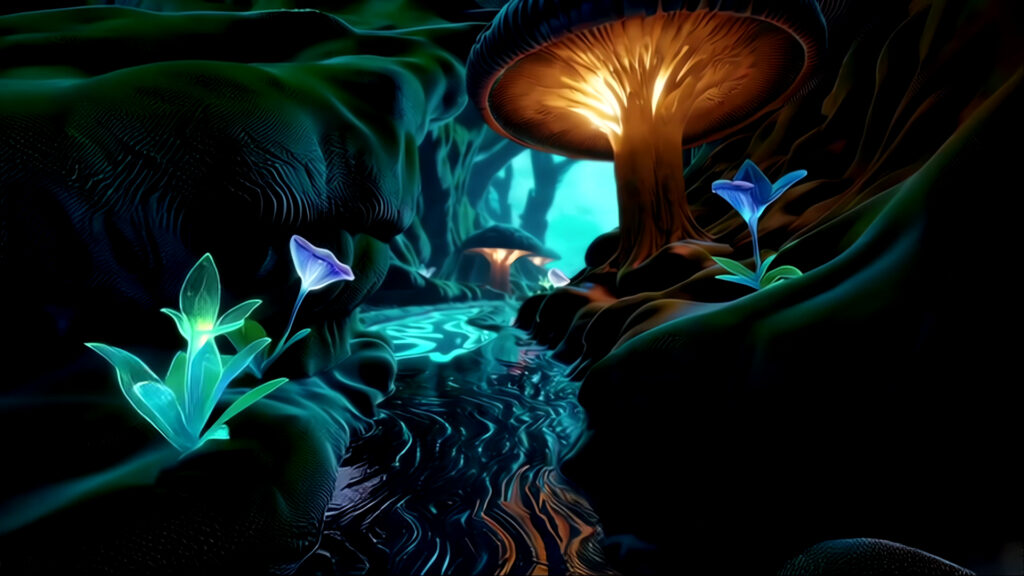
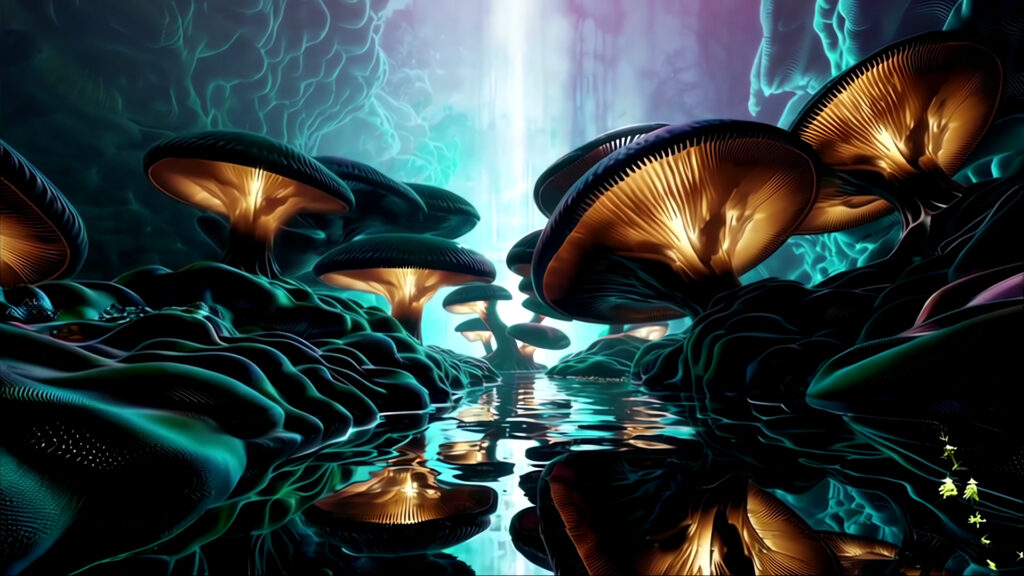
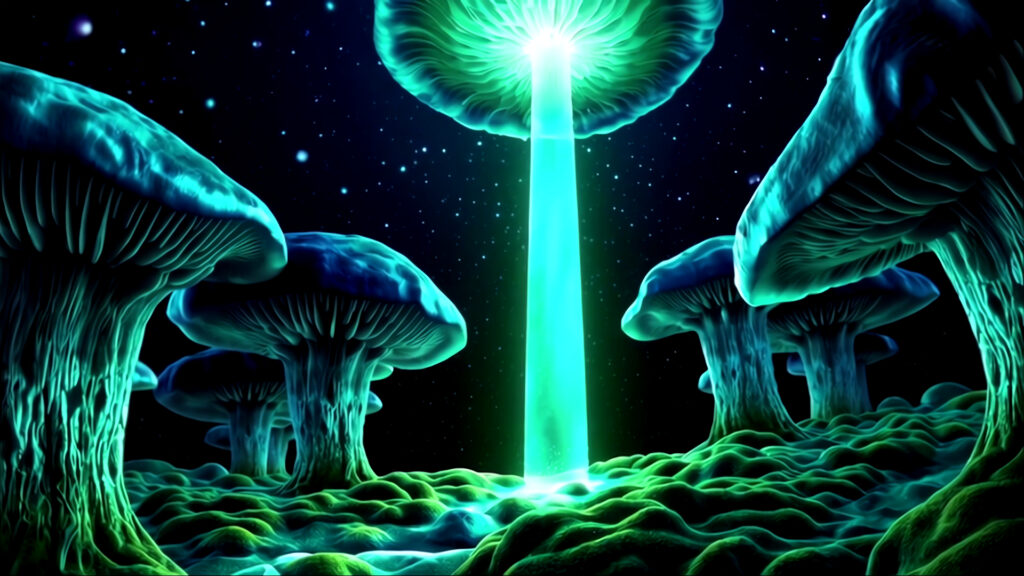
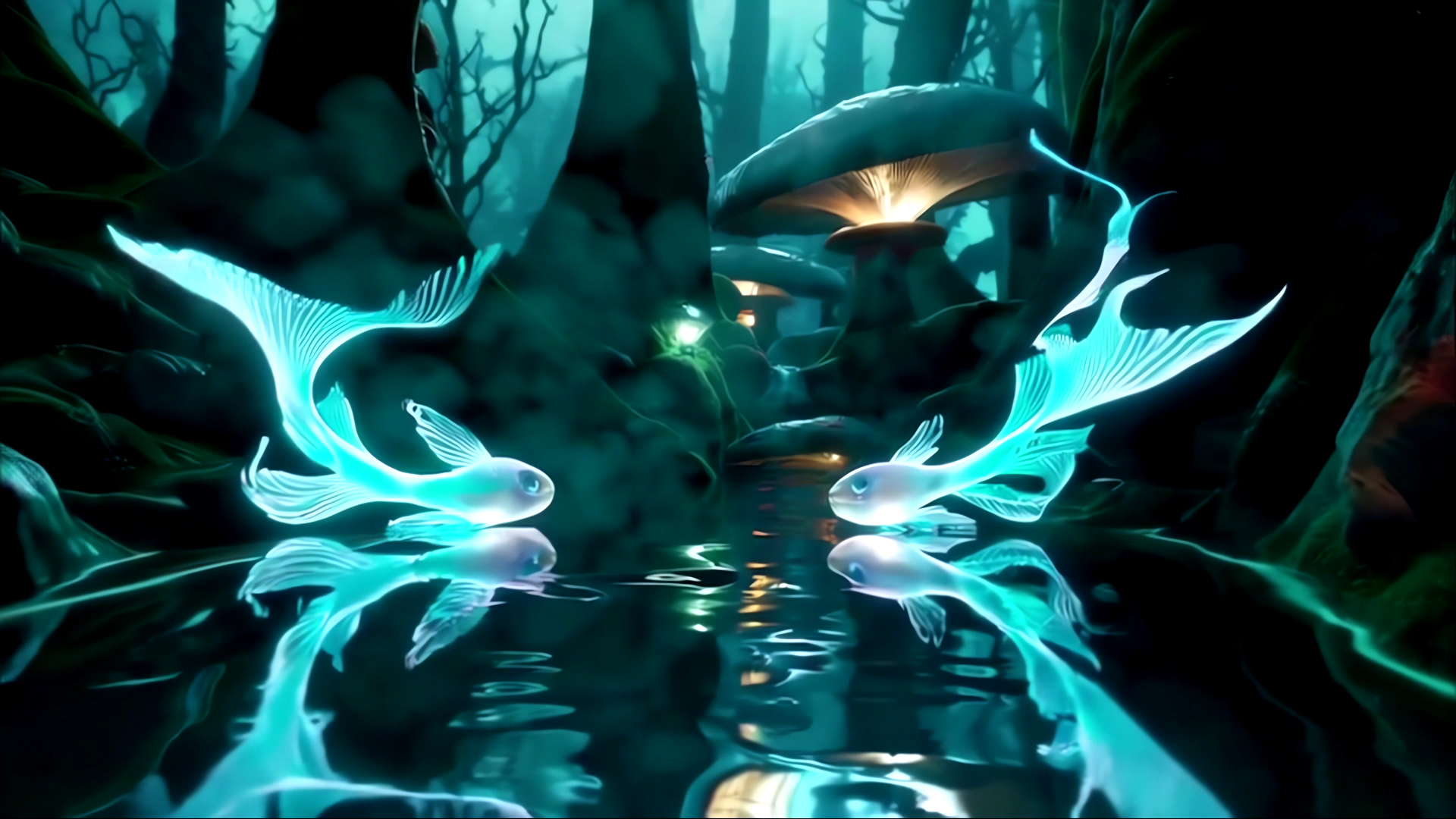
They say every slope remembers a different gravity. On the rim of the Tilted Basin, where mountains lean inward like listening giants, the Uphill Rivers begin their climb. Each current is a ribbon of daybreak running in defiance, shouldering skyward through terraces of stone mushrooms that rise like cathedrals—caps as wide as plazas, gills like organ pipes exhaling spores the color of starlight.
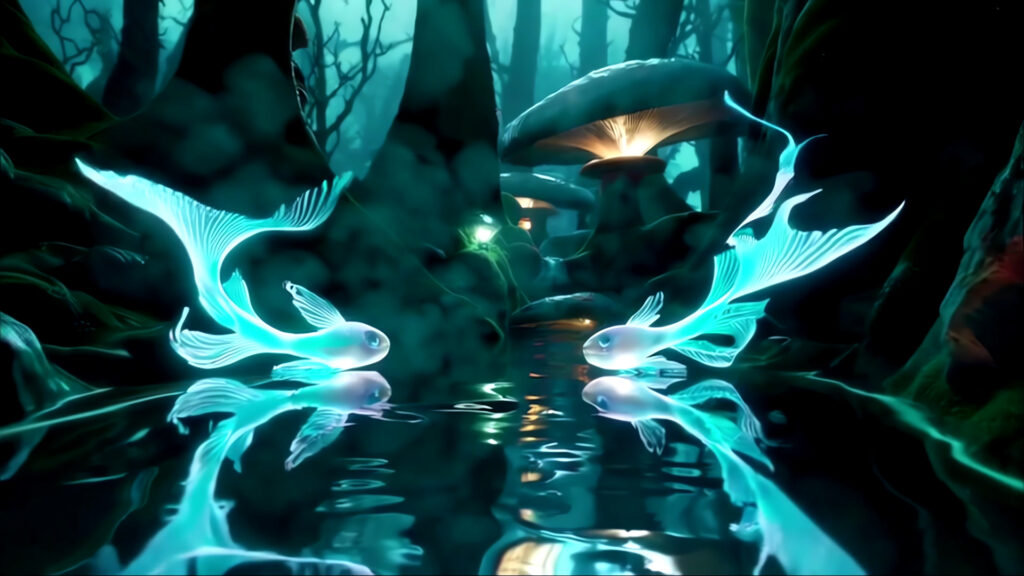
A figure waited at the basin’s cobalt lip: Vael of the Quiet Current. Vael was humanoid only by outline. Their skin was clear as river glass, cross‑hatched by slow constellations that pulsed with living tide. Where a heart might be, a small moon turned patiently. Vael’s hair fell as strands of liquid night; their eyes were twin wells, deep enough to drown a rumor. Around their ankles followed the Glimm, a shoal of thumb‑sized lights with gossamer fins—their bodies were not fish, not flame, but an argument between both.
The air tasted of metal and citrus. High above, Noctiluma—moths the size of sails with vellum wings—ferried glows between the mushroom cathedrals and the rivers, seeding the currents with inkblot stars. When they beat their wings, the shadows rearranged themselves into alphabets no mouth could pronounce.
Vael spoke to the slope. “I heard you dreaming of falling,” they said. “That is not your law anymore.”
From the undercap gloom, a guide uncoiled: a Psilid, one of the Mycelial Choir. It was taller than the tallest bell tower that ever considered being a tree, yet it lowered itself until its rim shadow sheltered Vael like a cloister. Its surface held maps of forgotten rains; along its stalk, slow lights climbed like prayer.
Welcome, Flow‑Bearer, it rustled, the sound like spores deciding to be snow. Ferrules of memory are sown within the rivers today. The crownless sigil stirs.
Vael inclined their head. “Then the path is open.”
The Psilid flexed a filament and etched a glyph in the damp air. Three strokes glowed—L, S, D—not letters as mortals carved them, but runes of the lattice: Lumen (the awakening shine), Spiral (the persistence of return), and Delta (the difference that births a current). These runes did not speak of powders or potions; they were older than such names, embossed into the world when light first decided to remember itself.
Step on the moving ground, said the Psilid. The rivers will carry you uphill if you carry their name.
Vael placed one foot in the nearest river, and the current accepted them like a long‑lost syllable returning to a word. The climb began.
As Vael ascended against the planet’s old decree, they passed creatures suited to the new law. Aster‑eels spiraled in the liquid dawn, skins pricked by constellations that winked only when viewed from the corner of the eye. Quartzlings, small bipedal facets with voices like clinking glass, built bridges of condensed mist between the mushroom colonnades. And pacing along the riverbanks were the Mirrorkin, mirrored silhouettes that reflected not appearances but intentions, their faces a rippling future if one dared to look.
Vael did not look. Intentions are treacherous when given too much mirror.
Clouds bent to drink from the upward flows. Somewhere beyond the terraces, the twin moons—Tarsa and Vesh—prepared to interlock. The world held its cobalt breath.
Movement II — The Brief Eclipse
At the first terrace’s summit, the river widened into an oculus pool that gazed directly at the sky. As Vael stepped onto its rim, the moons crossed: Tarsa slid into Vesh like a coin tucked beneath a tongue. For a heartbeat—a very deliberate heartbeat—the land inverted. Shadows gained weight; light became a rumor trying to stand up.
Out of the quiet stepped the Eclipsed, beings formed where light declined to go. Humanoid in gesture, they moved with the tact of librarians at the edge of a revelation. Their skin was a palimpsest, layers of unspoken sentences that suggested mountain and ocean simultaneously. Each bore a staff of darkened silver capped with a slow star.
“Flow‑Bearer,” said their speaker, whose voice was the pause before a promise is kept. “State your intent. This is the hinge of Ferrash, where gravity negotiates.”
Vael rested their palms against the air, and the Glimm gathered like punctuation. “I intend to return what was never stolen: a crown that isn’t a crown. I will set it on a path, not a head. I intend the Uphill Rivers to keep remembering.”
The Eclipsed conferred without moving, the consultation occurring in the shapes of their shadows upon the ground. Finally the speaker tapped their staff once. The water in the oculus rose, domed, and became a lens. In it appeared a gate—green as chlorophyll dreaming of music.
“Then pass,” said the Eclipsed. “But leave behind any name that insists on ending in a mouth.”
Vael exhaled the syllables that had once contained them. Their true name—unrounded, a geometry of rainfall—continued alone.
The moons separated. Light returned in a rush, tripping over itself and laughing. The gate opened.
Movement III — Emerald Gate
The Emerald Gate was a corridor of prisms that did not so much reflect as multiply. Each pane held a different sequence of possible steps, let loose like green birds in a crystal aviary. Vael walked the center line while holographic selves tried other doors: in one, they were a river entirely; in another, a hill remembering a long‑gone ocean; in a third, a single Glimm that had chosen not to become a shoal. All were true; none were sufficient.
Beyond the gate, the world reassembled into Ferrash—but sharper, every edge thinking about being a blade. The mushroom cathedrals had grown taller; their gills sang in vents of warm air, a choir of vowel‑colored winds. Across the river ran the Lattice, a network of luminous lines deeply knitted into soil and stone. The Lattice was not a road; it was a promise to the future that the ground made to itself.
Vael bowed toward the nearest node, where the Lattice rose like a fountain of straight lines. From it emerged a companion: A Heliocentaur, called Solrhyx—torso of a starlit humanoid, body of an antelope sketched in firelight, with a mane of filaments that hummed softly whenever he turned.
“I am the Runner of Right Angles,” Solrhyx said, his voice a chord strummed on sunbeams. “I keep the Lattice tight. I heard you speaking to the slope; it answered me as heat. The Crownless Sigil is stirring in the High Mantle. Will you ride?”
Vael leapt to the Heliocentaur’s back. Together, they arrowed upstream along terraces that leaned like hieroglyphs midway through becoming mountains.
Along the way, the Dimethyl Dawn pooled in basins of air—a vapor that tasted like mint and thunder, where color dilated the way pupils do in sudden night. In those pockets, beings hung upside‑right from nothing—Tidereefs, creatures of vapor and rhythm with bodies like auroras knotted into the shapes of coral. The Tidereefs hummed greetings, vowel‑rich oscillations that mapped the topography of thought more than the land.
“Your vowels are kind,” Vael called, and the Tidereefs laughed—a hush that expanded.
Movement IV — Return to the Slope
At the next threshold, where the big river split into seven climbing threads, the air cooled. Solrhyx slowed, hooves placing geometry onto the ground, and nodded toward a ridge of stone that wore the world’s patience the way a saint wears candlelight.
Perched upon that ridge slept a Grypholith: lionine in mass, avian in plan, reptilian in detail, and wholly other in spirit. Its wings were slate pages, written in gloss by rain. A beak of fused obsidian cradled a pearl that was not a pearl but a remembered day. When it opened its eyes, gravity cracked and reknit around the gaze.
“Travelers,” said the Grypholith, voice like millennia turning over in a tide pool. “You are under my purlieu. Pay me a story and pass.”
Solrhyx tossed his head, and sparks rearranged themselves into squares that became a carpet. Vael knelt and told a brief tale—the one about the moon housed in their ribs, how a small tide lives within all sentient things, even stones, and how listening is neither surrender nor conquest but a third thing not yet named. The Grypholith considered with the courtesy of a cathedral turning its attention to a single candle.
“Pass,” it said, “and take this fragment of downwardness.” From beneath a wing, it produced a shard of weight. It was warm and heavy, a corner of the old law shaved thin enough to carry. “You will need it when you reach the Mantle’s Marvel, to counterweight a thought too eager to rise.”
They thanked it. Vael tucked the shard into their chest, where the moon accepted it, balancing light with lovely reluctance.
The rivers narrowed; the climb steepened. The mushroom cathedrals thinned into monastic spires. The Lattice lines brightened, as if their job had just become urgent.
Movement V — Two Amber Corridors
At a bend where the Uphill Rivers slipped between amber cliffs, the world suddenly felt drawn with a finer pen. Shadows grew articulate; angles sharpened and nested like a set of secrets. Solrhyx halted, ears glassing forward.
“Here is the Double Corridor,” he murmured. “Two paths, both true, both needing you to miss what they are not.”
On the left, a hallway of sorrowless mirrors. On the right, a hallway of unchosen joys. Between them, a seam no wider than resolve.
Vael dismounted. The Glimm arranged themselves into glyphs—small commas and elder quotation marks—hovering at shoulder height as if to remind Vael that sentences may continue past the point where breath says otherwise. They walked the seam.
On the left, the mirrors offered versions of the Uphill Rivers if they had never learned to climb: oceans brooding in bowls, rain resigned, mountain faces streaked by obedient streams. On the right, the joys were intoxicating: cities of warm fungi where the Noctiluma wove tapestries of breeze; orchards of crystalline fruit that ripened into songs; coves where the Mirrorkin danced with their intentions set aside, their laughter a silvery rain.
Neither corridor lied; neither promised. Between them, the seam asked nothing but accuracy. Vael kept walking. Solrhyx paced the cliff’s rim above, hooves making a metronome of patience.
Halfway through the seam, the air solidified into an Archivist, a tall figure with a gown of threaded fog, many‑jointed fingers inscribed with moving script. The Archivist’s head was not a head but a floating stack of tablets, every side etched with the history of something that might have happened.
“Declare the nature of water,” it said, each syllable a small archivolt of sound.
“Water is a question,” Vael replied. “It is the world asking whether it prefers contour or company.”
The Archivist nodded so slowly moss might have found time to grow between movements. “Proceed. Keep your shard of downwardness close. Questions climb more eagerly than answers do.”
Vael pressed on. When the seam at last opened, the light returned warm and wide. The Glimm zipped like punctuation freed from a paragraph. Solrhyx pawed at the ground, pleased.
Movement VI — Cobalt Breath
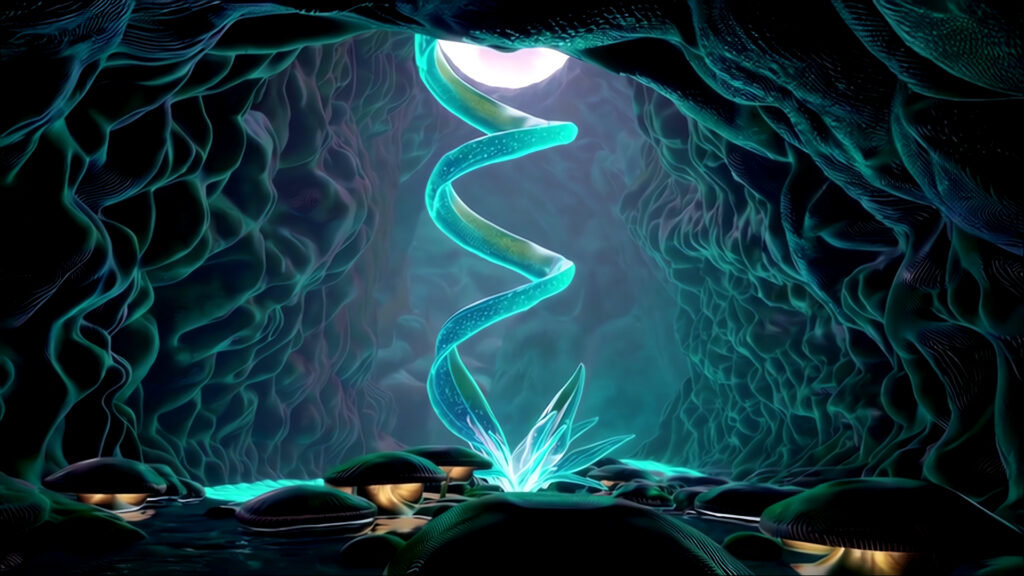
They emerged onto a broad terrace where the Uphill Rivers braided into a single Crownstream, climbing the steepest face yet. The world took a cobalt breath: the quiet after the hinge, the long vowel of landscape preparing to name itself.
Here the Psilids were even grander—Basilica Caps whose gills shaped the wind into processions. Beneath one such cathedral fungus stood a congregation: Obelisks of Moss‑glass humming dusty hymns; Selenic Foxes, white and many‑tailed, coiling around pillars like smoke learning to be animal; and the Fluvial Choir, beings whose bodies were cloaks of water draped over invisible frames, faces nothing more than ripples holding hands.
Vael dismounted. The Lattice rose and braided into an arch. From the arch’s bright knot, a face formed—facet upon facet—until it became a jewel that found itself glad to be a mouth.
The Mantle is close, said the Lattice‑mouth. But the Crownless Sigil sleeps in a riddle. Bring balance: rise with your right foot, fall with your left thought.
The Fluvial Choir unfurled their cloaks and sang a map: notes like stones thrown gently uphill, landing as terraces of sound. The Noctiluma answered with slow wingburn, painting the air with lumens that refused to stay put. The Glimm wove between all of it, stitching light to voice to wind to stone. Solrhyx pressed his forehead to Vael’s palm. It was like leaning against a sunrise, warm and enough.
“Forward,” Vael whispered.
Movement VII — Second Spiral
The path contracted into a Spiral Ascent, cut into the mountain as if by a needle that had spent centuries learning humility. Here time lifted its hem: sometimes Vael was three steps ahead of themselves; sometimes they followed their own footprints out of curiosity.
Guarding the apex curled a creature like a theorem that had chosen to wear feathers—the Parable. Its eyes were ink wells; its wings were convex proofs; its tail divided and divided until it resembled the idea of infinity trying to sit down.
“State your unsolved,” the Parable demanded. “You cannot carry a conclusion where you are going.”
Vael removed the shard of downwardness from their chest. The moon in their ribs flared, then settled, accepting the loss like a tide letting go of the shore for a reason it loves too much to explain. They placed the shard upon the stone, and it became a weight that held their next breath in place.
“My unsolved,” Vael said, “is whether rivers climb because they remember the sea, or because the sky envies the sea enough to rise out of itself.”
The Parable laughed with the embarrassment of someone caught admiring a mirror that turned out to be a window. “Good,” it said. “Carry that, not your answers.”
It unfurled one wing and revealed a set of runes burning pale as early frost: Lumen, Spiral, Delta, the triune lattice that had halos instead of mercy and mercy instead of borders. “Set these where they belong,” the Parable whispered. “Do not crown the head; crown the path.”
Vael pressed the runes into the air. They did not sink or hang; they agreed to be there. The Spiral accepted the placement like a throat swallowing a relief. Solrhyx stamped once, and the Lattice exhaled.
Movement VIII — The Crownless Sigil
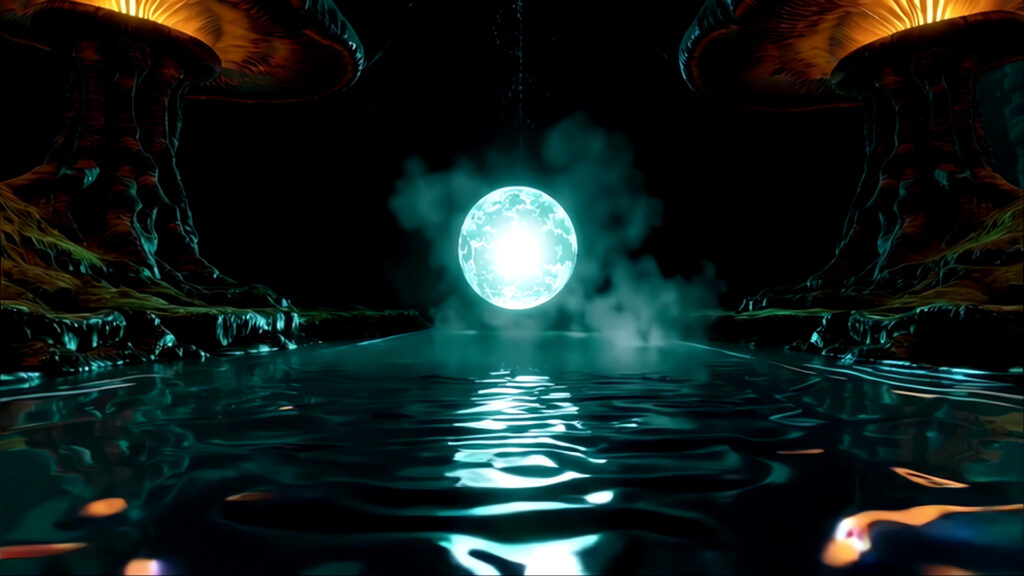
They reached the Mantle’s Marvel at a time of day that was not a time at all but the moment between. Before them rose a basin turned inward—a cup of sky carved into the mountain’s top. Into that cup, the Crownstream streamed, climbing as if dragged by the memory of stars. In the basin’s middle levitated the Crownless Sigil, a star made of directions, every ray a possibility leaning toward grace.
Around the basin stood twelve River Thrones, empty chairs carved from ascending flow. Each chair wore an expression of current: eddy, ripple, surge, fall, hush, fret, laugh, brood, wonder, hush again, hush again, and hush that understood hushing was only a kind of listening.
The Sigil pulsed. It sought a head, as crowns do by habit. Vael lifted their hands. The Glimm arranged themselves into a wreath that was not a wreath but a tutorial in remembering. The Noctiluma circled, and their wing‑heat melted the last reluctances. The Psilids, rooted deep in miles of cooled light, sent up a column of spores that spelled Yes in a script older than permission.
Vael did not raise the Sigil to any brow. They sank it into the path: into the Lattice where the Crownstream became the Seven, where the Seven braided into one, where the one collected the hopes of terraces that surely, surely understood themselves at last. The Sigil bit the road and dissolved, becoming geometry carried by footfalls yet to happen. The path shuddered and grew a spine of meaning.
The Uphill Rivers brightened. Far below, at the cobalt threshold, every source remembered its future and poured itself toward it with a gladness that felt like rain turned inside out.
The mountain exhaled.
The sky adjusted its understanding of “above.”
The land, which had been holding its breath so long it forgot it was doing so, finally let it go.
Solrhyx knelt. Vael placed their forehead to his and tasted sunlight as if it were a certainty newly invented.
Around the basin, beings assembled to witness the new law settle like dew:
- The Tidereefs, those Dimethyl Dawn creatures, arranged themselves into arches of vapor, and through those arches passed images of tomorrow rehearsing how to be kind. Their bodies were coral without mass, auroras with manners. When they bowed, the air chimed.
- The Grypholith arrived, carrying more fragments of downwardness, distributing them to the Quartzlings in tidy parcels. “In case of overswift joy,” it said, “anchor something you love and let it tug.”
- The Mirrorkin gathered on the far bank, their reflective faces finally steady enough to risk a look. What they saw in Vael was not a person but a verb; in themselves, they saw room.
- The Fluvial Choir washed themselves over the River Thrones like cloaks deciding which shoulders to keep warm. Each throne chose a different tempo of ascent. None insisted; all agreed.
The Crownstream’s surface did something it had never done before: it wrote. Words appeared in the granular glints—chains of glimmer that would be unreadable to any eye that needed letters. Vael read with the part of them that knew rainfall’s grammar.
The crown is a horizon. Wear it in the distance.
The mountain offered its slope. The rivers climbed, calmly delighted. And from the margin of the world came a sound: not applause, but continuation.
Interlude — What Lives Between Currents
In the gentler hours that followed, Vael explored the Mantle’s wonder. The basin’s walls were studded with Helioblooms—flowers of solid daylight that only opened under the gaze of patient moons. When Vael looked away, the blooms whispered to each other about whether looking was not itself a kind of opening.
A congregation of Myrmoria arrived. Humanoid in posture but composed of small, jointed mirrors, they smelled faintly of petrichor and distant bells. Each carried a hive of soft‑edged thoughts in the hollow between collarbone and throat. They were mythic archivists of lullabies, and they set to work collecting the new law into hums that would travel down through soil and root.
“Flow‑Bearer,” said their elder, whose mirror‑facets were patinated with the bronze of ancient rain. “If gravity is a story told by a patient teacher, you have given it an illustration.”
“Not I alone,” Vael answered, gesturing to Solrhyx, to the Psilids, to the beings gathered like punctuation around a sentence surprised to find itself true. “Illustrations do not hang without walls.”
The elder laughed—a bell rung by velvet—and offered Vael a ribbon of polished shadow. “Tie this around the idea that loves you most. Not to bind, but to remember.”
Vael tied the ribbon around the Glimm shoal, which accepted the honor by arranging themselves into a spiral that remembered being a galaxy.
The Noctiluma drifted lower. One landed upon Vael’s shoulder, light quivering through its vellum like a shy revelation. Its proboscis traced the Lattice’s map along Vael’s collar and into the air, as if redrawing the path helped it remain real.
Solrhyx slept standing up, as dawn often does.
Coda — The Uphill Rivers Keep Their Promise
When it was time to descend (which, given the new law, meant following ascent backward), Vael and Solrhyx traced their way along the braided Crownstream. Only this time, descent felt like a continuation of rising; the world had learned that direction was a conversation, not a command.
At the Spiral, the Parable nodded, satisfied to be less necessary. “Unsolveds suit you,” it said. “Keep several.”
At the Cobalt Breath, the Fluvial Choir crowned the seam with foam wreaths that sang without sound but hummed in bone. The Selenic Foxes escorted the travelers to the amber corridor and left luminous tails in the air that faded only once they were no longer needed.
Between the two corridors, the Archivist offered Vael a page that was also a window. On it, a single sentence kept changing its mind about its subject. Vael did not try to read it. Some literature is meant to be understood by walking.
Through the Emerald Gate, Vael saw their potential selves again. None had grown jealous of the chosen path. One waved, a version of Vael who had become a Selenographer, mapping the tides of moons within beings—proof that universes keep hobbies.
Under the brief attention of the next eclipse, the Eclipsed bowed without speaking. A permission, once earned honestly, did not require restatement.
At last they stood on the cobalt threshold where it had all begun. The Uphill Rivers gleamed with the glamour of a rule joyfully revised. Clouds came down to sip and went away a little braver. The Quartzlings cheered in their clinking way and fashioned a small prism to hang from Solrhyx’s mane. The Glimm spiraled upward, then dove, then formed the runes once more—Lumen, Spiral, Delta—because some reminders are celebrations.
The Psilid rustled undercap thunder. Flow‑Bearer, how does the crown sit?
Vael looked along the riverlines shining out of sight, a diadem stretched across distances that could not be worn by any one head. They felt the law settling into the Lattice, the way a new poem finds the breath that best belongs to it. Their moon turned once in their chest, commit to commit.
“It sits where we are going,” Vael said.
As all good crowns should, replied the Psilid.
They lingered while the upland wind sorted itself into scissor and silk. Beyond the basin, ridgelines stepped into a haze that did not conceal so much as suggest. Somewhere, an ocean realized it was being called uphill by its own reflection. Somewhere, a seed decided it would be a spire. Somewhere, gravity smiled like an old teacher discovering a better example.
When Vael and Solrhyx at last moved on, the Uphill Rivers climbed untroubled by old stories of falling. They carried with them in their streaming bodies the glows of the Noctiluma, the questions of the Parable, the humor of the Grypholith, the patience of the Archivist, the bright runes, the Glimm’s gratitude, the Tidereefs’ vowel‑songs, the Mirrorkin’s newfound mercy toward themselves, and the Lattice’s vow.
And behind them, the paths wore a crown no brow could bear—not because it was heavy, but because it was direction.