There are places the sky refuses to remember.
Beyond the last polite constellations—past the starfields that behave, past the ordinary dark where distance is only distance—there lies an expanse of fungal luminance and impossible weather. A region charted in sighs, mapped in symbols that wriggle when you stare too long, and guarded by beings who do not negotiate with certainty.
Travelers call it the Spore Plains, though “plains” suggests something flat and simple, and nothing here is either. The ground is a breathing mosaic of velvet moss, glassy mycelium, and chalk-white capstone ribs that rise and fall like the backs of sleeping leviathans. Spores drift in slow spirals, catching light that has no source, turning every horizon into a soft, shimmering bruise of teal and violet. Above, the firmament is layered—one sky folded atop another—so that clouds cast shadows on clouds, and the moon appears as a nested set of crescents, each one looking away.
And in the center of that living geometry stands an altar-city grown from colossal mushrooms, its towers stitched together with filament bridges like comet-silk. It is said the city listens. It is said the city judges. It is said the city keeps a door to someplace unwritten.
But none of those rumors mattered until the night the Spore Plains received a visitor.
I. The Arrival of the Void-Map
Sairyx came without engines.
Not because they lacked a vessel—Sairyx had crossed the dark in a craft formed from black meteor glass and bone-white resin—but because the final approach demanded humility. The Spore Plains did not accept the violence of thrust. They preferred surrender, slow and deliberate, as if the land itself needed time to decide what you were.
So Sairyx descended on a cradle of silken threads that unfurled from the craft’s belly like a jellyfish’s ghost. Each strand shimmered with a faint rainbow fracture, a lysergic lattice embedded into the fibers: a pattern that turned straight lines into gentle, breathing curves. The threads anchored into the ground with a sound like soft bells swallowed in fog.
Sairyx stepped down.
They were humanoid only in the loosest sense—two arms, two legs, a head at the top where heads were expected—but their body was wrapped in layers of dusk-cloth and ember-skin. Their hands were gloved in translucent membrane that glowed faintly from within, veins lit like river maps. Their face was hidden behind a visor carved from pale chitin, smooth as a pearl and marked with thin, spiraling runes that shifted position when viewed from the corner of the eye.
Sairyx was a Cartographer of the Beyond—one of the last order that mapped not lands but laws. Not seas but causes. The Cartographers had long ago learned that some distances were not measured in miles or light-years, but in the stubbornness of reality itself.
They had come for a rumor.
A whisper of a mechanism older than any empire, buried beneath the capstone ribs and spore-drift: the A-Root, the myth-machine that could stitch two unaligned truths into one.
Sairyx did not want conquest. They did not want war. They wanted a path. A safe route through a place that, by all rights, should not connect to anything else.
The Plains greeted them with silence.
But silence, here, had texture.
The air was thick with pollen light—fine motes that glowed when Sairyx breathed. Each exhale made the motes swirl into miniature spirals, tiny galaxies forming and unforming. Far away, the mushroom towers of the altar-city rose like the bones of a cathedral made from living ivory. Their gills shone with internal bioluminescence, ribbed and intricate, like pages in a book held open forever.
Sairyx began to walk.
The ground responded.
Under their boots, the moss shifted into patterns—triangles, hexagons, then spiraling rings that seemed to predict their next step. Each footfall left behind a faint afterimage of light, as if the earth remembered pressure the way skin remembers a touch.
And somewhere, deep beneath it all, a pulse began.
Not audible.
Not exactly.
More like a truth tapping on the inside of the skull: a repeated phrase in a language too old to have words.
You are noticed.
II. The First Warden
The first Warden rose from the fog as if it had been growing there all along.
Sairyx saw it as a silhouette at first: tall, narrow, a quiet vertical in the haze. Then the drifting spores parted and the being became detail, and detail became awe.
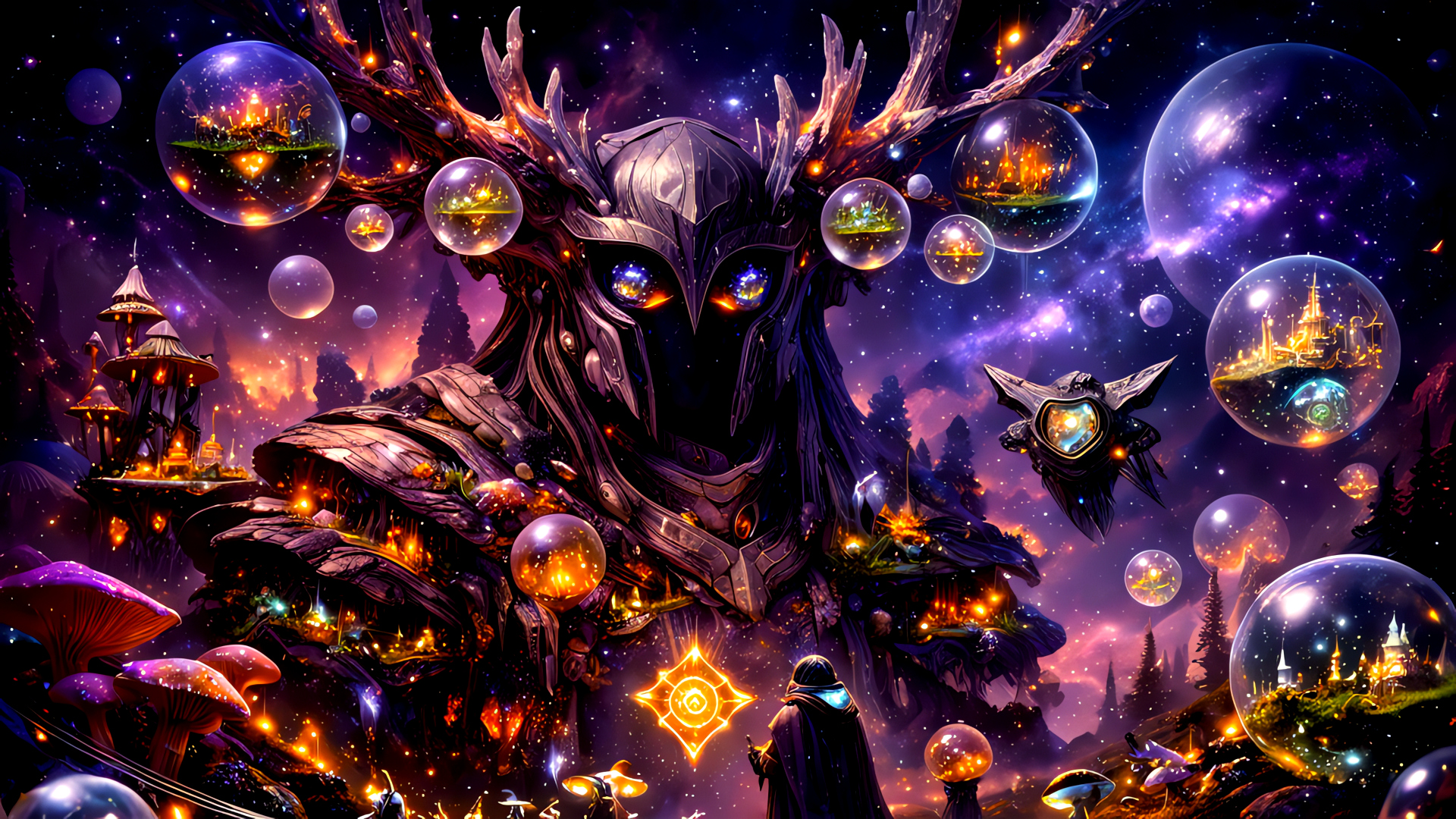
It was humanoid, yes—but stretched in a way that made the human shape feel like a rumor. Its limbs were long and jointed, each joint ringed with pale ceramic bands etched with star-math. Its torso was plated in bark-metal, a material that looked like tree bark that had learned how to be iron without losing its grain. The plates overlapped like scales, and between them, soft fungal tissue glowed with an inner emerald light.
Its head was masked.
Not a helmet. Not armor.
A mask.
Carved from the cap of a giant mushroom, lacquered until it shone like wet obsidian. Two eye-slits held no eyes—only darkness, deep and unreflective, as if the Warden wore a piece of the void itself.
Around the mask’s brow, antler-like protrusions rose and curved outward, made of translucent calcite, and within the calcite flowed slow-moving constellations—tiny points of light drifting like captive stars.
The Warden stood still.
Sairyx stopped.
The Plains held its breath, and the spores hung motionless for a heartbeat too long.
Then the Warden lifted one hand.
Its fingers were not fingers but segmented porcelain, each segment engraved with a symbol that shifted shape, never settling into a final form. The hand rotated slightly, palm outward, and the symbols aligned into something that felt like a question.
Sairyx, in their long years of mapping the unmapable, had learned that some questions were not asked aloud because sound was too crude a medium.
They lowered their head.
They placed their gloved palm against their chest and let a thread of their inner light leak out through the membrane glove. A pale ribbon drifted toward the Warden’s palm, hovering between them like a living moth.
The Warden did not accept the ribbon.
It examined it.
The porcelain fingers tilted, and the ribbon responded, curling into a shape: a spiral around a triangle, then a triangle around a spiral. A symbol of approach. Of intention without violence.
The Warden paused.
Then, slowly, it stepped aside.
Not granting entry. Not denying it.
Simply making room.
Sairyx walked past.
Behind them, the fog thickened, and the Warden dissolved into it as if it had never existed.
But the pulse beneath the Plains grew stronger.
III. The Spore Plain Tribunal
As Sairyx approached the altar-city, the world became increasingly… recursive.
The moss no longer formed simple patterns. It began to birth images: tiny faces in the grain of fungal stone, eyes nested inside the veins of leaves, miniature masks embedded in the bark-metal ribs protruding from the earth. None were clear enough to be real. All were clear enough to be noticed.
The air took on a faint iridescent sheen. When Sairyx turned their head, the haze split into colors like a prism caught in moonlight. It was as if the atmosphere itself had been woven with that same lysergic lattice, a geometry that made straightness feel like a mistake.
Then the second Warden appeared.
Then the third.
Then the fourth.
They did not arrive from a direction. They simply became present, assembling from fog and spore like thoughts crystallizing.
They formed a line across Sairyx’s path, tall and silent.
Each Warden wore a different mask.
One mask was carved with gill-like ridges that made it look like a face composed of ribs. Another mask bore spiral horns that looked grown rather than carved. Another was smooth except for a single vertical slit where a mouth might be—except it was too narrow to be a mouth and too long to be anything else. A symbol, perhaps. Or a warning.
Around them, the spores began to drift in a circle.
The circle tightened, and the motes of light arranged themselves into orbiting rings, like tiny moons spinning around an invisible center.
Sairyx realized: this was not a blockade.
It was a court.
The Wardens were not soldiers.
They were judges.
A fifth Warden stepped forward—the tallest yet, its bark-metal armor polished to a mirror sheen. Its antlers were not calcite but something darker: a crystalline substance that drank light, edged with thin amber rims like dawn trapped in glass.
The leader Warden raised both hands.
The spores brightened, swirling faster. In the ring of orbiting motes, images began to appear—faint, shimmering scenes projected into the air:
A city collapsing into sand.
A star turning inside out.
A traveler stepping through a doorway and leaving their shadow behind.
Sairyx watched without moving.
The images were not accusations.
They were possibilities.
A test of what Sairyx would do in the presence of power.
The leader Warden’s hands rotated, and the orbiting ring of spores tilted like a halo sliding off-axis. The images shifted—now showing Sairyx’s craft, their descent, their footprints, the ribbon of inner light.
The court was reading them.
Sairyx made no attempt to hide.
They lifted both hands slowly, palms open.
Beneath their gloves, their inner light brightened, and the pale ribbon emerged again—not as a thread this time, but as a small, hovering glyph, a compact knot of luminous lines.
It shaped itself into a symbol of purpose.
Not desire.
Not greed.
Purpose.
The Wardens’ masks did not change, but the air did. The spores dimmed slightly, as if the Plains had relaxed.
The leader Warden stepped forward and touched the hovering glyph with one porcelain fingertip.
The glyph did not break.
It did not flare.
It simply… held.
The leader Warden withdrew.
And with a slow, ceremonial motion, the line of Wardens parted.
Sairyx walked through the opening and into the shadow of the altar-city.
The tribunal did not follow.
But Sairyx could feel their attention, the way you can feel eyes even when you cannot see them.
IV. The Cathedral of Folding Angles
Inside the altar-city, the architecture stopped pretending to obey physics.
The towers were mushrooms, yes—but no mushroom had ever grown like this. Caps layered atop caps, each one a different translucency: milky glass, smoked quartz, pale amber, deep cobalt. Their gills were not soft tissue but delicate latticework, like filigree carved by patient lightning. Bridges of filament stretched between them, threads braided so tightly they looked like solid paths until you stepped close enough to see the microscopic hairs shimmering in the air.
Every surface was covered in faint, moving symbols.
Not writing.
Not exactly.
More like geometry performing meaning.
Sairyx followed a path that appeared beneath their feet as they walked: a line of pale light crawling forward, like bioluminescent moss deciding where they should go.
The path led into a cathedral chamber, wide as a crater.
At its center floated a structure that made Sairyx’s visor runes shift into frantic spirals.
A rotating, blooming geometry—a DMT-chrysanthemum of angles, petals of crystal folding in and out, each fold revealing a different interior pattern. It looked like a flower made of prisms and equations, turning slowly, patient as a planet.
The air around it was thick with refracted light. Colors split and recombined. Shadows cast shadows of different colors, like the concept of darkness had been fractured.
Beneath the floating geometry was an altar.
Not stone.
Not metal.
A slab of living fungal glass—smooth, black, and so reflective it seemed less like a surface and more like a window into another sky. The glass was rimmed with amber light, and within that amber, tiny spores drifted like fireflies trapped in honey.
Sairyx approached, slow.
Their breath fogged the air, and their breath-fog formed shapes that lingered too long: spirals, masks, eyes within eyes. The cathedral was watching, not with sight, but with pattern recognition.
Sairyx placed both hands on the altar.
The black glass was cold.
Then it wasn’t.
A pulse surged through it, rising up Sairyx’s arms like a wave climbing shore. The visor runes flared, brightening until Sairyx’s world became a wash of symbols.
In that flood of geometry, a voice arrived—not sound, but alignment.
ALIGNMENT REQUIRES SACRIFICE.
Sairyx’s inner light dimmed instinctively. Their body tensed.
They had expected guardians. Trials. Rituals.
They had not expected to be asked to give something away.
The voice continued, patient and absolute.
NOT BLOOD. NOT BONE. CERTAINTY.
Sairyx swallowed. The motion felt loud.
Certainty was the Cartographer’s treasure. It was the spine of maps. It was the one thing you clung to when the universe tried to become metaphor.
But Sairyx had come here because certainty had failed them.
They closed their eyes behind the visor.
And they let go.
Not all at once.
Not dramatically.
They loosened their grip on a single cherished assumption: that the path they sought must lead back to familiarity.
They allowed, in the deep quiet of their mind, the possibility that what they wanted might change them.
The altar warmed beneath their palms.
The floating chrysanthemum geometry above them slowed its rotation, as if listening.
Then it unfolded.
Petals of crystal opened outward, and within them, a corridor of light appeared—a tunnel lined with repeating crescent mirrors, each one shimmering with nested skies.
Sairyx lifted their hands.
The path was open.
They stepped forward.
V. The Corridor of Repeating Moons
The corridor felt like walking through a thought that had been repeated so many times it became a place.
Mirrors lined the walls, each mirror a crescent shape, stacked in endless repetition. In each crescent, Sairyx saw a version of themselves—not different outfits, not different faces, but different interpretations. In one mirror, they looked older, their inner light dimmer. In another, they looked younger, their light too bright, too reckless. In another, their visor was gone and their face was a blank expanse of smooth chitin like a Warden’s mask.
Sairyx kept walking.
The corridor shifted with them.
The crescents rotated, and as they rotated, the reflections changed. The corridor did not show Sairyx who they were. It showed Sairyx what they were capable of becoming.
Eyes appeared in the crescent mirrors—large, slow-blinking eyes, not attached to bodies. They watched, unhurried. The eyes were made of polished stone with iridescent veins, and within each iris swam a tiny, shifting map.
Sairyx recognized them: Oculoids, ancient watchers that drank light and returned it as knowledge.
The Oculoids did not speak.
They simply followed.
At the corridor’s midpoint, the air thickened into a shimmering membrane, like a veil of liquid glass. The veil was covered in faint glyphs that crawled like living ink. Sairyx could not read them—but their body understood them as pressure, as gravity.
Sairyx lifted a hand and touched the veil.
The membrane rippled.
And the corridor’s crescents flared with color—teal, indigo, then a sudden, violent streak of magenta like a bruise blooming. The colors danced in the air, splitting and recombining, as if the corridor was trying to decide which spectrum was real.
The veil parted.
Sairyx stepped through.
VI. The Spore Plains, Unmasked
They emerged not into another chamber, but back into the open Plains—except the Plains were no longer the same.
The fog had thinned, revealing the capstone ribs in full. They rose like the spines of buried giants, each rib etched with glowing runes. The spores drifting in the air were brighter, and their drift patterns formed spirals that echoed the shapes on the Wardens’ porcelain joints.
The altar-city behind Sairyx glowed softly, as if pleased.
Ahead stretched the Spore Plains proper: a wide expanse of fungal grass and prism moss, shimmering with thin-film iridescence. Every blade of mycelium caught light and refracted it into tiny rainbows. The entire field looked like it had been dusted with fractured starlight.
And waiting in that field stood the Wardens.
Not a tribunal this time.
A procession.
Dozens of them, arrayed in a long, curving line that led toward the horizon.
As Sairyx approached, the Wardens turned in unison—slowly, ceremonially—and began to walk. Their movements were precise, measured, as if each step was part of a ritual older than language.
Sairyx followed.
As they walked, creatures surfaced from the Plains.
Prism moths the size of shields drifted overhead, their wings made of stained-glass triangles, each triangle holding a different color of moonlight. Their bodies were soft velvet, dark as ink, with antennae that trailed luminous threads.
From beneath the moss, Mercury Drakes slithered—serpentine creatures with scales like liquid metal. They moved in slow waves, reflecting the Wardens and the sky and Sairyx’s glowing inner veins. When they turned their heads, the reflections on their scales distorted reality like a funhouse mirror, bending the horizon into curves.
A creature like a stag stepped into view—a Coriolis Stag—its antlers a labyrinth of condensed fog and crystallized dew. The antlers refracted light into rotating spirals. The stag’s eyes were pools of deep teal, and when it blinked, the blink left an afterimage of a different landscape behind its lashes.
The creatures did not attack.
They observed.
They were part of the ritual.
Sairyx realized the Wardens were not leading them to a place.
They were leading them into a state.
A readiness.
A compatibility.
And then the Plains began to sing—not with sound, but with vibration.
The moss beneath Sairyx’s feet resonated, and the spores in the air aligned into a pattern like a spiral galaxy viewed from above. The sky’s nested crescents brightened, and for a heartbeat, Sairyx saw a faint ring of light on the horizon—an outline of something enormous.
A gate.
A crown.
A truth.
VII. The Quiet Chamber of Intent
The Wardens stopped.
Before them rose a structure half-buried in the Plains: a mound of fungal stone shaped like a sleeping animal, its surface covered in gill ridges and soft bioluminescent veins.
A doorway opened in the mound—no door, no hinge, simply a seam that parted like a mouth.
The leader Warden gestured.
Sairyx entered.
Inside, the chamber was small compared to the cathedral, but it felt heavier. The walls were lined with mirror-lichen—a material that reflected not faces but intent. When Sairyx looked at the wall, they did not see themselves. They saw their own desire rendered as color: a pale, restless cyan that flickered like a nervous flame.
The chamber’s floor was a shallow pool of clear liquid, perfectly still. The liquid reflected an inverted sky—another layer of reality beneath the floor. In that inverted sky, stars drifted in slow patterns, forming symbols that dissolved before they could be understood.
Sairyx stood in the center.
The leader Warden entered behind them, then stopped at the doorway and did not come closer. The Warden was not here to guide. Only to witness.
The chamber’s liquid floor trembled.
From the reflection, something rose.
Not a body.
Not a creature.
A shape in the water’s surface—an outline that suggested a presence without committing to form.
It was called, in Cartographer legends, the Usher of Else: a being that existed only as a boundary, an edge where meaning thinned.
It emerged as a silhouette made of faint light, its “limbs” branching and re-branching like a fractal tree. Within its outline, tiny spores drifted like dust in sunlight, and among the spores were faces—hundreds of faint, overlapping masks, all looking in different directions.
The Usher did not speak.
It leaned closer.
And the mirror-lichen walls flared, reflecting Sairyx’s intent back at them with cruel clarity. The cyan flame became a storm of color—teal and indigo, with sharp magenta edges like knife-light.
Sairyx felt their old certainty clawing at them.
They wanted the A-Root.
They wanted a path.
But the chamber demanded they answer a different question:
Why should reality bend for you?
Sairyx’s inner light flickered.
They thought of their people—Cartographers scattered across dying worlds, trying to map paths through collapsing laws. They thought of the routes that failed, of travelers lost in places that rewrote them into something unrecognizable. They thought of the cold truth that knowledge alone did not save you if the universe decided to change the rules.
Sairyx lowered their head.
Then, in the quietest voice they had ever used, they offered something that was not an argument.
They offered a promise.
Not to control.
Not to conquer.
To carry.
To become a bridge for those who would otherwise fall.
Their inner light brightened—not with ambition, but with a steadier glow, like a lantern in a storm.
The Usher of Else tilted its fractal outline.
The liquid floor calmed.
The mirror-lichen walls dimmed.
The chamber accepted the answer.
The leader Warden, still at the doorway, raised one hand and made a slow, circular motion.
The floor’s reflected sky rotated.
And a seam opened in the air.
VIII. Crowncap City and the A-Root Engine
The seam widened into an arch of light.
Sairyx stepped through and emerged into Crowncap City.
It was larger than it had appeared from the Plains—vast, layered, alive. Towers rose like mushroom stems the size of mountains, their caps overlapping like protective shields. Bridges of filament stretched between them in graceful arcs. Beneath the bridges, the air was thick with drifting spores that glowed like slow snow.
But the most striking thing was the soundless hymn.
Not music.
Not voices.
A resonance in the bones, a gentle pressure that made the chest feel full. The city vibrated with it, every gill ridge and filament thread participating. It felt like the city was breathing a single enormous breath and asking you to breathe with it.
Wardens stood on balconies carved into the mushroom stems. Their masks turned as Sairyx passed, watching. Some held staffs made of twisted calcite and fungal glass. Some carried bowls of glowing spores. None spoke.
Sairyx followed the path of pale light that formed under their feet.
It led to the city’s center.
There, in a wide plaza of black fungal glass, sat the Engine.
It was not a machine in any familiar sense.
It was a ring—a circular arrangement of spore-crystal petals, each petal a curved slab of translucent material that shifted color as if it held a trapped aurora. The petals were arranged around a core of star-dark liquid that rotated slowly, as if stirred by invisible hands.
Around the ring, eight pillars rose—mushroom monoliths carved into the shapes of antlers, each pillar crowned with a cluster of glowing spores that drifted in a tight orbit.
Above the ring floated the DMT-chrysanthemum geometry Sairyx had seen in the cathedral, but here it was larger, richer, more alive. It unfolded and folded, revealing nested patterns that seemed to contain tiny worlds—forests, oceans, cities—each one a miniature reflection of something bigger.
Sairyx approached.
The star-dark liquid in the ring’s core rippled, and Sairyx saw, for a heartbeat, their own face—not behind the visor, but as the mirror-lichen would see it: intent made visible.
The Wardens gathered.
Not a tribunal.
A circle.
They formed a wide ring around Sairyx and the Engine, their masks reflecting the plaza’s faint light. The leader Warden stepped forward and placed both hands on the nearest spore-crystal petal.
The petal flared, casting amber rim-light across the plaza.
The leader Warden stepped back.
The gesture was clear.
It is yours to attempt.
Sairyx lifted their hands and hovered them over the star-dark core.
The liquid did not steam.
It did not splash.
It simply rose, forming a thin film over Sairyx’s palms like a living glove.
Cold flooded Sairyx’s arms.
Then warmth.
Then an overwhelming sensation of being read—not as a person, but as a pattern.
The Engine examined Sairyx’s inner light, their loosened certainty, their promise to carry rather than control.
And then, slowly, the ring began to rotate.
The spore-crystal petals shifted, aligning into a new configuration. The DMT-chrysanthemum geometry above unfolded into a wider bloom, its petals forming a tunnel of light.
Sairyx felt the world tilt.
Not physically.
Conceptually.
Like a page being turned.
A doorway opened—not in the plaza, but in the air itself. The doorway was a vertical slice of shimmering darkness rimmed with teal and amber, its surface covered in crawling glyphs.
The glyphs were not words.
They were conditions.
Rules for crossing.
Sairyx steadied their breath.
The Wardens’ circle held.
The city’s hymn deepened.
Sairyx stepped forward.
And as they did, the Engine whispered one last alignment—not a voice, but a pressure behind the eyes:
DO NOT RETURN THE SAME.
Sairyx smiled, unseen behind the visor.
They could not return the same.
They had already begun to change.
IX. The Unwritten Horizon
Crossing the doorway felt like stepping into cold water that was also light.
For a moment there was no up, no down, no body—only the sensation of moving through a tunnel made of folded geometry. Colors rushed past: indigo, teal, then sudden flashes of magenta like lightning inside a bruise. Faces appeared in the rushing light—myth-masks, oculoid eyes, the smooth obsidian masks of the Wardens—then dissolved before they could become fear.
Sairyx’s inner light held steady.
They remembered their promise.
Carry. Bridge. Do not control.
The tunnel slowed.
The rushing colors softened.
And Sairyx emerged onto a surface that did not exist until they stepped on it.
A plain of pale, soft material—like powder made from crushed moonlight. It held their footprints without resistance, then slowly erased them as if the ground could not commit to memory.
Above, the sky was empty.
Not dark.
Not bright.
Empty.
As if the concept of “sky” had not been decided yet.
In the distance, faint outlines hovered—suggestions of mountains, hints of towers, shadows of forests that might become real if observed long enough.
Sairyx turned back.
The doorway was still there, hovering in the air behind them like a suspended wound. Through it, they could see Crowncap City’s glow and the Wardens’ silhouettes standing in a circle, still and unwavering.
The leader Warden raised one hand.
Not a farewell.
A seal.
A closing of ritual.
Then the doorway’s rim-light dimmed, and the slice of darkness thinned until it became a line, and then a thread, and then nothing.
Sairyx was alone.
Or not alone.
Because the empty sky began to fill.
Not with stars—but with spores.
Tiny motes of light drifted down, slow as snowfall. They landed on the moonlight powder and sank in, leaving behind faint glimmers like seeds planted in ash.
Where the spores landed, patterns formed.
Triangular, hexagonal, spiraling.
A lysergic lattice blooming across the ground.
Sairyx watched, breath caught in their chest.
The world was building itself.
And it was using the same language as the Spore Plains.
Sairyx knelt and placed their gloved hand on the ground.
The powder warmed.
A pulse answered.
Not the old pulse of the Plains.
A new one.
Young.
Curious.
Hungry.
Sairyx felt, in that pulse, the shape of something approaching—not a creature, not a Warden, but a presence formed from the potential of this place.
A figure rose from the lattice.
Humanoid, tall, slender, its body composed of translucent fungal glass threaded with slow-moving light. Its face was a smooth plane of pearl-chitin with no features except a single spiral rune at the center, glowing faintly.
It watched Sairyx.
Then it lifted a hand, palm outward, and the spiral rune brightened.
A greeting.
A question.
A demand for intention.
Sairyx stood slowly.
They lifted their hands and let their inner light spill into the air, forming the same hovering glyph they had offered the tribunal—purpose, not greed.
The figure’s spiral rune pulsed.
The lattice beneath them brightened.
And somewhere, beyond the outlines of unborn mountains, something vast shifted in the empty sky, as if the world itself had turned to look.
Sairyx felt a shiver—not fear, but exhilaration.
They had crossed into an unwritten land.
And the first thing it asked was not what they wanted.
But what they would become.
Sairyx lowered their head in respect—not to a ruler, not to a god, but to the ancient truth the Wardens had guarded:
That the greatest doors did not open to places.
They opened to transformations.
Sairyx stepped forward into the lattice bloom, leaving footprints that erased themselves behind them, and the empty sky began to invent its first stars—slow, deliberate points of light, appearing one by one like a careful mind choosing its words.
Far away, unseen but felt, the Wardens of the Spore Plains stood in their silent circle and listened to the new world’s pulse, satisfied that the crossing had been made without violence, without theft, without certainty.
And in the new land, where nothing had yet been named, Sairyx walked toward a horizon that kept changing shape—toward a destiny that shimmered like iridescent spores in the air, trippy and sacred and alive.
Not a map.
A becoming.
Not an ending.
A beginning.