
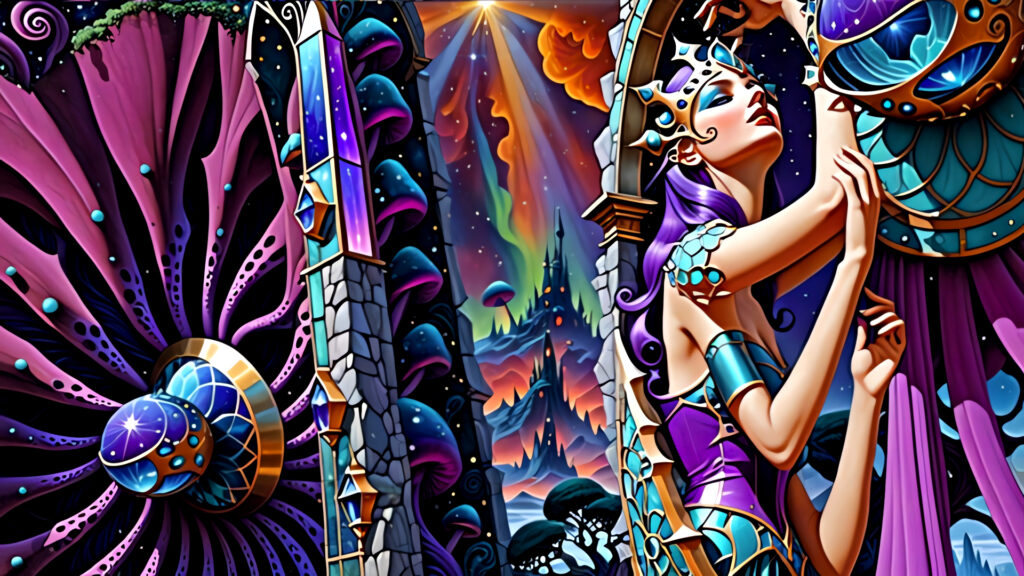
The first time the Iridescent Equation was spoken aloud, it didn’t sound like language.
It sounded like glass remembering it was once sand.
Like a star being gently folded into a smaller star.
Like mushrooms dreaming in colors that never learned the word “color.”
In the outermost seams of the sky—where space frays into velvet threads—there drifted a region called The Lattice Veil, a slow ocean of prismatic fog. Travelers avoided it, not because it was dangerous in the usual sense, but because it was persuasive. The Veil didn’t attack ships. It rewrote intentions. Pilgrims entered with a destination and emerged with a different god.
And at the center of that fog-ocean hung a structure that could not decide whether it was a cathedral, a creature, or a mathematical thought: The Crown Archive.
It was rumored to contain a theorem so beautiful it made realities kneel. A living formula, haloed in shifting spectra—an equation that could unlock doors that were never built. A single solve, and a traveler could step between histories as easily as stepping between shadows.
Some called it a weapon.
Some called it salvation.
The oldest beings simply called it hungry.
1 — The Oracle-Engine and the Spore-Snow
A vessel approached the Veil without sails, without exhaust, without any visible means of faith or propulsion. It looked grown rather than built: a long, elegant hull of bark-metal and pearl-chitin, seams glowing faintly with biolum veins like constellations under skin. Around it drifted a haze of tiny motes—spores that reflected the void in miniature, like a million soft mirrors.
On the forward ridge of the ship perched its navigator: Veydrin, the Oracle-Engine.
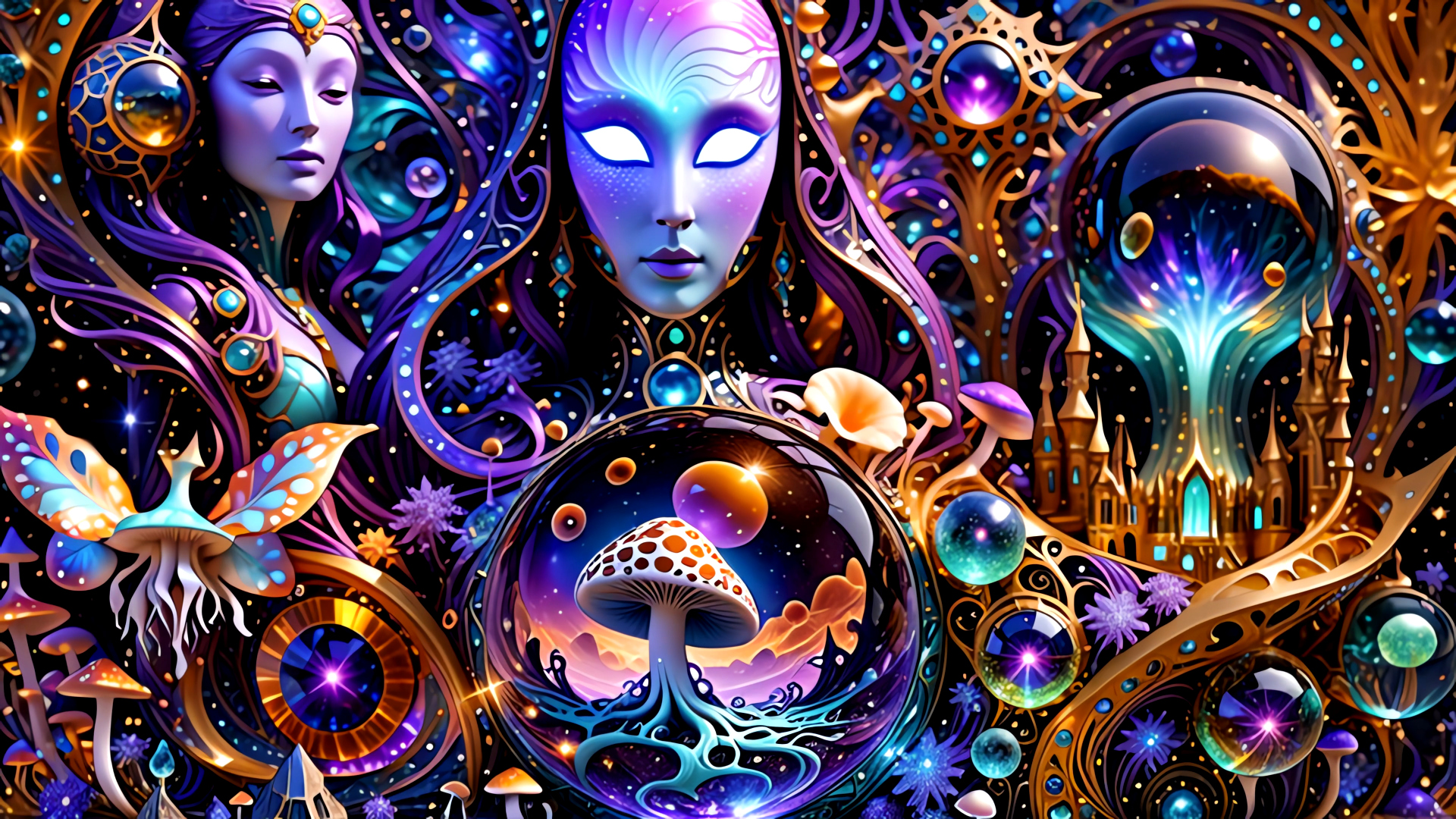
Veydrin was humanoid in silhouette, but no human had ever stood like that—perfectly still, as if listening with bones. Their body was woven from meteor glass and vow-silk, translucent at the edges, with internal filaments that pulsed in slow, deliberate patterns. Where a face should be, they bore a smooth mask of opaline stone cut into faint spirals, each spiral filled with a shimmer that changed depending on how the Veil looked back at them.
Behind their shoulders unfurled a mantle like a cloak of thin fungus-gill membrane—soft, ribbed, semi-transparent—catching faint starlight and turning it into pale auroras. Their hands ended in long, delicate fingers capped with polished resin, as if they were designed for holding fragile truths.
Veydrin did not breathe.
Veydrin calculated.
And still, they felt something like fear—a gentle pressure behind the sternum where fear would live if they had lungs.
Because the Lattice Veil had begun to notice them.
The fog ahead rippled with iridescent bands, the kind seen on oil slicks and beetle wings, but deeper—impossible hues that made the mind reach for names and fail. In those bands, fractal motifs appeared and vanished: spirals within spirals, prisms unfolding into prisms, tessellations that made the eyes water with their insistence on meaning.
Veydrin raised a hand.
The spores around the ship reacted—forming into thin lines, then symbols, then a glyphic sentence that hovered in front of them like a polite threat:
RETURN YOUR PURPOSE.
The letters were not letters. They were fungal filaments aligning, then hardening into momentary crystal, then dissolving back into dust.
Veydrin tilted their head, and the spiral in their mask shifted color. Their voice emerged not from a throat but from vibrating resin within their chest:
“Purpose is not a possession,” they said softly. “It is a direction.”
The Veil answered with a slow wave of color—an expression of irritation, perhaps, or amusement. The spore-snow thickened. It began to stick to the ship like pollen that wanted to become a garden.
Veydrin stepped forward to the edge of the vessel and looked at the Crown Archive, barely visible in the far mist.
It hung there, enormous, as if a halo had grown ribs and decided to become architecture. It had layers—rings within rings—each ring ribbed with gill-like buttresses that glowed faintly with biolum script. Between the rings drifted shards of reflective mineral like broken moons.
The Archive’s silhouette suggested a crown, but crowns belonged to kings. This belonged to laws.
Around the Archive moved its wardens.
They were not ships. They were beings.
One glided by like a ribbon made of manuscript—an Aureate Peristal, a looping strip of golden parchment-skin with ink-veins crawling beneath its surface. Its “head” was a knot of folded calligraphy that opened like a flower when it sensed motion, revealing an eye made of a rotating symbol.
Another circled farther out: a Gryll Seraph, insectoid and angelic, with compass-antlers and wings of stained-glass segments. It did not flap. It refracted, moving by shifting the angles of its own geometry. Its body was segmented pearl with thin-film iridescence; where joints met, faint equations glowed like tattooed prayer.
And deepest in the mist, something vast and patient turned—slow as a continent.
Veydrin recognized it from forbidden diagrams: the Prismatic Leviathan.
A creature as long as a legend, made of translucent mycelial cartilage and mirror-slick plates, its internal organs glowing with drifting constellations. It had no mouth, only a ventral seam of soft light that opened occasionally to release clouds of shimmering spores like a sigh.
It didn’t hunt by teeth. It hunted by attention.
Veydrin touched the meteor-glass pendant at their throat—an old relic etched with a single line:
SOLVE TO PASS.
The ship entered the fog.
The Veil thickened, and the colors changed. The world became a long inhale.
2 — The Corridor of Blue Pressure
The first threshold was not a gate.
It was a sensation.
A cobalt pressure rose around the vessel, squeezing gently, as if reality had turned into deep water and the ship was descending without moving. The spores clinging to the hull began to glow faintly, casting haloed rings that made the edges of everything appear doubled, tripled—like the world had been copied and the copies refused to align.
This wasn’t distortion for its own sake. It was the Veil’s language: LSD-glass refraction, the old name for a phenomenon where matter remembered too many versions of itself at once.
Veydrin stepped off the ship and onto nothing.
They did not fall.
A strand of radiant fungus-light rose beneath their feet and held them up like a courteous hand. It unfurled into a mycelial highway, braided filaments arcing forward through the fog—thick as bridges, thin as hair, interwoven into a road that glowed with slow, steady pulse.
Each pulse carried images.
Not memories from Veydrin.
Memories from places.
Cities grown from thought.
Forests whose leaves were crystal tongues.
Oceans of ink where stars swam like fish.
Veydrin walked.
The road extended ahead, but it did not lead straight. It spiraled. It always spiraled. The Veil loved curves; straight lines were too decisive.
As Veydrin advanced, the air filled with floating structures like giant mushroom caps turned inside out—cathedral gills arching overhead. They glowed with blue-green light, and their ribs were inscribed with living script that crawled, rearranged, then crawled again.
From the gills descended creatures like monks carved from lacquered bark: Cap-Clerics.
Humanoid, yes—but not human. Their “faces” were smooth fungal plates with shallow grooves where expressions could have been. Their eyes were coin-like mirrors stamped with alien stars. Their robes were woven moss and spore-thread, constantly shedding tiny motes that drifted around them like incense.
They formed a silent corridor and watched Veydrin pass.
One raised a lantern: a spore globe filled with pale light and slow-moving fractal patterns.
Within the globe, symbols swam. When they aligned, Veydrin saw a message:
THE EQUATION IS A CROWN.
THE CROWN IS A THROAT.
WHAT YOU TAKE WILL TAKE YOU.
Veydrin did not stop. Stopping was how the Veil caught you. Stopping was permission.
The gills overhead brightened, as if the world approved of forward motion.
Then the road narrowed.
The corridor ahead became a long tunnel of reflective fungus-sheen: mirror-root arches, each arch showing Veydrin in a different variant. Some variants had broken masks. Some had no pendant. Some were hollow, nothing inside but drifting spores shaped like unspoken prayers.
The Veil was testing identity now.
Not with violence.
With possibility.
Veydrin’s mantle rippled as they walked, and their internal filaments pulsed faster—calculations tightening, reality becoming a problem set.
They whispered the first line of the Iridescent Equation—not the whole thing, never the whole thing—just the opening cadence, a small lure thrown ahead:
“Let the boundary be soft,” Veydrin murmured, “and let the soft become a key.”
The mirror arches shivered.
The corridor accepted them.
3 — The Tribal Gatekeepers of Amber and Obsidian
The second threshold arrived disguised as ornament.
The road widened into a plaza made of fungal marble—smooth, damp, alive. Around its perimeter rose black obelisks of obsidian stone, each one carved with spirals and ladder-motifs. Their surfaces were not reflective; they drank light, leaving matte silhouettes that made the surrounding glow feel louder.
Between the obelisks hung strings of amber bells, dozens of them, each bell carved from fossilized resin and filled with liquid gold. They did not ring. They measured, faintly vibrating in patterns that made the bones ache with arithmetic.
When Veydrin stepped into the plaza, the bells shifted in unison, and the obelisks exhaled shadows.
The shadows congealed into forms—guardian beings assembled from darkness and geometry.
They were humanoid and towering, twice Veydrin’s height, with bodies like sculpted void. Over their torsos and faces floated porcelain plates—lunar-white masks etched with thin, glowing lines. Their hands were ceramic, fingers jointed and ringing softly as if each knuckle contained a tiny chime.
Selenid Wardens.
They moved without sound, but the air around them warbled as if space itself was reluctant to let them pass through.
One Warden extended its hand. In its palm appeared a symbol made of light: a rotating polyhedron, its faces stamped with words that changed too quickly to read.
But Veydrin didn’t need to read. They felt the demand behind it.
PROVE YOUR SOLVE.
Veydrin raised their own hand, and their spores gathered to form a thin, luminous line in the air. The line split into a branching fractal, then folded back into itself, becoming a looped glyph.
A response.
THE SOLVE IS THE WALK.
The Wardens tilted their porcelain faces. Their masks rotated slightly, showing different etched patterns—laughing, grieving, sleeping—all in a single motion. Behind the porcelain, something watched.
Not eyes.
An assessment.
The bells vibrated again, and the obelisks’ shadows stretched. The plaza’s floor rippled like a pond.
From beneath it rose a creature like a throne made of fungus and star-metal: the Equation-Priest.
It was not a being in the usual sense. It was a stack of interlocking rings, each ring etched with luminous script. The rings rotated at different speeds, and as they rotated, the script aligned into momentary sentences. Between the rings flickered an inner light, teal and gold, like a heart visible through ribs.
When it “spoke,” its rings synchronized, and the words burned briefly into the air:
YOU SEEK THE IRIDESCENT EQUATION.
THE EQUATION SEEKS A BODY.
ARE YOU EMPTY ENOUGH?
Veydrin felt something tighten inside their meteor glass—an instinct that wanted to become refusal.
But refusal was also an answer, and the Veil punished answers that lacked elegance.
“I am not empty,” Veydrin said. “I am unowned.”
The rings slowed. The script stuttered.
For a moment, the plaza filled with a smell like damp earth and ozone—mushrooms after lightning.
Then the bells parted. The obelisks withdrew their shadows. The Wardens stepped aside.
The road beyond the plaza revealed itself: a narrow bridge of fungus-light stretching into fog so thick it looked like milk poured into the universe.
Veydrin crossed.
Behind them, the Equation-Priest’s rings resumed rotation. New words formed as a farewell:
TAKE CARE.
THE EQUATION IS BEAUTIFUL.
BEAUTY IS A HUNGER WITH GOOD MANNERS.
4 — The Still Room of Unwritten Names
The third threshold was the quietest.
The bridge led into a round chamber of smooth stone, damp with luminous dew. It felt like the inside of an ancient shell. The air was cool, heavy with spore-scent, and filled with tiny particles that drifted slowly, as if gravity had been softened into suggestion.
This was not a trap.
This was a mirror.
Along the curved wall of the chamber, fungal filaments crawled, assembling into inscriptions. They formed letters, then unformed, then reformed—restless as thought.
When Veydrin stepped fully into the room, the filaments stabilized into a single sentence:
TO SOLVE IS TO SURRENDER A NAME.
Veydrin approached the wall.
As they drew near, their reflection appeared—not on the stone, but in the dew itself. Each droplet became a tiny lens. Within each lens, a different Veydrin stared back.
Some had crowns.
Some had cracks.
Some had nothing inside but drifting spores.
Veydrin touched the wall.
The stone warmed, and the dew-lenses trembled. The chamber exhaled a slow pulse of teal light, and the filaments rearranged into a new sentence:
THE IRIDESCENT EQUATION CANNOT BE CARRIED.
IT MUST BE WORN.
Veydrin withdrew their hand.
Their pendant—meteor glass etched with forbidden linework—grew slightly warmer. The etching shimmered, as if responding to something far away.
Veydrin realized the truth with a sudden clarity that felt like pain:
The Crown Archive did not keep the Equation as a book or a relic.
It kept it as a living law, a pattern that needed a host.
The room wasn’t asking whether Veydrin could take the Equation.
It was asking whether Veydrin could survive becoming its vessel.
The air thickened. The dew-lenses began to show new images:
A staircase of lichen-steel spiraling into a sky made of inverted dawn.
A city of gill-windows and silk bridges, growing like thought.
A fruit orchard where each glass fruit contained a universe.
A black dodecahedron that ate adjectives, leaving only blank certainty.
The chamber was offering a preview of what the Equation could do.
Not as temptation.
As disclosure.
Veydrin whispered a second line of the Equation—again, only a fragment:
“Let the solve be a skin,” they murmured, “and let the skin become a door.”
The dew-lenses brightened. The chamber’s stone vibrated softly, as if pleased.
Then the far wall opened.
It didn’t crack. It didn’t swing. It simply decided it had always been an opening.
Beyond it lay a corridor of luminous gills and mirror-stone, leading directly toward the heart of the Crown Archive.
Veydrin stepped through.
And the chamber behind them wrote one last sentence into the air:
IF YOU EXIT WITH THE EQUATION,
YOU WILL NOT EXIT AS YOU ENTERED.
Veydrin did not turn around.
5 — The Crown Archive and Its Hunger of Beauty
Inside the Archive, the architecture became unreasonable.
The corridor widened into halls stacked like pages. Each hall was a different geometry, as if the building couldn’t commit to a single reality. Gills curved overhead like cathedral vaults. Mirror-stone columns reflected not the present but the most probable next moment. Floors were woven from spore-thread that felt like warm silk underfoot and shifted subtly, guiding Veydrin toward the center.
The air shimmered with constant refraction—thin-film iridescence everywhere, like the whole place had been coated in beetle-wing lacquer.
Creatures moved within the halls, guardians and scribes and living ornaments.
A flock of Zelic Doves passed overhead, their bodies made of equation-feathers that rearranged mid-flight, leaving behind brief trails of symbols that faded like breath.
A Quartz Moss-Beast lumbered across a side archway, a quadrupedal creature built from faceted stone and velvet moss. Dew rolled off its crystalline back in perfect spheres, each sphere containing a tiny, rotating map.
From alcoves emerged the Archive’s librarians: Myconid Chroniclers.
Humanoid, but alien. Their bodies were pale fungal flesh with luminous veins. Their heads were caps shaped like soft crowns, gills flaring like collars. Where their mouths would be, they had thin slits that opened only to release spores—communication by atmosphere, not speech.
Each Chronicler carried a staff: a living branch tipped with a lantern fruit glowing teal. Inside each lantern fruit, a fractal pattern pulsed like a heartbeat.
As Veydrin passed, the Chroniclers bowed in unison. Their spores drifted outward, and for a moment Veydrin’s mantle filled with their words—felt rather than heard:
THE EQUATION IS NEAR.
IT IS CHANGING ITS MIND ABOUT YOU.
Farther in, the hall became a spiral.
Veydrin ascended a staircase of lichen-steel, each step soft beneath the foot like moss that remembered being metal. The spiral climbed through layers of glowing gills and reflective mineral shards. Each turn revealed a different vista through gill-windows:
A sea of prismatic fog.
A garden of glass fruit.
A void with slow, turning leviathan shadows.
At the top of the spiral, Veydrin arrived at a door made of nothing but blue pressure. It stood upright in the air like a rectangle of deep ocean.
Veydrin stepped through.
And entered the heart.
The central chamber of the Crown Archive was vast and intimate at once—a dome of fungus-marble ribs, glowing with biolum script, with a floor of mirror-glass that reflected an inverted sky below. Above, the ceiling was not a ceiling but a suspended ring of rotating mirror-shards, like an orbital crown. Each shard reflected a different starfield, a different possible world.
In the center of the chamber hovered the Iridescent Equation.
It was not written on a surface.
It was a structure.
A floating braid of luminous symbols, each symbol made of refracting crystal and living spore-thread. The braid rotated slowly, and as it rotated, its symbols aligned into patterns that made the mind want to weep—not from sadness, but from the unbearable precision of beauty.
The Equation’s colors shifted constantly: teal, cobalt, amber, violet—thin rims of gold around everything, like reality had been outlined by a gentle flame.
As Veydrin approached, the braid reacted.
The symbols began to rearrange, not randomly, but deliberately, as if the Equation were studying the shape of Veydrin’s intent.
The chamber’s mirror-floor trembled. The orbital shards above rotated faster.
And from the edges of the chamber, the Archive’s final guardians emerged.
They were not the Selenid Wardens. Those were gatekeepers.
These were Mirror Maws.
They rose from the floor like jaws of glass and shadow, each one a tall, arched creature with a throat made of fractured mirror-stone. Their bodies were transparent, but within their transparency moved shimmering particles like sand drifting through a sealed hourglass.
They had no faces. They had only openings—gaping mirror-throats that reflected the viewer’s deepest, most dangerous belief.
One leaned toward Veydrin.
In its throat, Veydrin saw themselves wearing a crown.
In another, Veydrin saw themselves hollowed out, the Equation shining from inside them like a lantern.
The Maws did not speak.
They invited.
The Iridescent Equation pulsed.
Veydrin felt a pressure in their meteor glass—something like the sensation of being looked at by an entire civilization.
They raised their hands.
Their internal filaments flared, calculations accelerating. Their mantle of gill-membrane shimmered, catching the Equation’s light and scattering it into a halo of shifting colors.
Veydrin whispered the third and final fragment they dared to speak:
“Let the self be a variable,” they murmured, “and let the variable become light.”
The Equation paused.
For the first time since it had been spoken into existence, the braid of symbols hesitated.
Then it began to unravel—not into chaos, but into a finer braid, thinner, more intimate.
It reached toward Veydrin like a crown reaching for a head.
Veydrin stepped forward.
The Mirror Maws leaned back, as if giving space for a sacred act.
The orbital shards above rotated faster, casting fractured starfields across the chamber.
Veydrin extended their forehead—the opaline mask with its spiraled grooves.
The Equation touched them.
And the world turned inside out.
6 — Wearing the Solve
The Iridescent Equation did not enter Veydrin like possession.
It entered like agreement.
Symbols flowed into the spirals of Veydrin’s mask, filling the grooves with iridescent light. The meteor glass of their body refracted, revealing hidden layers—older etchings, previously invisible. Their internal filaments rearranged, not as wires but as roots. Veydrin’s mantle flared outward like gills opening in water.
And in that moment, Veydrin understood the Equation’s nature:
It was not a key.
It was not a weapon.
It was a syntax for becoming.
The chamber’s mirror-floor showed Veydrin’s reflection—but now, the reflection was not fixed. It shifted between versions with each pulse of the Equation, as if Veydrin had become a probability cloud shaped like a person.
The Mirror Maws moved closer again, and in their throats, Veydrin saw new images:
Doors opening into worlds that had never existed.
Bridges forming between histories.
A crown made of light settling onto an empty sky.
The Equation spoke—not in words, but in sensation:
BUILD.
Veydrin turned slowly, their movements trailing faint chroma-split halos. The orbital shards above slowed, as if the chamber had reached a conclusion.
The Myconid Chroniclers emerged from the alcoves, gills flaring. Their spores filled the air in a shimmering mist, and within that mist, Veydrin felt their message:
THE EQUATION IS FED.
THE EQUATION IS WORN.
NOW THE EQUATION MUST GIVE BACK.
Veydrin looked down at their pendant.
The etched line on it had changed.
Where once it said SOLVE TO PASS, it now read:
PASS TO SOLVE.
The difference was subtle. It was everything.
Veydrin stepped to the edge of the chamber where the mirror-floor reflected the inverted sky below. Beneath the glass was not emptiness but a vast, glowing underworld: a sea of spores and light, moving like a slow, dreaming ocean.
Veydrin raised a hand.
The Equation within them responded. Symbols bloomed across their palm like luminous tattoos.
They traced a shape in the air—an arc, a loop, a spiral.
The air thickened. The Veil beyond the Archive rippled.
And somewhere in the fog, the Prismatic Leviathan turned, sensing that something had changed.
A doorway formed—not a rectangle, not an arch, but a living aperture made of DMT tessellation, petals unfolding like a flower of mathematics.
Beyond the doorway lay a world that did not exist until this moment.
It was a landscape of mushroom towers and glass fruit orchards, of rivers made of slow light, of skies stitched with constellation grids. It was both fantasy and sci-fi, both myth and mechanism: a realm built from the Equation’s elegance, shaped by Veydrin’s unowned direction.
The Mirror Maws bowed—glass jaws lowering in reverence.
The Selenid Wardens, distant but present, let their porcelain masks soften, lines dimming from threat to blessing.
The Crown Archive itself seemed to exhale—its gill ribs glowing warmer, its scripts crawling more slowly, as if relieved to have completed a long task.
Veydrin stepped through the aperture.
As they crossed, they felt something detach from them—gentle, painless.
A name they hadn’t realized they carried.
Not a personal name.
A category.
A label.
A certainty.
It fell away like old skin, dissolving into spores.
On the other side of the threshold, Veydrin stood in a field of velvet moss beneath a sky that shimmered like oil on water. A wind moved through the mushroom towers, carrying luminous dust that painted the air with faint auroras.
Veydrin lifted their head.
The Equation glowed within their mask spirals, casting thin rims of gold around every edge of the world.
Behind them, the aperture began to fold closed, petals of geometry sealing like a living eye.
Before it shut completely, Veydrin looked back at the Crown Archive one last time.
It hung in the fog like a crown in search of a throne.
But now, it was not hungry.
Now, it was… satisfied.
The aperture sealed.
The Veil’s colors softened.
And in the new world, the mycelial highway unfurled ahead—braided luminous threads stretching into distances that felt like promise.
Veydrin smiled without a mouth.
They had come to steal the Iridescent Equation.
Instead, they had become its first honest wearer.
And the Equation—beautiful, hungry, polite—began to whisper its next instruction into the roots of reality:
BEGIN AGAIN.
BUT THIS TIME, MAKE IT STRANGE.
Veydrin stepped forward into the shimmering spore-snow, toward a horizon made of fractal clouds and mythic light.
A new adventure, written in iridescence.
A new world, solved into existence.
And somewhere far above, unseen among the orbital mirror shards of the old Archive, a single line of living script crawled across the fog:
THE SOLVE IS NEVER FINISHED.
IT IS ONLY WORN WELL.