


I. The Thirteenth Seam of Sky
There are places where the world is stitched together so tightly that even gods can’t find the thread.
And then there is Glasscap Valley—a bowl of ancient stone hidden between mountains that curve like sleeping leviathans. From above, it looks like a crater left behind by something that fell from the heavens and decided, at the last moment, to become a garden instead of a wound.
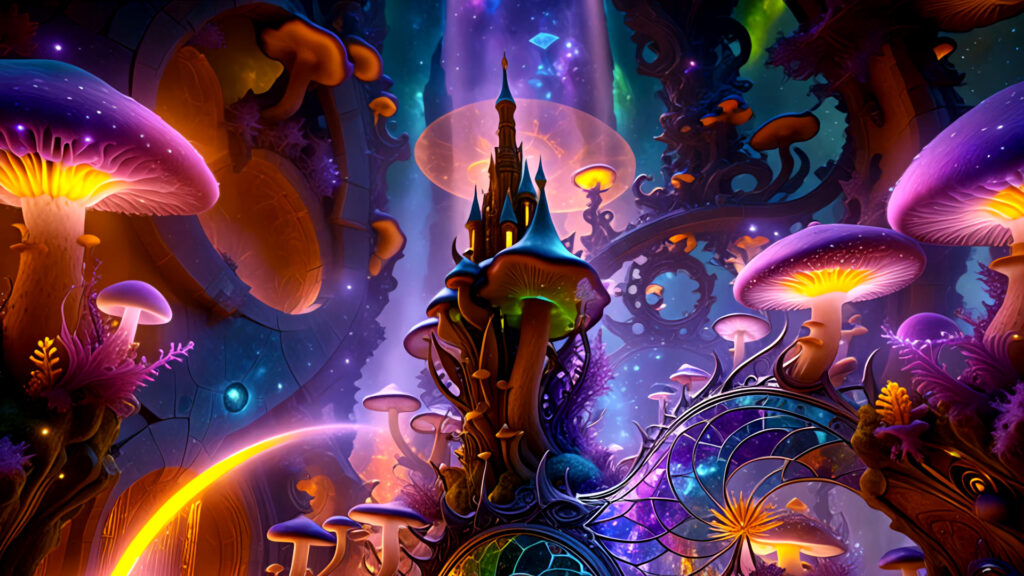
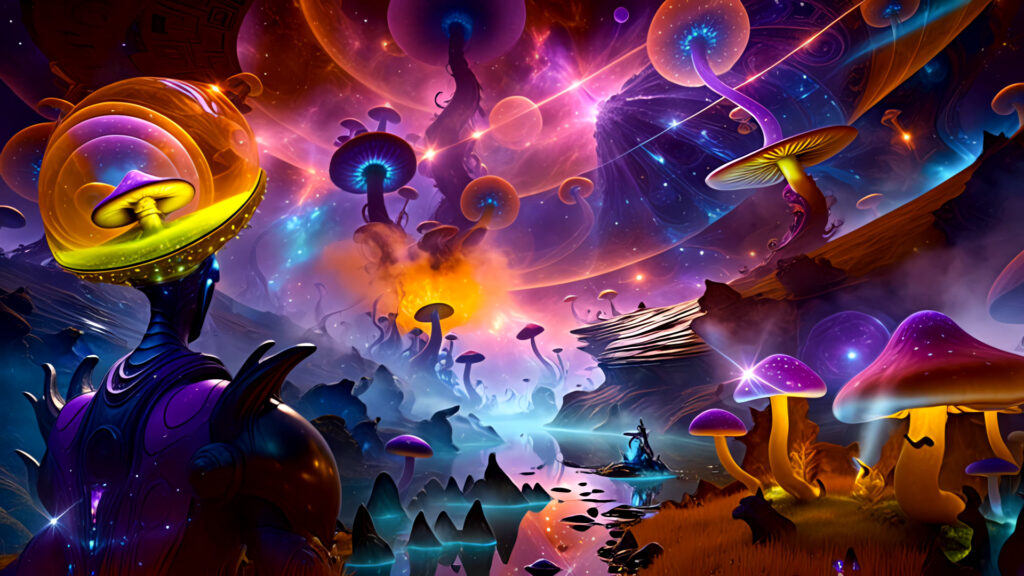
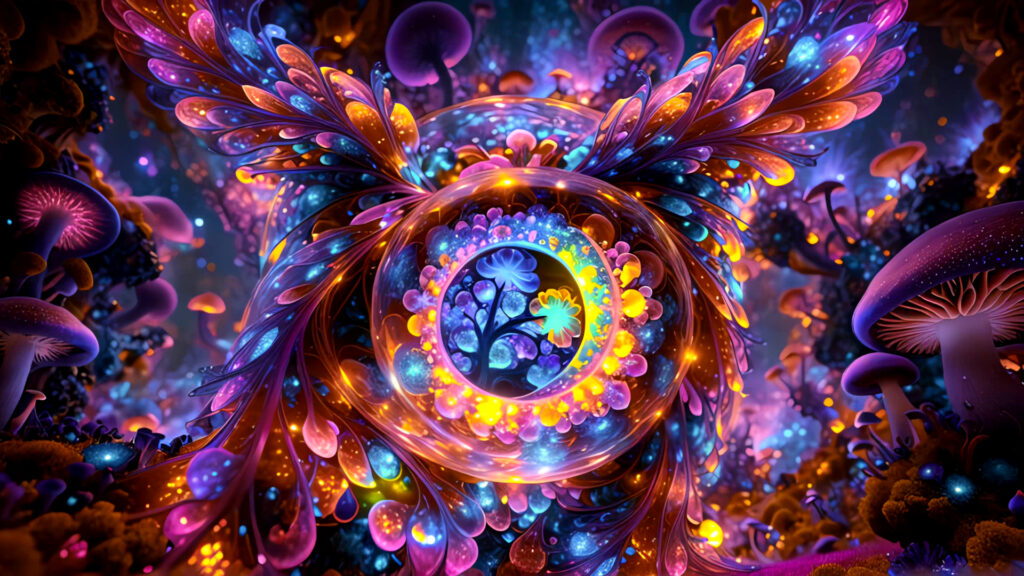
The valley’s mushrooms are not mushrooms in any ordinary sense. They are colossal glass organisms, their caps spanning entire ridgelines, their stems rising like cathedral pillars from the bedrock. Each cap is translucent and milky-opal, laced with faint internal veins that shimmer with cobalt and teal. Beneath those caps, the gills are etched with living glyphwork—runes that rearrange themselves when observed, as if the act of seeing is a kind of touch.
Above the valley, the sky has a flaw: a faint seam, like a zipper made of pale starlight. The locals call it The Thirteenth Seam because it is said to open only when the world exhales its thirteenth breath—an impossible count, because the world is not supposed to breathe at all.
Tonight, it breathes.
The seam loosens, and the air becomes slightly iridescent, as if lacquered with a thin film of impossible color. Not rain, not fog—more like the atmosphere has remembered a dream and can’t keep it contained.
On the basalt rim overlooking Glasscap Valley stands Vaelor, a being of the Ashbound, a mythic order neither alive nor dead in the simple way of lesser creatures.
Vaelor is humanoid in silhouette, but everything about him refuses the idea of flesh.
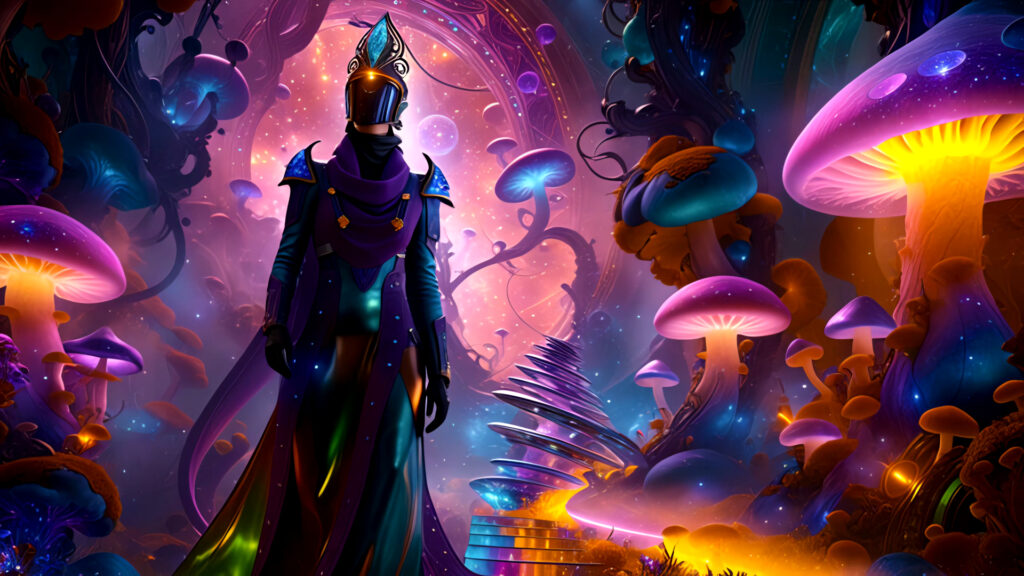
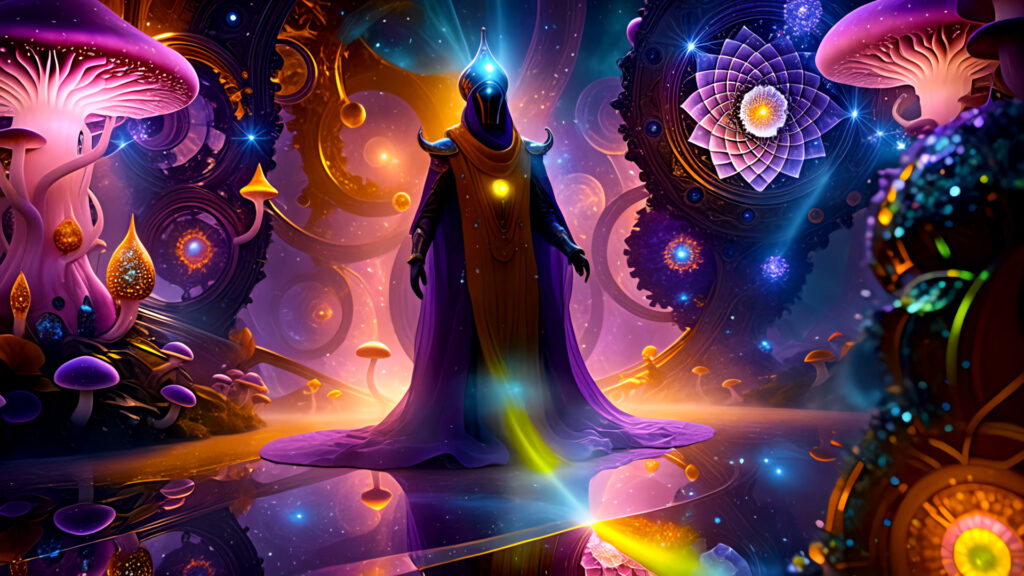
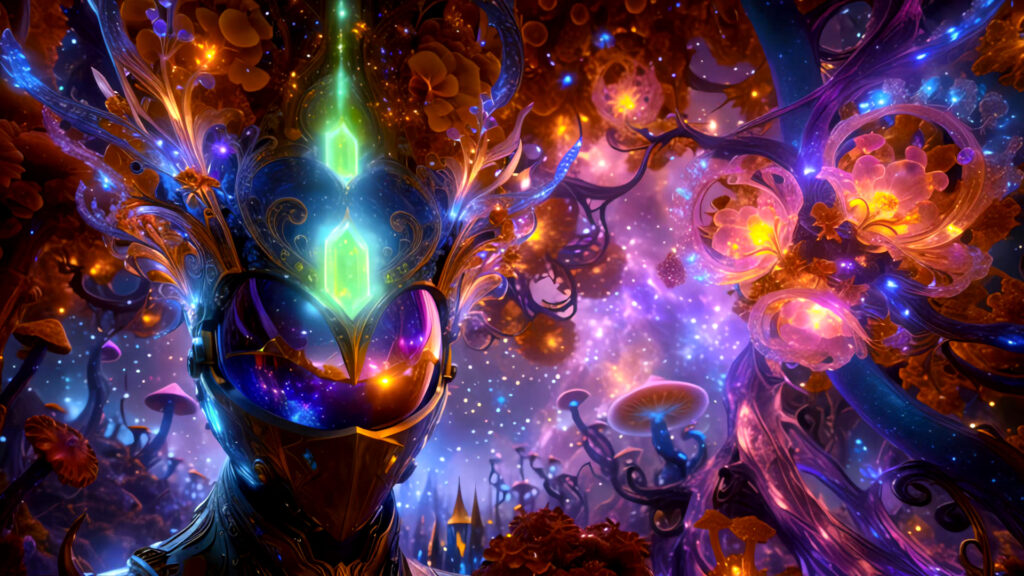
His skin is like obsidian lacquer laid over a structure of slow-moving green veins, as if moonlight were trapped beneath a dark glaze. His face is a smooth reflective plate—no mouth, no nose—only the faintest suggestion of cheekbones and a brow ridge. When the valley’s glow touches it, the reflection does not show the world behind him, but rather a dim shifting collage of other places, as if his face is a mirror that remembers landscapes.
From his shoulders hangs a mantle made of brittle light, thin shards that clink softly against each other without sound. At his hip, a relic swings: an amber-glass coin called a Sun-Seed, ringed with microscopic filaments that catch the air.
Vaelor is not here for pilgrimage.
He is here because the valley called him by a language older than words.
In his palm, he holds a single spore—perfectly round, faintly luminous, no bigger than a grain of salt. It fell from nowhere a day ago and burned into his hand cold, leaving a mark shaped like a spiral that never quite closes.
The spiral is a direction.
He looks down into Glasscap Valley, where the giant caps glow like pale moons anchored to earth. Between them, the ground is threaded with mycelium thick as rope, winding through stone like veins through a sleeping titan.
He speaks aloud, not as a prayer, not as a command—more as a test to see if language still behaves:
“Open.”
The valley answers without words.
A pulse rises from the earth, steady and certain.
And the Ashbound steps forward, into the first echo of the Glasscap dream.
II. The Rootway and the Lichen-Steel Wardens
As Vaelor descends, the basalt path beneath him begins to throb in time with the pulse. It isn’t vibration like an earthquake. It’s more like the ground is a drumhead stretched over a vast hollow space, and something below is tapping, patiently, to invite him deeper.
The soil splits.
Not violently—reverently.
A causeway of mycelial roots rises from beneath the stone, braiding into a roadway. Each strand is pale, thick, and slightly translucent. Within the strands, tiny lights move, like fireflies inside bone.
The Rootway forms itself beneath Vaelor’s feet, step for step, as if he is walking on the intention of a vast organism.
From the shadows between glass stems, figures emerge.
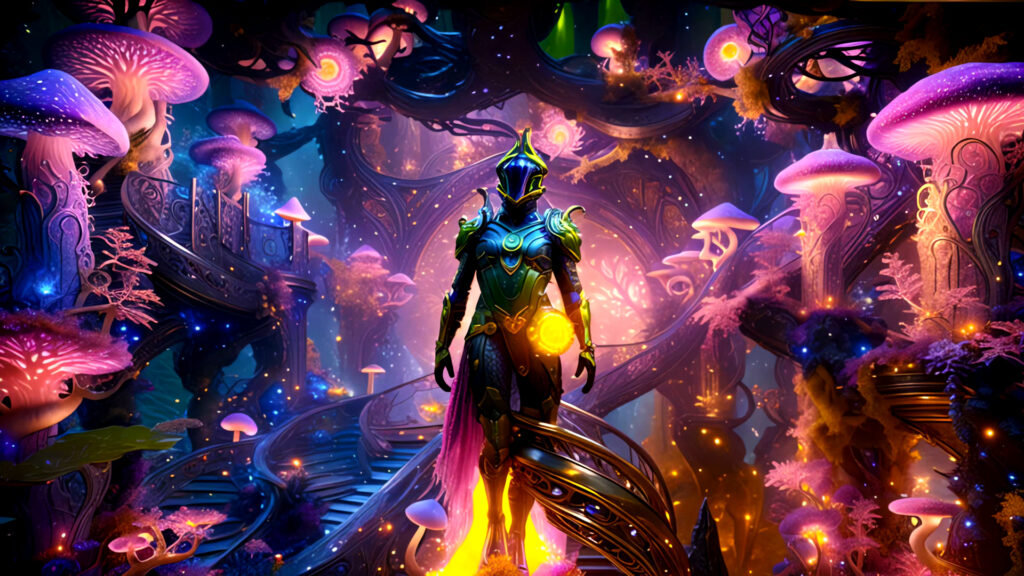
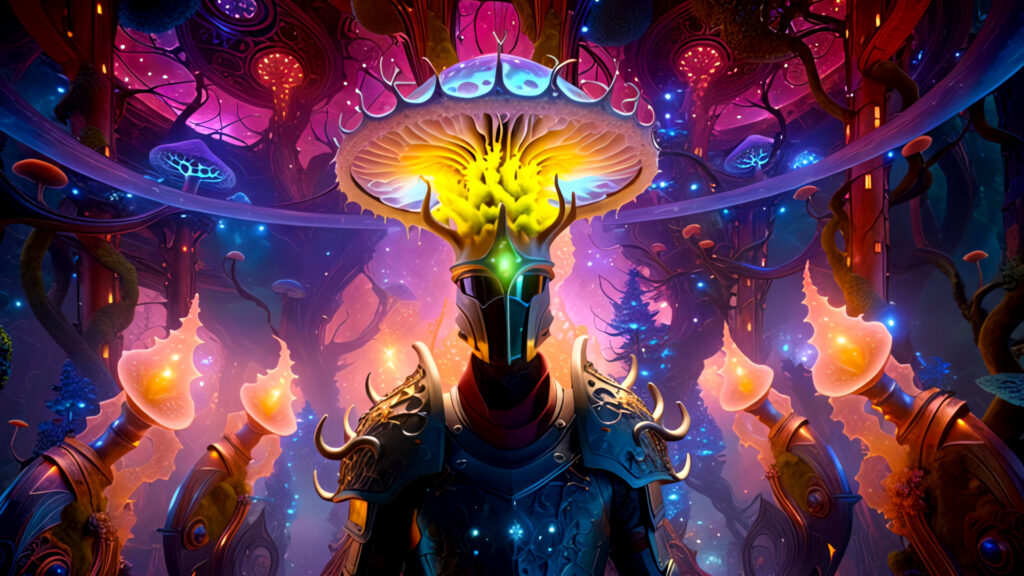
They are tall and narrow, wrapped in armor that looks forged from lichen-steel—a metal that is also a living crust. It grows in overlapping plates like moss trying to become a blade. Their helmets are horned, not with animal horns but with forked fungal antlers that rise and branch like frozen lightning. Their eyes are set deep: polished obsidian spheres that reflect nothing but the faint internal glow of the valley.
These are the Wardens of the Glasscap, guardians of a threshold so old it predates any single kingdom.
They do not block Vaelor.
They align themselves on either side of the Rootway and begin to move with him, silently, like a procession that has been waiting a long time for a leader who never arrives.
One of them—taller, crowned with antlers that spiral into a double helix—turns its head slightly. The motion is smooth and unnatural, as if joints are negotiating reality rather than obeying it.
A voice enters Vaelor’s mind. Not sound. A texture of meaning.
You carry the spiral. The valley remembers you.
Vaelor’s reflective faceplate catches the glow of the Glasscaps. For an instant, it shows not the Wardens but a city of stacked reflections, towers made of mirrored bark, bridges spun from luminous thread. The image vanishes when he blinks—except Vaelor does not blink.
He continues down.
The air grows stranger. Color begins to appear where color shouldn’t. The edges of the mushrooms glint with thin amber rims, while their cores stay cold teal. Spore-motes drift like slow snow, each mote leaving a faint afterimage as it falls.
The Rootway bends, guiding them beneath the first massive cap.
The underside is a cathedral.
The gills above them are lined with glyphs, and the glyphs appear to shift as Vaelor passes beneath—like the valley is reading him.
Then the valley does something it has not done in centuries.
It speaks in light.
III. The Cathedral of Living Gills
Beneath the first Glasscap, the air thickens into a luminous haze. It isn’t fog—fog is made of water. This haze feels like memory made visible.
Vaelor pauses.
The gills overhead begin to glow more brightly, their runes sliding into alignment. A slow, hypnotic pattern emerges: repeating arcs, spirals, and angular sigils that resemble crystalline geometry—shapes too precise to be natural and too organic to be crafted.
The Wardens kneel.
Their armor plates shimmer, and the lichen-steel blooms with faint teal filigree. The horns on their helms hum without sound.
From the far end of the cathedral space, something descends.
At first it is only a shadow.
Then it becomes a creature.
It moves like a manta ray swimming through air, but its body is built from glass-bone struts and translucent fungal membranes. Within the membranes, biolum veins pulse with a slow heartbeat. Its “face” is a ring of mirrored petals, closing and opening like a breathing iris.
This is a Mycelial Manta, a messenger-beast of the deep valley—rarely seen, never touched.
It circles Vaelor once, leaving a trail of shimmering dust. Where the dust falls, the Rootway briefly turns transparent, revealing vast tunnels below—an underground architecture of mycelium and stone, like the ribcage of a buried deity.
The Manta stops in front of Vaelor and opens its mirrored petals.
Inside is not a mouth.
Inside is a map—a lattice of light showing the valley from above, and beyond it, a stairway that doesn’t exist on any physical slope.
The stairway is drawn in a color Vaelor has no name for—somewhere between cobalt and bruised violet, with amber edges like heated metal.
The map pulses.
The message is clear:
Climb.
Vaelor looks toward the direction indicated. Between towering stems, he sees a vertical structure forming—slowly, like a vine deciding to become stone.
A staircase rises from the valley floor, but not straight.
It twists sideways through space, as if it is climbing not up but across the concept of up.
The Wardens rise and fall into formation again.
Vaelor steps forward.
And with each step, the valley’s geometry sharpens.
Not in clarity—in strangeness.
Distance begins to behave as if it is negotiable.
Near things feel far. Far things feel near. The world starts to tilt—not physically, but in meaning.
The Rootway leads to the base of the impossible stair.
And Vaelor begins to climb the Crown Stair that climbs sideways.
IV. The Crown Stair That Refuses Gravity
The staircase is built of braided antler-stone, each step carved with a symbol that changes when viewed from different angles. Vaelor lifts one foot and places it on the first step.
The step warms.
Not with heat—with recognition.
As he climbs, the valley below rotates in his perception. The Glasscaps seem to drift like anchored moons. The mycelial roads look like veins in a living crystal.
Halfway up, Vaelor feels something hook behind his ribs—a sensation like a thread being pulled through cloth.
He stops.
The Wardens stop too, though they are not on the stair. They remain at its base, heads tilted upward, antlers glowing faintly.
Vaelor looks at his palm. The spiral mark left by the cold spore has brightened. It now resembles a tiny halo, incomplete, as if waiting for a final stroke.
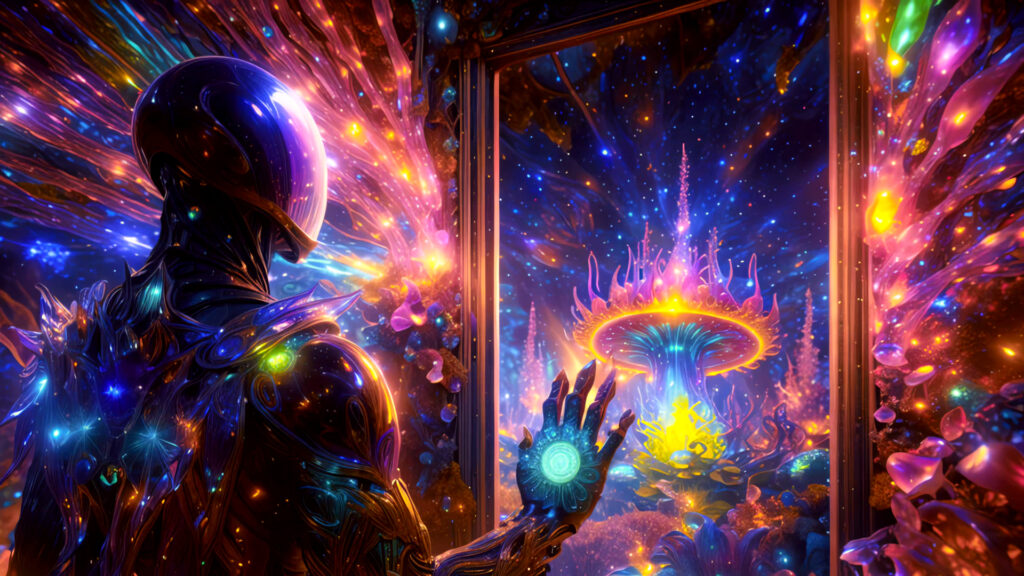
Above him, at the top of the staircase, hangs a doorframe with no door.
A simple rectangle, carved out of the air.
Within it is darkness so clean it looks polished.
This is The Unshown Gate—the threshold that does not reveal itself to those who do not carry the spiral.
Vaelor ascends the final steps.
The air around the frame is thin with iridescence, as if the atmosphere has been lacquered by a cosmic artisan. The colors ripple like oil on water, not flowing downward but sideways, like thought slipping out of its proper channel.
Vaelor raises his hand.
His palm approaches the empty rectangle.
And the world pauses, holding its breath.
For a heartbeat, all the spores freeze in midair.
Then the Gate reacts.
V. Prism-Flash: The Halo That Recognizes
The Unshown Gate emits a sudden flare—white-teal, edged with amber, sharp as a blade and soft as dawn.
Vaelor’s reflective faceplate catches the flash and throws it back in a fractured bloom. For an instant, his face shows a thousand versions of the valley, layered like stacked panes of glass.
Within the Gate, a vision snaps into place:
A city that grows like thought.
Towers of mirrored bark and mycelium spiral upward, connected by bridges of luminous thread. Streets flow like liquid glass, and above them hang hovering rings—arrays of reflective discs that rotate slowly, casting shifting light into the architecture below.
At the city’s heart floats a crown.
Not metal.
Not bone.
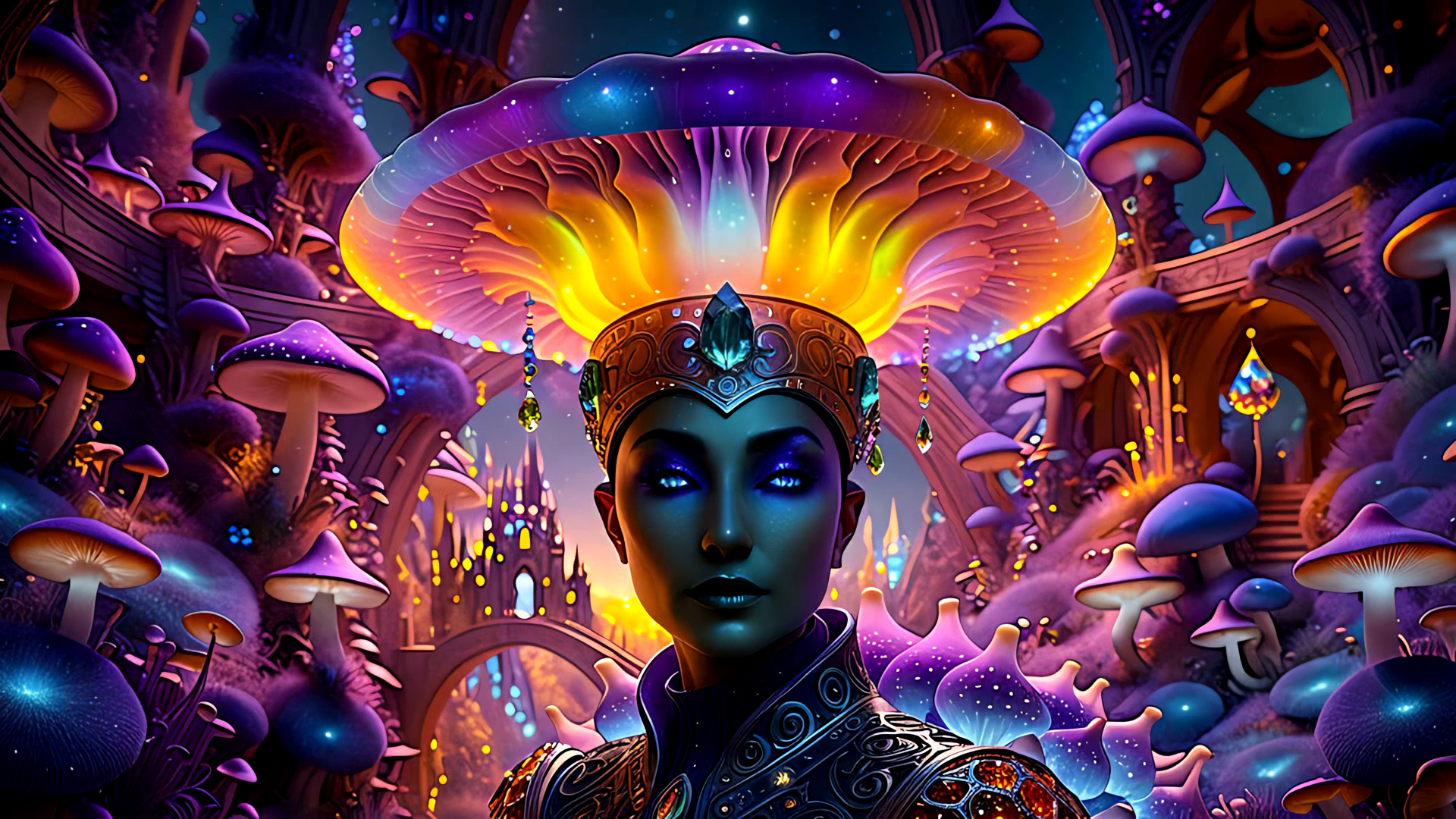
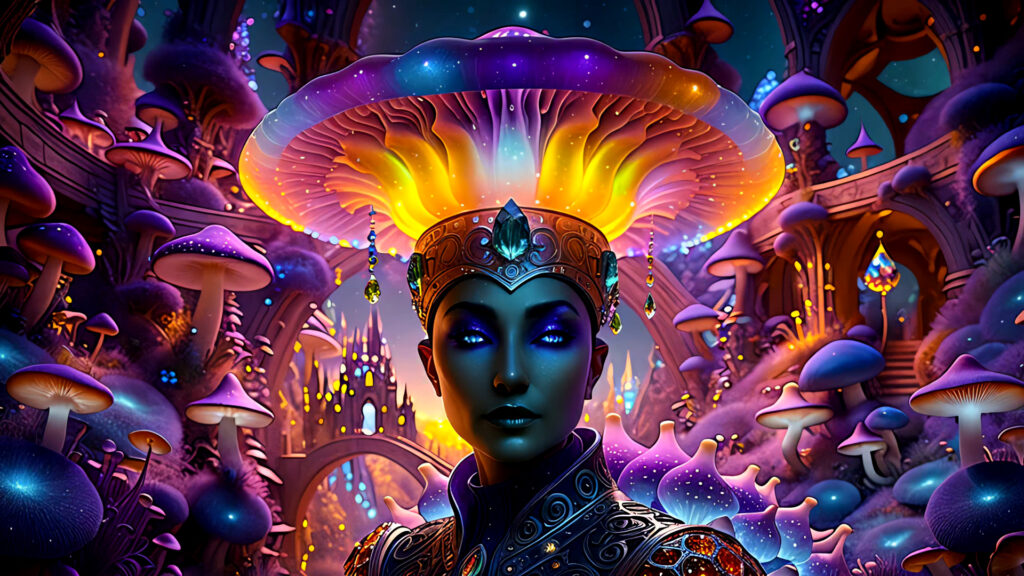
A living circlet shaped like a mushroom cap halo—translucent, iridescent, its edges rimmed with honey-gold. Underneath it, gills carved with runes pulse with teal fire.
The crown hovers, waiting.
The vision is so vivid Vaelor can taste it: metallic sweetness, cold air, the faint scent of wet stone and luminous sap.
Then the vision shutters.
The Gate goes dark again.
But Vaelor is no longer the same.
The spiral mark in his palm completes itself.
A thin line of light draws across the gap in the spiral, sealing it—like a lock closing.
Vaelor understands: the Gate has recognized him as a key.
Behind him, far below, the Wardens bow deeply.
Vaelor presses his palm to the empty frame.
The Gate does not open.
Not yet.
A debt must be paid.
A vow must be given.
Vaelor does not worship. The Ashbound are made of old oaths and stubbornness; their faith is carved into their bones.
Still, he speaks.
Not as a plea.
As a contract.
VI. The Oath of the Low Gate
“I will not steal what is not mine,” Vaelor says into the frame. His voice is not sound; it is a vibration in the air, like a tuning fork struck in a dream.
“I will not lie to what can hear truth.”
“I will not flee the shape of my own fear.”
The Gate drinks the vow.
Vaelor feels the words leave him as if they were blood.
The iridescent film on the air thickens. The colors begin to drift downward now, like slow rain made of light.
Then the staircase trembles.
Not shaking—folding.
The Crown Stair begins to descend into itself, steps turning inward, twisting like a creature curling into sleep. The doorframe remains suspended, but the stair beneath Vaelor becomes a spiraling throat leading down.
Gravity negotiates again.
Vaelor’s body becomes light, then heavy, then light, like a thought trying to decide whether it should become action.
He falls, slowly, through the Gate’s shadow.
The world flips inside out.
And Vaelor lands in the place beneath the valley’s dream.
VII. The Liminal Chamber: Where Names Become Debts
The cavern below is not made of rock.
It is made of dark velvet fungus, absorbing light so thoroughly that depth becomes uncertain. Massive caps rise like domes overhead, their edges burning with violet fire. The air is thick with floating motes that glow faintly, but their glow is swallowed quickly, leaving only short afterimages.
Here, the geometry changes character.
Above, in Glasscap Valley, patterns were cathedral-precise: reverent, guiding.
Below, patterns coil.
Angles chase themselves.
Lines loop into spirals that never close.
It is hypnotic, unsettling, and strangely beautiful—like staring into a mirror that refuses to reflect the same face twice.
Vaelor stands.
His faceplate no longer reflects landscapes; it reflects shapes—tessellations, crystalline lattices, rotating sigil-rings.
Then he senses something behind him.
A presence.
He turns.
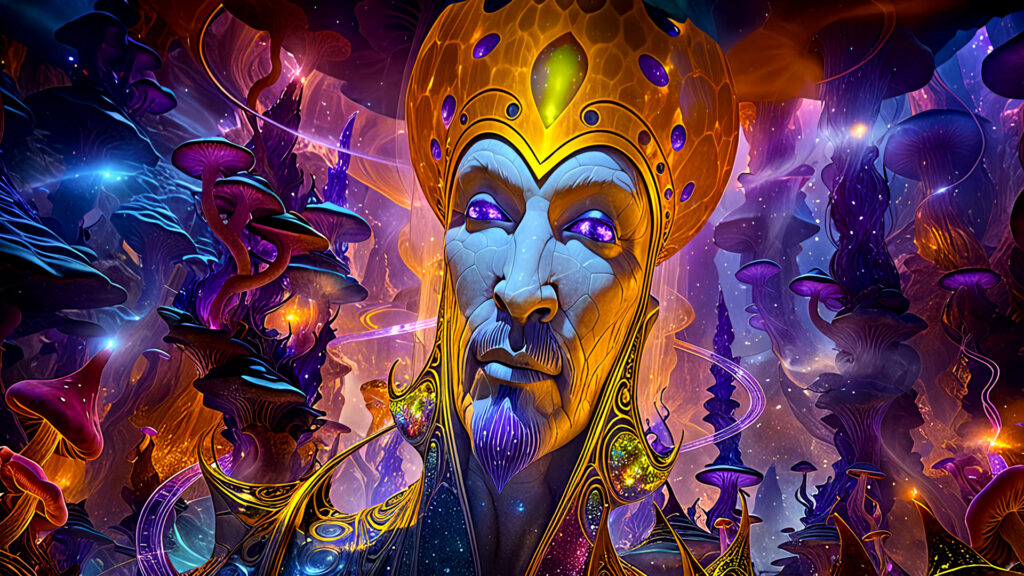
The creature in the cavern’s center is tall and draped in smoke-cloth that ripples as if underwater. Its limbs are long, thin, and jointed wrong—not broken, simply built by a different logic. Where its head should be, there is a smooth void crowned with a rotating shard of obsidian that spins slowly, casting thin crescent shadows across the air.
This is the Sable Cantor—a guardian whose voice arrives as meaning, not sound.
Your name is loud in the upper world, the Cantor says.
Here, names are debts.
Vaelor does not answer.
Instead, he holds out his palm, showing the completed spiral mark.
The Cantor tilts its head.
The obsidian shard rotates faster for a moment, throwing prismatic shadows—like fractured moonlight.
A key is not a king, the Cantor says.
To wear the halo, you must cross what cannot be crossed.
The cavern floor ripples.
A lake of mercury appears where solid ground should be. Its surface reflects nothing accurately; it lags, it warps, it offers delayed versions of truth.
Across the mercury lake, a bridge of near-invisible thread stretches—a filament so thin it seems imaginary.
Vaelor steps toward it.
The filament trembles.
The Cantor’s presence presses into the air like weight.
Walk, it commands, not cruelly but inevitably.
If you fall, you fall forever into the valley’s unspoken endings.
Vaelor’s mantle of brittle light clinks softly, a sound that is more felt than heard.
He steps onto the filament.
And the thread holds.
VIII. The Mirror-Bridge Over Mercury
With each footstep, the filament beneath Vaelor’s feet blooms with faint teal glow, as if the thread is made of light that remembers how to be visible.
Below, the mercury lake reflects Vaelor—but not as he is.
The reflection shows a version of him crowned with antlers of mycelium and glass, his faceplate cracked into a thousand mirrors, each mirror showing a different sky.
The reflection moves a beat too late, like a creature caught behind a transparent wall.
Halfway across, the reflection lifts its head and mouths a silent sentence.
Vaelor understands it anyway:
When you take the halo, the kingdom will dream through you.
Above, the cavern’s velvet caps pulse with violet fire, their runes shifting like living language. Spores drift in slow spirals, tracing loops in the air that feel like invisible doors.
Vaelor continues.
The filament bridge narrows, as if it is testing not balance but intention. The mercury lake beneath seems to deepen, becoming less a liquid and more a concept: a place where truth becomes reflective and therefore slippery.
At the far end of the bridge stands a ring of monolith mushrooms carved with faces that are almost faces—more like memories of faces, impressions left in stone by beings who once had mouths and chose silence instead.
Above them, wings beat.
Creatures circle.
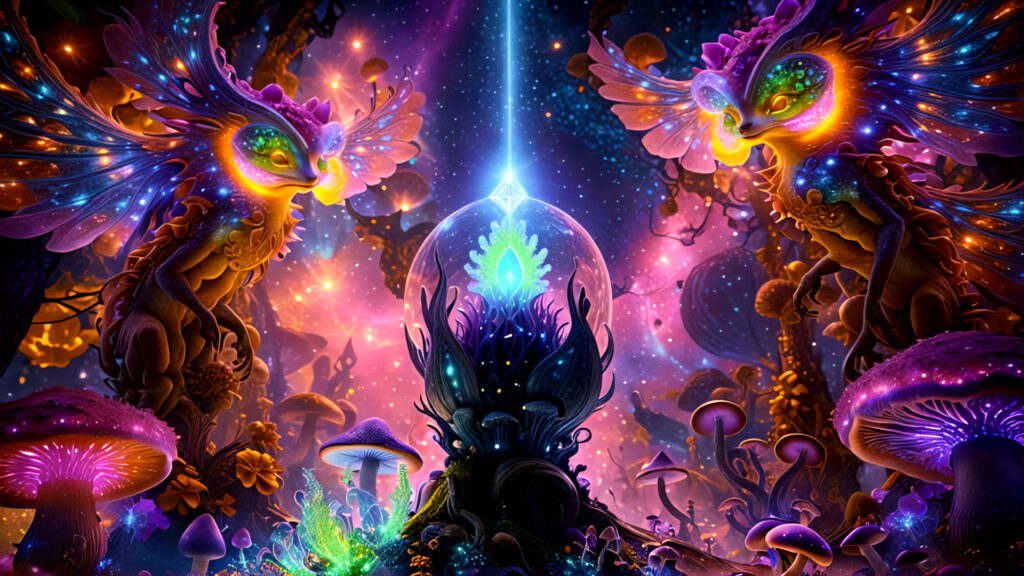
They are owls, but not any owl that belongs to air.
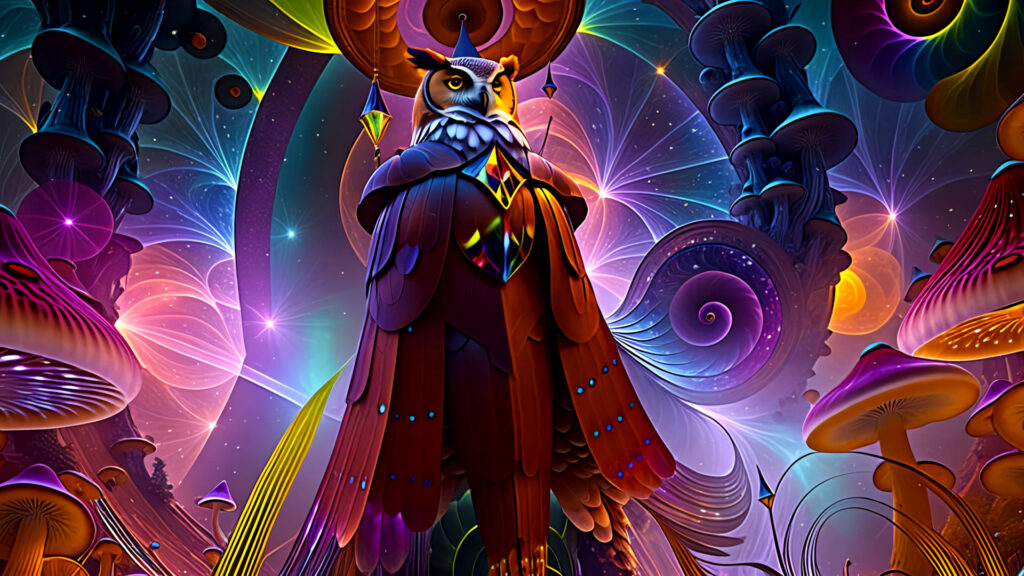
Their bodies are slender and glass-boned, their feathers made of stained-glass dusk. Their eyes are fractal spirals that seem to fold inward infinitely, as if each eye contains a tunnel made of sight.
These are the Spiral Owls—the tribunal of the valley’s deeper mind.
They descend.
And they judge.
IX. Tribunal of the Spiral Owls
The Spiral Owls do not speak. They do not need to. Their gaze is a pressure that peels open hidden layers of self.
Vaelor feels his past unfold like bark stripped from a tree.
He sees:
—The Ashbound forge, where beings are not born but sealed into oaths.
—The war-prayers that once scarred this valley, long before Glasscaps grew to heal it.
—The moment Vaelor took the spiral spore into his palm, and the cold burned a path in him that he couldn’t refuse.
The owls circle tighter.
Their wings scatter prisms across the air. Their eyes bore in, and Vaelor’s reflective faceplate begins to show not landscapes, not geometry, but choices—forking paths, each glowing with a different outcome.
One owl lands on a monolith. Its talons click against stone like tiny chimes.
It leans forward.
The spiral in its eye aligns perfectly with the spiral mark in Vaelor’s palm.
A verdict arrives—not as a sentence, but as a falling spore.
The spore lands on Vaelor’s brow and burns cold for an instant. It leaves a sigil shaped like an open doorframe.
The tribunal’s meaning pours into him:
YOU MAY ENTER. BUT YOU WILL BE CHANGED.
The cavern behind him trembles.
The velvet caps flare violet, then dim.
The mercury lake stills.
Ahead, a corridor opens—made of aligned shards of light, floating like broken windowpanes that have decided to become a hallway instead of debris.
Vaelor steps forward.
The corridor accepts him.
And the world begins to brighten again, not into safety, but into arrival.
X. The Corridor of Bright Debris
The corridor is built from floating slats of light—thin planes that reflect and refract. Between them is darkness that feels breathable, like a pause between thoughts.
Each plane shows a different version of Glasscap Valley.
One shows the valley flooded with amber light, caps glowing like suns.
One shows the valley drowned in cobalt fog, spores falling like ash.
One shows the valley empty, caps shattered, mycelium dried into bone.
Vaelor walks.
The planes drift with him, as if the corridor is moving too, adjusting its shape to keep him centered.
The air becomes a kaleidoscope.
Not chaotic—guided.
The light slats begin to align into patterns that resemble the gills of the Glasscaps above. The runes in the light rearrange, forming a stable lattice.
At the corridor’s end, a final doorframe appears.
This one is not empty.
It is filled with shimmering mist—high, thin, luminous, like the last breath of a storm.
Vaelor steps through.
And he emerges into the vision he saw during the Prism-Flash.
The city that grows like thought.
XI. Mirrormoss Bastion: The City That Dreams
The city is called Mirrormoss Bastion, and it does not sit on land so much as rest on meaning.
Its streets curve like rivers of glass. Its towers spiral upward in mirrored bark, their surfaces alive with fungal filigree that pulses faintly with teal light. Bridges of luminous thread connect structures at impossible angles, as if gravity is merely a suggestion here.
Above, a slow orbit of reflective discs turns in silence—an array like a halo around the city itself. The discs catch the city’s glow and throw it back in shifting patterns, painting the streets with moving geometry.
Vaelor stands at the city’s edge.
His faceplate reflects the towers, but the reflection is delayed—like the city exists a fraction of time ahead of itself.
A procession approaches.
Not Wardens this time.
These beings are tall, carved from translucent crystal, with bodies like faceted ice and halos of rotating rings around their heads. Their faces are smooth, their eyes glowing points of amber.
They are the Aurorans, keepers of luminous law.
They do not block Vaelor.
They bow, rings spinning slightly faster, casting honey-gold rims onto the street.
In the distance, at the city’s heart, floats the crown.
The Halo-Cap.
Vaelor walks.
With each step, the city responds. Threads brighten. Runes align. Spores drift in subtle spirals, tracing invisible symbols around him.
The closer he gets to the crown, the more the air feels like it is being tuned.
Not by sound.
By purpose.
He reaches the central chamber: a vast plaza paved with glass stone. In the center rises a throne made of braided lichen-steel and glass fruit, its surface wet with reflective sheen. Above it floats the Halo-Cap—translucent, iridescent, gills carved with living runes, edges rimmed with amber light.
Vaelor raises his hand.
The crown lowers.
Not falling—choosing.
It settles onto Vaelor’s head with no weight at all.
And the entire city shudders as if a lock has turned.
Teal light surges through the filigree. Amber rims ignite along tower edges. The orbiting discs above brighten, casting shifting halos across the streets.
Vaelor feels something pour into him.
Not power like a weapon.
Power like a responsibility.
The city’s dream enters his mind.
He hears not voices, not music, but an ocean of layered intention—millions of threads of meaning braided into one living tapestry.
He understands why the valley called him.
The Glasscap Valley is not just a place.
It is a mind.
And the Halo-Cap is the crown that lets that mind see beyond itself.
Vaelor turns toward the city’s balcony overlooking the edge.
Beyond lies Glasscap Valley, visible now through a veil of luminous mist.
He steps out.
And the epilogue begins.
XII. Over the Glasscap Valley
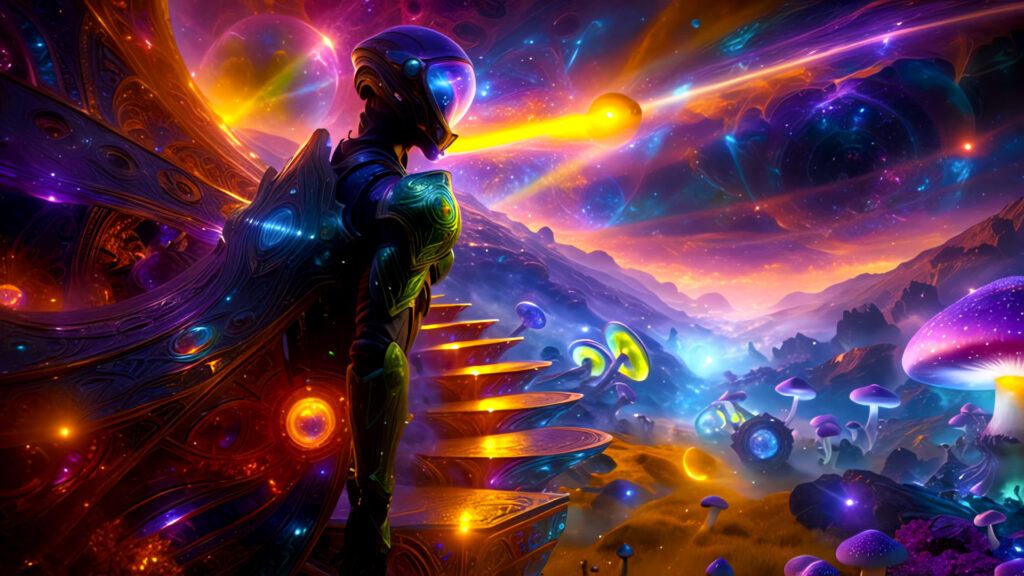
The balcony is made of crystal bark and luminous thread. Below, Glasscap Valley stretches, caps glowing like pale moons. Spores drift upward now, as if the valley is exhaling.
Above, the Thirteenth Seam of sky has opened wider. The seam spills thin-film color across the atmosphere—cobalt, teal, violet, edged with amber like heated gold.
Vaelor stands crowned.
The Halo-Cap does not command him.
It listens through him.
He realizes the truth the mirror-reflection warned him about:
The kingdom will dream through you.
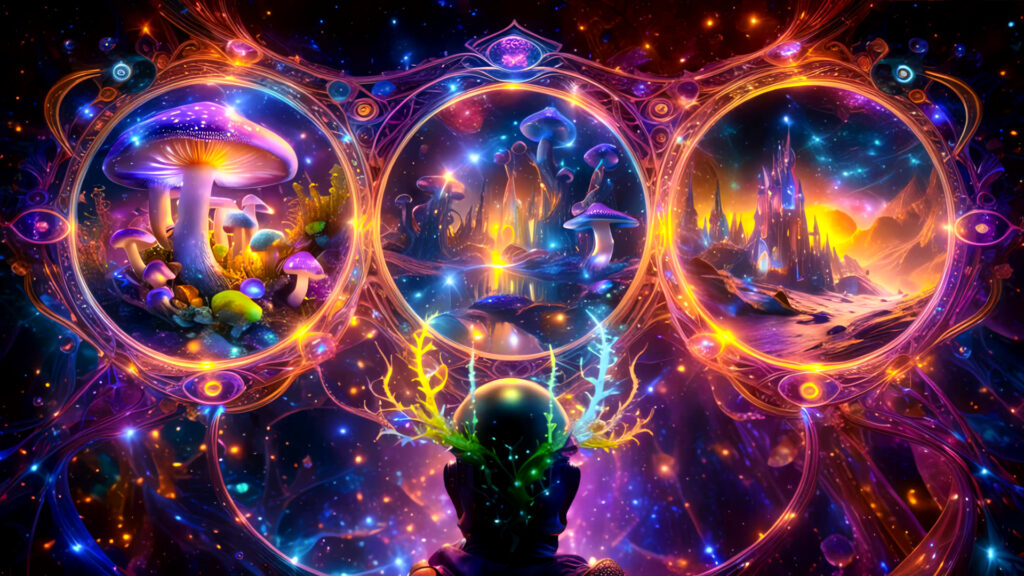
The valley’s dream pours outward, and Vaelor feels paths appear in the sky like threads catching sunlight—routes to realms previously unreachable.
He sees distant places awaken:
—An orchard where glass fruit hangs from mycelial branches, each fruit containing a different sky.
—A reef of cathedral mushrooms rising from an ocean of luminous fog.
—A desert of ash-stars where dunes are made of powdered mirrors and the wind speaks in runes.
—A gate shaped like an amber cube folding inside out, hovering over a coast of crystal kelp.
Vaelor exhales.
Spores drift from the Halo-Cap, not downward but outward, into the air above the valley. They form a map—not drawn on parchment, but written in floating light.
A map only the brave will ever be able to read.
Behind him, the Aurorans bow.
Far below, the Wardens of Lichen-Steel stand at the Rootway, heads tilted upward, antlers glowing faintly, as if satisfied their long watch has finally reached its intended shape.
Vaelor lifts his crowned head and faces the open seam of sky.
He is not a king in the way kingdoms usually mean it.
He is a threshold-bearer.
A living doorframe.
And as the luminous mist rises—thin, bright, afterimage-soft—the valley’s dream expands beyond the mountains, beyond the world’s old borders, into the stitched seam of the heavens.
The story does not end.
It opens.