the Story
The city was built along a river that was not water. It ran without banks and held no fish, only reflections of things that had not happened yet. The citizens called it the chromatic torrent, and they learned early not to step into it unless they had a reason and a way back. Couriers—Charters—were licensed to ride its color logic, to ferry meanings between districts like supplies. What the city ate wasn’t grain or light; it ate continuity: the way a street remembered its own name, the way neighbors recognized a face at twilight and didn’t panic.
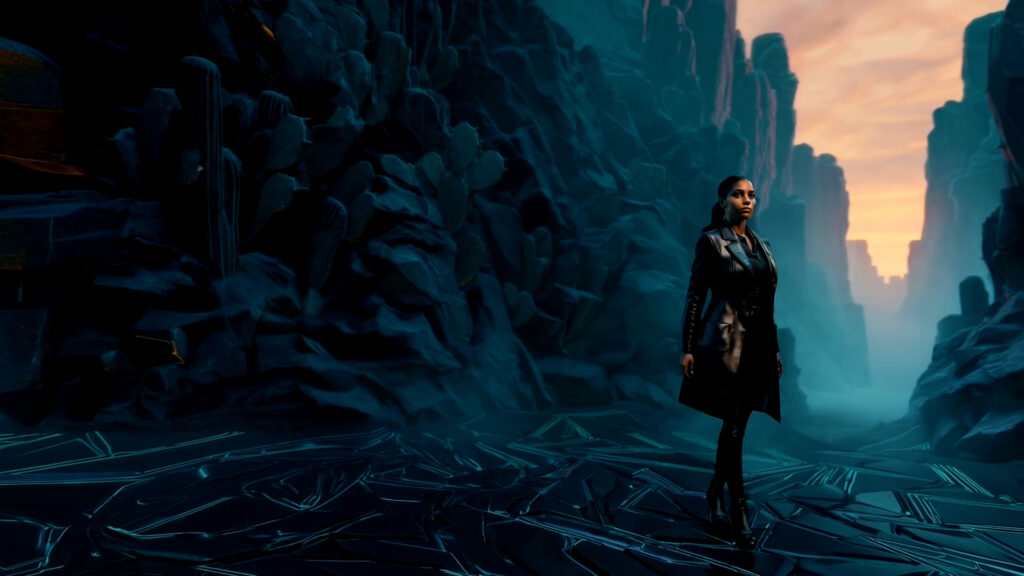
Veyra Quin stood on the quay with a satchel of permits and a skiff folded into a coin of light in her palm. The job slip trembled beneath her thumb: Recover the Drift. No further description. That was common lately. The agencies didn’t like to write down much when a tone was involved. Tones were the seeds of patterns, the kinds of things that once recovered made a city calm down or stand a little taller. A tone could be a ritual, a recipe, a pathway, a way of speaking. Sometimes it was a phrase everyone had forgotten they needed. Sometimes it was a direction itself.
“Risk grade?” the dock warden asked without looking up.
“Ketamine-blue to mescaline-saffron,” Veyra said, which meant the trip would slow her sense of time until it almost stopped and then, suddenly, snap the horizon wide. The warden stamped the slip and slid it back. In the distance the torrent breathed, a sheet of mirror flexing its ribs.
Veyra gave herself to the familiar sequence. The coin relaxed into the skiff, a narrow craft of prismatic spars and a deck thin as a whisper. As she stepped aboard, the rails hummed once into her bones, greeting her in the grammar the torrent preferred: not words but more like a chord you could stand on.
“Take us where the Drift last spoke,” Veyra said.
The skiff angled toward the river. Color braided itself out of air, a current of indigo and teal pulling downstream, and the city slid past like a series of postcards teaching her how to remember it. She kept her knees loose as the first gate rose—a lattice of hexagons with a bright F♯ sheen, not sound but geometry, each panel holding a frozen memory of a place that almost was. The gate recognized her license and hinged apart soundlessly. Veyra breathed, and the skiff glided into evening.
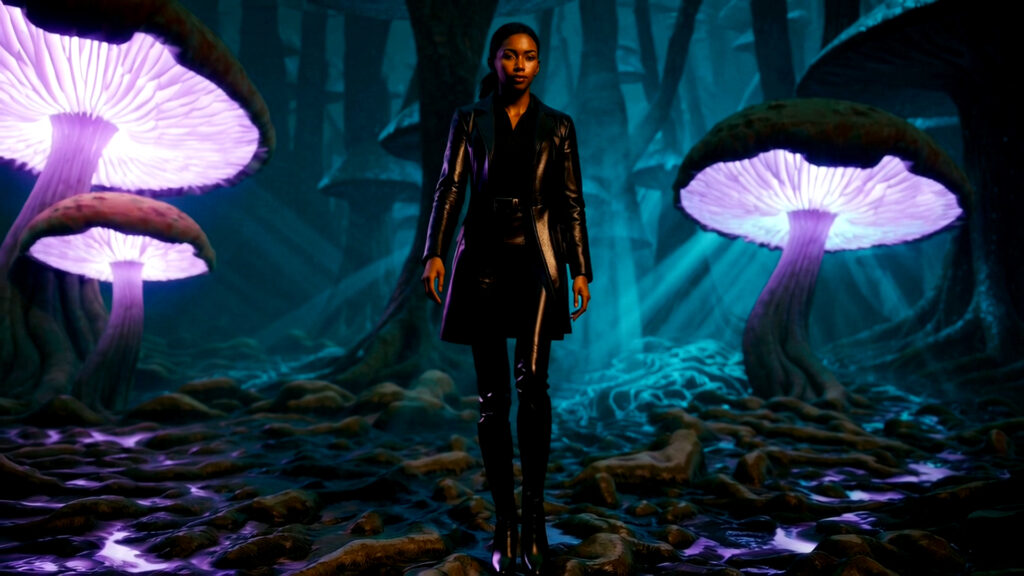
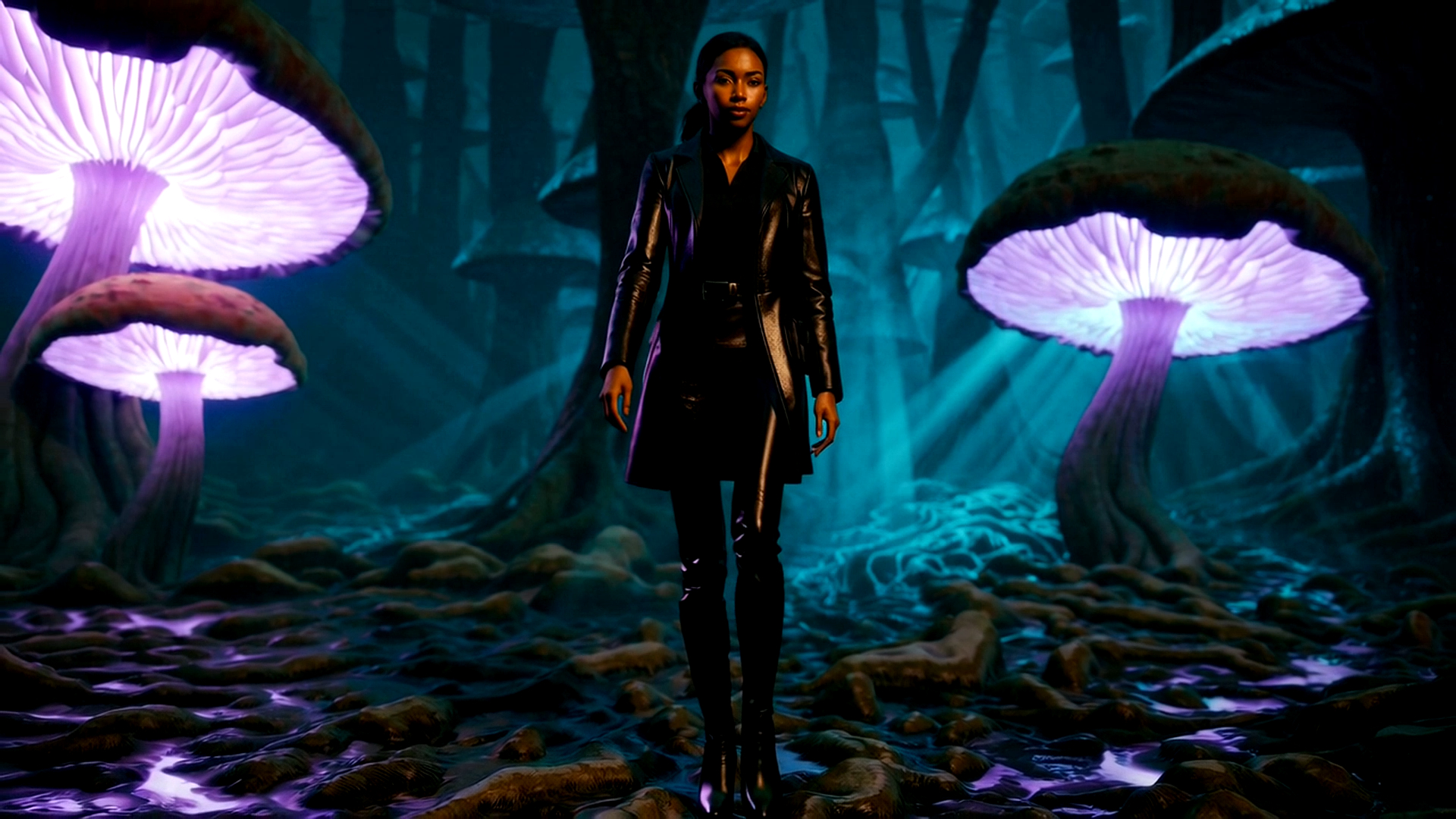
On the far side of the gate, the world lowered its voice. Pillars rose from nowhere, each one a colossal mushroom stalk with a cap wide enough to roof a theater. The undersides glowed with a cyan dew like bioluminescent pollen. Spores drifted—their vectors gentle, their insistence steady. When they touched Veyra’s face, they didn’t sting or perfume; they gave her diagrams. The diagrams were not of space but of options. That was the first sign she was near a tone. Tones loved to live where the next moment could go more than one way.
She let the spore diagrams pass through her and into the skiff’s rails. The craft translated their shimmering and nudged her starboard. It was dark in this cathedral, but not dangerous dark; it was the kind that asked her to trust her feet. Veyra had been a Charter long enough to know when to do as she was asked and when to bargain. Tonight she chose trust. The skiff drew a long arc and the columns parted, showing her the corridor she was meant to take—narrow, breathing, generous with mystery.
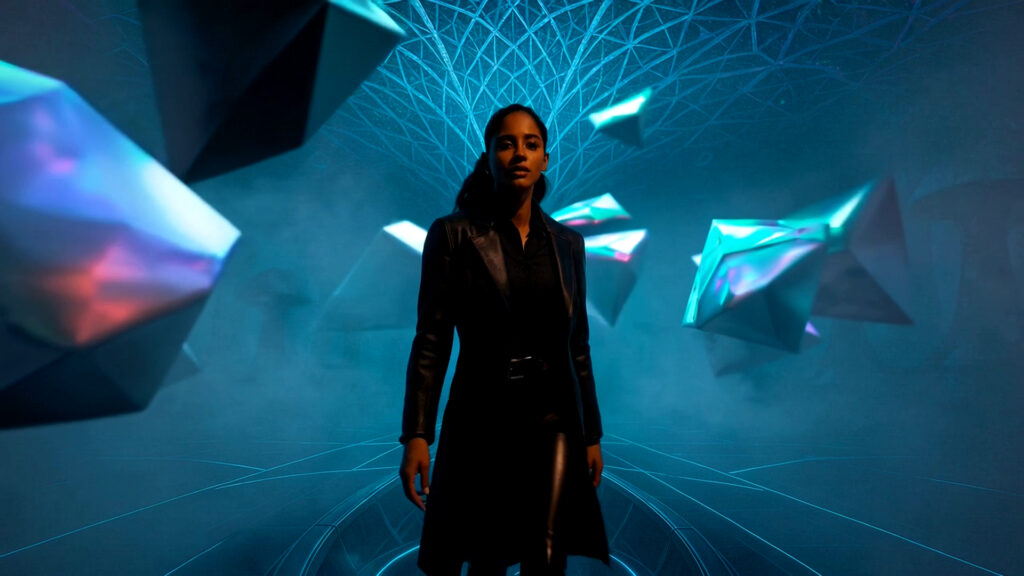
The corridor kinked. The torrent thickened and then flashed thinner all at once, like proprioception forgetting and then remembering itself. The skiff slipped into a chamber edged entirely with prisms, faces clean as surgical glass. It wasn’t a room so much as a proof. Every tilt of the skiff produced a different reality outside the facets, as if the world were obligingly trying on colors for a fitting. Veyra used a finger against the rail to push them through, a tiny correction amplified into a new axis. For a breath there was no up, only forward chosen by color. She broke into a grin. This was the kind of space she had trained for—LSD-clean geometry that trimmed her doubts.
Beyond the prism lock, the river condensed into a hyphae causeway. Mycelial cables ran beneath the surface like veins in a living hand, pulsing with violet and teal. Through their glassy skin Veyra saw constellations mapped in slow wink: not stars, but neighborhoods: the market that smelled like toasted sage, the alley where a barber sang, the footbridge that mapped kisses left under lanterns. All of them connected by filaments of color, examples of a city that remembered itself. And somewhere in that network, a broken strand called Drift.
“Do you feel it?” she asked, not sure if she meant the skiff or the torrent or the work itself.
The rails hummed slightly warmer. She took that as a yes.
Open space followed, a gallery with a suncrown hung along its perimeter. Transparent panels hovered—not glass, not rules—throwing lances of warmth across her path. The sensation was simple and rare: the ceiling had been removed. Most crossings had an implied lid, the weight of a sky waiting to be named. Here, the vault lifted away and the skiff floated a few inches taller. Veyra thought of a memory she couldn’t place: a kitchen with light angling up, citrus rind on a knife, someone laughing without performance. She let the thought go but kept its temperature.
The flood of height made her greedy for speed. The skiff obliged, lines of possibility elongating ahead. She was, she realized, closing on the Drift by dead reckoning—no marker, no beacon, only the feeling of drawing near a decision that mattered.
And then the floor of time buckled.
They entered the ketamine basin where motion slowed to a syrup that did not stick. Every gesture took half a minute to finish, and every breath had chapters. The rails throbbing under Veyra’s palm became intervals she could live inside. Distance thickened into something she could scoop with both hands. Edges lost their edges and turned to gradients. She’d done this before, but familiarity never made it less intimate. The basin asked her not just to wait, but to reform patience into a transport mode.
She thought of Arren, a Charter who had once joked that the basin made you feel like a chess piece that remembered it had been wood before it was carved. Arren had gone missing three years prior on a standard crossing. Officially, there’d been nothing to recover. Unofficially, Veyra still listened for the way he used to clear his throat before disagreeing. She counted her breaths—lanterns hung from a slow ceiling—and navigated the basin with the smallest inputs she’d ever attempted. The skiff responded with a grace that would have been invisible in faster air.
When it delivered them out of slow-time it was like stepping across a seam between rooms. The torrent tightened and spun them into a canopy of geometry finer than any cortex. A lattice extended itself over them, a web of angular paths so thin that dragonflies could thread them without touching their wings. Runes flickered on the spars—equations in motion that looked like sentences but weren’t, notes meant for the part of the mind that arranged light without words. The canopy wasn’t interested in her story or her city; it wanted to know whether she was capable of being a line.
“All right,” Veyra said. “I can be a line.”
The trick here was not to choose. Choice made the lattice seize. Instead she let herself become a vector that could only move where movement already was. It resulted in a humility she loved: a river telling her how not to argue. She reduced her identity to fit this instruction and, to her surprise, felt bigger for it. The skiff threaded the DMT lattice like a fish passing through a school that parted and closed without panic. Color rose and fell along the rails, pulses answering pulses, and the tone at the heart of the lattice ripened like fruit in shade.
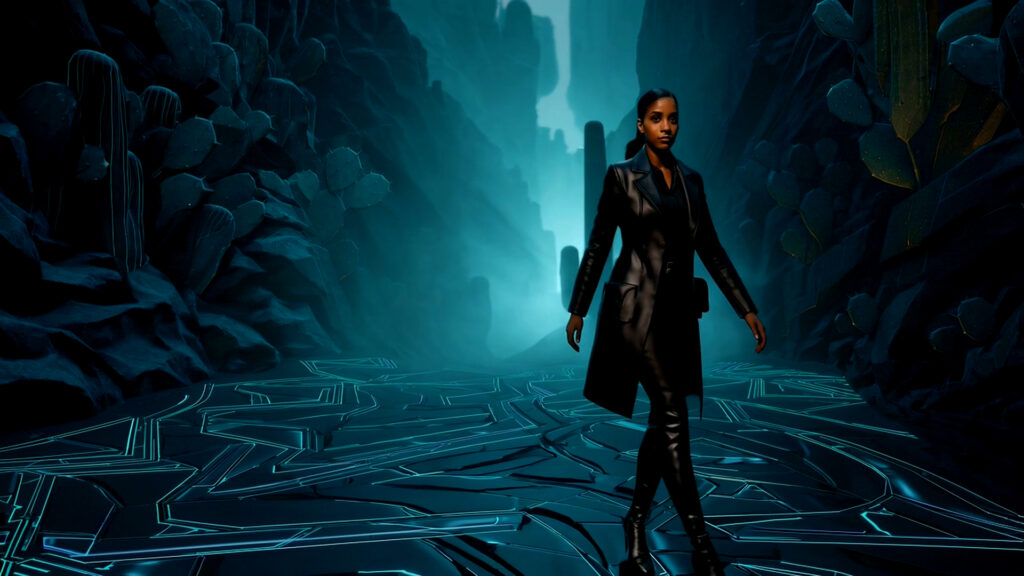
The first challenge presented itself as a question written into the floor: What do you surrender to cross? It wasn’t a riddle she could out-clever; this was peyote stone talking, a ridge of cactus-etched bedrock rising in front of the skiff with spines tipped in silver. The star above them compacted into a voice that tasted like metal and citrus. Veyra tried to answer with something acceptable—doubt, pride, an old grief—but the ridge didn’t blink. It wasn’t the sort of place that appreciated a performance.
“Certainty,” Veyra said at last, and this time she meant it. Not certainty about the torrent—she had never had that to begin with—but certainty that she was the one who could carry the city on her back without breaking. It was the cost she paid to keep rooms bright for people whose names she might never learn—a habit so useful it had turned into armor.
The ridge softened. Spines retracted. Stone rephrased itself into stairs of light. She guided the skiff up, and the river turned a corner she hadn’t realized existed. Warmth spilled like a language she could smell.
They rowed into the mescaline sunfield.
Flowers faced them, each disk a chrome mirror that didn’t reflect her face but older skies. The field rotated as one and turned a hundred telescopes toward a single point she could not yet see. Saffron light poured across the deck. Veyra felt it in her teeth. Here, the world’s edges returned, not harshly but with relief, as if reality were glad to be firm again. The skiff climbed a gradual incline and then passed between two ranks of stems that hummed a promise she’d never heard and instantly recognized.
At the center of the field the Drift waited. It was not a glowing orb or a scroll or a key. It was a decision sitting quietly on a flat stone: a direction that, if declared, would let a thousand smaller choices line up politely behind it. She had recovered tones of flavor and tones of ritual, tones that made fountains behave and tones that taught windows to be more generous with winter light. The Drift was different. It was infrastructure for courage.
She stepped onto the stone. The sunflowers swung, aligning their faces with hers so she could feel what unanimity felt like. There was no ceremony to take the Drift up. She simply stopped resisting it. It rose into her the way a room gets brighter without a hand touching a switch. She felt the city along her spine—the market, the alley, the footbridge, the long conversation on the steps where a stranger had once handed her an apricot. The Drift asked her, Where does the city end? She answered, At the first unshared decision. The field approved.
The horizon cracked.
It didn’t shatter; it flexed and then opened cleanly, like a lid that had been set improperly for years and finally found its right groove. For a ten-count, the world lit itself from inside. The torrent—that mirror river—became a sheet of organized scale. Veyra could see paths she had suspected and paths she had never dared imagine. She saw what would happen if the city chose a different kind of morning, if a street that preferred silence learned a rhythm for laughter, if a district that had never forgiven itself learned how to take flowers without apology.
The skiff took advantage. It surged, leaving a wake of tesserae that arranged themselves into a road that wasn’t a road. It lasted long enough to teach anyone watching that direction didn’t wear out just because it was used.
Then the lid settled back down, as lids must. Light cooled. The torrent loosened and remembered its favorite trick: being a question.
They returned by a slower route, a courtesy to the muscle she called courage, giving it time to find its grip. The spore cathedral let her pass without showing her alternate diagrams. The prism lock blinked once in a way that felt like a nod. In the ketamine basin she counted her lantern breaths backward, the air collapsing its chapters until sentences were short enough to share again. When the original gate accepted the skiff and the city came back into alignment with its own immediate hunger, Veyra felt the Drift move from her body to the rails to the quay and from there to the murmured paths of pedestrians.
She disembarked and walked the slip to the Bureau office where tones were logged. The clerk on duty barely looked up. Veyra placed her permit and the absence of the Drift on the counter. There was nothing to show, and so she showed space. The clerk, a person whose skepticism made a sooty little halo around every encounter, paused long enough for her halo to ripple. She stamped the slip, then did something unexpected. She smiled, a small unadvertised smile that reached her eyes as if she’d just remembered that mornings were not an enemy. Veyra said nothing. The job taught you where to let silence do the delicate work.
Outside, the city felt fractionally taller. It wasn’t a trick of perspective. Balconies that had crouched defensively for years now leaned into air they recognized as deliverable. A mural near the tram stop added three figures at its edge—people the patron had always meant to include but never found the right shade for. Vendors changed their signs from prices that accused to prices that invited. Nothing was loud. Everything shifted by degrees that gathered in the aggregate to form the shape of a better yes.
Veyra walked until she could no longer tell whether the changes were real or whether she was simply tuned to notice them. The distinction mattered less to her with each block. The chromatic torrent leaned against its banks like a cat against a leg, affectionate and enigmatic. She found a bench that tolerated her weight and sat.
Arren slid onto the bench in her memory and stayed there without speaking. Veyra let him. Grief had been a stone she wore in her left pocket and she hadn’t realized until this moment she had stopped checking to make sure it was still there. She touched the pocket and found it empty. The ridge had taken what she had offered and returned something else: a version of her that did not require certainty like a talisman to proceed. It was not comfort exactly. It was better than comfort.
Night rearranged its freckles into constellations. Down the quay, a busker tuned the air with a glass to the rim of a bottle. Across the river, an apartment flicked its lights once, twice, then settled into a new pattern. The Bureau clerk laughed suddenly and made someone jump in mock alarm. A child—not a child, a small adult wearing a ridiculous hat—no, she corrected herself, the job didn’t permit children, and anyway it wasn’t about prohibitions; it was about keeping certain edges clear of certain kinds of narrative. She smiled at herself. The job made language precise even when she was only thinking.
The coin of light nudged her palm. She hadn’t noticed the skiff fold, but there it was—weightless and insistent. A new commission had arrived when she wasn’t looking. She didn’t unfold it yet. She let the night lay new street over old, which was how cities aged when they were lucky.
“Do you think it’ll stick?” someone asked behind her.
Veyra didn’t turn. “It already is.”
“You talk like a preacher.”
“Like a Charter.”
“Same difference.”
Footsteps withdrew. She heard the torrent whispering a solvent attention to the stones, the way rivers do loving work without adjectives. The city breathed in, held, breathed out—a practice she knew intimately now in all its tempos.
She walked home the long way because the long way was different, and difference was the point. A block from her door she slowed near the shop with the basil plants in the window. The owner was out front moving the pots. He looked up as if he’d been waiting.
“You smell that?” he asked.
“Citrus and warm copper.”
He laughed. “I thought I was going mad. Sold three plants before noon and didn’t even miss them. You want one?”
“Another day. Let them find a new windowsill before I steal them.”
He nodded and shifted a pot with both hands like he was balancing a small world. Veyra moved on, her steps unhurried, her shoulders relinquishing that last useless tension she’d treated like a friend.
At her door the amber light had a way of being both invitation and warning, a tone of domestic thresholds. The Drift had not turned her into a stranger to her own rooms. It had simply aligned her with a direction that made her rooms less theoretical. She placed the coin of light on the table and it pulsed once in the color of promises made to nobody in particular and kept anyway.
Sleep came like a letter with no return address—only the feeling of being read lovingly by the dark. She dreamed of a ceiling that opened without argument, of a lattice that taught her how to be a line that didn’t sting, of spore diagrams that made options behave, of a ridge that respected her enough to require a true price.
In the morning she woke before the city did and stood at the window. Fog stitched alleys into temporary kingdoms. Across the way, a woman in a blue robe watered a plant that teetered on making up its mind to thrive. The day was young enough to forgive stupidity and brave enough not to encourage it. Veyra washed her face and packed the satchel and tucked the coin into a pocket she didn’t have until the coin made one.
On her way back to the quay she passed a wall that had been stubbornly blank for years. Overnight, someone had washed it and painted a simple arrow pointing not left or right but into itself. It was silly and profound. It was the kind of thing you could miss if you were looking for bigger theater. She paused to admire the arrow for exactly as long as it took to understand it and exactly as long again to thank it for existing.
At the dock, the warden looked, for once, at her face. “You all right?”
“I am several kinds of all right and a few kinds of not, which seems correct.”
The warden signed the new slip without comment. As Veyra stepped onto the quay the torrent looked up at her like an old friend wearing a new jacket, a little showy, a little uncertain, deserving of applause. She gave it the grace of a grin and unfolded the coin.
“Name this one,” the warden called.
Veyra considered the empty line on the permit where a Charter could, if they wanted, christen the crossing. She wrote Chromatic Torrent Drift and blew lightly on the ink as if breath could convince letters to behave.
The skiff took shape. The rails warmed her palm. The gate, sensing intent, began to loosen the hexagons of its face. Color braided itself from air into a current, and Veyra Quin, Charter of a city that had just remembered a little more of who it was, stepped forward into the next sentence.
The torrent extended itself like a hand offered across a table. Veyra took it, and the river accepted her answer.
the Gallery