the Story
I — The Map That Wasn’t a Map
You arrive where the atlas stops pretending it knows anything.
Beyond the ridge, the land is a black opal plain veined with cobalt veins that hum in no wind. A hush sits on it the way frost sits on grass—delicate, temporary, sacred if you move gently enough. The dew here is wrong in the way a dream is wrong: each bead is too round, too steady, too awake. They don’t roll or soak in. They hold. They wait.
You kneel and the beads reflect not your face but diagrams—hexes nested in hexes, spirals that refuse to end, angles that feel like numbers you once knew. The longer you look, the more they join: a filament touches a filament, and there’s a glow passing between them like the smallest current. It is not water. It is a statement.
The old story said the Oracle grows where dew refuses to be only dew.
You rise, dust the grit from your palms, and walk without choosing a direction. The plain chooses for you. Lines of cold light thread from bead to bead like veins answering a heartbeat. The geometry doesn’t push, it persuades, shaping your steps, showing paths only as you take them. The horizon stays perfectly level, the sky a long bruise of cobalt with a single pale star pinned in the wrong place. Your breath fogs and then the fog arranges itself into numerals you cannot read and then dissolves. It’s almost kind, the way this place tells you: you are in the presence of a very patient intelligence.
When you feel it—before you see it—the hair along your arms rises not from fear but from recognition. As if a song you used to know finds your throat from the outside.
And then you see the Oracle.
II — The Humanoid That Was Also a Tree
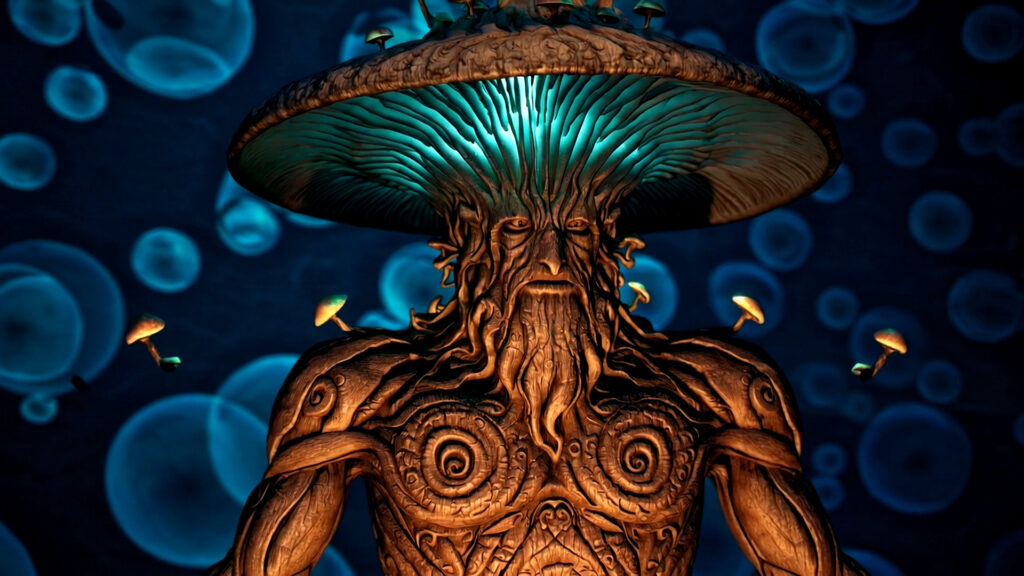
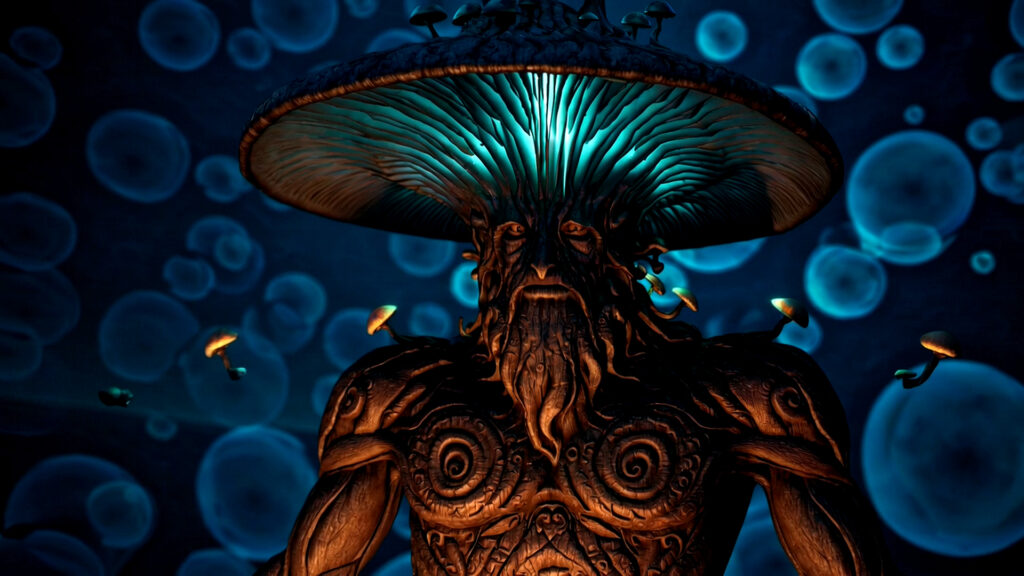
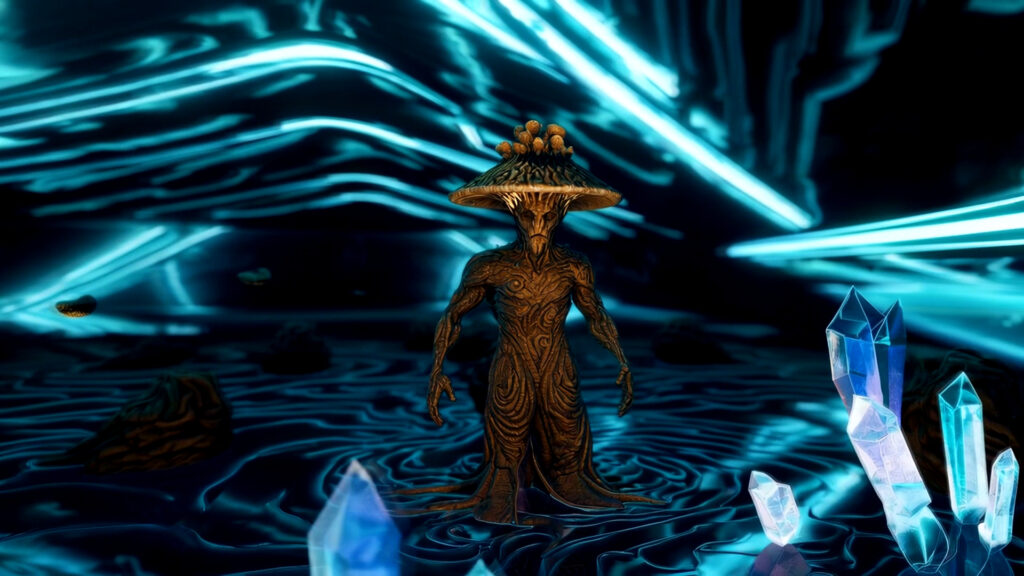
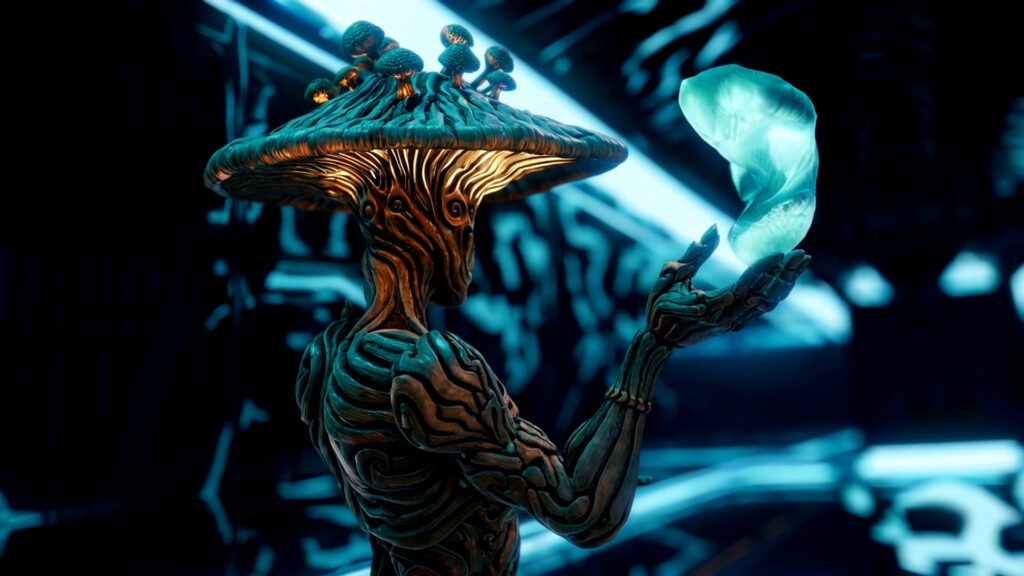
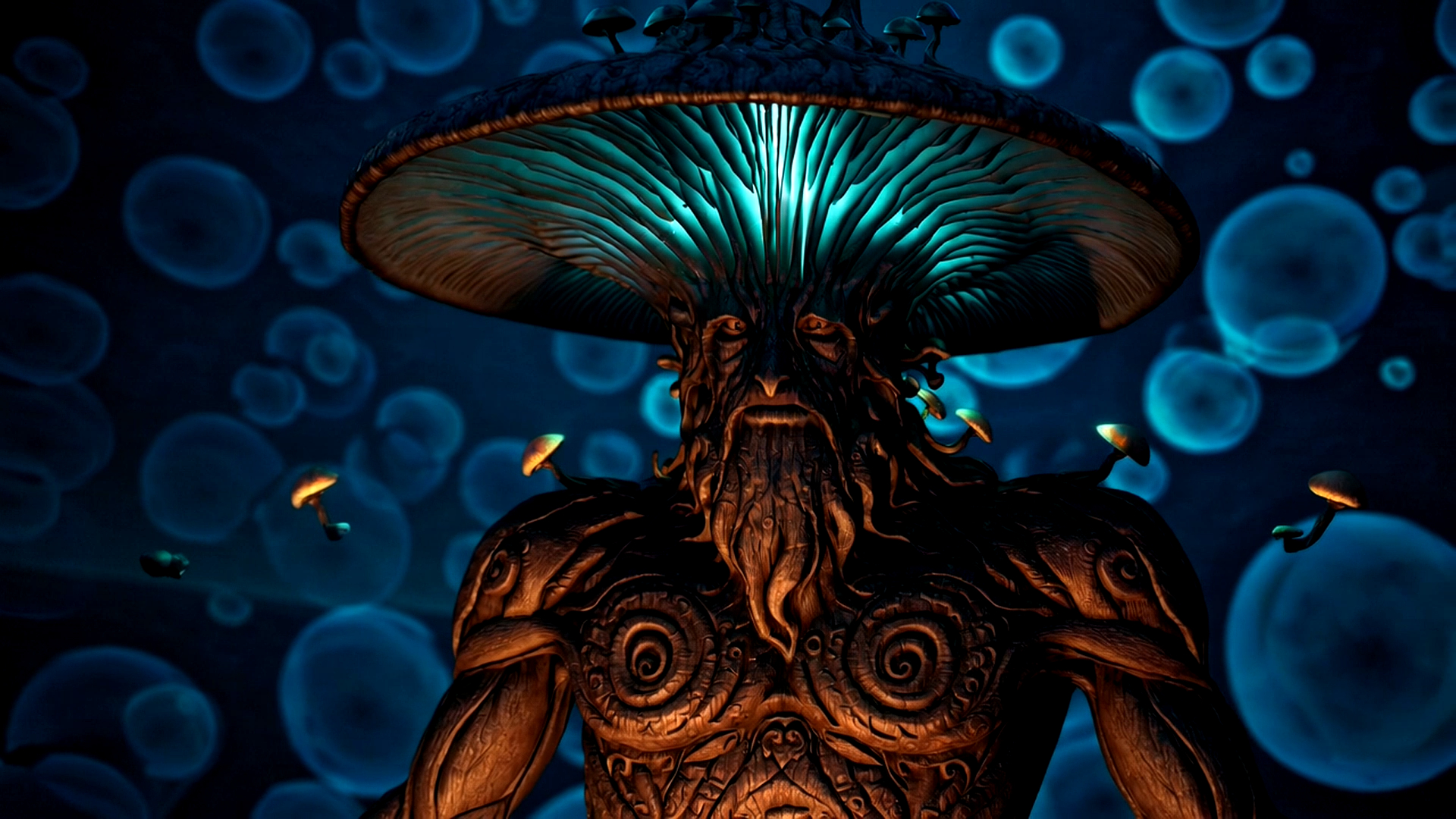
It towers but does not loom. A torso of varnished bark with shoulders braided out of roots, hips heavy with the memory of storms. The arms bend the way branches bend, and where hands should be, the wood splits into filigreed fronds—their undersides ribbed with gill-like lamellae that pulse with bioluminescence. The face is not a face, not really, but a mask of old growth and lichen with hollows where eyes should be; inside those hollows slow constellations wheel like watch gears. A crown of fruiting bodies bursts from the skull and then recedes, then blooms again in a long, tidal breath, spores drifting like snow that has learned how to glow.
Its feet are not feet, they are a root-crown woven into the plain, plugged into the dew like a nerve into a brain.
You do not speak. You bring your question the way you were taught to carry flame—cupped, stubborn against the wind. The question is old and small enough to be dangerous: what am I for?
The Oracle turns its head and the world swivels with it. Every bead of dew along the plain tilts, catching a slice of the same light. A ring expands—no sound, only pressure, like the soft hand of a large clock moving one minute forward. The ring becomes an aisle. The aisle becomes an archway. The archway hangs in the air ahead of you, an aperture with edges made of prism-thin leaves that catch the cobalt and break it into a thousand disciplined shards.
The Oracle lifts a frond and gestures—not to you, but to the geometry.
You step.
III — Corridor of Prisms
Inside the archway, the air has opinions.
Light doesn’t only illuminate; it instructs. Planes of transparency slide like patient doors, closing and opening as your intention wavers. Where you hesitate, they cloud; where you commit, they clarify. Your hands leave after-images that say less about your shape than your pressure against the world. You can’t be clumsy here; clumsiness would be an instrument you don’t know how to play. You slow. You lean into grace. The corridor rewards you for noticing.
The floor is not a floor but a mesh of lines as thin as hair and as strong as decision. Through it the plain is visible, dew still waiting, but the geometry here is bolder, a chalkboard that writes itself: tetrahedrons turn inside-out, spirals anchor themselves without a center, squares become kites that nudge your knees as if pleased by your momentum. It’s not hallucination. It’s instruction with ornament.
Spore-motes drift, each wearing a different tiny geometry, like a census of possibilities. Some pass through your skin without resistance; some nestle in your eyelashes and draw seahorse curves that make your scalp fizz. You like it more than you should. You move like a swimmer taught by bioluminescent fish.
Far ahead the corridor narrows. You feel the Oracle behind you without footsteps, like a cathedral follows a pilgrim who can’t stop looking up. Past the narrowing, the light changes—shifts from prism to satin. Blue deepens to something with gravity.
You brace without being told. Somewhere inside you a door that is not made of wood starts to open.
IV — Descent to the Shadow Sap
The corridor ends in a lip of stone that isn’t stone. The air is viscous, like the underside of time. You step and the world catches you not like a floor, but like a body of liquid that learned patience. You sink without wetness. You accept without understanding.
Welcome to the Basin.
Colors run long here. Blues are molasses. Blacks are velvet. Your pulse drags like a heavy needle across a slow record—not music, but the feeling of sequence. Gravity behaves like a suggestion from a trusted friend. Your limbs become thoughts. Your thoughts put on weight and fall slowly toward conclusions they may or may not reach. You let words go because they’re clumsy down here, and the silence that replaces them is not empty. It’s like walking into a library of sleeping whales.
Memory slides. It doesn’t vanish. It isn’t stolen. It is brushed smooth—edges rounded, corners blurred, a kindness enacted by something that believes the world is yours only when your grip is gentle. This is the slow medicine of the Basin: your most alarmed histories are sanded down until even your fear is elegant. You don’t lose yourself; you lose your flinch.
Shapes move through you because down here you are porous. A boulder of clear bark passes through your chest and leaves a cool ribbon behind, a runic line you know you will keep. There is a taste in your mouth that smells like rain on coins. You don’t know how long you remain, which means you have begun to belong.
When the lift comes, it’s simple: the viscosity thins. Your thoughts regain speed without panic. The dark lifts like a curtain nobody needed to pull. You feel a sigh you did not exhale and rise.
The Oracle is there, hand out—a frond cupping a glyph you recognize as your own name in a language from tomorrow. You take the glyph. It dissolves into your palm, leaving warmth you will forever associate with being understood without confessing anything.
V — Peyote Glyph Meadow
You walk together not as companions—companion suggests equality and repertoire—but as something older: tree and lightning that has learned to strike softly. The corridor pours you into a meadow made of angles. The plants here are not plants. They are hypotheses about plants.
Cacti lift from an ashen soil, each arm a hexagonal column patterned with micro-etchings that rearrange as you watch. The spines do not threaten; they measure. Light comes from nowhere you can point to and finds the glyphs braided into your bones. When you stand still the glyphs on the nearest cactus tilt politely, as if telling you they have read your spine and find the narrative promising.
One of them opens—not like a flower but like a code base unlocking a module—and shows you an interior lined with tiny mirrors. Each mirror holds a moment you thought you’d lost: a doorway you failed to enter years ago; a laugh you declined because it masked something you didn’t believe you deserved; a coastline at dusk where you carried a heavy decision and put it back down. The cactus is not accusing. It is inventorying. You nod. You thank it for the list. You promise nothing. The geometry in the dew around your ankles brightens anyway.
The Oracle places its frond on the tallest cactus. Across the meadow, rings of light expand in silence and then return, like a breath pulled through the mouth of a sleeping giant. Your shoulders drop. The angles in the air round and soften, as if someone has poured warm metal over a sharp thought and made it gentle enough to hold.
A path appears, edged with saffron powder that floats just off the ground, blown by no wind. You follow because following is what you came here to remember how to do.
VI — Mescaline Sunfield
The meadow opens and the world stands up straighter.
Stems rise from the ground like pillars in a cathedral that grew itself. Chrome-obsidian—dark, reflective, stubborn. At their tops, faces turn toward you. Not faces of animals or people; faces of suns. Disks, each petaled with small metallic tongues that flicker and catch the light, sending it across the field in disciplined waves. They do not follow the starless sky; they follow you. Or rather, they follow the intention humming like a tuning fork in your ribs.
The Oracle steps into the field and becomes taller. The fruiting bodies along its crown braid into a corona of thin blades, each etched in the same spirals you saw in the dew. It does not glow more brightly; it glows more specifically. The suns nod, not in unison but in canon, their fine petals clicking delicately, like the smallest applause.
You raise your hand without thinking. The nearest sun tilts and lets go a cloud of saffron motes. They crown your wrists, coil around your fingers, then spin to your throat where they hover like well-behaved bees. Warmth moves along your forearms, a polite fever, then down into your sternum where it lodges and becomes a small, honest fire.
The Oracle turns its face toward you and if it had eyes they would be kind.
You are ready for the question.
VII — DMT Lattice & The Question
The field dissolves from the edges inward, not vanishing but becoming scaffold. The world reveals its draft. Honeycomb strata extend in every direction at once—up, down, through—like the secret architecture behind reality’s smooth skin. Each cell is a room you crave and fear: rooms full of unmade versions of you; rooms full of decisions that never learned they were decisions; rooms where your shadow dresses in your clothes and waits on the edge of a bed that is perfectly made.
You step onto the lattice. It refuses to be a flat thing. Every angle births another. Your foot finds purchase only when you choose where you intend to be. Indecision becomes a hole that is not a hole, only an absence of permission. You choose. The lattice brightens under your weight—pleased, perhaps, or simply registering your participation.
The Oracle speaks, and it is not a voice. It is a sequence.
Equations unfurl in the air the way ferns untuck after rain. They are not mathematical in the way school was mathematical; they are kin to breath. A term grows from another because it wants to. A variable dashes away on a slanted line and returns wearing a different hat, blushing with context. The sequence threads through you and lights your old refusals. It is gentle but it will not lie for you.
What are you willing to shed to know what you are?
It is not a challenge. It is an inventory with a question mark.
The lattice offers examples. In one cell an image of you stands surrounded by trophies that look like mirrors turned backward. You knock; nothing answers. In another, you trail a ribbon made of excuses. It is a beautiful ribbon. It throttles a small, quiet animal you finally recognize as your courage. In another, you clutch a map signed by everyone who ever told you they knew better. The map’s lines never meet.
You look back at the Oracle. It does not move.
You lay the ribbon down. It looks smaller on the floor. You peel the name tags from the map and hand them to the air; they evaporate like morning fog and return as rain that lands on your shoulders, making them clean. The trophies you walk away from don’t call your name because they never knew it. You walk until a musicless rhythm catches your stride and then you walk inside it, until what you are shedding stops feeling like loss and starts feeling like unburdening.
In the center of the lattice there is a room with no walls, only corners. In its center there is a spindle made of light-wet mycelium, rotating not around itself but around the idea of an axis. On it: a single bead of dew. Cobalt. Impossibly round. It contains a map that contains a path that contains a question that contains you, asking it.
You touch it. It doesn’t break. It opens.
Inside is not an answer but a circuit. A path traced through the field of what is possible and what you are for, a route you know by taste more than by sight. The circuit does not need to be written down. It needs to be walked.
You nod to the Oracle. It does not bless you because it doesn’t have to. It belongs to the circuit the way the dew belongs to geometry, which is to say: entirely.
VIII — Return Through the Spore Gate
The lattice collapses into friendliness. Angles wear soft edges again. The suns at the edge of your vision relax and return to their watch. You feel your shadow catch up, hop once, and slot into your heels. The cacti turn their mirrors inward, as if closing eyes after a long, meaningful look.
The Oracle’s crown decants spores. They do not drift away; they come toward you and settle along your collarbones like medals from someone who knows what they cost. The frond touches your sternum where the saffron warmth hums. For an instant the whole plain is a lung and it inhales you—then exhales you back exactly where you stand, only now when you breathe, the geometry in the dew breathes with you.
You walk out of the corridor of prisms and the archway rubs itself into the air like chalk from a sleeve. The cobalt sky on the horizon thins until it is not sky but a curtain in a room where somebody has just opened a door.
Behind you the Oracle is still connected to the plain, its root-crown deep in the dew’s arithmetic. It turns its head in neither farewell nor invitation. It simply participates in your leaving with the same attention with which it welcomed your arrival.
Something gentle and permanent clicks inside you, like a gear finally finding its neighbor.
IX — The Work of a Circuit
The ridge you came over is the ridge you go back to, but your legs know different angles now. Every slope is an equation with two or three solutions. Every rock is a variable that doesn’t mind being solved. The air is less cobalt; it is more the color of breath.
On the trail down you pass through places you thought were empty and find they hold rehearsals for events that will happen to you: a shadow becoming a door; a door becoming a mouth; a mouth refusing to speak a lie you were used to telling. It is not omen. It is practice.
You sleep on the plain because there is no other honest place to sleep. Starlight stitches itself into your blanket and your dreams behave, not because you instruct them but because you stop yanking at the string that runs through them. When you wake the dew has arranged itself again—new geometry, same patience. Where your body pressed the ground, beads have collected in the shape of a circuit. The circuit points to the east.
So you go east.
Villages occur, and people who watch you the way people watch a stranger decide how he will keep his hands. You keep them kindly. You fix small things because you can see their circuits now: a jammed mill-stone with a brace twisted wrong; a well-rope that never sits back in its pulley because its knot is a boast; a little square of field that refuses to grow because it was asked to remember the wrong kind of story. When you touch those things you do not perform miracle; you remind. You nudge them back onto their path and then make sure your fingerprints are not on them when you leave.
Sometimes, in the brass angle of afternoon, you feel the Oracle the way you feel weather change. The dew in the ditch by the road arranges itself and you look, and for a heartbeat there’s the plain again—hums turning and turning—and then it’s only ditch-water in the honest sunlight, and you continue.
You do not tell the story. You live it, which is the only way it leaves a trail others can follow without being told which way to turn.
X — The Geometry of Dew
Seasons roll. The cobalt fades into summer’s gold and then returns in winter’s edge. You build nothing that lasts forever on purpose. What you are for is movement with memory: a traveling shape that repeats without repeating, a litany of angles that knows what it feels like to forgive itself.
Once, in a town that believed too hard in straight lines, you draw a curve in chalk on the bakery’s wall when no one is watching. In the morning they don’t know why the bread rises differently—better, as if the yeast finally remembered what song it had been singing in the dark. You pay for your loaf and say nothing. Outside, the dew on the window of the adjacent shop pulls itself into a neat spiral and then loosens, like a muscle unclenching. You touch the glass; your fingertip is cool, and when you pull back there is no print. Geometry prefers humility.
Another time a caravan leader asks you to map a safe path through the salt flats even though everyone knows there is no safe path, only faster ways to get lost. You pour water from your flask onto the hood of the lead cart until a few drops cling there, perfect and bright. The caravaners watch, frowning. You tilt the hood and the beads run, and as they run they throw lines between themselves and those lines describe a curve that has nothing to do with your hand and everything to do with the wind two days from now. You scratch the curve into leather and hand it over. A week later you receive a packet wrapped in cloth dyed with the first color you saw on the field of suns. Inside: salt crystals shaped like flowers. A thank-you from the flats.
Years pass in the sense that you shed them behind you like the light skins of a patient snake. You visit the ridge again when your sleep is too clean and you need a more demanding silence. Sometimes the Oracle is there the way thunder is there even when you don’t hear it. Sometimes it is not there, which means you did not need it in this particular shape. The dew is always there, assembling and disassembling, practicing the news.
On the evening that the pale star finally falls out of its wrong place, you stand on the plain and hold your hands out. The star does not land. It arranges itself into beads a thousand miles above and for a moment you see the whole country drink from a circuit you recognize. The Oracle tilts its head and for the first time you think you understand: it is not a tree that became a god; it is a god that remembered how to be a tree.
Your question—what am I for?—never got a sentence in reply. It got a geometry.
And geometry, in the end, is just story with the sound turned down.
XI — Coda: How a Circuit Says Goodbye
The last time you cross the plain as a walker, your steps echo a rhythm you didn’t invent but had the good sense to practice. Cobalt light has weathered you; you glow where the angles rubbed you smooth. The Oracle stands in the same place as everything else it ever was—plugged in, patient, specific. You do not kneel. The dew would have to form a request, and it has never needed to.
You raise your hand and the fronds raise their lamellae. Spores lift, then pause, then drift back down as if to say: you have what you came for. The air makes a ring you barely feel—the lightest adjustment of a machine that is both cathedral and field—and the ring passes through you and keeps going, crossing grass and rock and the bones of forgotten travelers, reaching places no story ever reaches because it is older than narrative and too polite to brag.
You turn before the archway forms. You walk back into the world that needs what you know. Behind you, not a farewell but a continued participation, the dew beads answering the sky in a language you speak best when your mouth is closed.
As darkness folds its clean cloth over the plain, the geometry persists. It is not urgent. It is not proud. It is as inevitable and gentle as morning.
Somewhere a baker’s bread rises with sincere ambition. Somewhere a caravan follows a curve scratched into leather with a thumb damp with dew. Somewhere a child—no, not a child, you promised this story—somewhere a mountain changes its mind about what shape it wants to be.
And you, well, you walk like a solved problem that still enjoys the work.
The name of it—this way of moving, this circuit, this patient bright map that isn’t a map but a companionship—arrives and fits: Cobalt Dewfall Geometry. It is not a destination, and it is not a secret. It is the way the world arranges itself around anyone who is willing to shed what is not them in order to become more exactly what is.
It is the signature of the Oracle written in water.
It is the shape your life makes when it finally says yes.
the Gallery