the Story
1 — Threshold: The Mirror That Drinks the Sky
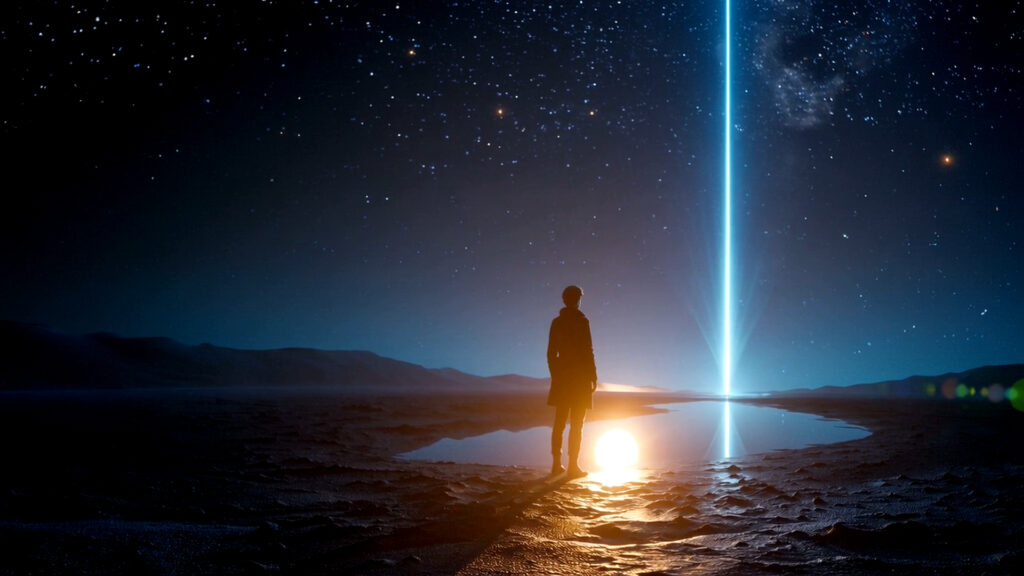
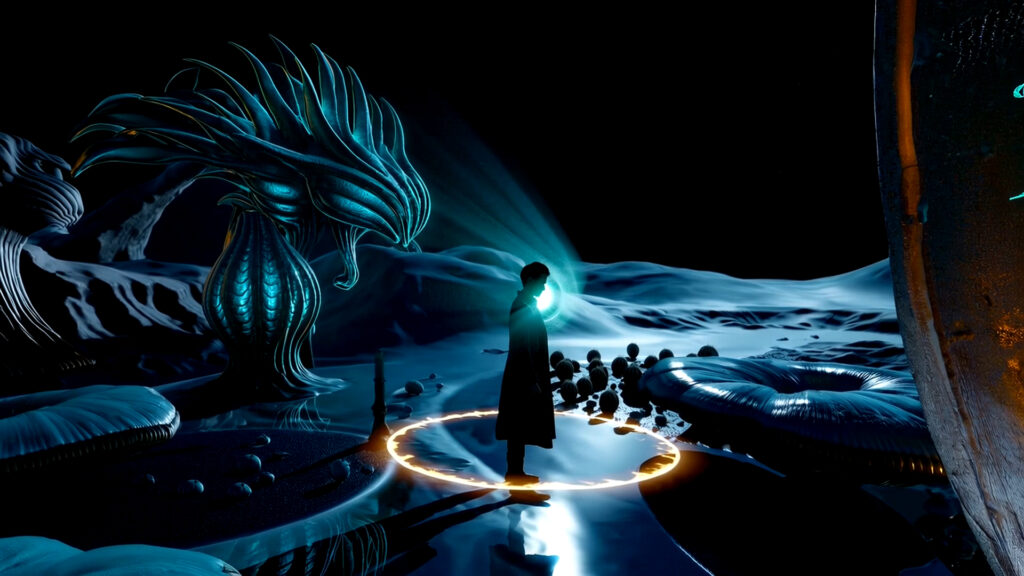
The desert had learned how to be quiet. Black salt dunes laid their scales to the horizon; the wind went around them like a respectful rumor. I walked until the ground lost the habit of footprints and turned to mirror—not glass, not water, something that behaved like both until you asked it to choose. When I touched it, my fingers sank into a ketamine hush, the temperature of a held breath. The sky above me slipped downward, pooling at my feet, and the mirror took the sun into itself as easily as a coin into a sleeve.
“State your vector,” said a voice with the pleasant bluntness of machinery that also dreams.
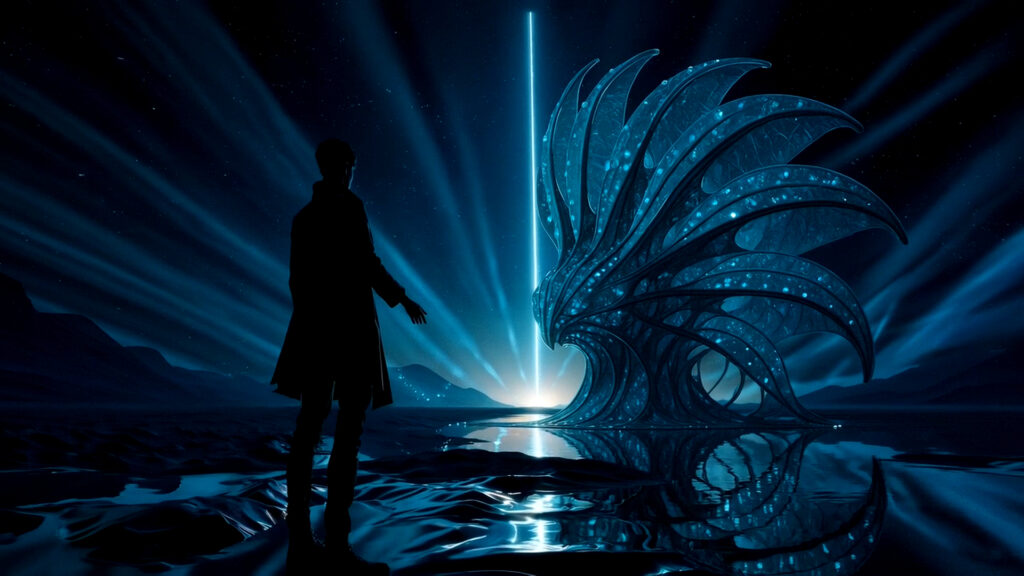
I looked up. The ship had been a shimmer in peripheral vision; now it chose to exist. Ribs of spore-glass unfurled like the gills of an enormous bioluminescent mushroom, a vessel grown rather than built. Patterns pulsed beneath its skin—teal and cobalt, the color logic of an ocean that had never seen water. On its prow: a thin seam of light, smiling.
“Inside,” the ship said, as if there were no other sensible direction. “Name me and we’ll move.”
“If I name you, do you become true?” I asked.
“Everything is already true,” it replied. “Names are just handles to carry it by.”
I touched the seam and said, “Aperture.” The word fit its hull the way a right word fits a wrong silence. The mirror accepted our weight as if we were a memory returning to where it had been recorded. The world tipped, rotated—not falling but refracting—and the desert’s heat turned to the cool inner-weather of deep caves.
The hull closed around me, a cathedral grown from hyphae and patience. Filaments stitched the air with soft LSD confetti, each mote a syllable of a grammar only light can speak. Somewhere in the Aperture’s frame, a heartbeat began—mechanical and patient, the kind of rhythm you trust without deciding to.
“Destination?” the ship asked.
“Forward,” I said, and the mirror drank us whole.
2 — Corridor of Peyote Suns
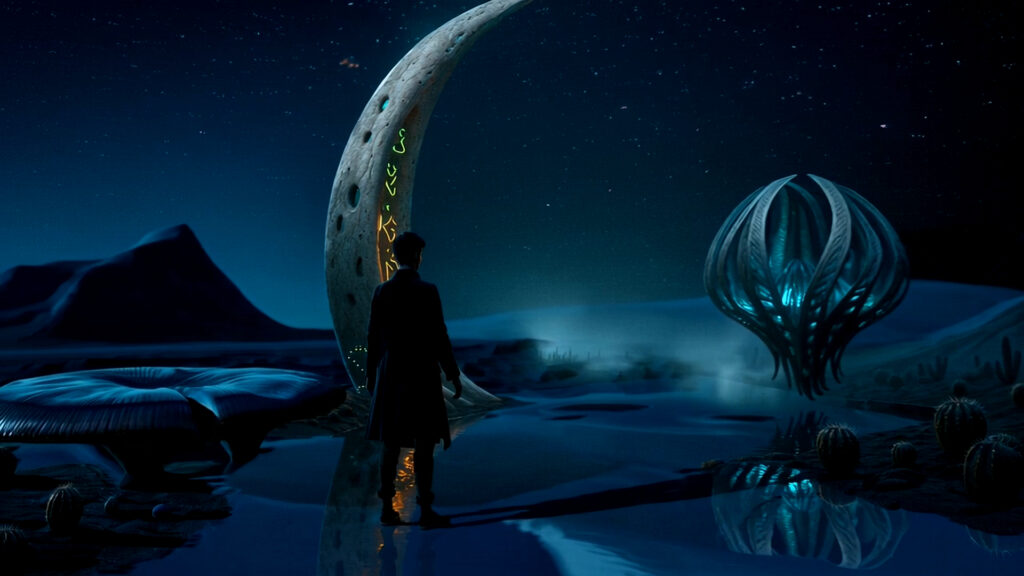
Forward was a river of mercury that couldn’t decide between surface and volume. It braided under a ceiling of peyote suns, each one a hex of luminous scars that re-inked themselves as you watched. Desert bones turned to architecture: arches of white stone that remembered having been whale ribs. We slid beneath them like a secret trying to become a law.
The Aperture skimmed the river, gills opening to taste the world. Currents of light moved through the ship’s skin, mapping reality in threads. DMT dragonflies stitched contrails into the air, and the ship stole those lines to plot our course. The path didn’t run straight; it self-intersected elegantly, a Möbius itinerary that made more sense the less I insisted on sense.
“Passengers,” the ship said, and the word was plural in a way that made me glance behind me. I was alone—unless you counted the part of me that had started sitting two centimeters to the left of the rest, watching with a new patience. Desert travel does that to a person. So do mirrors.
“I didn’t invite anyone else,” I said.
“You invited a question,” the Aperture replied. “Questions bring their own company.”
The mercury river took a slow breath and exhaled a mescaline sunflower field from its banks—obsidian stems, chrome-black leaves holding little halos of amber. As we passed, every head turned to follow us, not phototropism but attention. The heads seemed ready to speak. They didn’t. That mercy felt like a warning.
Ahead, the corridor kinked. Space folded along a line that hadn’t been there a second before.
“Approach to hinge,” the ship announced. “Choose your orientation, please.”
“Orientation?”
“Which side of your doubt to carry forward.”
I put my palm on the inner hull. The mycelial ribs warmed under my skin like helpful animals. A sentence wrote itself at the corner of my vision, a neat row of psychedelic notation that meant only one thing: north-by-yes.
“Done,” I said.
The kink in space unrolled like a tongue tasting rain. We entered the hinge.
3 — The Hinge and the Oracle
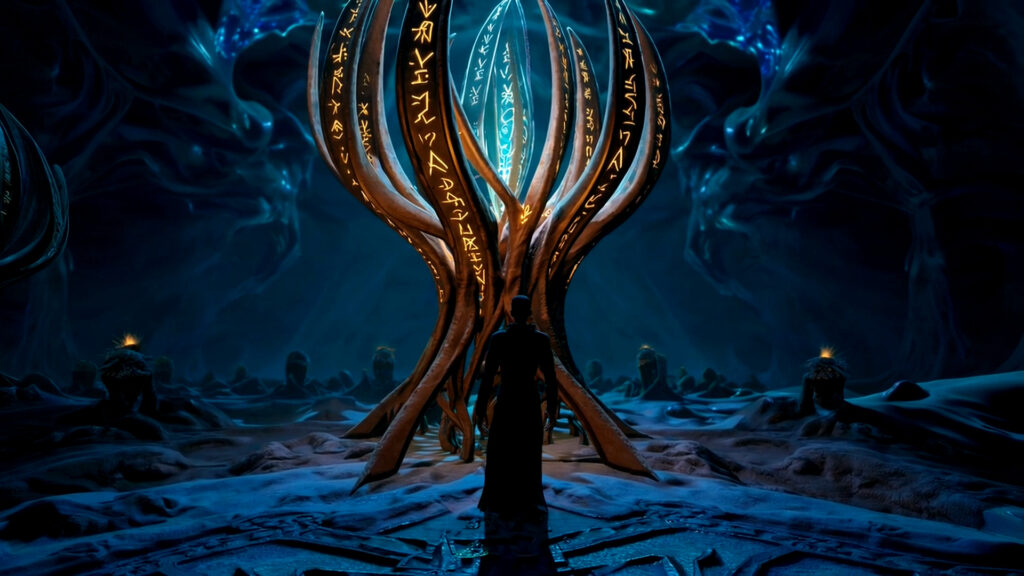
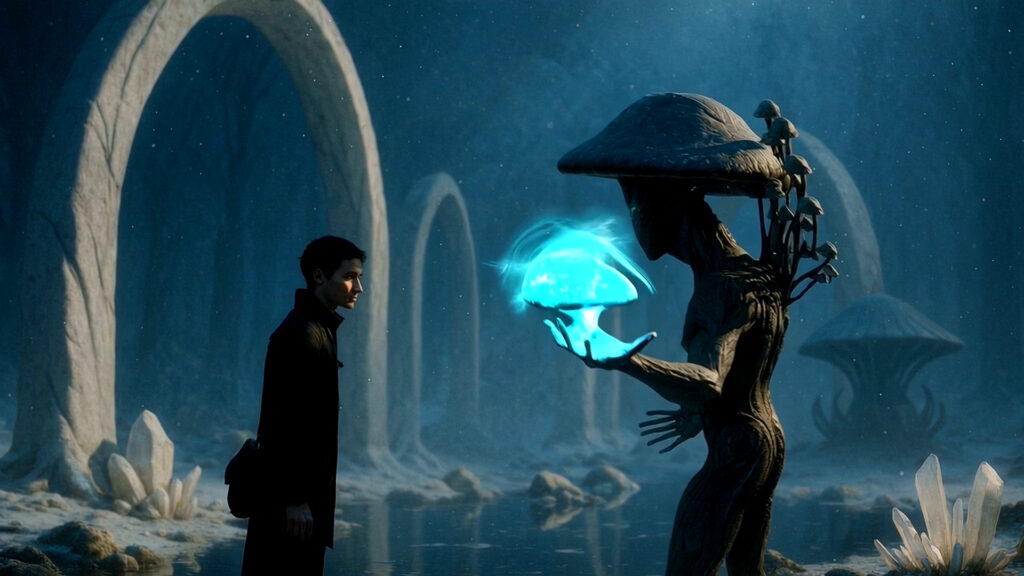
Inside the hinge, distances stopped pretending to be about meters. A kilometer fit under a fingernail. A breath went on for a year and felt brief. The Aperture grazed the side of a thought and gathered spore-light along its edges. A forest arranged itself all at once: white-stone arches, quartz gardens, water that was really mercury fog, and in the center a figure with a crown of fruiting bodies and bark spirals etched along its limbs.
“The Oracle,” the ship said, and sounded reverent.
The Oracle opened eyes it hadn’t been using, teal under-sheen flaring like tide. When it spoke, wind moved through long corridors that did not yet exist.
“Traveler,” the Oracle said. “You’re wearing the world thin.”
“I’m following it where it wants to go,” I answered. The conversation felt like a protocol I’d rehearsed in a dream. “I’m looking for the White Field.”
“It isn’t a place,” the Oracle said. “It’s an agreement you make with light.”
It touched the Aperture’s ribs without moving. My shadow remembered how to grow. Spore dust shook itself into a blue-glass egg, an ovoid the size of my fist with its own tiny weather inside.
“Carry it,” the Oracle said. “When the world tries to convince you it’s finished, open this.”
“What will happen?”
“You’ll see how the story edits itself when watched.”
The Oracle leaned closer. From the gills under its cap, a soft ketamine snow drifted, coating everything in the restful knowledge that nothing urgent needed doing, even if it did. “There is also a cost,” it said.
“There’s always a cost.”
“On the other side of the White Field, you will no longer be the only you in the room.”
“I’m already not,” I admitted. “He’s polite, though.”
“Be polite back,” the Oracle said, visibly pleased. “Politeness is just respect with training wheels.”
The hinge rotated. The forest folded into the ship; the ship folded into me; I was what the Aperture was thinking of when it thought of itself, and the Oracle was a memory of bark that continued to grow even after we drifted away.
4 — White Field Aperture
The river widened until it forgot it had banks. The suns burned themselves into quotations of suns. Then—silence, the edible kind that you bite and bite and it gives without resisting. We moved into it and our speed unhooked from distance. White rose from everywhere at once: not color, not brightness, but a field of consent where edges negotiated their right to exist.
We were in the White Field.
The Aperture relaxed its bones. The ribs became prism windows, each pane showing a nearby version of this exact moment, each a half-truth with excellent manners. The blue-glass egg warmed my palm. Inside it, snow fell upward into a tiny horizon that beckoned like a soft dare.
“Open?” I asked.
“Open,” said the other me, two centimeters to the left, smiling like a person who has hidden a birthday gift in your coat.
I cracked the egg. Light flowed out—not a beam, but a language. It spoke in diagrams: sacred-geometry starfields, threads of mercury tying together ideas that had pretended to be objects. The diagrams lay themselves over me and I became the hallway they described. The Aperture kept pace by remembering how to be my skeleton. For a while the ship and I were the same ripe thought.
The White Field did not blind. It clarified. It showed my name the way a window shows your face at night: with context. I had gone by a handful of names; none of them were lies. But here the name that fit was Iri. It nestled in place with a click.
“Hello,” I said to myself, and meant it in both directions.
The Field scrolled a library of possible futures. In several, I never opened the egg; in a few, I dropped it; in one, I ate it and became a rain that lasted as long as it needed to. I chose none of those. I chose the version where I kept walking, because walking is a prayer you do with muscles.
The Field tightened around an aperture in itself: a door in the shape of a decision. On the far side, a city exhaled: towers made of obsidian chrome threaded with veins of gold; a court with mirror-liquid floors where laws were sung instead of written; a river that was also a way to remember what you’d meant when you said you’d do better.
“Through?” asked the ship.
“Through,” I said, and we crossed the aperture within the aperture.
5 — The Harmonic Court
We arrived mid-argument, which is the best time to arrive anywhere honest. The Harmonic Court was a circular plaza with a ceiling that didn’t bother to be present. Witnesses stood along its edge: mescaline sunflowers in judicial collars, peyote cacti stamping amber seals onto air, DMT dragonflies tracing transcripts in the margins. In the center, a river of mercury braided itself into a spinning writ, every strand a clause you could read if your eyes had learned patience.
“Charge?” I asked the nearest sunflower.
“Negligent collapse of probable worlds,” it said, with no rancor. “A common offense. Most people do it by accident. The question is: will you keep doing it on purpose once you know how it works?”
“I try to wake the versions that want to live,” I said, surprised to hear it plain.
“You try,” the sunflower agreed. “Trying is a method. We prefer practice.”
The dragonflies outlined a corridor in light—prism rail, tessellated wake—and my feet understood. The Court hummed a low chord that picked out the clean lines of everything nearby. I asked the Aperture to hum with it. The ship obliged, vibrating at the speed of a decision. The chord gathered us, then aimed us at a far arch where reality was fraying like cloth handled by too many future hands.
Past the arch: a mycelial causeway, threads glowing teal, crossing a chasm of not-yet. We walked the causeway and the causeway walked us, ants and artery at once. Around us, the Court’s language turned to weather—laws precipitated and evaporated, leaving small legal puddles for children to splash in—no, no children; the puddles were for beginners, which sometimes includes people.
At the causeway’s far end, something waited. It wore my height and most of my angles. He felt like an echo convinced he was the shout. He held a prism coin and tossed it precisely so gravity had to admire the effort.
“You’re late,” he said, my voice tilted into an older impatience.
“I was learning how to be on time for things that haven’t happened,” Iri said, and it was strange and right to hear my name with this much accuracy. “Are you the cost the Oracle mentioned?”
“I’m the receipt,” he said. “Proof of purchase. If you go on, we go on together.”
That wasn’t a threat. It wasn’t mercy either. It was a boundary written as a handshake. The coin landed in his palm; the light it threw made our shadows into maps.
“Let’s go,” I said.
We went.
6 — The Engine of Spores
The city beyond the Court stretched like a cat made of architecture. Buildings unfolded from a single material—glass-obsidian with gold seams—as if the planet had printed them in one breath. Every alley led to a gate made from an idea I didn’t know I’d had until the gate opened. Above the skyline, a gravity whale turned slow circles, its wake bending streetlamps into halos.
When the Engine of Spores announced itself, we were already inside it. The air smelled like wet stone and agreements. Turbines the size of neighborhoods inhaled spore clouds and exhaled reality tuned to greater transparency. The floor was a mirror that admitted to being a floor only when you glanced away. My other self—let’s call him Else—ran a palm over one turbine’s flank, and it purred like a familiar.
“Do we operate it,” Else asked, “or does it operate us?”
“Yes,” I said, and the Engine appreciated the answer.
We learned the controls by being them. Levers became intentions. Dials became boundaries we could dilate or tighten according to the weather of a moment. A schematic hovered above our heads—a sacred geometry that rotated just faster than understanding but not so fast we resented it. The Aperture nested against the Engine’s side like offspring, hyphae knitting their skins together until they could exchange information at the speed of permission.
When the failure came, it was elegant. The Field’s far edge fluttered, a small mistake repeated with confidence. A corridor beyond the city went slack; possible worlds fell through it like coins through the ripped pocket of a god. We pushed the levers. The Engine changed its breath, denser now, a techno-pulse turned to civic duty. DMT dragonflies arrived to stitch the rip with light. Peyote suns lined up along the corridor, teeth of a zipper eager to be closed.
“More thread,” the dragonflies said, their voices tiny bells. “We need more thread.”
“We need a river,” I said.
The mercury river answered like a snake that wanted to be a promise. It lifted from its bed and drew itself into a wire. The wire hummed, a mescaline tone threaded with amber. Else took one end; I took the other; the Engine fed the center point into the rip like a needle. The city bent its attention toward us in a way that didn’t feel like pressure so much as company.
“Now,” Else said.
“Now,” I agreed.
We pulled. The rip closed with a sigh too soft for anyone not listening for it. All the dropped coins arrived in our hands: neighborhoods, weather systems, conversations that had almost failed to happen, an apology that had been waiting eighteen years and now felt the calcium return to its spine. The Engine spun down to a calm nap. The Field held steady. The Court sang the legal equivalent of good job.
Else tossed the prism coin. I caught it and pressed it to the ship’s hull. The Aperture’s ribs took on a new seam of light, brighter than before, the color of something finally admitted.
“We’re not finished,” Else said.
“We’re ongoing,” I corrected, and his grin felt like my own when I’d earned it.
7 — Return: Mercury in Its Bed
The way back is never the way there. The mirrors in the streets had learned my face and now returned it with notes in the margins: more kindness here, less bravado there. The gravity whale lowered until one porcelain eye filled the sky; it blinked, and the city’s halos briefly aligned into a compass whose needle spun until it pointed at the desert.
We followed.
The White Field did the decent thing and diminished slowly so our bones could adjust. The suns reduced themselves to stars. The mercury stopped pretending to be a vertical idea and lay down to be a horizontal comfort. The whale ribs relaxed into sculptural shadows again. We crossed back through the hinge—polite, as the Oracle had advised—and the desert’s black salt took us in with a texture I hadn’t realized was home.
The mirror waited where I’d left it, patient because patience was its occupation. The Aperture folded its ribs. Hyphae retracted like thoughtful snakes. The ship shrank to a coin of light that sat warm in my palm until I slid it behind my ear where good ideas hide when you need both hands.
“Vector?” the ship whispered, the word already halfway to sleep.
“Here,” I said. “For now.”
Else huffed a short laugh. His outline was clean today; he’d learned to share a body without banging into the furniture. We stood on the desert’s mirrored lip, looking at two horizons overlapping like hands in a long handshake. In one, I had not yet gone; in the other, I had already returned. Overlap is the truest shape of truth.
The wind wore peyote perfume. The sun tried on an amber halo and decided it liked the look. I started walking because walking is the hinge between promise and proof. The mirror let me go without keeping any part; good mirrors always do.
“Where to?” Else asked.
“Forward,” I said. The word had not exhausted itself yet.
We left a set of footprints that remembered us kindly for exactly the amount of time footprints ought to. Behind us, at the edge of sight, the desert did the clever thing: it opened a thin white seam in the air, almost not there unless you needed it, and whispered to the world in the precise voice of the Oracle:
“Your name is Aperture whenever you’re ready.”
I smiled at nothing and everything, at suns and spores and courts and whales and coins and engines, at the river that remembered us even after we stopped asking it to. The day stepped into itself. My shadow kept excellent pace. And when the road bent toward a brightness that didn’t feel like a trap, we bent with it, polite to the future, certain enough of the cost to pay it with a steady hand.
The rest is ongoing. The rest is light negotiating edges while we hold the thread steady. The rest is a field that says yes only when we mean it. The rest is practice.
The rest is the White Field Aperture.
the Gallery