the Story
The field was a sheet of cooled night—black glass stretched to every horizon, unmarked, unscarred, holding a silence that felt designed. Nothing moved. Even the wind kept its thoughts to itself. Above, a single white disk hung in a sky the color of an unblinking eye. It wasn’t a sun in any faithful sense; it didn’t warm, it didn’t arc, it didn’t dim. It merely existed in a way that implied observation.
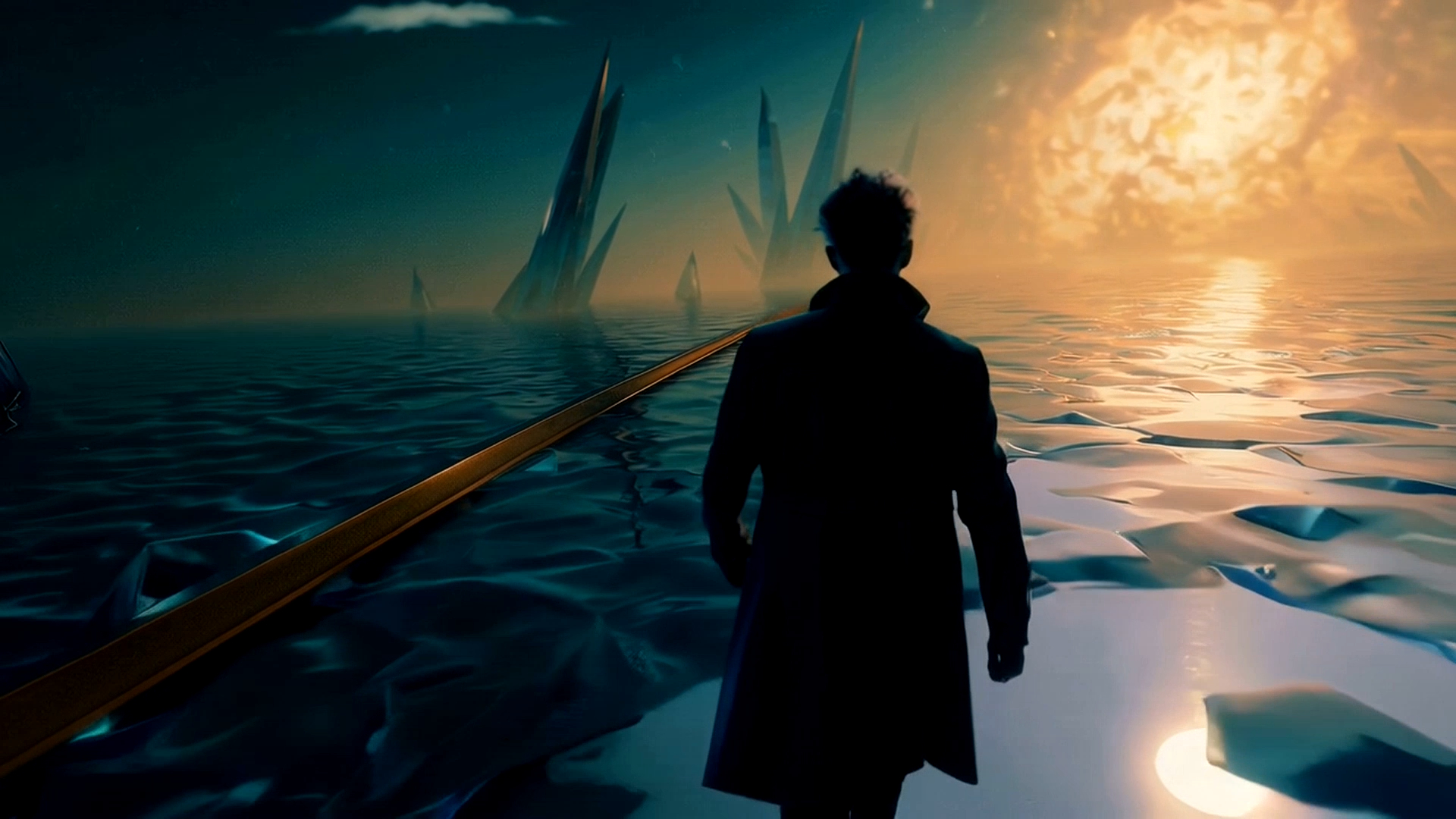
The traveler arrived with boots that did not echo. They paused to test the place with a breath. Air, metallic and clean, entered and left their lungs as if passing through a narrow instrument. Their coat carried a seam of cyan light along the hem, a habit taken from other worlds where shadows kept score; here, the light cut no more than a suggestion along the glass.
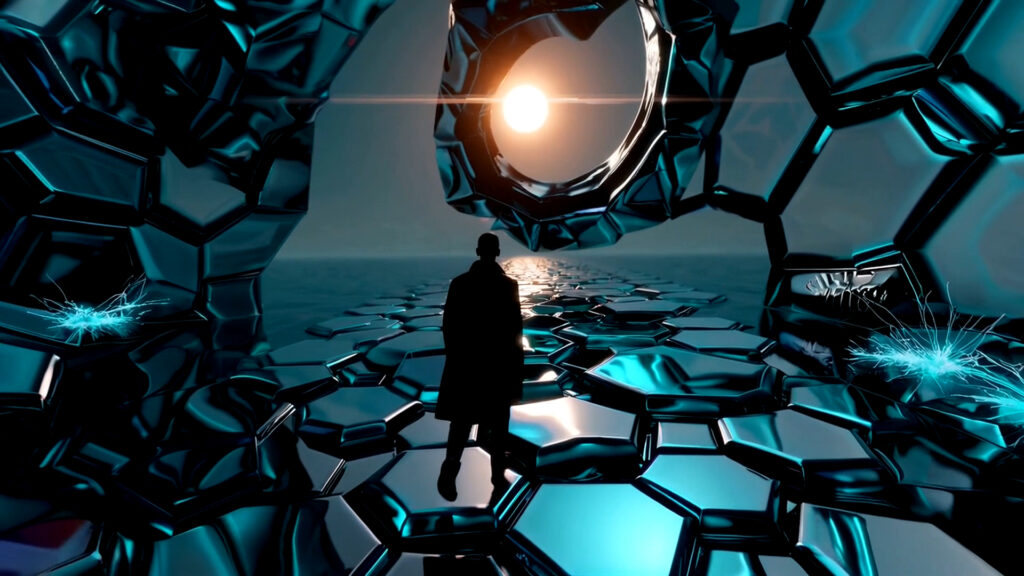
A tremor rose beneath their feet—steady, unhurried, identical from one pulse to the next. The black field flexed like the surface of a held note, then cracked along a hexagon so precise it might have been measured by a patience older than mathematics. Light bled upward through the seam, saturating the hexagon, then the one beside it, then the next, until a column of hexagonal plates rose into the air with the diligence of a plant uncoiling.
It was an elevator without walls, a starwell, and the steps it offered were simple: up.
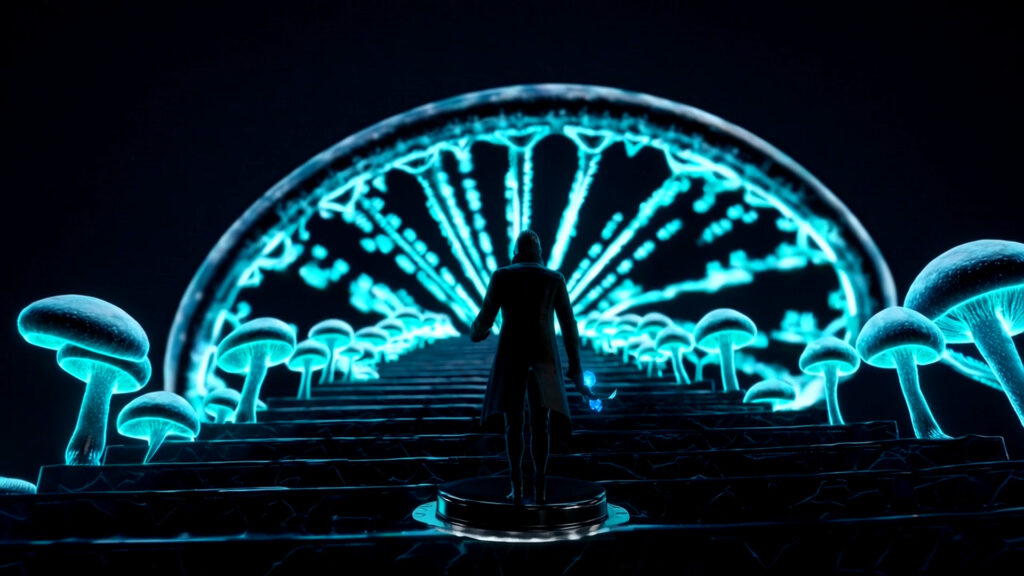
The traveler set a foot on the first light-plate. The plate accepted the weight, glowed a shade deeper, and ascended. Another plate took its place beneath, then another. The starwell climbed, carrying its passenger into a shaft of perfectly still air where dust never existed and sound had to invent itself. Each hexagon expanded and contracted as if breathing; the traveler matched that rhythm without knowing when the decision had been made.
As they rose, the glass field below revealed patterns like frost. Threads of quartz traced sigils that widened into channels and closed again, searching for a memory of water. Halfway through the ascent, the white disk overhead winked—one crisp shutter of absence—and returned to watching. The starwell reached a height where the horizon curved, then stopped as if listening.
The traveler stepped off. The platform had delivered them to a hovering terrace cut from nothing: a balcony of air with a thin rail of light to keep the idea of falling honest. Far below, the glass field was no longer empty. Pale filaments were pushing through it, quivering as they tested the world. In seconds the filaments thickened into latticed columns—quartz spines veined with faint teal. Plates slid into existence along the columns, opening like gills. The gills pulsed and released motes that drifted upward in spirals.
Spores.
“Alive,” the traveler said, though no companion stood near enough to hear. The word left on the same vector as the motes and dissolved above their head.
They held out a palm. Motes landed, and the skin drank them. Warmth gathered in the patterns of old scars. The traveler closed their hand around it, guided the warmth into a small sphere—thought shaping matter out of invitation rather than force. When they opened their fingers, a blue seed hovered over their palm, faint as a rumor. It drew in light and let it go again, reducing the world to the simple truth of a breathing point.
One breath later, the seed chose a direction and moved. It drifted away from the traveler, shedding a narrow trail of cyan like a slow comet. Where the comet touched air, gates formed—thin hoops of light that stood one behind the next, aligned along the seed’s trajectory. The hoops quivered as if eager to begin their work.
The traveler stepped through the first hoop and met a new rule.
Distance shut down.
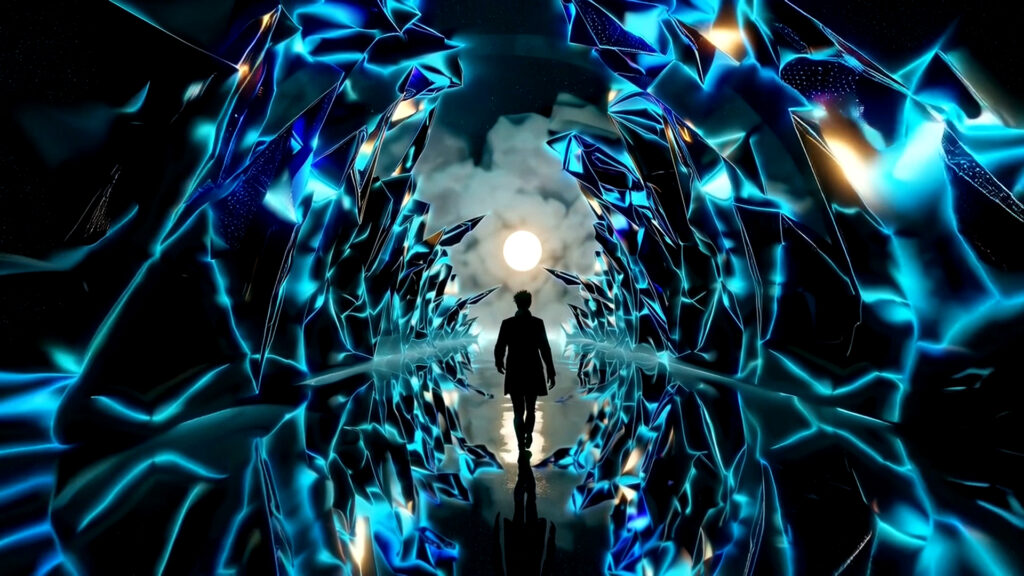
The balcony cracked open into a corridor whose walls were the inside of a Möbius band. The band carried tessellations—honeycomb meshes with threads between the threads, lattices that hinted at smaller lattices, recursion like a polite cough kept leaving and returning. Colors were scarce, reserved: cobalt, teal, a line of magenta glancing along an edge when the corridor decided it was time to nudge a thought.
The traveler walked and learned that the corridor could lengthen by subtracting space. They took three steps and found themselves passing the hundredth gate. The seed always kept its lead, just far enough to tempt but not enough to accuse, drifting toward a bright point where the corridor seemed to end in a pin.
The pin swallowed them.
Everything tighted into intention and then released. When the world returned, it had traded narrowness for angles. The traveler stood inside a hall of prisms, each one tall as a bell tower and clear as a decision you will not unmake. Light entered the prisms, bent, and created a hundred versions of the traveler, each a degree off from the next. They moved, and the avatars moved with them, lagging by a heartbeat, catching up, sometimes overtaking with a grin the real face did not mirror.
“You,” a reflection said in a voice the traveler recognized by its ability to unsettle without injury. “And you. And you.”
They ignored the chorus and walked. The floor held—a glass path suspended over a wider darkness. The prisms leaned, crowding, asking to be used. The traveler did not refuse. They reached into a prism and pulled out a sliver of themselves that remembered how to run faster; the sliver clicked back into the original like a shard of ice into water.
Far ahead, a metal gleam widened and widened until it showed itself as an ocean without waves. The path extended into a high causeway over that ocean, and the prisms thinned to spires that stood apart, as if respecting the gravity of what lay below. The traveler’s reflections fell away one by one until only a shadow kept pace at the edge of their peripheral vision: a twin that insisted on being present without introducing a name.
Glass lifted from the edge of the causeway and began to orbit the traveler, a constellation of obedient fragments. The path straightened. The world gained a direction.
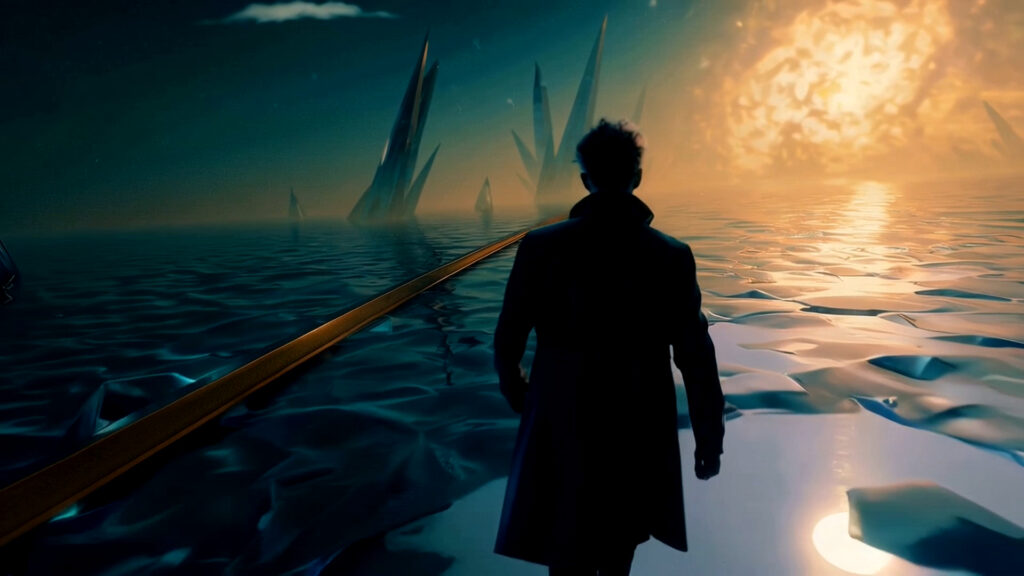
A breath like a held chord broke at last. Something in the atmosphere unlatched, and every hard edge in the traveler’s sight softened, then softened again, then blurred into sincerity. The causeway widened into a balcony without deciding where it began, and the ocean below became more mirror than metal, mimicking everything except the traveler. They leaned over the rail and stared into the mercury and saw a city that had almost never formed.
In the mirror, white towers grew from a foundation of rules. A court of obsidian and chrome wrote traditions into the floor; laws left echoes as soon as they were spoken. People walked along bridges of sung stone, their feet ringing with consequence. The traveler knew the architecture well. They had once believed the city would last forever, because permanence was a spell cut into every street. When the first fracture appeared, the traveler argued for a revision. The council answered with continuity and ten thousand signatures.
Continuity didn’t hold.
The city split along a seam no pen had predicted. Towers that had grown by measuring themselves toppled into the river. The river took everything into its mouth and it sang silence around the rubble. The traveler stood on a bridge that was half idea and half stone and understood that keeping something exactly as it was could be another way of killing it.
Now, on a balcony over a mirrored sea, the traveler put two fingers into the surface and felt the world tilt. Their fingers sunk and kept sinking, as if going through the surface of a dream made out of every surface. They gripped a thread—thin, silver, patient—and drew up one memory from the bed where the broken city slept. It was a seed, like the one that had led them through the hoops, but yours, it seemed to say. Yours to keep if you promise to spend it.
Time shifted. The air learned a new rule. The white disk above did not move, but the light it gave off changed color like a thought you don’t remember deciding to have.
The traveler turned. The shadow that had been keeping pace at the edge of their vision stepped forward and resolved into a person with their face. Not a doppelgänger or a trick of refraction—an echo from the city that still thought permanence could be made virtuous by authority.
“You left,” the echo said.
“I did,” the traveler answered. “Because I stayed too long where nothing could change.”
The echo considered this with a mouth the traveler had learned to distrust. “Then why come here? This place is another engine, isn’t it? Another system.”
“Engines do not forbid motion,” the traveler said. “They make it possible. This one listens. I think it’s built to learn.”
The echo’s hair caught a cyan rim of light and did not move in the wind because there was no wind. The echo’s coat carried no seam of light along the hem. “What will you do with the seed?”
“Find the part of the city that can be saved,” the traveler said. “And let the rest become past.”
“Past is treacherous,” the echo said.
“So is future,” the traveler answered, and held out their palm. The blue seed hovered a few centimeters above it, choosing which way to breathe. “But this is a present tense. Come.”
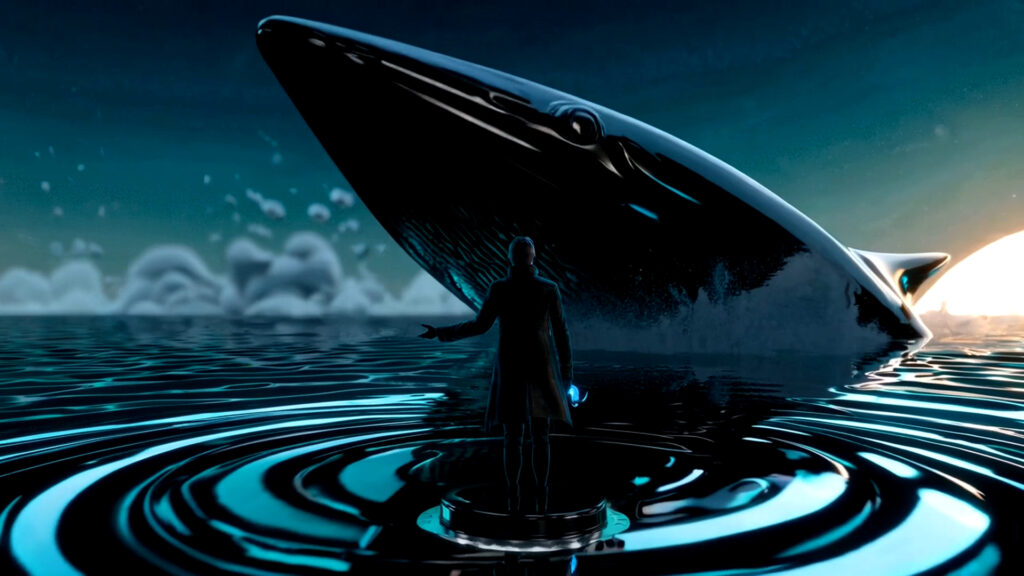
They stepped together toward the edge where the balcony narrowed into a ramp. The ramp twisted into a road whose tiles were hexagons stamped with tiny glyphs—a geometry neat enough to reassure a skeptic. The tiles unfurled ahead with a confidence that suggested rehearsal. On either side, the mercury lifted in slow curls, as if showing off the glass whales gliding beneath. The whales wore the horizon like a casual accessory; when they turned, the horizon turned with them.
One whale rose close enough that the traveler could feel the temperature held steady by the creature’s skin. Its eye reflected them both without distortion. A ridge along its back offered handholds. The traveler placed a hand on the ridge, and the whale eased up until its wake became a corridor of calm water.
“Ride,” the echo said, and the traveler nodded.
They rode. The whale did not disturb the sea because the sea liked the whale. It made room. The corridor they cut flickered with small bluish fish that were only fish for as long as they needed to demonstrate swimming; then they became signatures written in quicksilver script, then vanished into thin letters too tidy to decode.
In the distance, a tower rotated. It was not a tower so much as an inhalation given shape. Spores drew toward it from every direction: motes, filaments, flecks of light, dust, expectations—the tower inhaled all of it and did not grow full. Vanes opened along its waist and hinted at wings. It was an engine, and not a metaphor. It took in the world’s excess and returned it as possibility.
The traveler dismounted onto a ledge that appeared where it needed to be. The echo did not jump down. They stood on the whale’s back with one hand on the ridge, as if reluctant to commit to land or water.
“Come,” the traveler said.
“You sound like a promise,” the echo said. “We made too many of those.”
“We made too many that expected others to stop moving,” the traveler said. “This one is different.”
“It had better be,” the echo said, and stepped onto the ledge.
They climbed. The ledge became stairs because every ascent prefers rhythm to improvisation. The stairs became a winding because every engine prefers a delay before the prize. The air thinned but did not grow difficult; the engine seemed to care.
At the summit, a platform with a hole. Not a hole you could fall through, but a hole that would take whatever you gave it and return the best version of that gift if one could be made. The traveler approached, seed in hand, echo beside them.
“Before you do it,” the echo said, “tell me why you failed the city. Say it aloud so that if we fail this place, we at least get a different sentence.”
The traveler did not wince. “I thought we could set the law like a diamond. I thought we could build a song that never learned new verses. I thought we could be right for longer than we were alive.”
“And now?”
“Now I think a law should behave like a garden. You tend it. You weed it. Some things reseed themselves. Some die and feed the soil. The song isn’t set. The song listens and answers.”
The echo’s mouth softened, not quite into a smile. “If you had said that to me then, I would have called you sentimental.”
“I still might be,” the traveler said. “But the world has a pulse, and I’m done pretending I can teach it a better one.”
They held the seed over the hole. The engine inhaled.
The seed shivered and shed its shell. Light skinned it, then unsheathed it, then redressed it in a color the traveler had not seen on any spectrum before—something between blue and the feeling of standing in a doorway you built with your own hands. The seed multiplied without splitting; versions of it budded and did not become separate—droplets of meaning smiling in their small way.
The engine opened like a pupil. A hundred thousand glass seeds lifted into the air in clean lines, then broke their lines and scattered upward. Each seed carried a map you could only read if you weren’t looking at it. The sky went from indifferent to stippled to crowded with options. The white disk overhead paused its watchful blankness and began to spin with the slowness of a continent deciding to drift.
“Take one,” the echo said—not an order, not a plea. A request we ask of ourselves when we meet a better version.
The traveler reached up without reaching and a seed came down without descending. It settled above their palm and sent a heat into their scars that felt like being forgiven by something that had not known their name yesterday.
“What will you plant?” the echo asked.
“Not a monument,” the traveler said. “A perimeter that moves. A school without grades. A river that changes its mind and is still called by the same name.”
The echo gave them a look the traveler had almost never seen on that face: trust with its guard down. “Then let me be present for the mistake we make first.”
They laughed. It made the engine laugh in a deeper register. The glass whales lifted their heads above the sea and added a rhythm that looked like applause.
They descended into air that had learned how to be warm without bringing a wind. The ledge became a road because journeys are impatient creatures. The road unscrolled across the Mercury Sea toward a structure rising where the starwell had first offered its plate. The traveler walked. The echo kept pace as a separate person for three steps, then two, then one, then none. Without ceremony, they merged—not disappearance, not conquest. A braid. Two minds learning how to keep each other company without borrowing each other’s pasts. They spoke as one and as two, depending on whether the sentence was about memory or about tomorrow.
The starwell had returned to the ground. The black field still owned its calm. The columns of quartz continued to open their gills and release motes that did not hurry. The traveler—plural in a way that had nothing to do with number—stepped onto the first plate and nodded to the geometry as if greeting a colleague.
The starwell descended.
As they sank, the air acquired a texture like quiet rain falling upward. The white disk spun once, and the reflection of that spin traveled out across the glass as a ripple of bright hexagons that turned each shard of the city’s memory beneath the surface into a coin polished by a thumb. The ripple reached the horizon and did not stop; horizons had rarely been honored here except as flexible suggestions.
At ground level the starwell retracted. The plates slid back into the field and sealed with a sigh the ears made up to imagine. The seed over the traveler’s palm brightened, then obeyed gravity and lay against the lines on their hand where a fortune teller would have tried to sell a story. It warmed the skin enough to tell the nerves there was a reason to exist.
They walked. Where they walked, the glass underfoot turned matte, like a path that had been walked before even if it hadn’t. The clouds—if you could call them that—gathered in clean hexagonal cells, each cell subtly different from the next in a way you could feel in your teeth. The mirror sea arranged itself into canals without stopping being sea. The whales turned their backs into bridges and held still long enough to let the idea catch on. The engine of spores inhaled and exhaled at an interval that matched a human stride.
“I will come back,” the traveler said to no one and to everything. “I will bring this seed to a city that taught me a trick with stone and forgot to teach me this one. I’ll ask it to plant this and learn to bend. And when it resists, I’ll use this place as proof that bending is a kind of strength.”
The field listened. It had time. It knew the patience of geology and the eagerness of moss. It kept a pulse as reliable as a lighthouse with no shoreline, beating its certainty into the soles of the traveler’s boots: move, move, move.
They crossed into an area where the glass had cracked. The crack did not threaten to widen. It simply ran like a scar along the skin of a world that preferred scars to erasure. From the edges of the crack grew small black plants with leaves like blades and tiny blue berries that ought to have looked poisonous but instead looked determined. The traveler plucked one and held it next to the seed. The seed did not object. The berry did not contradict. They pressed together and made a soft, brief light that held steady until it remembered to become a memory.
“I used to think healing was putting things back,” the traveler said. “Now I think it’s letting things change and counting that as continuity.”
The echo braided into them agreed. “Then let’s make a promise without freezing it into stone.”
“A promise with legs,” the traveler said.
“Or roots,” the echo corrected.
“Roots that walk,” the traveler offered, and the echo accepted the nonsense because sometimes that’s how you earn a rule that isn’t brittle.
The white disk chose this moment to wink again. Not a warning. A punctuation mark. The kind you put at the end of a chapter when you know the story continues.
Near the place where they had first arrived, the black glass lifted its last secret of the hour: a low gate shaped like an arch made out of reflections. The arch didn’t lead anywhere obvious. You could walk under it and remain in the same place—the trick was that you would not be the same person. The traveler ducked beneath it and felt a sequence of adjustments: posture easing enough to admit a different kind of thinking, fear folding into alertness, certainty turning into a plan that could be revised without shame.
On the other side, the field looked like itself and unlike. The engine granted them a small detail as proof: a single hexagonal tile near their heel rotated ten degrees and then stopped, pleased with the asymmetry it had created.
All journeys require a departure. The traveler chose northeast because northeast felt like a decision that couldn’t get complacent. The Mercury Sea rippled as far as it could without becoming ocean; a line of mirror-whales escorted them with the kind of courtesy that doesn’t imply distance. Spores fell upward in slow blizzards and landed among the clouds, where they grew into thoughts that took weather the way a courtyard takes footsteps.
By the time the starwell sank entirely and the white disk decided to consider moving, the traveler was nearly to the edge of the Null Garden. There was no fence. The edge announced itself by silence changing flavor. The air tasted less metallic and more like rain that comes from a sky you recognize. The ground acquired imperfections that were not designed. The traveler looked back once.
The Null Garden looked back—not with eyes, not with vanes, not with laws. With presence. With the suggestion that it would remain available to anyone willing to be rearranged by it. The traveler raised a hand. The garden answered with a wave you felt in the bones: a hush, sweet as the first second after a long held breath—the ketamine hush of a world staying still just long enough for you to step forward into a better version of your own story.
They stepped.
The seed in their palm warmed once, twice. In the distance the city that had almost never formed waited like a patient argument. The traveler smiled at the shape that argument would take, at the mistakes they would make, at the rules they would loosen and write again. They walked with roots and with legs, with a river that would change its mind and a promise that would learn to bend.
Behind them, in the center of the glass plain, the engine of spores inhaled the quiet and exhaled a sky full of seeds. The white disk spun just enough to count as dawn. And somewhere out there—east, or north, or some direction you only learn after you’ve earned it—a gate prepared itself to open for anyone willing to arrive.
the Gallery