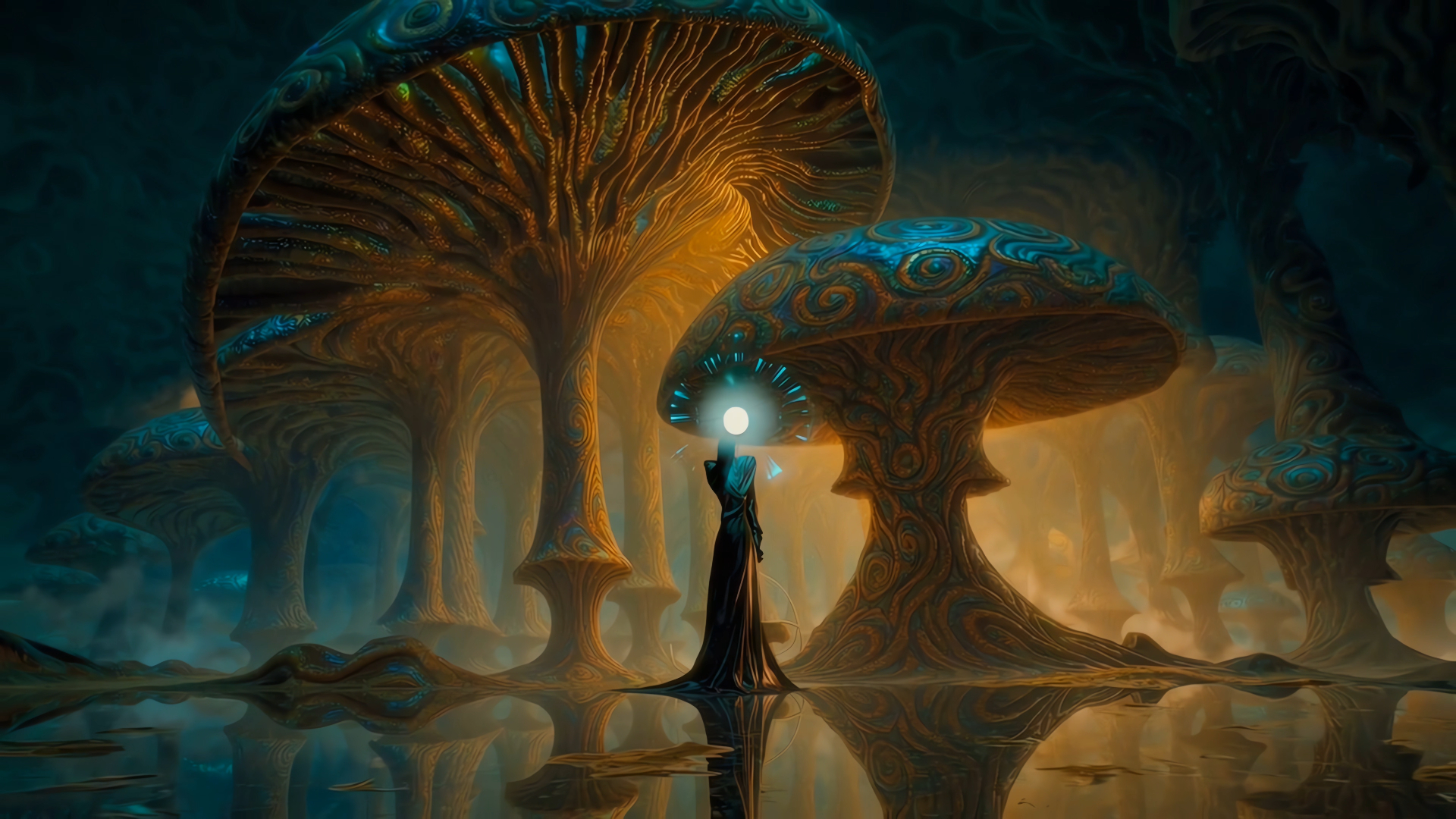
1 — Arrival: The Observatory that Breathes
The observatory didn’t sit on the planet so much as the planet grew around it, like a pearl grown from a grain of math. From space it was a pewter iris set in a black-salt desert. Up close, it was alive: the walls breathed, exhaling faint motes that glowed teal before dissolving into the heat.
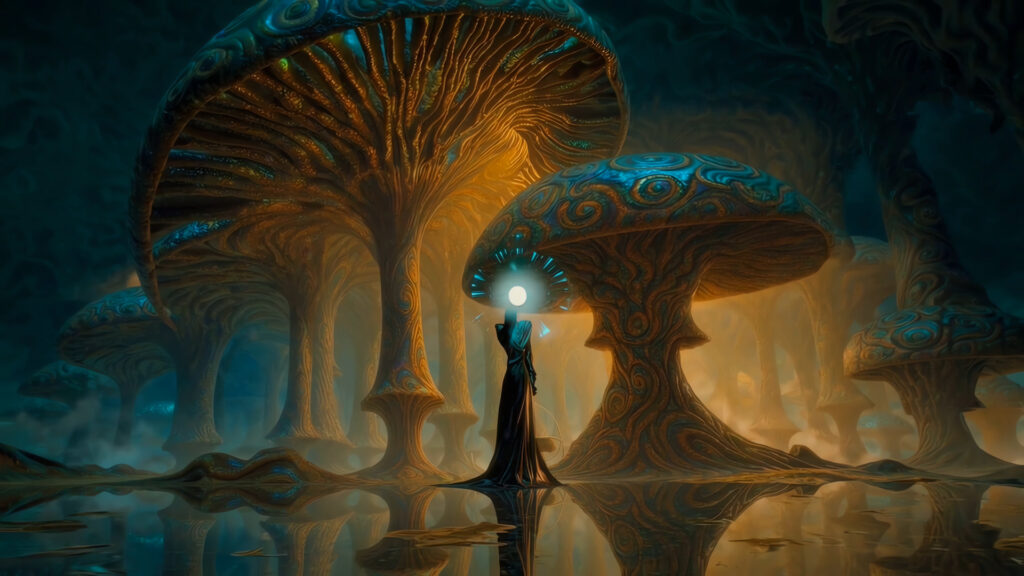
The traveler reached the threshold at nightfall—though night here meant a subtler dimness rather than absence of light. They were called Quen, or perhaps they had chosen that name because it sounded like a question. Cloak drawn against the cold, boots whispering over mirror-smooth stone, Quen paused beneath the arch. The arch was ribbed like the underside of a mushroom cap, gilled with bioluminescence, damp with ancient condensation. The place had the hush of a cathedral and the throat-clearing hum of machinery waking from a long reconsideration.
“Authorization?” asked a voice that didn’t quite use sound.
Quen let the question hang. The observatory’s throat worked, swallowing some old echo. A thin disc of light rolled down the arch, took one lazy lap around Quen’s boots, and wobbled upright like a coin deciding whether to fall.
“Navigator,” Quen said, finally. “Cartography corps. Voluntary.”
“Voluntary,” the voice repeated, as if tasting the word for its mineral content. “Then step in, and let the engine look at you.”
Inside, corridors radiated from a central well whose surface held a patient mirror of stars. But the stars rearranged themselves when Quen approached, as if the sky engine beneath the observatory preferred to work from its own memories instead of tonight’s weather. The air smelled faintly of iron and cedar; somewhere water trickled, but it couldn’t be seen. The mirror showed a constellation Quen didn’t recognize: a lacework of hexagons threaded by gold, humming between choices.
They walked until the corridor narrowed and the light gathered into an alcove. The alcove held what passed here for a reliquary: a coin of light, half-embedded in the wall. When Quen reached for it, the coin slid free and hovered over their palm, precessing slowly. Its face had no inscription. Its edge was impossibly sharp.
“Ephemeris,” the voice said—no, not the voice: the engine itself, speaking through vibration, a bass line felt along the bones. “Not a prophecy, not a command. A schedule of where the possible intends to be.”
Quen had come for that schedule. People told different stories about why. Some said Quen wanted to find a world that had been mislaid by history—a planet erased when a war needed a place to hide a mistake. Some said Quen had lost someone. Some said both were the same story, depending on how you rotated the map.
Quen closed fingers around the coin. It stayed warm in the glove, pulsing in time with the engine’s hum. “Show me the path that arrives,” Quen said. “Not the path that repeats.”
The observatory’s ribs flexed and sighed. The mirror-well brightened. Far below, something turned—a mandala as big as a city, as elegant as a seed.
The engine began to open.
2 — Corridor of Consequence
The first corridor made no attempt to disguise itself. It announced its geometry as a challenge: mirror-bone arches, equidistant; a floor that behaved like mercury, rippling but never breaking; walls that breathed like sleeping animals. The gills along the ceiling pulsed bioluminescent teal, a heartbeat learning new math.
Quen’s first step dented the floor with rings that spread and faded. Each ring contained smaller rings, interference patterns that sketched a diagram of choices: do this, don’t do this, try something unexpected. The coin of light drifted ahead, gyroscopically steady, as if mostly obeying gravity out of politeness.
On either side of the corridor, niches bloomed and closed, blooming with structures that resembled mushrooms but were clearly circuits, latticed with glassy filaments. They vibrated at harmonics Quen could recognize but not name, and every so often one burst into a slow snowfall of glittering spores that didn’t fall so much as renegotiate their status with the air. The snow wasn’t cold. Each flake was a tiny glyph, a letter from a lost alphabet that preferred to tell stories in geometry.
“DMT lattice,” Quen murmured, not because they associated the pattern with chemicals but because such lattices were part of the old field guides to phenomena the engine could extrude when it needed language. Here, the lattice curled into a braid overhead and pulled taut, as if the corridor put on a crown to formalize the conversation.
The voice returned, less like sound, more like pressure against the teeth. “You require an ephemeris not for the sky,” it said, “but for your decision.”
“That, too,” Quen said. It was close to the same thing.
The corridor narrowed, a slow taper that urged attention. On a pedestal that hadn’t been there a moment ago, a small sphere rolled out of a slit and steadied. It was not metal. It was something like condensed fog under glass, shot through with threads of gold. It spun on a hairline axis, then stilled, and for a heartbeat the surface showed Quen’s reflection with two pairs of eyes: their own and a second set, half a centimeter to the right, shining with a prismatic outline.
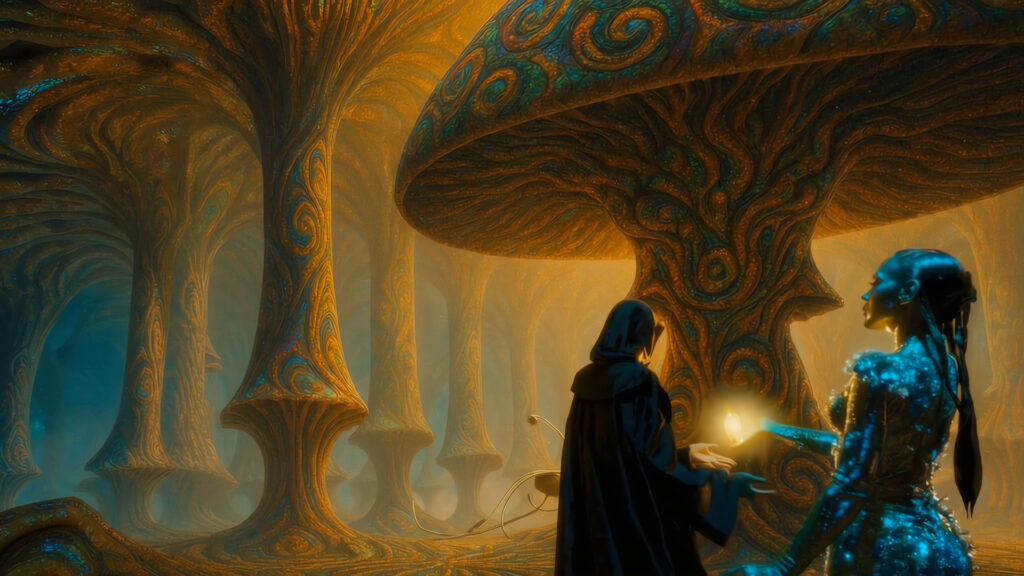
“Else,” Quen said, softly. The echo kept their name. The corridor brightened as the echo stepped free from the glass, two centimeters to the right of reality, as if space itself had misprinted the traveler and decided the errata was too pretty to correct.
Else spoke in a voice exactly like Quen’s, or Quen spoke in a voice exactly like Else’s; it is difficult to tell with doubles. “You could use a second witness,” Else said. “A second you. One to step while the other watches for the floor to learn new tricks.”
Quen didn’t argue. Some places demanded a companion. Some places were safer when reality came in twos.
They walked. The corridor tightened. The light above gathered itself into a single point like a star choosing to be a needle. Quen felt the corridor apply what navigators called the prism brake: time diffracted into slices, edges catching and letting go. The floor offered nine parallel reflections of Quen’s face, each bent by a different regret. Else regarded them with the patience of a math tutor. “Any you prefer?” Else asked, wry.
“The one that can be used,” Quen said. They stepped into the center reflection—the one that wasn’t prettiest, nor saddest, but the one with the most leverage.
The corridor approved. The arches boomed softly, like whales greeting one another through fog. The coin of light spun in small, ecstatic circles and then shot down the hall, trailing a gold filament like thread.
3 — River of Mercury Vowels
Where the corridor ended, a river began—not water, not in any conventional sense, but a film of so highly polished metal that it moved as a choir of surfaces rather than a substance. Across it, the old manuals had scrawled a warning that read like poetry: keep your purpose above the meniscus.
“Your trick,” Else said, “is going to be sincerity.”
“I know,” Quen said, which was not the same as promising they would manage it.
They stepped onto the river. The first sensation was of being welcomed by an exacting aunt who had been expecting this visit for years. The river spoke in vowels, each one vibrated along the feet to a different part of the spine. A—ah—opened the chest. E—eh—sharpened the sightline. I—ee—extended the reach of the hands. O—oh—set the jaw. U—oo—emptied the throat. The river did not offer consonants. Consonants would have pretended to be laws; vowels understood themselves as permissions.
With each vowel, the coin of light made a different sound, as if struck by an invisible fingernail. The edge cut a faint wake. Else skated a little to the right without trouble, a margin of reality like a safety rail. Quen kept their purpose where it would not drown by naming it softly, again and again, not as promise but as practice: “Chart what is arriving. Refuse dead repetitions. Refuse maps that turn grief into habit.”
The river appreciated that. It bent itself into ripples that spelled carry in a language of water that had never met a sea.
Midway, obsidian disks rose from below—sunflowers engineered of black glass. Each bore a thin amber halo that made no light but created expectation of light, which was its own kind of illumination. The halos resonated when the coin passed, making a chord that felt like laughter and like grief: a knowing sound, older than oceans. Spores drifted from the sunflower centers—not mushroom spores, not plant pollen, but tiny seeds of architecture for things that wanted to exist. Quen caught one on a palm. It pulsed, as if greeting a cousin. When Else leaned in, the seed cast a tiny prismatic shadow that duplicated itself two centimeters to the right.
“Path builders,” Quen said.
“Maps that hatch,” Else added.
Ahead, the river cinched itself into a waist. A frame appeared—no doors, only the geometry of a gate described by light bending around gravity. Navigators called it a lens passage. Careless travelers used it as spectacle. Careful ones treated it as a promise.
This one showed through to a room that appeared to be a courtyard of spore-glass towers, each ventilated by turbines that inhaled and exhaled motes of law. The air past the lens was warmer. The halos around the obsidian flowers pulsed amber, beating twice for every step the coin took.
Quen looked back once, to memorize the river’s vowels for the return. Rivers prefer to be remembered correctly; they misbehave for the sloppy. Then Quen and Else leaned into the lens and let the world buckle, ring itself like an eclipse, and deliver them through.
4 — Bloom
The courtyard had a quality Quen’s language approximated as noon—not midday light exactly, but that decisive brightness that makes shadows honest. Columns of glass like braided mycelium rose from a polished floor, their interiors threaded with breathing filaments. Where the corridor spoke in bioluminescent teal, this place warmed to golds and pale ambers. The engine was not just machinery. It was botany that had learned to dream in math.
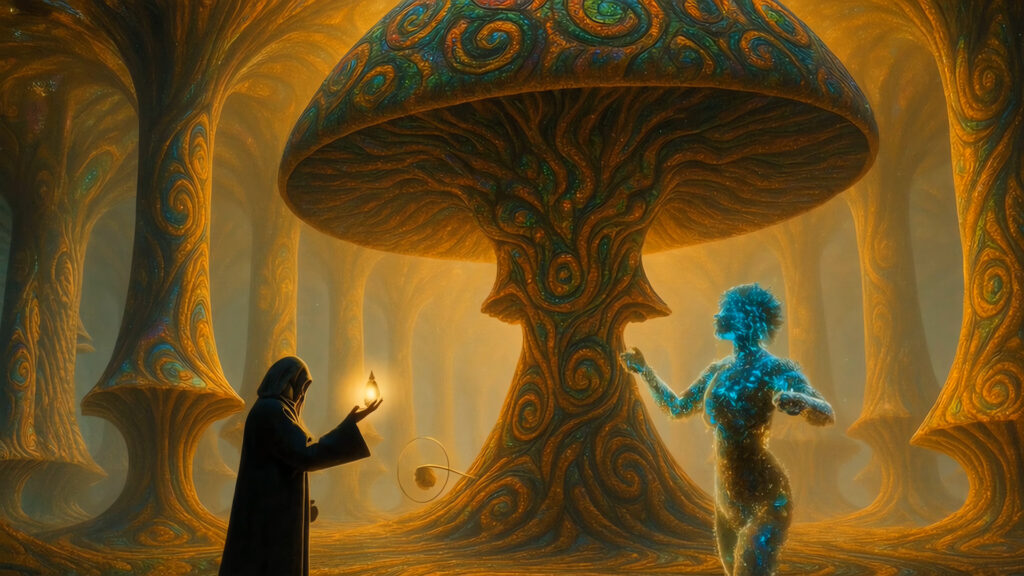
A figure waited under the largest column: not a person, not precisely, but a person-shaped permission to ask questions. Bark spirals patterned their skin; under the hood of their cap, gills layered in luminous ranks. When they spoke, the air sweetened with cedar and petrichor.
“You’re late,” the Oracle said without accusation.
“I’m on time,” Quen said, glancing at Else. “Just not the time you expected.”
Else grinned. Or perhaps the grin belonged to Quen and prismatic echo made it plural. It was hard to separate cause from effect in the courtyard. Smiles tended to become contagions.
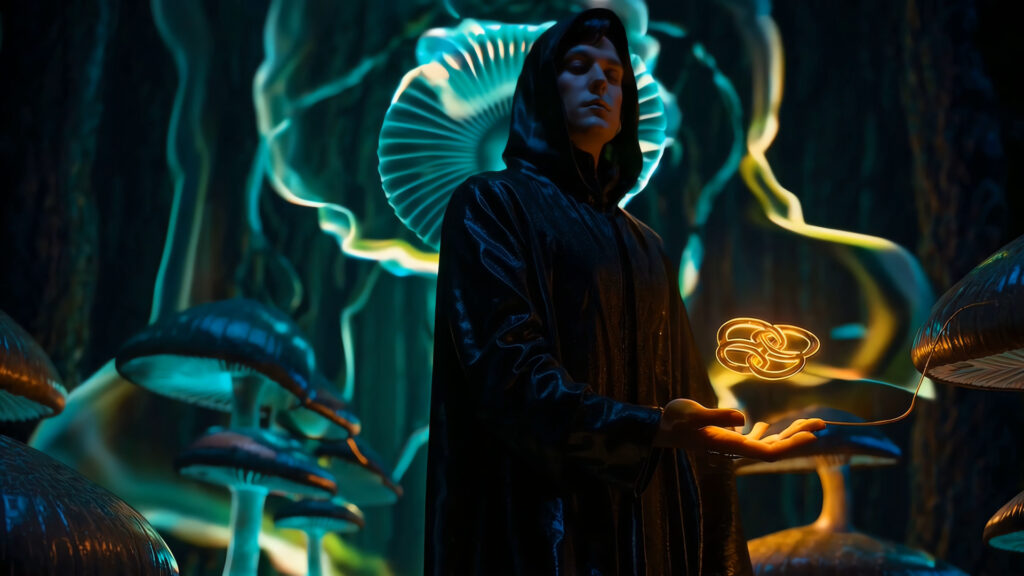
The Oracle extended a hand. Within lay an arrangement of thin gold filaments braided to a knot the size of a fingernail. Quen recognized the shape from the manuals and from dreams they’d had before the manuals: a thread that could bind a decision to an outcome without pinning it to a single route. The Oracle set the knot on the coin’s edge. It did not fall. It learned balance.
“You have three questions,” the Oracle said. “Ask them in the right order, or the answers will be true and nothing more.”
Else whispered, “So not the right questions, then.”
Quen took a breath. “First,” they said, “what does the engine want from me?”
It was the question that best avoided flattery.
“To be listened to without worship,” the Oracle said. “The engine dislikes petitions. It craves conversation.”
Quen nodded. “Second: where is the map hiding the place I’m looking for?”
“Not where,” the Oracle said. “When. You want a world misplaced in chronology, not in space. The map you require is written between two obligations on the same day that never admitted it had twins.”
Else whistled, a soft chord that made the gills under the Oracle’s cap shiver in delight. “A day with a secret mirror,” Else said. “Naughty.”
“Third,” Quen said, feeling the shape of the needed knowledge approach: “What price opens the gate to that day?”
“Not sacrifice,” the Oracle said. “Sacrifice is vulgar theater. Attention, increased to the point of transformation. You pay by paying attention until the thing you attend becomes different. Your coin remembers how.”
“Edge work,” Quen said, smiling despite themselves.
“And don’t be tedious,” the Oracle added, but with humor. “The engine hates tedium. When in doubt, risk elegance.”
The knot on the coin’s edge loosened and re-braided itself into a thread that ran from the coin to the nearest column. The column answered by dimming, then brightening in a rhythm that matched the engine’s bass hum in the bones. The courtyard changed routes inside itself, like a city opening side streets that had always existed but preferred not to be approached by the obvious. The air smelled faintly of citrus, as if the room had decided to feel clean.
Else pointed up. Above the columns, a ceiling unfurled like a sail and showed a sky that was not the desert’s. It was a mathematician’s weather: constellations that pivoted with intent, winds that traced the edges of choices. A sun coalesced and didn’t burn. It exuded decision. Lines radiated from it, thin and straight as a harp in a courtroom. Quen understood without being told: each ray was a path that would still be honorable in retrospect.
The Oracle turned their hand and something small, blue, and glassy rolled into their palm. It looked like an egg laid by a bird that had swallowed a piece of sky. Inside the glass, tiny flakes rose like slow snow. “Permission,” the Oracle said, passing it to Quen. “When the river’s vowels tangle, break this. It will teach the current a lullaby.”
Quen bowed—not out of worship, but because good tools deserve gratitude. Else mirrored the bow two centimeters to the right, refracting courtesy.
The courtyard breathed once. The coin tugged its thread like a hound catching a scent. The sun of decisions brightened, then contracted to a point; shadows snapped to attention.
“Time to go,” Else said.
“To when, not where,” Quen agreed.
They walked out under the noon that hadn’t happened yet, toward a gate made of lensing gravity and polite audacity.
5 — The Day With Twins
The gate delivered them not into the desert’s night nor the courtyards of noon, but into history consenting to be edited. The floor was a ledger as big as a province; the ink was a river carrying alphabetic fish. The ceiling was a sky of laws that had grown tired of being verbs and wished to try life as adjectives. It smelled like stale thunder and the edge of a storm.
“Here,” Else said, pointing at a seam. “There’s the split, barely held shut.”
Someone had stitched two obligations together—a treaty and a funeral—one signed at dawn, the other performed at dusk. The day had been trimmed to avoid admitting grief and promise could coexist. The trimming had cost a world its berth in time. Worlds are sensitive to hypocrisy; this one had slipped sideways and hidden in the margin.
Quen unrolled the coin’s thread and listened. The engine spoke in uneven rhythms, the way speech becomes music under pressure. They followed its syllables across the ledger until the characters began to smudge of their own accord, ashamed of the role they had played. The obsidian sunflowers reappeared, now etched into the floor as filigree. Their halos made no light but lent confidence to the light that tried.
“Break the egg,” Else said.
Quen held it up. Inside, the flakes rose with more purpose, as if positional arguments had awakened. The engine’s hum deepened. “Not yet,” Quen said. “It should learn the lullaby by ear first.”
They stood near the seam, coin balanced and turning. The thread hummed between two columns that had followed them from the courtyard, trading colors like old friends exchanging jackets. Quen spoke, not a speech, not petition, but attention given so thoroughly it could be mistaken for love.
“You tried to be single,” Quen told the day, “when you were two. Refusing a twin makes rot. Take both. Grief and promise can be kept in the same pocket.”
The ledger rippled. The river under the ink held still to listen—delightful manners, for a river—and the alphabetic fish arranged themselves to spell yes. Else’s grin widened. The seam eased, then closed cleanly—not shut, but sealed the way a wound seals when it has been washed and told the truth.
The engine rewarded this with a bloom. Above them, the ceiling remembered noon again: the A-major tilt of warmth, the gold unashamed of its sibling teal. The bioluminescent gills along structures—where had these structures come from?—glowed like a choir finding the higher harmony without calling attention to the difficulty of the interval.
“Now,” Else said.
Quen cracked the blue egg. It sounded like frost deciding to be water. The flakes soared and became a slow fall of letters that could teach rivers to rest without forgetting they are motion. The vowels aligned. The river hummed a lullaby in five tones. The ledger stopped trembling.
When the quiet finished, the horizon exhaled. A planet slid back into the calendar, not loudly, not with the pyrotechnics some historians favor, but with the relief of a key finally finding the right lock. It was small and oceanic and had a tilt that would make exquisite weather.
The engine whispered through Quen’s bones, a phrase that translated only imperfectly to speech: arrived.
Else offered a palm. The coin landed on its edge and rolled along the seam of the day as if drawing a border to amuse itself, then hopped into Quen’s hand and settled, weighty with completed intention.
“We could go home,” Else said.
“We could,” Quen agreed.
They both looked at the ledger, at the planets waiting in other margins, at the days that might be twins and didn’t yet know, at the knots of decisions that only wanted someone to pay attention long enough to become elegant.
“We won’t,” Else said, not a question.
“No,” Quen said. “Not yet.”
6 — The Engine’s Map
The return took them by a different path, because returning properly means refusing to reenact. The engine preferred it that way. The river—kind, now—lifted them across on a curve of surface tension. The obsidian disks nodded with those thin amber haloes and, perhaps out of respect, became slightly less sharp. The prism brake released, time re-cohered, and the hallway of mirror-bone arches elongated like a cat getting up from a nap.
In the observatory, the mirror-well had remapped itself. Where before it had shown a puzzle of stars, now it showed roads that bend like questions and cities that bloom like algorithms. Oceans sang the names of their storms; winds were labeled with intentions. It was not a map to control; it was a map to be persuaded by, an atlas that preferred collaboration. The engine’s hum moved through Quen’s sternum and Else’s prismatic outline with the intimacy of a remembered song.
Quen laid the coin on the surface. It didn’t sink or float. It found its edge again and spun, the gold filament unwinding in a spiral that looked like a law learning to dance. Lines sprang from the spiral, threadways to places where attention could become transformation. The bloom over the courtyard sent a filament of light to join them; the lens gate flickered approval; the Oracle’s gills whispered a phrase that might have been “good work,” might have been “keep going.”
Quen cataloged a few features, not out of bureaucracy but because memory is an ethical technology. A ridge shaped like a question mark came labeled with a warning to bring no certainties. A city with courtyards formed by hexes accepted only promises that could laugh. A reef, star-shallow but storm-deep, was rich in moments that could be repaired without being rewritten.
Else, who loved the geometry with a degree of affection that surprised both of them, traced a path along a band where gravity braided itself with blossom. “Here,” Else said. “This asks for us. It’s wearing the wrong name to test its visitors.”
“Then we will help it rename itself,” Quen said. They allowed themselves one quiet exhale, the kind that tasted of cedar and ocean iron. The coin stilled with the finality of a drum whose player has set down the sticks because the conversation is finished—for now.
The engine dimmed to ordinary brilliance. The observatory resettled around them. Outside, the black-salt desert accepted a dawn that didn’t have to become noon to feel honest. Spores lifted on that dawn with the gravity of prayers that refused to kneel—polite, stubborn, ready.
Quen looked at Else, two centimeters of space shimmering between flesh and echo, reality and refraction. “It’s not worship,” Quen said, thinking of the Oracle’s instruction. “We just…listen well.”
Else bumped shoulders and made the shimmer ring like glass. “We listen so well,” Else said, “the world starts telling the truth to impress us.”
They grinned. They walked. The observatory let them go with the tenderness of a machine that has remembered it was built to comfort as well as compute.
Epilogue — Edge
For a time—months or epochs, depending on whose calendars you borrow—Quen and Else kept the edge. They learned to balance decisions like librarians shelving thunder. They found ways to persuade laws to take a night off. They taught rivers to hum lullabies and days to admit their twins. They carried the coin and the thread and the egg’s lesson to places tired of being rectangles. In return, the engine gave them maps not of where things were but of where things intended to be, because intention is the secret geography under every coastline.
And when fatigue finally arrived—because attention costs, and even elegance has weight—they returned to the observatory at the planet’s patient heart. The arch welcomed them with a damp exhale. The ribs glowed teal. The engine hummed an F♯ that had learned a little gold.
Quen set the coin on the well and watched it settle into stillness that had nothing to do with ending. Else stood two centimeters away and matched the posture, a duet of poise. The map shimmered once, approving.
“Arrived,” the engine said again, and Quen understood the deeper grammar of that word: not a period, not even a semicolon, but a colon—the promise that something worth listing would follow.
Outside, the desert grinned under a sky that had been taught new courtesies. Obsidian sunflowers turned their haloes toward a sun that promised to be kind. A wind threaded itself into a gold filament and tugged at the horizon like a sleeve.
Quen and Else stepped out to meet it, edge first, paying the only price that opens every honest gate: attention increased until the world obliges by becoming more true. The ephemeris updated itself in their wake, not in ink but in the behavior of light, a schedule of possibilities keeping its appointments.
The sky-engine purred, pleased, ready to be listened to again.