I. The Dusk That Would Not End
The world of Lurith had forgotten what a sunrise looked like.
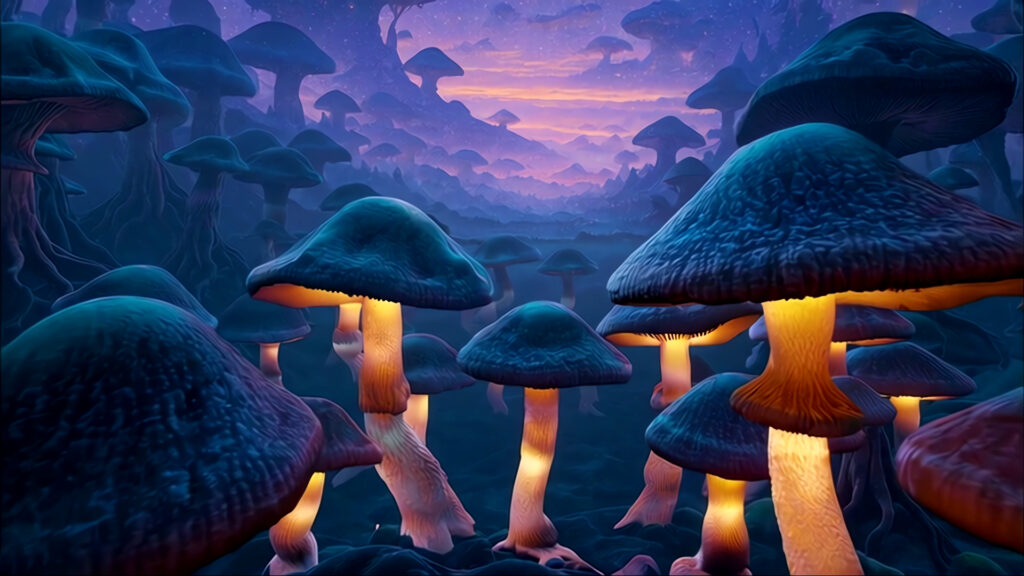
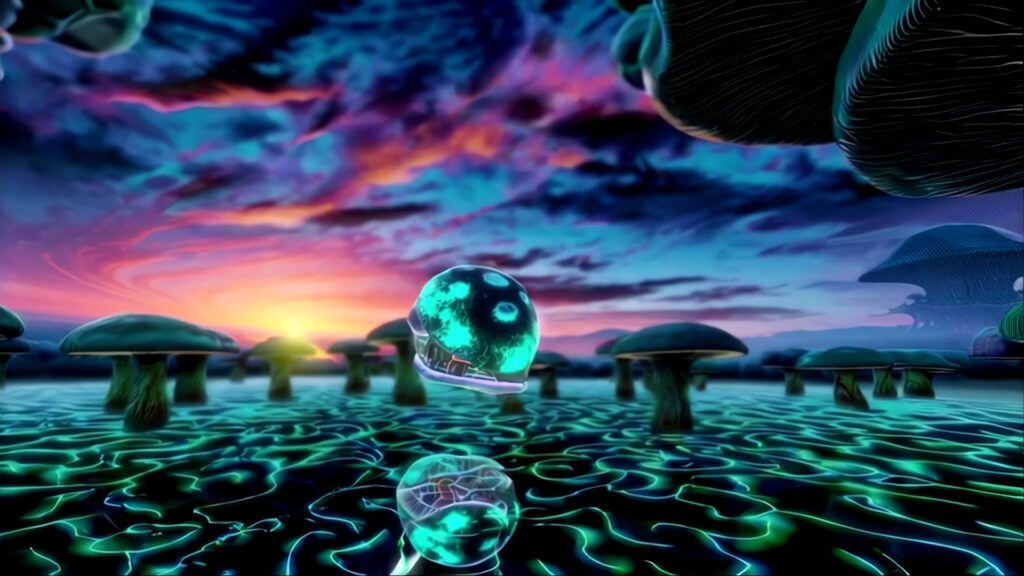
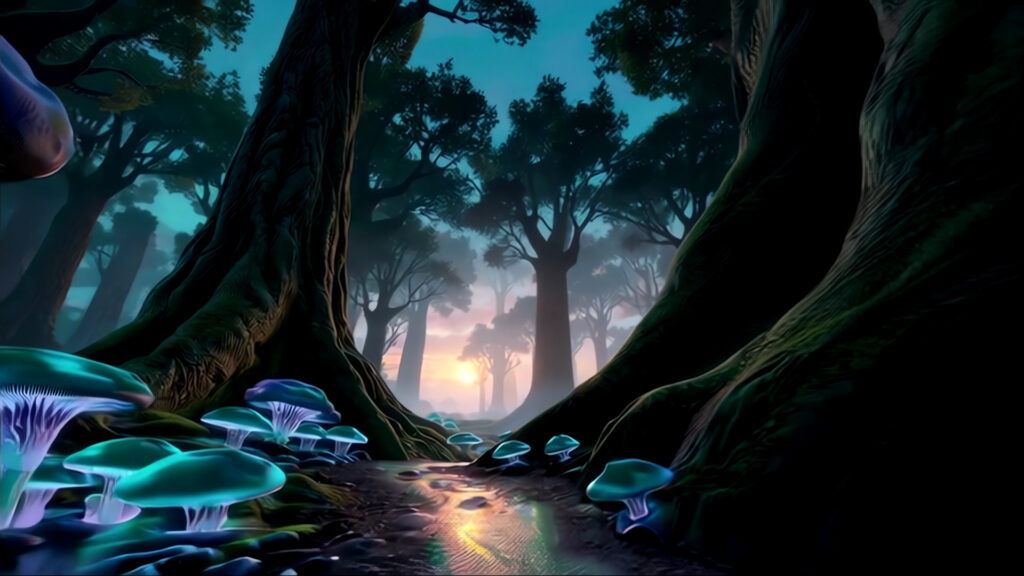
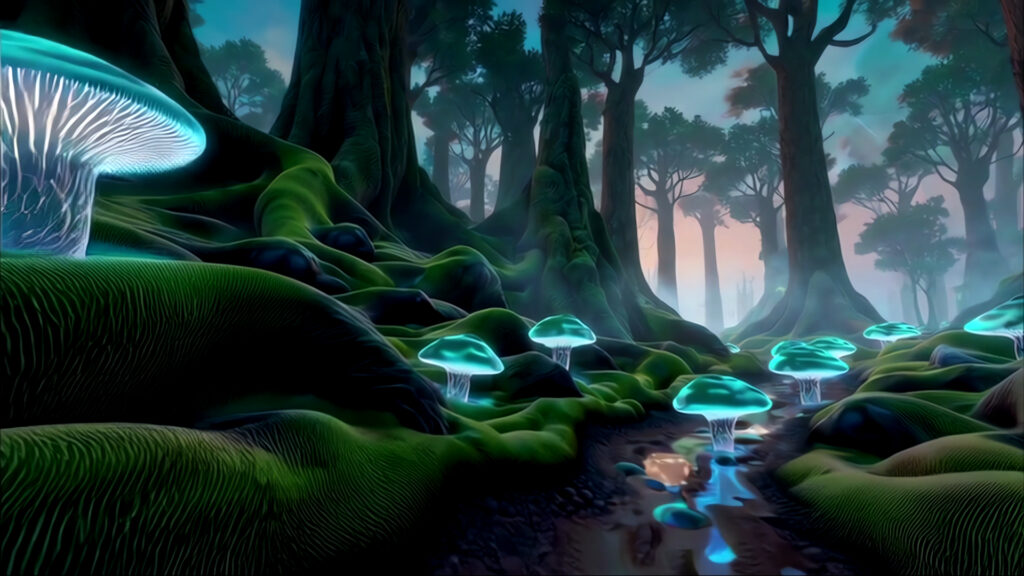
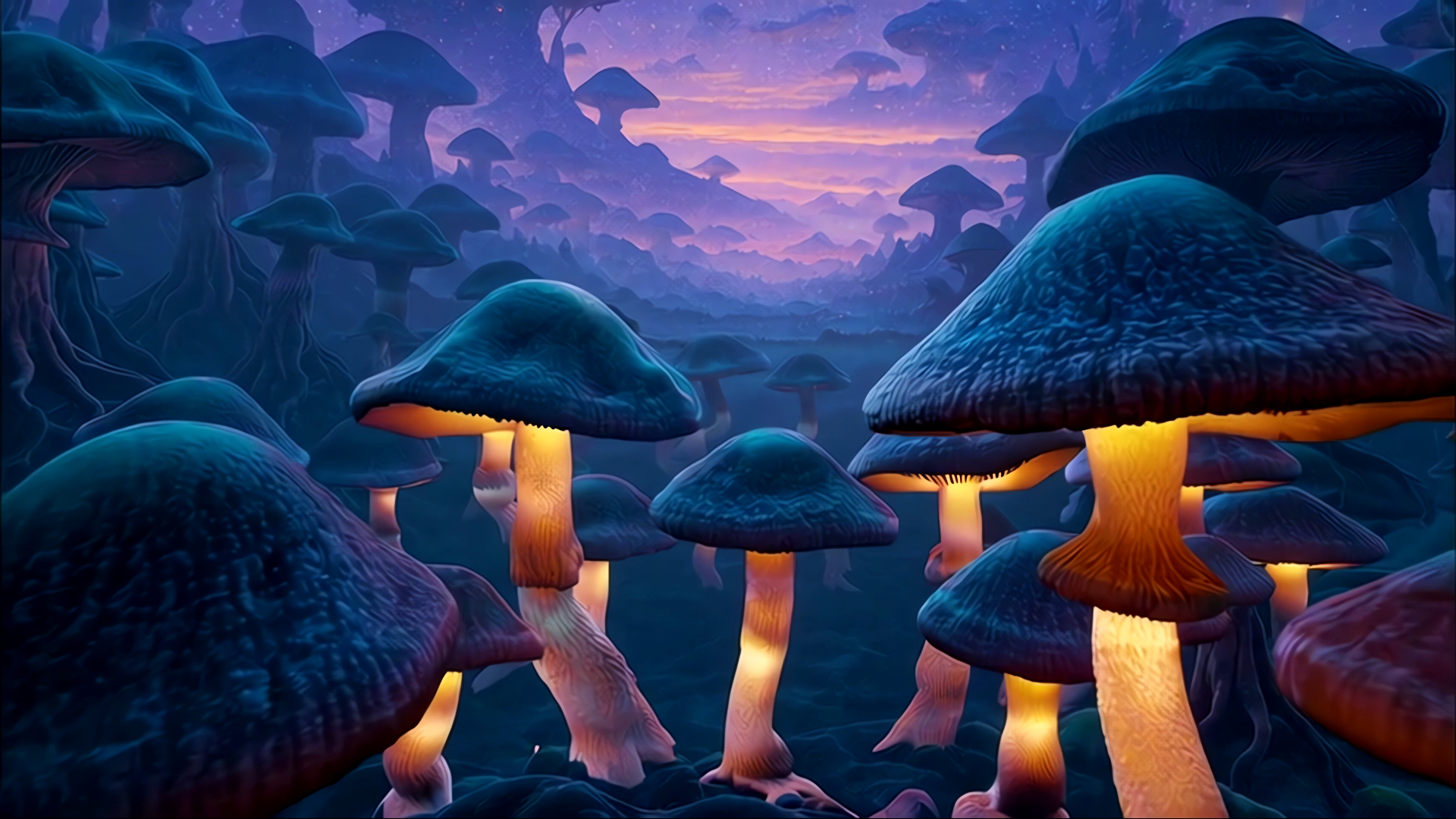
For ages uncounted, the sky had been a permanent twilight: a bruised gradient of violet and deep indigo, stitched with slow‑moving nebulae and drifting mushroom constellations. Towering fungal forests grew from floating islands of stone, their caps shimmering with bioluminescent glyphs that crawled like living script. Rivers of pale light flowed upward instead of down, vanishing into the dark clouds.
In this dusk‑locked realm walked Aelthren.
Aelthren was not human—no such thing existed in Lurith. Their body was tall and slender, woven from translucent, opalescent fibers like spun moonlight. Beneath their skin, strands of softly glowing mycelium pulsed in slow patterns, tracing a living constellation through their limbs and chest. Where a face should have been, there was an ever‑shifting mask of geometry: triangles and hexagons sliding over one another, forming eyes of amber light, a mouth when speech was needed, then dissolving back into fractal stillness.
From their shoulders sprouted two sweeping crests of crystal feathers, thin as glass and tinted with faint psychedelic colors—pink like a thinking cloud, green like the reflection of an emerald forest in moving water. When Aelthren moved, the feathers chimed faintly, and spores of glittering dust drifted from their edges, curling through the air like lazy comets.
They wandered the Dusklands with a single memory carved into their mind: a rumor, passed in flickers of thought from luminous beast to drifting spirit.
Somewhere, hidden beyond the ordinary folds of Lurith, there was a place called the Chamber of Inverted Dawn—a chamber where sunrise did not break over the horizon, but fell inward, like water pouring into a well. It was said that the last true dawn had been caught there, turned inside out, and the world had stayed twilight ever since.
Aelthren did not know why the memory remained when others had been erased, but whenever they closed their eyes, they saw it: a vast vault of stone, the sky on its floor, and a sun rising downward.
So they walked, and the Dusklands watched.
II. The Procession of Fractal Beasts
On the thirty‑third night‑that‑was‑not‑night, the sky changed.
Three mirror comets tore through the twilight, leaving behind tails of liquid chrome that dripped in slow motion across the vault of the world. Each comet was a faceted tetrahedron, its surface etched in tiny, precise symbols like the notes of an impossibly complex equation. Where their trails intersected, a sigil formed—a blazing glyph in the clouds shaped like a circle pierced by a downward arrow.
It hovered directly above Aelthren.
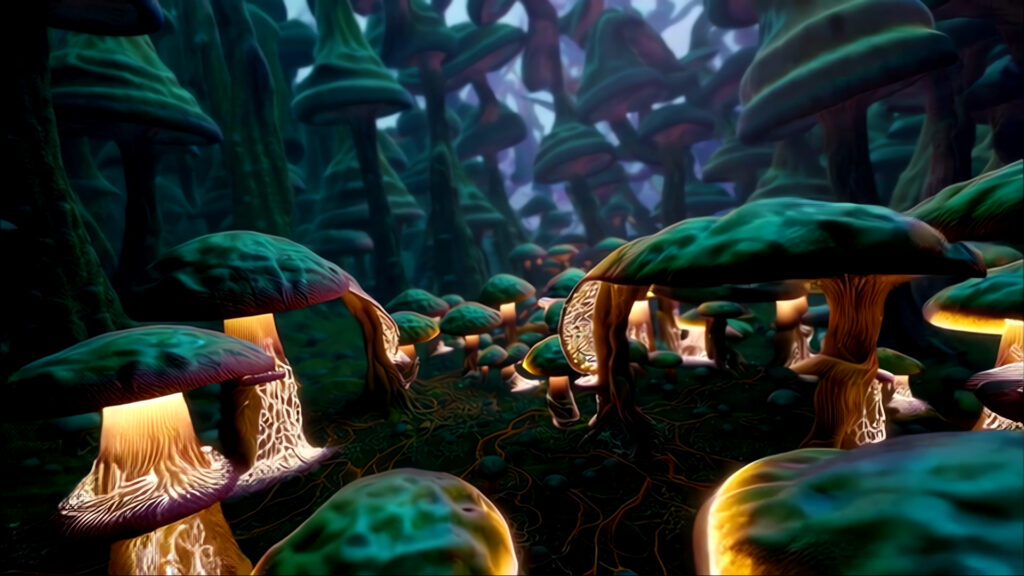
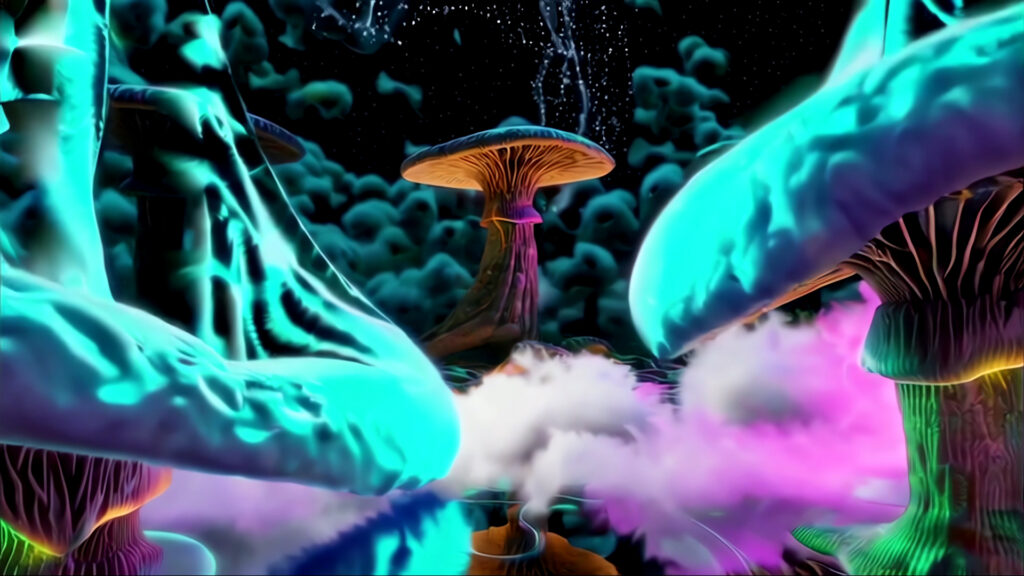
The mushroom forest under their feet stirred. Colossal caps uncurled like the lenses of some vast, organic observatory, turning upward to face the sigil. Their undersides flashed in bands of LSD color—neon blues and radioactive pinks and verdant greens that refused to be solid, shifting and breathing like live pigment.
From between the towering stalks came the Fractal Beasts.
Each beast was a walking mandala of fungal plates and crystal spines. One looked vaguely quadrupedal, its legs jointed in too many places, each step fracturing the ground into kaleidoscopic shards that refolded behind it. Another was serpentine, made entirely of interconnected tetrahedrons of bone and glass, scales patterned with spiraling DMT glyphs that rippled across its body like thought waves. A third had the shape of a great stag, but every antler branched into cities of tiny mushroom pagodas, each pagoda ringing softly with chiming bells of quartz.
They arranged themselves around Aelthren, forming a slow, ceremonial circle. Their eyes—if eyes they were—glowed with silent understanding: swirling galaxies, pits of dark fire, rotating cubes nested within one another.
The ground between them opened like a gently separating wound.
From the split in the mycelial earth rose a stair of roots, each step braided from glowing fungal threads and veins of pale stone. Descending into the earth, the stair glowed with a soft, entrancing luminescence, as if lit from below by a buried aurora.
Aelthren looked up once more at the downward arrow burning in the sky, then at the waiting beasts. They felt the mycelial threads inside their own body humming, aligning with something deeper.
Without a word, they stepped onto the stair and began to descend.
The beasts bowed their fractal heads, and the wound in the world closed above.
III. The Gate of Melted Horizons
Downward felt wrong.
The deeper Aelthren descended, the less sure they were of what direction meant. The stair seemed to spiral inside a folded space; sometimes the next step was beneath them, sometimes to the side, sometimes above, but their body adjusted without protest, as if gravity itself were a polite suggestion easily ignored.
The walls around the stair were not walls but membranes of dim light, flexing and pulsing with slow waves of color. Images flickered inside them: old dawns captured in still frames. A sunrise over a forest of crystalline pines. A horizon where the clouds themselves were mushrooms, blooming in radiant orange. A sea that glowed with bioluminescent plankton like drifting stars as the first light touched it.
Each scene was tinged with something that made Aelthren’s geometric face ache—a sense of loss they could not name.
Eventually the stair ended.
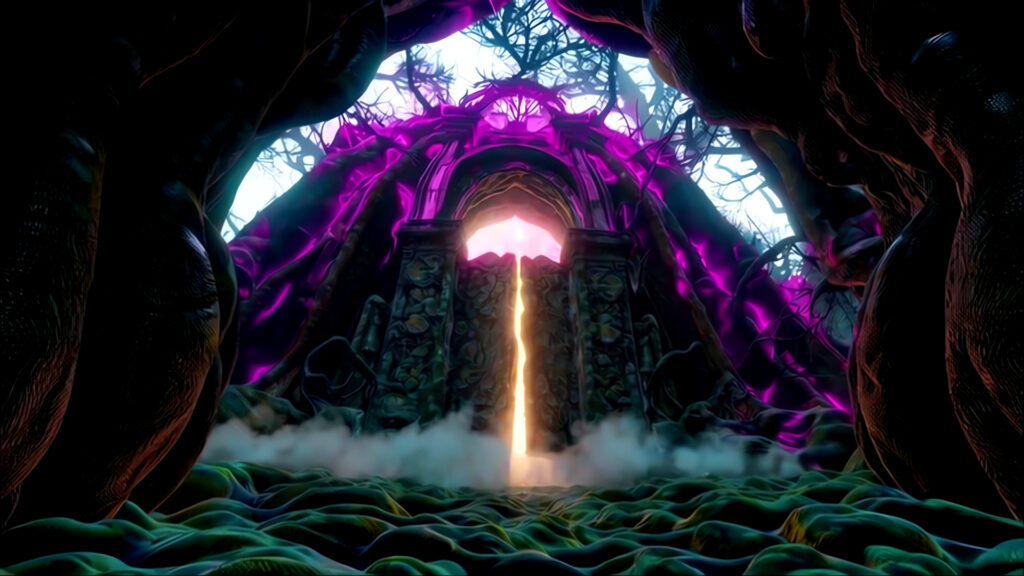
Before them stood the Gate of Melted Horizons.
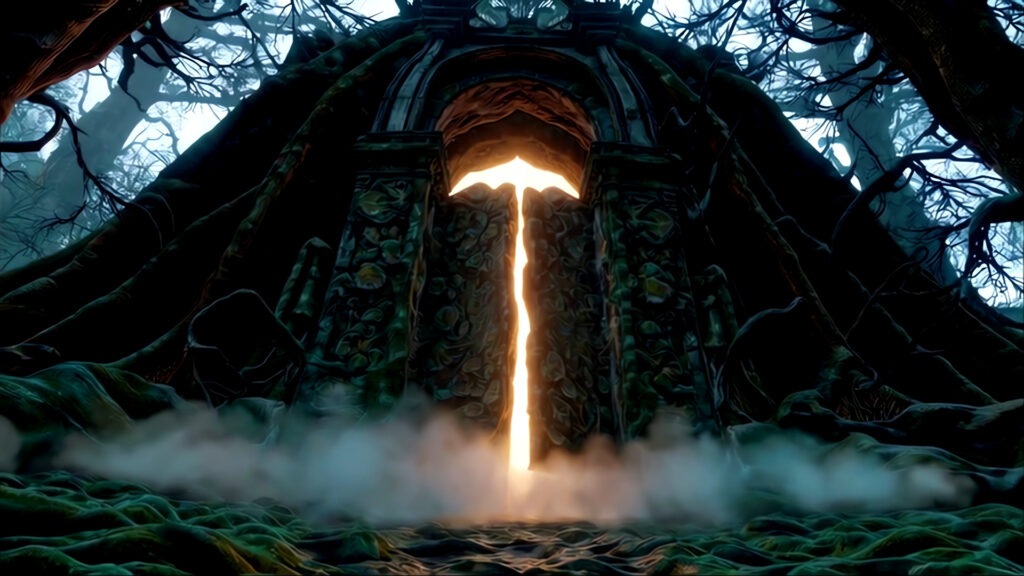
It was a colossal archway carved from solidified dawnlight, frozen in mid‑pour. The stone wasn’t stone at all; it was light trapped in the shape of stone, amber and rose and gold flowing together like thick honey. In its surface, horizons melted and dripped downward: mountains running like wax, skies liquefying into rivers that emptied into some unseen below.
Beyond the archway, there was nothing. Not darkness, not light—simply an absence, a blank that hurt to look at.
Aelthren approached. The mycelial threads under their skin brightened, responding to the Gate. Their crystal feathers quivered, shedding faint trails of psychedelically colored dust that drifted forward and vanished at the threshold.
They lifted a hand and touched the Gate.
The melted horizons shivered. For a moment, the frozen dawnlight turned liquid again, flowing around their fingers like warm glass. The blank space beyond the archway rippled, and something like a heartbeat reverberated through the void.
The Gate opened.
The blankness yawned wider, and Aelthren stepped through, into the Chamber of Inverted Dawn.
IV. The Chamber of Inverted Dawn
The first sensation was falling upward.
Aelthren’s sense of direction disintegrated as the world inverted around them. Up became down, down became sideways, sideways stretched into spiraling tunnels of color. For a fraction of a timeless moment, they were a smear of consciousness streaking through an infinite hall of mirrors, each mirror reflecting a different version of Lurith under a different kind of sky.
Then everything snapped into a new shape.
They stood, though they couldn’t remember deciding to stand, on a vast expanse of mirror‑smooth glass. Above them stretched an endless stone vault, carved with reliefs of strange, humanoid figures whose faces were replaced with suns at various stages of rising and setting. Their bodies were inked with whorls of constellations and fractal sea‑creatures, all animated in slow, living motion.
But it was the floor that stole Aelthren’s attention.
The glass under their feet did not reflect. Instead, it revealed a sky.
Clouds rolled silently beneath their toes, tinged with the colors of dawn—but the dawn was moving downward. A sun, too bright to stare at directly, was rising from the upper edge of that sky and sinking deeper into the floor, illuminating the unseen depths below while leaving the stone vault above in perpetual twilight.
This was the inverted dawn: a sunrise turned inside out, falling away from the world instead of toward it.
Around the chamber, clustered along the walls, were towering fungal obelisks. Each one was a gigantic mushroom cap turned vertical, its gills facing outward. From those gills dripped LSD‑bright nectar, casting ripples of refracted color across the glass. The obelisks hummed faintly, their surfaces alive with sliding symbols in shapes reminiscent of atom diagrams and ancient runes fused together.
Within the chamber drifted the Aurorans.
They were humanoid, but only just. Tall, slender bodies of translucent crystal shimmered with slowly rotating patterns of sunrise: bands of orange, pink, and gold circulating beneath their surfaces. Instead of faces, they had circular discs of pale light, like halos pressed flat and embedded where heads should be. Around these discs orbited smaller rings inscribed with moving, psychedelic sigils. Their hands ended in five delicate tendrils, each tipped with a bead of liquid dawnlight that stretched and recoiled as they moved.
Aelthren recognized them instinctively, as if a buried memory had been waiting for this moment.
These were the keepers of the last dawn.
The Aurorans turned as one, drawn by the newcomer’s presence. Their halos brightened, and the chamber seemed to lean in, its obelisks shivering with added resonance. One Auroran glided forward, feet barely more than a suggestion. When it stopped before Aelthren, its halo rippled, forming a complex pattern of overlapping circles, triangles, and spirals—a language made entirely of geometry and hue.
Aelthren understood.
“You were called by the fracture in the sky,” the pattern said. “You carry twilight in your veins and spores of forgotten mornings in your bones.”
“I remember only the rumor,” Aelthren replied, their own mask folding into circles within circles. “The world has no sunrise. Only dusk. Only memory. Why is it kept here? Why inverted?”
The Auroran tilted its halo. Beneath their feet, the downward‑moving sun brightened briefly, casting sharp highlights through the glass.
“To preserve it,” the Auroran answered. “The world could not endure its full light. So we turned it inward, to let the dawn rise where it would harm no one.”
“But the world is dying in twilight,” Aelthren said softly. “The forests do not sleep or wake; they simply persist. The rivers flow backward. The beasts walk in loops. Nothing changes.”
“That is… the cost,” the Auroran said.
Aelthren looked down once more at the sky beneath the glass, where clouds glowed with impossible colors and the sun sank slowly into unseen depths.
There was another option. They could feel it, like a pressure behind their geometric mask.
The dawn could be turned again.
V. The Inversion Within
As soon as the thought formed, the chamber reacted.
The fungal obelisks shuddered, their LSD‑bright nectar flickering like candle flames in a storm. The downward‑falling sun beneath the glass stuttered, then continued its slow plunge, but now its light changed color—bleeding from warm gold into an eerie, radioactive green, then into soft lavender.
The Aurorans gathered around Aelthren in a loose circle, halos spinning faster. Symbols flashed across their faces, complex and overlapping: caution, curiosity, the faint afterimage of fear.
“You are a hinge,” the leader said. “We did not design you. We do not know who did. But you are patterned for reversal.”
Aelthren’s body responded without their permission. The mycelial threads beneath their translucent skin lit up, one after another, in dizzying succession. Their crystal feathers expanded, fracturing into dozens of smaller shards that hovered in a halo around them, each shard reflecting a different dawn: some blazing, some muted, some in strange, unfamiliar colors like ultraviolet teal and infra‑red crimson that vibrated oddly inside the mind.
The chamber itself unfurled.
Walls stretched outward; reliefs of sun‑headed figures melted into the stone and emerged again closer, more distinct. Each figure stepped from the carvings and became a towering golem of basalt and ember, their faces still radiant spheres of light. They took positions along the perimeter, watching silently, arms crossed over chests inscribed with slowly rotating galaxies.
The air thickened with DMT‑laced mist, swirling in structured eddies that traced enormous sigils across the vault. The mist coiled around Aelthren, writing luminous equations in the space between their chest and the downward‑falling sun beneath the glass.
They understood none of it, and yet every symbol felt intimately familiar, like a word on the tip of a tongue that could never quite form.
“Do you wish to turn dawn outward again?” the Auroran asked.
Aelthren did not answer with geometry this time. They simply looked up at the twilight stone above and then down at the swallowed sunrise below, and within them something aligned. The twilight of Lurith, the memory of mirror comets, the beasts, the gate of melted horizons—all of it crystallized into a single intent.
Yes.
The chamber heard.
The glass under their feet cracked—not in jagged lines, but in intricate fractal patterns like frost racing across a windowpane. Through the cracks, the upward‑falling sky shimmered, and the sun paused, suspended in the center of the chamber’s unseen depth.
Threads of dawnlight shot upward, spearing through the glass and lacing themselves into Aelthren’s mycelial veins. Their body arched. For a moment, they were not Aelthren but a conduit, a filament bridging twilight and morning.
Inside them, dawn began to invert again.
VI. The Blooming of the Reverse Horizon
The Chamber of Inverted Dawn expanded into infinity.
At least, that was how it felt. Aelthren’s consciousness stretched, strung like a vine across countless versions of Lurith. In one, fungal forests glowed in gentle rose light. In another, entire mountains of crystalline mushrooms dissolved into clouds of glitter as the first rays grazed them. In a third, rivers running into the sky evaporated in instant fog, raining down later as mescaline‑scented storms.
Each version was a different answer to the question: “What happens if dawn returns?”
The dawnlight coursing up through Aelthren split into innumerable threads, each one tuned to a particular reality. They felt the weight of them, the shimmering probability of countless futures brushing against their crystalline bones.
Around them, the Aurorans chanted—not with voices, but with synchronized patterns of light. Their halos flashed sequences of shapes: spirals, cubes, roaring mandalas. The fungal obelisks exhaled spores that resembled tiny galaxies, each spinning slowly through the air before sinking into Aelthren’s flickering aura.
The basalt golems stepped closer. Their sun‑faces dimmed and brightened in pulses that matched the beating of something in Aelthren’s chest. One by one, they extended their hands, placing them lightly on the air around Aelthren’s shoulders, as if laying on invisible fingers.
“You cannot send it all back,” the Auroran leader warned, symbols ticking across its halo. “A full dawn would unmake what now exists. The world has grown adapted to twilight.”
“So… I choose,” Aelthren replied.
“You divide the light,” the Auroran said. “You weave a thinner dawn, a new pattern. If you succeed, the world will see mornings again—but not the same mornings it lost.”
The threads of dawnslight within Aelthren trembled on the edge of release.
They looked inward, into the strange architecture of their own being. Their veins were not rivers but branching roads of luminous fungus, crossing and recrossing, forming loops and spirals. At key junctions floated nodules of pure color, each one representing an idea, a feeling, a memory: the awe of the Fractal Beasts, the silent acceptance of the Gate, the mirror comets and their downward arrow.
Aelthren began to weave.
They braided the threads of dawnslight differently this time, drawing some colors and leaving others folded back into the depths of the chamber. Warm gold for warmth. Soft pink for relief. A touch of lavender for strangeness. They left behind the blinding white at the core—the part that burned too fiercely.
Above them, the stone vault of the chamber grew translucent, then transparent, revealing the Lurith that waited beyond: the cloud‑clotted twilight sky, the giant mushroom forests, the drifting islands.
The ward between realms grew thin.
Aelthren gathered the braided dawn into a single luminous knot in their chest and pulled upward.
The knot exploded.
VII. The Daybreak Flood
The first dawnbeam punched through the ceiling of the chamber like a spear of molten glass.
It shot into the sky of Lurith, tearing a hole in the twilight. Color spilled out: not the gentle wash of a normal sunrise, but a spectral torrent. Wavelengths never meant for mortal eyes cascaded into the air, painting the clouds in hues that tasted like metal and remembrance and citrus if you looked at them too long.
Outside, the world convulsed.
The floating fungal islands bucked as if struck from below. Mushroom caps the size of cities unfolded, their gills turning to face the new light. From those gills burst arcs of spores in brilliant, LSD‑neon patterns, forming vast, moving mandalas in the air. Rivers that once flowed upward shuddered, paused, and then split: some streams continued into the sky, others reversed and carved new paths into the rejuvenated ground.
Creatures across Lurith rose from their twilight stupor.
In caves of dripping DMT crystal, Glass Wyrms unfurled from their coils. Their bodies were long and sinuous, made of overlapping plates of transparent gemstone that refracted the incoming dawn into hundreds of dancing beams. Wings of thin, flexible quartz spread, catching the light and splitting it into fanlike rainbows that cut through the thickening morning mist.
On the fungal plains, Mushroom Colossi stirred. Each colossus was a walking grove: dozens of giant caps clustered on a central stalk, legs formed from intertwined roots that ended in talons of obsidian. Eyes opened along their stems, each pupil a swirling galaxy of soft pastels, reflecting the first hints of dawn.
High above, in the boiling newborn sky, Aurora Mantids took flight—humanoid figures with elongated limbs and translucent exoskeletons glowing in gradients of violet and teal. Their wings were veils of prismatic gossamer, trailing behind them as they danced through currents of reshaped air.
Back in the chamber, Aelthren stood amid a hurricane of light.
The dawn still poured upward through them, but now it branched, sending tributaries out along new paths. Some of the braided light flowed into the Aurorans, whose halos blossomed with more complex, vibrant patterns than they had ever displayed. Some seeped into the fungal obelisks, drenching spores in morning colors so they could carry bits of dawn wherever the chambers opened small tears into reality.
The basalt golems cracked as their sun‑faces split like seeds. From the fractures burst smaller entities—Sun Sprites—tiny humanoid forms made of pure glow, their limbs defined by negative space, their eyes twin vortices of burning gold. They scattered like sparks, racing toward cracks in the air that led to distant corners of Lurith, bearing shards of newly tuned sunrise.
Aelthren threw back their head.
Above them, the hole in the stone vault widened, and they saw, for the first time, a true horizon—not one stolen beneath glass, but a line where earth and sky met honestly. Along that line, the braided dawn rose in a wide fan, painting the world in layered colors.
It was not the dawn the world had lost. It was stranger, more delicate, laced with twilight.
But it was dawn.
VIII. The Second Horizon
The flood could not last forever.
Slowly, carefully, the Chamber of Inverted Dawn began to close its wound in the sky. The hole in the stone knit itself with delicate filigree of rock and light, like lace woven from petrified sunbeams. The torrent of dawn tightened into thinner streams, then smaller rivulets, then threads.
Outside, the first morning in ages softened into a seamless blend of day and dusk. The world did not flip fully into bright blue; instead, a double horizon appeared. On one side of the sky, the new sun climbed, radiating its braided, tempered light. On the other, the old twilight remained, deep indigos and violets smoldering quietly, now enriched by hints of gold.
Lurith had become a realm of eternal early morning, where the memory of night and the promise of day coexisted.
The creatures adjusted.
Mushroom Colossi rotated their caps to capture specific angles of the new rays. Aurora Mantids choreographed intricate aerial dances along the line where dawn met dusk, their prismatic wings drawing luminous sigils in the still‑shifting atmosphere. Glass Wyrms learned to bask in shafts of sunrise piercing crystal caverns, their refracted bodies turning each ray into a cathedral of color.
Down in the chamber, the Aurorans gathered one last time around Aelthren.
The leader’s halo shone softer now, full of slow‑turning patterns of sunrise clouds and faint stars. “The world will not go back,” it said. “Nor will it stay as it was. You have woven a new rhythm between light and shadow.”
Aelthren looked at their own body.
The mycelial threads beneath their skin glowed with a steady, subtle radiance. Their crystal feathers had reformed into two sweeping crests once more, but now each feather held a different dawn: some cloudy and subdued, others blazing, others strange and chromatic like the inside of a dream. Their geometric mask had settled into a stable configuration: two amber eyes, a simple mouth, and a faint halo of shifting glyphs hovering just behind their head.
“What is my place now?” Aelthren asked.
The chamber answered, not with a single voice, but with many. The fungal obelisks hummed. The basalt golems rumbled softly. The Aurorans’ halos flickered in agreement.
“You are the Second Horizon,” they said together. “The bridge between twilight and dawn. As long as you exist, the balance holds. You may walk the world. You may sleep within this chamber. Wherever you are, morning will remember how to arrive.”
Aelthren stepped to the edge of the glass.
Below, the inverted sky still gently glowed, though the downward‑falling sun had dimmed to an ember. Above, through the patched stone, the true sky of Lurith shone with its new, doubled light.
Aelthren chose upward.
They walked back through the Gate of Melted Horizons, which now shimmered with both the fading dawnlight of its original charge and the newer, gentler radiance that had just been woven. The stair of roots carried them toward the surface, but now it bloomed as they passed, sprouting tiny luminescent mushrooms that released spores smelling faintly of rain on warm stone.
The Fractal Beasts awaited them in the Dusklands, their forms subtly changed. The quadrupedal one had grown small sun‑discs in its joints. The serpentine one now glowed along its spine in pulses that matched the distant rising of the braided sun. The stag‑grove’s mushroom pagodas chimed in a new key, resonating with the dawn.
Aelthren stepped onto the twilight soil and looked up.
Along the horizon, the Chamber of Inverted Dawn was not visible, but its influence was. A thin band of impossible color—somewhere between peach, lavender, and electric teal—ran around the world where sky met land. Tiny, embryonic suns winked inside that band, not yet born, waiting for later days.
Aelthren smiled, or the closest thing their geometric mask could manage.
Behind them, the wound in the world sealed completely, leaving only a faint ring of fossilized dawnlight in the mycelial roots—a scar and a promise.
Ahead, Lurith stretched out, caught between its ancient twilight and its new, strange morning. Creatures stirred, spores rose, and rivers chose their directions.
The first true day of the Second Horizon began, and somewhere deep below, in a chamber where dawn still fell inward in slow spirals, a quiet, inverted sun kept dreaming.