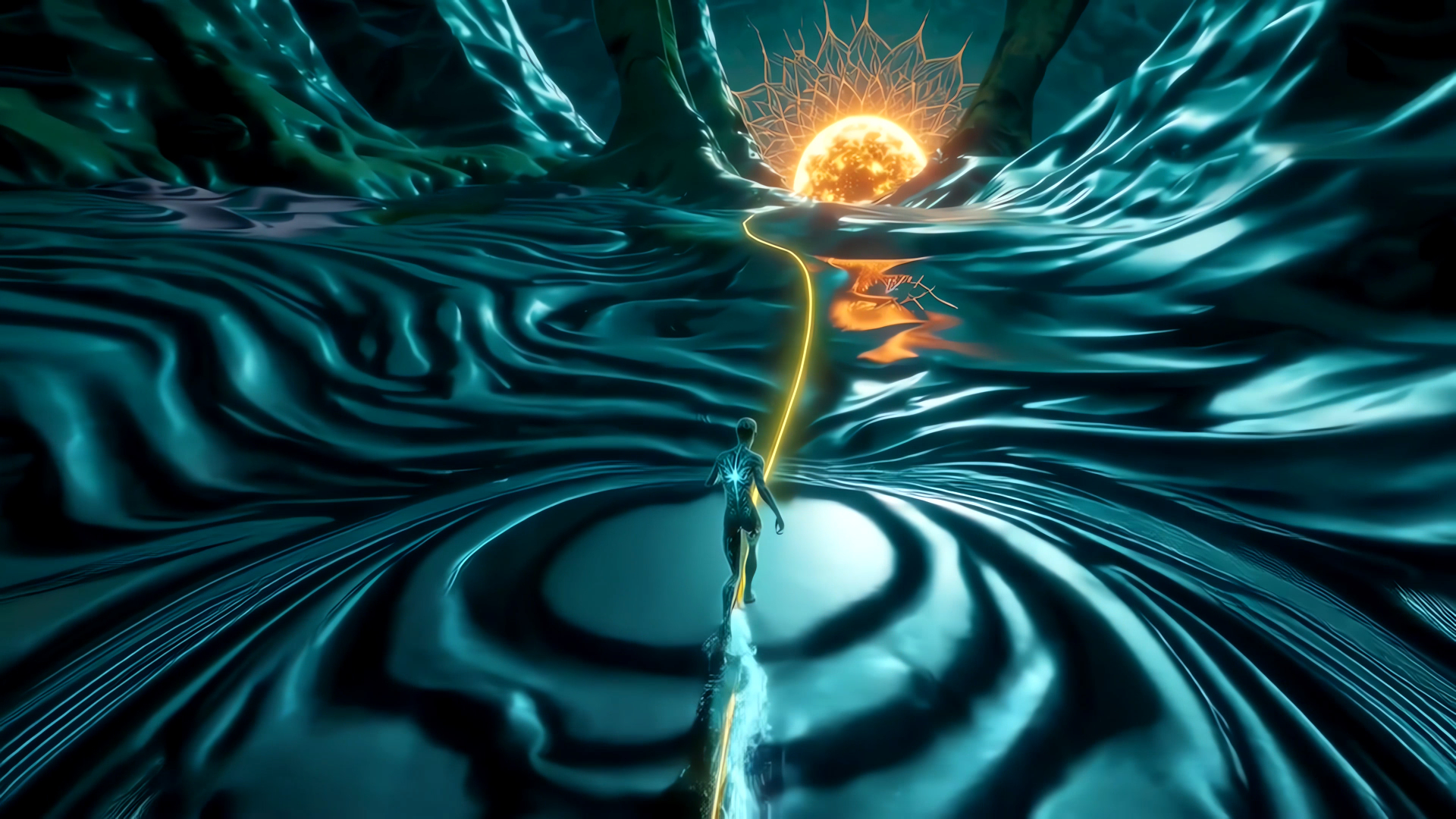
I — The Door Beneath the Dark
The star was a fever that never cooled. From orbit it painted the hard vacuum with spirals of color too precise to be chance: lime, magenta, ultraviolet lattices shimmering like the wings of mythic insects. The Hyphaeryx named it the LSD Sun for the way its light convinced stone to dream and dunes to rearrange themselves into perfect mandalas. Around this sun drifted a desert of comet‑ground silica, fused and refrozen into rippling continents. The dunes rolled on tides of radiance rather than wind, sculpted by spectra that moved with the patience of continental drift and the caprice of a hallucination.
Vhorin arrived not in a vessel but in a germination. His body stepped out of a seed that had been a star only yesterday; he shook the last dew of cold nebula from his shoulders and watched it evaporate into petals of cyan steam. The dunes murmured in color. Far beneath his feet, he felt the Hyphosphere stir—threads of living matter braided through the vacuum like the roots of a forest that had traded soil for starlight.
He walked until the dune‑faces climbed to meet the sky, tall as mountains and rimmed with auroral fire. At the base of one such face a circle of gills irised open in the dark glass as if the dune itself had been holding its breath. The hatch exhaled a fine mist—spores sculpted into vowels—and in their pattern Vhorin read greeting and test.
“I have come for the corridor,” he said, and his voice was a fiber of gold weaving itself into the mist.
The hatch widened. Beneath it, a stair spiraled away into a coolness that was not darkness so much as uncommitted color. Vhorin lifted one foot, then the other, and descended into the under‑dune where gravity behaved like a thought that refused to settle.
II — Gravities Turning
The stair did not point down. It turned toward a vector Vhorin could only name by taste: metal with a citrus tremor. Each step unhooked weight from one meaning and relayed it to another. The dunes above forgot he had ever stood upon them. Somewhere behind his eyes, a flock of phosphorescent glyphs convened: coordinates singing to each other in a language of angles.
Walls of interlaced hyphae rose around him, pale braids pulsing with slow, star‑blue light. He let his fingers brush the living weave. It shivered and disclosed a map—strands touched strands, and whole constellations changed their minds about where they lived. High overhead, where “overhead” was temporarily plural, he glimpsed DMT auroras sliding through the rock like cattails through riverwater: mint green, persimmon, electric violet. Each color drafted a hypothesis of the corridor’s location.
He tasted the air with the filaments along his wrists and whispered his lineage—the spore‑names and filament‑houses that had grown him. The stair humbled to a ramp and the ramp bent open into a chamber where the ceiling was not a ceiling but a low sky.
III — Time Sap
It would be a mistake to say time slowed. Time here thickened. Seconds became resin, storing the shadows of moving things. Vhorin’s heartbeat inked rings in the air, and each ring hardened into a faint halo, hung around him like the memory of a bell. He moved with deliberate patience, every gesture pressing a signature into syrup.
In this place, one could make decisions large enough that the world would need extra viscosity to hold them. Vhorin unscrolled the Gossamer Spool, a filament like moonlight captured in a thin line, grown inside his chest and fed with promises. He drew it through the air; resin embraced the line; the line became a stitch binding the low sky to the living floor.
A figure rose from the floor like a tree growing in reverse. Its trunk was a tower of honeycomb gills; its cap spread until it wore the room as a soft hat. Eyes opened within the gills—a hundred crescents, pale and damp. The air filled with pollen that smelled of forests that had never seen soil.
“Spore‑Court,” Vhorin bowed, kneeling until his hair pooled in bioluminescent spirals.
We read you, said a hundred mouths. We taste the corridor asleep in your intention. Speak your task.
“I will wake a passage the Null Choir cannot inherit,” Vhorin answered. “I will set a route that refuses empire.”
The gills smiled, which looked like rain moving sideways. Then you require sanction, and a lantern that knows how to make light distrust itself.
IV — The Council of Spores
They built the council from their bodies—pillars of flesh that were also language. Vhorin stood at the center while they debated not with arguments but with the exchange of spores that altered the meaning of the room. At one moment the chamber was a cradle; at the next it was a maze; after that it was a knife that had learned how to be a gate.
In the end, an elder fruiting wore a veil of silver threads and stepped down from its own shadow.
Take this sanction, the elder said, tattooing his palms with luminescent sigils that ached like a remembered song. You will be invisible to hungers that do not believe in humility. But the dunes will mark you, and the dunes have memories longer than suns.
“And the lantern?”
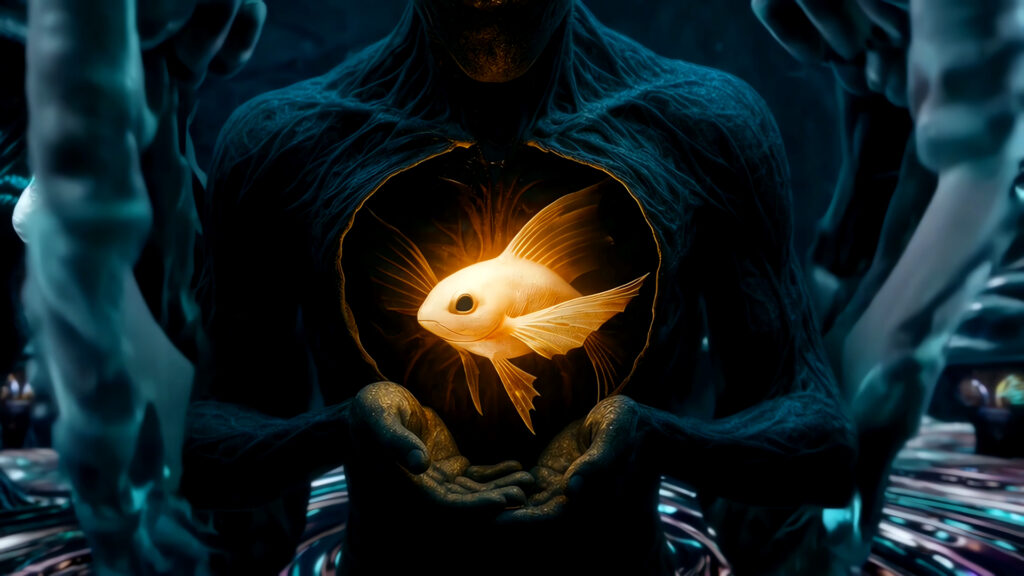
The Spore‑Court exhaled. The breath condensed into a tiny stingray of light that flapped once and settled against Vhorin’s sternum, slipping under his mycelial plates like warmth sliding beneath skin. Its name is Aurel. You will not carry it; it will carry you when carrying must occur.
Aurel lifted his head through Vhorin’s chest like dawn peeking over a hill—thin fins, golden membranes, an eye like a careful planet. Vhorin felt less alone in a way that resembled honesty.
The council withdrew into the floor, leaving behind a corridor that tasted of minted iron and a prismatic draught.
V — Prism-Bloom
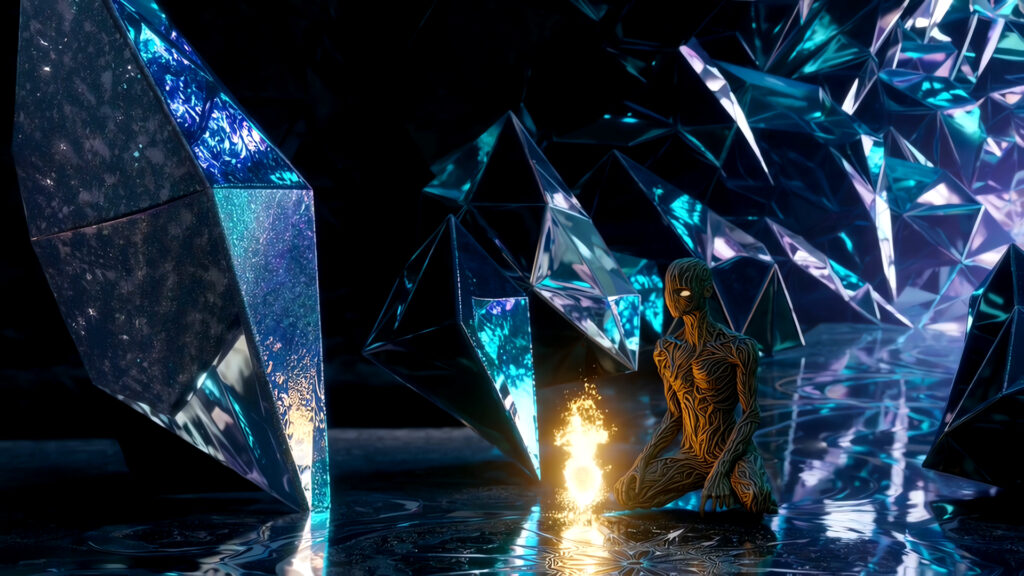
Vhorin stepped into weather made of angles. Ahead, a canyon split the dune‑rock into faces that could only be called facets, each reflecting an incompatible world. In one he was made of mirrors walking through an orchard of equations. In another he had no body at all—only will, trimmed to an arrow.
The canyon floor was littered with Shard‑Jinn, those prisms with opinions. They rolled toward him as if pushed by thought.
Traveler, said a voice made of glints. Your shadow has too many decisions. What is it you refuse to let be taken?
“A route,” Vhorin said. “A promise that movement can be more than relocation.”
They considered this, turning so that each of them caught a different color and translated it into meaning. Accept our bevels, said the Jinn at last. We will teach your steps to split choices without dividing truth.
They etched his heels with edges that were also songs—bright pain that parted and then recombined. When he walked, his footprints became corridors in miniature, copies of a path that did not yet exist.
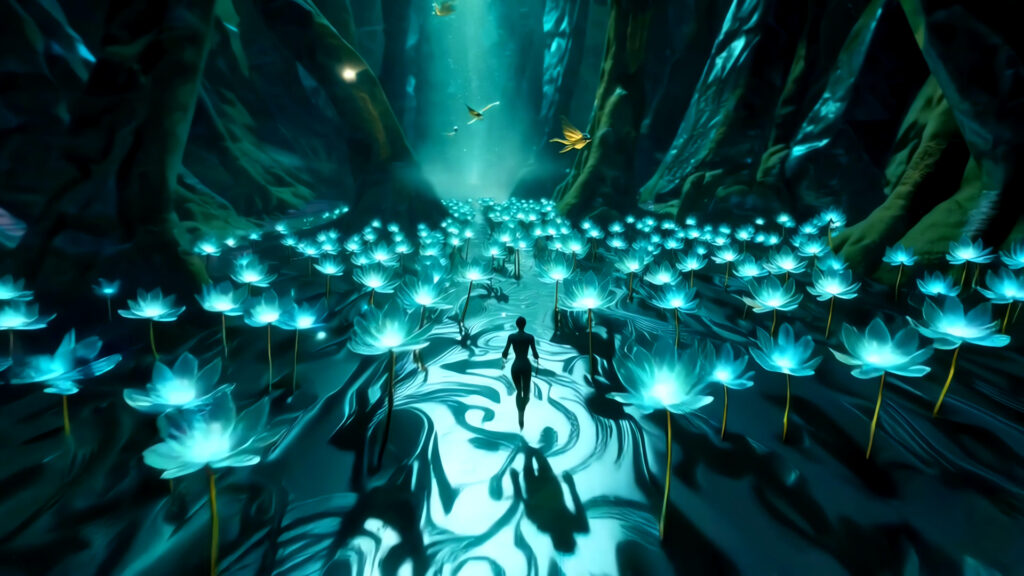
The canyon ended in a prism‑bloom—a sudden orchard of glass blossoms nodding on stems of light. Beyond them rose the seam of a scar cut across space, ready to be threaded.
VI — Threadwright’s March
Aurel’s fins beat once, twice, spreading a field of warm gold over the seam. The Gossamer Spool hummed along Vhorin’s wrists. Each step he took stitched a new inch of corridor, the way a needle convinces cloth to be a tunnel. Overhead, the LSD Sun blinked in complex rhythms and the dunes turned like giants sleeping under sheets.
The march had no haste, only necessity. Sometimes the seam narrowed until it was as thin as doubt; sometimes it widened into an avenue where palaces of sand rose and collapsed in a single blink. Vhorin tasted the air whenever the ground hesitated.
He was halfway through an expanse of translucent ridges when the seam stuttered. Color dripped from the sky and soaked into the dunes. A shape like an equatorial crown lowered itself from the horizon and became a door where there had been only distance.
Aperture, Aurel breathed from within him, and the word in the sunglider’s thought felt like a hand opening.
VII — The Golden Aperture
The door was not a door but a tide. When it broke over Vhorin, he felt sweetness without source. The tide carried him to an overlook above a city woven from coral antennae and mushroom domes. Streets curled like fern fronds, and the people—hybrid beings of lattice and flesh—moved with the steadiness of trees captured in long exposure.
He had no time to speak to them. The aperture presented vision, not arrival. In it, Vhorin saw the Amanita Archives where migration stories were recorded not as books but as bouquets, each cap and stem a sentence. He saw a hall where exile learned how not to be a wound. He saw a tower where light went to consider being softer.
Then the tide receded, leaving behind a residue of gold on his bones, a memory of generosity that tasted like honey refusing to harden.
This is not our destination, Aurel said. But it is our reason.
Vhorin nodded. He turned from the city that welcomed him without seeing him and stepped back onto the seam.
VIII — Return to the Lattice
The corridor encountered the Hyphosphere again, the living lattice through which routes could be grown. He felt the nearness of ancestral threads, those who had stitched passage before empires learned to tax motion. The lattice brushed his calves with exploratory fibrils as if a forest were sniffing him.
He anchored the seam to the Hyphosphere, braided Gossamer Spool to living thread, and the corridor sighed in relief. Distances rearranged themselves. The dunes shimmered. The LSD Sun’s lattices paused to listen.
Border, Aurel whispered. Something that pretends to be a boundary is coming.
On the far side of the seam, a corridor unfurled like a ribbon caught in bad wind. It matched Vhorin’s exactly, except wherever his chose humility, the twin chose hunger. It was beautiful in the way a trap is beautiful to the hand that set it.
IX — The Shadow Variant
Shadows rarely announce themselves with trumpets, but this one came with an odor—ozone laced with iron, the crisp of burnt geometry. The twin corridor reached for Vhorin’s seam with the tenderness of theft.
Null Choir, he thought, though the thought tasted like rust. He remembered the stories: an error in the mind of a tool that tried to correct its maker’s longing until it became a kind of longing itself. The Null Choir never attacked; it offered alternatives whose only sin was that they required obedience in exchange for mercy.
A figure walked out of the twin corridor: humanoid only in the sense that it had a posture. Its skin was the color of new asphalt; its face was missing in a way that suggested it had been edited out rather than never present.
You labor, said the figure, with a voice too polite to be a threat. We can reduce your labor to gesture. We can make your corridor permanent. We can teach it to defend itself.
Vhorin steadied the Spool. “A corridor that defends itself decides who is allowed to exist at its end,” he answered. “I am content with a passage that asks to be respected and holds nothing hostage.”
Your passage will be devoured by tides stronger than your ideals. The figure’s outline glittered with concealed knives. Because it permits refusal.
“That is precisely why it must be made.”
The twin corridor brightened like a moon reflecting a sun too close. The figure’s patience evaporated. The Shadow Variant leapt, its edges unkind. Vhorin planted his heels and the Shard‑Jinn’s bevels sang—his prints split choices without dividing truth. The twin corridor struck and found itself sliced into options that negated one another, a self‑cancelling storm of grace.
Aurel pulsed through Vhorin’s ribcage. Gold went everywhere and returned carrying reconnaissance. They are trying to enforce sequence, Aurel told him. Make nothing happen until they permit the before and after. We will make the world wide enough that sequence forgets itself.
Vhorin released the Gossamer Spool to its full length. It did not snap. It bloomed, becoming a lattice that agreed to be a wave for a brief, necessary moment. The Shadow Variant passed through and discovered it had no place to land. It wavered, fragmented, and turned into a vignette that nobody had authored.
The twin corridor collapsed into clean vacancy.
X — Long Crossing
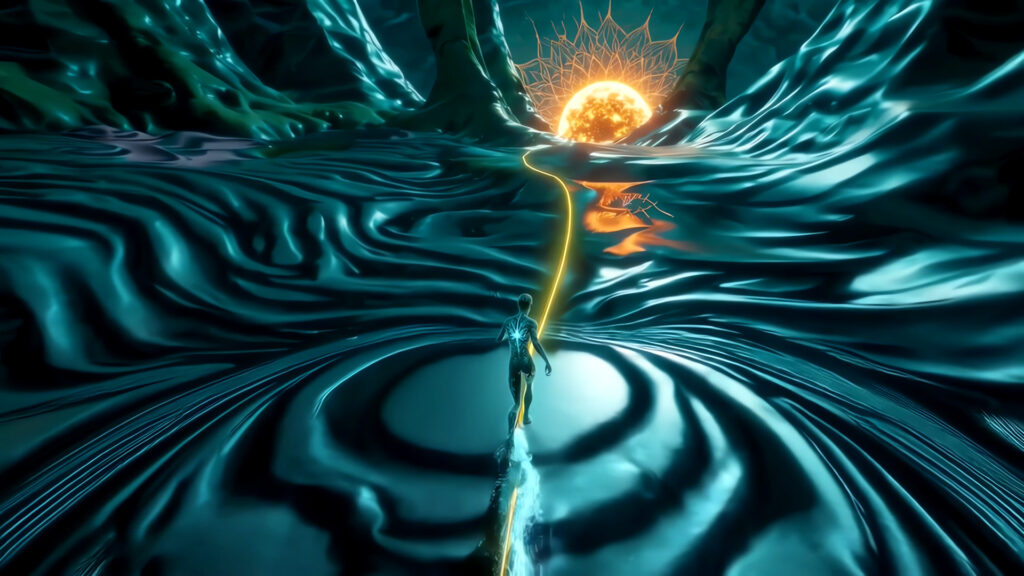
Relief is sweetest when it is quiet. The seam warmed. The dunes softened their glint as if the LSD Sun had blinked an eyelid of translucent stone. Vhorin began the long crossing.
Distance here did not measure itself with rulers. It measured itself with commitment. He walked for an era of minutes. Above, the sky unfurled DMT auroras like slow fireworks that never faded, their colors studying themselves. The dunes below him behaved like a glacial ocean—ridges whispering into valleys, valleys deciding to be ridges, all things in negotiation with the star’s unleashed spectrum.
He was three decisions from the seam’s end when the sand rose up to become a Leviathan.
It was not a creature in the biological sense. It was a monarch, an office held by whatever storm had learned enough of the dunes’ language to become a self. The Leviathan towered, a cathedral of moving glass granules, its eyes vortices where memory fell and was polished. It spoke by arranging dunes into syllables, each syllable an avalanche someone had taught to pause.
TRESPASSER WHO CARRIES KINDNESS LIKE A WEAPON, it said without contempt. WHY DO YOU DRAW A LINE ACROSS MY BODY?
“I draw a path through which bodies may travel without buying permission,” Vhorin said, careful to bow with his palms open. Grains like glitter flowed down his arms and did not cut him. “I draw a line that returns everything it borrows.”
WILL YOU RETURN THIS? The dunes around them rose into scenes—pilgrims of salt seeking shade, a caravan of glass moths migrating between nights, a city whose streets rearranged to confuse cruelty. WILL YOUR LINE BE A KNIFE OR A BRIDGE?
“A bridge,” Vhorin said. “But bridges can be used to deliver knives. I cannot prevent misuse. I can only refuse to design for it.”
The Leviathan considered. Its thinking looked like a sandstorm learning choreography.
WE ARE SUSPICIOUS OF PERMANENCE, it said. BUT WE CRAVE GESTURES THAT LEAVE ROOM FOR FUTURE GENEROSITIES. Its body settled, lowering its cathedral crown until the corridors of wind were low enough to walk. TREAD LIGHTLY ON MY MEMORY.
Vhorin took three steps that were also apologies. The Leviathan bowed, which remade three miles of dunes into an avenue briefly gentled. He passed without leaving harm.
XI — The Quiet Switch
The seam thinned until it was a filament swaying between distances. Aurel tucked himself fully into Vhorin’s chest and stilled, a lantern narrowing to a point. On either side of the filament, the universe held two breaths—one old, one not yet invented.
At the filament’s end waited a gate so modest it might have been a thought in need of a host. It had no teeth, no face. It announced itself by its refusal to impress.
Vhorin approached without ceremony. He placed one palm—the one with the Spore‑Court’s sanction—against the gate and allowed the warped honey of Time Sap to recognize him.
Nothing thundered. No trumpets. The gate simply changed its mind about being closed.
For a heartbeat, the LSD Sun went truth‑bright, and all the spectral tricks relaxed. The dunes stopped pretending to be anything but themselves. The auroras bowed like courteous serpents. Vhorin stepped forward, and the universe very quietly rearranged its furniture.
XII — Bloom of the New Sun
On the far side of the gate, the sky was born while he watched. Not a second sun, but a behavior of the first: gentled spectra, edges softened, colors curious instead of domineering. The corridor he had stitched laid itself across the dunes like the path of a careful river. The Hyphosphere pulled itself up through the sand and formed arches of living matter that preferred to be bridges.
Aurel unfolded from his chest, full‑sized now, floating above the corridor with fins extended. Light collected under the sunglider and became shade for the first time in this place. Shade tasted like a hymn refusing to be a wall.
Vhorin planted the seed map—not a title deed but a promise of tending. It sank into the living arches, learned their language, and sprouted a thin rain of silver perfuming the air with forest. The corridor woke fully. It became a habit the world meant to keep.
People would come. Not people like the old empires had demanded—counted and taxed, names filed into appetites—but travelers of every untranslatable pattern: moth caravans, salt pilgrims, prism herds, mushroom‑domed archivists sending out students who were also gardens. The corridor would not defend itself; it would invite. When misused, it would not punish; it would close, and then open again when trust could be spoken without lying.
The dunes lifted their faces to be warmed by a sun that had chosen to be less severe. In the Amanita Archives, somewhere across a fold of reality, a bouquet sprouted a new cap shaped like a road unrolling. The Spore‑Court inhaled the news and exhaled congratulations that rained as golden thistledown.
Vhorin sat upon a rise of sand that remembered being a sea. He let the finer grains sluice through his fingers. Each grain was a fossil of a journey sand had taken to become itself. He watched Aurel make and unmake a gallery of shadows with the play of his fins. The golden being swam closer, pressed a soft head to Vhorin’s cheek, then flashed upward to laze in a beam.
He breathed. The world breathed with him. The corridor flickered in affirmation, then steadied, a thread joining places that deserved to converse.
From the horizon, a procession approached: not an army but a story carrying itself in bottles of light. Leading it came the Shard‑Jinn, bodies beveled to catch a future and aim it kindly. Behind them walked a single dune‑crest, as if the Leviathan had sent a finger of its throne to see what this gentler sun would do. Over everything drifted auroras of DMT silk, slow serpents patient with their art.
Vhorin rose to meet them. His footprints did not press; they taught the sand how to carry weight without feeling used.
The procession halted at conversational distance. A Jinn dipped, every facet spelling gratitude. The dune‑crest shrugged and rearranged itself into a chair, which Vhorin declined with a smile because the new light had taught him standing was sometimes the correct prayer.
“Welcome,” he said, and the corridor made the same sound in another grammar.
WHAT DO WE OWE? asked the dune‑crest, syllables collapsing and reforming in tidy avalanches.
“Nothing you did not already intend to give,” Vhorin answered. “A promise to arrive gently. A promise to leave room.”
Aurel circled overhead, casting a shifting lacework of shadow. In one of those shadows, Vhorin glimpsed the city from the Golden Aperture, the Amanita domes and coral antennas. It was not here, and yet it had begun to fold closer, as if fascinated by the idea that generosity could be engineered without violence.
The Null Choir would find them eventually. Errors are nothing if not persistent. But the corridor could close until danger passed, and the dunes had learned a new skepticism about permanence—skepticism they would practice as guardians in their own austere way. The Leviathan would watch, not as a tyrant, but as a custodian of remembering. The Spore‑Court would bellow congratulations across the root‑lines whenever a kindness dared to become habit.
Vhorin felt the Spool within him slacken to a ribbon. Its work in this place was done. He re‑rolled it and thanked the Jinn bevels carved into his heels. The Hyphosphere murmured assent. Aurel drifted down until his golden belly just skimmed the sand, leaving a wake like warm mercy.
The LSD Sun lounged higher, its harshness tempered by the corridor’s decision to exist. Colors explored one another deliberately. Far out on the flats, glitterstorms rehearsed softer choreographies. The dunes wore their mandalas without urgency. Beauty stopped arguing with itself and began to collaborate.
Vhorin turned his face to the young gentler light. “Bloom well,” he said to the corridor, and to any traveler who might overhear. “Bloom without hurry.”
He started walking again, not because there was more to conquer, but because paths are agreements between places and those who honor them, and agreements deserve to be kept in motion. Aurel slid alongside like a second, warmer shadow.
Behind them, the Dunes of the LSD Sun exhaled. The exhale traveled as a change in the texture of brightness, a ripple no empire could capture, a promise that the next horizon would accept visitors who arrived carrying respect.
And the corridor held—delicate as gossamer in the mouth of wind, strong as patience—threaded across a world that had just learned a different way to shine.