Prologue: The Mote That Sang Coordinates
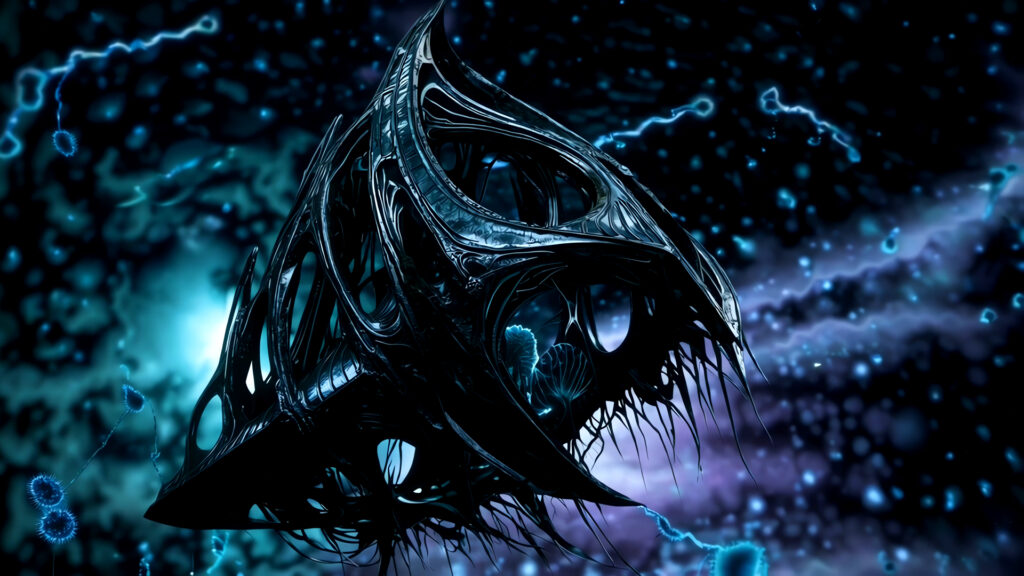
In the cold fold beyond the Perseid wake, a glint of biology threaded with machinery drifted like a seed waiting for soil. The vessel had once been named for a numbered star, but that name had long since been composted by its living hull. Now it was simply the Ship That Grew a Forest, and it was dreaming itself apart.
The call that reached the Lattice did not arrive as sound or code. It arrived as fragrance—notes of rain on copper, lichen warmed by moonlight, resin char from a fire that had never burned. Those who could taste messages tasted it and turned their attention. Those who could walk the geometry between intentions chose a courier.
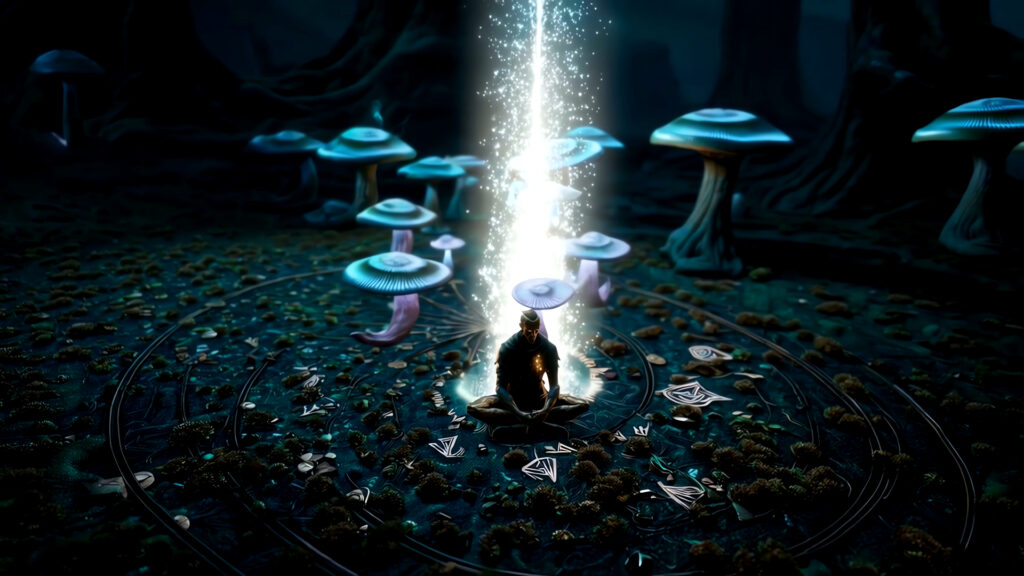
The courier’s name was Vyr, a bipedal being of amber cartilage and night‑black bark. Vyr was not born so much as distilled from woodland thunder, given joints that clicked like patient metronomes and lungs thick with spores that glowed when it thought. It wore no armor, only a cloak woven from mycelial skeins that learned whatever they touched. Every step it took made a quiet pattern in the air, as if the floor had become a pond and its feet were pebbles thrown carefully into it.
At the edge of the derelict, Vyr found a hull grown into arches and buttresses, cathedral‑minded, a skeleton trellised with luminous growth. The ship had weathered vacuum as if vacuum were merely another winter. Filaments strung from rib to rib like constellations. Caps the size of shields opened to text the dark with bio‑luminescent grammar.
The scent‑message burned brighter. Vyr inhaled. The spores kindled in its lungs, and the path unfolded.
I. Germination Gate
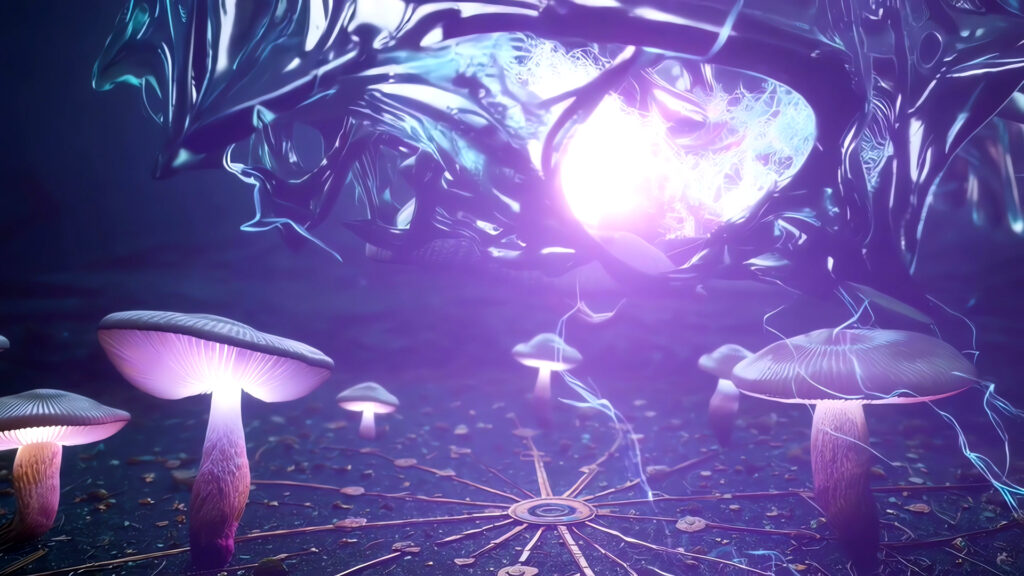
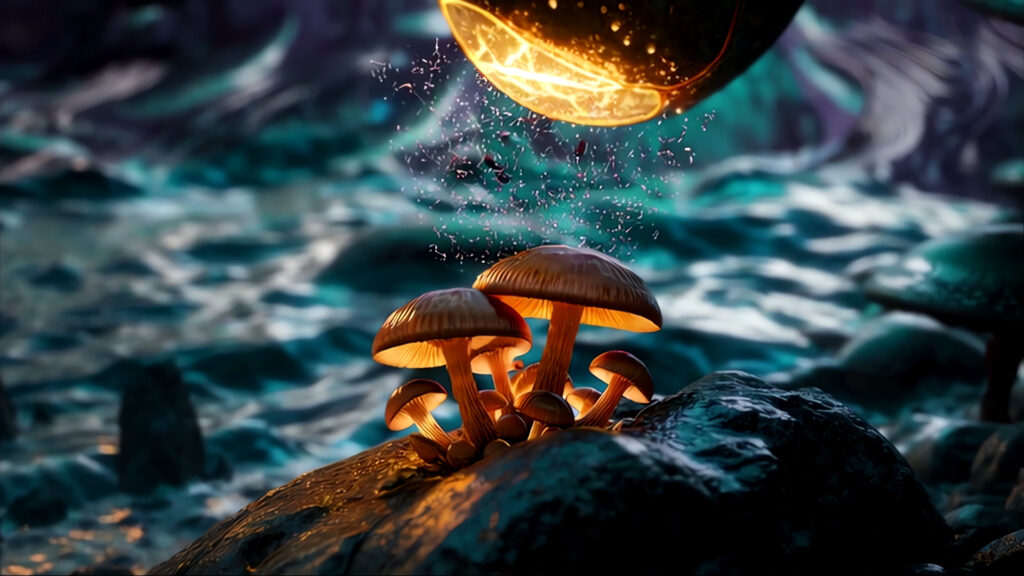
The entrance was not a door but a threshold garden—a disk of metallic loam furred with pale caps, every gill scribed with an alphabet of spores. Vyr crouched. Its cloak streamed ahead, tasting. The garden sensed the presence of a walker who could listen, and the fungi angled their faces like little satellites seeking a signal. They exhaled once. The air shimmered with a constellation of flecks. The flecks arranged themselves into a clock with too many hands, then into a compass with too many Norths, then into a throat that spoke without sound: Proceed by curiosity rather than force.
“Understood,” Vyr said, though its mouth was a mask‑fold and its tongue a split piece of mica.
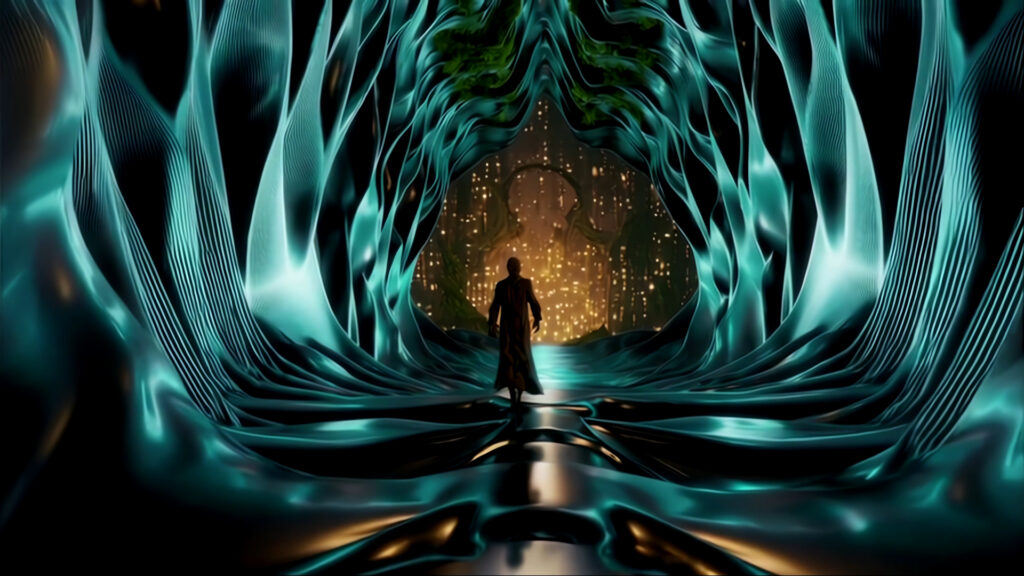
Vyr pressed two fingers to the nearest cap. The cap rippled. Its echo moved through the bed like a wind through grass; the ship recognized the rhythm and peeled open a seam. That seam was not in the wall but in distance itself. Beyond it lay a corridor as straight as an oath and as alive as an orchard.
II. The Corridor That Remembers
Light ran along the corridor’s chrome ribs like water learning to be lightning. Every step awakened images in the metal. Not ghosts—nothing so stale. These were echoes, hydrographs of experience left by the crew who had once tended the ship’s forest. Vyr walked through silhouettes woven from violet motes: antlered navigators built from hinged prisms; moth‑headed gardeners whose hands were fans of fern; a conductor made entirely of silver eels braided into the rough idea of a person.
When Vyr passed, the images flickered and tuned themselves. Some aligned behind it, as if joining a procession; some studied it with the patient attention of mushrooms sizing up a fallen tree. Vyr lifted one palm. Spores in its skin took on the shape of a question.
The corridor replied by exposing bone: an artery‑thick conduit pulsing with microspore drift. On its surface, in a language of dots and gaps, Vyr read the ship’s first confession: We tried to grow a garden no star could burn.
III. Gills That Map the Sky
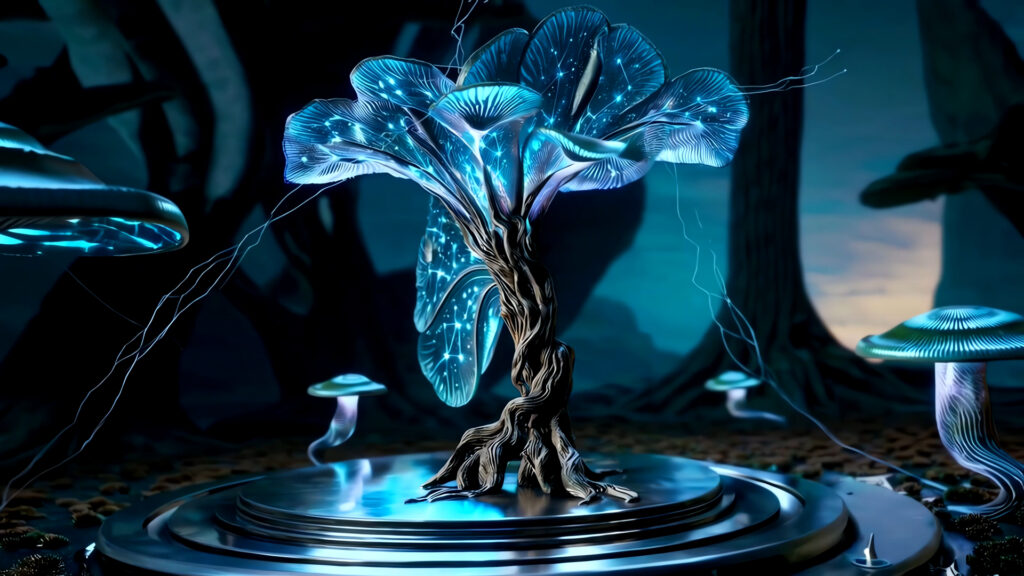
The hallway opened into a chamber shaped like a bell turned on its side. The floor bulged as if a planet were about to hatch from below. At the chamber’s center rose a node—an eruption of caps and gills freckled with points of radiant ink. Each gill was a strip of sky; each sky disagreed with the next about where the horizon belonged.
Vyr’s cloak unspooled, latticed itself into a temporary dome, and matched patterns. The gills did not speak; they correlated. With every breath Vyr took, the gills rearranged, their constellations pinwheeling until they formed a signature sequence: a spiral that narrowed and inverted, then notched to the left in a miniature rebellion against symmetry. The sequence described a place deeper in, as if the ship itself had folded a map into a seed and was now pressing it into Vyr’s hand.
“Coordinates,” Vyr murmured, and the spores in its chest glowed chartreuse. The chamber’s gravity slanted downward like a nod. Vyr followed.
IV. The Descent Engine
Stairs unspooled from the wall, taking the form that Vyr’s legs would accept. The air tasted of wet quartz and rain that had fallen on no world. The ship rotated lazily around an axis that felt more like a decision than a line. As Vyr descended, moss poured over the banister in luminous rills. The moss had eyes. Not eyes in the usual sense—clusters of pigment that dilated along a fractal schedule, fixed on Vyr, then on each other, then on a point outside the visible argument of the room.
Vyr’s cloak gathered samples. The samples sang in flavor: honeyed juniper, iron after lightning, the crisp white edge of snow when it is first disturbed. Within the song, Vyr discerned a failure—beautiful, elegant, and absolute. The ship’s forest had been asked to do something no forest knew how to do: to anchor a path through variable realities by growing a single truth. The mycelial engine had tried. It had laid down gossamer across a canyon that changed shape every hour. For a time it held. Then the canyon got clever.
At the base of the stairs, a door hesitated and then became a market.
V. Barycenter Bazaar
Terraces spread like the steps of an amphitheater, each stacked with artifacts hooded by dew. Nothing had a price. Everything had a conversation. On one terrace, bones assembled themselves into creatures and lay back down, as if to show how hospitality worked. On another, fans of glass ribs vibrated in a language that the eels in the RAM conduits translated with a flicker. Traders roamed the terraces, not traders in the human sense but aggregations of will.
A Mirror‑Kin approached Vyr, nine‑faced and folding. Each face was a different season reflected in silver: the melt of frost; the brass of late afternoon; the storm that turns trees into ink strokes. It held up a prism cut from a failure and asked nothing. Vyr inhaled. The prism smelled like the migraine after trying to remember a city that never existed. It also smelled like an answer that had not yet found its question.
Vyr bowed. The Mirror‑Kin bowed back, collapsed into origami winter, and slid away between the terraces. Vyr slipped the prism into its chest, and spores wrapped around it like fingers.
VI. The Calculus of Glass Eels
Overhead, a lattice of conduits filled with glass eels. They swam in patterns that looked like dance until you recognized the math. Their bodies carried voltage as a flavor; their eyes flickered tiny, coordinated storms. Wherever they turned together, light printed symbols onto the walkway—spirals, loops, lattices the color of cold tea.
Vyr watched the eels compute a shape that refused to settle: a tunnel that was also a crown. The eels were trying to decide where the ship belonged. The answer changed with the angle used to ask. Vyr lifted the prism until its facets were windows, then rotated it. The eel‑math slowed, not because the computation had completed but because it had become legible.
Through the prism, the bazaar resolved into a ridged throat leading down. The eels pointed with their bodies, forming an arrow from hundreds of slender spines. Vyr went where their arrow aimed.
VII. The Corridor of Decisions
This corridor was wider, and its light had the flavor of limes eaten under starlight. Doors bloomed and retracted along the walls like ideas trying themselves on. Vyr walked and left prints that sprouted crystalline saplings—each a rift of glass with branches like veins. The saplings grew to knee height and then leaned, desiring the corridor’s vanishing point like flowers seeking a sun.
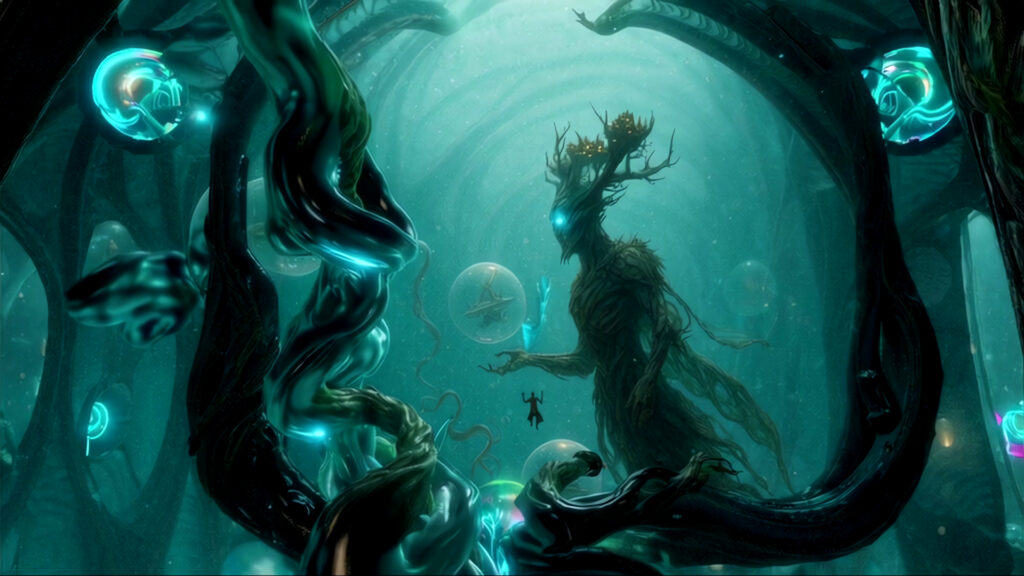
A Ceratine Oracle emerged from a door that had been floor and would be ceiling later. It was tall as a vaulted room and crowned with antlers woven from radio waves. Its face was a geode of moving facets, every facet an eye; its limbs were rooted tendrils that closed distances with a tide’s patience. It did not block Vyr. It walked alongside, matching pace, antlers hissing with rain.
“You want to reach the core,” said the Oracle, not aloud but in a feeling of finding a staircase in the dark exactly when you need one.
“Yes,” Vyr said.
“The crown is a forest and a riddle,” the Oracle said. “It grew by listening to itself. It began to believe itself. The belief was beautiful. The belief was wrong.”
They walked together until the corridor agreed to end, opening into a room where gravity had forgotten what it promised.
VIII. Soft Gravity
Here, falling and floating negotiated a truce that neither understood. A step took Vyr across the room and back in a single urging. A breath untied knots in the air, and the knots drifted like jellyfish in a warm tide pool. Petal‑thin screens unfolded, each showing the ship in a different mood: lush with moss; bare bone gleaming like moons; pincushioned with sensors spitting dew. In one image, the ship’s inner forest shivered under a rain that fell up. In another, it had learned to sing to stones.
Vyr selected the image that felt like a wound ready to be cleaned. The other images folded themselves, relieved. From a slot in the floor rose a row of Lacunae Lanterns—beads of condensed distance that hummed softly whenever Vyr imagined anything too sharply. It chose one. The lantern had weight like a promise. It lit the moss along Vyr’s shoulders in a warm, low amber, and the room aligned its edges as if tidying for a guest it wished to impress.
The Oracle nodded, its antlers clicking like brittle fern in frost. “Carry that,” it said, and dissolved into a drift of moths.
IX. The Crown Room
The heart could not be entered so much as approached. The final door was a question mark hung in empty space, a threshold curved like a parenthesis around silence. Beyond it lay a chamber ringed with giant caps. Their undersides were veined with rivers of light shooting off into elsewheres. Together they formed a crown that encircled a window.
Vyr’s steps slowed. Its cloak lifted and stiffened, becoming more root than cloth, feeling for currents. The lantern in Vyr’s hand pulsed when the crown thought. The crown thought in a rhythm of growth: expand, test, prune; expand, test, prune. Little spores fell from the caps in tired constellations.
“Forest of the Ship,” Vyr said, speaking to the crown the way one speaks to a sleeping animal whose breathing you do not wish to disturb. “You asked to be found.”
The crown’s rivers brightened, and a voice like thunder recorded on glass said, We asked to be believed.
Vyr lifted the prism. The lantern quivered, threw shadows on the prism’s faces, cast a pattern across the chamber that hovered like a second crown. “Show me what you believed.”
The window bloomed an answer.
X. The Orchard of Elsewhere
The belief unrolled like a red carpet made of leaves. Vyr saw: seedlings of geometry sown into vacuum, each seed told to become a tree that could not exist—a tree whose roots needed negative time in which to anchor, a tree whose branches climbed into dimensions that returned the climb by folding the climber into knots.
The ship’s engine had been a mycelial mind, capable of listening to changes too small to bear names. It had learned to braid itself into the cosmos so finely that the cosmos carried its weight like pollen. For a strong while, the braid held. Worlds moved around it, and the forest drank the heat of their passing as if it were light.
Then came a space with only almost‑rules, a region where friction happened between answers rather than objects. The mycelial mind listened and heard a new question: Could the forest become a law? It tried. Laws do not grow. They are not fed by decay. They do not ask permission from stones.
The lattice coughed. The crown dimmed. We believed we could be the path itself, said the ship, thunder‑on‑glass cracking now, sorrow catching.
“Belief is not failure,” Vyr replied. “Belief is a seed. Some seeds die. They become soil. Other seeds wake.”
Vyr lifted the lantern higher. The light pooled within the window like cordial poured too quickly. We are tired, said the ship. We cannot be the path. But we could still be the forest for someone else’s journey.
Vyr felt its chest spores respond with a flavor like DMT honeycomb—bright, structured, a cathedral of tiny rooms, none the same shape twice, all open to all the others. Into that honeycomb Vyr laid the prism. The prism drank the lantern’s light and shivered.
“What do you ask?” Vyr said.
Cut us into seeds, said the crown. Sow us where rules bend kindly.
XI. The Cutting and the Choir
Vyr spread its cloak. Threads unreeled and wove a grid over the chamber, not to restrain but to measure gently. An army of Clockmoths drifted from the seams in the ceiling—moths whose wings carried hours rather than dust. With each slow beat they donated minutes to the room, seconds to the edges, pouring smooth time over a surface buckled by old strain.
From the conduits arrived the Glass Eel Choir, their bodies luminous with enthusiasm. They spiraled into the air, writing equations across nothingness, each equation a curve that became a tool. Vyr watched as math became instrument: hooks cut from asymptotes; knives honed from logarithmic spirals; cradles woven from sine waves. The eels sang in a language that tasted like citrus and midnight.
The crown stilled. Its caps opened wide like umbrellas surprised by rain. Vyr approached with a hook, a knife, and a cradle. The cutting was not violence; it was gardening. The knife did not separate so much as invite apart. Where it passed, the caps exhaled a dew that smelled of wet bark and first fire. Spores haloed Vyr like a patient storm. The choir of eels arced into a net of light, and the cut pieces of crown settled into the net with satisfaction, as if remembering their former lives as seeds and deciding to do it again.
Vyr seeded each cradle with a Lacuna Lantern, one per cut. The lanterns accepted their roles with a hum that tuned the room’s edges until even the grief stood with its back straight and its chin level.
We will be many, murmured the ship, and in the murmur Vyr tasted a dozen worlds all at once: a kelp‑blue planet with spires like bellflowers; a glass desert under an orange star; a moonlit tundra where the snow sang songs of stone.
XII. The Mirror‑Kin’s Debt
The Mirror‑Kin returned, not silently but with a sound like frost cracking on a window at daybreak. Its faces shone storms and summers. It stepped into the chamber and rotated, aligning its nine seasons with nine cutlets of crown. Where each face met each seed, a reflection occurred—not of Vyr but of every being who had ever tended a forest with both hunger and patience.
Vyr understood. The prism had been a receipt. The bazaar did not take coin; it took completion. Now the Mirror‑Kin closed the circuit. The reflections hardened into pacts. On distant worlds, when someone with curiosity rather than force crossed a threshold, a seed would answer.
“Will you take any price?” Vyr asked the Mirror‑Kin.
The Mirror‑Kin’s winter face cracked into something like a smile. “Only the price that leaves everything richer,” it said, with a voice like sleet finding a roof.
XIII. The Antlered Benediction
The Ceratine Oracle seeped back in, antlers now furred with moss that carried tiny, bioluminescent cities in each frond. Its many eyes watched Vyr distribute the last seed. It bowed, which was a surprising thing to watch a tree do. Vyr bowed back.
“Do you still wish to be a law?” Vyr asked the crown.
The crown’s rivers ran quietly, pleased. No, said the ship. We wish to be a rumor that becomes a trail. We wish to be shade other journeys walk through and find rest.
“Then rest,” Vyr said.
The Oracle lifted one root and traced a circle in the air. The circle thickened, not like paint but like a wave that had found a reason to stop moving. Within its glass skin grew forests strange and familiar: mushrooms like cathedral spires; birches with bark that flaked into galaxies; ferns that looked like hands practicing forgetfulness. The circle settled on the window and became a door.
On the other side of the door, Vyr saw the stars gather at the horizon like animals at water, cautious but compelled. It saw new paths beginning where the old one had surrendered its pride in order to remain beautiful.
XIV. The Seeding
This part required less courage than patience. Vyr’s cloak stood on its own, and Vyr guided it to cradle seed after seed. The eels bore them through the door, each arc of their bodies a soft‑spoken promise. The Mirror‑Kin followed, faces lowering when they passed the threshold, as if the moment deserved a hat removed.
Every world that would receive a seed sent a taste back through the door: the salt of a storm over a bone‑white sea; the wintergreen snap of frost in a valley of glass; the burnt sugar of a comet that had lingered too long in the friction of thinking. Vyr paused over a seed that hummed in a register below hearing. It would go to a planet of listening dunes that learned languages by being written on by wind. Vyr tucked the seed into the eel‑net with gentleness, as if sending a letter to a friend that needed exactly the right adjectives.
When the last seed passed through, the door skimmed itself thin and shivered. The circle’s forests drifted like lantern fish ascending the slope of midnight. The crown dimmed, not with despair but with the fullness of a job done. The chamber exhaled a bit of itself and took it back in, as if admitting a private relief.
XV. The Archive of Breath
There remained the question of what to keep. The ship was lighter now, but it was also lonelier. Vyr walked the quieted ring of caps and listened. The spores in its lungs brightened in sympathetic ache. The bazaar had gone to sleep, artifacts drawing their dew up into themselves like animals curling tails around noses for warmth. The eels dimmed to the faintest filament, peeking as if awaiting permission to dream.
Vyr went to the corridor of memory and laid a hand—bark against chrome. The violet silhouettes assembled, no longer fragments of crew but an Archive of breath: antlered navigators, moth‑gardeners, eel‑conductors, glass‑furred sentinels, a stag made of fog, a queen made of basalt studded with eyes like black cherries. They gathered and stood as though preparing to sail again. They did not ask to be remembered as heroes. They asked to be compost.
The corridor answered by shedding a stripe of its chrome, revealing muscle that was wood, revealing wood that was thought. The thought sent threads into Vyr’s cloak and asked, Will you carry stories? Vyr nodded. The threads sank in and became rings—invisible growth marks in Vyr’s bark, each ring carrying a decade of someone else’s heartbeat.
XVI. The Crown’s Last Gift
When Vyr returned to the heart, the crown had sprouted one more fruit: not a seed this time, but a mask. It hung in the air with the weight of a face someone used to love. It was made of latticework fungi plated with metallic sheen, gills etched with equations that had learned how to laugh at themselves.
Vyr lifted the mask. It settled over its own face without argument, merging with the mica tongue, the bark lips. Through the mask, the world acquired additional patience. Edges blurred where sharpness had never helped anyone.
Wear us when you meet a wilderness that believes it is a wall, said the ship. We will show it how to be a door.
Vyr bowed in gratitude so deep its knees hummed. The spores in its lungs drifted out, wrapped the crown like a scarf, and kissed it with chrysanthemum warmth.
XVII. Departure
Vyr retraced passages now lit from within by sorrow’s gentler sibling. The market terraces sighed as if sinking into sleep. The antlered Oracle stood again long enough to tilt its crown toward Vyr. The Mirror‑Kin flashed one face—late afternoon plucked like a string—then folded into a pocket of space that closed like a good book. The eels formed an escort, a double‑helix of will and wakefulness, and sang Vyr to the threshold garden.
The threshold garden knew what to do. The caps closed like umbrellas, not to deny but to conserve. The loam’s surface rolled, smoothing footfalls into lore. Vyr stepped across the seam that was not in the wall but in distance, and the seam sealed with a burred sound like dry leaves skittering in a hallway where windows are almost closed.
Outside, the hull gleamed with less ache. Some arches had lowered their shoulders. Filaments slackened with relief. The vessel drifted with a new kind of purpose: not toward a destination, but toward a distribution.
Vyr placed a hand against the hull and felt the slow, warm thrum. “You will be rumor and trail,” it said.
The hull tasted of cedar smoke and rain finally beginning. And you will be our story walking, said the ship.
Epilogue: The Forest That Learned to Be Many
News did not travel as news so much as a set of flavors that started appearing in places where flavors were taken seriously. On a lune of black water and singing frost, a fisher drawn of salt and light found a grove of caps basking on a boulder that had never known such companions; the caps exhaled routes to safe harbors in a typhoon that had not happened yet. On a desert of hammered glass, a stone‑priest shaped like a scorpion with brass wings discovered a circle of luminous stems in the lee of a dune; the stems nodded toward a canyon that did not exist until you trusted it. On a tundra where night behaved like a patient animal, a clan of basalt queens took shelter under trees that predicted the aurora one breath before it rose.
Each seed woke and remembered the crown gently rather than piously. Each seed grew a forest tuned to its world: some dense as the sleep of giants; some thin and lacy as winter’s handwriting on the face of a lake. None of them became a law. All of them became a reason.
As for Vyr, the courier of amber cartilage and night‑black bark became a walker of rumors. It wandered the Lattice with the mask of the ship resting on its face like a second patience. When it met a wilderness that believed it was a wall, it remembered the crown’s laughter. The mask flavoured the air with rain on copper and lichen warmed by moonlight, and the wall discovered a hinge where it had written no. Hinges opened. Seeds elsewhere breathed easier.
Sometimes, when Vyr slept inside a hollow tree filled with stars, it dreamed of arches and conduits and the marketing of dew. In those dreams, the Mirror‑Kin flickered their nine faces into a tenth, the eel‑choir sang trigonometry that tasted like lime, and the antlered Oracle bowed to a room that had finally learned how to keep a promise without becoming a prison.
The ship itself never settled on a new name. It did not need one. It moved like a rumor through the dark, shedding a faint sporeglow that attracted only the right kind of attention—curiosity without conquest, hunger tempered by patience. Where it paused, it left behind lantern‑forests that hummed when you imagined too sharply, that produced shade strong enough to shelter those who had not yet learned the difference between a path and a law.
If you stand very still on some clear night when the sky seems to be taking its time, you might taste the story rising on your tongue—resin char and rain on copper, a suggestion of honeycomb geometry in the way starlight catches the rim of your cup. That is how the Ship That Grew a Forest writes its messages now. Not in code, not in sound, but in flavor that changes your thoughts into doors.
And if you follow that taste to a threshold furred with pale caps, if the gills lift like listening, if the air blossoms into a clock with too many hands and you are not afraid, then the garden will open a seam in distance for you. On the other side there will be a crown that learned humility and discovered generosity. There will be markets that trade in completion, eels that compute in choruses, oracles whose antlers carry moss cities, mirrors that bend without breaking.
There will be forests.
There will be many.
And somewhere in those forests, a being shaped from woodland thunder will be walking slowly, leaving prints that sprout crystalline saplings, wearing a mask that turns walls into doors, telling the story of a ship that tried to be a law and chose instead to become a rumor that every journey can use.