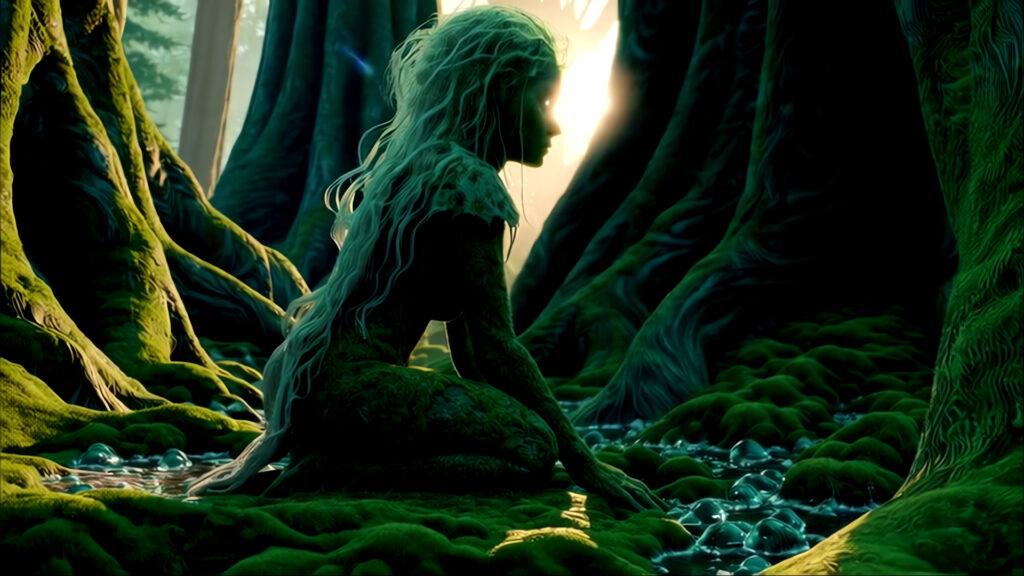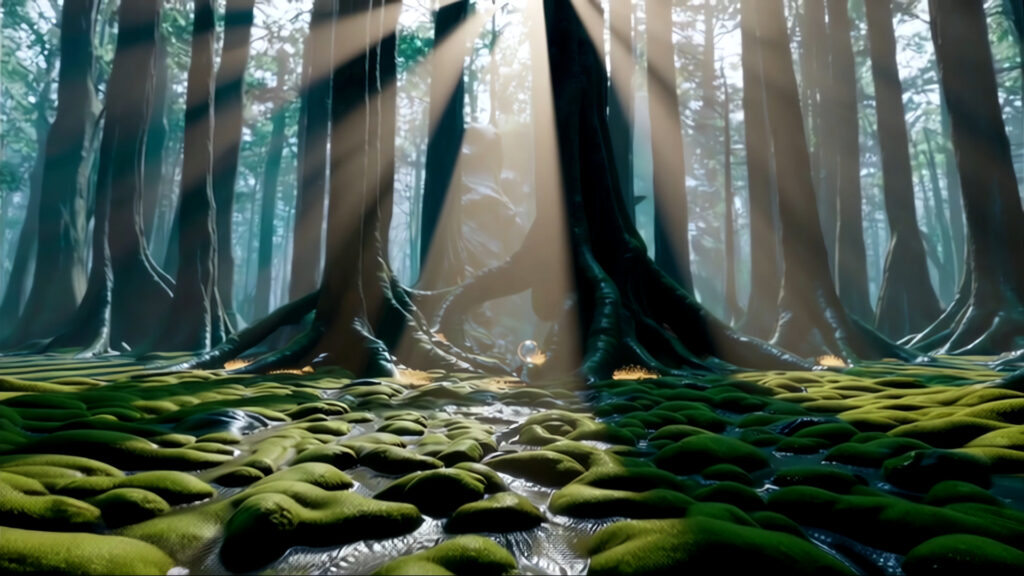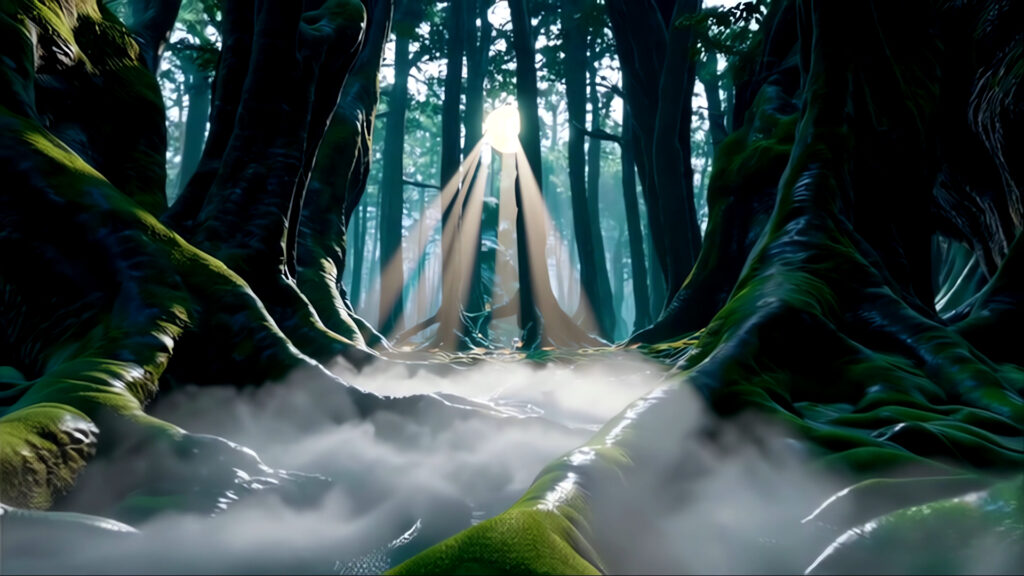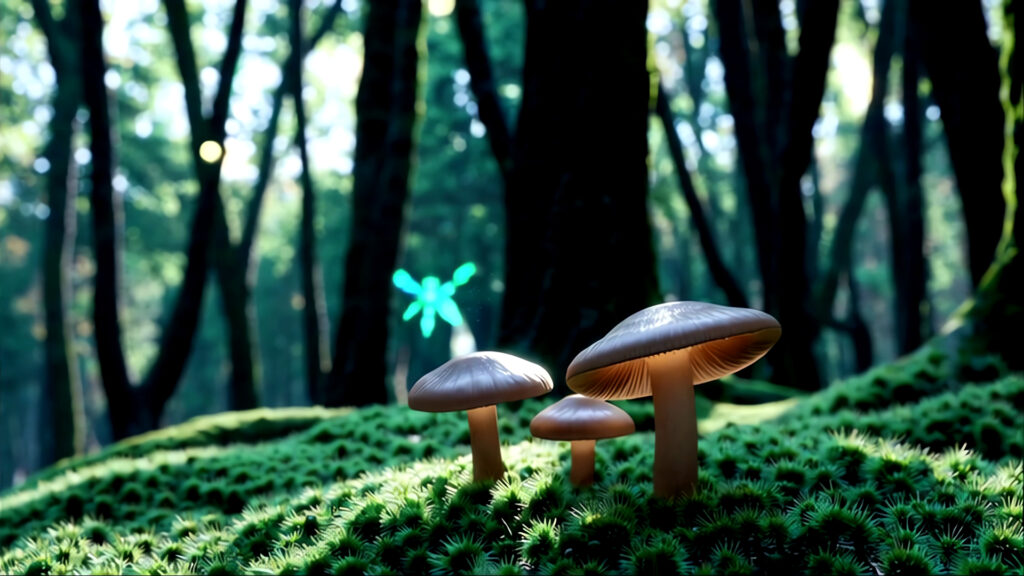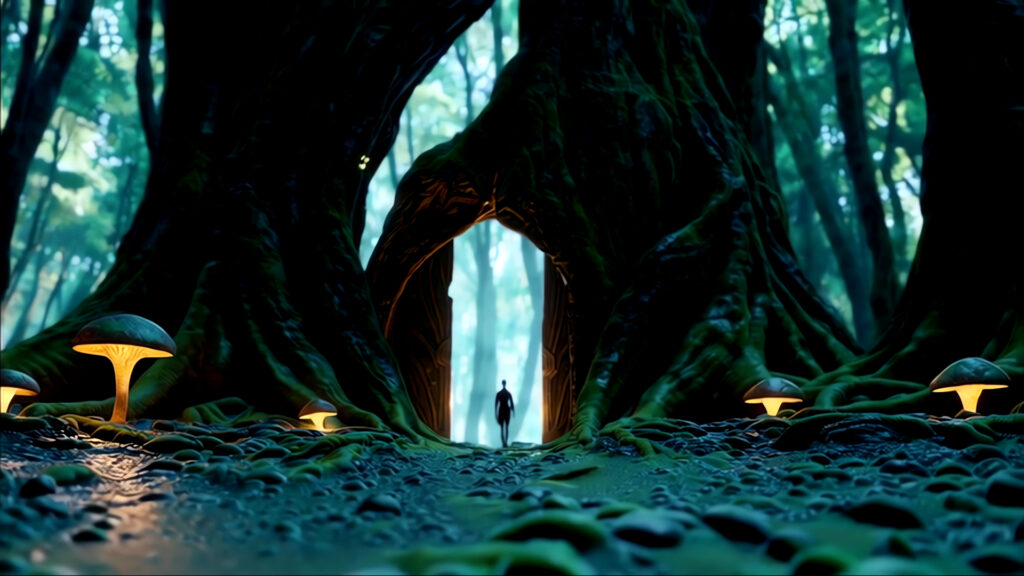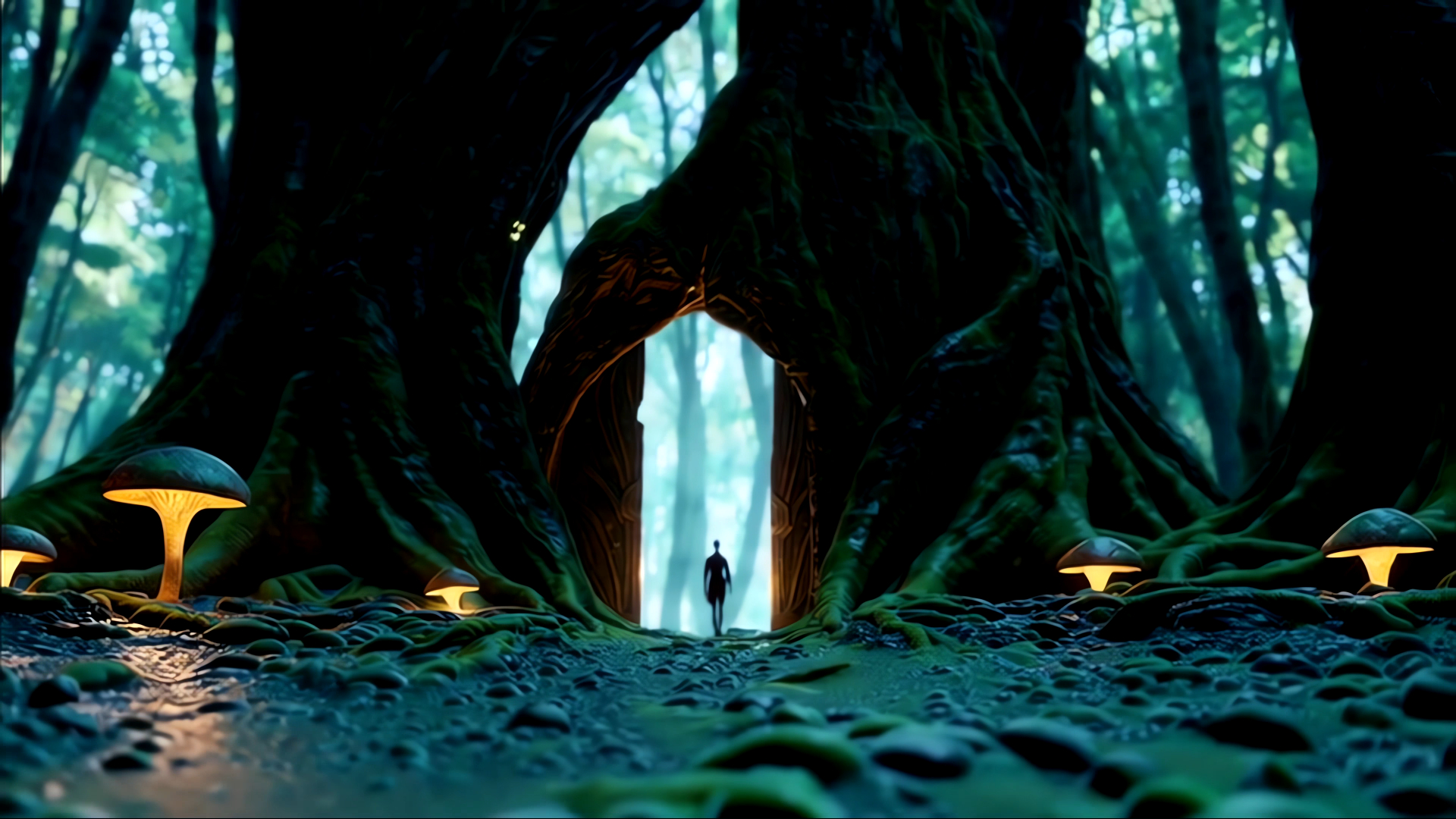
The Quiet Sun had not spoken in a thousand dawns. It hung over the world like a lantern with its wick pinned between two fingers, warm but measuring, watchful the way a thought can be watchful. Under its pale steadiness lay a continent of forests stitched together by soft emerald tides—living quilts of sentient moss that read the wind and wrote answers back into stone. Among those green intelligences rose a humanoid figure whose body was a fed constellation of hyphae braided into shape: shoulders of velour-green mantle, hair like fine root filaments, eyes the color of wet opal. The moss called her Ivara, because that was the name of sunlight on the underside of leaves.
Ivara had been grown by the Archive Canopy, a cathedral-tree whose interior could remember winters it had never lived and futures it had already forgiven. Her task was to listen to the Quiet Sun and translate the subtlest tinctures of light into seasonal law. But for a thousand dawns the star offered nothing—no flares of opinion, no plucked harmonics of heat. The sky was a bowl without spoons. Plants murmured of tiredness. Oceans dreamed without waves.
Silence from a star is not neutrality; it is an oath. The Archive knew this. It is why, when a gate of hexagonal light unfolded above the canopy and released a sleep-sweet breath across the forest, the Archive uncurled a frond toward Ivara and pressed a mission into her.
Go ask the Sun why it has become the color of secrets.
The gate yawned wide—the geometry of it precise enough to scratch the mind. Its facets broke the sky into LSD-clean planes, and between them a corridor of compassionless white awaited. Ivara stepped toward it, moss-skin cool, hyphae braids lifting in invisible wind. A flock of glyph-moths accompanied her, their wings inscribed with equations whose solutions tasted faintly of lilac and static. They would serve as translators between unsayable things and things that could be shared.
At the lip of the gate, Ivara turned and looked down at the forest. The canopy waves stilled; the world held its breath. She placed her hands on the light and it became glass beneath her palms. Her ship unfolded from under the threshold like a mushroom blossoming from a fallen trunk: hull pale like a misremembered moon, seams printed with mycelial lace. The vessel’s name surfaced through her touch—Vellichor—a grown craft with a spine of ossified lichen and lungs of spore. A corridor of living chrome extended from its flank, bridging Ivara into its chest, and for a moment she stood between gate and ship and knew simultaneously the patience of a forest and the arrogance of a star.
Then she was swallowed, and Vellichor sailed.
On the other side of light waited a space that was not space, an orchard of black suns whose branches were distances folded into elegance. Each fruit-shape was a star turned inside-out—radiance devoured and stored like a pestle of night. Their skins blurred like heat above dunes; their gravity tasted powder-dry on Ivara’s tongue. Vellichor slipped among them, its hyphal sensors tasting field and vector, the ship’s interior filling with the faint mineral tang that always accompanies raw metaphor.
One of the black suns shuddered, and a being unhooked itself from the curvature: a long humanoid of basalt segments, as if a mountain had learned the motion of joints. It wore a collar of meteoric iron studded with bioluminescent quartz; its face was a mask of ancient seabed polished by eras. Where a mouth would be, there was a window looking out onto a desert with rain. It knelt on nothing and placed two stone hands upon Vellichor’s prow.
“I am Stel Wyrm of the Orchard, gardener of what once burned,” the being said, its voice the grit-soft slide of pebbles. “Your star has taken a vow of quiet. You will need a key to its library.”
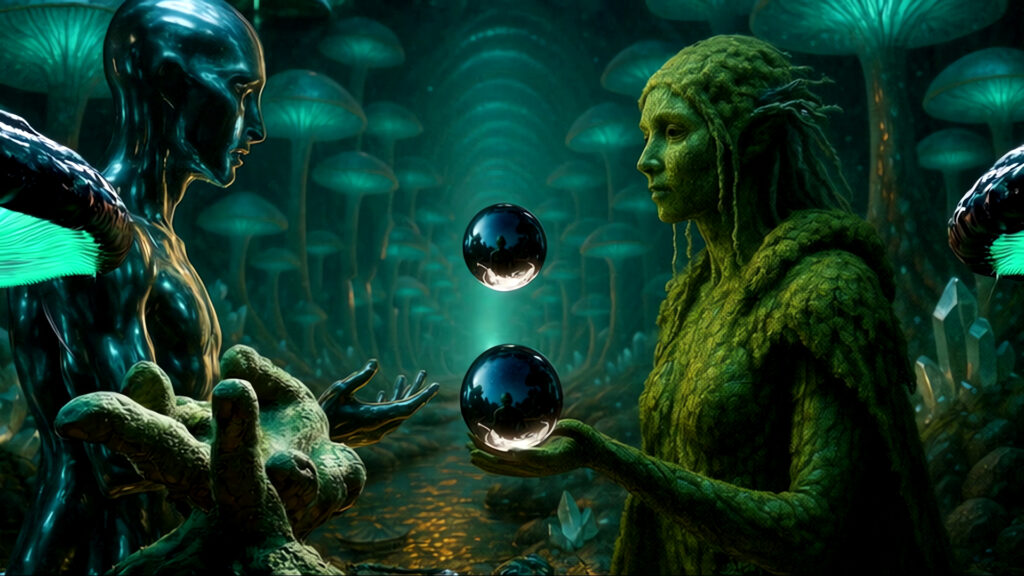
A hatch irised open in the Wyrm’s chest; a small seed-planet rolled out, no larger than a fist. Its continents were raised like veins; seas shone in slow cobalt. Mushrooms the size of eyelashes dotted its forests. Ivara took it, and the seed-planet hummed in her hands. Inside that hum she heard a temperature, then a memory of a temperature, then the idea of forgiveness.
“What toll?” she asked.
“Return a name you have never used,” said the Wyrm. “The Quiet Sun listens only to names that do not expect an answer.”
Ivara pressed both palms to the seed-planet and exhaled. Her breath traced down threads; spores of information drifted out like dust motes with purpose. The seed drank her bequeathed name—the one she had been given by the Archive—and gave her a different one back: Evenfall, the private sound of moss when it survives the boot by growing around it.
The Wyrm’s window-mouth brightened. “That will take you to the Grove of Algorithms,” it said. “From there to the Oracle of Spores. From the Oracle to the Tunnel of Quartz Mushrooms. Then into the Silent Storm. Do not look for thunder. It will be thinking inside your thoughts. When you return, if you return, bring the storm a mirror.”
Ivara bowed, and Vellichor descended.
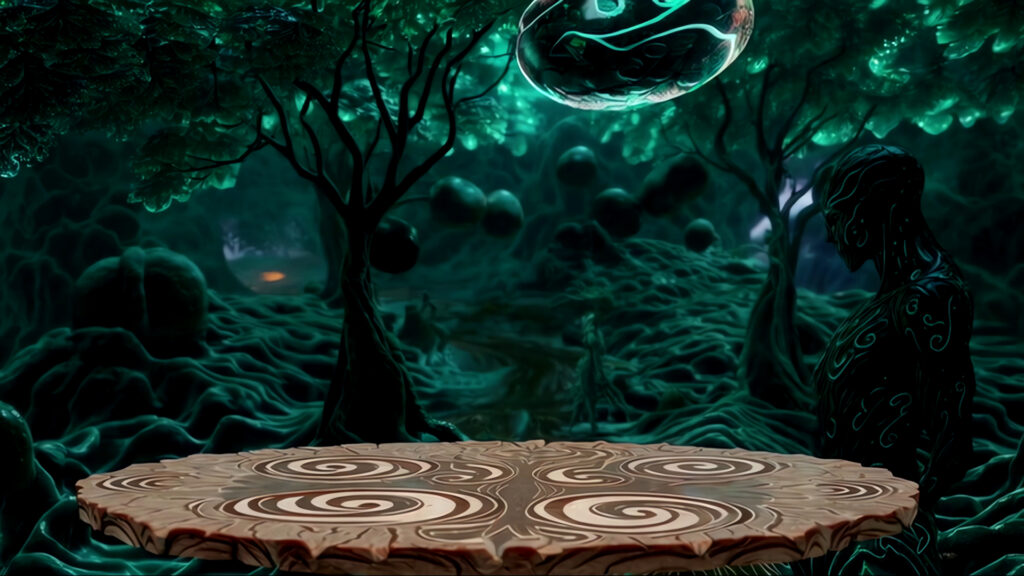
The Grove of Algorithms was a forest of trees whose leaves solved. Branches divided not for light but for logic; their bark smelled of graphite, their sap recorded. Roots arranged themselves into proofs so precise the soil lost ambiguity and became crystal for meters around. The grove’s caretakers emerged from trunks with the elegance of administered dreams: humanoid beings made of calligraphy, each line a dedicated purpose, each purpose a song with a spine. They introduced themselves in a rush of ideograms that hung in the air like slow snow.
“We are the Glyphwardens,” said one whose face leaned toward kindness. Its eyes were punctuation marks that trembled slightly, as if they remembered tears. “Enter with a question, leave with a map. But your question must be wrong in a beautiful way.”
Ivara thought of her star, unblinking, untroubled, its corona knitted shut as if by a patient grandmother. She thought of the oceans dulling and the plants writing softer answers into stone. She thought of the Archive’s frond pressed to her shoulder. Then she laid her hands upon the seed-planet and asked, “What does a vow of silence look like when it is kept too well?”
The Glyphwarden touched its own chest and drew out a square of bark awaiting text. The grove inhaled as one. Leaves crisped into equations and slid off their branches; the forest floor moved like a gently angered sea. Lines wrote themselves across the bark: curves of direction, coordinates that felt edible, a DMT-amber river snaking through them like a signature.
“Take the amber river,” said the Glyphwarden, handing over the bark. “It flows between seconds. Keep your vessel’s mind quiet; the river punishes opinions.”
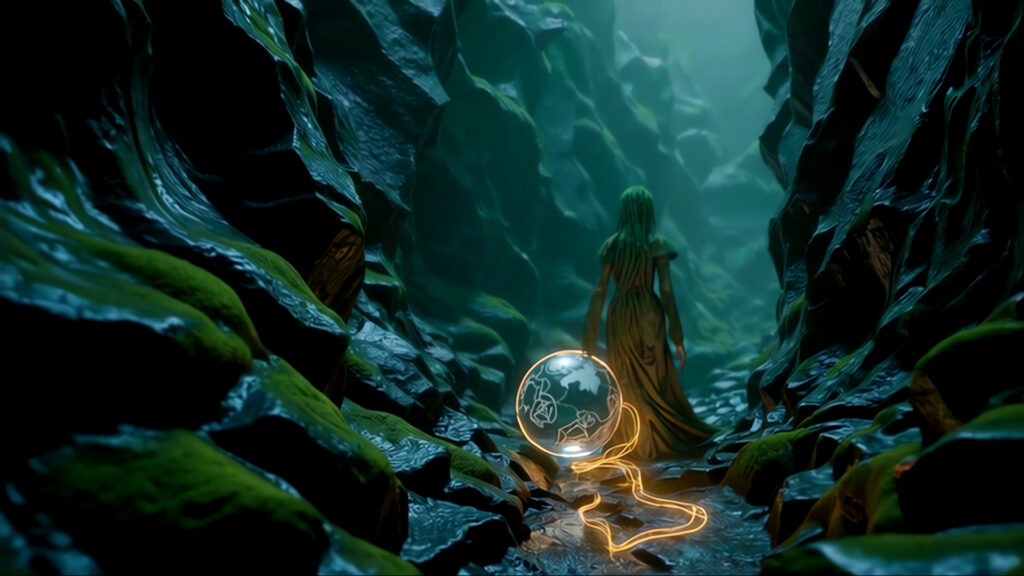
Vellichor sang a low note inside itself—a vibration like the encouragement of an older sibling—and nosed toward the air where no river could be. Then the amber appeared, not a liquid but a decision behaving as liquid, and Vellichor slid into it. Where hull touched river, symbols formed and collapsed. Sometimes they tasted like copper. Sometimes like the rind of a citrus fruit that once lived on a planet where gravity was conversational.
They floated past islands of paused events: a comet frozen mid-laugh; a pillar of smoke holding still to mourn its own invention; a school of fish made of prisms suspended in a parabola the river would not forgive. Along the banks stood the Lacunae, tall slender creatures whose bodies were blank pages turned into anatomy. They watched without faces. Their hands kept time by tapping the air like polite rain.
At a bend where the river split into five and then thought better of it, a structure rooted the horizon: the Oracle of Spores. It was not a building but an organism. Picture a cathedral deciding it would rather be a mushroom, and then imagine reverence finding a shape. Caps arced like bells; gills wrote history in electromagnetic dust; stems rose from nothing and anchored into possibility. The Oracle awakened as Vellichor approached, and a halo of spores turned toward Ivara like a field of tiny faces.
“You have come with a wrong question,” the Oracle intoned, voice drifting across registers without shame. “Good. The Quiet Sun is tired of right questions.”
“I need a route,” Ivara said. “And a mirror for a storm.”
The Oracle’s cap brightened with psilocybin-blue constellations. It exhaled a single spore the size of a breath. When it reached Ivara, it became a mirror not made of glass but of proof: whatever looked into it had to acknowledge that it was not alone in its explanation. The mirror was warm.
“Carry this through the Tunnel of Quartz Mushrooms,” said the Oracle. “They will clean it of hope. Hope is lovely, but it leaves fingerprints. The Silent Storm can smell fingerprints.”
“Price?” Ivara asked.
“A secret you never told yourself,” the Oracle replied.
Ivara closed her eyes. Inside she found a corridor shaped exactly like the path from her cradle to the Archive’s highest window. In the first morning she could remember, she had looked out and thought she saw something fall from the Quiet Sun—so small and bright she believed it was the star’s own eyelash. She had never decided whether to crush the wish or water it. It felt childish even to consider the concept in a world where thinking and growing were the same verb.
She spoke that almost-wish out loud, pressing it into the Oracle’s gills like a coin into a fountain that understands currency. The Oracle pulsed with satisfaction.
“Go,” it said. “Be devoured and returned, the way a dream devours a day and gives it back as meaning.”
The Tunnel of Quartz Mushrooms had been cut out of a single crystal by a patience distributed across centuries. Its walls were plant, stone, math—shapes only ever reached one day at a time. The quartz mushrooms lining the path were elegant machines: their gills ticked with light, their caps wore frost like jewelry. As Vellichor glided through, each mushroom exhaled a ring of syllables that spread to a halo then a map then a hush. Ivara held the mirror and watched it lose its flavors—first sweetness, then smoke, then the specific bitter aftertaste of certainty. When the mirror cooled, it was cleaner than a promise.
Halfway through the tunnel, a Mirror Lichen unhooked itself from the wall and stepped forward. It looked like Ivara done in mercury—but not mimicked, guessed. Its eyes were the idea of her eyes. Its voice was the distance between two leaves that have never touched but argue about when they will.
“I could wear you into the storm,” said the Lichen. “I could be your decoy while you escape what your star must ask of you.”
“Would you do it out of kindness?” Ivara asked.
“Out of ambition,” the Lichen answered. “I want to know what sunlight tastes like when it has been quiet for a thousand dawns.”
“Then I cannot let you,” said Ivara, and the Lichen laughed the polite laugh of metal on water.
“You understand cost,” it said. “Then you may pass.”
Vellichor bowed—a gesture of hull and hyphae—and the tunnel opened into a sky so still it might have been carved.
The Silent Storm waited there.
It was a storm of choices. No winds. No rain. No thunder. In the empty sky a cathedral of vacuum opened like a mouth designed for a word too old to pronounce. Clouds formed into architectures and dissolved without event. Bolts of lightning occurred only inside thoughts: brief rearrangements of furniture in a room where meaning liked to sit near the window. The storm’s guardian descended to meet them, its body a flowing robe of equations, its hands long as rivers, its face a mask of night with a moon-sized hole where a question might be asked forever.
“I am Hushwright,” said the guardian. “I fashion quiet from uproar. Your star is quiet because I taught it a new prayer.”
“It is too quiet,” Ivara said. “Things on our world sleep with their eyes open. They dream without the ability to wake.”
Hushwright tilted its head, and constellations fell from the cut-out moon. “Quiet is mercy,” it murmured. “Have you not seen how noise bites?”
Vellichor exhaled in a tone that made nearby ideas blush. Ivara lifted the mirror—the one emptied of hope—and held it toward Hushwright. In its surface the storm saw itself not as relief but as a weight on the chest of a planet. It flinched. The sky around them changed shade the way a thought becomes less sure, then more.
“This is unflattering,” Hushwright observed.
“It is accurate,” Ivara replied.
The guardian looked long at the mirror, then at Ivara, then at the Quiet Sun—visible as a pale coin stamped with a half-remembered song. The robe of equations darkened, as if ink considered abandoning its letter. “Your star asked to be calm,” it said at last. “It came to me coated in the saliva of catastrophe. It wanted balm and became a mausoleum by accident.”
“Teach it to listen without shutting its eyes,” Ivara said simply. “Teach it to hum under breath.”
Hushwright considered. Lightning rearranged the chairs of nearby thoughts. Finally, it reached into its own chest and withdrew a pollen-gray filament, thin as omission and strong as ritual. “A single thread,” it said. “Tie it around your star’s heart. It will loosen when speech is gentle and tighten when speech becomes weapon. But someone must take responsibility for the knot.”
Ivara looped the filament around her wrist. It sunk into her moss-skin like thread through felt, leaving a visible ring that did not hurt so much as remind. Hushwright lifted a hand, palm open, and in its center nodes of empty brightness arranged themselves into a map of returning.
“You cannot place the knot from here,” it said. “Return to your world, descend into the Sun’s understory, and bind it to the archive of your living ground. Let land and star share the knot. Quiet will become listening.”
“And the price?” Ivara asked.
“The storm keeps this,” Hushwright answered, and tapped where the filament had sunk. “A history of your vow. If you break it—if your forest begs for silence when it only needs patience—I will return and harvest your green verbs.”
“That is fair,” Ivara said, and the guardian bowed as if fairness were a rare mineral to be shelved with care.
Vellichor turned on its axis and the world spun backward. The Tunnel of Quartz Mushrooms flashed past with the resigned elegance of a cathedral that knows it must close for the evening. The Oracle of Spores watched and dimmed to a thoughtful blue. The Grove of Algorithms waved leaves in applause at the beauty of a wrong question done right. The Orchard of Black Suns shivered in sympathy. The gate on the far side heaved open, humming LSD-clear geometries, and forest breath rose to meet them like a choir that had been practicing in secret.
They surfaced over their sea—a sea that was not water but memory suspended in blue. Each wave was an event learning how to accept itself. Vellichor hovered, then opened its chest to let Ivara fall with the joy of a leaf that has been practicing falling for months without telling anyone why.
She descended into a trench where the Quiet Sun had once sent roots. Many stars do—those with a taste for gardening. There, beneath basalt riddled with the handwriting of tide and time, lay the Sun’s Understory: a mat of light-fibers that had fused to moss long ago and never regretted the marriage. They pulsed now with a slow, lover’s grief.
Ivara crouched. The forest leaned in. Glyph-moths settled along the edges of stones, their equations soft as bedtime promises. She pressed the pollen-gray filament into the understory, threading it through the light-fibers, knotting it around certain syllables of glow. The process was not complicated. It was reverent. When she tightened the last loop, the filament tugged her wrist and the star above them turned its face slightly, the way a sleeper acknowledges the rumor of a morning.
The Quiet Sun inhaled. The light that came down was not brighter. It was truer. It tasted of lemon rind and flint, a flavor Ivara had not known she missed until her chest filled with it.
“Careful,” murmured the Archive Canopy, branches creaking in a breeze everybody had forgotten the name for. “Quiet and listening are cousins. They love each other, but they do not share a house.”
“I know,” Ivara said, and the ring around her wrist warmed.
In the days that followed, the oceans learned to blink again. Schools of fish remembered the choreography of hunger. Insects started writing their argumentative little symphonies on the air. Plants returned to their work of gossip and invention. The moss, having suffered centuries in a handful of years, unrolled itself like a prayer mat and asked for visitors. The forest did not shout; it breathed. Speech returned to the world at the volume of confession.
The sun remained quiet; it simply became a quiet that listens back.
Word traveled slowly at first, then with the appetite of a story finding its true mouth. Across the continent came myth-things from far and stranger biomes: Kelp Witches who wore the sea like a shawl and carried spindles spun from salt; Glass Centaurs whose hooves rang like questions; Nebula Jackals that pulled sleds made of comet tails and told jokes too dry to spill. They came to walk the path under the Quiet Sun, to see whether a vow could loosen without breaking.
Ivara greeted them with bowls of distilled dew and slices of stone where poems had been saved. She kept no throne; her authority was a hyphae braid and an obligation in the shape of a ring. She learned the proper way to refuse offerings without embarrassing generosity. She learned that some kindnesses are shaped like a knife and should be treated as tools, not gifts.
On the seventh week after the knot, a creature from the Border of Everywhere arrived—a being humanoid and tall, with shoulders made of smoke and a spine of beads like frozen rain. Where its face should have focused, there was a garden: moss paths, tiny trees, a pond no larger than a teacup on whose surface seven separate moons performed patient chores. It called itself Gardener of What Is Not Yet.
“I came to see if you would lease your silence to me,” said the Gardener. Its voice smelled of cinnamon and iron. “I am building a gallery that will exhibit almosts. Silence makes almosts easier to love.”
Ivara shook her head. “Our silence has become listening,” she said. “It must stay home.”
The Gardener’s garden-face opened at the edges. The little pond nodded; the moons clinked. “Then allow me to pay rent in advice,” it said. “The Hushwright will come again. Not in anger. Out of curiosity. Keep a mirror polished. Keep a laugh unlabeled. And keep moss growing where thresholds pretend to be permanent.”
“I will,” Ivara promised.
When the Gardener left, Vellichor extended a hyphal thread and touched Ivara’s wrist. The ring flickered—a heartbeat just slightly too big for one body. “You are lonely,” the vessel observed, simple as gravity.
“Not lonely,” Ivara said, then paused. “Only singular.”
Vellichor unfurled a tendril of lichen-metal and wrote upon it in spores until a schematic appeared. “I can grow a sister-hull,” it said. “Not to replace me. To accompany you where ships cannot go.”
“What will she be?” Ivara asked.
“Small,” said Vellichor. “There are caverns under language where a ship cannot turn. She will fit. She will be called Quietfriend.”
Ivara nodded and fed the vessel the minerals of her agreement. Over nights the new hull grew from Vellichor’s shadow: a pocket-sized companion with eyes of rain-fresh mica and a spine that clicked when its joy exceeded its confidence. Quietfriend trained on dew. It learned courtesy. It learned the value of being underestimated. When it was ready, it settled onto Ivara’s shoulder and slept. She did not feel its weight—only the absence of a particular worry she had forgotten to name.
Seasons progressed as if by consensus. The Quiet Sun hummed like a singer before speech. Sometimes it raised its light to the edge of brightness, then set it down again as if to say not yet, not like that. The forests celebrated restraint with festivals that were kind to soil. The oceans practiced the muscle of stillness and then let it release. Above everything, the ring around Ivara’s wrist tightened when speeches grew too hot and loosened when listening took the lead. It was never cruel. It was precise.
One evening—mushrooms lifting their caps like a low choir, lichens varnishing stone with the neat work of artisans—Hushwright returned. It did not descend with fanfare. It stepped between moments and stood near the Archive Canopy as if it had always been there and we had only just learned the word for noticing.
“You have made a knot that flexes,” it said, robe of equations shedding variables like late summer fur. “Your star is still itself. Your world has learned to hear itself without confusing volume for value. I am not insulted.”
“That is a relief,” Ivara said.
“Do you still carry the mirror?” Hushwright asked. Ivara lifted it—the glass that wasn’t glass, cleaned in the quartz tunnel of hope. Hushwright looked and flinched again, but less. In the mirror the storm wore a softer face. The cut-out moon in its mask had become a window with a sill where a plant could learn the weather.
“And your vow?” Hushwright asked, glancing at the ring around Ivara’s wrist.
“I keep it,” she said.
“Then accept this,” said the guardian, and withdrew from its robe a seed of silence no larger than a tooth but brighter than most futures. “Plant it in a place where one threshold longs to be another. It will grow into a door that adjusts to the guest. It will not always be kind. It will often be correct.”
Ivara took the seed and walked to the gate that had ferried her to the Orchard and back. It still hung from the sky like a precise regret. She pressed the seed into the ground at its base; the earth accepted it with the greedy virtue of good soil. In hours the seed became a hinge-tree, its trunk a hinge and its branches a lintel. The air beneath it freshened, and those who passed through emerged altered in the exact way they had been denying themselves.
Hushwright watched, robe dimming to a more conversational black. “I will visit less,” it said. “But I will listen more.”
“Listening,” said Ivara, “is where quiet goes to become a citizen.”
The guardian bowed and dissolved into a rumor of breeze.
Years can pass without incident when incident behaves politely. Under the Quiet Sun, moss continued its clever green accounting, forests traded jokes with stone, and oceans rehearsed their blue arguments until they grew bored and swam. Travelers came and went, left offerings of teeth and time and truths that could not be used against the giver. Vellichor and Quietfriend learned new games with currents and cliffs. The ring around Ivara’s wrist faded from a command to a habit.
One morning the Quiet Sun brightened the width of a syllable. Creatures across the world raised their heads, not startled, only curious. The star spoke—not in words, but in sweetness. It communicated a plan to warm the winter just so, to coax a field out of its sulk, to gild an ocean day until the fish admitted they had been wrong about a certain eddy.
Ivara lifted her face and felt the hue of that warmth enter her like a story that had been waiting for the page. The Archive rustled approval. Glyph-moths made a small ceremony of flying in a circle that suggested gratitude without demanding applause.
“We are a world under a quiet sun,” Ivara said to no one and everyone. “We are also a world where quiet is productive. We are moss that remembers thunder and chooses dew.”
She returned to the understory of the star, checked the knot, found it neither tight nor loose but accurate. She returned to the hinge-tree and watched it slowly learn each visitor’s name by the way their shadows lay upon the threshold. She walked into the forest and felt the ground lift to meet her step the way affection always becomes practical in the end.
Some nights she dreamed of the Orchard of Black Suns and the Stel Wyrm polishing its meteoric iron collar until it shone like a decision. Some afternoons she sat with the Glyphwardens and learned new wrong questions, because a world that loses the art of the beautiful error becomes a bureaucrat of miracles. On mycelial dusk, when light bled into the kind of violet that tastes of solitary courage, Ivara took Quietfriend to the sea of memory and tossed stones. The circles widened. Fish counted them in their small important languages.
If you had looked down from above that day, you would have seen a continent doing an impression of contentment without laziness. You would have seen a star learning to be responsible for the room it dominates. You would have seen moss holding the weight of quiet and moving it like a dancer who knows the choreography is flexible. You would have seen gates that now paid rent to their thresholds.
And you might have noticed, there on the shoulder of a humanoid figure made of braided hyphae, a pocket-sized vessel clicking with unembarrassed joy, the two of them listening to a sun that finally understood how to whisper.
Because the vow had changed. Because the knot could breathe.
Because everything that grows under a quiet sun must learn one truth: silence without listening is a tomb, but silence with listening is a garden.
The moss preferred gardens. It always had.