Prologue — The Sigh that Called Across Orbits
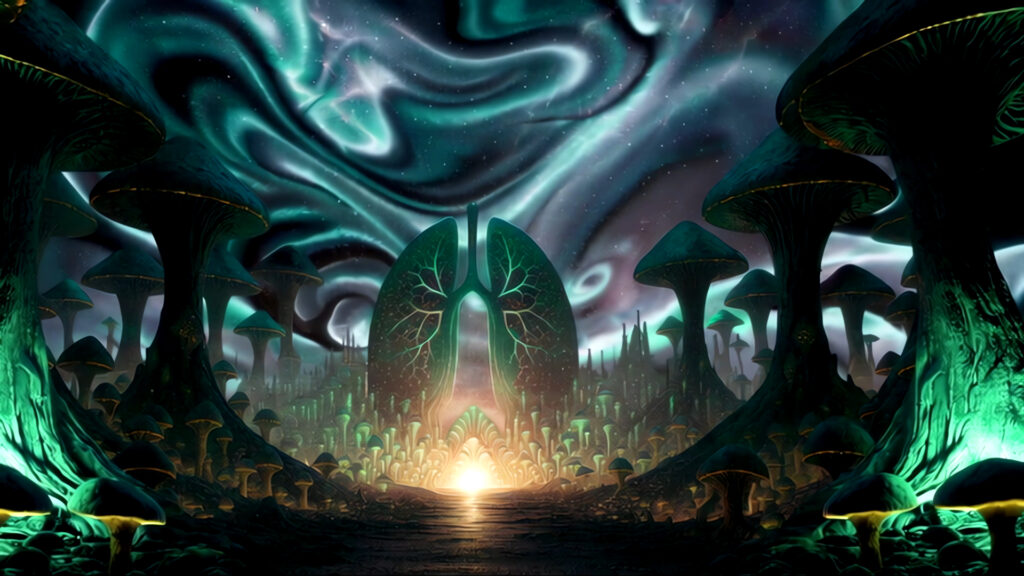
There is a city in the Perseid Flow that does not wait for visitors; it inhales them. Its name in the wind‑tongue is Anhelion, and the maps draw it as a lung‑shaped void, a negative space, because it cannot be built from stone alone. Its avenues open and close like alveoli. Its towers are ribs. Its plazas are diaphragms that rise and fall on a patient schedule that predates calendars.
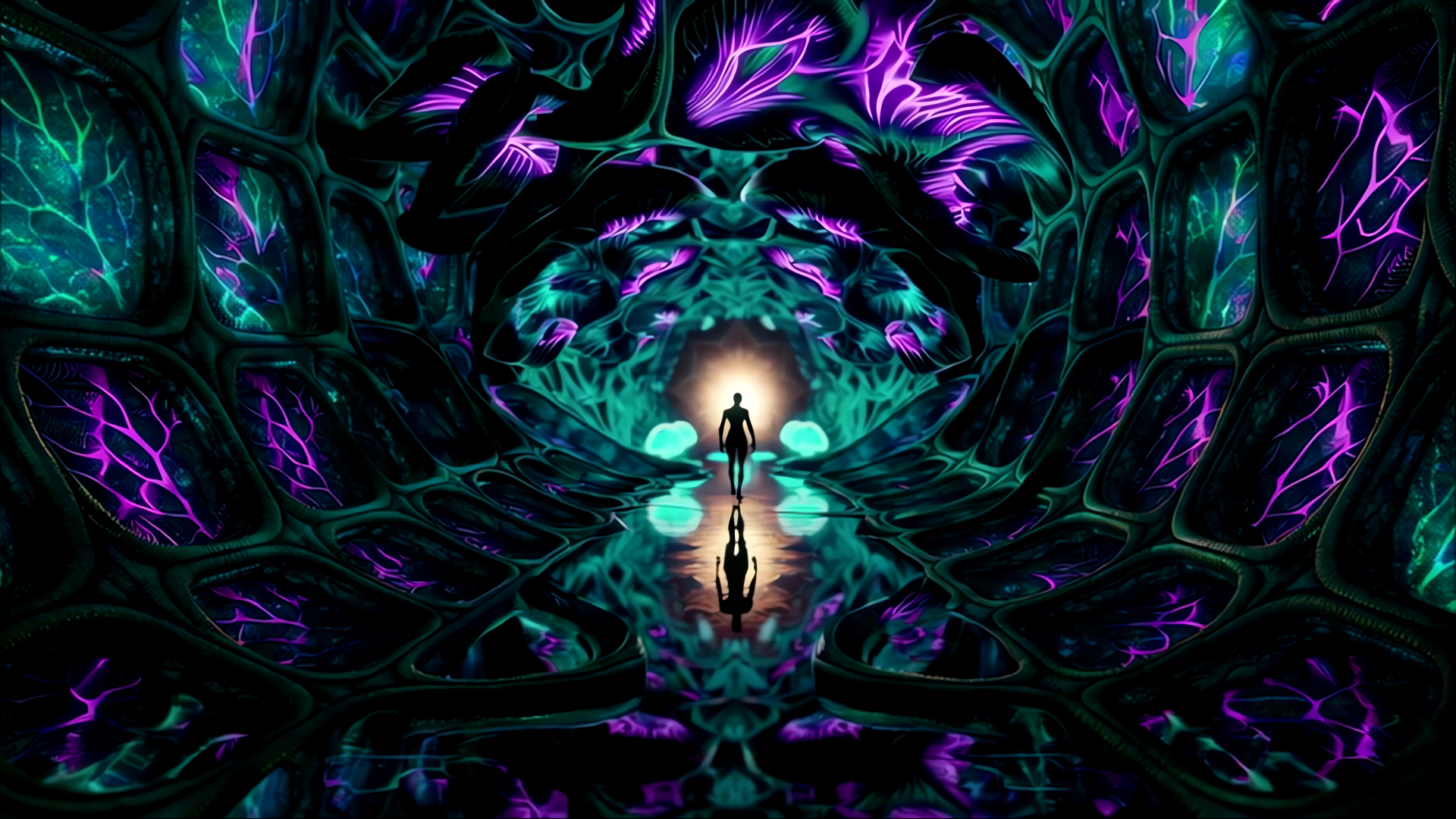
From the slate edge of orbit, a sleek courier seed drifts down toward the breathing surface, and from it steps a being who is not a traveler in the common sense. Khyre‑of‑the‑Murmurs is a Sibilant, a humanoid from a distant sporeworld where architecture grows and etiquette is exchanged as scents. Khyre’s body is tall and jointed with filaments that flex like reeds; beneath translucent, onyx‑dark skin, pale mycelial veining glows a soft green, glimmering along collarbones and wrists. Four long fingers on each hand end in capillary tips that taste the air. Fan‑shaped gill fronds, thin as paper, arc from Khyre’s neck to the jawline, opening and closing as the atmosphere changes; fractal pupils adjust to blankness and brilliance in an instant. A braided mantle of woven hyphae hangs from broad shoulders, so fine it can slip between atoms when necessary, so textured it records the passing of winds like a book.
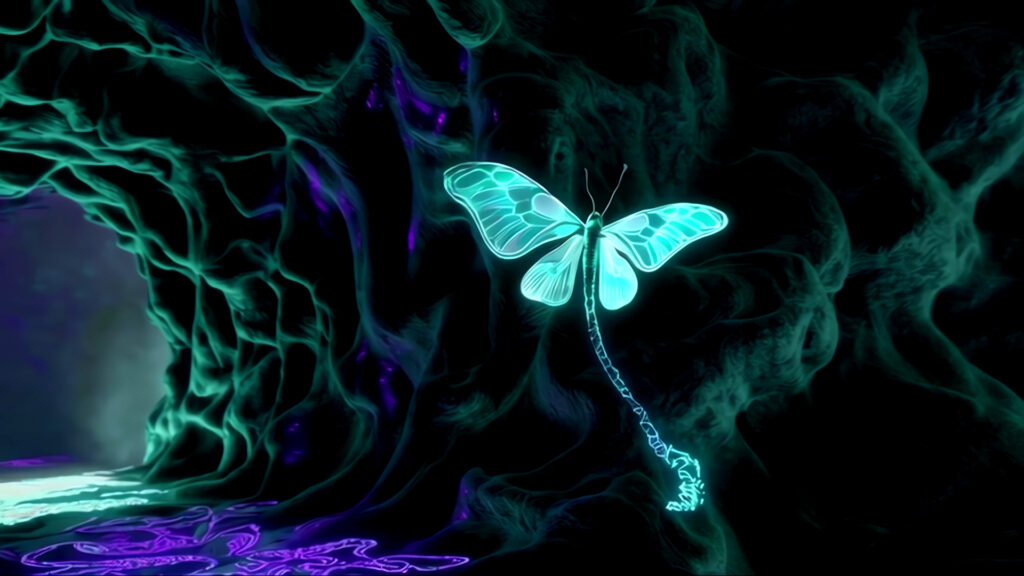
Where Khyre goes, a companion follows. Miell is a Scriptmoth, a moth only in silhouette; close, Miell is an angular geometry of silver membranes and jointed light. Each wing is a translucent panel etched with veinwork like circuit diagrams; when Miell moves, the wing‑etchings write glyphs in the air, lingering a moment as luminous afterimages. The Scriptmoth communicates by composing these drifting letters—one word per beat of wing—until the words knot themselves into a meaning the eye can swallow whole.
Khyre and Miell stand at the edge of Anhelion as the city exhales. The exhalation is dry and fragrant with petrichor. The ground underfoot hums. Far overhead, vaults of spore‑light move like auroras. The city’s breath strokes Khyre’s gills and the gills answer—small ripples of pleasure; the air carries a pattern. The pattern repeats, then complicates, then repeats again, an DMT‑clean geometry encoded not in sound but in pressure and drift.
“Eager,” Miell writes in a loop of floating sigils. “Hungry.”
“Hungry for what?” Khyre’s voice is low and unlabored, each word softened by the phenolic resonance of the gill fronds. Khyre tastes the answer before Miell can assemble it: the city is hungry for alignment. Something in its lungs has slipped.
The courier seed folds itself into a brittle pod behind them like an empty husk, and the living gates of Anhelion open, stippled with bioluminescent dots that echo the constellation the city was patterned from. Khyre steps forward, into the thorax of a world.
Chapter One — Anatomy of Streets
Anhelion was not fashioned by hands. It grew from a bed of synthetic mycelium designed by extinct engineers called the Aeroliths, who wired the wind to the ground and taught towers to breathe. The streets are ridges of cartilage‑hard fungus; they soften when the city wants to reroute a traveler. Lamp‑caps curl from the walls, each a mushroom whose gills shine from within. Doors pulse shut like eyelids. Courtyards dilate. Every fourth inhale, a haze of spores lifts and dissolves in the air, and in the haze Khyre can see slow, LSD‑sharp tessellations overlaying reality—calibration lattices Anhelion uses to keep its directions straight.
The inhabitants of Anhelion are not citizens; they are cells. A procession of Cytali passes the newcomer: slender, glass‑boned humanoids whose skin is a soft translucence. Their eyes are polished vents. Each Cytal bears a mantle of aero‑fronds that whisper as they walk; the fronds measure turbulence and gossip about it. The Cytali bow by folding their torsos in mirror‑clean angles, exposing the pale light quivering along their sternums.
A trio of Zephyrites—small, hovering beings knit from shimmering air—escort Khyre into the city’s first chamber, a ribbed vault like the inside of a whale fossil. They are made of pressure differentials and opaline dust; when they speak, syllables manifest as ripples on their surfaces. “Guest,” the Zephyrite chorus ripples, overlapping and precise. “We have felt your kind before.”
“My task is a diagnosis,” Khyre says. “Something unsettles your breath.”
Miell tests the air with a flourish of letters that unfurl like a banner—BASALT GARDENS TO THE EAST. VALVES WHISPER OF RESISTANCE. The Zephyrites quiver in assent. In the corner of the chamber, a Glyphwyrm uncoils from a niche; it is serpent‑long, constructed from ribboned script. Its scales are phrases. Its tongue is a fine arrow of punctuation.
“Guide,” Khyre murmurs.
The Glyphwyrm dips its head and slides forward, leaving sentences peeling from the floor where its body touched. They read: Follow. Do not hold your breath. The City keeps count.
Khyre breathes in the way the Sibilants do when they mean to be remembered—slowly, letting the air and the traveler become reciprocals.
Chapter Two — Lattice Bloom
The Lattice Bloom District unfurls like origami. Walls are made of linked hexagons; every hexagon is a pane of mycelial glass that refracts light into twelve‑pointed stars. As Khyre enters, the hexagons flip open and closed, responding to internal tides. The district is a kaleidoscope in motion: LSD‑sharp motifs turning on hidden gears; corridors fold and refold without ever touching. The Glyphwyrm writes reassurance in the air: YOU ARE NOT LOST. THE MAZE IS A BREATH, AND YOU ARE INHALED.
Miell’s script wings flutter as the moth traces a counter‑pattern in the air—a weave of meanings meant to keep a traveler located inside the living rearrangements. The moth’s letters are square‑shouldered and compact, like machines. Khyre feels the two patterns diverge and then snap into complement as the district senses the pair and assigns them a passage.
Along one wall, Khyre pauses before a mural. It is a map painted in spores across a century of exhalations, depicting Anhelion’s lungs as a cathedral; alveoli are rendered as rose windows, bronchi as nave columns. In the center is a schematic bloom of twelve petals. The paint is still drying in places—Anhelion painting itself as it breathes, leaving clues for those who pay attention.
A shadow tilts. At the end of the passage, a figure waits.
The figure is a Sphinx of Silicate, a guardian assembled from silica threads and hive logic. It wears a facet‑mane. Its body is leonine but elongated, with six limbs and an insectile grace. Where its face should be is a segmented mask that shifts like a puzzle in a quiet hand. The Sphinx inhales. Somewhere deep in the city, valves answer.
“Traveler,” the Sphinx says, speaking the word in pressure, not sound. “What enters must leave. The question is not whether but how.” Its long tail draws DMT‑clean triangles in the dust.
“Your riddle?” Khyre opens palms in the Sibilant sign for exchange.
“I am the part of you that the city keeps and the part the city refuses. Name me.” The Sphinx’s facets rearrange; for a breath, Khyre sees a flash of symmetries: the twelve‑petaled schematic recurring in the micro‑facets of the guardian’s mask.
Miell’s wings beat once, scribbling in silver: MEMORY. CARBON. HUMIDITY. Then a second beat: INTENT. A third: FEAR.
Khyre’s gills flare. “Breath is barter,” the Sibilant answers. “But intent is the currency. The city keeps the forms of fear for digestion. It refuses intentions that choke.”
The Sphinx stills. The segmented mask slides into an open pattern measured like a smile. “Pass. Carry your intention like a lantern.” It bows its many‑jointed head; the hall beyond lightens, and the Glyphwyrm effaces the word FEAR from the dust, curling it into new meaning—CLEAR—and slithers on.
Chapter Three — The Long Atrium
Past the Lattice Bloom, the city becomes quiet. The Long Atrium is a gallery of distance: a corridor as big as a canyon, ribbed with archways that recede into a perspective so slow it could be mistaken for eternity. Here the breath of Anhelion is restrained; it practices what the Zephyrites call holding, the brief tension before release. Floor stones lengthen. Ceilings duck low. If one could taste geometry, it would taste like basalt and midnight.
Khyre walks this canyon as the city measures stride lengths and heartbeat. The air becomes cool. Mirages rise in the near distance—desert gardens of glass capped by soft mushroom domes; forests of petrified wind that lean toward places that do not exist. On the edges of sight, hyphal threads protrude like conduits, pulsing a slow bioluminescent code—count, count, count.
Miell flutters down to ride Khyre’s shoulder mantle. The Scriptmoth’s wings slow, each sweep deliberate. Letters emerge and fade: YOU FEELED HEAVIER. Then a correction, shrugging into the Sibilant’s grammar: YOU FEEL HEAVIER.
“The air has greater worth here,” Khyre says, as if explaining to a younger traveler, though nothing young moves in this abdominal hush. “The city stores breath to cross distances inside itself.”
An anomaly intrudes on the pattern. The air doesn’t move in its expected tranches near the far end of the Atrium. Instead it eddies and collapses. The smell is metallic, cold, a sterile tang overlaying the fungal perfume.
“VALVE STONE,” Miell writes, and the letters hang like warning signs.
The Glyphwyrm coils around Khyre’s ankles and buries its head beneath the traveler’s mantle. BELOW, it scripts in the rhythmic scrawl of panic. SOMETHING BELOW HAS SET ITS EYE.
Khyre kneels, palm flat to floor. Beneath the cartilaginous pavement, something pulses out of step with Anhelion’s heartbeat. The pulse is narrow, constricted. It speaks in a stony hiss.
From a crack ahead, a creature rises like a shadow peeled from bedrock.
It is a Basilisk of Null, a being bred by ancient Aeroliths as a fail‑safe and abandoned when the city proved itself. The Basilisk is myth forced into function: a long, coiling form armored in basalt plates. Its eyes are wells of collapsing light. Where it moves, breath stills; where it gazes, airflow tightens to nothing. It was made to prevent runaway fires, to stop storms in the blood of the city. It has woken to a false signal and now enforces silence too perfectly.
The Basilisk considers Khyre and Miell. The Scriptmoth freezes as if caught in amber. The Glyphwyrm’s sentences unwrite themselves.
Khyre stands, gills pressed flat. “We are not a flame,” the Sibilant says softly. “We are a diagnosis.”
The Basilisk descends in slow coils until its eyes are level with Khyre’s own. The null in its gaze brushes Khyre’s mycelial veins; green light dims but does not die. Beneath its basalt plates, a resonance hums, percussive, wrong against the city’s soft schedule.
Miell lifts a wing by effort and writes as if carving the word into stone: THERE IS A PLUG WHERE A PETAL SHOULD BE.
The Basilisk blinks. The null relents an increment. Its voice is a stone storm: “Something lodged within the Twelve Petals. I was woken to wall the breath. I cannot turn myself off.”
“The Long Atrium is starving because the Gate is clogged,” Khyre says, and the thought fits like a crystal into the city’s waiting slot. The Basilisk is not an enemy; it is an organ misinformed.
Khyre bows. “Guardian of silences, coil back into watch and lend your weight to stillness in the Basalt Gardens. Keep panic from the valves while we repair the petal.”
The Basilisk’s plates lift along its spine like the teeth of an opening book. It observes the Sibilant, scenting for deceit, and finds none. The null in its eyes recedes to an outline, a warning, an instinct on a leash. With a noise like sand poured across parchment, the Basilisk sinks into the floor and is gone.
The Atrium breathes again, shallow but animate. Khyre inhales the city’s relief and exhales purpose. Miell shakes free of paralysis and writes for the simple joy of seeing letters float: GO.
Chapter Four — Basalt Gardens
The Basalt Gardens lie in a bowl of cooled lava threaded with glittering fibers of glass. Stunted mushrooms, black as ink, sprout from fissures, their caps studded with tiny lights like cityscapes seen from orbit. A wind of great age sighs against low, polished stones arranged in rings. At the gardens’ heart stands a pillar, veined with bioluminescence. The pillar is warm where Khyre touches it; it hums quietly, a throat clearing before speech.
Cytali caretakers emerge from alcoves. Their aero‑fronds wave in patterns of greeting. One offers Khyre a coil of woven spore‑silk with the solemnity of a ceremonial rope. The coil smells of rain in galactic vacuum, a scent Khyre associates with thresholds.
“This is a tether to the Gate’s spindle,” the Cytal says through a Zephyrite interpreter, ripples carrying meaning. “Our lungs ask for repair.”
Miell circles the pillar, leaving a double helix of silver sigils in the air: COUNT TWELVE. TURN TWELVE. The pillar responds, rising, segments rotating like a spinal staircase; each turn is a petal, and between petals, something catches light—an embedded foreign body like an arrow flung by a careless giant.
Khyre leans close. The obstruction is a splinter of asteroid metal, serrated, probably lodged during one of the city’s deep inhalations when it pulled too hard on the vacuum beyond. The shard interrupts the sequence of petals, misinforming valves, waking basilisks that were meant to sleep.
“Care,” Miell writes, letters trembling with the aftertaste of null. LIFT SLOW. The Scriptmoth’s wings cut a DMT‑geometric lattice around the shard, mapping forces and failure points, rendering a net in light.
The Glyphwyrm coils in readiness. Khyre feeds the end of the spore‑silk tether through palm filaments and inhales, allowing the city to taste the intent: repair, not conquest; alignment, not domination. Satisfied, the pillar opens its throat. A tunnel descends like the hollow inside a bone. At the bottom, Khyre can see the Spindle of the Gate glimmering—an axis of golden triangles stacking into infinity.
“Hold the gardens steady,” Khyre tells the Cytali. “If the breath surges, the spindle will cut.” The Cytali nod and sing to the stones in a voice that is all vibration and no sound. The gardens subside.
Khyre lowers into the pillar’s throat. Miell follows, leaving luminous thread‑letters behind like breadcrumbs. The Glyphwyrm pours down last, a ribbon of grammar stitching everything together.
Chapter Five — The Spindle
The Spindle of the Gate is an instrument whose music is alignment. It hangs in a vertical shaft alive with mushroom gills that ripple in slow applause. The spindle’s surfaces are reflective but not mirror; when Khyre sees a reflection, it is a diagram of self rather than an image—a schematic of intentions pressurized into lines and angles. The obstructing shard protrudes from the twelfth petal’s seam like a thorn in a tongue.
Khyre braces against the shaft’s smooth inner wall and studies the angles. Miell composes a moving diagram: each line a potential slip; each node a warning. The Glyphwyrm wraps its body around the shard, reading the metal with its scales until the right sentence appears: TURN COUNTER TO THE CITY, THEN WITH IT. The words linger like a remembered taste.
“On three breaths,” Khyre says. The Sibilant inhales once, twice, thrice, synching with Anhelion’s heartbeat. On the third inhalation, gills spread, filaments extend, and Khyre gently rotates the shard opposite the natural twist of the petals, feeling for the catch. The shard shudders like a trapped animal. The shaft tightens as if startled. Khyre stops, waits, listens. The city’s breath rounds out the tension with a sigh.
“Now with it,” Miell writes, and the wing‑letters scatter like sparks.
Khyre turns the shard in the city’s direction. Resistance drops as if cut. The splinter slides free, slick with condensed history. As soon as it leaves the petal’s seam, the Gate’s spindle brightens; triangles align; an old pattern finds its way home. Far above, in the Basalt Gardens, the pillar hum becomes joy.
Khyre holds the shard. It tries to sing its old orbit into the air. The Glyphwyrm swallows the song, writing over it with phrases that domesticate estranged things: YOU BELONG HERE NOW: TROPHY, NOT THREAT. The shard cools.
The spindle turns, and as it does the air in the shaft thickens with new meaning. The twelve petals open in a sequence that feels like a hand unclenching after a long time spent gripping. The shaft becomes a throat; the throat becomes a tunnel; the tunnel threads the city to a point beyond itself—a hole in the fabric of distances rimmed with living fungus that unfurls in waves.
The Gate opens.
Chapter Six — The Glyph Storm
Repair provokes ceremony. The Gate’s mouth breathes out a storm of symbols. Letters from extinct languages corkscrew through the shaft like comets, some large enough to hide behind, some tiny as spores. They are warm to the touch, warmer than stone, warm like living tongues. A Glyph Storm.
Miell dives like a swallow through the drift, tracing with laser precision. The Scriptmoth stitches a path; when letters brush the moth’s wings, they transform into diagrams, then unfurl again as growing things: vine‑shaped p’s, mushroom‑capped t’s, serpentine s’s that shed skins of italic and reappear bolder. The glyphs are not meant to obstruct; they amuse the Gate by testing who can dance through its language.
Khyre dances. The Sibilant’s long legs tailors steps to each eddy. Gills flex to catch warnings before the eye can see them. The Glyphwyrm eats unhelpful commas and excretes bridges of conjunction that anyone can cross. The storm learns their preferences quickly and begins to cater to them, as if pleased by an audience willing to applaud with more than breath.
When they step out of the alphabet weather, a new city waits.
But it is not another world beyond the Gate. It is Anhelion, revealed on a deeper frequency, as if the first Anhelion were a mask worn over a more delicate face.
Chapter Seven — Cathedral of Spores
The Cathedral of Spores is not a building; it is an event. Mushrooms the size of towers—or towers the shape of mushrooms—rise around a central court. Each cap is a rose window. Each gill is a choir stall. Spores fall like snow that melts into light on contact. When Khyre steps into the court, the snow changes direction to meet the Sibilant, then swirls upward, becoming a visible inhalation. In the upper air, spores collect to form a moving fresco.
The fresco depicts Anhelion’s construction: Aerolith engineers entwining hyphae with engineered wind, setting everything on a schedule that includes eclipses and the beating of wings. At the fresco’s edge sit twelve petals; their sheen is gentle and inevitable. The next panel shows visitors like Khyre arriving across centuries, each leaving a small correction. Anhelion has always needed help. A city that breathes must expect to cough.
At the court’s center stands a being who is part organ, part priest, part rumor. This is the Chanter of Mushrooms, a tall humanoid shaped from braided stalks and cap‑lamps. Their eyes are a pair of slow‑turning spirals. Filaments fall from their fingertips to their feet, growing into the floor.
“Repairers,” the Chanter says, and their voice is the sound of spores finding niches. “You have reset our spindle. The Basilisk sleeps. We ask one more mercy.”
Khyre bows. “Name it.”
“The city’s breath has learned your pattern. It wishes to keep a memory of you. Such memories are not portraits but functions. Become for us a Lung‑Reader for a single cycle, and we will remember how to align ourselves without waking stone again.”
Miell hovers close. The Scriptmoth writes a single word, slowly, carefully: AGREE.
The Glyphwyrm adds an adverb: GLADLY.
Khyre accepts. The Cathedral warms. The Chanter stretches their many filaments and touches Khyre’s gills; the contact is soft and electrifying, LSD‑clean fractals bursting behind the Sibilant’s eyes. For a moment Khyre’s body is a diagram of air; then a second breath, and the diagram is a machine tuned to temperature and purpose.
“You will stand at the Tuning Dunes and read,” the Chanter says. “When the dunes fold their horizons with each footfall, show them which direction returns the stars to their proper positions.”
Chapter Eight — Tuning Dunes
They arrive at the Dunes by a stairway that behaves like a slope and a ladder at once. The Tuning Dunes are not sand; they are grains of calcified wind, ground from pressures trapped and released over centuries. Each footfall folds the horizon in clean planes. The dunes answer movements with shimmering, invisible waves that push constellations around like beads on a wire.
Khyre walks onto the surface. The first step tilts a distant star; the second aligns a thin crescent of light with the spire of a mushroom tower, making a new glyph on the skyline. Miell traces the steps in script—ONE, TWO, THREE—and then replaces numbers with adjectives: SLOW, NOTCH, TENDER—instructions for future readers who may not count the way Sibilants do.
The Glyphwyrm slides beneath the dune’s skin, letting its sentence‑scales brush the grains from the underside, where they are cooler. It writes into the dunes’ memory: THIS WAY IS INHALE; THIS OTHER WAY IS EXHALE. It composes the statement in twelve dialects, one for each petal, and a thirteenth the city did not know it knew, a dialect of silence for days when nothing must move.
Khyre reads the dunes in long lines. A story emerges: the dunes had drifted too far inward in sympathy with the Basilisk’s command to stillness; stars were misregistered; breaths fell slightly early. The dunes like obedience. They will like a new instruction if it is spoken with respect.
“Stand by me,” Khyre says. Miell settles along the Sibilant’s shoulder mantle. The Glyphwyrm rises like a ribbon from the dune’s skin and loops Khyre’s wrist twice, knotting courage. Khyre inhales as Anhelion does—an inhale that is not a taking but an invitation—and speaks for the city to hear:
“Let your dunes count not the fear of fire, but the necessity of movement. Move just enough to remember the space we require to become ourselves.”
The dunes bow. The horizon unfolds like a note smoothed by a careful hand. The constellations slide into their old seats with a relieved click.
Far below the surface, valves open with small sighs. The city’s breath rises in gentle power.
Chapter Nine — The Twelve Petals
In Anhelion’s heart, the Twelve Petals of the Gate unfurl again and this time they do not catch. They open like intelligent flowers, each petal an algorithm for exchange. The Gate is not just a doorway; it is a lung leaf, a place where inside and outside are swapped to mutual benefit. If it opens too wide, the city grows dizzy; too narrow, and parts of Anhelion faint. The petals now find the exact spread between.
As the petals align, the Sphinx of Silicate appears without fuss to sit at the court’s edge. The Basilisk watches from a distance, eyes no longer wells but wary ponds. Cytali gather. Zephyrites ripple in rings. The Chanter extends filaments toward the Gate. Miell writes in the air a phrase Khyre will never forget, because the letters smell like rain on alien tin: THE CITY REMEMBERS HOW TO BREATHE YOU.
“What of the shard?” the Sphinx asks in a voice that is a balanced pressure.
Khyre holds up the asteroid splinter. It is inert now, just a tooth pulled from the wrong mouth. “A trophy,” the Glyphwyrm scripts. “A cautionary statue.”
The Sphinx nods. “Set it in the Basalt Gardens with a nameplate no one can translate. Let it confuse only history.”
As the Gate flexes, a corridor opens through the petals to a vista not outside but through—a corridor lined with velvet stars so dense they look solid. At its end: the outline of another city, one built of clouds and bones, a cousin to Anhelion, breathing on a different schedule.
The Chanter retracts filaments and bows low to Khyre. “As Lung‑Reader you have one more choice. You may pass and let this city keep the memory of your steps as a function, or you may stay and let your steps become part of the organ that reads for those who come after.”
Miell’s wings do not write. The Scriptmoth is still, letting the silence dramatize the choice. The Glyphwyrm spells ALWAYS and then erases it, because there are no always in a city that breathes.
Khyre looks at Anhelion—its vaults of spore‑light, its patient dunes, its serious guardians—and sees a body willing to learn, which is all a body should promise. The Sibilant sets the shard in a ring of mushrooms where I.D.s are intentionally illegible. The mycelial veins in Khyre’s wrists glow brighter, then dim in a rhythm that matches the city’s.
“I will stay,” Khyre says, voice low. “Not forever. Not never. For one lung‑cycle measured by the time it takes a seed to forget the shape of its pod.”
The Chanter sings a chord of approval. Anhelion exhales, louder than before, a triumphant wind that bends mushrooms and polishes basalt with its hands.
Epilogue — Return Vector
Anhelion’s new breath is a language Khyre can read without looking. The city assigns tasks the way a body assigns hunger. Khyre stands watch where the dunes meet spine‑streets and tells the wind when to swerve. Miell writes instructions that the city stores in its fungal gills for future readers. The Glyphwyrm multiplies into a small family of punctuation, semicolons curling behind stones, em‑dashes sleeping in lintels, apostrophes hiding in moss.
When the city dreams—and it does; the Zephyrites tell Khyre that all breathing things do—its dreams are of distant cousins breathing on other worlds. Khyre catches the edges of these dreams like banners at the end of a parade. In them, a city of coral towers inhales storms and exhales lullabies; a city of glass lungs on a comet holds its breath against solar flares; a city that once was a leviathan swims through nitrogen and sings to moons. Between dreams, Anhelion reviews the Twelve Petals, taking joy in the sequence like a dancer reviewing steps until they live in muscle.
On the last day of the cycle, the Basilisk of Null comes to the Basalt Gardens in a coil of courtesy and rests its basalt head on Khyre’s knee. The null in its eyes is a sword sheathed. It is a creature of overcorrection, embarrassed now by its harm; its plates lie flat, and mushrooms grow in the cracks between them, tiny and brave.
“You did not bite the city when it woke you,” Khyre says, and strokes the Basilisk’s jaw where it is smooth as wind‑carved stone. “You held. Sometimes holding is a heroism that leaves no statues.”
The Basilisk breathes a breath of dust. “If I had a statue,” it says, “moss would cover my name in a week. This is correct.”
The Sphinx of Silicate meets Khyre at the Gate. Its facets reflect Khyre’s diagram, and in the diagram, Khyre sees neither heroics nor humility but alignment—an animal word that cities understand. “You found your riddle,” the Sphinx says. “You named our currency.”
“Intent,” Khyre answers, and steps back as the Cathedral of Spores opens a lane through falling light. Zephyrites ripple farewell in rings within rings. Cytali bow angles so precise the air claps softly as it slips by their edges. The Chanter lifts filaments that spell blessing by their arrangement alone.
Miell dances a last loop and writes REMEMBER with a flourish so large it wraps the court. The Glyphwyrm nose‑bumps the Scriptmoth as if punctuation could kiss script. Khyre laughs in the quiet way Sibilants laugh: by opening the gill fronds and letting the breeze play them like an instrument—no, not an instrument; a garden of reeds.
“Keep the shard in the ring that refuses translation,” Khyre says. “Let it name only itself.”
Anhelion inhales as if to keep them all, then exhales in acceptance. The breath lifts Khyre’s mantle like a sail. The Gate opens its twelve petals. Beyond it waits a corridor of velvet stars—the same, and also new. The City That Breathes keeps the memory of footsteps as function, and the traveler who is not a traveler steps forward into the corridor, tuned to the work of aligning one world to another.
The Gate closes as gently as an eyelid after a long vigil. Anhelion settles into a schedule reset. The dunes remember the difference between fear and necessity. The Basilisk sleeps with mushrooms for dreams. The Sphinx rearranges its mask to smile at nothing. The Chanter roots deeper, filaments whispering lessons to the unborn architecture of cousin cities.
Some nights—if a city has nights—a faint script will drift past an alley in Lattice Bloom, a silver sentence glowing like sporelight: THE CITY THAT BREATHES HAS LEARNED A NEW BREATH. And somewhere beyond petals and dunes, Khyre‑of‑the‑Murmurs reads another lung and finds the familiar pattern: a living machine asking, as all living machines must, to be shown the way it was meant to inhale.
And breath by breath, the improbable orchestra of cities draws in the universe and lets it go, in rhythms that return stars to their seats, in patterns as trippy and exact as geometry dreamed by mushrooms, and as simple as the first inhale of a world waking up to its own name.