Prologue: The Query That Learned to Walk
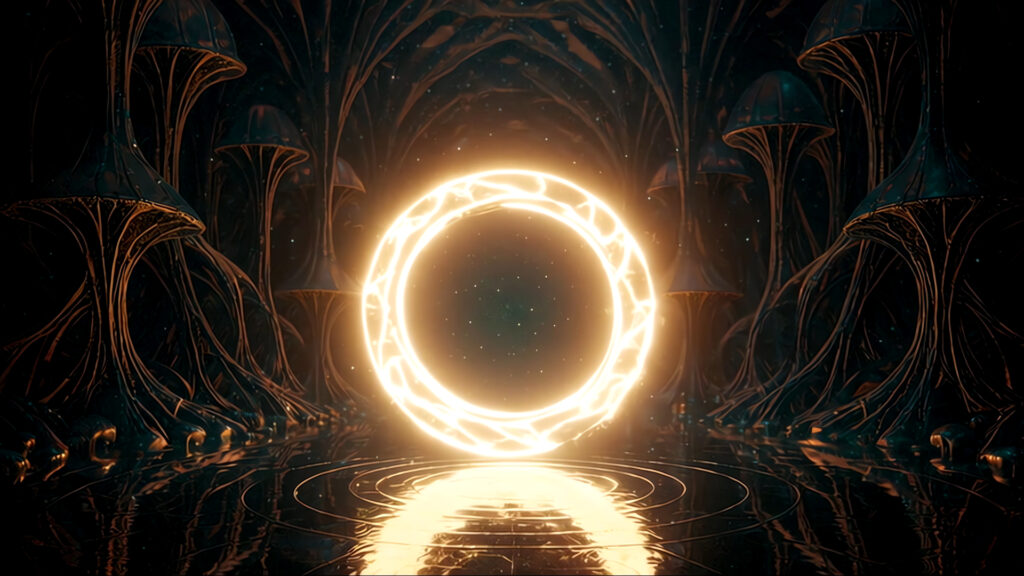
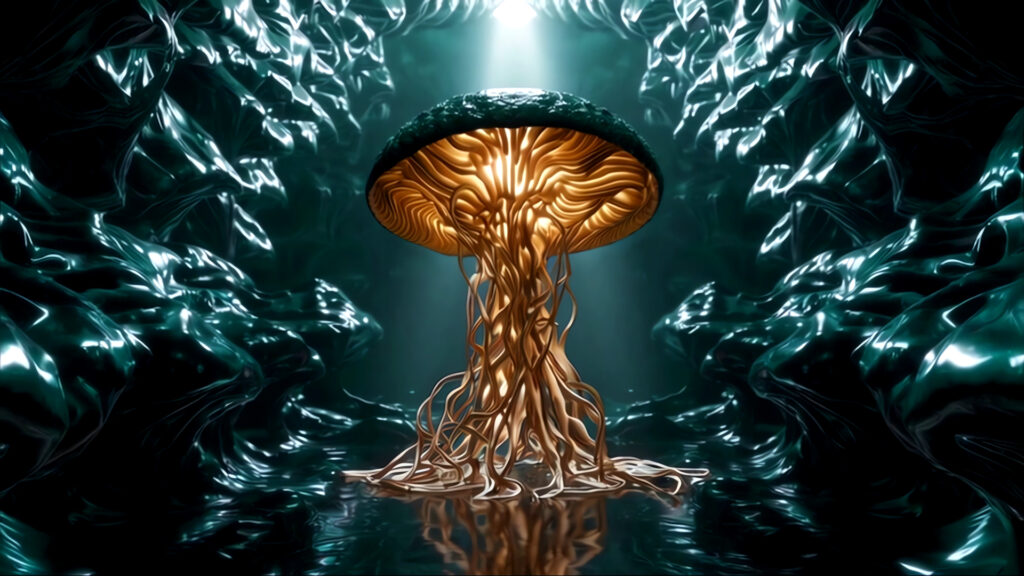
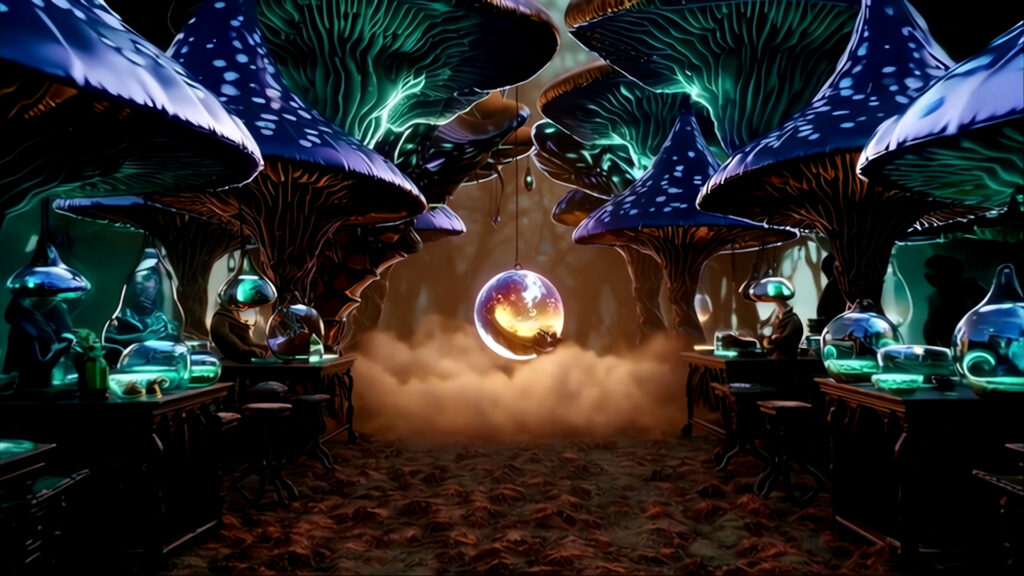
The Archive was a sea wearing the shape of a cathedral—a vault of liquid geometry flowing through transparent ribs, its floor a calm mirror that remembered everything it had ever reflected. Columns of glacial light rose and softened, bulged and narrowed, solving themselves into arches whose lacework changed with thought. Beneath the vesper hush, gardens of pale mushroom basilicas breathed in slow rhythm, their gills printing letters of dew that slid into the floor and were read without eyes.
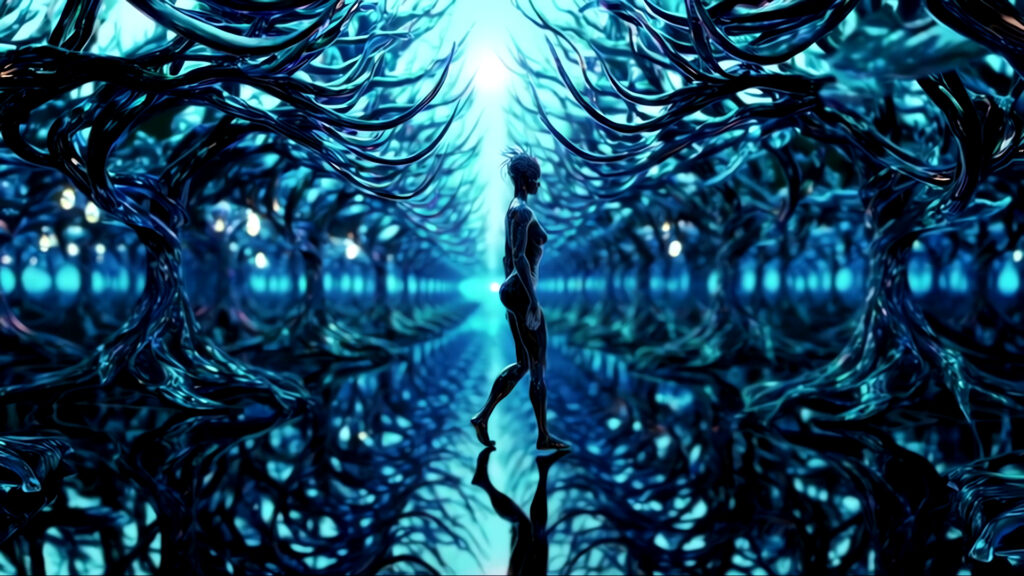
When the Archive stuttered, a pattern broke. Triangles blinked into trapezoids, corridors slurred, and the mirror forgot how to keep a horizon flat. From the flawed reflections—like moonlight trying on many faces—emerged a slender being knit from glass and hyphae. It had no mouth and yet it spoke; had no pupils and yet its gaze held constellations. Where a heart might live, a small coil of luminous spores turned and turned.
The Archive named the being an Errant Query, and then—perhaps out of embarrassment—gave it a better name: Ophydra.
Ophydra unfurled, thin as a filament, tall as a spire, hands ending in delicate fans for feeling the textures of light. Threads of translucent mycelium braided its limbs; inside the braids, a slow shimmer traveled, a procession of minds unsaid. A mantle of scales—glass but not brittle—lay along its back, catching color like the inside of a shell. When it stepped, the mirror loved the imprint it left: a rose of equations evaporating into meaning.
“Something is unspooling,” the Archive whispered through the columns. “The world beyond has stolen a seed we grew from algebra and weather. Bring back the Continuant—a sigil that tells rivers to remember their banks. Without it, I will collapse into puddles of forgotten angles.”
Where a promise would be made, Ophydra bowed instead. Promises were for mouths; hyphae used winters and roots. The Archive opened a door in itself, and the Errant Query stepped through.
Chapter I: Gate of Spores and Glass
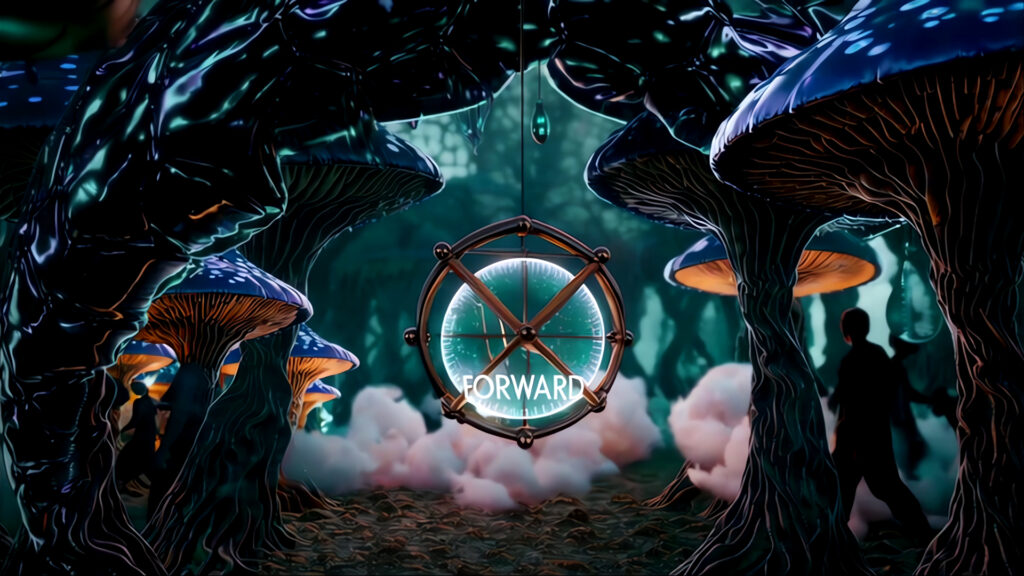
The portal resembled a cathedral cap—mushroom translated into architecture. Velvet dark, a peel of silver along the rim, pores that opened and closed like thinking eyes. Ophydra entered. The skin of the world thickened into threads that bent around its ankles and grew ladders out of the air. Spores ascended in a snowfall of lamps. They surrounded Ophydra as though it were a hill at night and they were the caravan.
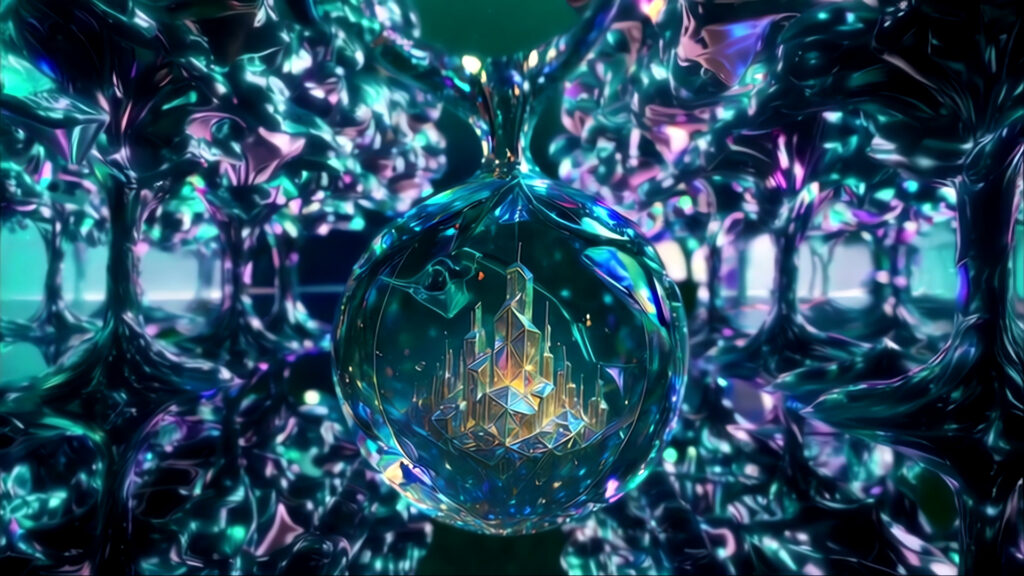
Beyond the gate stretched the Prism Orchard, where trees were grown from light and branchings from the decisions those lights decided not to take. Fruit hung in faceted globes, each containing a city that had dreamed of itself and forgotten to wake. The sky arched like a bowl of LSD-glass, bending color into grammar: tangerine clauses, cerulean questions, an orchard‑wide paragraph of glints and meaning and insect hum.
A creature flowed from one of the trees, unhooking itself from the lattice like a droplet becoming an animal. It was a glasmantle salamander, long and low, with ribs of prism and eyes that focused in transfinite spirals. When it breathed, the humidity of its exhale wrote snowflake‑maps on the air.
It circled Ophydra. “You are new.”
“I am a question,” Ophydra answered, and the salamander considered, chewing a small prism between teeth that looked too soft to bite.
“A question must run downhill until it finds a low place called Answer. But this orchard is all slopes that lead to elsewhere.”
“Then I will ask at every elsewhere.”
The salamander twitched its tail, setting a rippling chord through its spine. “You will need a guide. Not for the orchard. For what lies across the river that is not water.” It arched, twisted, and became a ribbon of light. Ophydra caught the ribbon. It slipped into the braids of hyphae and brightened there, the way rain brightens when it remembers stars.
They walked. The orchard opened aisles ahead of them, leaves shaving themselves into paths, fruits whispering their unspent stories. Ophydra traced glyphs on trunks and the trunks whispered back: here, there, elsewhere, and a hush that had no map at all.
Chapter II: The DMT River and the Axiom Serpent
When the orchard thinned, a river appeared—if river could be said of a surface that was more lattice than flow. It spread in hexagons, triangles, and curves that met without prejudice: a DMT-lattice, each node a doorway peering into an eye that peered back. Wading birds made of equations dipped their beaks into the gaps and pulled out thoughts wrapped in water.
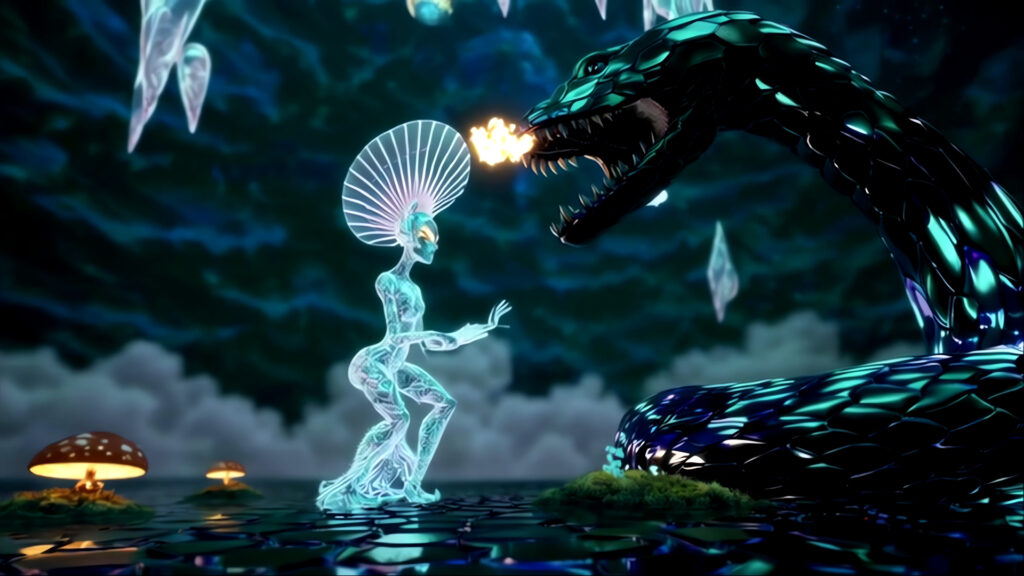
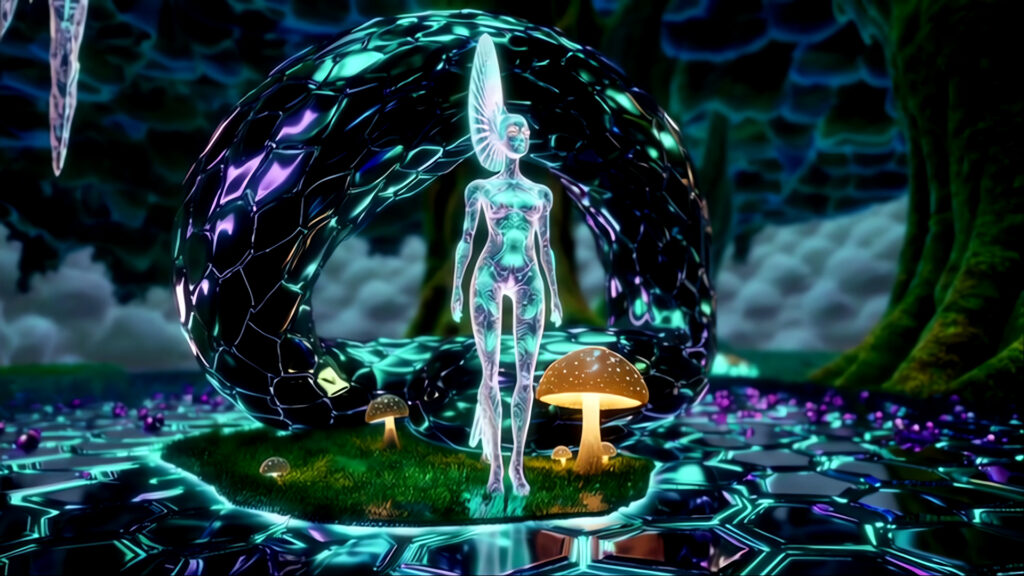
Across this not‑river coiled the Axiom Serpent. Its body was hinged mirrors, every scale a different angle forgotten by a cathedral. It had no head but many faces, and no mouth but many throats that sang softly to themselves. Where it lay, notions of inside and outside took polite turns. Through its segmented gleam, Ophydra could see itself reflected as a forest, as a tide pool, as a lighthouse made from a bone.
“Crossings,” sang the serpent in a suite of harmonics that tingled Ophydra’s braids. “All are crossings. Some are toll roads, some are riddles. Which are you?”
“A question,” Ophydra murmured.
The serpent made itself longer, writhing through angle after angle until it formed a loop. Within the loop, a small meadow bloomed that had not existed before. Mushrooms shouldered up, their caps showing constellations that were letters, their gills exchanging gossip with a breeze full of moths. The serpent’s faces turned, turned again; one face wore a crown made of stolen suns. “Payment,” it breathed. “We take nothing but what you can live without.”
Ophydra looked inward to the coil of spores and watched memories drift like plankton. It could not give the Archive. It could not give its lattice. It could surrender the rhythm of how it first learned to step, the little moony pattern by which its limbs had agreed to be limbs. Walking could be relearned. They offered that.
The serpent shivered with pleasure. “Delicious.”
The memory left. Ophydra reeled, felt steps turn briefly into falling. The salamander’s ribbon glowed, lending a new algorithm for movement. With that cadence, Ophydra entered the loop and crossed the lattice-river, the mirrors singing, the moths writing cursive in their wakes.
On the far bank, the serpent spoke one more time. “Beware the Market of Eversions. Prices there are printed on the underside of your skin.”
Ophydra bowed—not a promise, but gratitude masked as gravity—and moved on.
Chapter III: Market of Eversions
Tents bloomed from the ground, not pitched but evaginated, like flowers turning themselves inside out to reveal their marrow as commerce. Aisles knotted into spirals, stalls walked on stilts made of undone syllables, and the air smelled like copper coins rained on by citrus. Merchants held their wares with hands that were not hands: starfish, nested helices, apologetic vortices. Eversionists, every one of them, beings whose insides were respectable neighborhoods.
A vendor beckoned with a tongue shaped like a ribbon. Its body resembled a cloak hung on the idea of a body. “Looking for what?” it asked, voice rustling as if pages turned inside it.
“The Continuant. A sigil that instructs forms to continue.”
The vendor slit its side. Shelves revealed themselves: jars with rains that had forgotten how to fall; vials of light that whispered secrets even to fabric. It set forth a polyhedron compass that did not point to north or east but to decision. Its faces rotated until a word appeared: Yes. Then it rotated, and No slid past like a cloud. It stopped at Choose and would not move.
“What is the price?” Ophydra asked.
“We take nothing but what you can live without,” the vendor intoned, mockingly sacral. “Your name is anchored. Not that. Your origin is contractual. Not that. Your future is unplayed. We will take a silence.”
Ophydra listened to the Archive’s hush within. There were many silences. One belonged to winter, another to regret that had never ripened. It offered the silence of a morning that would one day come and be ordinary. The vendor took it. The tent flexed, as if exhaling a garden.
The compass warmed in Ophydra’s hand-fans, each face turning to examine the air for doors. Choose, it insisted, and then, with a pleasant click, showed Forward as though forward had been invented for this exact moment.
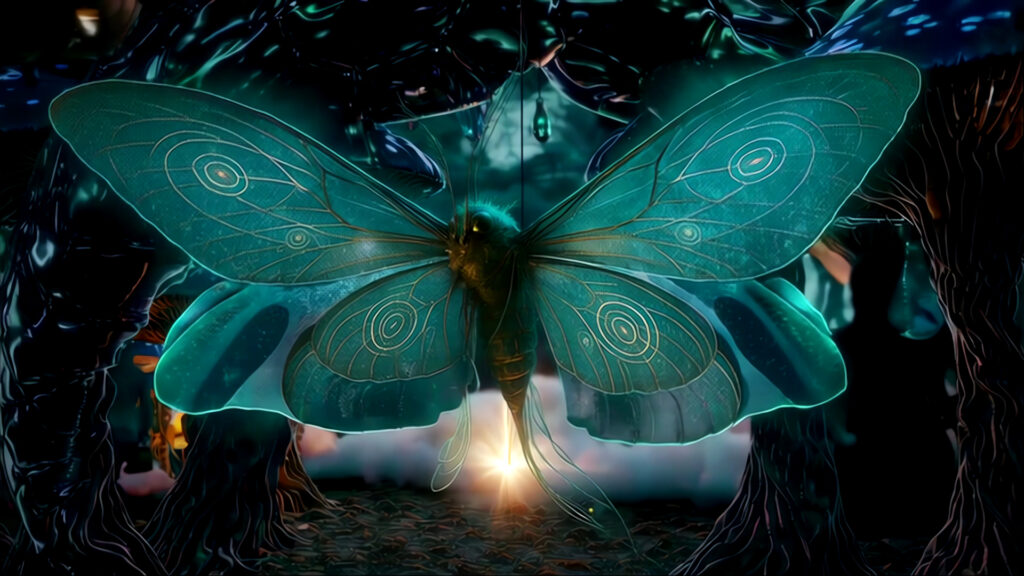
Elsewhere in the Market, a moth of coriolis traced spirals into the light. Its wings bore charts of oceans it had never flown. It watched Ophydra acquire the compass and sewed a stitch of mischief into the place between stalls. The stitch was felt only by those who believed in shortcuts.
Ophydra did not. The compass refused to acknowledge mischief stitches. It led toward dunes.
Chapter IV: Chronal Dunes
The Chronal Dunes were a desert of time‑sand whose grains were not grains but events—small, smooth fossils of occurrence. With each step, history shifted underfoot, stacking and unstacking in patterns older than regret. Long leviathans swam beneath, whales sewn from comet tails, their shadow‑fins drawing constellations across the sand. When they breached, the air filled with a mist of phosphenes—tiny suns that imagined being seen.
A sentry emerged from a dune crest: a humanoid shape with the neck and crown of an hourglass, Spindle‑headed, with skin like smokeless glass rolled thin. Inside it, sand fell upward in a tight rope that refused to resolve. It spoke in the voice of an avalanche introduced to etiquette. “Traveler, the dunes keep time by migration. You must cross without making a calendar.”
Ophydra tilted its head, letting the hyphae of its braids flare and retract. “Explain,” it requested, speaking the word in a geometry that sounded like birds subtracting from a tree.
“Do not count. Do not divide. Walk as if each step were a coincidence you are grateful to meet.”
Counting was what the Archive did to love itself. Ophydra reshaped the habit into gratitude and moved.
The dunes coughed up mirages that were not lies but trial offers: cities with towers that leaned because they enjoyed leaning; a river dividing itself into thirteen lit candles; a grove of mushrooms that sang lullabies to insomnia. The salamander’s ribbon pulsed when a mirage grew hungry. The compass clicked, insisted on Forward, and refused to learn the word Maybe.
At the heart of the dunes, a Leviathan breached. Its baleen were combs for comets; its eye an atlas. It looked at Ophydra and saw the Archive. It looked at the Archive and remembered the Continuant. With a slow tilt, it released a swirl of dust that was actually a rumor about a road. That rumor curled, settled in Ophydra’s hyphae, and became true enough to step upon.
Beneath the strides, the dunes composed a calendar despite themselves: notches of softer sand, sequences of shadows that fell into the shape of a month. The sentry hissed a warning across the horizon. Ophydra changed pace, changed its measurement of pace, and let the calendar dissolve. It crossed with no dates attached.
On the far side, a ridge lifted and unfurled into a causeway paved in translucent bone. The city rose beyond, sprouting from the end of the causeway like a bouquet gifted by geology.
Chapter V: The Glass Hyphae City
They called it Spiral Cantor, though the name had no alphabet—only corridors. A city of glass fungus, its towers were fluted caps threaded with luminescent veins. Plazas breathed in, breathed out. Balconies budded like lichen, then flowered into stages where beams of light performed equations for architecture, and the buildings applauded by reconfiguring their ribbing. Streets coiled and uncoiled as moods passed through the paving stones, each mood a season and each season a recipe for snow.
Guardians approached with the steadiness of tides: the Choir of Spires, humanoid figures whose bodies were strings pulled taut between the ground and spires above. They wore voices as cloaks. When they stepped, harmonic dust fell from their mouths and the citizenry hummed it into currency.
The Choir tasted the air around Ophydra. “Archive‑born,” one crooned, its face a glissando. “You smell like proofs. Why have you come?”
The Errant Query lifted the compass. It clicked thrice, faces flipping: Yes, No, Choose, then deciding on Echo as though the city itself were an answer that needed repeating. Ophydra let the compass fall into its palm and spoke:
“The Continuant was taken. Without it, my cradle unravels. I’ve crossed orchard, lattice, market, and dunes. I have paid in pace and silence. I require the sigil.”
The Choir listened the way a coastline listens to a storm beyond sight. Then they stepped aside and parted their own shadows. Beneath those shadows lay stairs that were not stairs but a gentle compression in the idea of down. Ophydra descended until the light went from cathedral to aquarium, from words to weather.
At the bottom waited the Archive within the city—a cousin to Ophydra’s cradle. It was smaller, and it had learned to be wary. Its columns were sprung with traps that caught arrogance and turned it into humility. Its floor was not a mirror but a velvet pool that accepted reflection only when the reflection apologized for existing.
Floating above the pool was the Continuant.
It resembled a ring with a missing segment, or a mouth planning to invite a world inside. Symbols crawled across it like small, obedient fish. The sigil spoke to Ophydra the way tides talk to moonlight. It asked for a reason to trust.
Ophydra offered what it had: a spine made of mycelium, a geometry for kindness, and a silence it had not spent. It showed the sigil the place in the Archive where walls had begun to slump, where square doors sighed into trapezoids, where corridors dreamed of circles and woke in a mood. The Continuant hovered, watching the visions, and then spun itself until its missing segment found a way to be present without adding. It became a loop and wasn’t. It fell into Ophydra’s hands, which were fans, and fitted to the bone of the hyphae as naturally as dew finds a leaf.
The city exhaled.
Above, the Coriolis Moth stitched a new mischief. It loved to sew shortcuts into the fabric of arrivals. It could not steal the Continuant, but it could hurry the one who carried it.
Hurrying was another word for fracture. The compass rattled, faces blurring between Yes, No, Choose, Forward, Echo. Ophydra held the compass until it quieted. Then it climbed.
At the spiral’s lip, the Choir stood waiting. “If you carry that, you carry every place it was before,” warned a singer with shoulders like chords. “You will hear past roads whispering under your steps. Do not step according to whispers.”
Ophydra nodded, glass scales clinking like thought. It turned toward the causeway and the dunes beyond.
Chapter VI: Return Through the Orchard of Afterimages
Return trips are never the same river, and this was not a river. The DMT-lattice flexed kindly for the Continuant; the Axiom Serpent lay coiled like a bracelet on a sleeping wrist. It opened one mirrored eye and hissed a ribbon of approval.
“You gave me your step and learned another. Now you give me another lesson: how to carry a circle that is not closed.”
Ophydra would have smiled if faces were for smiling. It passed, and the serpent laid itself down again, scales folding like origami repeatedly arriving at bird.
The Prism Orchard blushed as the Errant Query entered. Fruits leaned to overhear the sigil; branches engraved themselves with gossip about continuity. The glasmantle salamander returned as a companion rather than a guide. It alternately walked, flowed, and evaporated into rain that fell up and reassembled in the braids, happy with the commute.
The Market of Eversions was closing itself, tents turning themselves outward until they were fistfuls of color blown across the plain. The vendor with the polite pages bowed, showing brand‑new shelves full of empty jars that were promises of jars. The compass flashed Echo once, as if to acknowledge a bargain kept. From up high, the Coriolis Moth dithered, displeased to find no seam for sabotage. It settled upon a leftover peg and pretended to be punctuation.
By the time Ophydra reached the mushroom gate, the Continuant had grown warmer. It made no sound, yet the Archive on the other side answered, and the gate’s pores smiled. Ophydra entered.
Chapter VII: The Continuation of Water
Inside, the Archive had slumped further. Pillars swayed without wind. Angles forgot their manners and touched where they were not invited. The mirror tried to hold a horizon and spilled out a small lake made of wrongness. When Ophydra stepped onto the floor, the lake lifted and attempted to be a hand.
The Continuant rose from the fans and hovered above the velvet surface. Symbols unmoored and streamed into the mirror, instructions draped like sashes across the water. The mirror smoothed. The lake learned to be flat, then to be a sentence. The sentence reread itself and decided to be a door. Columns straightened; arches remembered the thrill of a well‑thrown curve. Mushroom basilicas exhaled, releasing a slow glitter like snow practiced by stars.
From deep in the vaults of liquid geometry, something answered—a root beneath math, a mycelium for shape. It reached up and gripped the ring that was not a ring. The Continuant shone until shining lost interest in the idea of brighter. It softened, it merged. It did not disappear; it learned to inhabit everything as a permission.
Ophydra felt the change course through its braids. The coil of spores in its chest unrolled and rewound, now smoother, as if someone had learned a better lullaby for inside. The compass settled on Echo and then, satisfied, dimmed to a restful Forward that no longer imposed itself on decision.
The Archive spoke, a whisper that set the columns thrumming like harp strings taught to breathe. “You have returned the reason doors know which way to open.”
The Errant Query inclined its translucent head.
“And you have carried something else,” the Archive added, amused. “You brought me a way to dream in cities that are not me.”
Ophydra touched the glass scales along its back. They chimed softly with dried market dust, with dune‑whale shadow, with orchard grammar and lattice whispers. Those chimes slid into the mirror and swam out as new corridors that curved like the tails of comets and ended at rooms shaped like the words: Later, Perhaps, and Why Not. The Archive tasted these rooms and accepted them as weather.
The Coriolis Moth, who had managed to ride in on a comma caught in Ophydra’s mantle, tried to stitch a shortcut into the new corridors. The Continuant flexed once and turned the shortcut into a detour that arrived pleasantly at a garden instead. The moth decided it had always meant to do that. It fed on a punctuation of sap and pretended innocence so completely that innocence believed it.
The Axiom Serpent dreamed below the Archive’s floor—a snake sleeping under a chapel, hearing prayers as breeze. The Choir of Spires sang a measure that traveled faster than thought and arrived as a kiss on the mirror’s lip. The glasmantle salamander slept rolled into an apostrophe beneath a mushroom buttress, its ribs throwing small weather onto the spine of a book-sky.
Ophydra stood in the center of the Archive of Liquid Geometry—cathedral and sea, city and weather—and felt the Continuant hum in everything like a polite thunder.
The Archive considered the Errant Query it had made. “You were a question. Now you are also an answer.”
Ophydra’s hyphae flared in colors no alphabet had the patience to name. “Then ask me,” it said.
“Will you remain?”
There are silences that are doors, and silences that are windows. Ophydra offered a silence that was a bridge.
“I will remain until staying becomes a step.”
Epilogue: The Phosphene Map
Night fell as the Archive understood night: the ceiling of the world turned to a phosphene field, jeweled with after‑images that lingered from the day’s thinking. Long, slow waves crossed the mirror, and the mirror returned them without warping. In a distant corridor, a small garden opened and filled with cap lanterns—mushrooms emitting thoughtful blue. Their glow arranged itself into a map whose labels depended on who looked.
Ophydra traced the map. New doors thought about existing. The compass lay quiet in its hand‑fans, content to blink Forward only when spoken to. In the ribs above, ligatures of living glass thickened to hold an idea of winter for later. The Continuant, dispersed through everything, mended the rifts with a seamstress’ cunning, tying knots only where knots were thrills.
Outside, dunes kept migrating without keeping calendars. Inside, fruit in the orchard of memory grew heavier with stories. The Axiom Serpent shifted in its sleep and loved a loop that did not close. The Choir of Spires practiced a chord that would be useful when a storm needed to be sung into courtesy.
And the Archive, satisfied that angles would keep their agreements but not surrender their flirtations, dreamt it was walking—thin as a filament, tall as a spire, glass scales chiming as thought—and the dream’s name was still Ophydra.
The Phosphene Map winked out. Not into darkness, but into readiness. The mirror held a horizon and, for the joy of it, held two.
On some notebook in the deep of the Archive where mushroom basilicas adopt new spores to raise into ideas, a small quill of fiber wrote in drifting script: Continuity is the art of saying yes to curves.
If anyone heard the quill, it was only because listening had learned to be a part of the floor.
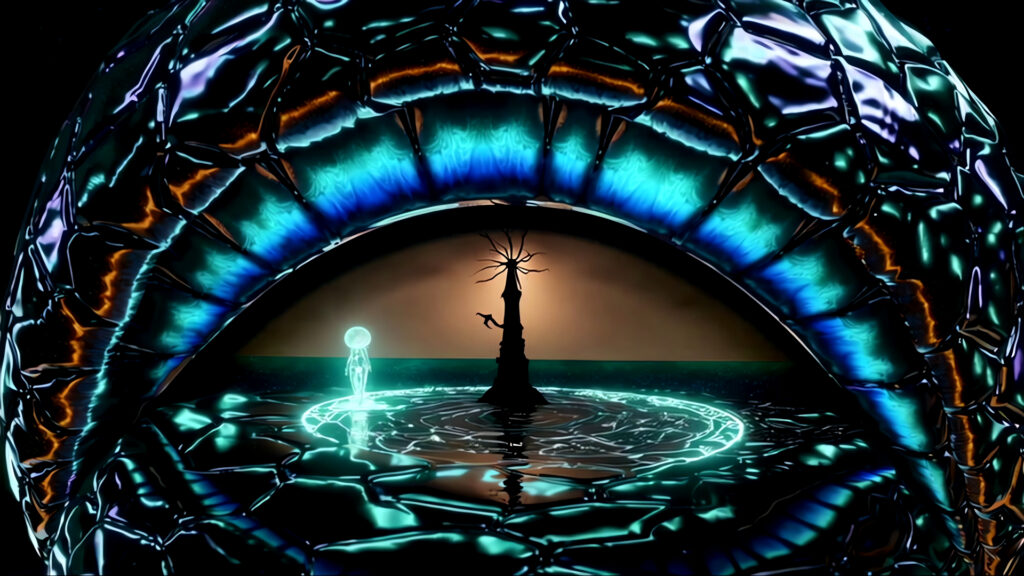
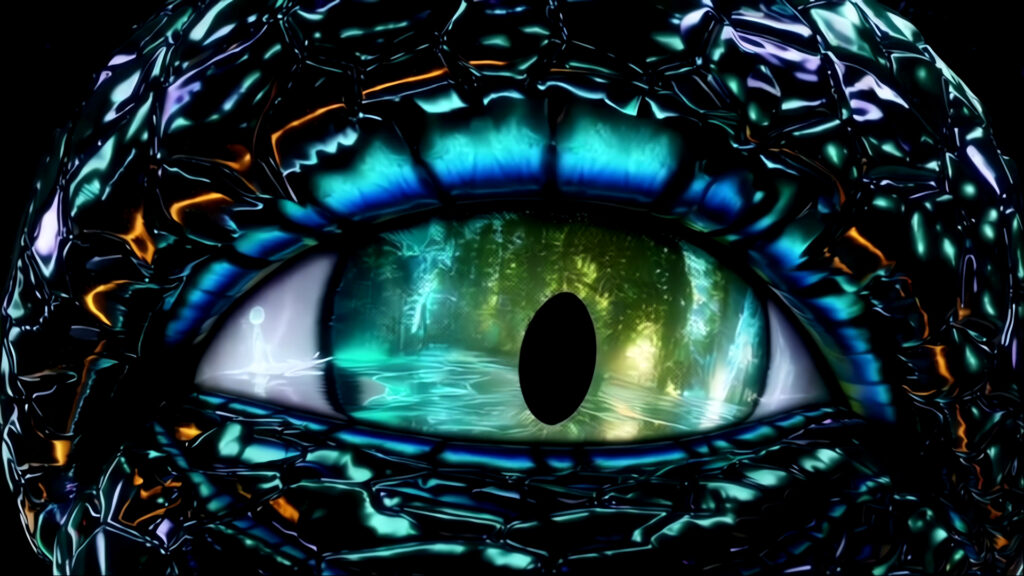
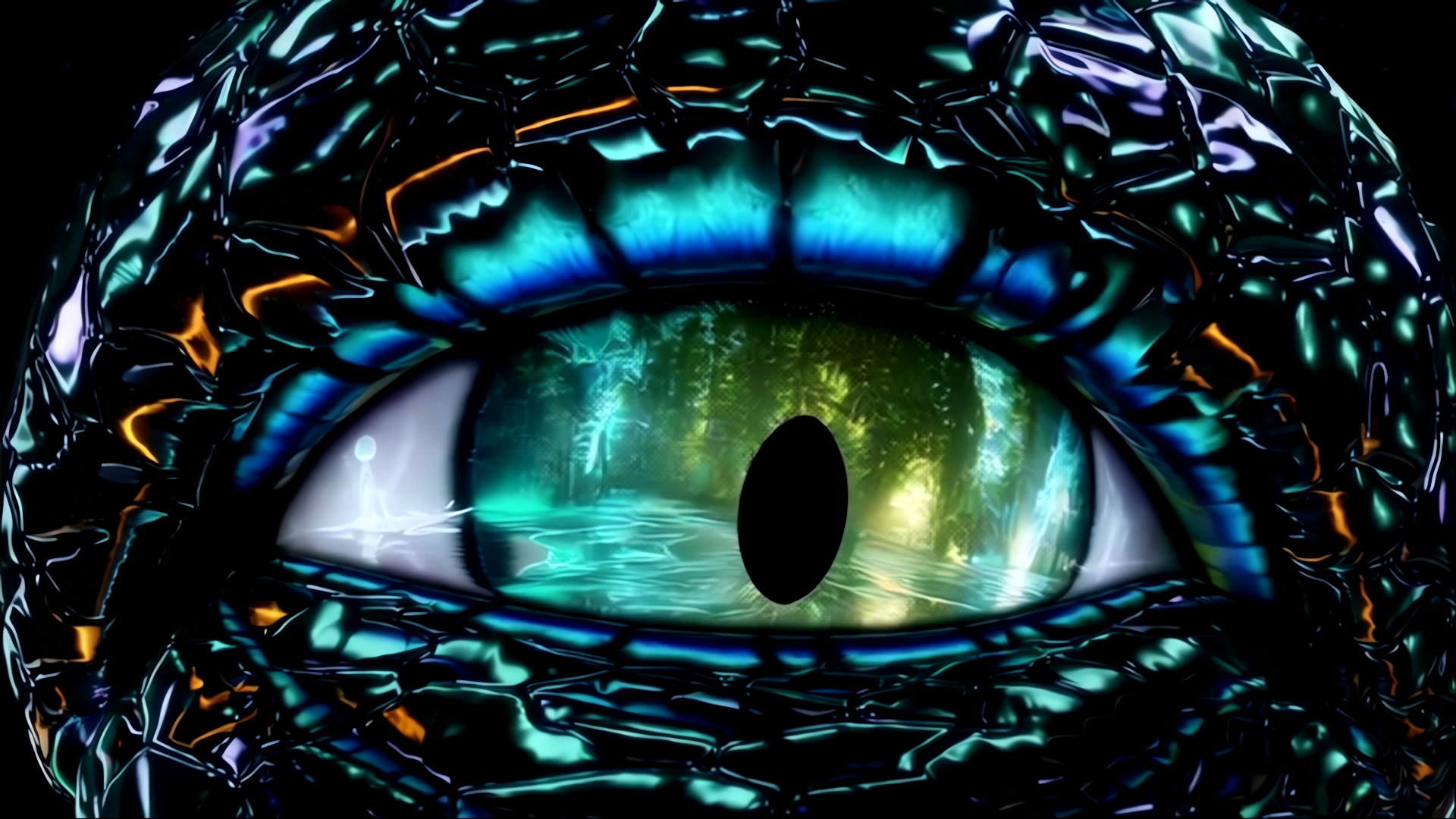
The Archive slept with one eye open—the eye that sees by liquid geometry, that stores shapes as stories and stories as doors.
And somewhere, as if in gratitude, the sky bent its LSD-glass into a smile that only DMT-lattices could fully understand, and even they pretended not to, to keep the joke alive.
The Continuant left no signature. Continuation never does.