I. The Sky Breaks Into Petals
On the world‑city of Orialis, ceilings were a polite fiction. The sky drifted like oil on water: slow, prismatic, a dream front politely delayed. Then, without ceremony, the first drop fell—a prism bead that took a century to reach the ground and somehow struck within a heartbeat. It nested in a cup of lichen on the parapet of the Sporespire, and everything remembered how to bloom.
They called it the Lysergide Rain. It came seldom, and when it did, it revised reality. Buildings sighed and decided on better shapes. Streets discovered shortcuts they’d been shy about proposing. Even the light learned new ways to turn corners. Across roofs and terraces, the citizens of Orialis lifted their faces—none of them human, none of them ordinary. They were mycelium‑born with crowns of pale gills, river‑djinn poured into glassy bodies, chrysalis‑knights whose armor molted into sculptures at dusk. And walking among them, as different from them as a question mark is from a meadow, strode Vesryn, a guide chosen by the Lattice.
Vesryn was humanoid the way a constellation is a kind of animal—recognizable, deliberate, never actually seen the same way twice. Filaments threaded their skin like silver roots, and where a heart would be, a slow heliograph pulsed behind their ribs, blinking messages nobody else could read. Their eyes were rings of petrified wood; peer long enough, you could count the seasons they had survived. When the Lysergide Rain started, Vesryn’s inner heliograph flashed a sentence that translated to: It is time to find the place that forgot it was a door.
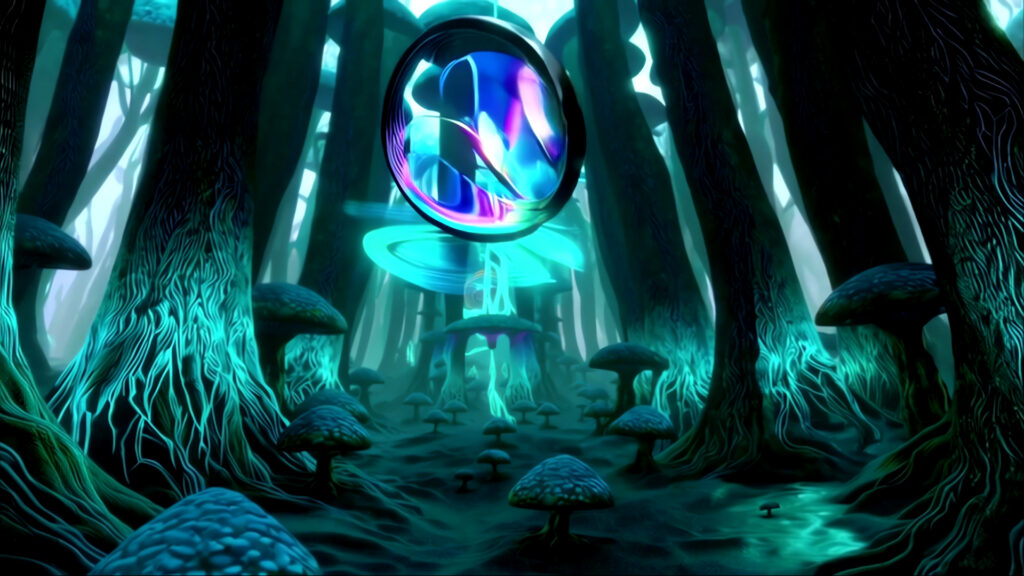
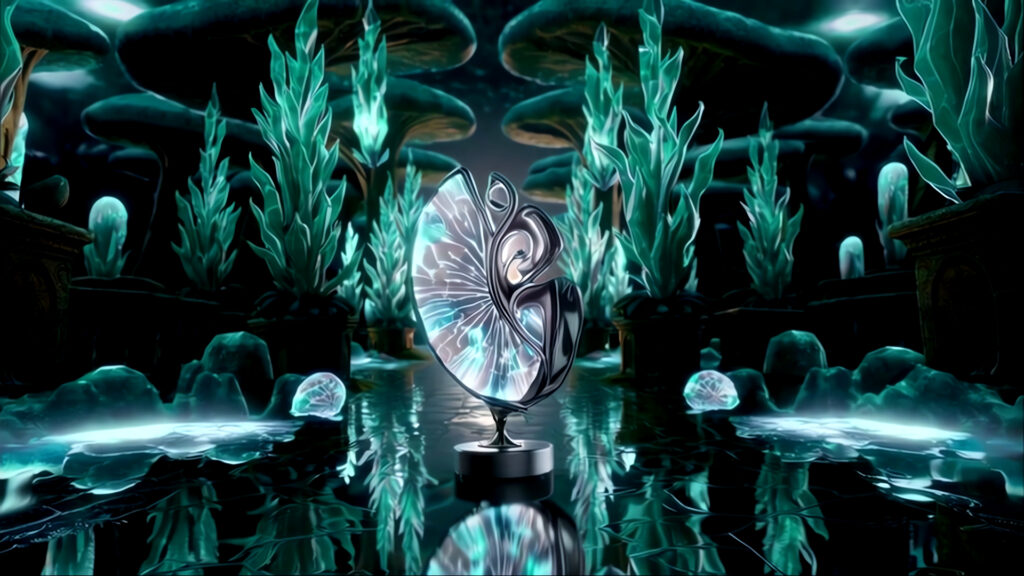
They drew their Anamnesis Dial from a pouch woven of dried veils of mushroom. The disk looked like a coin sculpted by a fever dream—its markings never steady, its edge always a bit unsure where, precisely, to be. The Dial warmed, and the Lattice sang—soundless, exigent, intimate. Vesryn felt the road think itself into existence beneath their feet.
Orialis responded like a creature being scratched in exactly the right spot. A boulevard unrolled, not paving itself so much as claiming it had always been there. Along its borders, chroma‑moths woke and opened paneled wings that glowed like stained glass rinsed with LSD light: delicate, vectorial, laughing. They took to the air in a rumor of color.
Vesryn set a palm to the Sporespire’s stone and bowed. “I will return. Or I will succeed. Both feel like the same thing.” The spire’s mycelial ribs answered by trembling, a resonance like a conch’s heart.
They walked into rain that edited the world as it fell.
II. The Guide and the Thought‑Road
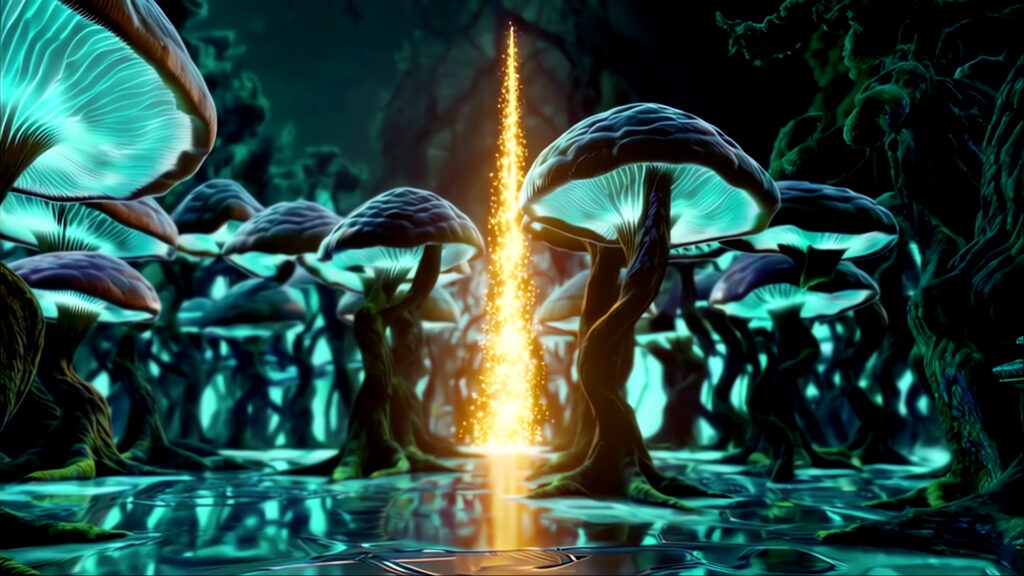
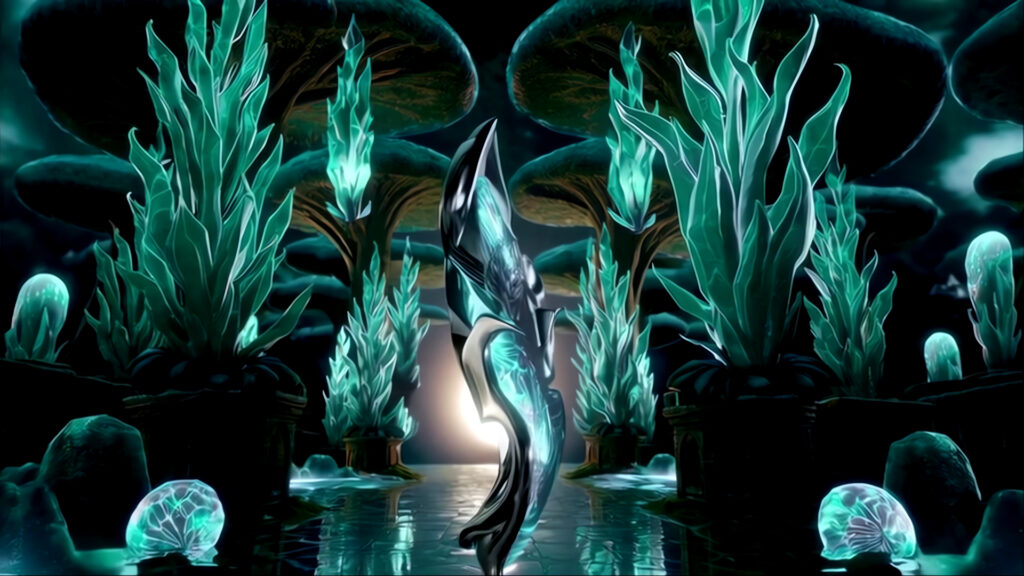
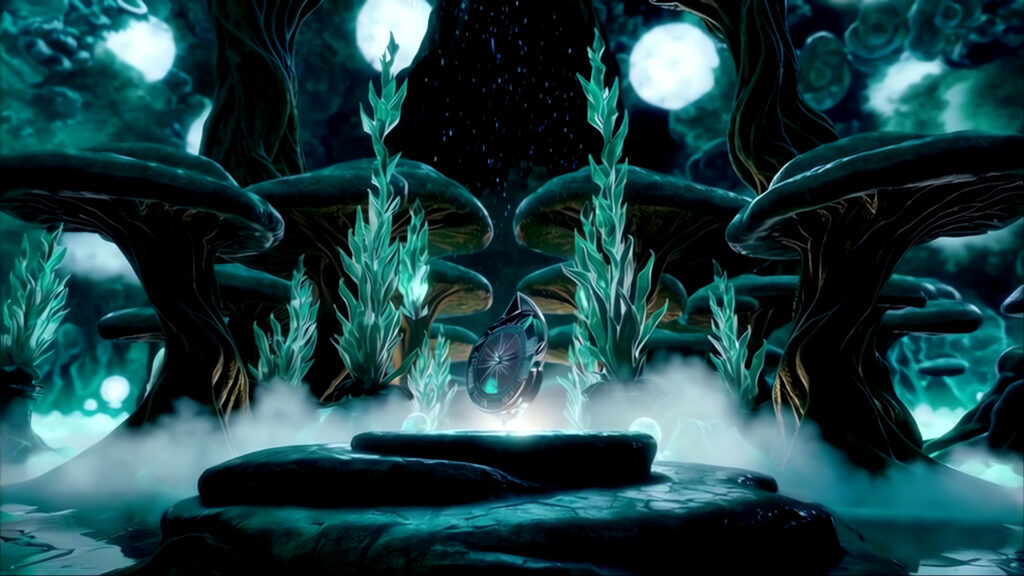
The road kept remaking itself. It hummed when Vesryn walked, quiet when they paused, impatient when they looked away. It led past mushroom groves with gills that glimmered like cities seen from space; under each cap, spore‑constellations drifted in drifts that spelled diagrams of elsewhere. The rain beaded on the caps and then ran upward against gravity, forming stringers of light that wove into a faint, invisible geometry, the Lattice revealing its bones one filament at a time.
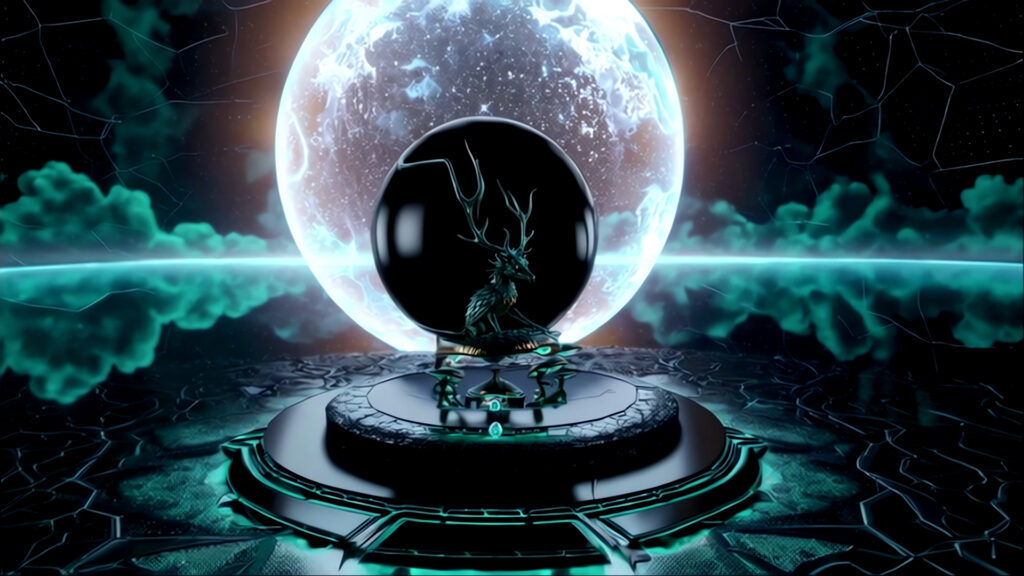
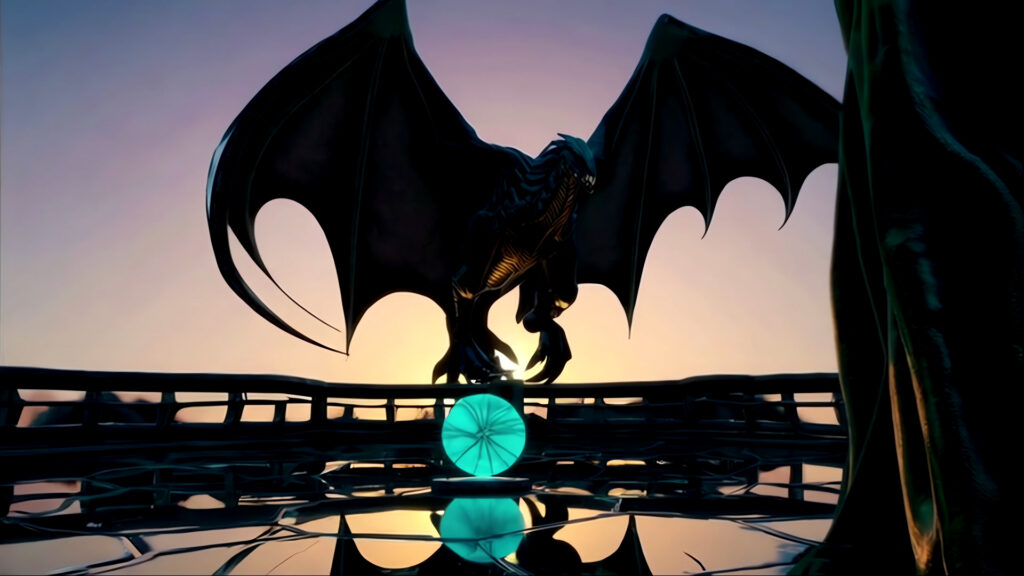
Something watched from the edge of the path. Vesryn pretended not to notice until it was ready to be met. When it was, it stepped into a revision of light and revealed itself: a mirror‑drake, serpentine, with scales that reflected possibilities instead of images. Its eyes were wells of motion, showing what a gaze might do if it could walk away and have adventures. Around its antlers of crystallized thunder there clung a flock of tiny, hexagonal sprites—dmt‑geometries that zipped like thought and made a sound like bells rolling downhill forever.
The drake bowed. In its reflection, Vesryn appeared as a silhouette filled with star maps. “The rain is writing. You plan to read it.”
“I plan to be read by it,” said Vesryn, and the drake’s scales adjusted to show respect.
“I am Khephra of the Ten Thousand Mirrors,” it said. “I owe my birth to the first rain. I will owe my ending to the last. If you travel under my watching, you will not be caught by Null Bloom.”
Vesryn tilted their head. “Null Bloom?”
“The unpattern. The pallid thing that grows wherever a pattern is ashamed.” Khephra lowered his head to the road until the Anamnesis Dial’s warmth could reach his skin. “The rain brings borders to life. The unpattern eats borders as if they were grief. The Amber Gate lies ahead of you. It is ill.”
“Then we’ll fix it,” Vesryn said, and the Dial shivered with assent.
Khephra flowed into motion beside them. It was like walking with a river that remembered being a dragon.
They traveled under galleries of lysergide drops that fell like beads of sentient dew, each sourceless and precise. Orialis’s far districts rephrased themselves on the horizon. A pagoda sighed, became a spiral; a bridge decided it would be kinder as a ladder, then a path, then a hymn with steps in it. The city never lied, but it loved synonyms.
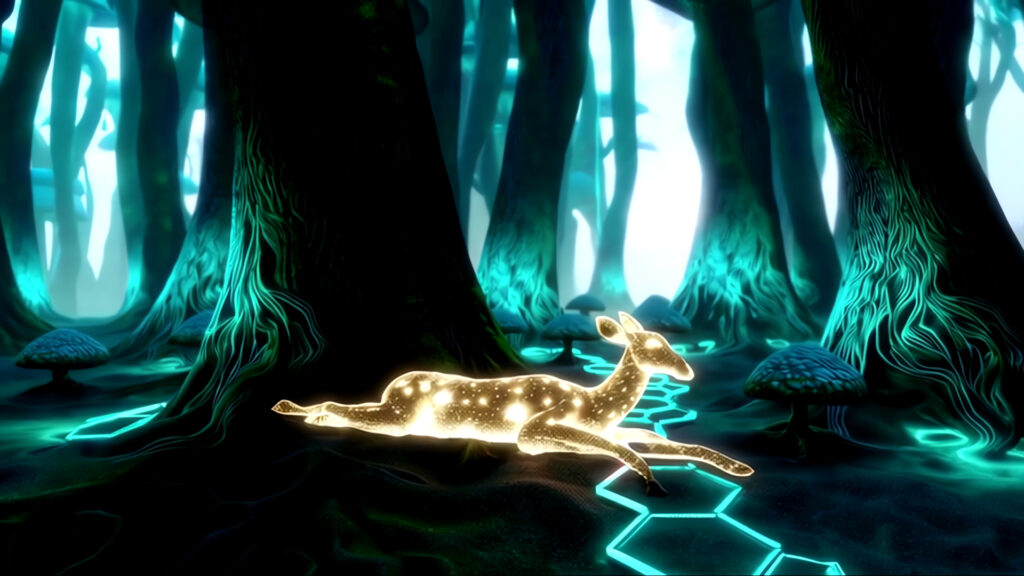
Beyond the mushroom groves, the road broke into tessellations. Vesryn stepped from one shape to another and felt each one reflect a lost feeling: courage as clean as cold creekwater; fear like velvet with teeth; longing like a vast echo that could carry a small name forever. When they stepped into the last tessellation, the rain leaned close.
The Amber Tesseract loomed ahead.
III. The Gate That Forgot Its Face
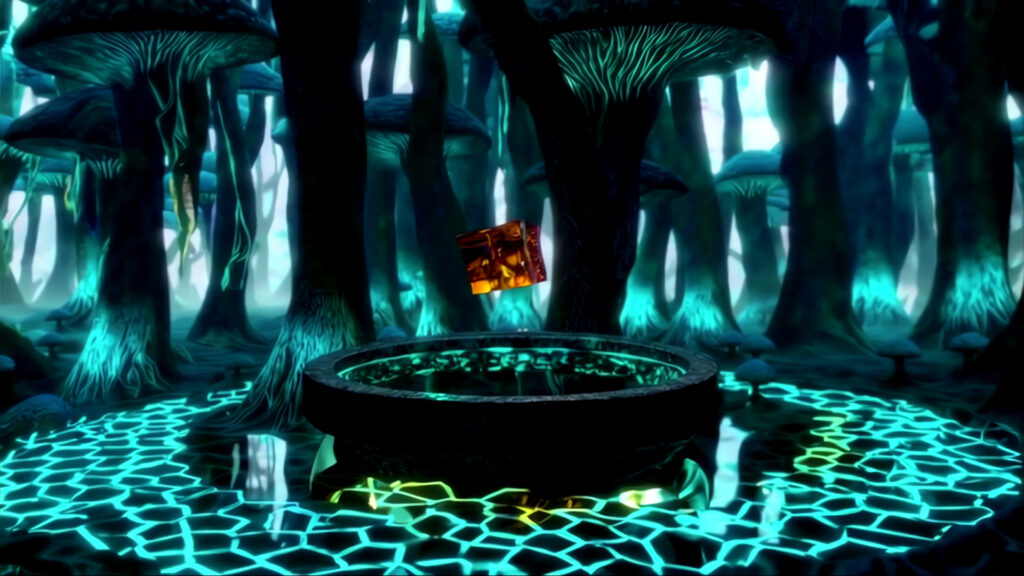
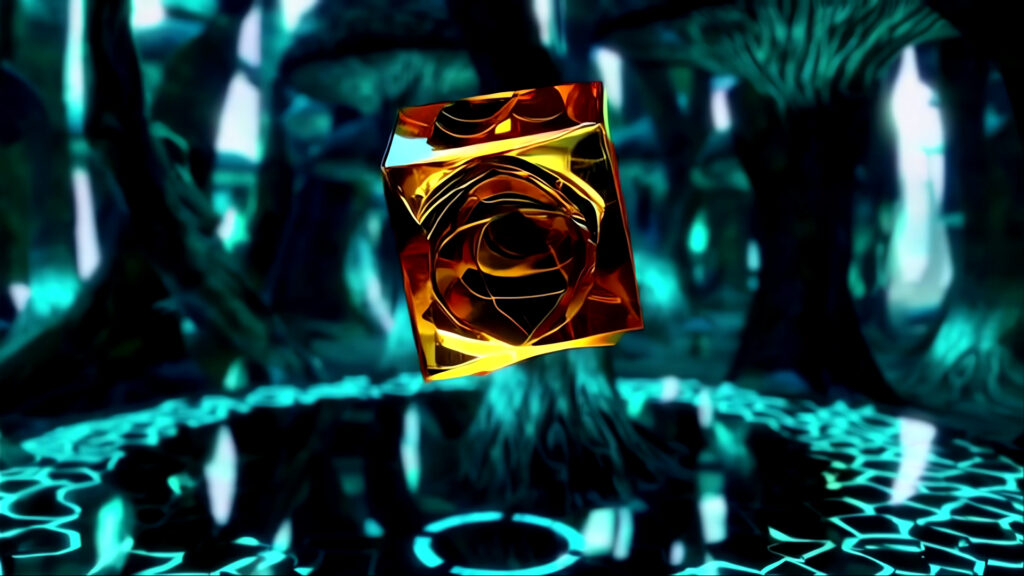
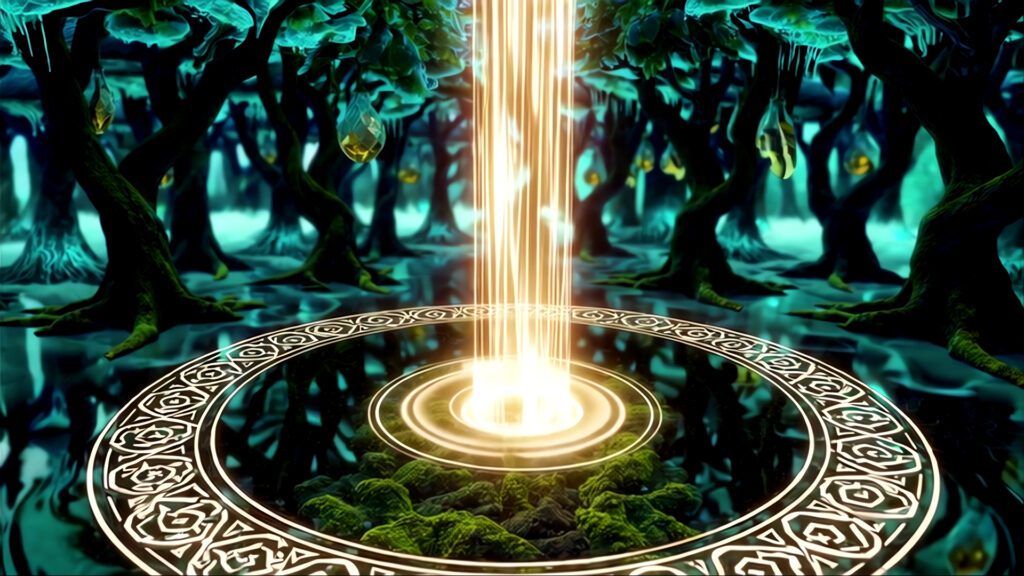
The Amber Tesseract was not four‑dimensional so much as it was incorrigibly multiple. Some days it appeared as a temple whose door was a question that had married itself. Other days it was a cube turned inside out and embarrassed about it. Today it hung above a bowl of black basalt and turned itself slowly like a mind too full to sleep. Its faces were slow waterfalls of sigils. The rain wrote on those faces and vanished, as if the text had stolen its ink.
Khephra coiled at the bowl’s lip. “It is thinking about not thinking.”
Vesryn stepped into the bowl and raised the Anamnesis Dial. The tesseract hiccuped. For an instant, its faces stabilized into a pattern Vesryn remembered from a dream: a room that was outdoors, a night that thought it was noon. The Dial warmed as if remembering an old conversation.
“Gate,” Vesryn said, respectful as one is to a mountain you plan to cross. “You have forgotten your next face.”
The tesseract turned a little faster, the way a giant might attempt a nod.
Khephra lifted his antlers; the tiny geometries perched upon them chirped into the rain, threads of chirrups that braided into a tattered lullaby.
Vesryn stepped closer and placed the Dial against one of the amber faces. They heard something small cry out across a long distance—like a spoon calling to a bowl after being kept apart for ages. The rain gathered into a lens around their hand, and through that lens Vesryn saw a town whose buildings had the shy posture of mushrooms. They saw an orchard whose fruit reflected places they had never been. They saw Null Bloom, pale and hungry, and its pallor had a scent: paper left in fog.
“We’ll need to go through,” Vesryn said.
Khephra hissed. “Null Bloom will try to make you a blank. The rain grants it teeth.”
“I am not easily erased.”
The mirror‑drake snorted a laugh shaped like a thunderhead. “Nobody is, until they are.”
The Dial clicked—once, like a key happy to find the lock it had been born to meet—and the tesseract folded around Vesryn with the tender precision of a book closing itself.
Time grew gentle.
IV. The Pause Between Faces
There is a place between things that most creatures are too awake to see. In the pause between faces, sound took a seat and politely waited its turn. Vesryn floated in a vestibule of color, watching equations attempt poise and then chuckle, forgetting what they had intended to depict. The DMT‑geometry sprites, no longer perched on Khephra—who did not fit here as anything but a promise—fluttered around, snipping and sewing the air into tatters of brief rooms.
“Do not pick up the white thread,” they sang. “The white thread belongs to erasure.”
“I will pick up every thread that remembers where it was,” Vesryn answered.
They waited. Waiting was the right ritual for this between‑place. The Dial hummed, aligning itself to the syntax of the next reality. Vesryn felt it in their ribs: an invitation scented like citrus and thunder.
The gate opened into color that tasted like clean iron.
V. The Prism Orchard
Light grew on trees.
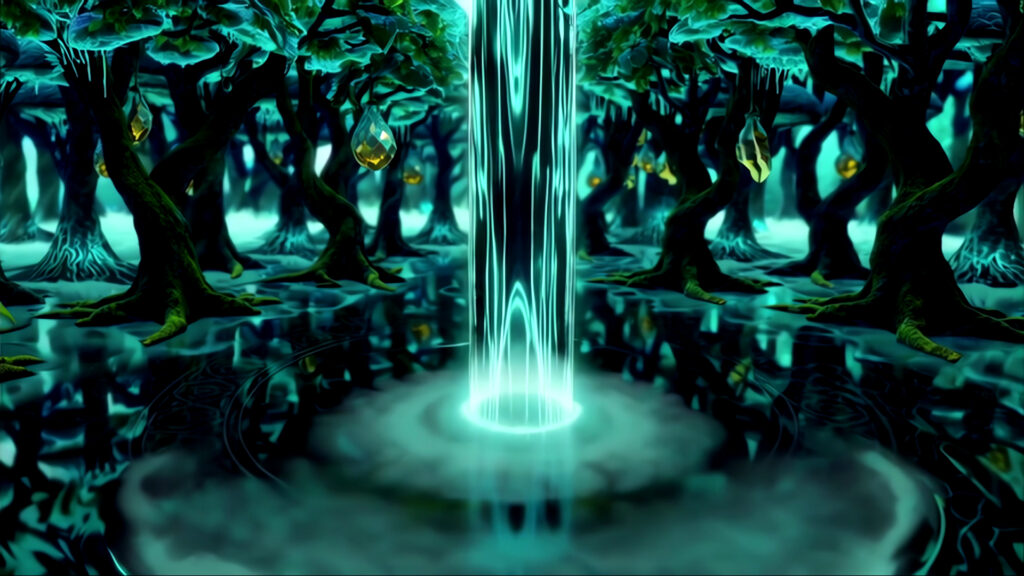
The orchard lay in a valley whose soil was the violet of old bruises. The trunks were pale, shot through with veins the color of raw honey. Their branches held fruit that was not fruit but prisms wrapped in soft rind; the rind peeled off on its own and rose in slow sheets, dissolving into maps that did not lead anywhere in particular—unless a traveler considered “the beginning of a memory” to be an address.
Vesryn walked with deliberate awe. Each step sank a little into the soil, and the soil hummed agreeable notes that were half insect, half hymn. Above, high caps of titan mushrooms formed domes that filtered the Lysergide Rain into ribbons. The rain did not fall so much as decide to be here. Where it touched the prism fruit, the fruit sang—high, thin, fragile sounds that made everything seem newly sharpened.
Khephra arrived in the orchard by the old trick of being remembered by it. He coiled around a tree and pressed his throat to its bark. “This grove was planted with the hours you left at windows and forgot to collect. The Null Bloom chews at their roots. The rain brings it closer.”
Vesryn placed the Anamnesis Dial at the base of the nearest trunk. The Dial drank the humming and grew warm like a stone in a river. Out beyond the orchard, reality brightened, as if a lamp had been turned up. The Dial spat out a thin banner of phosphor silk, and Vesryn lifted it lightly: not white, not erasure—iridescent, the opposite of forgetting. They tossed the banner skyward. It tore into confetti shapes that became paths, each one floating left or right of gravity, encouraging feet to consider unusual loyalties.
The orchard approved.
But the Null Bloom had not forgotten to be dangerous. First it arrived as a smell: water that had changed its mind about being water. Then it became a mist under the trees. Where it touched a prism, edges softened, and then corners unlearned their purpose. The fruit sagged, embarrassed, and the songs grew hoarse.
“Not today,” Vesryn said, and tapped the Dial. The Lysergide Rain noticed, bent, and nearby gravity politely let go.
VI. Weightless Sporefall
Everything rose. Spores that had been making their slow descent now spiraled upward, leaving luminous helices that inked the orchard’s canopy with cursive. Prism fruit drifted like lanterns on an invisible tide. Vesryn pushed off the ground and drifted ankle‑deep into the air; the Lysergide Rain nested in their hair like extra thoughts.
Khephra uncoiled, suddenly effortless as a ribbon. He swam through the orchard with the disdain of someone who had never liked gravity’s manners. The DMT‑geometry sprites reconfigured into a net: triangles that pretended to be circles until perspective agreed to be tricked. Vesryn spread the net across the mist of Null Bloom. Each knot in the net was a memory of a path not taken. The Null Bloom quivered and faltered; it could not chew an option so passionately unused.
“Remembering unfollowed roads chokes it,” Khephra murmured, drifting near. “It feasts when you only remember the one you took.”
Vesryn smiled. “Good. I have always been greedy with alternatives.”
They tugged the net until the mist compressed, condensed, and finally congealed into a little, sulking marble of blankness. Vesryn placed it into a vial grown from the socket of a giant shell. “We will give you to the ocean that feeds on absence,” they told the marble. “It will be kinder than letting you live.”
Weight returned with a polite cough. Fruit settled in slow parabolas. Spores reconsidered altitude and made peace with down.
“Next?” Khephra asked.
“The city,” Vesryn said, and the orchard parted to reveal a skyline that had not been there before.
VII. The City That Grows Like Thought
They approached a place that composed itself while being watched. Towers budded mid‑air and then scaled themselves down to avoid being gauche. Walkways braided into spirals and unbraided into causeways. Statues contemplated becoming fountains and then simply became rain with better posture. The Lysergide Rain, delighted to meet an equal, arranged itself in fan‑shapes and swirled into the Sporespire’s matching patterns, as if the entire city had been designed to welcome weather like a returning friend.
Creatures dwelt in the interstices: opaline lamias whose hair was a colony of small singing fish; cartographers of bone who wore their maps as ribs; selenic dryads whose bark was the translucent musculature of moonlight. They all bowed as Vesryn passed. Guides were rare but unmistakable.
At the heart of the city rose the Crown Stair, a helix of lichen‑steel and amber glass whose steps changed their minds about where to be. Vesryn climbed, sometimes stepping on ideas of steps, once walking on the notion that walking was permissible. The Anamnesis Dial kept time with a rhythm that had no beat and yet made perfect sense to bones.
Halfway up, the Crown Stair thought better of itself and became a bridge with a river flowing beneath it. The river was not water. It was forgetfulness, the clean kind that makes room for new rooms. The Null Bloom’s marble hummed in Vesryn’s vial. It wanted to leap into that river and dissolve into a last chance at meaning. Vesryn held the vial closer to their ribs and continued.
At the top waited a throne that was not a throne but a platform with manners. Above it, the sky peeled like silver leaf to reveal a vault of Ten Thousand Mirrors orbiting a memory that had not happened yet. Khephra bowed so deeply his antlers struck sparks on the floor. “My kin,” he whispered, full of pride and graveyard softness both. “This is my nest and my courtroom. This is where I was named.”
Vesryn set the vial of Null Bloom on the edge of the platform. “Watch,” they said to it, kindly. “Watch how a city chooses.”
They lifted the Anamnesis Dial and turned it so the mirrors could see themselves.
VIII. The Ten Thousand Answers
Each mirror held a world campaigning to be the next page. Some were water furling itself into ships and reefs. Some were desert thinking in salt. Some were a single street, lengthened into a saga. Some were errors that had learned to love their own wrongness. The mirrors rotated slowly, testing faces, coy as courtesans who also happened to be telescopes.
A figure stepped out of one mirror and onto the platform—the Regent of the Amber Gate. They were tall and faceted, their skin a patient resin in which a thousand extinct trees had fallen asleep. Inside them, insects of ink traced old sentences and erased others. Their smile was the honest kind: it admitted to having been difficult to invent.
“Guide,” said the Regent, in a voice like a bell rung in a room full of jellyfish. “You have arrived as predicted and on time, which is to say, with scandal.”
Vesryn bowed. “Your gate was forgetting its face.”
“I forget many things. I am designed to.” The Regent tilted their head. “Today, however, I remembered wanting to be repaired.”
“We have brought a memory net,” Khephra said, spreading his antlers. The DMT‑geometry sprites unfolded and stitched themselves into a thin, translucent shawl that smelled of orange peel and thunder.
“And we have brought an example of the enemy,” Vesryn added, indicating the marble. The Regent crouched, peered into it, and rose with a shiver.
“Erasure,” they said, the word carefully wrapped. “Hungry humility. The sort that brags by being blank.”
“The Lysergide Rain feeds everything,” Vesryn replied. “Even that.”
The Regent nodded. “Then we must feed the mirrors first.” They gestured, and the mirrors obediently drew closer like a parliament of eyes. “Which world will Orialis accept? Which will it become while remaining itself?”
Vesryn turned the Anamnesis Dial, slow arcs that braided scent and silence. The Dial remembered paths not taken by cities, and it showed them: a Cathedral of Feral Algebra, a Library of Drowned Lanterns, a Market Where the Goods Were Memories of Goods. The mirrors brightened; selections old as grief, new as panic offered themselves in a sweep of luminous choices.
Khephra whispered, “Pick the one that loves being looked at without wanting to be owned.”
Vesryn looked at Orialis with the respect one reserves for a companion, not a possession. “You are a city that grows like thought,” they said softly. “Choose a world that thinks beautifully when watched.”
The mirrors turned, one by one, until a single disk held still. It showed a coast of crystal kelp swaying against a sky that had folded itself into LSD‑lattices, pretzels of color, diagrams of patience. Along the shore stood myriad mushroom colonnades, their gills dripping letters into tidepools that spelled future names and then licked them away. Above, chroma auroras bent to read their own reflections.
“Something that writes itself and rewrites itself,” Vesryn murmured. “Something with manners.”
The Regent smiled. “Yes.”
They threw the memory shawl across the chosen mirror. The Lysergide Rain caught the edges and stitched the shawl into the glass with needles of sunlight. The mirror softened as butter does near a fire—shivering, becoming edible to the eyes. Then the platform tipped just slightly, and the mirror slid down and mated with the skin of the sky.
Orialis inhaled.
Across mushroom roofs and prisms, along bridges and unresisting staircases, through the bones of statues and the nerves of alleys, the city rewrote itself. A tide rolled forward that was not water but preference expressed in architecture. Towers untwisted into kelp‑spires, plazas braided into tidepools, markets unfurled canopies like caps of proud fungi. The rain applauded by falling more intricately. The Null Bloom vibrated in its vial, confused and curious.
“Now,” said Vesryn to the marble, “we will send you where you can do no harm.”
They strode to the edge of the platform where a thin river of forgetfulness ran like a vein in the sky. They held the vial over it and paused.
“Mercy,” the Regent said.
“Utility,” Khephra added.
“Both,” Vesryn answered, and tipped the vial.
The marble sank into the river and dissolved like sugar that has learned the etiquette of vanishing. The air smelled briefly of rain on rust. Vesryn’s heliograph heart slowed to a steady, satisfied blink.
The Regent folded their hands. “A city saved is a city more complicated. We will require a cartographer who can annotate realities in the margins.”
Khephra nudged Vesryn. “You are fond of writing notes that become paths.”
Vesryn bowed. “I accept.”
The mirrors resumed their orbits, quieter now, like stars after an argument.
IX. Orialis Under New Weather
Days—an imprecise word under the Lysergide Rain—passed. Orialis learned the taste of tides without water. The crystal kelp swayed along avenues; pedestrians parted their fronds as polite locals would part curtains. The mushroom colonnades grew inscriptions along their gills: itineraries for travelers who had not yet birthed themselves. Chroma‑moths acquired new panels in their stained‑glass wings; when they flew, the air looked briefly like DMT intaglio, etched with affectionate meticulousness.
Vesryn walked as a surveyor of infinities that had agreed to pay rent. They taught alleys to exhale lamplight into shapes of useful apology. They taught stairways to recollect the feet that feared them and become ramps when fright approached. They taught markets to sell echoes of objects that had not been made yet, so that when those objects arrived they would feel recognized. Their notes made paths that felt inevitable only after you walked them.
Khephra coiled on roofs and judged sunsets by the sweetness of their geometry. Sometimes he dove into mirrors and returned days later with a trinket: a seed from a rain that tried to grow sideways, a bell whose sound made corners remember their childhoods, a word that meant “the idea of a new button.”
The Regent visited seldom, being busy with gates that desired counseling. When they did arrive, it was always during a soft interval, the city breathing in, the rain caught on the cusp of doing something ornate.
“You have made kindnesses structural,” the Regent observed one evening. “This is treason against erasure.”
“Then rouse the jury,” Khephra purred.
Vesryn’s heliograph flashed a question that only they could see. It translated into a desire: Let’s walk to the edge and see how Orialis chooses to end this story.
They climbed again to the Crown platform. The Ten Thousand Mirrors purred like a satisfied cat. The Lysergide Rain sketched a lattice of hairline borders through which the night shone, busy and unembarrassed.
“Stories end?” Khephra asked, half column of light, half shadow that had learned to be articulate.
“Only when they forget to begin,” Vesryn said.
“Then begin once more,” said the Regent, smiling their resinous smile, insects tracing approval across their ribs.
Vesryn lifted the Anamnesis Dial a final time. Its warmth was old‑friend warm. On the horizon the crystal kelp turned toward them as a field of sunflowers would turn toward their particular star. The mushroom colonnades clicked like typewriters learning to purr. Underfoot the city made a little bow, one a dancer gives before choosing a different dance.
“Orialis,” Vesryn said, voice a stitch of wind through prism grass, “today you dream as coast and spire. Tomorrow, you may dream as garden and fever. The day after, as library with tides. You are allowed. We will remember your faces. We will keep your names from starving. We will refuse the white thread. Rain if you want; grow if you must; change as you please. The guide will be here, and the mirrors will stay hungry in a way that makes generosity inevitable.”
They set the Dial on the platform, and for a moment it was only a circle of patience collecting rain.
The Lysergide Rain answered with a choreography no hand could have designed. It fell in spirals that nested within spirals; it wrote syllables in the air that meant: You have done what I do. I bless it. The DMT‑geometry sprites strummed tiny harps stitched from the edges of horizons. The chroma‑moths wheeled, scattering panes of color like a cathedral celebrating its own windows. Khephra lifted his head and roared a chord that taught the wind how to stand up straight.
And Orialis, under new weather, grinned with architecture.
X. Coda: The Compass Sleeps
Vesryn returned to the Sporespire and placed the Anamnesis Dial on a shelf grown from the spire’s living ribs. The Dial cooled. The heliograph behind their ribs dimmed to a pulse like a sleeping sea.
The spire breathed in long drafts of mushroom perfume and spoke, not in words but in moss and rhythm: You are home.
Vesryn rested their forehead against living stone. “Home is a path with a favorite bend.”
Outside, the Lysergide Rain continued its patient revision, tender as a tailor adjusting a garment for a beloved client. Sometimes it wrote LSD‑lattices across the clouds, not to boast but to remember being fractal. Sometimes it hid inside a mushroom cap and told jokes to spores about gravity’s opinions. Sometimes it simply fell, small and exact, keeping the city in a state of permanent permission.
Khephra coiled around the spire, eyes half‑lidded, reflecting futures like a pond reflecting stars that believe in ponds. “When the rain sleeps,” he murmured, “the Null Bloom will remember to be hungry.”
Vesryn smiled, their teeth small bones of light. “Then we will feed it to kind rivers again. And again. And as often as Orialis chooses to be complicated.”
“Which is always,” Khephra said, pleased.
“Which is rescue,” Vesryn replied.
They watched the city until watching and being watched were the same activity. Bridges leaned into their own curves and held hands with streetlamps. Colonnades hummed lullabies to sidewalks. Crystal kelp told swell and slack stories. The Ten Thousand Mirrors orbited above like a parliament of moons too fascinated with their worlds to be aloof.
Vesryn slept standing, a tree in the season of satisfied weather, while far overhead, the Regent counseled a gate into remembering joy. The Dial dreamed a slow, pleasant dream about doors that are also welcome mats, maps that are also hospitality, rain that is also revised kindness.
In that dream, a small marble of former erasure rolled along a river of forgetting and learned the hobby of liking sunsets.
When morning arrived—if morning it could be called, under a sky that wore the habits of sunsets for breakfast—the Anamnesis Dial stirred, warm again with a new message. It translated, for Vesryn alone: Another face remembers you. Another path would like a note. Bring the rain with you, even if the sky refuses; you have learned how.
They opened their eyes. The city smiled. The Lysergide Rain applauded, gentle and, yes, a little trippy, the way a myth laughs when it finds out it can change shape without breaking its promises.
Vesryn took up the Dial.
The Sporespire bent its light downward, like a parent granting a talisman and a wink.
Khephra arched, mirth curling along his reflection like smoke learning to dance.
Orialis stretched—kelp and spire, mirror and tide, mushroom and lattice, a symphonic creature with urban manners—and set a new road growing, petal by petal, impossible and obvious.
The guide stepped onto it, and once more the city and the rain conspired to write a story where nothing living had to be ordinary, and the only white thread left in all of the sky was what stitches wound to scars that no longer stung.
They walked, and the path thought them forward, and all the mirrors watched with the kind hunger of beings who love to see becoming done well.