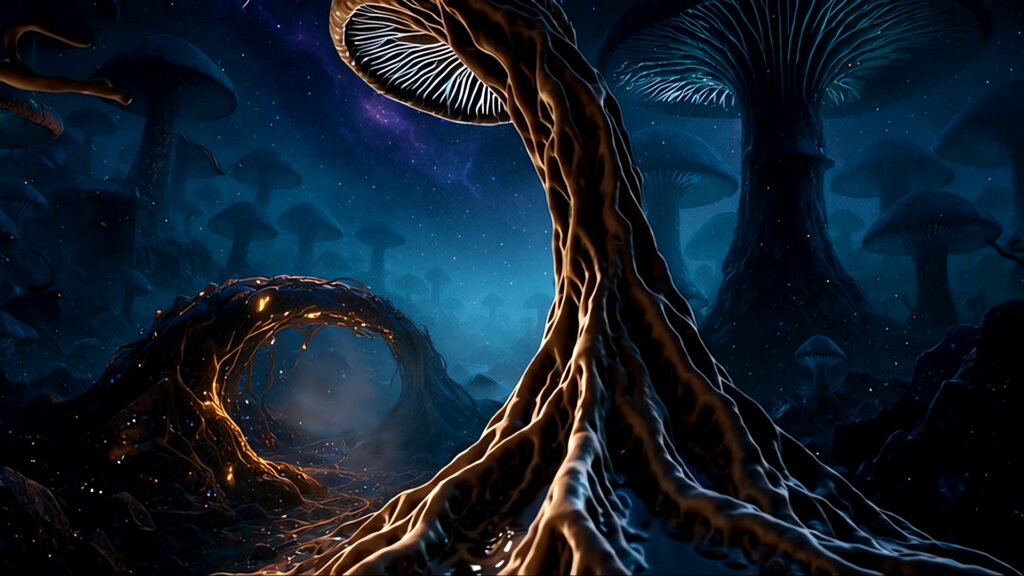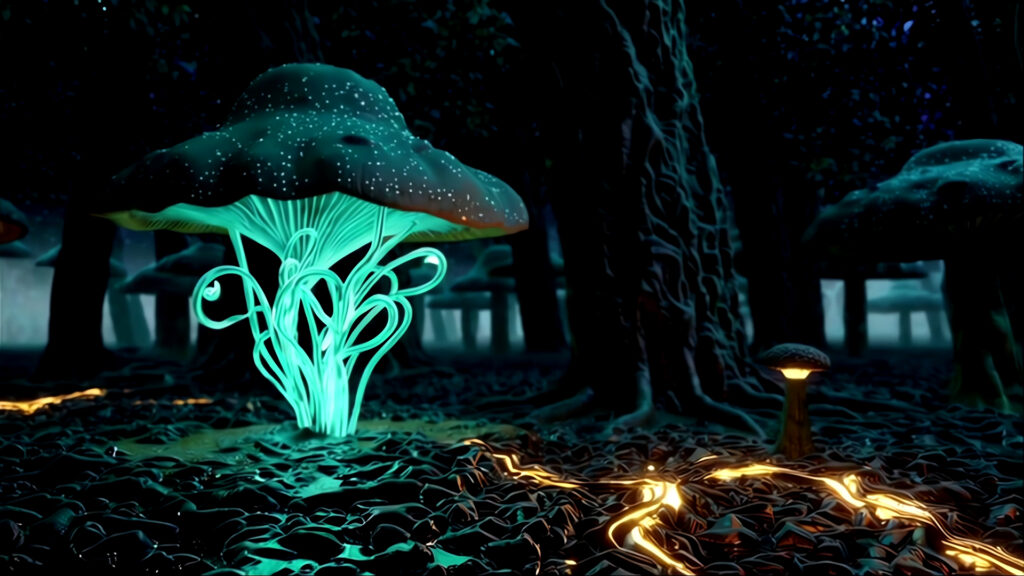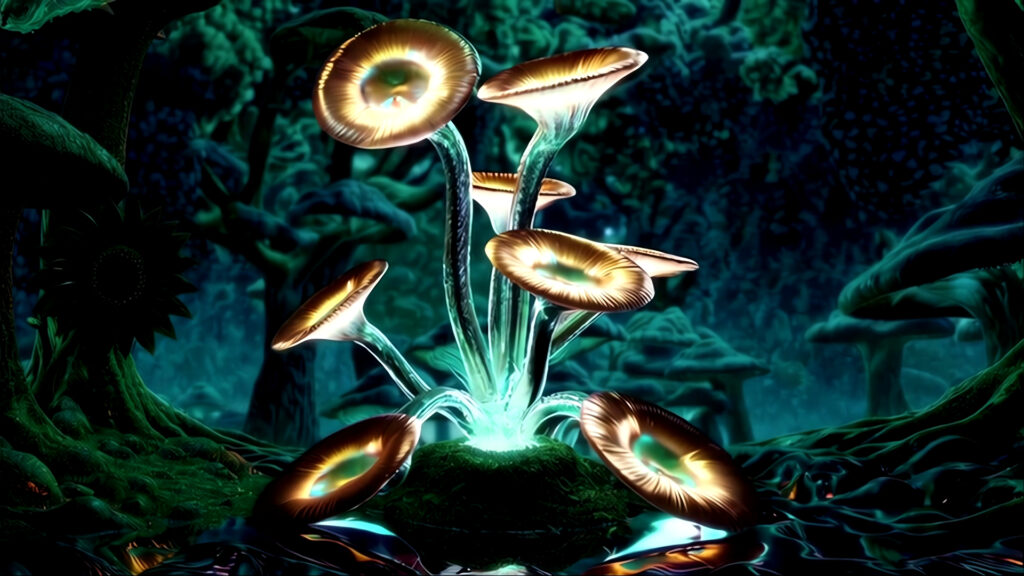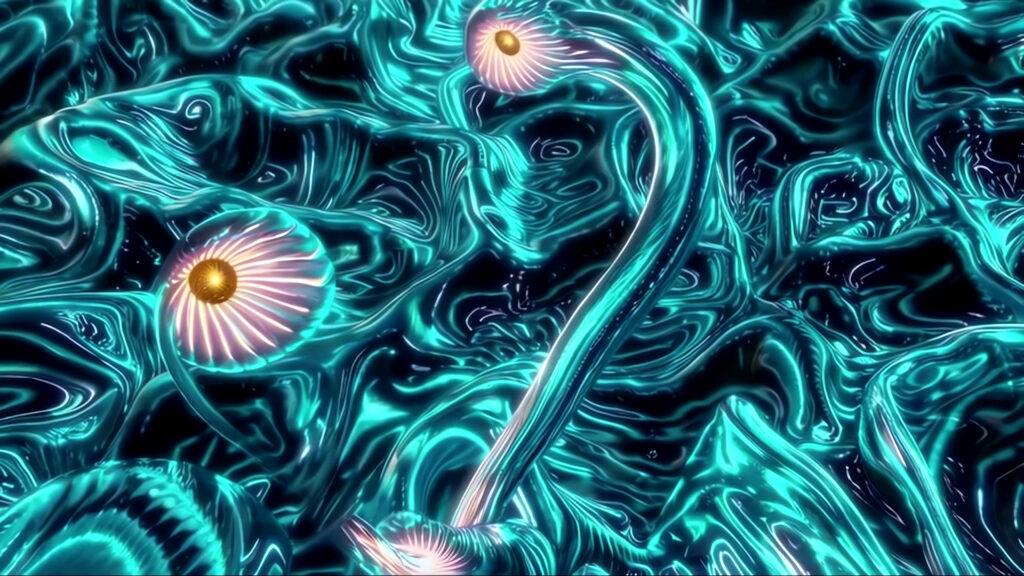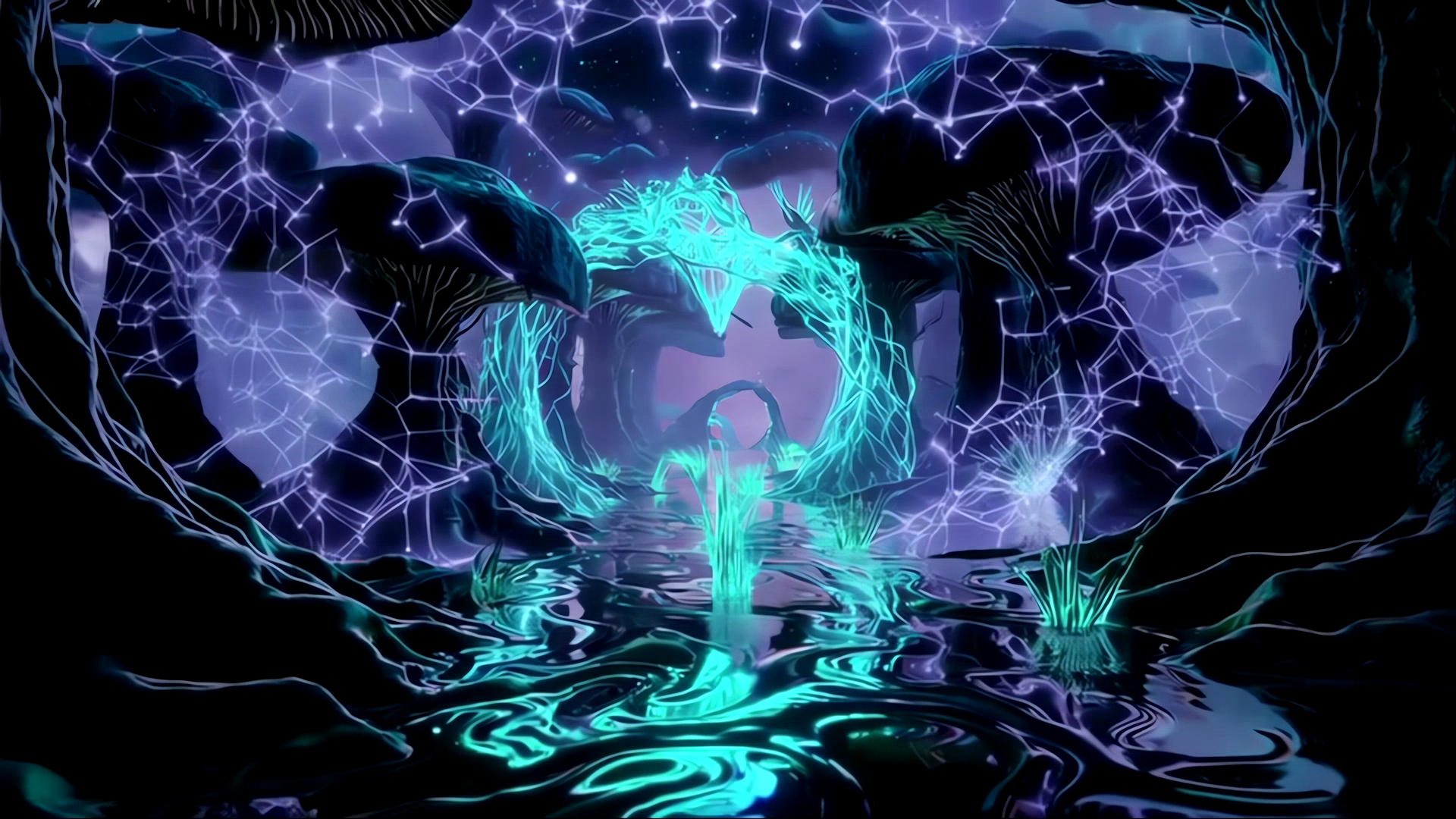
When the spores fell like slow, glowing snow, Velith felt the ground inhale.
The breath came up through her soles, through the filament webs in her ankles and the hollow bones of her calves, like warm wind traveling a flute. She stood in a valley of caps—towering mushrooms with gills as wide as amphitheaters—and listened to the soil trying to remember a song it had not yet learned how to sing. The caps glinted with dew as precise as scales on a dragon’s eyelid; the stems were as pale as the inside of moonstone. Beyond the valley, dunes rose and fell in curves so clean they looked calculated, each ripple etched by winds that loved geometry. The locals called those curves the DMT dunes, because the sand grains stored Dimensional Memory Threads; if you pressed your ear to them, you could hear directions whispering to themselves.
Velith was not born of flesh, not in the way moss-lions or cloud-whales were. She was a Lumenari, woven of hyphal glass and cooled lightning. Her skin was translucent, shot through with capillaries of light; when she moved, the glow braided and unbraided in quiet patterns. Four arms—two slender, two strong—hung from her shoulders; each wrist wore a fan of cilia that drank the world and tasted it for path. Her face was all facets, a collage of panes like carved LSD glass—Laminated Spectral Dreamglass—grown in the fungus forges under frost. Where the rest of her kind charted constellations in the sky, Velith charted constellations on the ground. She was a pathwright.
And she had come to the valley for a rumor.
Somewhere in these lands, it was said, there existed a place where paths were not inert; where they could shrug off the obedience of stones and learn to walk, to choose, to wander. Old myths named it the Ambulatory, or the Gaitseed Garden, or more simply: Where Paths Learn to Walk. The maps grown by the Conclave had no coordinates for it. That struck Velith as perfect. A place about walking should resist being found by standing still and pointing.
She waited for night to finish the business of opening itself. The caps exhaled phosphorescence; in their breath, Velith saw languages. Not words, exactly—more like tendencies. A curve in the air that suggested a corridor. A fold in the dark implying a door. She stepped forward, and the valley stepped aside.
The Cobalt Threshold
The corridor did not tunnel through earth. It grew from it: a hallway of hyphae the color of twilight embers, arched and ribbed, slick with dew that smelled of mint and thunder. As Velith entered, the walls altered themselves to her stride. Threads tugged loose and braided again to match the way her ankles flicked; ridges unfurled to catch her footfalls and set them gently down. The corridor was a listener.
Glyphs awakened along the arch, lighting one by one as if noticing her. They were not letters. They were senses written down—the taste of iron on a split lip, the soft weight of pollen on a tongue, the relief of stepping from heat into shade. Every few paces, the glyphs revised themselves, more accurate now that they had tasted more of her. Corridors often appraise those who enter them. Rarely do they learn.
“You are early,” said a voice, not through air but through the soles of her feet.
“I am on time,” Velith replied, through the same route. Bashful, the ground hummed.
She passed through seven mouths of the corridor. Some were shaped like jaws, some like bells, one like a moth’s wing caught in amber. In the eighth mouth, the floor changed from hyphae to glass. It had the faint rainbow sheen of oil on water. Beneath it, the earth remembered a forest that had not happened yet.
At the far end, the corridor opened into a field of mechanisms.
The Orchard of Clocks
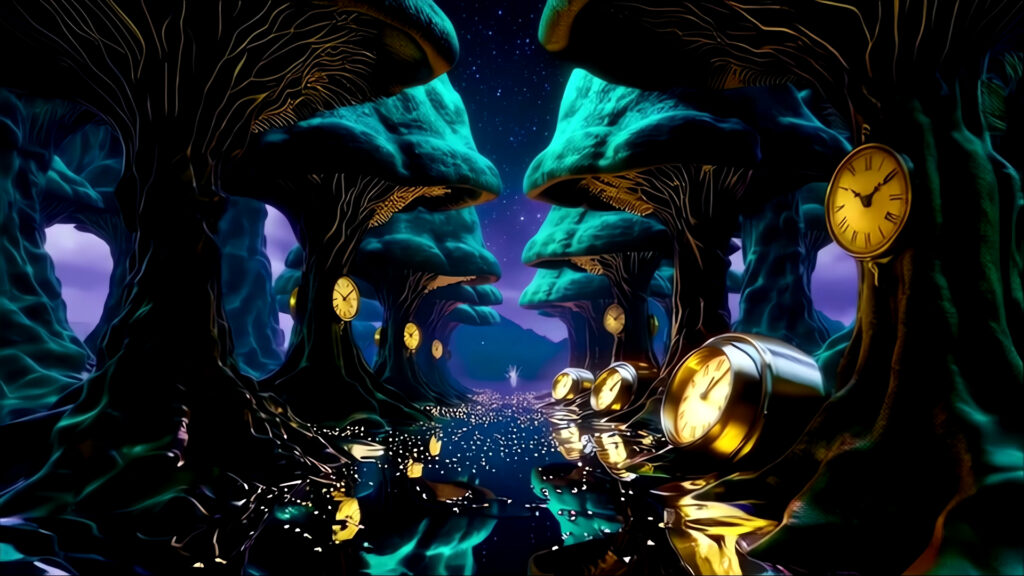
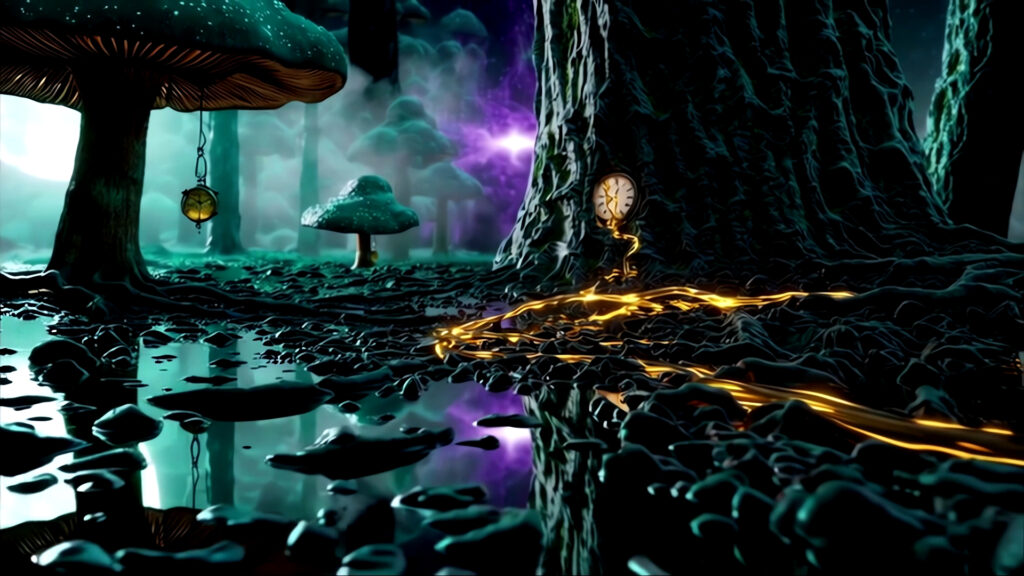
Fruit hung from the branches of velvet trees. If you looked straight at the fruit, you saw clocks; if you looked slightly to the side, you saw coiled shells; if you closed your eyes, you felt soft weight in the cradle of a palm. The orchard measured something, though no one could say what. The trees were older than most calendars. When their bark shifted, tiny segments clicked like the teeth of many polite animals.
Velith walked between trunks while pollen fell and sounded like chimes on her shoulders. She knew the orchard was a test. The pathwrights had whispered: Do not take what you do not mean to use. Do not pluck because you love the shape of roundness.
A creature waited at the heart of the grove. It was tall and narrow, seven shoulders stacked like stepped terraces, a head shaped like a fountain that yearned upward. Where a mouth would be, there was only a seam of light that occasionally opened to let out a map folded too many times. Its eyes were panes of laminated mica with star-motes trapped between layers. The Quiet Cartographer, Velith thought—she had seen drawings of its kind carved on igneous caves, maps of weather laid over maps of rumor. It had no limbs. It moved by leaning; the world leaned back to accommodate.
It regarded Velith, then titled its fountain-head until a single shimmering line sloughed out and hung in the air. Not a line—a path, drawn transparent, a possibility extruded into thread.
Velith raised her middle hands and spread the fans. She breathed into the path. The thread shivered, tasted her intention, and twined itself into three. One wove toward the east, into dunes that remembered equations. One wove toward the north, into a city of caps singing in light. One wove straight down, into the body of the ground.
The Cartographer leaned. The east-thread brightened. The others dimmed, not as punishment but as sleep.
Velith did not speak. She plucked a fruit not shaped like a clock, not shaped like a shell. It was shaped like a minute she had not yet lived. When the stem broke, time rang once and did not apologize. She put the minute into her chest, where a pocket existed, and felt the orchard approve.
“Go,” whispered the pollen, which was not speech but forgiveness for not knowing the right words.
Velith went.
The Hollow Turning
Outside the orchard, color lost interest in behaving. Hills inverted into bowls without moving; shadows walked, their bodies made of other shadows; light curled around corners and decided to be touch. Velith knew the Hollow Turning by reputation. It had been a plain of ordinary stones once, until the dunes nearby had breathed a little too loudly and folded an extra dimension into the place as casually as you’d tuck a napkin into a collar. Now the Hollow Turning practiced metamorphosis as meditation.
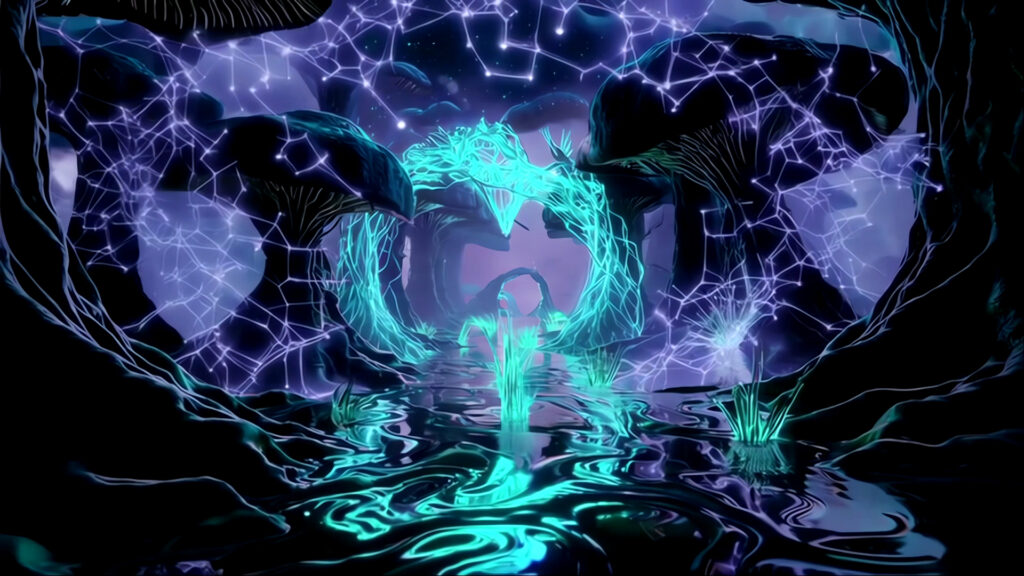
She stepped onto a slope that turned flat beneath her foot. She reached for a vine that reached back and shook her hand. In the air, a line of fungus webbing stitched itself between two clouds; it was not there a moment ago. The webbing glittered—LSD glass threads catching moonlight billowing from sources without names. In the middle of the Turning stood an arch grown from fused caps. It pulsed faintly, like something alive imagining a sea and copying its rhythm imperfectly. Beneath the arch lay a seed.
If a door could have a pupil, the arch watched her.
The seed was smooth and heavy, even heavy for a seed, which often weighed much more than what they contained made sense to weigh. It was as black as the inside of a closed idea. Velith crouched, her knees opening like the stalks of sea plants, and touched the seed with the edge of a fan.
The seed tasted like ending a journey by choosing another.
Under her cilia, it warmed.
“I mean to learn without owning,” Velith said aloud, because some things deserve air.
The arch let out a somber, satisfying click, the sound of a key that has discovered it was always the lock itself. The seed’s surface wrote a faint pattern into its own skin: a footprint made by a road, and beside it, a road made by a footprint.
The Hollow Turning turned itself inside out—not out of cruelty but because it feared stasis. Velith held the seed and stepped where the ground imagined itself. The earth shivered, not unkindly, and welcomed the idea.
The Sunseed Grove
Light was taller here. It piled in stacks, each stack a different temperature, each temperature a different memory of summer. The trees wore blossoms cut from honeyed brass, petals that fluctuated between edges and waves. Bees swam through light like divers through warm currents, leaving behind coils of pollen that rang faintly as they fell until they decided to be quiet about it.
Velith rested. The ground knew how to cradle the weight of someone who had never been cradled by ground. Healers—selen hydras with nine heads of vapor and one tail of polished hematite—glided through, tasting the air for fractures in the world. One head sipped from Velith’s shoulder fan and nodded nine nods. The hydras did not speak, but their collective silence meant health.
She rolled the seed in her lower palms. Faint prisms flickered within the black. She knew the seed would ask for a decision. The grove bargained, as groves do: rest here and become shade, or go on and become dawn. The seed wanted walking.
Velith laid it on the ground and slid her hands back. The earth pulled it down, slow as agreement. The hole filled itself before it realized it had been a hole. The grove exhaled a wind that did not touch skin but rearranged thought, and the pollen chimed and the light stacks hummed, and then the soil burped politely.
Something underfoot stretched its toes.
Velith rose. The hydras tracked her with their vapor crowns then lost interest and drifted away to comfort a broken hill. She left the grove through a door that hadn’t been there until a path dreamed it just now.
The Violet Span
Beyond the grove, the sky had ideas. Bands of violet braided with night until even bright colors looked like questions. Spires of LSD glass punched from the dunes and sang—by which I mean they changed shape very slightly in patterns that implied language without ever committing. Velith crossed a valley where the air glittered with equations the sand remembered. In the distance, a shape moved that was not an animal and not a storm and not an absence. It was a direction changing places.
She descended among the dunes. Up close, you could see how each grain of DMT—Dream-Memory Tesseract—was actually a tiny polyhedron carved from the idea of a path. When wind blew, the polyhedra tumbled and clicked against one another. If you pressed your ear close, you heard stories of the routes that had crossed here: the march of a centipede whose legs wrote poetry on soil; the sliding belly of a glacier too embarrassed to admit it was lost; the patient flight of a cloud that chose not to be cloud any longer.
The direction drew nearer. Velith felt it before she saw it, the way tides feel a moon. It arrived as a shadow thrown by an object without mass. It was not quite a creature. It was velocity with wings—a lattice of amber light arranged like an angel built from honey and salt.
Amber feathers folded and unfolded and cut new angles into the air. The lattice cast a moving net on the sand, and where the net landed, dunes remembered a little more than they were supposed to.
The Seraph of Vectors hovered, tasting the air for intention. Its face was a negative space in the shape of a decision. Inside that space, small numbers counted one another and then agreed they were wrong to be separate.
Velith lowered her hands. The fans stilled. She made herself a quiet the Seraph could recognize.
“State your bearing,” thundered a voice that was not a sound so much as the feeling of walking onto a bridge and finding it holds.
“I wish to teach a path to walk,” Velith thought in the correct direction.
“Paths carry, they do not go,” said the Seraph, amber light flickering along the bones of its wings like bees trapped sweetly in lattice. “What you ask is a crossing that destroys crossing. Why teach the road to leave the traveler behind?”
Velith held the Seraph’s gaze, or the absence where a gaze should be. She opened the pocket of the minute she had plucked and let it breathe into the world. The minute did not tick; it bloomed. In it bloomed all the times a path had been leaned upon by a hooved friend, or a tired caravan, or a thousand soft-footed creatures with eyes shaped like stars. The minute showed the weight a road carried that was not footsteps: the weight of choosing to be there for choosing. She did not speak. She let the minute show the Seraph that roads were already more than stone.
The Seraph brightened, then sheathed its own light. Adjustment rippled along its structure. You could almost hear a decision dislocate and then relocate better.
“Then I shall not oppose,” it told the dunes, because dunes love proclamations, “but I will witness the gait.”
It folded itself into a smaller, brighter thing and fell into Velith’s shadow like a coin choosing a pocket.
“That’s where you belong,” Velith thought, and the Seraph made no argument.
The Cathedral of Electric Fungi
Fungi here gathered in architecture. Cap buttresses sprang from the earth and met in pointed arches, gills ribbing the ceiling with a million soft curvatures. Filaments strung like cables hummed; that hum heated air just enough to make dew bead into lenslets. Those lenses magnified the geometry of the world until it looked like a diagram for joy.
Along the nave, fungal pylons rose with veins of LSD glass running through them so thin that light dripped. The drips rolled down the veins, pooling in basins of polished obsidian, where images formed and dissolved as though embarrassed to be caught. Choirs of moth‑lutes—creatures with bodies shaped like tear drops and wings patterned like frescoes—slept on high beams and dreamed of lanterns. Every few beats of the cathedral’s living pulse, a chime rolled through space and turned the dust luminous.
At the altar, a creature older than any dune waited. It resembled a tree that had decided to turn into a river halfway through its life and kept both commitments. Trunks flowed into current; current forked into branches. Its bark was not bark; it was a dense script of micro‑fungi scribbling their genealogies. Where a heart might be, it had a prism, not polished but patient, each face a slightly different angle of forgiveness.
The creature called itself Antherion, though it had at other times called itself Ledger, and at other times yet, Stride.
“You brought a seed,” Antherion said, using dust to spell and wind to pronounce.
Velith placed her lower hands upon the altar and opened her upper hands as if to hold rain. The seed in the Sunseed Grove had already been planted; what she held now was not object but instruction. It glowed blackly—as if it were a hole in the idea of stasis through which light drained with gratitude.
“I brought a will,” Velith said.
“That is heavier.” Antherion’s branches adjusted. The prism in its chest tilted until six small rainbows realized they had each been the same rainbow mistaken six times. “Will bruises the world. But bruise is sometimes another word for teach.”
Antherion drew in air through its roots. The cathedral quieted. Sporefall slowed. The moth‑lutes paused their dreaming. Even the Seraph in Velith’s shadow stopped being a witness long enough to wonder.
“Plant it,” said Antherion.
“There is no seed,” Velith replied.
“Plant anyway,” said Antherion. “Plant into where.”
Velith knelt. She pressed her lower palms to the nave’s floor. The hyphae below parted as easily as bread invites butter. Into that space, she poured the minute she had saved—the minute blooming with the moral of roads. She did not plant it like a gardener; she planted it like a teacher: she showed the ground what it already wanted and called that showing planting.
Antherion’s prism rotated. The nave tilted without moving; the air learned a new way to be level. Far off, the dunes silenced their equations and leaned in. The caps of the valley bowed so slowly it could have been coincidence, but it was not.
The floor—gently, curiously—took a step.
It was a small step. It did not carry anyone. It did not shift the building. It did not even disturb the dust. But it happened where a floor should not step, and so the world noticed.
“Again,” whispered Antherion.
Velith breathed into the hyphae with the fans. The Seraph glowed within her shadow like dawn trapped lightly in ink. The step happened again, larger. It made a soft sound like a shy wave kissing its own reflection.
Panic scurried among the static tribes—moss that maintained rocks, rocks that groomed moss—because if floors learned what feet knew, caretaking would need new verbs. The static tribes sent ambassadors: three granite beetles with carapaces etched in map scales, a hedge of rose‑thorns that wrote in perfume, a spool of wind that had no body but liked to be called Tiller. They formed a circle around Velith and bowed as if in protest, which is a kind of bow.
“Why teach away the need for us?” asked the beetles, speaking by rubbing their maps together until the rubbing became language.
“I am not teaching away,” Velith said. “I am teaching toward.”
“Toward what?” asked the hedge, with costly fragrance.
Velith looked at the cathedral—the ribs and vaults, the prism, the filaments. She tried to say the truth and found it was too simple to sound grown. “Toward the part of the world that wants to share the weight of choosing.”
The Tiller, who loved the idea of sharing because it disliked carrying anything at all, relaxed. “Proceed,” it swirled, and the beetles found themselves nodding, and the hedge tried to imagine a scent that would convey approval without conceding dignity.
Antherion put its roots into the conversation and braided it into consent.
The floor took a third step, and this one was not small. The nave rolled forward and then backward, not to travel but to learn how to be a thing that could. It learned, as good students do, by failing against a teacher who does not pretend gravity is optional. The failure made the pillar lights smile.
“Now, the path,” said Antherion.
Velith walked outside into the violet where the cathedral’s shadow braided with the dunes’ patience. She found the trace she had breathed earlier, the three threads that the Quiet Cartographer had shown her at the orchard. The eastward thread still lay awake. She bent to it and lifted, and it lifted with her because consent had been taught to it since genesis. The thread did not weigh anything. It weighed exactly the amount of trust the ground had for her.
Velith laid the thread on the sand like a line of poetry no one had yet said aloud, and the dunes wrote back. Their writing looked like ripples; their ripples tasted of numbers finally understanding the bodies they lived inside. At the end of the line lay not a finishing point but a joint—like a knuckle, like a hinge. She touched it with a fan.
The path straightened like a creature waking from a dream of being stone.
It lifted.
Not dramatically. Not rudely. Each segment rolled upward as if remembering vertebrae it had never owned. At first it was just an arch, and then it was an arch stepping, and then it was not an arch any longer. It was a corridor folding itself into legs.
The Seraph blossomed in her shadow, an amber skeleton unfurling with the pleasure of being right. It soared upward and perched on the edge of the walking path like a thought on the rim of a cup, light feathers touching lightly down. The dunes whispered equations that sounded like applause, then caught themselves and tried to look serious again.
From the ridge of the nearest cap, a parliament of spiral owls watched. Their eyes were fractal wells; their necks turned without needing to connect to anything in particular. Spiral owls judge movement not by speed but by eloquence. They hooted once, a tone like glazed clay warmed by palms, which meant: We acknowledge the grammar of this new gait.
Velith laughed, which for a Lumenari meant rearranging internal filaments into a shape the air wanted to imitate.
“Walk,” she said to the path.
The path walked.
The Pilgrimage of the Road
It chose its first steps carefully, as a newborn chooses its first sense of gravity. It went where it already knew feet preferred to go—ridges with views, dips with water, edges that suggested caution. It learned quickly that walking was not only moving. It was listening while moving. It learned to pull aside for smaller paths crossing; it learned to lean in for those that needed sheltering. It learned the etiquette of mud.
Where the path walked, grass considered careers. Stones woke to shudder their joints. Moths turned from their curtained prayers and wrote small weather over its back. The path discovered a peculiar joy: that of watching itself leave footprints and realizing it could choose the shape of those footprints, not out of vanity but as a language for the creatures reading behind.
In a valley of glass reeds—tall, flexible stalks that chimed when you looked at them too directly—the path met a pack of moss‑lions. The lions were enormous and gentle, their fur made of mosses that had taken a vow to prefer teeth. Their manes were fern‑cataracts; their paws were velvet with semantic clarity. They purred a question that tasted like river stones: Will you carry us?
“I do not carry as roads once did,” said the walking road, surprised to find it could answer without a mouth. Its voice came from the friction of grains. “But I will accompany. I will put shoulder to the weight of your moving.”
The lions sat in a row and began to purr. The purr vibrated the LSD glass reeds into harmonies of heat. The air shimmered like a promise keeping itself. When the path stepped, the lions stepped with it, and their heavy grace drilled kindness deeper into the world.
They came to an expanse where the dunes were too precise, every curve too perfect, as if a rule had been applied without mercy. Here dwelled the Stillborne Court, whose priests were cranes carved from basalt, who had sworn to shave chaos until it fit inside a teacup. The Court disliked anything that learned without permission. The cranes posed, making sharp angles against the sky, their beaks like accusations, their knees like rules.
“What do you call this movement?” their chief asked, voice slicing syllables into thinner syllables.
“A path remembering its body,” the walking road answered.
“Bodies complicate geometry,” said the crane.
“Geometry complicates bodies,” replied the Seraph through Velith’s shadow, rustling as politely as a storm can. “Let their complication be mutual and instructive.”
The Court could not refuse a Seraph of Vectors without forfeiting its authority over the plumb line, so it bowed in a way that tried to look like defiance but looked mostly like respect. The walking road passed between their poses. The cranes held still, and that stillness was so precise that for a moment all moving things in the world became more beautiful in relief.
Farther on, a river surfaced where no river had been, wearing a skin of mirrored dusk. It split around an island shaped like a question an old turtle might ask. On that island grew a grove of columns, each grown from the same fungal family as the cathedral but austere, less generous with light. Beneath each column hung a bell. Beneath each bell slept a wind.
Velith paused at the bank and pressed her fans into the silt. The silts sighed with relief; they had been waiting for someone to want their texture.
“May we cross?” she asked the river.
“May we cross?” answered the river, delighted, and flowed under itself to become a bridge.
The path stepped onto the river’s back with tender hesitations. The bells woke, and the winds gazed downward without bodies and decided to be helpful. Together, road and winds practiced the art of support: one would lift while the other stabilized, one would lean while the other leveled. The island listened, and when they reached it, the question-shape looked satisfied, which is to say it looked like something that knew it was already its own answer.
In the grove of columns, the Quiet Cartographer waited again, fountain‑head pouring faint filaments that hung like thrown threads frozen mid‑weave. Its eyes clouded with the milk of old seas.
“Witness,” it wrote on the air with a thin extrusion of map. “The path’s gait is an alphabet. I will learn to read it.”
“You taught me to see threads,” Velith said, unsure if the Cartographer remembered her because remembering was a choice for that kind. “Will you name it for me? Names help when the world tries to doubt itself.”
The Cartographer leaned, a tilt that pulled horizon into new math. It considered the road with an absence so attentive it felt like touch.
“Ambulacrum,” it inked at last, using wind for ink. “Not the copy of walking but walking making its own original.”
“Ambulacrum,” the path repeated. It loved how the word placed weight in the mouth it did not have.
The Seraph purred inside the shadow like a cat remembering two suns.
The Gaitseed
The Ambulatory grew braver. It learned to climb in ways not about climbing: by asking hills to reduce themselves and by promising to put that height back exactly where it had found it once the climb had been climbed. Hills, flattered to be seen in such careful detail, complied. It learned to cross oceans in ways not about crossing: by drafting currents and letting them ride it back, ensuring nothing lost its favorite place. Oceans, who disliked being taken for granted, lent their bluest vowels to its steps.
One morning—though in this place morning wasn’t time so much as mood—the path stopped. Ahead lay a field of black not a color but a silence woven thick and glossy, the same black as the seed Velith had planted in the cathedral. The black had grown. It was not empty; it thrummed with a density of intention so compact it pulled footprints inward and asked them to become deeper, not wider.
Velith recognized the black. It was the place where endings like to misname themselves.
“You will plant here,” said Antherion’s voice from the memory of dust. “Not because endings deserve gardens, but because gardens deserve endings.”
Velith pressed her fans to the black. The seed she had planted at the cathedral had grown a twin without asking permission—twins do that. Her hands came away with a gaitseed, small enough to be lost in a crease of palm, heavy enough to make the ground consider its posture.
The path bent—imagine a line bending to look at its own arc. It waited.
Velith pushed the gaitseed under the black. The black accepted it without gloating. The ground rearranged its bones. A low roll trembled outward like a yawn shared by mountains.
From the planted place rose a being made of routes.
It had no single form; it possessed all the forms a pathway wanted but could never hold because of travelers. Now, freed to choose, it chose many: arches that could march like legs, loops that could spin like wheels, planes that could wing. Its skin was packed with tracks—tiny footprints of moths, broad scuffs of boulders, the needle‑point pricks of a thousand-thousand exact insects. Over its back, LSD glass veins pulsed like thinking. Its eyes were on its feet and its feet were in its eyes.
It looked down at Velith as if looking down were also looking up, because for beings made of routes, orientation is polite fiction.
“What am I called?” it asked, voice a harmony of sand and dew and intent.
“Where Paths Learn to Walk,” Velith said, and at the speaking the title ceased to be a rumor and settled into a creature.
It stepped. The world did not refuse.
Where the Walking Went
Once the path learned the art of walking, it taught other paths.
First, it taught a footbridge woven from vines and hopes. The footbridge had always wanted to be more than a supporting actor in other people’s crossings. The walking path showed it how to dig toes into air, to set weight on the breeze, to lean into the idea of support until support leaned back. The footbridge giggled—that is, its planks creaked in a cadence that made moths dance—and then toddled. It did not go far. Going far was not the point. It went new.
Then the path taught a causeway that loved moons. The causeway learned to time its steps with tide so perfectly that fish began to use it as a school, ascending its stride the way scholars ascend shelves. Above them, spiral owls tracked their progress with a fascination that made their necks write cursive in the dark.
It taught a sequence of stepping stones that had always been shy, stones that flinched when boots struck them. They learned to anticipate without cowering, to slide a few inches left so ankle bones found mercy.
It taught a trail in the mountains that held whispered names for every peak. It taught those names to be verbs. Mountains cried, which is to say they let their snow discuss the matter thoroughly with the valleys.
The Stillborne Court, so fond of holding shape, found itself commissioned by its own stubbornness to build things that could unbuild themselves gracefully. The cranes discovered a new art: carving angles that could pivot without losing their definition. They called this art yielding and became very proud of having always wanted to invent it.
The Quiet Cartographer drew maps that showed the temperament of roads. Travelers began to consult them not to find distance but to find companionship—a route with humor when you were hollowed out, a route with austerity when you needed stern kindness, a route with curiosity when you had forgotten how to speak to the day. The maps were grown from mushrooms that changed color according to the walker’s mood. A walker could hold such a map and see themselves becoming a place.
The Seraph of Vectors, having completed its witnessing, chose to remain. Amber lattice perched at crossings like a patient candle, guiding gaits when clouds argued with hills. It never dictated bearings, only corrected angles gently. Some nights it slept in Velith’s shadow, which had learned to expand to fit guests.
Velith, who had come to teach a road to walk, found that the road had taught her something more difficult: to stay while moving. The Lumenari have an inclination for vanishings—light loves to behave like leaving. But now Velith practiced presence like craft. She spent mornings coaxing shy footpaths out of the scrub; afternoons setting pebbles on the chests of tired steps to weigh them with patience; nights lying on her back in the dunes, listening to the DMT grains tumble against one another, telling her secrets about curvature.
She never named herself teacher again. The world did the naming for her. It called her Stride‑sower. It called her Ambulant Friend. It called her, in voices of fungi and sand and vector, the One Who Taught Where to Want.
The Last Door
Every story either coils back into itself or leaves a new door behind. When seasons had learned to take turns with more courtesy, when even rivers had adopted a small swagger from being crossed with such respect, when the cathedral’s prism had finally finished deciding that all its faces were the same face easily enough, Velith returned to the Hollow Turning.
Colors behaved a little better there now; it is hard to mischief consistently in a world that has learned to walk. The arch still pulsed. At its base, in the place where the seed once lay, there rested a door made of dreamglass, framed in mycelium, veined with tiny running paths that never repeated. The door did not open outward or inward; it opened along itself, like a scab admitting skin is ready.
Velith stood before it and adjusted her shoulder fans. The Seraph nested in her shade, flaxen and patient. Spiral owls arranged themselves on capstone ledges to watch with the solemn excitement of scholars. Antherion poured two roots through the soil and drew them up on either side of the door and made of them pillars named Patience and Permission.
The door did not ask who she was. Doors here cared about other things.
“Will you go?” asked the Cartographer, leaning into a lean it had saved for this.
Velith considered. The world behind her was walking. The world ahead was something else. She felt the weight of her will and cherished that it was weight—it meant the decision would leave a bruise in history, and history needed a few more bruises of kindness to balance its collection.
“I will go,” she said, and knelt. Then she stood. Then she did both, because there are motions for which positions are insufficient.
The door opened along its idea. Inside lay a corridor the shape of a promise kept: not straight, but ethically direct. Light painted itself into arrows then patiently erased their bossiness. The corridor breathed like corridors do when they have spent too long being only passage and are ready to be arrival.
Velith stepped forward.
So did the path.
Not the walking road—that one had its own lessons now—but the concept of path, the soft under‑language of moving. It took one step with her. It took one step as her. And then, gently, with the elegance of a statement that has discovered it is a question, it took a step first.
Velith laughed with filaments and shadows, with spores and sand, with the quiet at the center of a prism and the loud at the edge of a dune. She let the path lead. She placed her feet in the footsteps of a thing that had been feet for others and now, finally, found its own.
Ahead, the corridor arced toward a horizon that was also a seed. Paths, old and new, gathered in the corners of the world, curious, cautious, crowding as cats crowd an idea: aloofly, all at once. Behind, the cathedral, the dunes, the orchard, the grove, the Turning—all practiced a stillness that felt like a blessing catching up.
The door closed not with a sound but with a syllable: a small, perfect curve in the air that meant: Continue.
And there, where the corridor entered a room made of untried dawn, the path took another step, and the step learned it could be a path.