I — The Call Beneath Luminous Soil
Sporespace began as a tingle in the roots of the world.
On the moon of Vyr, where continents are braided with glassy mycelium, the ground whispered to a pilgrim named Khyra of the Filament Choir. Khyra was not born but grown—humanoid in outline, her body a cathedral of translucent quartz and opaline threads. Beneath her skin, hyphae shimmered like constellations, moving with the steady breath of an organism that remembered thunderstorms, extinctions, and the taste of meteor dust. Her eyes held crescents of violet seeded with starmotes; her hair was a drift of fine filaments carrying the faint scent of anise and rain.
The call rose through the soil—an electrical murmur, subtle as a secret. Pale caps opened around her ankles and released a micro‑fog of silver spores that wrote tiny glyphs in the air, then erased them, as if shy of being understood.
Khyra knelt and pressed her palms to the hum of the ground. She felt networks far below, cycling through patterns older than any spoken word. The message was simple and absolute.
Come. The Crown turns. The Path blooms.
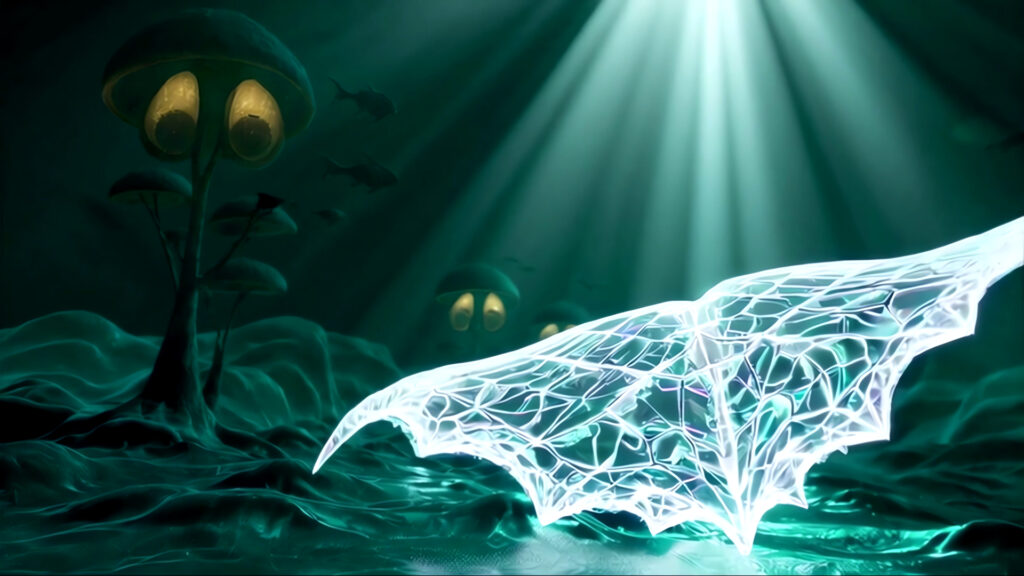
When Khyra stood, her joints chimed softly, crystalline plates settling into travel geometry. From her shoulders unfurled a pair of living membranes—lamellae latticed like wings, grown not for flight but for catching the tides between worlds. She faced the horizon, where the sky wore a faint lysergic sheen, colors sliding through each other like oil on a dark sea.
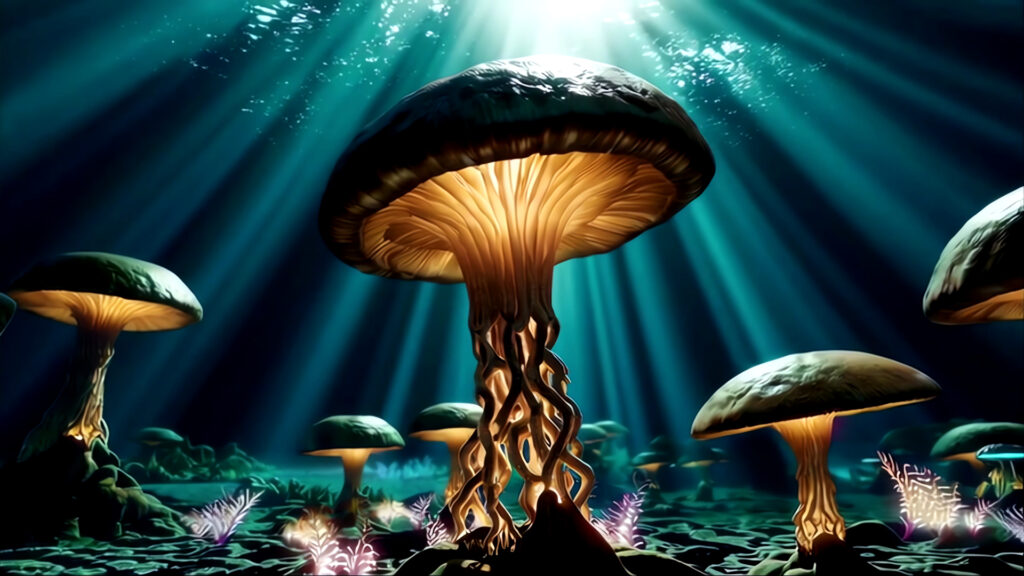
She was not alone. A guardian drifted from between the bulb‑trees: Tholos, a spore‑sphinx whose body was a hovering cap the size of a small shrine. His face grew on the underside of the cap, a geometrical mask of shifting polygons and amber eyes without pupils. Hyphal tassels trailed beneath him like whiskers of pale lightning. When he spoke, it sounded like velvet being combed in the wrong direction.
“Pilgrim,” Tholos murmured, “the Path is open. To walk it is to be rewritten.”
“To refuse it,” Khyra said, “is to go blind on a day of brightest sun.”
Tholos’ amber eyes narrowed into gentle scythes. “Then we begin.”
The world exhaled. The ground unrolled a ribbon of phosphorescent moss, and on it pulsed the first step of the Sporespace Pilgrimage.
II — The Oratory of Basidia
The path led to Basidia, a monastery never built so much as persuaded to appear. Its domes were stacked caps, porcelain white and freckled with burnt gold; its corridors were gills turned into hallways, banded with iridescent ridges. Caretakers greeted Khyra at the gate—the Monachae, dignified beings whose bodies resembled tall spindles woven from threads of milk‑glass, each bearing a halo of spores like a snowfall forever suspended.
Mother Sephrae, eldest among them, came forward with motions as measured as tides. Beneath her translucent chest lay a rosary of quiescent seeds, each seed a record of a friend she had ever lost and ever found again.
“Child of the Choir,” Sephrae intoned, “your pulse arrives with the turning Crown. Do you carry the question?”
Khyra placed a hand against her own sternum. Beneath it, the filaments hummed and spun a small glyph of amber light. The Monachae inhaled as one, and the spores in their halos glittered like galaxies.
“The Crown seeks a listener,” Sephrae said. “Not a conqueror.”
“I’m a door,” Khyra said simply. “Let me open.”
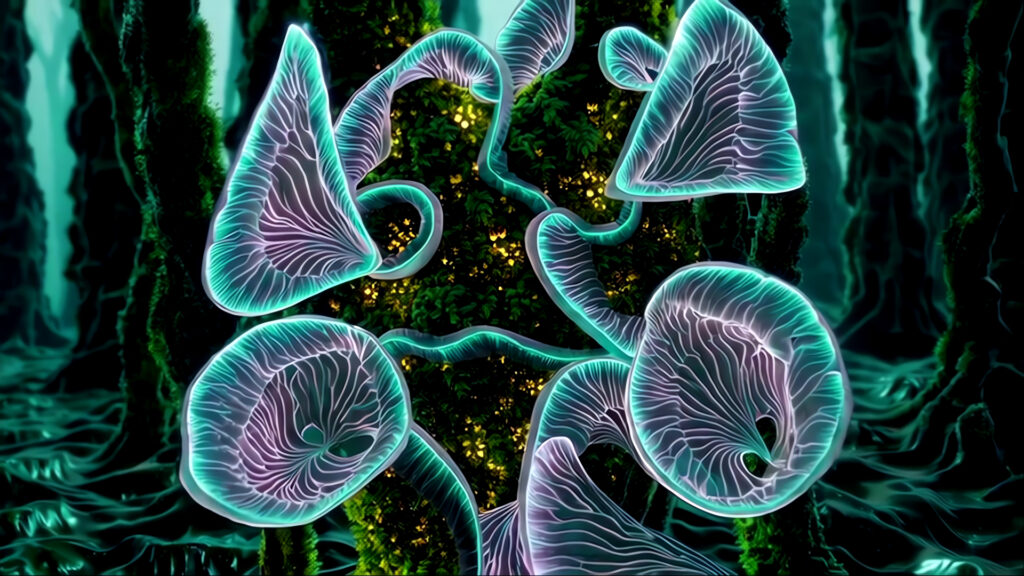
The Monachae led her into the Oratory of Basidia, a chamber where columns were columns no longer—each was a frozen cascade of hyphae, branching and rebranching in a fractal cathedra that called to mind both coral and thunderheads. Tholos drifted behind her, tassels barely stirring the patient air.
Sephrae offered a basin filled with sporewater—liquid brighter than any metal, which mirrored not the face above it but the thoughts behind the face. Khyra leaned in, and in its DMT‑tinted depths unfurled a landscape of gates: rings suspended in velvet dark, each ring not metal but knowledge braided so densely it could fool the hand. Some rings were gentle glows. Others were storms contained; others yet were asleep, dreaming in hexagons.
“The path you walk leads to the Crown of Passages,” Sephrae whispered. “It grew at the heart of the Rhizosphere when time was still damp. It is not a machine. It is a vow.”
Khyra cupped the basin with both hands. The liquid leaned toward her like a flower turning to light.
“Vows,” she said, “want to be kept.”
Sephrae held Khyra’s gaze for a long, bright heartbeat. Then she smiled, the smile of someone watching a star pull itself free of an old gravity. “Go with a name the Crown will respect. Walk as Keeper of Soft Footprints.”
“Keeper of Soft Footprints,” Tholos repeated, eyes softened. “A name that enters rooms without frightening the dust.”
They left Basidia under a sky threaded with humming filaments. The horizon flickered as if winking, like a living threshold about to relish being crossed.
III — The Prism Wastes
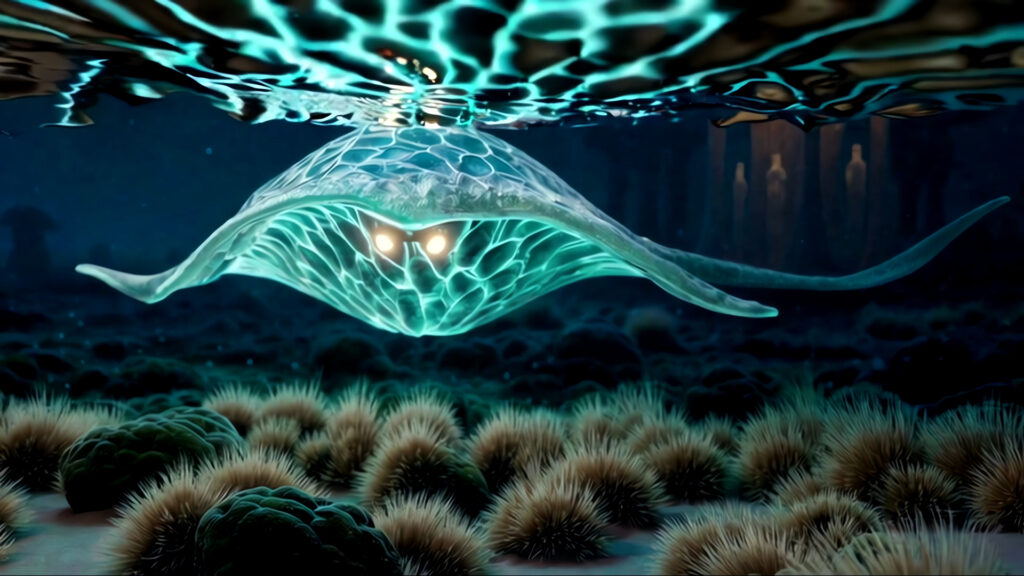
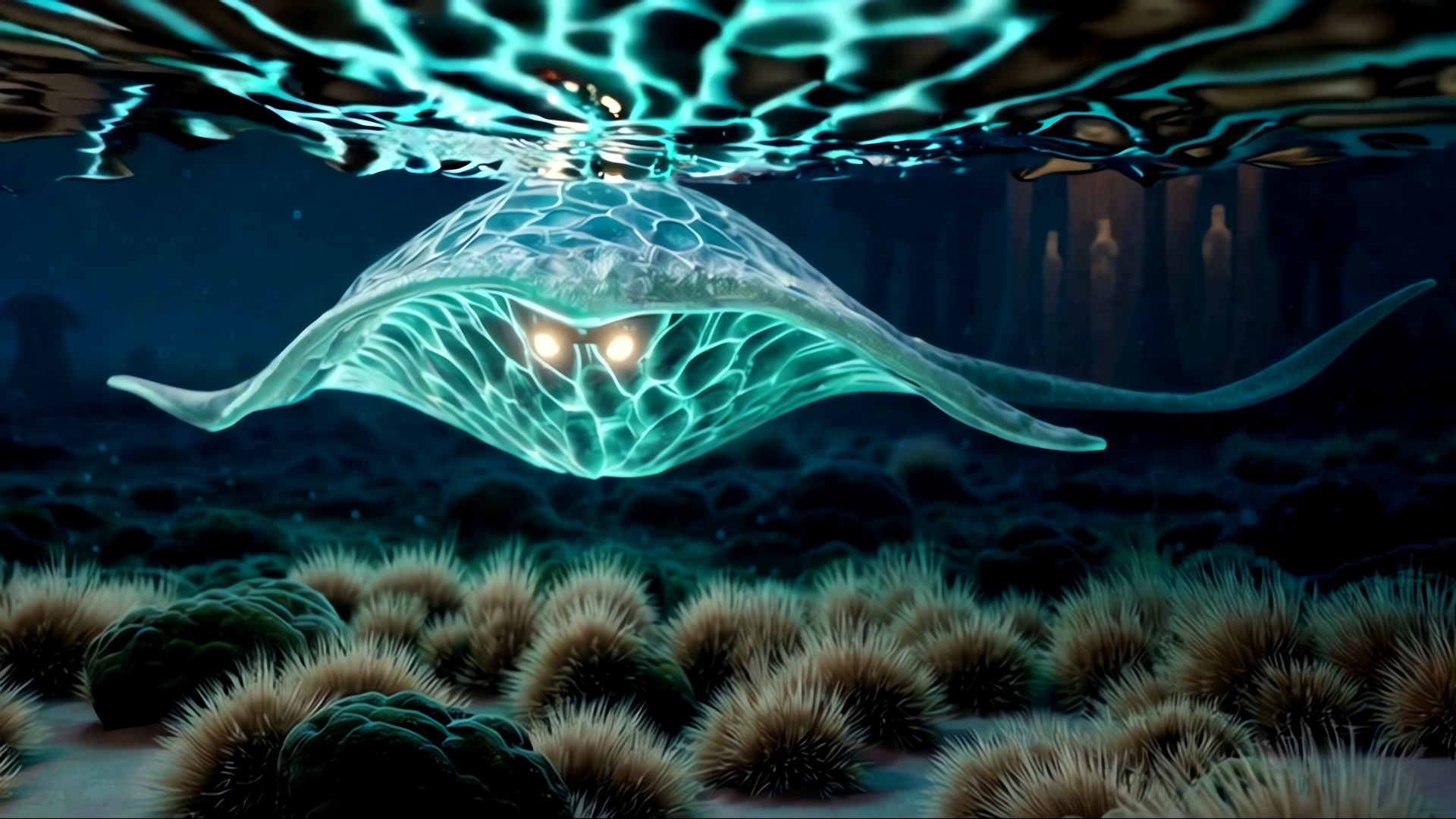
The Prism Wastes looked empty until looked at too long, whereupon they unfolded—sheets upon sheets of relict atmospheres blown flat and glassy, each one a once‑sky compressed into sled‑dune and whetstone ridges. Over them flowed prism mantas, not creatures of flesh but swims of light, whose fins were the thin edges of refractions. Their passage set off ripples of lysergic rainbows that tasted like citrus and meteor‑iron.
Khyra and Tholos moved with the mantas, letting their wakes lift and carry. The air smelled dust‑clean, and their shadows traveled with them as patient comrades. Once, a manta dove close and passed through Khyra’s body without harm, leaving her full of geometric afterglow. For a stunned second, she saw the world as the manta did: a lattice of vectors, nothing solid, only the agreements things made to be themselves.
“Do you fear the Crown?” Tholos asked, drifting at her side.
“I fear its silence,” Khyra said. “The kind that means the question asked was the wrong one.”
Behind them, their footprints filled with phosphorescence, then with small trumpet mushrooms that opened and tasted the world, then with nothing—soft feet, indeed.
At the far lip of the Wastes rose a ridge of fossilized hyphae, petrified mid‑weave, as if a colossal underground mind had surfaced at speed and been caught by sudden morning. The ridge’s summit shone with a clean, baffling brightness that had no source. Khyra climbed, each step an exhale. The brightness intensified, not burning but clarifying, stripping distraction until only the vow remained.
Beyond the ridge lay a clearing that was not a clearing but a pause in the universe’s sentence. Nothing grew there; nothing slept there. In its center hovered a not‑ring, an absence shaped like a crown. Around it stood the Amanth, oracles who were not separate beings but gestures of a single mycelial intention. They appeared as robed figures of spun moonlight; beneath their hoods flickered faces that were faces when seen from one angle and forests seen from another.
“Keeper of Soft Footprints,” said the Amanth with many voices braided into one. “We have not waited for you; we have been waiting with you.”
The not‑ring turned slightly—an almost nod. Khyra felt her body align with a rhythm that was not a rhythm, a series of near‑happenings drawing close to the verge of happening.
“Does the Crown consent to be asked?” Khyra whispered.
“Ask,” the Amanth replied.
IV — The White Aside
Khyra stepped into the clearing and was erased into clarity.
She did not fall; she did not rise. The world around her became a white aside, a parenthetical snow so saturated with meaning that meaning became texture. Time loomed sideways, brushing past her shoulder with the intimacy of an old friend, and from the whiteness emerged diagrams the size of countries: hexagons nested in spirals whose arms were made of history, circles of events braided like hair.
She understood without thinking. The Crown of Passages was here and not here, existing where the universe’s grammar allowed exceptions. It was not an object but a permission: the will of world‑thread and mind‑thread to entangle, to share their secrets gently.
Figures glided through the White Aside—Acolytes of the Crown, humanoid yet alien, their forms a compromise between cathedral and lanternfish. Their long fingers trailed gossamer coding that wrote itself on Khyra’s skin as a gentle coolness. She tasted deep water and old stone and a spice like summer nights.
They approached with reverent slowness. Their faces were masks of lichened jade guarded by multiple eyelids that blinked in an elegant cascade. Where a mouth might be there was a fan of vibrating filaments that spoke in a timbre both chime and purr.
“Listener,” they chorused, “state your vow.”
Khyra held up her hand; the filaments within it rose like sap at dawn. “I vow not to harvest but to inherit. Not to force but to persuade. I vow to leave the places that host me better than I found them.”
The Acolytes’ filaments brightened, briefly showing tiny gardens and cities in reflection. “The vow is sufficient,” they said, and stepped aside.
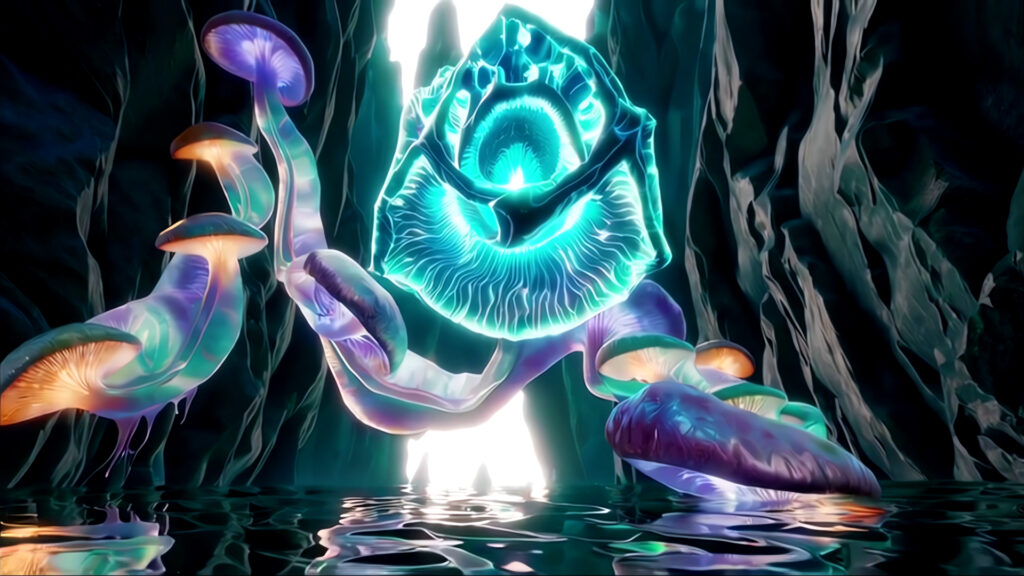
From the cleared space grew the Crown. It grew like a memory remembered too hard: first a pressure on the temples, then a ring of soft thunder, then a shimmer hanging at forehead height. It consisted of interlocking hoops, each hoop woven from living hyphae and unguessable mathematics. Within each hoop hung a scene—an ocean the color of eight kinds of dusk; a swarm of translucent leviathans singing equations; a continent moving at the pace of thought.
It turned. The universe paid attention.
V — The Filament Key
Tholos hovered at the edge of the White Aside, tassels trembling. “Once you place your name in it,” he whispered, “the name returns with teeth—teeth that belong to you.”
Khyra nodded. “I have been many mouths,” she replied. “Let this one be kind.”
A filament uncoiled from the Crown—thin as a sigh, bright as a knife’s thought. It reached for Khyra’s sternum and trickled through her translucent plates, not piercing but weaving. Where it passed, her body opened into rooms she hadn’t known were locked. Inside each room lay a single object: a seed, a bell, a cup carved from night. She placed them on invisible tables and lit invisible candles; inside her, a vigil formed.
When the filament reached her heart’s cage of crystal slats, it paused, tasted the air, and continued. Khyra’s vision filled with emblems: auroras learned to hold steady, a river of DMT‑colored light flowing in straight lines, glyphs that were simultaneously question and answer. The Crown spoke without sound, and Khyra understood it as a pressure behind the eyes.
Open, but do not empty. Carry, but do not clot.
“I will be permeable,” Khyra said, voice soft as the underside of a mushroom cap. “I will be precise.”
The filament pulsed in approval. The White Aside bent like a reed and became a corridor lined with doors. Each door was a cap turned upside down. Beneath each cap slept a dreamer‑species: the Iofyr, whose dreams fertilized comets; the Rahn, who calcified hope into amber archives; the Urovelle, whose wings were prisms that separated memory from pain.
Khyra walked and did not stumble. Tholos followed, whispering to the air in the language of dust.
VI — Corridors of Many Horizons
The corridor changed at a pace just shy of panic. It moved like weather; it breathed like a forest. Every step Khyra took opened another stacked horizon, each a plane of reality shaved so thin it could be folded into a pocket. She passed through rooms of cold green light where moss‑astronauts drifted like ideas not yet chosen; through waterless seas where the waves trudged like herds of transparent stones; through orchards where fruits split open to reveal small, sleeping moons.
The air was full of small movements, transient alphabets formed and unformed by spore motes—THIS WAY / NO WAY / EVERY WAY—iterated until the message became a trance and the trance became a map. Khyra stretched out a hand. The words landed on her palm, cooled, and became a single coin of meaning: forward.
On the seventh horizon, a hunter waited: the Null Bloom, a being that ate adjectives. It looked like a disease had learned geometry: a dodecahedron of soot with mouths at every face, each mouth ringed with teeth that resembled stale stars. When it spoke, flavor left the air.
“You carry permission,” the Null Bloom said. “Permission breeds corridors, corridors breed wandering, wandering breeds waste. Close and become efficient.”
Khyra felt her inner rooms dim, candles guttering. Without words, Tholos moved between Khyra and the Bloom—his amber eyes wide and calm. From his tassels fell a powder of spores luminous as frost. Where the spores landed on the Null Bloom, meaning returned—edges softened, color peered in from the threshold’s spine.
“We are not efficient,” Tholos murmured. “We are sufficient.”
The Null Bloom writhed and tried to remember rage. Failing, it collapsed in on itself until it resembled a small, sad sentence. Khyra knelt and cupped it; her filaments sang. She planted it in the floor and covered it with the coin of meaning. From that burial grew a tiny cap of midnight blue, dew on its rim, whispering the single true word learned at great cost: Enough.
The corridor exhaled. The horizons parted like curtains negotiable to kindness, and the river of straight‑lined aurora returned, inviting.
VII — Crown‑Bloom
They arrived at a vault so tall that distance became a rumor. Its ceiling was a firmament of floating caps, each cap a slow carousel displaying lives that could be lived by beings not yet born. Between the caps hung lianas of crystal, swaying as if an invisible tide threaded through. The Crown hovered at the vault’s heart, no longer a not‑ring but a crown‑bloom, its hoops flowering into grids that resembled the throats of lilies and the circuitry of ancient engines.
A Keeper must become a Bridge, said the Crown in pressure and warmth.
Khyra stepped beneath it. Her lamellae unfurled, membranes trembling under a wind from nowhere. The Crown lowered until its smallest hoop touched her brow, and what had been corridor became garden.
Every edge softened to petal. Every question branched into smaller, sweeter questions whose answers were acts. The garden smelled simultaneously of petrichor and comet tail; tasted like stardust dissolved in cold spring water. Insects of hexagonal glass rose from hidden nests and hovered before Khyra’s gaze, each wing‑beat a syllable of blessing. Beneath the soil, something large and gentle turned over—perhaps the planet’s old thought, stretching after a nap.
Tholos circled above, a pale moon with a velvet voice. “Remember your soft feet,” he called. “Bridges crumble when stamped upon.”
Khyra was not stamping. She was listening the way cliffs listen to tides. The hoops of the Crown rotated around her, resolving and blurring, and within them shone passages to places rumor had not yet had the nerve to invent: a city whose houses grew from the backs of migratory whales; a library carved from a glacier that knew how to read itself; a desert where shadows nested like birds, each egg a map.
Choose, whispered the Crown. Not forever. Only for now.
Khyra lifted her hand; her filaments glowed in a spectrum beyond color. She chose the whispering archipelago, a chain of islands grown along the seam where two realities rubbed and warmed each other. Her choice became a door. The door became a field of sporelight. And the field welcomed her as if she were returning home from a war she had never fought.
VIII — The Whispering Archipelago
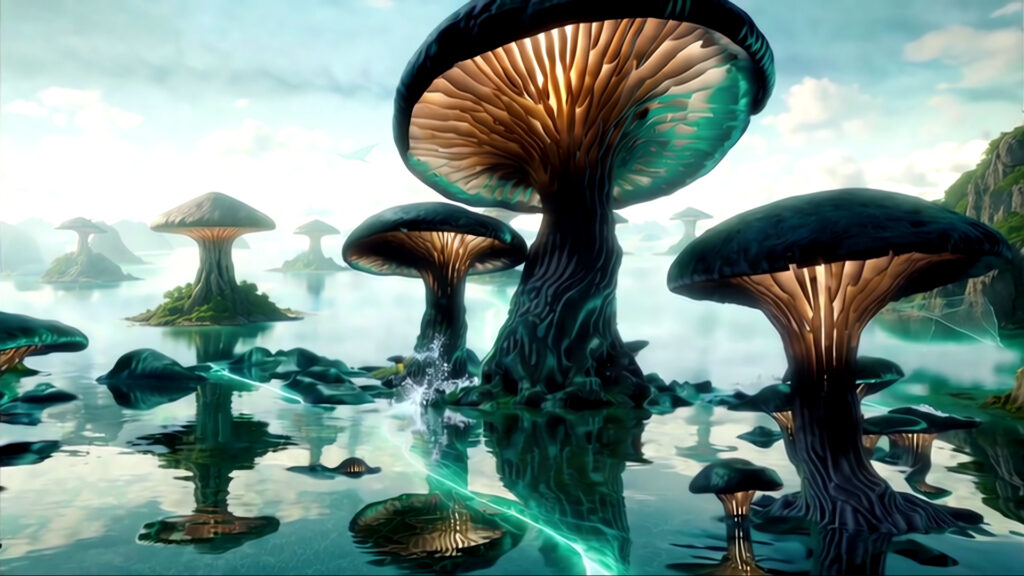
Wind arrived the way attention does—sudden, widening. Khyra stood ankle‑deep in a lagoon so clear that the fish beneath looked like the memory of birds. The islands ahead rose from the water like sleeping giants wearing crowns of mushrooms: caps in jade and carmine, caps pale as breath, caps whose gills wrote sutras that the tide sang when it made and unmade languages against the shore. Floating over it all, Tholos shaded Khyra with a tender orbit.
She met the archipelago’s hosts: the Trisme, humanoids of long, interlaced limbs and triple throats that made chords when they spoke. Their skins shone with powder like pollen distilled into star‑dust, and on their foreheads grew small, articulate antennae that wrote poems in the air when they thought too hard. They were not primitive; they were not superior. They were exact, which is rarer.
“Pilgrim Bridge,” intoned the Trisme elder, whose triple voice felt like three rivers arriving at night to wash your house without asking permission, but with love. “We live under good rules. Our storms are polite, our quarrels brief, our feasts seasonable. Yet the Shatter Current has begun to pull at the edge of our tide.”
They brought Khyra to a cliff where ocean fell not downward but sideways, sliding into a rift that shimmered in DMT‑bright bands. Within the rift darted fish whose bodies were the shapes of letters in an alphabet spoken once, long ago, by a certain wind to a certain mountain. The water sang in vowels that made the skin remember other skins.
“It drags at our islands,” said the elder. “It asks us to leave ourselves.”
Khyra knelt and placed her palm on the cliff. The Crown’s filament hummed within her chest, and she felt the Current taste the island, test the island, try to love the island too hard. It was not evil. It was overeager.
“You do not need to leave yourselves to learn yourselves,” Khyra murmured.
She asked the Trisme for gifts: a cup of brine in which starlight had slept, a scroll of gill‑writing, and a handful of spores from a cap the color between indigo and forgiveness. With these, she wove a Listener’s Net—a mesh as thin as any belief that worked too well, and as strong as a promise kept when it would have been easier to break it. She cast the net into the Current. It did not catch. It did not bind. It persuaded.
The Current trembled, then softened, as if realizing it had been talking over someone brave enough to speak quietly. The sideways waterfall exhaled and turned a degree toward kindness. Islands sighed; their crowns unfurled a notch of pleasure. In the water below, alphabet fish spelled THANK before losing their place, which was all any thanks need be.
The Trisme sang without instruments, their triple throats folding harmony like warm bread. Tholos drifted nearer, tassels tickling Khyra’s cheek. “Bridge,” he whispered, “the Crown counts this as a way kept.”
Khyra looked at the horizon, where a new brightness gathered, not harsh but exacting. The garden feeling returned, this time with a hint of bite—like citrus on a wound that deserved healing.
“Another door,” the Crown breathed through her, “and then another. Do you tire?”
“I tire like a seed,” Khyra said. “By swelling.”
IX — Violet After‑Image
The pilgrimage arced toward its final bend with a swiftness that did not scold. Khyra returned, by Crown’s gentle insistence, through the corridors of Many Horizons. The Null Bloom had sprouted into a shrub bearing dull, honest berries. The prism mantas escorted her across the Wastes, their fins carving new angles of light. Basidia’s caps chimed a welcome, Mother Sephrae’s halo of spores falling around Khyra like a blessing left in a doorway with a note that read simply Eat.
At last, the clearing received her again. The Amanth flickered with pride too old to boast. The Crown held steady, its hoops a calm, luminous machine that made nothing and allowed everything.
Khyra stood at the clearing’s center and let the filament withdraw. It left her body slowly, stitching her closed with threads of patient light. When it passed her heart, it paused as before, and this time placed a kiss—if light can kiss—upon the crystal slats. She felt gratitude arrive with the gravity of a new moon rising.
The Crown dimmed to a violet after‑image, the kind that lingers in the corner of sight and flees if chased. It had not grown weaker. It had learned to be gentle in places that needed gentleness and thunder elsewhere. It turned once; the universe met its eye and behaved itself.
Tholos lowered until he and Khyra shared the same shadow. “Keeper of Soft Footprints,” he said in the voice he reserved for truths that could start as jokes and end as psalms. “You are a bridge that a river respects enough to pass beneath without vandalism.”
Khyra laughed, which she did rarely and well. “And you,” she replied, touching his cap with the back of her hand, “are the moon that knows a tide’s true name.”
The Amanth parted to reveal new soil where there had been none. It was small, no larger than a cloak folded twice. Khyra knelt, cupping from her satchel a handful of spores she had collected with permissions more elaborate than any border ritual—spores remembered from the whispering archipelago; spores gifted by a prism manta in the shape of a word never spoken aloud; spores Tholos had shaken loose from his own tassels while pretending not to notice.
She planted them. She covered them with a palm and told them a story in a voice that had learned how to be a garden. Beneath her hand, the ground warmed. A thin, bright root touched her skin like a curious tongue. Khyra closed her eyes and saw, as one sees in sleep without sleeping, what would grow here: a waystation for pilgrims who had not yet learned the word forward and were shy about confessing it. Caps would open like lanterns in the dorsal night. Lianas of crystal would hum like fair weather. And among them would drift a hundred gentle guardians, each with amber eyes and tassels like fennel smoke.
She stood. The clearing was still a pause in the universe’s syntax, but now it carried the aftertaste of a sentence lovingly completed. Khyra turned, lamellae folding against her back with the clean efficiency of a mind that had just put away its favorite book to read it better next time.
“Where now?” Tholos asked.
Khyra looked past him to the ridge, the Wastes, and beyond all that to the idea of a road. Spores rose in a faint column, shimmering in DMT‑bright colors that meant Do not fear your size and Carry water and Listen until listening is the only act left.
“Anywhere a soft foot may step,” she said. “Everywhere a soft foot must.”
They left the clearing. Behind them, mushrooms grew where their footprints had been, small caps of midnight blue whispering enough to any who might listen. The Crown tilted once more, an old god letting itself be understood just enough, then drifted a fraction back into its own thought.
Above the world, Sporespace unfurled like a vellum of living diagrams across the night. Pilgrims would come: beings crystalline and vascular, beings made of liquids that remembered snow, beings whose bodies were the argument between stone and echo resolved into choreography. They would bring questions—some generous, some greedy—and the Path would teach them to make the first kind larger and the second kind shyer.
Khyra and Tholos walked until evening decided to be born. The first star—no, the first spore of night—rose, bright as a promise that kept itself even when forgotten. In its light, Khyra felt the gentle engine of the universe cycling through vows it loved: Open, carry, mend, seed, return.
Soft feet, soft feet, soft feet.
And so the pilgrimage went on, which is to say it began again, which is to say a bridge became a river that learned to respect the things it banks.