I. The Valley of Needles and Nebulae
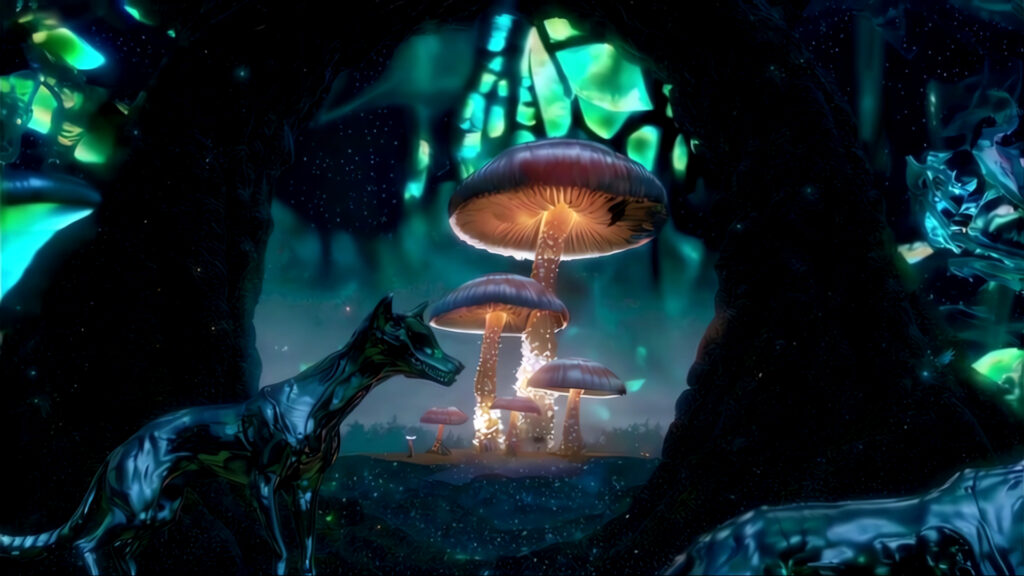
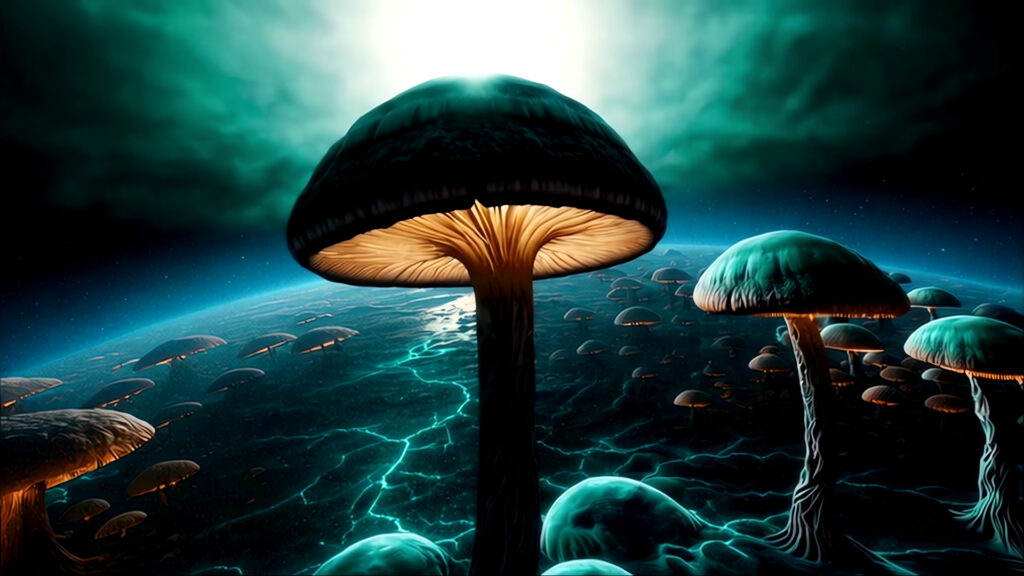
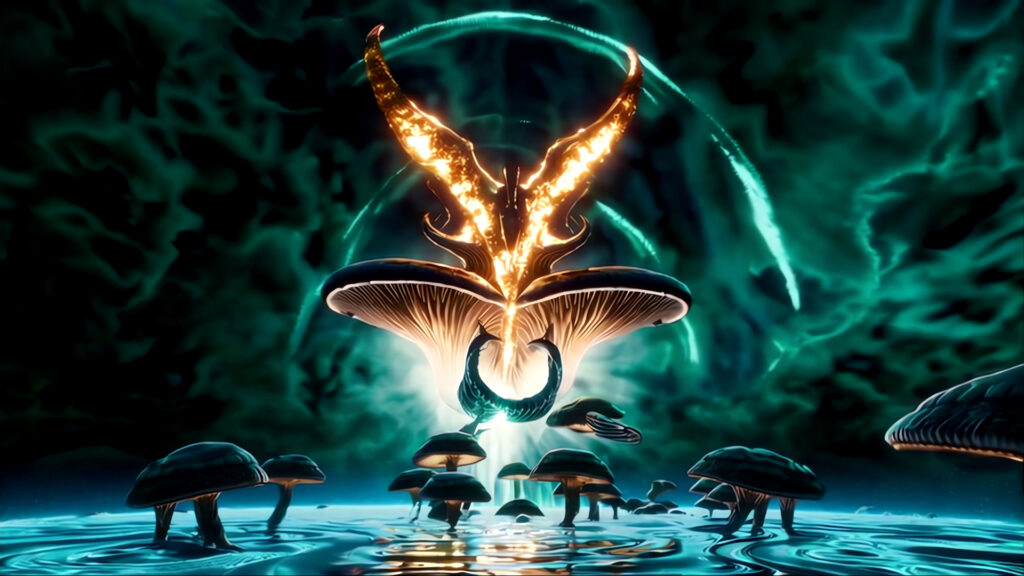
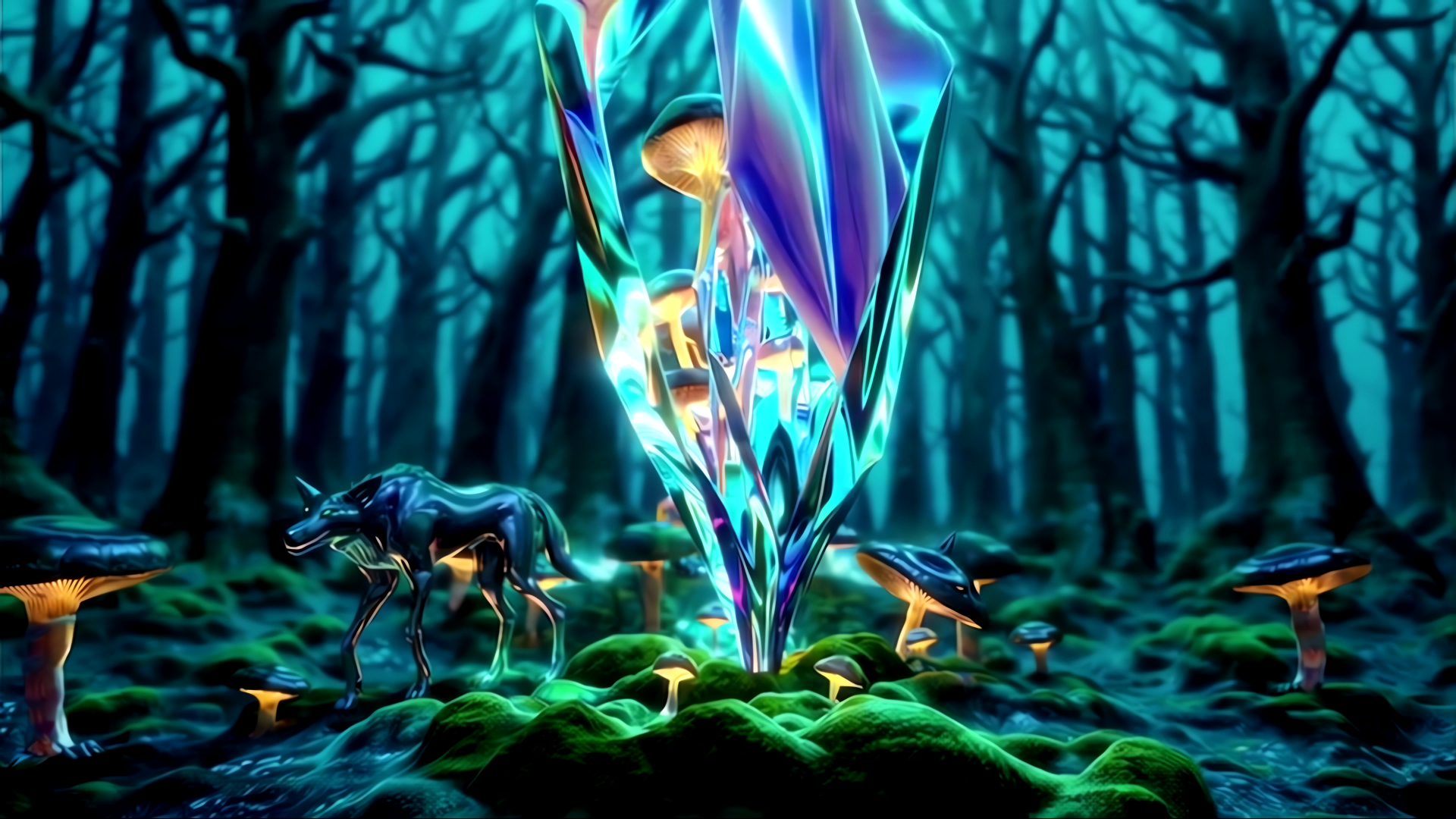
The valley did not possess a sky so much as it wore one—like a mantle stitched from night and fossilized lightning. There, mountains grew as spirals, unfurling like ammonites that had learned the grammar of distance. Between them unrolled a plain of obsidian grass, each blade the height of a knight’s fingerbone and sharp enough to cut a breeze. Among the grass rose gardens of mushrooms whose caps glowed with psilocybin‑cool luminescence, swelling and shrinking as though the land itself were breathing. The air shimmered with prismatic latticework, the kind of crystalline geometry the old mages called LSD frost: not a substance, but a behavior of space when it remembered how to speak in angles.
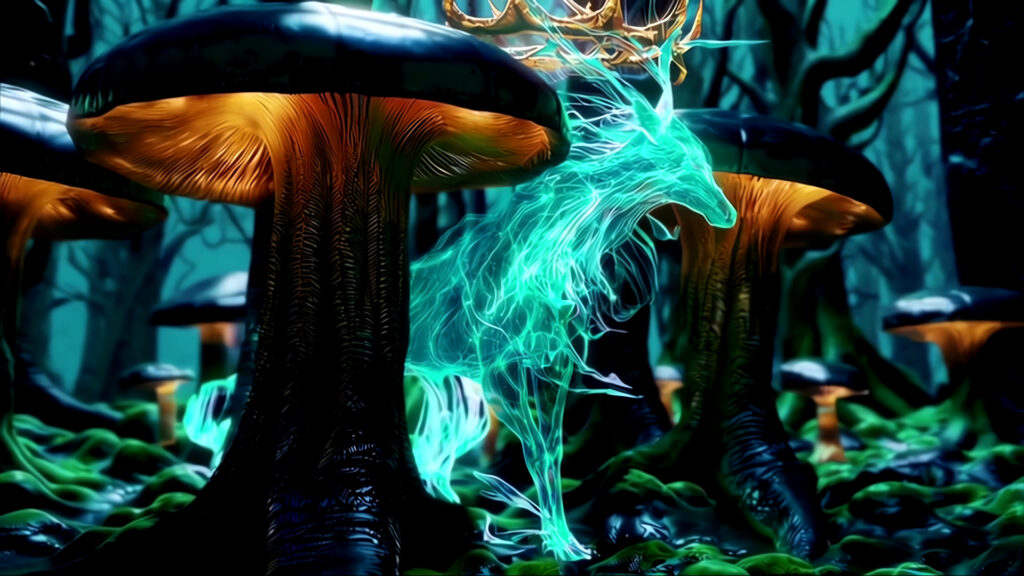
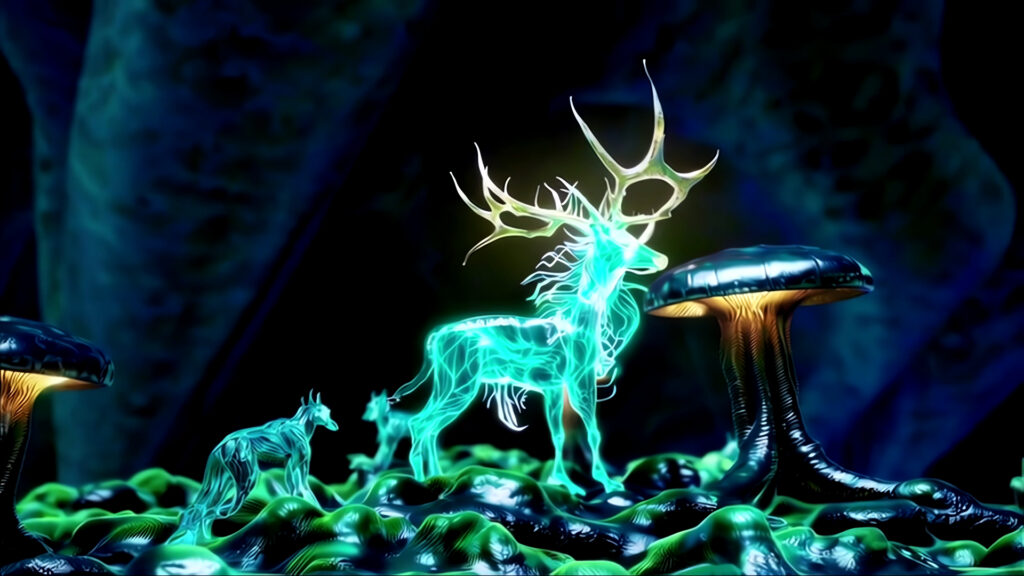
From the far lip of the valley, a figure descended—tall, limber, and jointed like a cathedral. A crown of thornlike antlers curved from their brow, clear as frozen starlight. The skin beneath was night poured over basalt, veined with faint mycelial fire. Their eyes were two small nebulae, each laced with silent storms. This was Veyra of the Hollow Constellations, Thornbearer‑designate, though no coronation had yet bound the title to their name.
Veyra’s cloak whispered as it moved, stitched from comet dust and the lensing of gravity. Around Veyra’s ankles flowed a low tide of spores, soft as fog. They did not carry weapons. What lay ahead was not a war but an agreement older than war—older, some said, than the first thought the universe ever had about edge and center.
The valley’s gate was a living thing grown of stone and hyphae. It woke as Veyra approached, its arch unfurling in segments like a thornless jaw. Runes climbed across its face, rearranging themselves as if embarrassed by old spelling mistakes. Beneath the arch the air deepened to a dream. Veyra placed a palm against the gate and felt it taste the lines of their hand: the cool curiosity of limestone, the slow joy of mycelium, the seriousness of granite. The gate found Veyra true. It opened enough for a sun to pass, though only starlight slipped through.
Beyond the gate there was a bridge, but not one that any empire would have built. It spiraled upward—an amber helix woven from fossil light and the memory of insect wings. A hundred lantern moths, their bodies written from pale green fire, whirled around the helix and painted the air with script. Each swoop left a calligraphic ribbon that fluttered for a heartbeat before folding itself into the next ribbon, until the whole sky seemed to write a single, never‑ending word.
Veyra set a foot upon the helix. The bridge understood and answered in geometry. Every step translated weight into letters; every letter bent the helix half a degree toward the heart of an unseen star.
Above the valley’s slow breathing, the firmament gathered into a bowl. The stars were close—so close that a patient hand might stroke their bark. Their thorns flashed silver where they pricked the dark, and the light that bled from those wounds trickled down in threads, affixing to the bridge and to Veyra’s antlers. These were the thornstars, the oldest seeds of authority—neither crown nor constellation, but both.
A coronation had been promised. The land remembered.
II. At the Spore‑Lit Threshold
At the helix’s summit waited a plaza hung in the air like a paused raindrop—an island of stone with no mountain beneath it and no visible tether to keep it from floating away. The surface was a mosaic of mica and petrified lichen. Every tile matched the sky above it as if the plaza were a mirror coaxed into patience. At its center stood seven thrones, none of them meant for sitting.
The first was a ribcage of quartz grown into the suggestion of a chair. The second, a coil of petrified ivy, each leaf barbed into a smile. The third was a column of transparent fungus, hollow as a flute and alive with faint bioluminescence. The fourth was a naked knot of meteoric iron. The fifth, a low squat seat hewn from bone that had never belonged to any beast. The sixth, a twisted hoop of drifting dust that maintained the shape of a throne only because it had taught gravity to love it. The seventh was absence: a perfect negative space shaped like acceptance.
Around the plaza moved the Asterum Wardens, guardians born of the sky’s older alphabets. They were humanoid only because the air remembered that shape fondly: their limbs were braided filaments of aurora, their hair a fall of star‑glass needles, their faces partly masks and partly the idea of faces. Within each Warden’s chest a pale galaxy turned, slow and intent as a thought. They bowed to Veyra—not low, and not high, but at the angle that signified recognition.
“Veyra of the Hollow Constellations,” said the Warden whose voice resembled snow thawing on quartz. “You are called to the Thornstar Coronation. The crown is not a circlet here; it is a garden and it is a winter and it is a law. If it chooses you, you will not wear it. You will become the place it requires.”
“I accept,” Veyra said, and their breath fogged in amethyst shapes that broke apart and fell like slow rain.
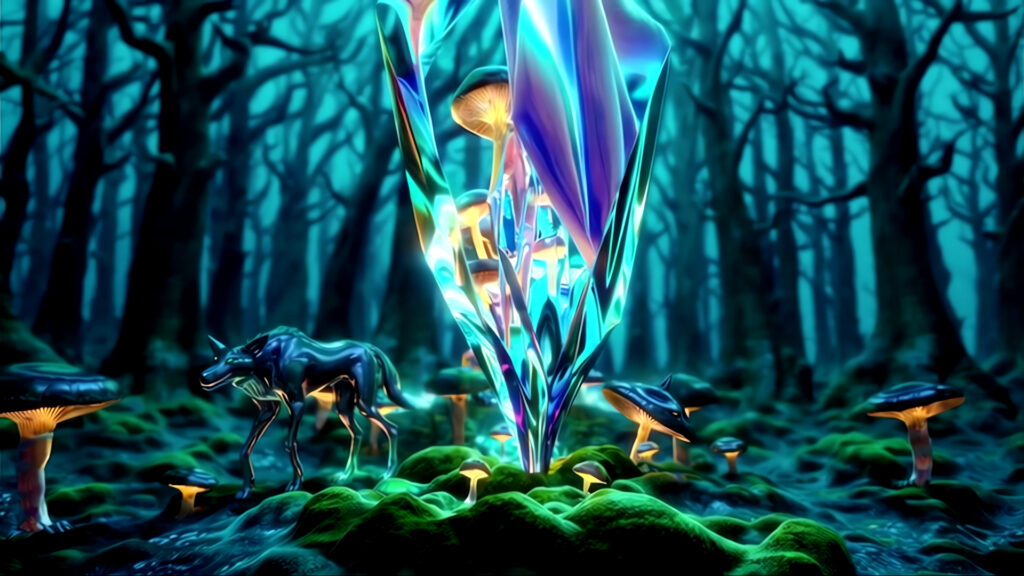
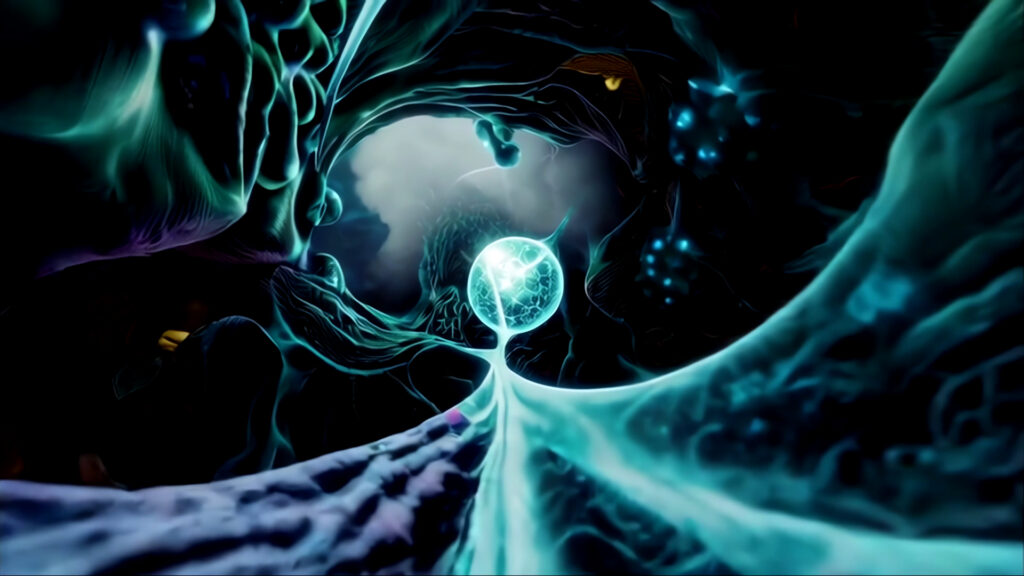
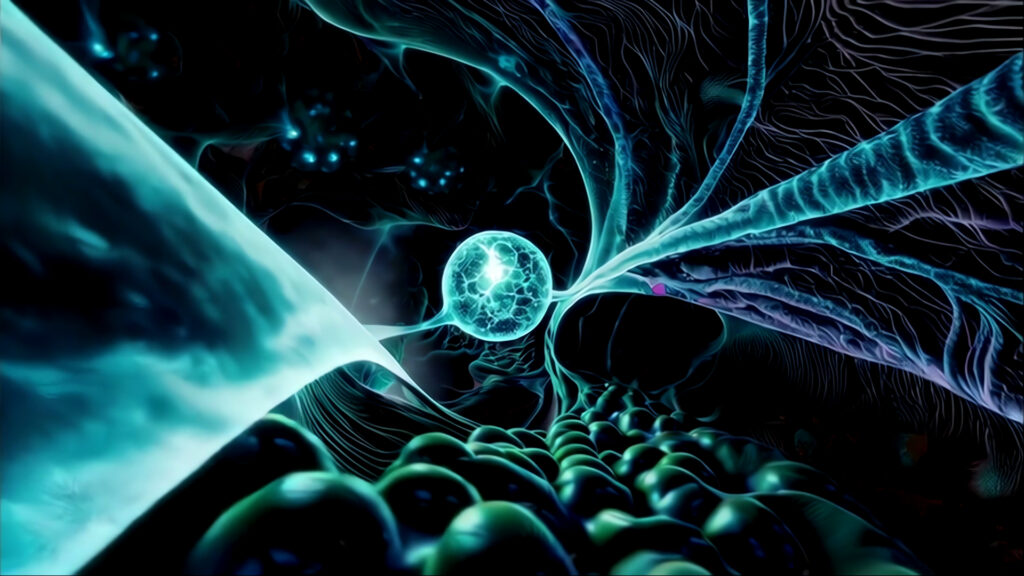
The Wardens stepped aside. Between the thrones the floor unstitched: lichen tiles flexed as if waking from a long nap, and the plaza opened its mouth. Inside was not darkness but depth—a chamber where mushrooms grew as pillars, where stalactites glittered with imprisoned lightning, where rivers wandered not with water but with DMT‑bright filaments that braided and unbraided the way a mind sometimes does when it remembers more than one meaning at once.
Veyra climbed down into that depth. Moths followed, writing spirals that kept their footing honest.
III. The Coronarium Below
The Coronarium was a cathedral grown by soil out of patience and sky out of wonder. Its ceiling arched in ribbed vaults of calcified spore. Between the ribs, prisms hung and drifted—no strings, only decisions. Within those prisms sloshed colors with the wet soundlessness of oiled glass sliding upon glass. The floor’s lip took Veyra to a path lined by lichen runes. The runes were indigo, then violet, then green; they changed as if remembering who they had been when the world was younger and louder.
Creatures attended the path. Moss Titans ambled in the manner of moving hills, their niches overflowed with fern gardens and tiny star‑shrubs whose fruit clicked like pearls in a wooden bowl. Lattice Serpents coiled through air in seven‑sided spirals, their scales mirroring the Coronarium itself, so that when they passed, Veyra saw the cathedral in miniature and felt a brief vertigo, like falling upward into a smaller truth. Marrow Cranes stalked on legs too thin to be kind, beaks made from wind sharpened to a line, their eyes kindled lanterns: not flame, but the intention to enlighten.
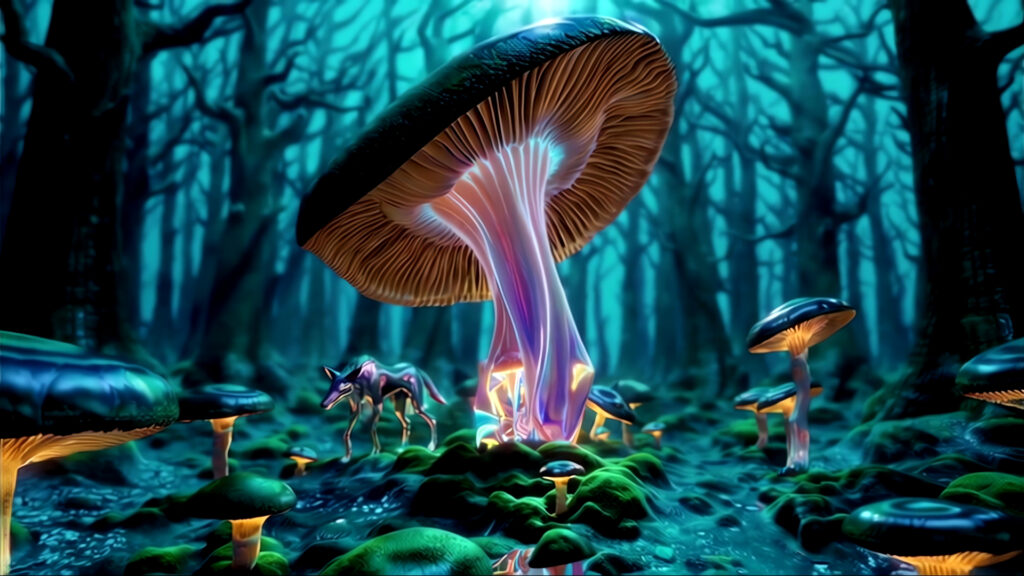
And then came the Spore Oracles—mushroom‑towers grown around pillars of blue ice. Their caps were broad and terraced like ziggurats. Faces formed inside their gills, not carved but condensed, like faces one finds in the steam of breath on winter windows. Each spoke without mouth or language. They spoke by altering the temperature of the air.
Veyra, they changed the air enough to say. What you think is a crown is a choir of edges. Each thorn is a syllable in the planet’s name for itself. The ceremony is not to place metal on a brow. The ceremony is to convince the land that a brow exists in the right shape.
Veyra did not bow—this was not the Oracles’ preference—but they allowed the spores to collect upon their palms. Light pooled there: glows of psilocybin blue widening into shallow lakes. Within each lake a smaller Veyra stood, then dissolved, then stood again, altered and truer. The path inclined slightly. It became a ramp that became a stair that became a nerve.
The Coronarium inhaled.
Far ahead, something moved, and the movement wrote meaning upon the entire chamber. Pillars aligned. The prisms faced forward. Even the spores oriented their glow like watchers tilting toward a stage.
The Thornstar Crown arrived.
It did not approach so much as recompose itself in Veyra’s proximity. A ring of star‑thorns rose from the floor, each thorn a sliver of cold daylight bent into matter. Inside the ring, geometries nested—deltoids, lemniscates, polyhedral illusions—folding with LSD‑clean precision that made Veyra’s antlers sing with sympathetic silence. Where the thorns touched the air, the air took on the frail sound of crystal learning to forgive.
From the intentioned dust stepped another presence: a Caryatid of the Night Orchard, a being whose bones were vine and whose vine was bone, whose mouth was a mouth only when speaking to someone who needed a mouth to receive truth.
“Who bears thorns to be crowned by them?” asked the Caryatid.
“I do,” Veyra said, their voice quiet enough to let stone listen. “Not to hold power, but to become a shape worthy of being used by it.”
“A pilgrim’s answer,” said the Caryatid, and where it smiled, lichen healed.
IV. Tests of Shape
No coronation in the Coronarium was a matter of kneeling and rising. Shapes had to be proven. For a crown of star‑thorns, which was geometry that had learned hunger, a bearer had to demonstrate the capacity to hold more than one edge at once.
The first test was Weight.
From the ceiling descended a spindle of quartz with no thread, rotating on the patience of stone. Upon it balanced a sphere of compressed dusk. The sphere did not fall; the spindle did not bend. Yet both were heavier than any gravity Veyra had met. To show that they could be the shape the crown required, Veyra placed a hand beneath the sphere and lifted—not with muscle, but with meaning. They offered the sphere a truer description of up. The sphere softened and glowed, satisfied that the bearer could tell a direction a better story than inertia could.
The second test was Wound.
The crown’s thorns opened and closed like breathing. They exhaled cold. A vine of meteoric iron unfurled, its barbs tipped with a mercy older than pain. “Bleed,” said the Oracles by altering the Coronarium’s temperature to winter. Veyra extended an arm. The vine kissed their wrist with a scratch of day. Light—thin, concentrated, indifferent to audience—pearled where skin opened. The pearl did not fall. It rolled along Veyra’s forearm and nested at the crook of the elbow. The light became a seed. The wound closed with a sound like frost eaten by noon. The seed pulsed as a second, quieter heart.
The third test was Sight.
A prism lowered—no longer crystal but decision in crystal form. Inside it flickered forests and cities and deserts, all folding into each other like pages read too fast. At last it stabilized into an orchard where stars grew on stems and sang as wind passed. At the orchard’s center waited a throne made from absence. Veyra stepped into the prism—and found they had become three: one walking, one watching, one recording. The orchard welcomed them with a breeze that smelled of meteors ground down to citrus.
At the throne’s foot lay a creature like a stag birthed from moon‑char. Its antlers were candelabra but the candles burned inward, lighting the creature’s thoughts. It was the Crown’s Familiar, the Ilith Stag. “We are not objects,” it said, voice a drift of snow on black water. “We are relationships that learned to keep a shape long enough to be loved. Sit, Veyra. Not to rule. To promise.”
Veyra did not sit. They knelt and pressed their brow, thorned with antlers, against the throne’s invisible edge. The act created a pressure wave that arranged the orchard’s leaves into runes: I am not above the land. I am its chosen place to gather sharpness when sharpness must be used.
The prism released them. They were single again, though richer by three perspectives. The Coronarium waited, polite and predatory. The crown hovered, thorns breathing, stars within it spinning as if each were a small, forgetful god trying to remember how to turn.
The last test was Naming.
A figure rose from the mosaic floor—a Lichen Sphinx with the body of a sleeping mountain and the face of an equitable question. Its mane was moss; its eyes were the color of agreements kept. “Say the name of this world,” said the Sphinx, and when it spoke, stalactites dripped silence.
Veyra listened. They listened past wind and past stone and past their own pulse. They listened until their body was more ear than any other part. The name came—not in letters, but in interlocking curves, a sound one can only make by letting breath remember its origin. Veyra exhaled it without voice. Frost wrote the name upon the air. The thorns of the crown chimed the way glass chimes when two oceans marry.
The Sphinx bowed. “True,” it breathed, and its breath was soil learning to laugh.
V. The Brief Eclipse
The Coronarium flickered.
For three breaths, the world inverted—only inside the chamber, where rules were affectionate but strict. Pillars turned negative, their shadows solid glass; light took on texture and fell in braids that rustled like silk. Veyra’s antlers grew inward, into their skull, then outward again as if the mind had learned how to antler. The Thornstar Crown collapsed into a line so thin it had to steal existence from other lines to remain visible. In that instant the Asterum Wardens became perfect stars: not ornaments in the sky but the verbs by which sky asserts identity.
Eclipses in the Coronarium meant the choice had been made.
When the color returned, it returned different—cooler, like a fever breaking. A gravity gathered that was not downward but toward. The thorns bent to it. The Wardens stepped back. The Spore Oracles brightened to an almost pastoral glow, caps haloing the chamber in a patience ordinarily reserved for gardens and old stories told well.
“Stand,” said the Caryatid of the Night Orchard.
Veyra stood.
VI. Procession of the Silent Giants
Before any crown closed its circle, the land demanded witnesses. The Coronarium opened its ceiling like a curtain trained to applaud with light. Through the aperture drifted Moss Giants, their cities on their backs lit by lanterns made of caught lightning. Walls of those cities were not stone but promises; roofs, not shingles but memories woven until water respected them.
With the giants came Lantern Moths, and with the moths their ever‑unfurling script. The letters they wrote had flavor; the air tasted of sugar iron and moon‑bruised citrus. Each glyph softened the heart’s armor by a reasonable degree. Lattice Serpents descended in helices tight as vows. Marrow Cranes, gentle on joints that were nearly too slender to deserve their grace, dotted the procession like solemn thoughts between exclamations.
Behind them rolled the Aether Leviathan—a creature so large that it had to wear clouds to keep from startling the sky. Its sides were rivers of wind braided with aurora; within its gaze stirred distant maps. On its back sat the Seven Attendants of the Crown‑Garden, beings so thin they were stitches between places, their hands full of seeds that looked like teardrops of daylight.
They shaped a circle around Veyra, and not a single footfall marred the Coronarium’s mosaic. Witness is the softest way to change a world, and each witness understood softness to be a discipline, not a weakness.
The Attendants extended their hands. Seven seeds, seven alphabets, seven slivers of weather. Veyra opened their left palm, where the wound had closed over a pearl of day. The pearl rose like a sun asleep inside a bubble. The seeds circled it, then aligned along invisible axes as if the pearl had grown a skeleton. The Thornstar Crown lowered until its thorns grazed the seeds.
The seeds broke.
Light spilled with a sound like frost delivered of its purpose. The sound could not be heard, yet every creature present learned a lesson from it and felt more honest for the learning.
VII. Coronation
The crown did not descend upon Veyra; Veyra grew into the crown’s space.
Their antlers braided with star‑thorns until no weave could be said to be first. Their skin learned the idea of day even where no sun entered. A network of glows—delicate as spore‑lanterns, as rigorous as geometry taught by a patient ancestor—flowered beneath Veyra’s surface. The pearl nestled at their elbow pulsed once, twice, then settled into the rhythm used by roots.
The Asterum Wardens raised their hands as if lifting the weight of ceremony itself. The Coronarium’s prisms tilted and sent down curtains of clarity. The Lichen Sphinx breathed out, and its breath outlined an unseen throne—the empty seat shaped like acceptance. Veyra did not sit; they stood within that outline, and their shadow filled it like water filling a mold meant only for this hour.
The crown’s thorns found purchase not on bone but on intention. Each pricked an idea and drew from it a thread of consequence. Threads crossed and locked like a loom learning a new vocabulary. A circular halo formed—not above, not around, but through Veyra, as if coronation were a ring cut into the nature of a person at the right depth.
The Spore Oracles cooled the air by a sonnet’s worth of degrees. “Witness,” they scented the chamber. The moss on the giants’ backs shivered as if remembering rain. Lantern moths stitched a final line in the air, then folded their wings, and for a heartbeat the script held itself and could be read. It said: The land wears the crown, and today it chooses a head.
Light withdrew not outward but into Veyra and found room there. The crown dimmed to a calm that did not mean weakness, only fidelity. The thornstars no longer needed to gleam; their work had migrated into the bearer.
Veyra inhaled and felt the world consent.
VIII. The Cinder Orchard
After coronations, the Coronarium gave an orchard as a gift—because gifts, like crowns, are ways the world reminds itself to be generous to its edges.
They walked out beneath a sky rinsed by the ceremony until it tasted of minerals and mercy. Ash drifted from nowhere in particular. Each flake was engraved with a tiny map of constellations, and each map was accurate for a sky that had not yet been born. Trees had grown where there had been no soil to promise them. Their bark was a color between pearl and rain. Their leaves were thin membranes of night with stars embedded like seeds. The fruit was cinder, but cinder with the patience to become soil in the hand of anyone who knew a story well enough to tell it at the right time.
At the orchard’s heart stood a Caryatid of Dawn’s Bone, kin to the Night Orchard but tempered by day. Its face, carved from gentleness, broke into lines that the eye mistook for wrinkles and the hand recognized as years. “What will you do?” it asked Veyra. “Not with power. With shape.”
“I will go where edges quarrel,” Veyra said. The crown agreed quietly in their bones. “I will help them find a circle that honors both.”
“Good,” said the Caryatid, and tipped its head as trees do when wind worships them. It cracked one finger from its hand—no blood, only the sigh of bark—and offered Veyra a seed of bone‑light. “Plant this whenever a horizon forgets that it is allowed to say yes.”
Veyra took the seed. It was warm with those small, ancestral suns one keeps in pockets and only removes in the presence of old water or older friends. They knelt at the orchard’s edge and pressed the seed into ground the color of after. Mycelium reached like reasoning. Hyphae shook hands with rootlets with the formal grace of queens meeting on a bridge over a river both could claim. From the wound in the soil a thin shoot uncoiled and levered itself into being: a sapling crowned with star‑thorns that did not cut flesh but sharpened attention.
The Asterum Wardens bowed—not to Veyra, but to the work coronation turns into a public trust. The Moss Giants turned and began their slow return, cities humming on their backs. The Aether Leviathan drifted down to taste the orchard wind, then shouldered the horizon and moved on, trailing a ribbon of weather shaped like a promise. The Lantern Moths unfolded their wings again and spelled one more word. It read: Go.
Veyra went.
IX. Roads Without Rulers
Authority in that country was a verb, not a throne. Newly crowned, Veyra found that the land answered when addressed with respect—the way a river will confide if asked a question that does not presume to correct it.
They crossed Prism Fens, where water wore glass to remember its knees. They knelt at the banks and offered the water its own name. In return, the fen lifted a path of hexagons that held perfectly, not because they were strong but because the water consented to make them true.
They traversed Halls of Aether, corridors of pressure carved between mountains of wind. There a Mirror‑Fox slipped alongside, its fur a field of reflected constellations that chose which star to show based on the honesty of the viewer. It led Veyra through a doorway framed in silence. On the other side a dune of black sugar stretched beneath a fractured moon. “The crown is heavy only if you believe in weight,” said the fox. “Belief is a pulley. Practice is a lever.”
They met a Saurian of Obsidian, its scales veined with lichen that glowed when it thought of kindness. It lowered its head, and Veyra scratched the spot where a mountain might itch if a mountain had nerve endings. They shared a gaze—two old things agreeing to walk parallel for a time.
They passed Glass Orchards whose fruit contained small, precise storms. When one broke on the ground, it rained upward for three breaths, then became cider for any creature wise enough to drink with intention rather than thirst. They did not drink. They listened to the cider’s whisper and learned how orchards argue with winter and win.
Everywhere the crown rested in Veyra’s bones like a well‑taught instrument of geometry ready to draw a circle around harm and make it confess.
X. The Horizon That Says Yes
Night returned slowly, the way a thought returns when a story invites it back. Veyra climbed a ridge and found a coast whose waves were constellations undone and remade with every roll. Beyond the surf lay a city whose towers were transparent bone—no skeletons here, only architecture grown from the idea that a shelter should never hide a sky. The towers leaned toward arrival, as if they heard a traveler coming and wanted to meet them halfway.
Veyra knelt on the ridge and pressed their palm into the soil. The pearl of day at their elbow warmed. The thornstars in their antlers hummed as very thin ice hums when persuaded by sunlight. The crown was not on their head; it was in their speech and their patience.
Below, along the beach, beings walked—humanoid only because the beach found that shape flattering. They were spun from moonfall and lichen wind, hair threaded with lantern moths, hands full of maps that altered themselves to remain true when the land changed its mind. They looked up. They did not shout. The city’s towers rang without sound. The surf paused long enough to say welcome.
Veyra rose.
The ridge did not end; it unrolled like a ribbon being repurposed into a road. The sky did not darken; it learned a more intimate brightness. Behind Veyra the orchard glowed with small, industrious stars. Ahead, the city parted its avenues and waited at the angle that signifies recognition.
Ceremonies are never over; they are merely portable. The Thornstar Coronation had not crowned a person. It had reminded a world of the shape it prefers to trust when learning to change.
Veyra descended toward the bone‑bright city. The Lantern Moths followed, writing the last line of the day—the line that means, simply, again.