the Story
The desert is black salt and starlight, a plain so smooth it could be the pause between two thoughts. Heat doesn’t shimmer here. The night itself does. You stop to catch the sky rearranging itself—the constellations running a quiet algorithm—and the seam appears, a stitch in the dark that pulls apart as if the heavens were a coat that someone decided to unbutton.
Something slips through the gap.
It is not a coin, but your mind insists on that word because it must be small enough to hold and bright enough to spend. It spins, calmly, like a promise made by a patient liar. Its face is neither gold nor silver, but all metals at once, a mirrored glyph constantly writing and unwriting itself. It hums. It casts prismatic letters on the salt, a language that becomes clearer the less you try to read it.
When you reach for it, gravity forgets you. Sand grains lift, hang, learn a new way to be obedient. Your hand closes and the world edits. The seam in the sky zips shut. The hum threads down your bones and finds your pulse. The coin is warm, precisely the temperature of a person whose name you can’t remember and whose presence you can’t forget.
You stand in the desert, and the desert stands in you, and the coin hangs in your palm like a second sun scaled down for intimacy. On the horizon, a thin line of silver draws itself with a ruler no one is holding.
You have been invited.
—
The river runs uphill.
It is a mirror more than water. You test it with your boot and the surface dimples then firms, an elastic sheet stretched over an abyss full of answers. When you step onto it, the reflection refuses to be yours alone. The face staring up is you with different histories in the eyes, variations of a chord you never learned to play. Behind those other-yous dart schools of chrome fish arranging into starfields and disassembling into arithmetic you feel in your teeth.
The coin hums and the current syncs to it. A gentle upstream pull. The hum wants you forward, wants you to become the map it’s asking you to read.
Overhead two moons lean close, and between them, a flotilla of dragonflies writes ultraviolet calligraphy. Their threads hang in the air for heartbeats before the wind erases the sentence and the insects begin again as if repetition were a kind of prayer.
You let yourself be carried. The Mercury River curves not with geography but with memory, as if it follows the path of a story told out of order.
A bend, and you see it: the gate.
—
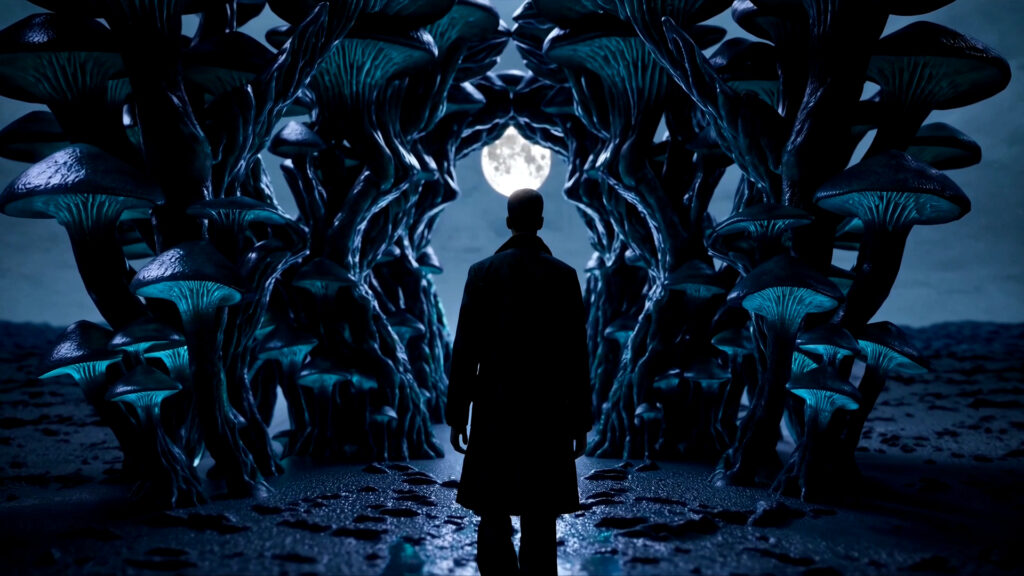
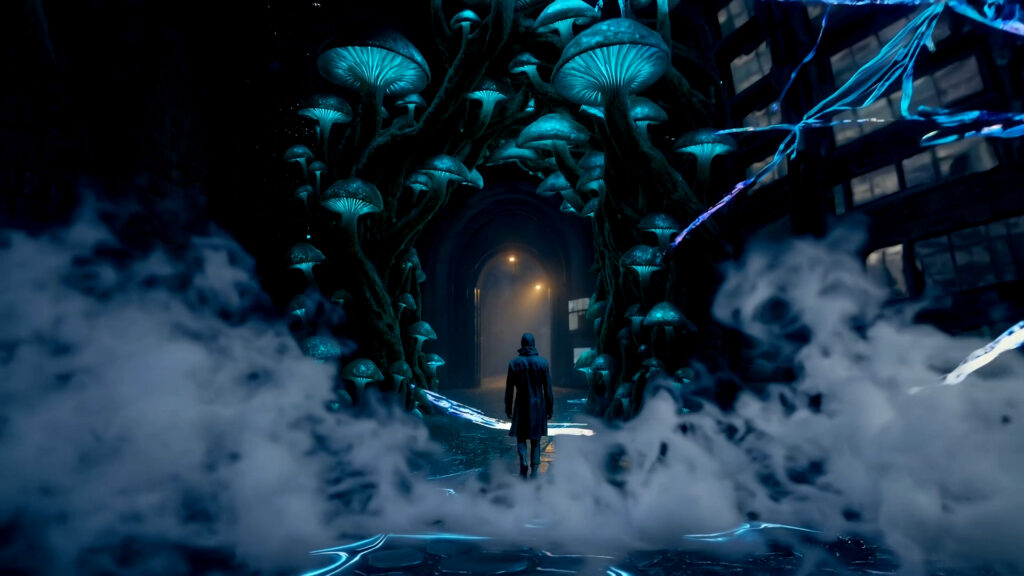
Mushroom spires braid themselves into an arch so tall it could yawn and swallow a cathedral. Each cap reveals teal gills that breathe like lungs learned to glow. The gate’s surface is not bark but something polished into a glass that remembers being alive. Spores drift in patient spirals, then rush inward in a single inhalation you feel along your ribs.
A tendril rises, delicate as a finger lifting a thread. It taps your hand and the coin weft-passes through skin without offense. The coin becomes a loop becomes a crown becomes a circuit. You feel brightness at your temples. The gate opens not by moving, but by remembering to be open.
Corridors inside are spore-glass, tessellated windows into rooms extending into infinity, each pane reflecting you as if you were a deck of cards shuffled and fanned. You walk and multiply, then reduce back to one with each step. The air tastes like clean water poured through old paper.
The map does not lead; the map listens. The crown of light slopes your thoughts toward architecture. You do not plan; you intend, and the hall favors your bias like a friend.
—
Snow starts and the world slows.
Each flake falls with the seriousness of a held breath. Up close, they are prisms encasing frames of film from lives you haven’t lived: a lighthouse’s pulse cut by fog; a staircase that is ordinary except for how vividly the wood remembers being a tree; a hand reaching for another hand that will never be held, hovering an inch from forgiveness.
You lift a palm and the flakes avoid it as if your skin emits a gentle No. Your footsteps lag behind then catch up then drift ahead in a choreography your body understands before your mind does. Time isn’t an arrow; it’s a field, and you are a small animal crossing it without leaving a trail and somehow leaving ten.
The ketamine snow makes silence so clear you can hear the building think. The corridors inhale; exhale. On the wall, your shadow arrives three beats early and waits, amused, for you to catch up.
You do not think of home. Not yet. The word would tilt the walls; you can feel it, the way a name shifts a conversation.
You move on. The flakes keep falling, a soft correction to your momentum.
—
Light the color of late honey pours down a slope and carries scent: citrus, rain that hasn’t fallen, a new book opened for the first time. The spore-glass gives way to a valley of stalks black as polished obsidian, each supporting a disc for a face. The discs are not petals but instruments of attention. They turn toward you not with need but with recognition.
The faces are not sunflowers, but your mind uses that category to keep from fainting at the geometry. Within each disk, sacred shapes drift and click like locks picking themselves. Not symbols—mechanisms. You feel the warm tick of alignment. When the wind threads the valley, the flowers lean, and their shadows run backward.
From the nearest disk, a seed lifts. It is a knot of black glass, the size of a fingernail, hovering with the cheerful insistence of a bee. It spins and spins until the spin slows and holds, pointing into a canyon whose sides look stacked by a meticulous child who never tires of building worlds from hexagons.
You follow the seed as if following a coin dropped in a dream. The seed loves the role of compass. It loves you for needing it.
—
The canyon floor is a tessellated hymn.
You step and the hexagons ripple outward, each wave a feedback note that warms your bones. The walls re-tile in response, a slider puzzle rearranging itself to whisper instructions in a language you weren’t taught but can suddenly speak. Your weight is a question. The canyon answers by building a staircase that had been waiting for your foot to tell it where to start.
You climb.
With each step the hexagons ripple, and with each ripple a word arrives: open, through, again. The words do not arrive in your ears, but in the joints of your fingers and the hinges of your knees.
At the top the canyon solves into a doorway—a circle rimmed with mirror-bone. The coin in your crown warms. Glass-bone catches light and throws it back in thin slow braids that remind you of a memory you’re not ready to fetch.
You pass through the aperture the way a thought passes into speech.
—
Across the void, a bridge builds itself out of proof.
Not stone and not rope—filament turned into geometry, a theorem you can walk. The first step feels like stepping onto a sentence that agrees with your feet. The second, like an answer that opens into a better question.
Beyond the bridge hang cities that almost happened. Glass ribs vault over squares paved with liquid reflections. Spore turbines inhale nebulae and exhale clean corridors. Archivists stand in doorways without faces, the absence there elegant as a minimalist signature. Each time your foot falls, one city aligns and nearly becomes real, then drifts away with the humility of an idea not chosen.
Midway, the air gathers into a person.
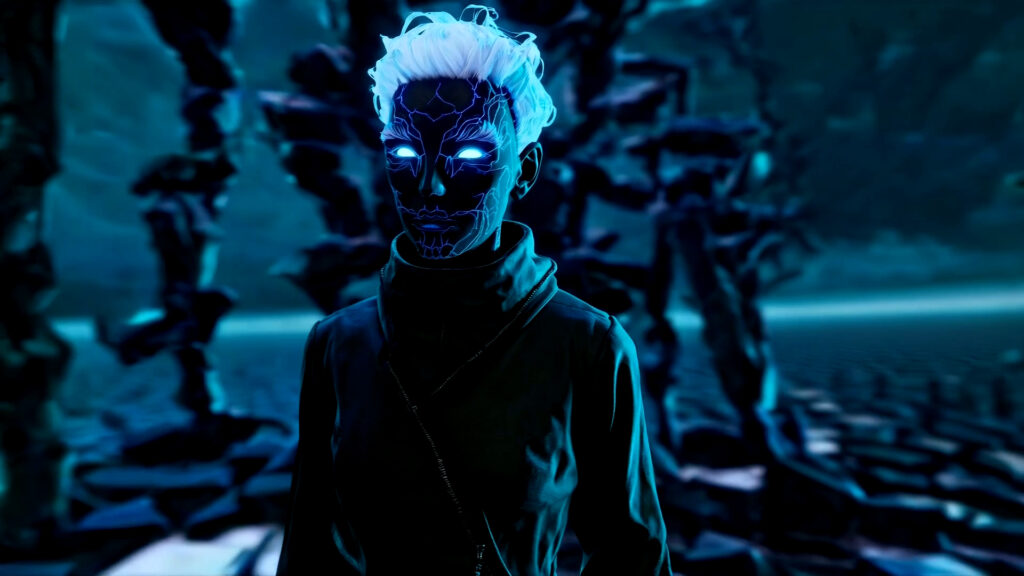
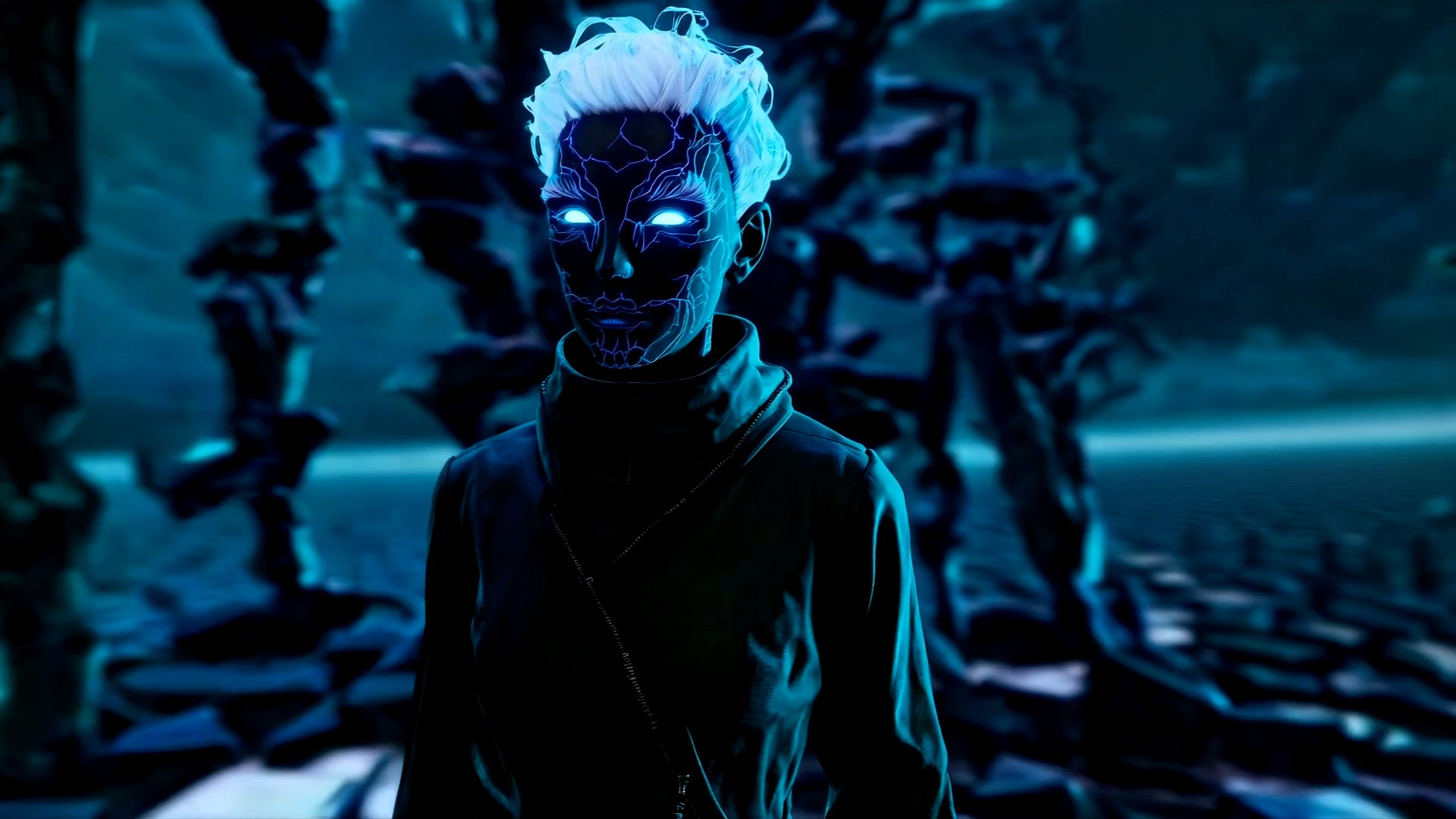
Robe of paper leaves. Porcelain face fissured with hairline cracks glowing cobalt from within. The Librarian smiles without changing the porcelain mouth. A filigree of light threads from your crown to their wrist as if you are sewing yourself into a ledger. The coin’s hum becomes a notation. You have been indexed.
The Librarian doesn’t ask your name. It proceeds as if the truer inventory is the weather inside you. Between you blooms a diagram inked in mushroom spore: fear on the vertical axis, wonder on the horizontal, risk as a gradient flowing across both. Where the colors intensify, an arrow points forward.
The Librarian tilts its head: this way.
You walk together, your steps synchronized as if both of you share an unseen metronome. The Librarian’s robe rustles like a paper forest. The bridge sings a line you recognize from the Mercury River. You are being braided into a pattern that feels inevitable without being cruel.
—
Breath becomes architecture.
The chamber opens around you and the floor flexes under your boots like the diaphragm of a sleeping leviathan. Walls expand and contract. Spores drift toward a turbine of glass teeth. Each inhale births corridors that shoot away like basking sharks. Each exhale edits them back into not-yet. The room is a lung and a drafting table.
You realize the Engine is not replacing your choices. It’s correlating them. Each hesitation gives a door a different frame; each curiosity installs a window where there wasn’t one. The Librarian watches you watch yourself being measured. It is not judgment. It is a scientist’s delighted hum when the experiment surprises even the design.
You ask nothing aloud. The room answers anyway. A panel opens. Air with the taste of iron and night pours in.
The Librarian gestures with the economy of someone who understands that in certain rooms pointing is impolite. You step through.
—
The lake is not black, not really. It is the color of everything drowned in thought.
You stand on a shore that is not a shore but a suggestion a map makes when it needs a place to put a boundary. The lake’s surface is so perfectly level it aches to look at. You think of home and the water splashes silver. You think of running and a red lace spreads, then dissolves. You think of staying and a gold bloom rises like sun in accelerated time.
You experiment. You think of becoming without specifying what. The lake answers with an image: a topography of you you haven’t met yet, warm ridges of habit, cool valleys of potential. You feel the ghost of a smile at the sheer audacity of a map that dares to draw a person.
In the center, where brightness insists, the water pushes up a shape that shouldn’t be possible: a narrow island of basalt rising like a monolith learning to stand. On it perches nothing, yet you feel a waiting pressure as if a seat had been prepared in the exact shape of your weight.
Something moves beneath the surface. Something large and patient.
—
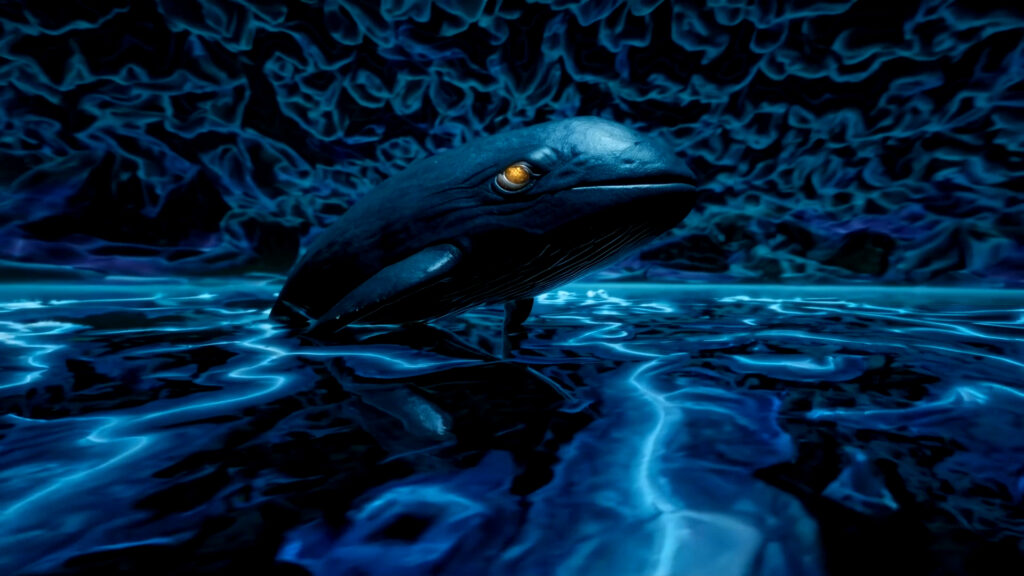
When the whale arrives, it does not break the surface. It exists inside the reflection and the stone at the same time, a city-block of pearl-basalt skin that re-textures gravity just by remembering how heavy it is. The wake behind it bends straight lines into parentheses. The Librarian appears on the far shore, raises a palm. The whale shifts the field in response, as if gravity and gesture have been married for longer than either will admit.
The whale’s eye is an amber lens full of distant deserts. You walk up the slope of its splashless breach as if climbing a hill the whale kindly invents for you. At the summit you do not touch it, though your hands burn with an ache you recognize as reverence mixed with fear. You stand so close your breath fogs the idea of skin the whale projects.
A pressure builds in your chest. The coin in your crown vibrates. The whale lowers you to a ringed plaza that was not visible until being the right height to see it was necessary.
You stand now at the center of a circle of mirrored floor. Around you rise towers of obsidian and chrome etched with laws the air remembers as having been sung. The Librarian returns and does not enter the circle. Even devotion has etiquette.
A chair waits. On the seat, the coin spins and throws off prismatic numerals like rain. The sunflowers of the valley have followed, or perhaps they were always here. They lean toward you, faces full of geometry that has learned patience.
You sit.
The towers draw themselves into alignment with your spine. The plaza’s mirrors correct the angle of your jaw. The coin slows and considerately pretends to be an ordinary object obeying momentum. The Librarian’s porcelain face admits, for an instant, relief.
You stand.
The towers tilt toward the horizon.
Choice is not a door. Choice is a bridge that adds itself beneath your feet as you walk.
—
What do you choose?
The question isn’t spoken because the room isn’t a place where language is needed. It is obvious what stands before you: a return through the gates to a desert almost exactly the same as the one that brought you in. Or a remain, a deeper fold, a willingness to hang your life in a closet at the back of an infinite library and try on what is kept there.
You think of the lake’s gold flare when you allowed staying to mean not stagnation, but devotion. You think of the Mercury River’s insistence on upstream, on the ways movement can be more about defiance than destination. You think of the Librarian’s soft relief when you sat—how even a functionary of the Engine can be soothed by someone choosing to be responsible to their own map.
Both, you tell the plaza, without words. Return and remain.
The Engine likes paradox. You can feel its pleasure in the way the air smooths. Spore-ring blooms around your ankles and the world folds, not like paper but like water changing its idea of how to be wet. Prism hinges, mirror lick, ketamine drift, peyote ripple: you are folded into two answers at once until the two answers become one more interesting question: how to be two places without lying about either?
The coin departs the chair and slides under your skin below the collarbone, a warm circle pulsing once, twice, until it learns your cadence. Your chest glows briefly then remembers modesty.
You turn toward the gate that is not a gate but a reunion. You turn toward the deeper corridors that are not deeper but more specific. You walk and do not split. You are an and carried in a body that used to assume or.
—
You step through the mycelial arch and stop on black salt that has decided to shine. Above, two moons have practiced so hard at being two that a third ghost-moon lingers like an afterimage. The desert smells faintly of rain-gods and tangerine peel. The night has learned new constellations and is trying them on with the half-shy satisfaction of someone who changed their hair and isn’t sure if you’ll notice.
Behind you, the Peyote Engine turns over once, a sleeping creature adjusting under the weight of gentler dreams. Corridors unspool like ribbons from a spool too dignified to tangle. The Librarian does not follow, because that is not the Librarian’s job. You suspect you will see it again in some useful doorway where a theorem hopes to be walked.
You begin across the plain. Footprints appear exactly where you intend them to. Ahead, the Mercury River glints like someone drew a straight line with too much love. It will still run uphill. Gravity has preferences now; you can feel them. The coin’s pulse under your skin syncs with your breath and both settle into a shared, low heat that means: available.
You do not look back, not because the story behind you has finished, but because you have become the kind of person for whom behind and ahead are not opposing directions. The map flickers in your peripheral vision, a transparent overlay only you can see, corridors and bridges and lung-chambers dotting a plane that used to be a desert and will be again.
You are tuned.
Every path hums with a barely audible invitation: again.
—
Nights afterward (or perhaps they are minutes; perhaps they are centuries—time has adopted manners but not consistency), you find the Engine in the ordinary. The lick of a reflection in a window that wasn’t there yesterday. The hex of a floor tile underfoot that ripples when you step and commits the ripples to memory. Rain that falls from a cloud too thin to do that, and yet here you are, damp hair and a sudden hunger for citrus.
People speak to you and the words carry coordinates. You arrange them on an inner grid the coin whispers to and discover that most questions are not questions but doors waiting for the right hinge.
You build small gates in small places. You stand in a corridor that is only a train aisle until it exhales and becomes the beginning of something someone else needs. You sit across from a stranger who believes this is a café and watch their shoulders settle because an invisible sun has warmed the room by one degree.
The Librarian appears once in a reflection, not to summon, but simply to nod approval when you let a decision remain a duet instead of forcing it to sing solo. The porcelain face has fewer cracks. Or perhaps the cobalt glow has learned how to love its own fractures.
You never brag that you rode a whale that wasn’t a whale across a lake that reacted to your thoughts. The story would taste absurd off any tongue. You simply step onto the Mercury River when nobody is watching and cross to the one shelf on the far side of the world that holds the book with the exact page you are missing—and when you return, you remember to dry your boots.
There are nights when you lie under a sky that finally figured out how to keep three moons without dropping one, and the coin under your skin vibrates with a frequency that collapses distance between you and everything else. It is not ecstasy. It is something older and calmer. Call it alignment. Call it the map recognizing the traveler and offering an update.
The black-salt plain cools. You close your eyes. The breath of the Engine moves through the gates, through the mycelial corridors, through the Lung that constructs and edits and constructs again. It reaches you and keeps going. It reaches everyone. The coin hums.
You sleep.
Somewhere in the desert, the Peyote Engine exhales and a new corridor opens, awaiting the next person who will arrive to discover that maps can love you back if you ask them the right kind of question.
And when you wake, there is always the same beginning: a seam opening in the sky like a zipper in velvet, the coin of light turning as if it never stopped, and the sense, renewed and precise, that you have been invited once more to walk into a story that does not end so much as widen.
Again.
the Gallery