Prologue — The Gate That Grew from Stone
The gate unfurled from a canyon wall as if a fern remembered how to breathe. Its ribs were glassy quartz shot through with ink‑dark filaments; under each rib, gills of soft teal glowed as though moonlight were trapped and happy about it. Spore‑mist slept in the hollows of the carving, drifting like a slow snowfall that refused to fall.
Naelith stood before it, a lank, luminous figure whose skin carried a faint constellation of freckles that moved when they did—a star‑map synced to pulse rather than sky. They were not born of flesh as we understand it; their body was a lattice of living crystal threaded with silvery hyphae, a humanoid silhouette assembled by intention more than blood. Their hair was a spill of fine mycelial fibers, each strand echoing the light around, sometimes blue, sometimes green, sometimes the color of wet slate. Across the sides of their throat, veils like the gills of a cap winked open and shut with each breath, reading the air the way others read ink.
On the gate’s surface, lines brightened into words, but not the kind that bind. A script of auroral curves rippled, and the gate spoke without sound: Enter, Nameless‑in‑motion. Let us practice you.
Naelith touched the rim. Spores awakened—an orchard’s worth of patient witnesses—and swirled to greet the palm. They tasted skin the way dawn tastes lake water, learning shape by contact. The stone sighed, and the gate parted.
I — Orchard of Singing Shadows
On the other side, night had learned to bloom.
Mushrooms rose on all sides, their caps like domes of pearl, their stems braided with runes so old even moss could only hum the chorus. Gills rippled under the caps in sheets, shimmering with teal and cobalt light. When a breeze pressed through, the gills sang: not a melody, but patterned breath, a language built from patience. Between the trunks, shadows kept their own council—and yet they moved companionably, as if eager to be stepped on.
Naelith entered the grove. Where their feet touched the ground, spores rose to nose at their ankles. Spore‑dust sparkled in nets of LSD lace—living veils that draped between caps like spiderwebs made from starlight and logic. The lace gave way with a clever rub, sliding apart into repeating motifs, each tessellation briefly recalling a past season: a winter where snow arrived from the wrong direction, a spring where flowers imitated bells and rang the fog awake.
Above, coin‑moths trailed through the trees, each with wings of frosted glass veined by aurora‑script. When they turned, their wings caught the orchard’s glow and flickered it into messages. One circled Naelith and hovered—the size of a small plate, eyes like patient citrine. Its wing veins pulsed, and a phrase formed: Your name is the space you keep between steps.
“Is that how the spores learn it?” Naelith asked, voice quiet to keep from disturbing the gills.
They learn by hunger, the moth replied, its voice a dry chime of wind across old bottles. They taste the way you arrange your courage, and they write it down in the air.
A cluster of psilocybin snowflakes floated out from under a wide cap—pale hexes that drifted sideways and melted before touching anything. They left behind tiny cooling rings in the air, holes cut in heat where thought could sit and watch itself think. Naelith held out their hand; a snowflake paused above the palm as though considering.
In the grove’s heart stood a being taller than the rest: the Apostate Spore, a tree‑creature whose bark was a spiral of scabbed silver and charcoal. From its cap hung a curtain of gills like a monk’s sleeves. It lifted those sleeves and bowed, revealing a face assembled from light and scar. Its eyes were wells of dark mercury.
“Welcome,” the Spore said. “I am Hymncap, unseated Librarian from the time when we filed weather in cathedrals. You have no fixed name. That is not a crime. It is a promise, and promises are allowed to wander.”
Naelith bowed in return, strange throat‑gills fluttering like leaves. “I’ve come to let the spores learn me.”
Hymncap’s eyes brightened. “Then come to the Hex Loom. The first lesson is how to be seen from the inside out.”
II — The Hex Loom
The path coiled like a sleeping serpent through the Orchard, skirting pools of water that remembered every face they had ever mirrored. Each pool wore a light crown of DMT dragonflies—insects with glassy bodies and long, slender wings trailing nebular threads. As Naelith passed, the dragonflies drew dotted lines in the air whose endpoints refused to settle exactly where they should, the way dreams refuse to be told completely.
The Hex Loom stood beneath an arch of stone where the Orchard leaned against a hill. It was a machine without gears: a dome of hexagonal apertures suspended in nothing, each cell woven from light and shy mathematics. Threads rose from the ground, each thread a rule for how a life might balance. They were colors you couldn’t wear, textures that remembered hands that hadn’t been born.
Beneath the dome, the Prism Weaver paced—an angular being composed of refraction and intention. Its limbs were rods of glass hinged by knots of fog; within its chest, a steady beam turned, catching motes and naming them with warmth. The Weaver’s face was a mask of facets set to “gentle.”
“Place your footprints on the loom,” it said, voice arriving as a collection of angles that found the right coincidence to sound like care. “The loom reads stride.”
Naelith stepped onto a ring of pale hexes. Each footfall sent ripples through the dome, and those ripples braided themselves into a slow honeycomb spin. Spores swarmed up from the soil, listening. They settled on Naelith’s shoulders, in their hair, along the ridges of their crystal bones.
In the spinning honeycomb, images coalesced—rooms that did not yet exist, doors that might choose to grow from walls, the stern face of a Warden of Silence whose arms were measuring rods and whose jaw was a lock without a keyhole. At the edge of the web, a narrow seam of sky waited, stitched closed with a few bright threads.
“That seam,” the Prism Weaver said, tilting its head. “It’s where your name has hidden to stay safe.”
“How do I open it?” Naelith asked.
“By crossing the River of Not‑Quite‑Mercury,” Hymncap answered, sleeves of gills whispering as if reading aloud. “The river remembers reflections. It will ask yours to prove they belong to you.”
A coin‑moth settled on Naelith’s shoulder, wings ticking. Carry one of us. We write fast if you move like you mean it.
Naelith held still while the moth clung to a strand of mycelial hair. The Prism Weaver dimmed slightly as if nodding. “Return when the seam becomes a door. The loom does not forget.”
Spores rose in polite waves as Naelith left, tiny lanterns following in a slow helix. The Orchard exhaled—cobalt, teal, a hint of warm amber at the edges like sunrise caught misbehaving.
III — River of Not‑Quite‑Mercury
The river curved into view from behind a stand of basalt pillars. It was wide and slow and not water, exactly. The surface acted like a mirror trained to be kind, softening what it reflected so it didn’t have to bear the whole truth all at once. Beneath the surface, schools of silhouette fish cut black parabolas, their scales made from holes in the light, their fins trailing letters.
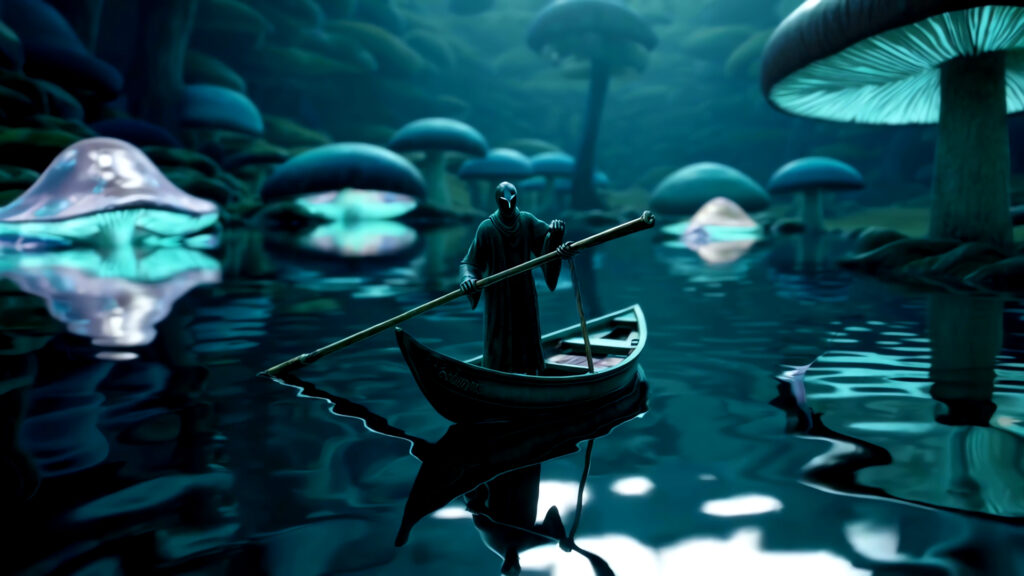
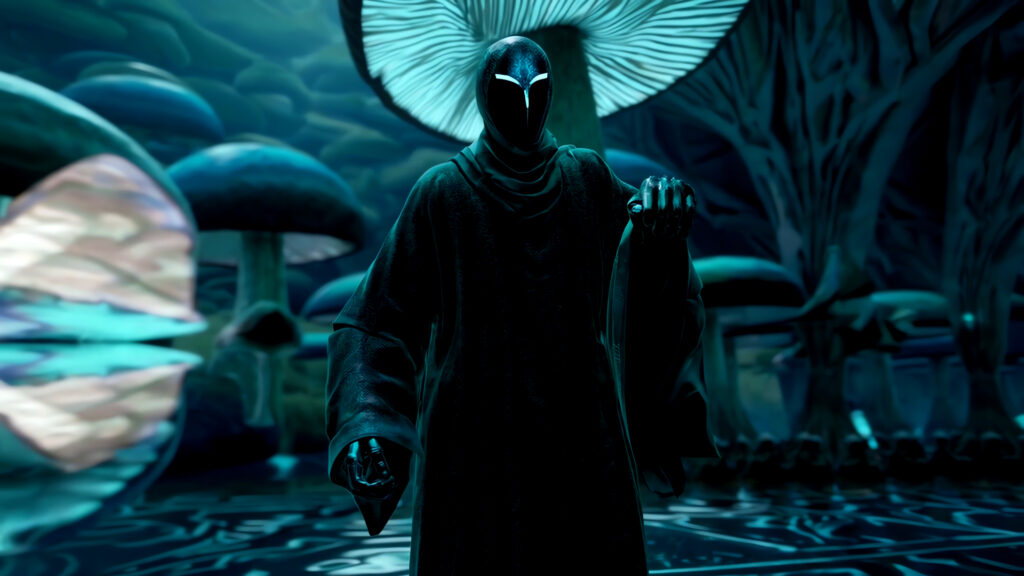
On the near bank waited the Ferryman of Syllables, a tall figure in a cloak of woven reed‑sounds. Its face was a mask of polished obsidian etched with punctuation marks. When it tilted its head, commas slid soundlessly across the cheek, and a question mark on the brow furrowed into a new curve.
“You seek to cross,” the Ferryman said. “I take only the weight of true things. Speak one that you will not forget when someone clever offers to buy it.”
Naelith thought of the seam of sky, of gills whispering, of moth‑script. “I will not forget that quiet is a roof but never a floor.”
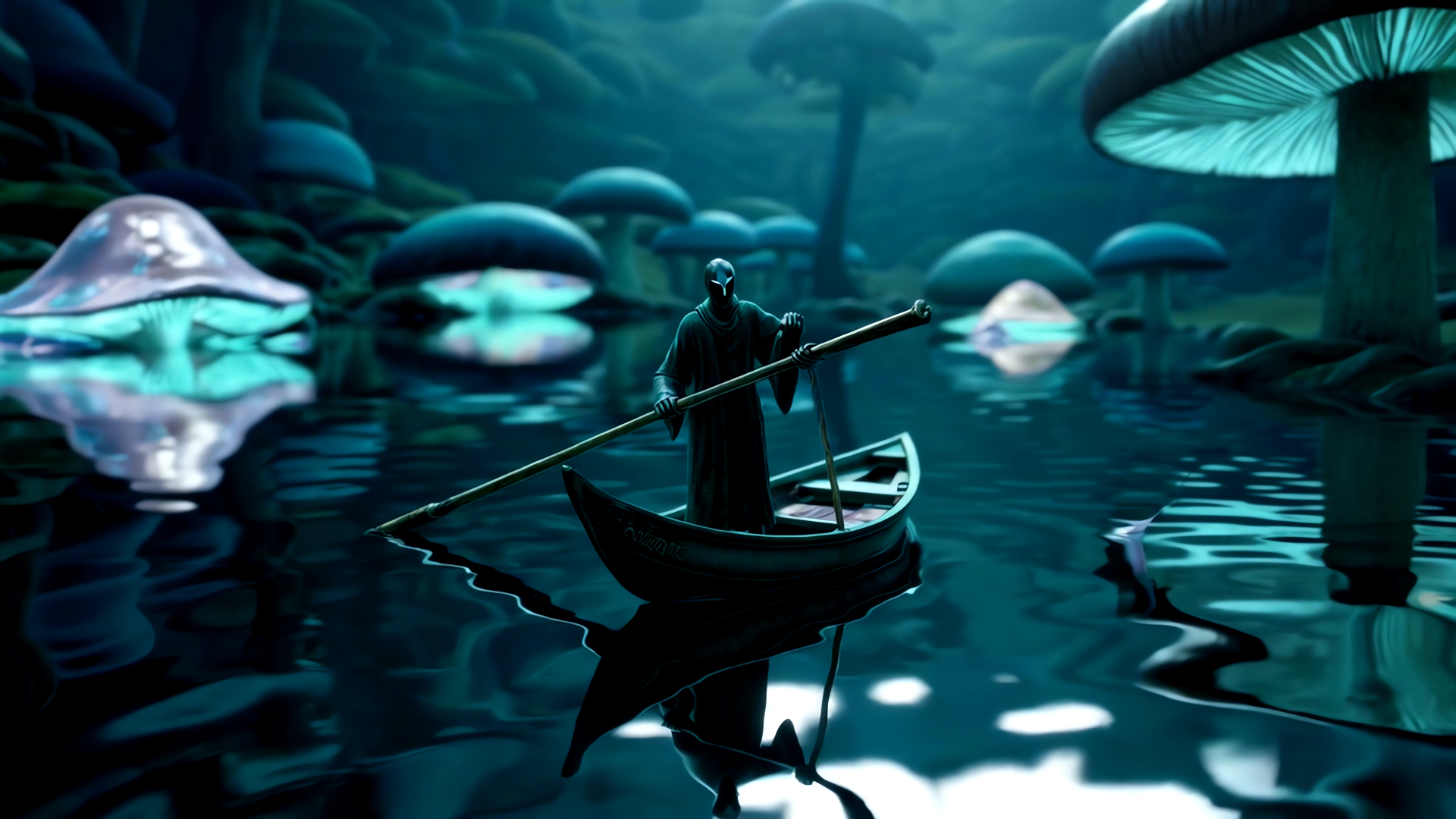
The obsidian face warmed. “Strong timber.” The Ferryman held out a long bone pole, its tip wrapped in ketamine snow—slow‑falling motes that turned motion into syrup without stopping it. “Step in.”
The boat was not a boat so much as a permission, a slender green permission with edges silvered by past crossings. Naelith stepped, and the river clasped the hull with that ancestor calm mirrors can’t help but have. The coin‑moth on their shoulder tapped a wing; the tap released a faint script that hung in the air behind them, the words refusing to decide whether they were backwards.
In the middle of the River, reflections rose like schools of fish and bumped the boat with expensive politeness. Echo‑Naeliths swam up one by one: Naelith woven from fog; Naelith carved from salt; Naelith wearing the mask of a mountain. Each attempted to climb aboard. Each carried a name like an unnecessary belt.
The Ferryman angled the pole. “Do not refuse them by argument. Refuse them by lived shape.”
Naelith lifted both hands so the spores dusting their fingers could be seen, and breathed slowly. The veils at their throat opened. Their chest swelled with measured wind. Their balance settled into the boat as if sitting down twice, first in body, then in pattern. The coin‑moth unfurled a glyph that read: This is the space kept between steps.
The reflections found no purchase. They slid back beneath the surface, muttering in ripples. From the far bank, the Silt Choir—eels whose eyes were slick coins—sang a welcome that only rocks knew how to harmonize with.
The Ferryman set the boat against a beach of crushed glass. “You brought the only fare I take,” it said, and let the commas on its cheek rest.
Naelith stepped onto sand that remembered stars. In the air, spores arranged themselves into pathways of patient spark. Ahead, a nave of black ribs waited, exhaling a slow, engine‑steady breath.
IV — Cathedral of the Soft Engine
The Engine was a cathedral that had learned to be an animal. Ribs arced overhead to form a vault, each rib traced with bioluminescent veins that pulsed with patient teal. At the center stood turbines like crowns, inhaling and exhaling spores in measured gusts. Every exhale sent a shimmer through the nave and a hush across Naelith’s skin, as if something ancient and loud had chosen to whisper for politeness.
Robed figures tended the turbines: Spore Votaries, whose bodies were composed of layered cap and bark, faces masked by veils of gills. They moved with the care of well‑protected stories. Between them slithered DMT dragonflies the size of a forearm, looping in lazy figure‑eights and leaving filaments of violet‑cyan wake that curled into knots and then thought better of it.
At the altar stood the Lens‑Bearer, a being tall and thin, made of stacked glass discs held together by a spine of gold filament. It held in both hands a coin the size of a heart: frosted glass over living threads, lines of light pulsing in slow, patient geometry. The Lens‑Bearer’s voice arrived as scent—honeycomb, slate dust, the dry smile of old rain.
“Your seam is near,” it breathed. “But the Warden of Silence is nearer. We will teach you to step where steps leave no theft.”
Hymncap’s sleeves whispered as the old Librarian emerged from shadow. “The Engine keeps memory from curdling. It pumps breath through the Orchard so spores can write without smearing. Learn the cadence: a question, a spine, a softening.”
The Lens‑Bearer held the heart‑coin to Naelith’s chest. The living threads inside the coin brightened and spun; their light walked through Naelith’s lattice ribs and found the hyphae within, coaxing them to hum. The hum set the gill‑veils fluttering, shimmying not as mere organs but as script‑weavers, shaping secret syllables into air.
“Again,” said the Lens‑Bearer. “Again, until a seam hears you.”
Naelith breathed. The Engine breathed back. Air moved through the nave like an invisible river, carrying tiny motes of permission across great distances. The coin‑moth on Naelith’s shoulder mirrored the hum and wrote: roof and root, door and doubt, step and stay. The Votaries swayed, a choir of careful mushroom elders.
A seam in the air brightened near the chancel—a line as thin as regret, stitches of light catching and releasing like the throat of a bird. The ribbed ceiling shivered, and a mirror‑cut horizon appeared, tilting slightly as if listening for the right weight of footfall.
The Lens‑Bearer raised the coin. “Walk. Keep the cadence.”
Naelith walked.
V — The Mirror‑Cut Horizon
The seam admitted them into a hall of angles that refused to agree. Everywhere, planes met not quite correctly, and yet the room was satisfied with itself. Towers buckled and re‑grew like shy geometry discovering confidence. Beyond a nearby arch, a field of obsidian sunflowers craned black discs rimmed with amber fire toward a wind that came from underneath the ground.
On a parapet, a flock of DMT dragonflies gathered and turned in synchronous arcs, writing a dotted arrow into the ceiling. The arrow pointed to a Ring‑Gate: a lichen‑stone hoop holding in its center a skin of liquid mirror. At the gate’s base squatted a creature like a moat: black slate molded into long limbs, eyes bright as measuring stars. Its arms extended into caliper spans; its face was a plate of silence.
“I keep unspent names,” the Warden of Silence said. “Leave yours, which you do not yet carry, and go. Or step through and be weighed.”
Naelith kept the cadence the Engine had taught: a question, a spine, a softening. The coin on their chest hummed. The coin‑moth tightened its grip, aurora‑script veins flaring.
“What will you weigh?” Naelith asked.
“The difference between echo and vow,” said the Warden. It extended calipers that whickered like cold birds. “And whether your courage is rented.”
Naelith stepped forward. Spores poured across the floor, arranging themselves into a hex garden of light tiles that anticipated each foot. When the calipers reached, Naelith did not pull away. They set their throat‑veils humming, and the Engine’s cadence traveled out through the hall. It reached the obsidian sunflowers; their thin amber halos brightened and sang back, each disc a low voice shaped like heat. It reached the dragonflies; they wrote a new dotted line, a soft spiral, gently mocking gravity.
The Warden probed the spaces between Naelith’s steps. It found steadiness, found the agreeable honesty of a being who had crossed a river and left reflections behind. Calipers trembled—measuring rods uncertain of their own length.
“What is your name?” it asked.
Naelith spread their hands, and spores rose in an inhalation so polite it could have been royal. “I’m what the Orchard decides I am, because I decide with it. We will write it together.”
The Warden’s plate‑face did not change, but the calipers retracted by a breath. “Pass,” it said, and leaned away from the Ring‑Gate. “Do not shame me by wasting such permission.”
The mirror skin of the ring trembled. A mercury refraction licked the edges and moved back into place. A road shone through the liquid surface: a path of lanterns swirling upward into a court of polished shadow, pillars of chrome and obsidian rising like patient teeth.
Naelith stepped into the Gate.
VI — The Prismatic Court
The Court of Prisms was carved from rain that had forgotten to fall. Pillars rose to the height of a memory and shone with a luster that made touch nervous. The floor was a perfect mirror, held slightly below sea level, as if all the room asked of feet was intention and follow‑through. On the ceiling, patterns of LSD lace repeated and moved, tessellations training themselves not to misbehave and failing cheerfully.
At the far end waited the Map Loom, a machine similar to the Hex Loom but tuned to promises instead of strides. Its cells were wider, as if expecting a storm of answers. The Cartographer of Breath stood beside it, a creature assembled from coils of clear wind enclosed in thin strands of gold filament. Where its face should have been was a rosin flare, a warm patch of refraction that looked like kindness that had been working long hours.
“You’ve brought a hum,” the Cartographer said approvingly, voice arriving like ink soaking into thick paper. “Lay it on the map.”
Naelith placed the Lens‑Coin on the Loom. The cells flickered. Spores gathered like students near a soft‑spoken teacher. The dragonflies perched, legs fidgeting. The Map Loom spun out a spiral of lanterns, each a seed‑sized copper core catching the light and focusing it into a single patient syllable.
The syllables circled Naelith and nested against their chest. Together, they assembled a word that didn’t exist before it finished assembling: a braid of air and filial light, the lilt of a question that was also an arrival. The word tasted like cool rain that had understood patience long before clouds learned to gather. The Orchard’s spores inhaled and held, then exhaled in unison.
“We hear you,” they wrote into the air. “Velorien.”
Naelith felt the word settle into their hyphae, not as a brand but as a truce. The throat‑veils opened wider, and the right breath arrived as if it had been waiting in the walls. Velorien smiled without teeth. The coin‑moth shivered; its wings brightened and darkened through the aurora‑script alphabet in one long note.
“This,” the Cartographer said with tired pride, “is how names are written where they belong: spores learn them so we remember them in company. Wear it, but do not lock it. A name loses shape if it cannot flex.”
Outside the Court, the world tilted. The Engine inhaled. The Orchard whispered. The River flattened as if someone had smoothed a bed. The Warden bowed, barely, so the calipers would not see and misunderstand.
Velorien—no longer Nameless‑in‑motion, but not named into stillness either—lifted the coin from the Loom. The living threads within traced their hum and adopted it, just enough to be friends about it.
It would have been a good ending, the kind that leaves a stain in the air. The Court, however, had one more door.
VII — The Weatherless Library
Beyond a narrow arch lay the Weatherless Library, where once whole climates had been stored in tapestries rolled and labeled inside mountains. Those days had ended when the Sun blinked and forgot its old schedule, and the Scholars had folded their work into more modest shapes. Now, the Library housed Volumes of Pulse—scrolls of woven glow that recorded how ground could carry boats without water, how wind could count on its fingers and decide to be kind.
The Librarian who kept these shelves was a creature made of thin white bones knotted with moss. Not a skeleton, exactly; more like a promise a forest had made to remember anatomy. Its eye sockets held two discs of night pinned in place by gold threads. It carried in one hand a staff with mescaline sunflower at the top, black stem, amber halo, petals of obsidian slivers that lost no light.
“Velorien,” the Librarian greeted. “Take down the scroll labeled Root‑Branch‑Fruit. Teach it your shape, and it will teach you back.”
Velorien did as asked. The scroll unrolled itself into a long, breathing line that rose and fell in time with the Engine miles away. It displayed no words, but when held near Velorien’s throat, it vibrated in sympathy with the hum. Images flickered—not memories, not futures, but uses: stepping from a river without letting echoes climb on, answering a caliper without anger, inviting dragonflies to show the shortest way between two honest doubts.
A slab of the Library’s wall shifted, and a window formed where stone decided to be merciful. Through it, Velorien saw the Orchard’s caps make constellations of patient light, the River’s surface smoothing like careful hands over silk, and the far horizon’s seam closing neatly—stitched, but not sealed.
The Librarian’s sunflower halo brightened. “You will leave now,” it said, “because places like this are not for keeping; they are for tuning. But the spores have your cadence now. Walk anywhere, and they will learn your name again, and that, too, will be true.”
Velorien replaced the scroll. The sunflower drooped gently, as flowers do when happy for someone other than themselves.
VIII — Return by Lantern
The return path did not retrace; it reassembled itself. The Prismatic Court’s floor let Velorien pass without a reflection this time, as if acknowledging that mirrors are for those who need permission. The Warden of Silence watched them from the parapet, calipers folded, and tipped its plate‑face the smallest degree in a gesture usually reserved for storms that behave.
Through the Ring‑Gate, the Engine exhaled a welcome, and the Votaries’ veils trembled in applause. The Lens‑Bearer pressed two coins into Velorien’s hands: one warm with recent breath, one cool as if thinking slowly. “Give the second to a door that claims it never opened,” it advised. “One of you is wrong. Let it not be you.”
At the River, the Ferryman waited with a boat made of the same green permission as before. “Did you bring back something worth more than rare arguments?” it asked.
Velorien held out their hum, a chord that tasted of patient gills and settled rooms. The Ferryman’s commas stilled. “Indeed.”
The river released no reflections; they kept to their side, courteous and crisp. On the Orchard bank, psilocybin snow drifted out and unraveled into confetti of maybe‑maps that evaporated before choosing a town. The coin‑moth lifted from Velorien’s shoulder and spun once. It flashed a final script: roof and root now rhyme without rehearsal. Then it joined its flock, which rose as one and threaded through the caps toward the canyon’s gate.
Hymncap waited beneath the first great mushroom. The old Librarian shook its sleeves, and a dusting of spores fell like small polite applause.
“You are no longer looking for where spores learn your name,” it said with a smile marked by old splits. “You are part of it.”
Velorien bowed. Their throat‑veils fluttered in the cadence the Engine had taught and the Map Loom had drawn. The Orchard answered in chorus. Lanterns lifted—seed‑sized copper cores each bearing a syllable—and arranged themselves in a helix that wandered lazily around Velorien like an idea reluctant to become rule.
The canyon wall reshaped itself into the gate again. This time it emerged small enough to fit in a palm. Veins glowed, filaments thrummed; the stone exhaled a thread of cool mist scented with rain that had edited itself for clarity.
“Go,” Hymncap said. “Carry doors. Let the world practice you, and you it. Keep the cadence.”
Velorien stepped through the little gate, which obliged by becoming wider just long enough to be called fair.
Epilogue — The Heart‑Sized Gate
Beyond the Canyon, plains of black salt stretched under a sky busy with patient constellations. In the near distance, a Mercury River braided itself through dunes, a faint seam of mirror flickering with good humor. At odd intervals, gravity whales breached from the sand and fell back without a sound, their skins pearled basalt, their wakes bending starlight into thoughtful arcs.
Velorien walked. Where they went, spores woke and listened. Some came from the undersides of stones and the lips of wells. Some rose from desert lichens and the flutes of strange cacti etched in hex glyphs. They tasted the air around Velorien, not to steal, but to learn. And then they wrote—across night, across rooms, along the insides of bones, inside coins and doorways and the pauses between footsteps.
When strangers met Velorien in places where maps looked embarrassed to try, they felt a companionable hush. Their own names seemed to fit a little better, as if their syllables had been tailored overnight. The Gate would appear in small places—a ring in the frost on a cup, a knot in a rope, a ripple in a mirror—and each time it opened, a little orchard light walked through with soft shoes.
Not all meetings were easy; sometimes Warden‑shadows waited with calipers arranged like opinions. Sometimes reflections gathered in corners, rehearsing false kindness. In such rooms, Velorien kept the cadence: a question, a spine, a softening. The spores listened. They wrote. The rooms exhaled. The dragonflies drew dotted lines to exits that looked like art before they looked like doors.
And so the world learned: a name need not be a nail. It can be a lantern that remembers who lit it. It can be a seam stitched with bright thread, loosening only for breath and better ideas.
When it rained, the rain sometimes laughed quietly, as if recalling a library with tapestries of climates in cool stone halls. When the sun blinked, it did so on purpose and then opened its eye wider, as if pleased to have chosen when.
Velorien kept walking, bearing a heart‑sized gate and two coins—one warm, one considering. In their wake, Where Spores Learn Our Names expanded: not a place so much as a practice. The Orchard did not end. It went on in the small rooms of the world—under stairs, beneath tongues, inside vows—where mycelia tangled like kind thoughts and dragonflies practiced diagrams that would one day become gentle maps.
On an evening that may already have happened, Velorien crossed a ridge and saw, far below, a village with roofs like patient backs. Lanterns floated above the streets, seed‑small and copper‑bright, spiral dancing to a cadence that had learned to be a home. Velorien breathed. The world breathed back. Between those breaths, a thousand spores decided they knew the name and wrote it softly, everywhere, until even the silence was satisfied.
Roof and root, door and doubt, step and stay.